
Guide to Academic Writing Writing Myths 1 The


- Slides: 19
Guide to Academic Writing
Writing Myths #1 – The “Paint by Numbers”: Writing is recursive. We cycle through and repeat various activities of the writing process many time as we write. #2 – Writers only start writing when they have everything figure out: Writers figure out much of what they want to write as they write it. #3 – Perfect first draft: Nobody writes perfect first drafts. Polished writing takes lots of revision. #4 – Some got it; I don’t – the genius fallacy: With effort and study, you can improve your writing.
Writing Myths #5 – Good grammar is good writing: Writing is about more than just grammatical correctness. (Don’t forget: Nobody writes perfect first drafts. ) #6 – The five paragraph essay: Some people say to avoid it all costs, while others believe no other way to write exists. However, to decide the format of your writing depends on you. #7 – Never use “I”: The use of “I” depends on what kind of writing you will do. (You can use “I” in a semi-formal style writing)
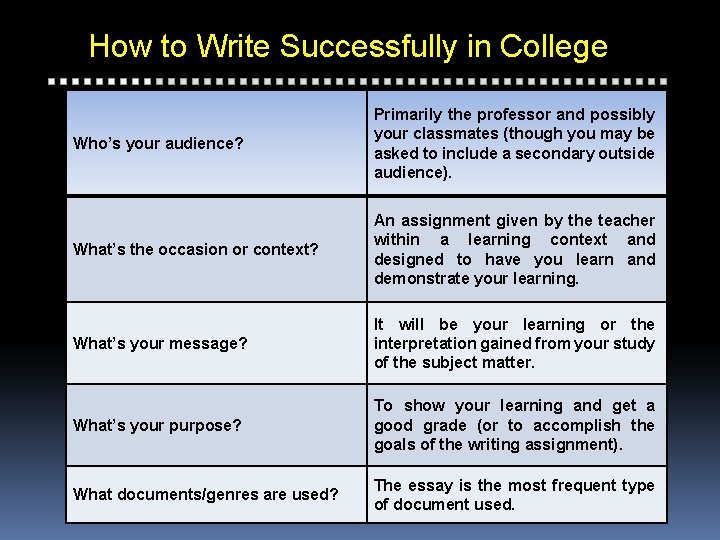
How to Write Successfully in College Who’s your audience? Primarily the professor and possibly your classmates (though you may be asked to include a secondary outside audience). What’s the occasion or context? An assignment given by the teacher within a learning context and designed to have you learn and demonstrate your learning. What’s your message? It will be your learning or the interpretation gained from your study of the subject matter. What’s your purpose? To show your learning and get a good grade (or to accomplish the goals of the writing assignment). What documents/genres are used? The essay is the most frequent type of document used.
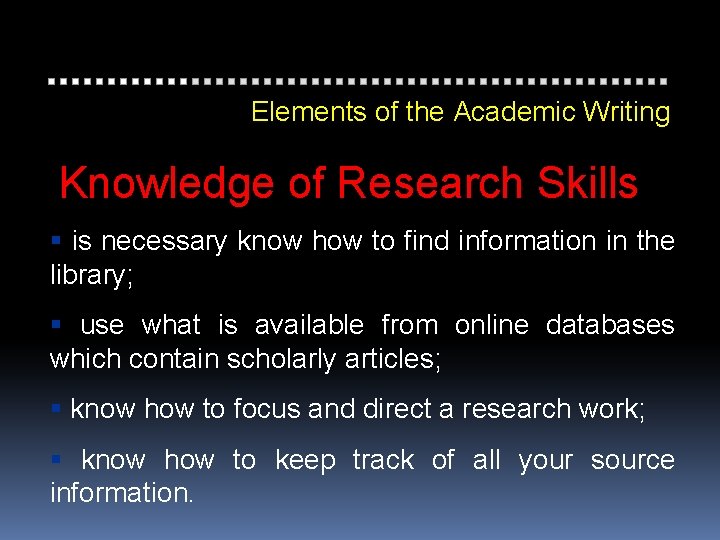
Elements of the Academic Writing Knowledge of Research Skills is necessary know how to find information in the library; use what is available from online databases which contain scholarly articles; know how to focus and direct a research work; know how to keep track of all your source information.
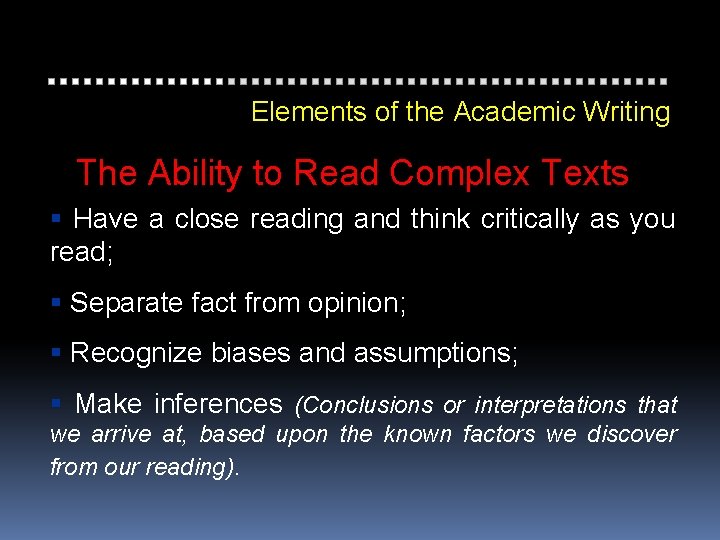
Elements of the Academic Writing The Ability to Read Complex Texts Have a close reading and think critically as you read; Separate fact from opinion; Recognize biases and assumptions; Make inferences (Conclusions or interpretations that we arrive at, based upon the known factors we discover from our reading).
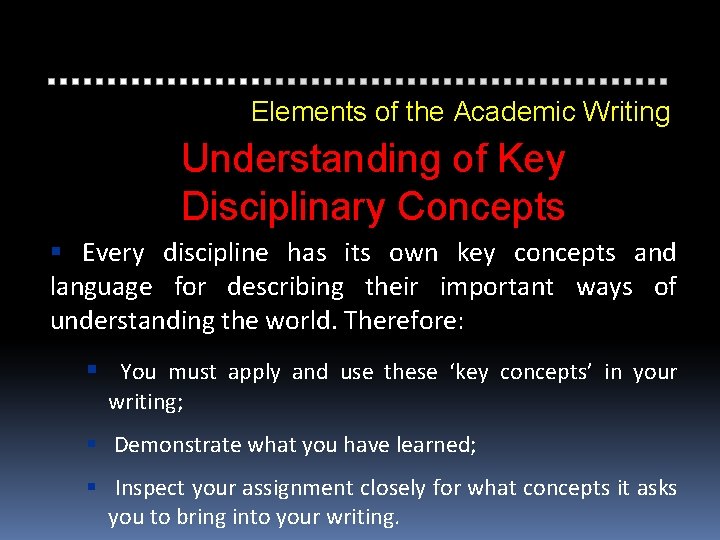
Elements of the Academic Writing Understanding of Key Disciplinary Concepts Every discipline has its own key concepts and language for describing their important ways of understanding the world. Therefore: You must apply and use these ‘key concepts’ in your writing; Demonstrate what you have learned; Inspect your assignment closely for what concepts it asks you to bring into your writing.
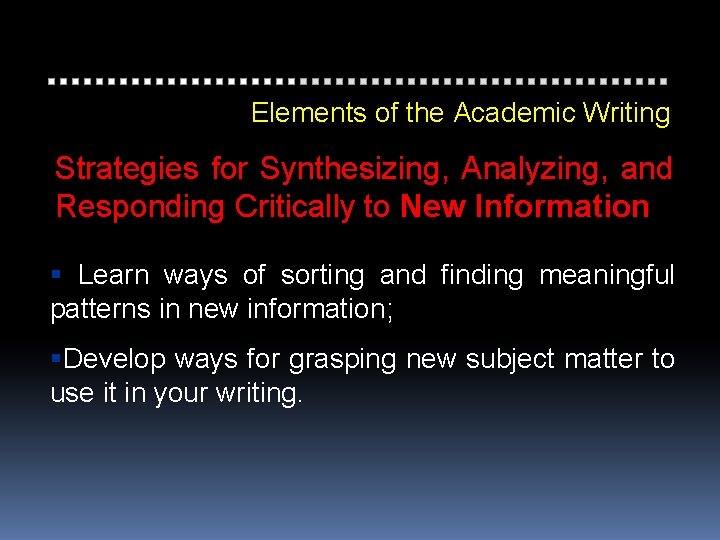
Elements of the Academic Writing Strategies for Synthesizing, Analyzing, and Responding Critically to New Information Learn ways of sorting and finding meaningful patterns in new information; Develop ways for grasping new subject matter to use it in your writing.
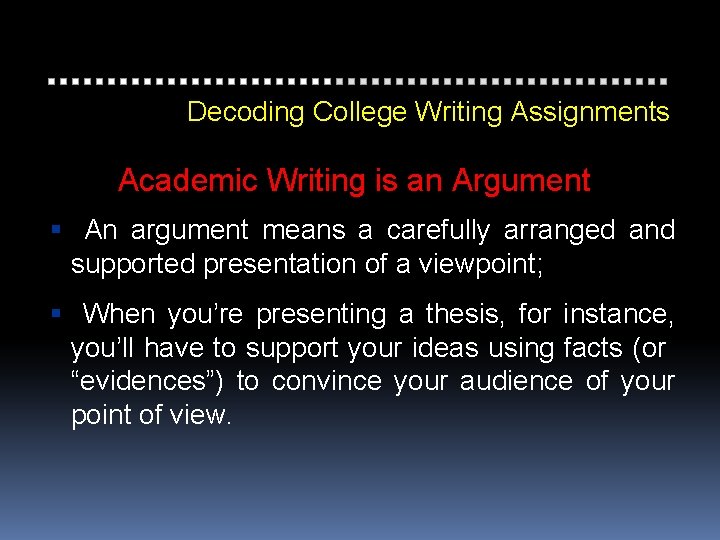
Decoding College Writing Assignments Academic Writing is an Argument An argument means a carefully arranged and supported presentation of a viewpoint; When you’re presenting a thesis, for instance, you’ll have to support your ideas using facts (or “evidences”) to convince your audience of your point of view.
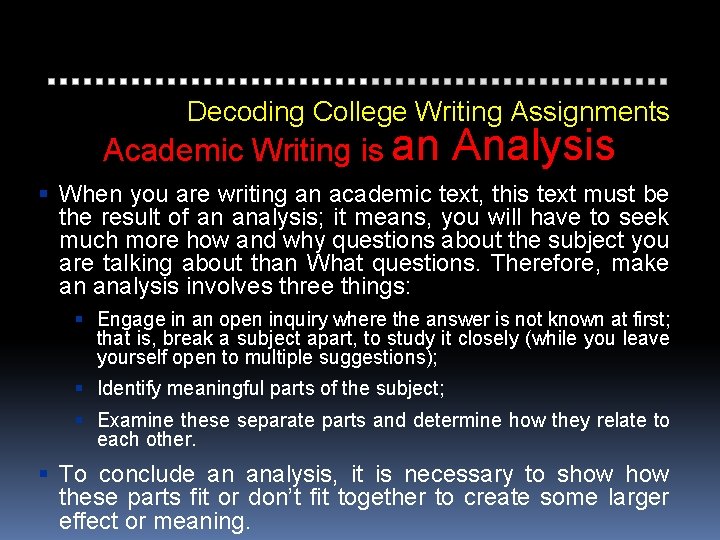
Decoding College Writing Assignments Academic Writing is an Analysis When you are writing an academic text, this text must be the result of an analysis; it means, you will have to seek much more how and why questions about the subject you are talking about than What questions. Therefore, make an analysis involves three things: Engage in an open inquiry where the answer is not known at first; that is, break a subject apart, to study it closely (while you leave yourself open to multiple suggestions); Identify meaningful parts of the subject; Examine these separate parts and determine how they relate to each other. To conclude an analysis, it is necessary to show these parts fit or don’t fit together to create some larger effect or meaning.
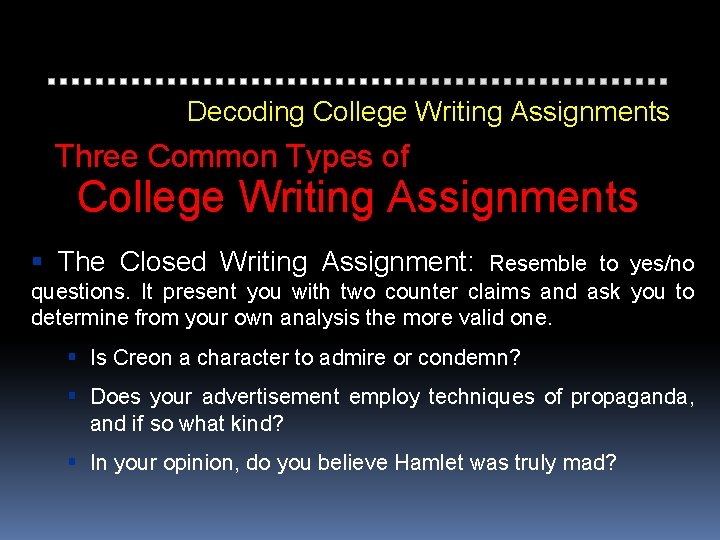
Decoding College Writing Assignments Three Common Types of College Writing Assignments The Closed Writing Assignment: Resemble to yes/no questions. It present you with two counter claims and ask you to determine from your own analysis the more valid one. Is Creon a character to admire or condemn? Does your advertisement employ techniques of propaganda, and if so what kind? In your opinion, do you believe Hamlet was truly mad?
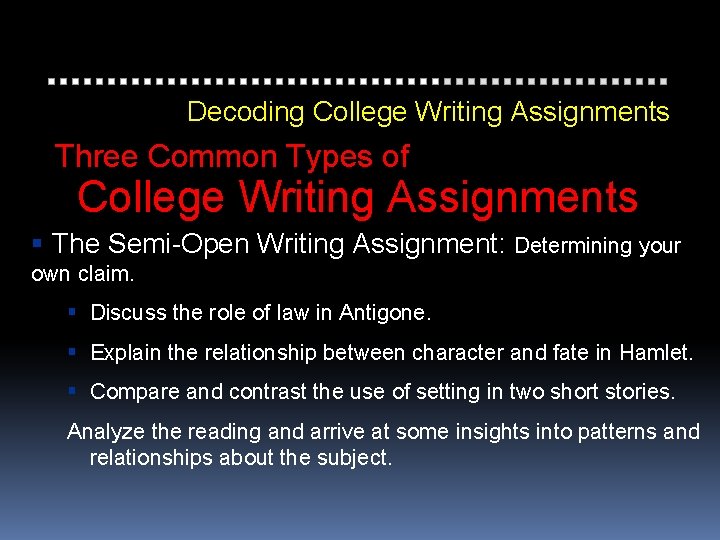
Decoding College Writing Assignments Three Common Types of College Writing Assignments The Semi-Open Writing Assignment: Determining your own claim. Discuss the role of law in Antigone. Explain the relationship between character and fate in Hamlet. Compare and contrast the use of setting in two short stories. Analyze the reading and arrive at some insights into patterns and relationships about the subject.
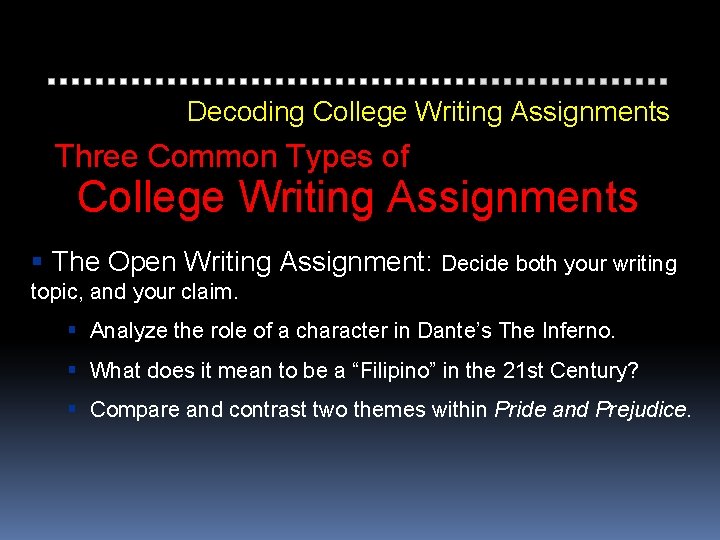
Decoding College Writing Assignments Three Common Types of College Writing Assignments The Open Writing Assignment: Decide both your writing topic, and your claim. Analyze the role of a character in Dante’s The Inferno. What does it mean to be a “Filipino” in the 21 st Century? Compare and contrast two themes within Pride and Prejudice.
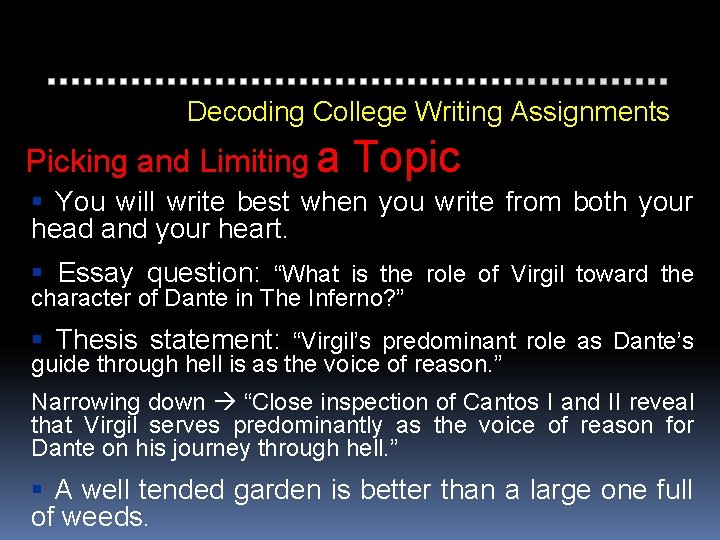
Decoding College Writing Assignments Picking and Limiting a Topic You will write best when you write from both your head and your heart. Essay question: “What is the role of Virgil toward the character of Dante in The Inferno? ” Thesis statement: “Virgil’s predominant role as Dante’s guide through hell is as the voice of reason. ” Narrowing down “Close inspection of Cantos I and II reveal that Virgil serves predominantly as the voice of reason for Dante on his journey through hell. ” A well tended garden is better than a large one full of weeds.
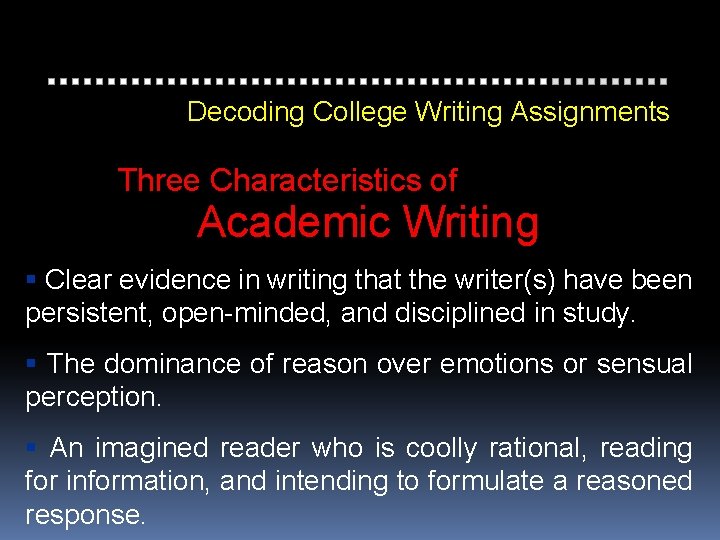
Decoding College Writing Assignments Three Characteristics of Academic Writing Clear evidence in writing that the writer(s) have been persistent, open-minded, and disciplined in study. The dominance of reason over emotions or sensual perception. An imagined reader who is coolly rational, reading for information, and intending to formulate a reasoned response.
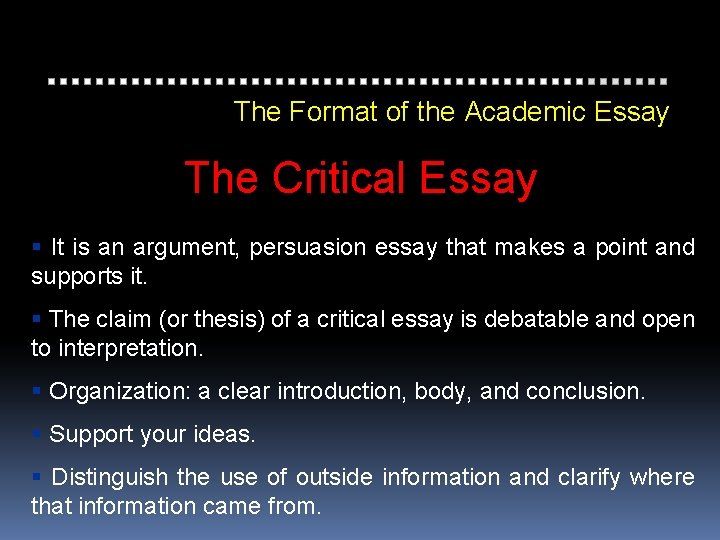
The Format of the Academic Essay The Critical Essay It is an argument, persuasion essay that makes a point and supports it. The claim (or thesis) of a critical essay is debatable and open to interpretation. Organization: a clear introduction, body, and conclusion. Support your ideas. Distinguish the use of outside information and clarify where that information came from.
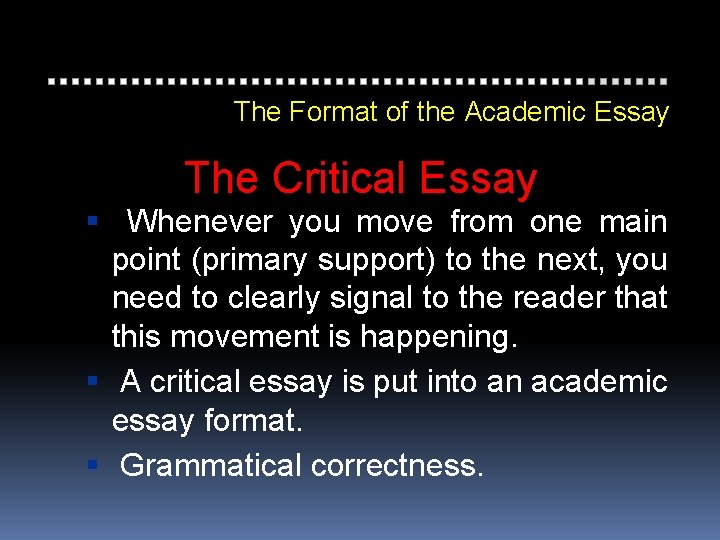
The Format of the Academic Essay The Critical Essay Whenever you move from one main point (primary support) to the next, you need to clearly signal to the reader that this movement is happening. A critical essay is put into an academic essay format. Grammatical correctness.
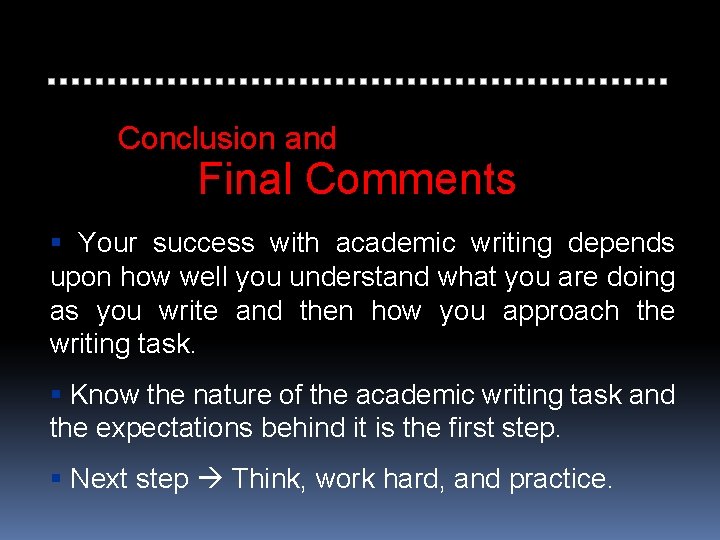
Conclusion and Final Comments Your success with academic writing depends upon how well you understand what you are doing as you write and then how you approach the writing task. Know the nature of the academic writing task and the expectations behind it is the first step. Next step Think, work hard, and practice.
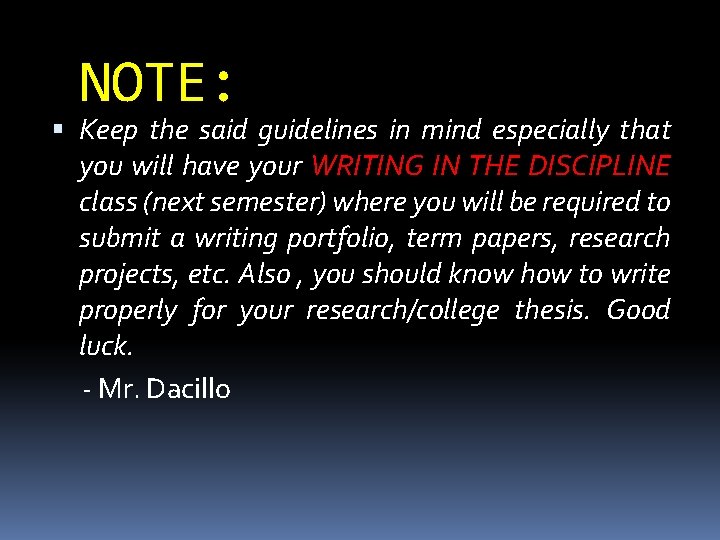
NOTE: Keep the said guidelines in mind especially that you will have your WRITING IN THE DISCIPLINE class (next semester) where you will be required to submit a writing portfolio, term papers, research projects, etc. Also , you should know how to write properly for your research/college thesis. Good luck. - Mr. Dacillo