15 213 Memory Management I Dynamic Storage Allocation

- Slides: 29
15 -213 Memory Management I: Dynamic Storage Allocation March 1, 2001 Topics • Explicit memory allocation • Data structures • Mechanisms class 14. ppt
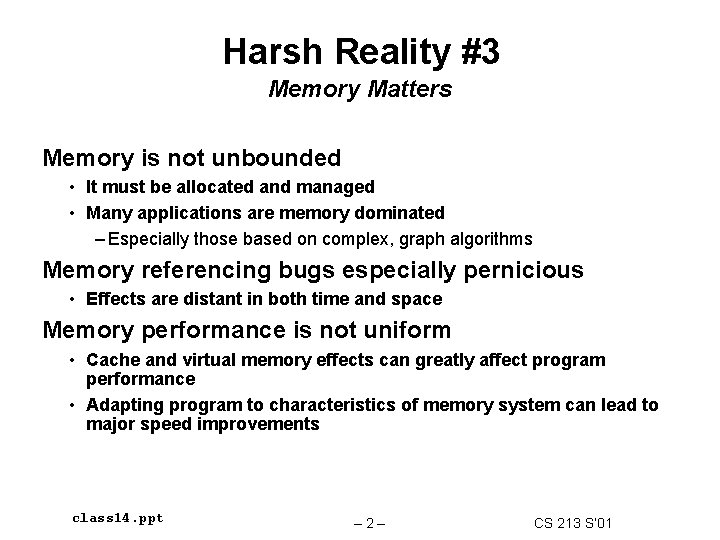
Harsh Reality #3 Memory Matters Memory is not unbounded • It must be allocated and managed • Many applications are memory dominated – Especially those based on complex, graph algorithms Memory referencing bugs especially pernicious • Effects are distant in both time and space Memory performance is not uniform • Cache and virtual memory effects can greatly affect program performance • Adapting program to characteristics of memory system can lead to major speed improvements class 14. ppt – 2– CS 213 S’ 01
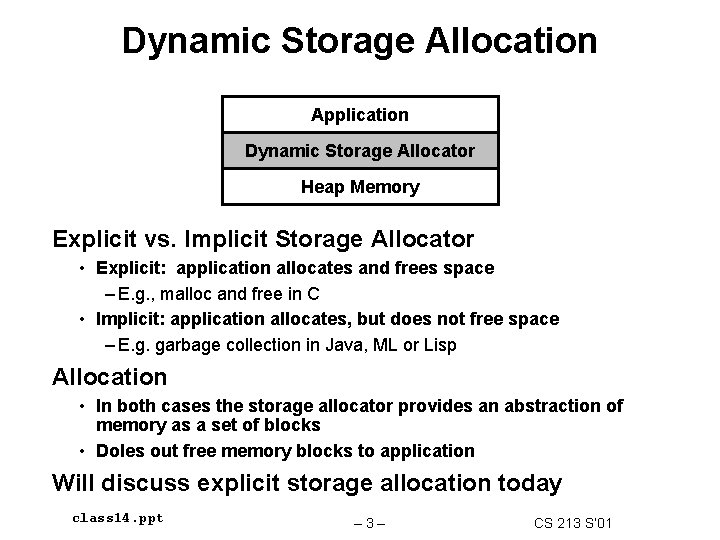
Dynamic Storage Allocation Application Dynamic Storage Allocator Heap Memory Explicit vs. Implicit Storage Allocator • Explicit: application allocates and frees space – E. g. , malloc and free in C • Implicit: application allocates, but does not free space – E. g. garbage collection in Java, ML or Lisp Allocation • In both cases the storage allocator provides an abstraction of memory as a set of blocks • Doles out free memory blocks to application Will discuss explicit storage allocation today class 14. ppt – 3– CS 213 S’ 01
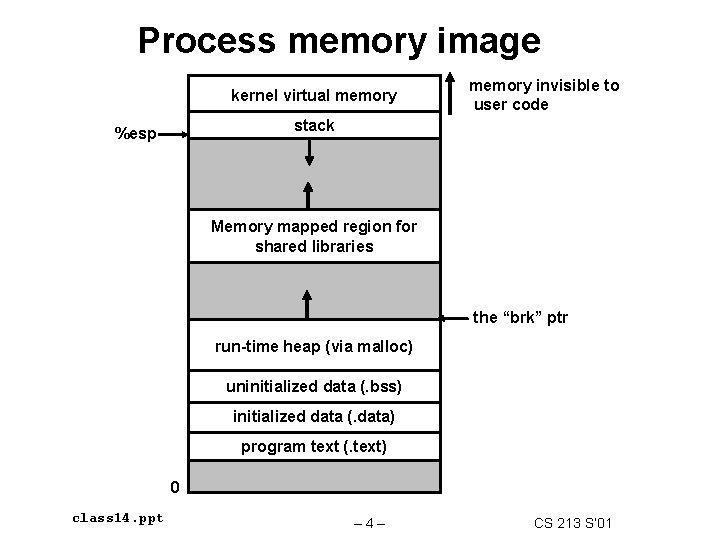
Process memory image kernel virtual memory invisible to user code stack %esp Memory mapped region for shared libraries the “brk” ptr run-time heap (via malloc) uninitialized data (. bss) initialized data (. data) program text (. text) 0 class 14. ppt – 4– CS 213 S’ 01
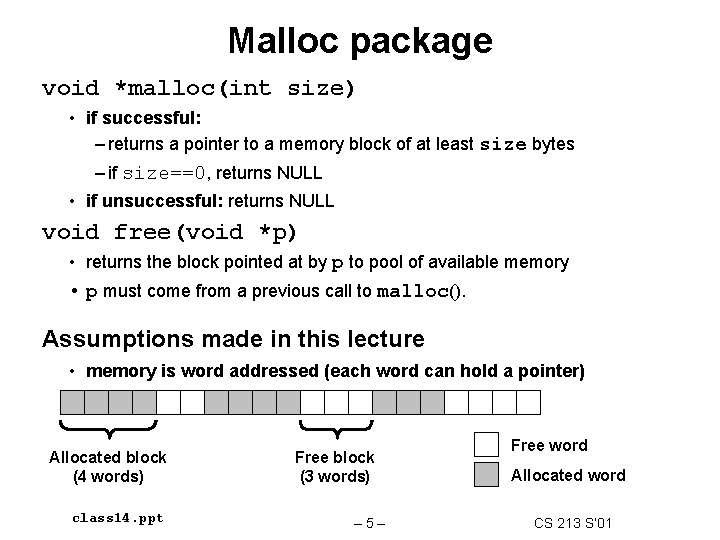
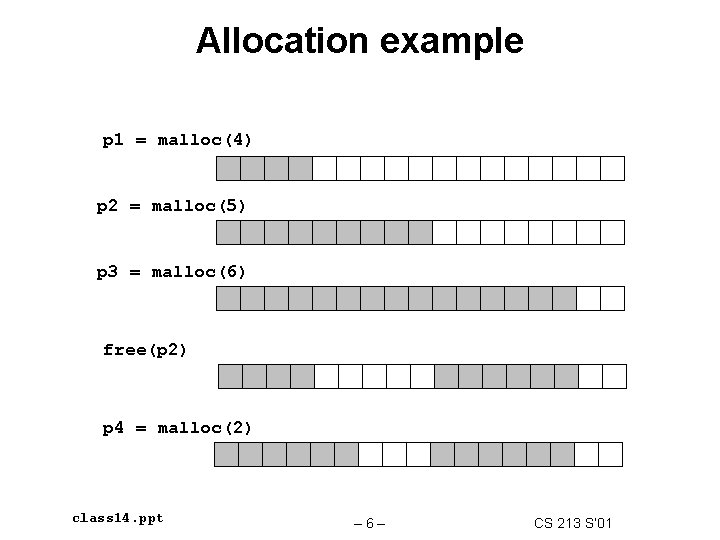
Malloc package void *malloc(int size) • if successful: – returns a pointer to a memory block of at least size bytes – if size==0, returns NULL • if unsuccessful: returns NULL void free(void *p) • returns the block pointed at by p to pool of available memory • p must come from a previous call to malloc(). Assumptions made in this lecture • memory is word addressed (each word can hold a pointer) Allocated block (4 words) class 14. ppt Free block (3 words) – 5– Free word Allocated word CS 213 S’ 01
Allocation example p 1 = malloc(4) p 2 = malloc(5) p 3 = malloc(6) free(p 2) p 4 = malloc(2) class 14. ppt – 6– CS 213 S’ 01
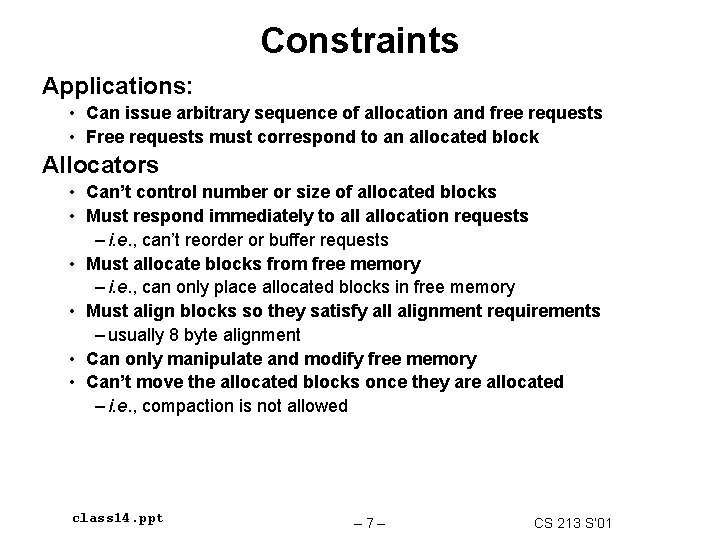
Constraints Applications: • Can issue arbitrary sequence of allocation and free requests • Free requests must correspond to an allocated block Allocators • Can’t control number or size of allocated blocks • Must respond immediately to allocation requests – i. e. , can’t reorder or buffer requests • Must allocate blocks from free memory – i. e. , can only place allocated blocks in free memory • Must align blocks so they satisfy all alignment requirements – usually 8 byte alignment • Can only manipulate and modify free memory • Can’t move the allocated blocks once they are allocated – i. e. , compaction is not allowed class 14. ppt – 7– CS 213 S’ 01
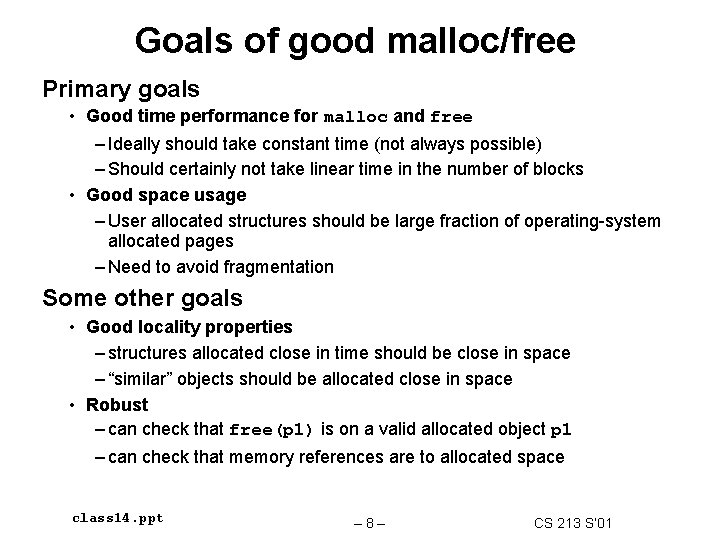
Goals of good malloc/free Primary goals • Good time performance for malloc and free – Ideally should take constant time (not always possible) – Should certainly not take linear time in the number of blocks • Good space usage – User allocated structures should be large fraction of operating-system allocated pages – Need to avoid fragmentation Some other goals • Good locality properties – structures allocated close in time should be close in space – “similar” objects should be allocated close in space • Robust – can check that free(p 1) is on a valid allocated object p 1 – can check that memory references are to allocated space class 14. ppt – 8– CS 213 S’ 01
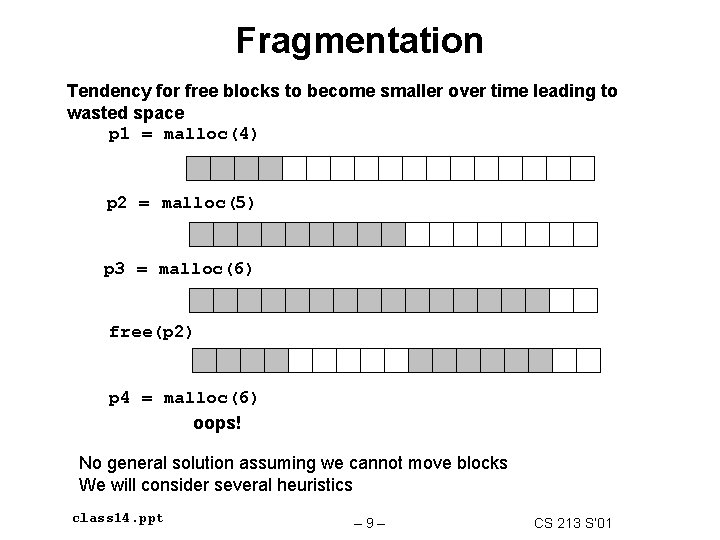
Fragmentation Tendency for free blocks to become smaller over time leading to wasted space p 1 = malloc(4) p 2 = malloc(5) p 3 = malloc(6) free(p 2) p 4 = malloc(6) oops! No general solution assuming we cannot move blocks We will consider several heuristics class 14. ppt – 9– CS 213 S’ 01
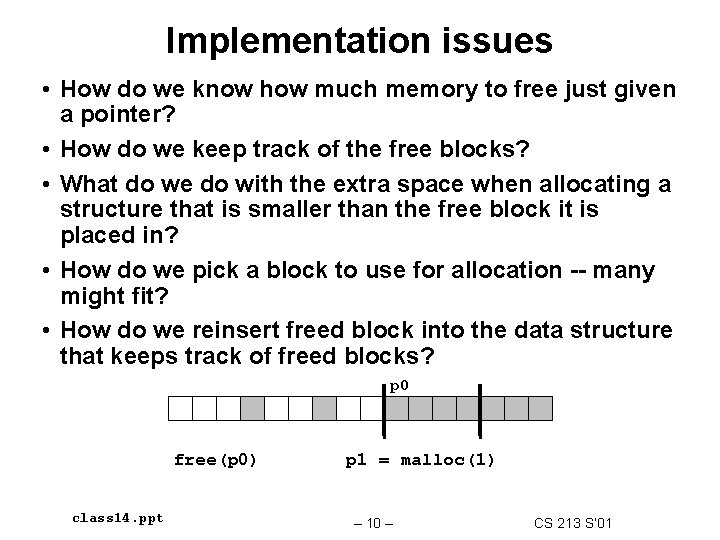
Implementation issues • How do we know how much memory to free just given a pointer? • How do we keep track of the free blocks? • What do we do with the extra space when allocating a structure that is smaller than the free block it is placed in? • How do we pick a block to use for allocation -- many might fit? • How do we reinsert freed block into the data structure that keeps track of freed blocks? p 0 free(p 0) class 14. ppt p 1 = malloc(1) – 10 – CS 213 S’ 01
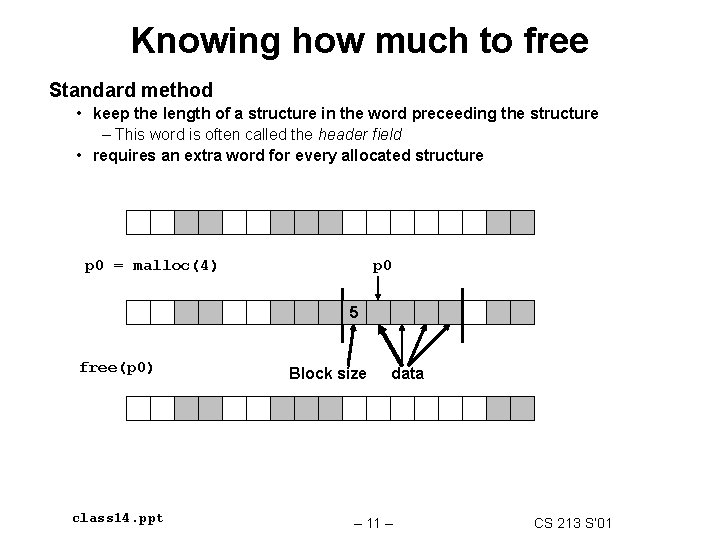
Knowing how much to free Standard method • keep the length of a structure in the word preceeding the structure – This word is often called the header field • requires an extra word for every allocated structure p 0 = malloc(4) p 0 5 free(p 0) class 14. ppt Block size data – 11 – CS 213 S’ 01
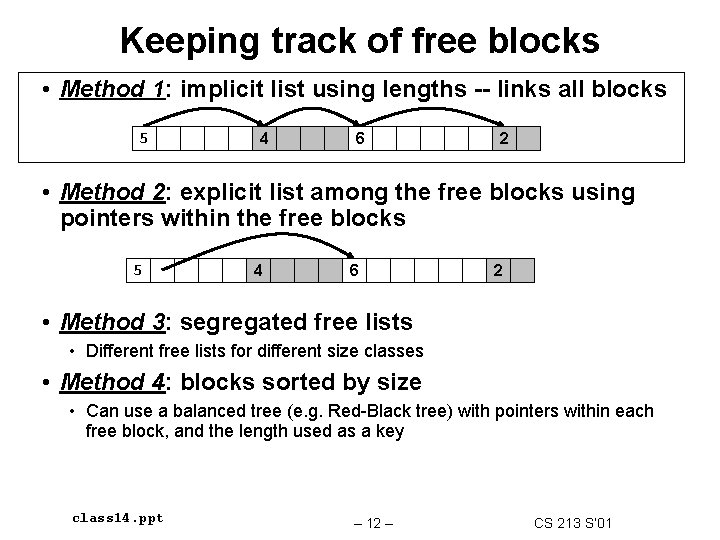
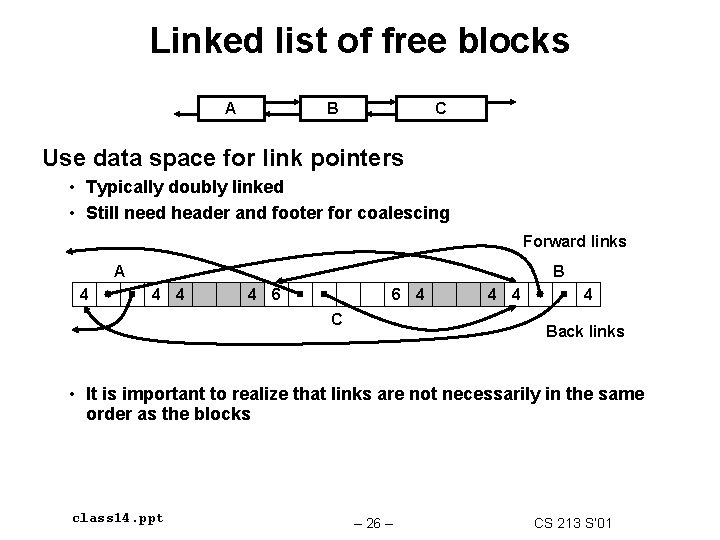
Keeping track of free blocks • Method 1: implicit list using lengths -- links all blocks 5 4 6 2 • Method 2: explicit list among the free blocks using pointers within the free blocks 5 4 6 2 • Method 3: segregated free lists • Different free lists for different size classes • Method 4: blocks sorted by size • Can use a balanced tree (e. g. Red-Black tree) with pointers within each free block, and the length used as a key class 14. ppt – 12 – CS 213 S’ 01
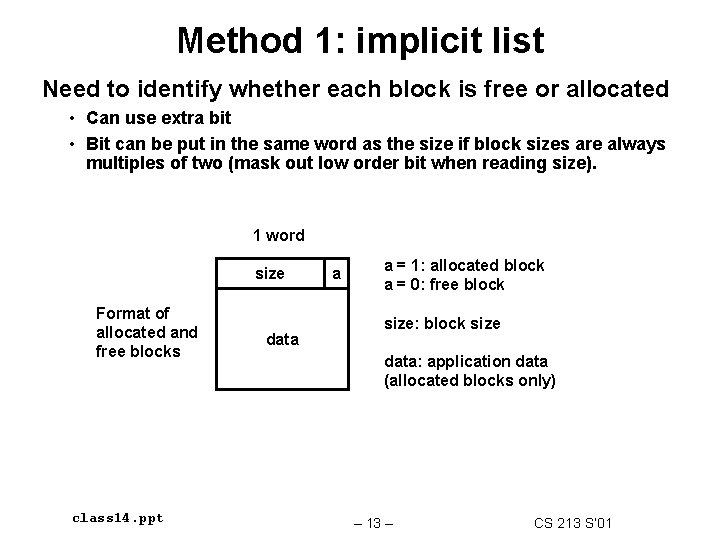
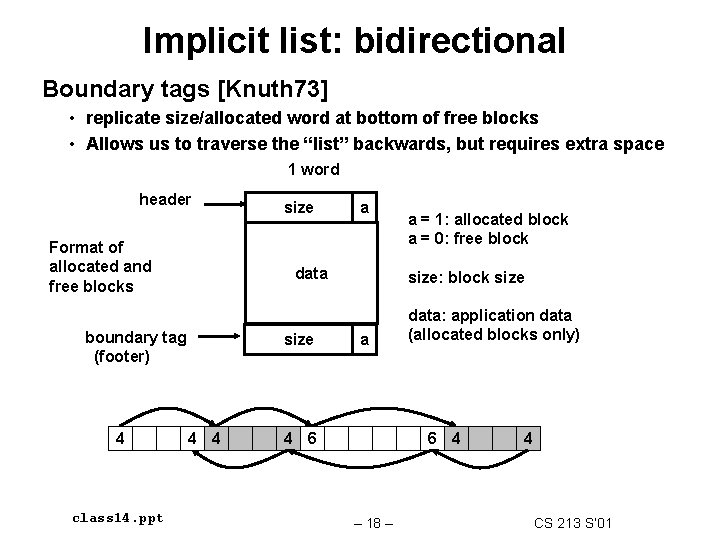
Method 1: implicit list Need to identify whether each block is free or allocated • Can use extra bit • Bit can be put in the same word as the size if block sizes are always multiples of two (mask out low order bit when reading size). 1 word size Format of allocated and free blocks class 14. ppt data a a = 1: allocated block a = 0: free block size: block size data: application data (allocated blocks only) – 13 – CS 213 S’ 01
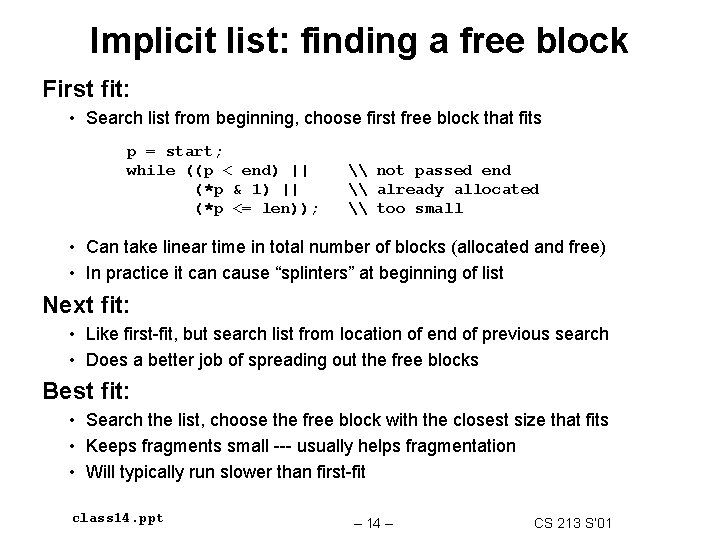
Implicit list: finding a free block First fit: • Search list from beginning, choose first free block that fits p = start; while ((p < end) || (*p & 1) || (*p <= len)); \ not passed end \ already allocated \ too small • Can take linear time in total number of blocks (allocated and free) • In practice it can cause “splinters” at beginning of list Next fit: • Like first-fit, but search list from location of end of previous search • Does a better job of spreading out the free blocks Best fit: • Search the list, choose the free block with the closest size that fits • Keeps fragments small --- usually helps fragmentation • Will typically run slower than first-fit class 14. ppt – 14 – CS 213 S’ 01
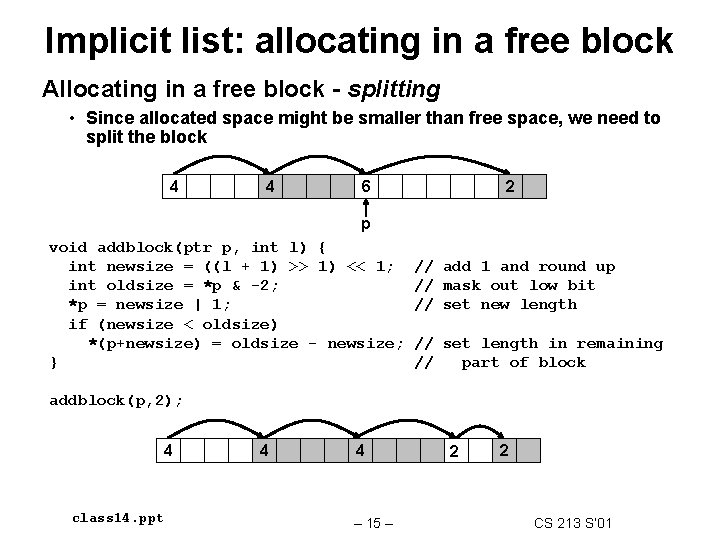
Implicit list: allocating in a free block Allocating in a free block - splitting • Since allocated space might be smaller than free space, we need to split the block 4 4 6 2 p void addblock(ptr p, int l) { int newsize = ((l + 1) >> 1) << 1; int oldsize = *p & -2; *p = newsize | 1; if (newsize < oldsize) *(p+newsize) = oldsize - newsize; } // add 1 and round up // mask out low bit // set new length // set length in remaining // part of block addblock(p, 2); 4 class 14. ppt 4 4 – 15 – 2 2 CS 213 S’ 01
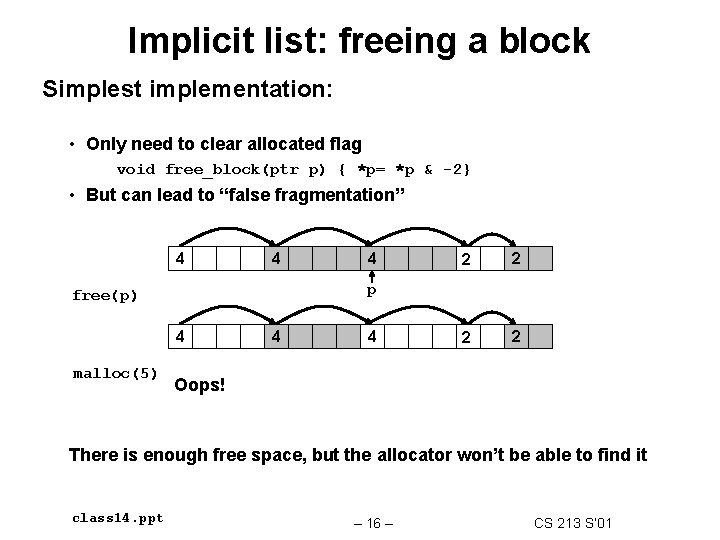
Implicit list: freeing a block Simplest implementation: • Only need to clear allocated flag void free_block(ptr p) { *p= *p & -2} • But can lead to “false fragmentation” 4 4 2 2 p free(p) 4 malloc(5) 4 4 4 Oops! There is enough free space, but the allocator won’t be able to find it class 14. ppt – 16 – CS 213 S’ 01
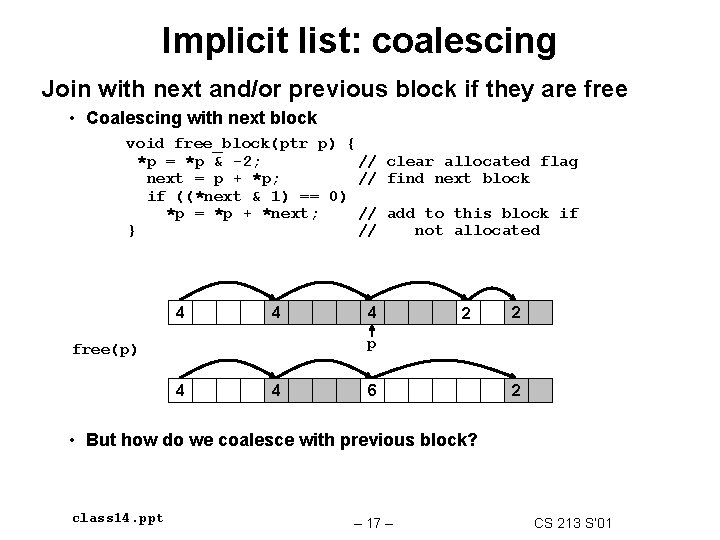
Implicit list: coalescing Join with next and/or previous block if they are free • Coalescing with next block void free_block(ptr p) { *p = *p & -2; // clear allocated flag next = p + *p; // find next block if ((*next & 1) == 0) *p = *p + *next; // add to this block if } // not allocated 4 4 4 2 2 p free(p) 4 4 6 2 • But how do we coalesce with previous block? class 14. ppt – 17 – CS 213 S’ 01
Implicit list: bidirectional Boundary tags [Knuth 73] • replicate size/allocated word at bottom of free blocks • Allows us to traverse the “list” backwards, but requires extra space 1 word header Format of allocated and free blocks class 14. ppt a data boundary tag (footer) 4 size 4 4 a = 1: allocated block a = 0: free block size: block size a 4 6 data: application data (allocated blocks only) 6 4 – 18 – 4 CS 213 S’ 01
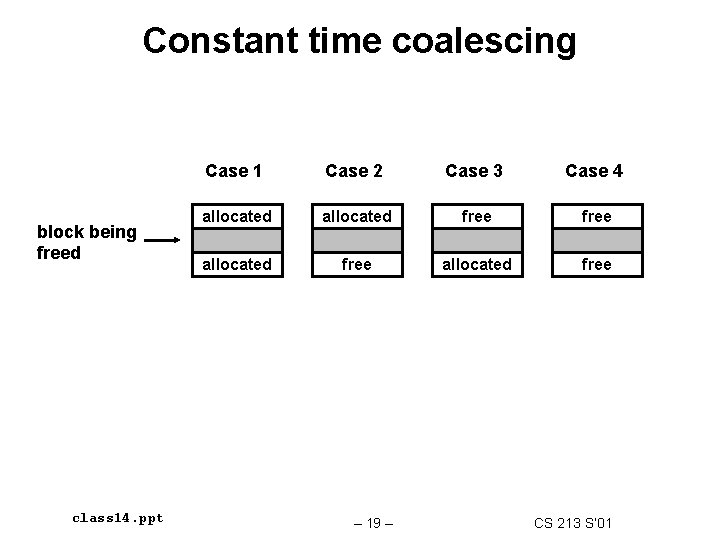
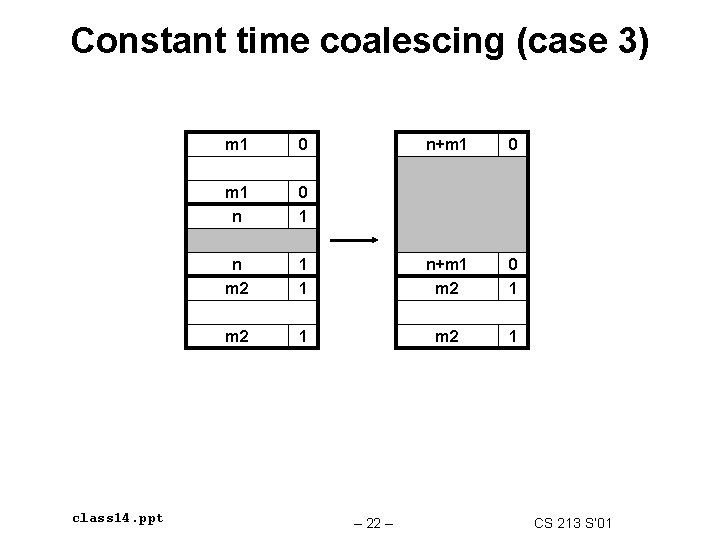
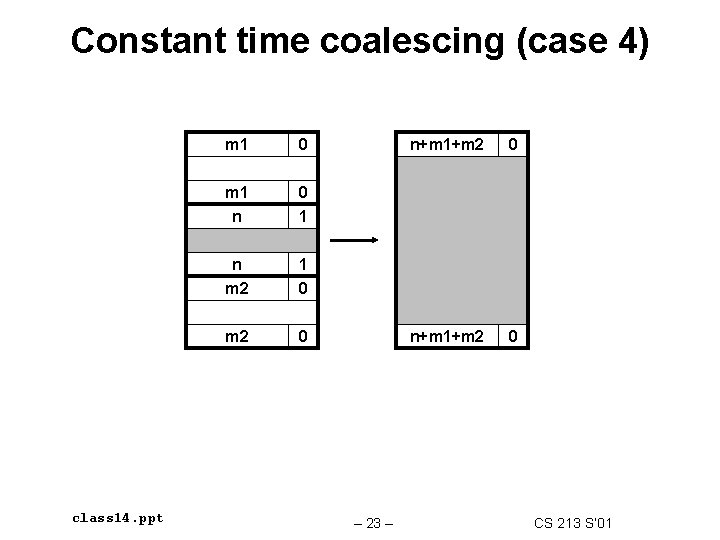
Constant time coalescing block being freed class 14. ppt Case 1 Case 2 Case 3 Case 4 allocated free – 19 – CS 213 S’ 01
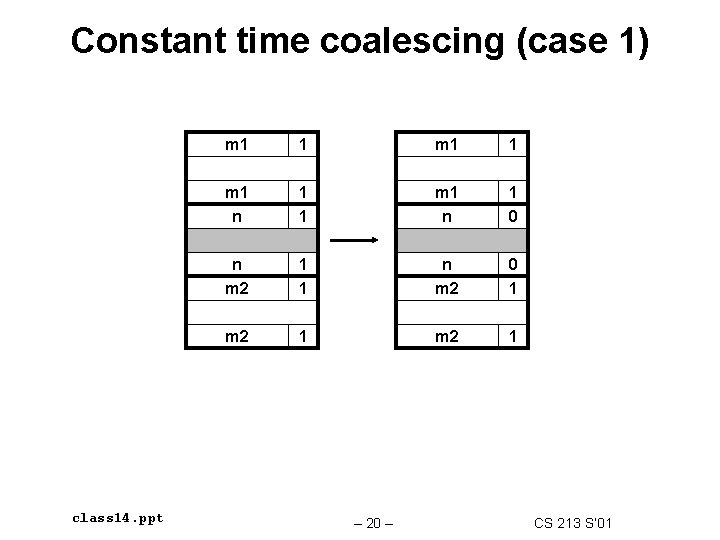
Constant time coalescing (case 1) class 14. ppt m 1 1 m 1 n 1 0 n m 2 1 1 n m 2 0 1 m 2 1 – 20 – CS 213 S’ 01
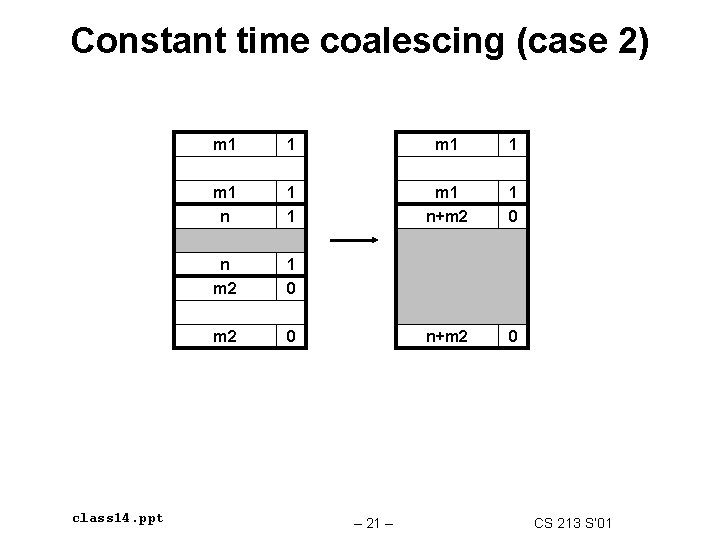
Constant time coalescing (case 2) class 14. ppt m 1 1 m 1 n+m 2 1 0 n m 2 1 0 m 2 0 n+m 2 0 – 21 – CS 213 S’ 01
Constant time coalescing (case 3) class 14. ppt m 1 0 n+m 1 0 m 1 n 0 1 n m 2 1 1 n+m 1 m 2 0 1 m 2 1 – 22 – CS 213 S’ 01
Constant time coalescing (case 4) class 14. ppt m 1 0 m 1 n 0 1 n m 2 1 0 m 2 0 – 23 – n+m 1+m 2 0 CS 213 S’ 01
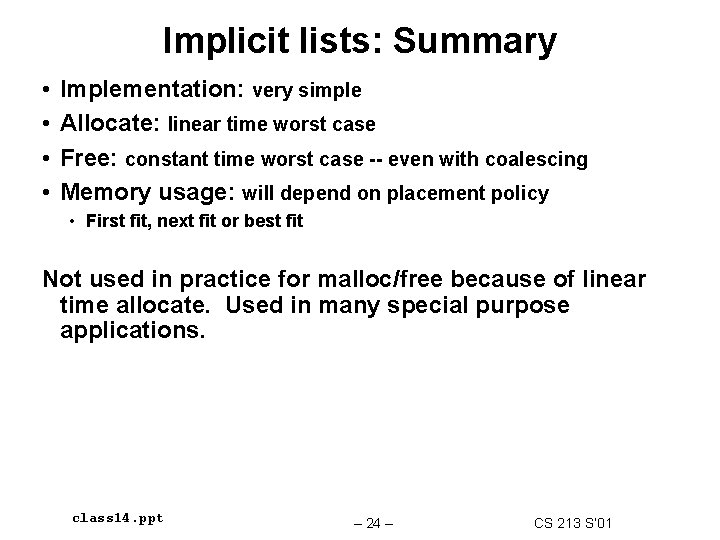
Implicit lists: Summary • • Implementation: very simple Allocate: linear time worst case Free: constant time worst case -- even with coalescing Memory usage: will depend on placement policy • First fit, next fit or best fit Not used in practice for malloc/free because of linear time allocate. Used in many special purpose applications. class 14. ppt – 24 – CS 213 S’ 01
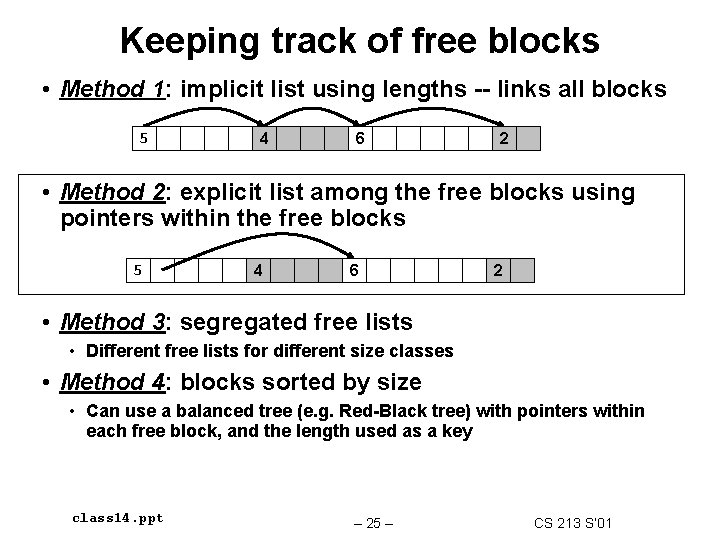
Keeping track of free blocks • Method 1: implicit list using lengths -- links all blocks 5 4 6 2 • Method 2: explicit list among the free blocks using pointers within the free blocks 5 4 6 2 • Method 3: segregated free lists • Different free lists for different size classes • Method 4: blocks sorted by size • Can use a balanced tree (e. g. Red-Black tree) with pointers within each free block, and the length used as a key class 14. ppt – 25 – CS 213 S’ 01
Linked list of free blocks A B C Use data space for link pointers • Typically doubly linked • Still need header and footer for coalescing Forward links A 4 B 4 4 4 6 6 4 C 4 4 4 Back links • It is important to realize that links are not necessarily in the same order as the blocks class 14. ppt – 26 – CS 213 S’ 01
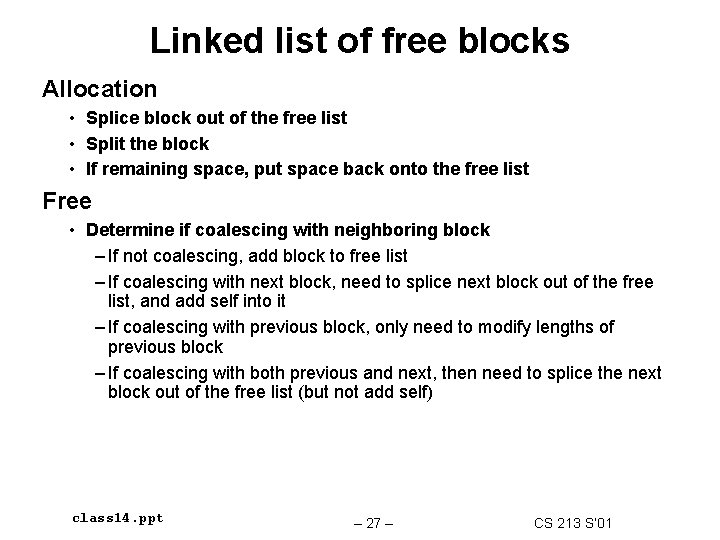
Linked list of free blocks Allocation • Splice block out of the free list • Split the block • If remaining space, put space back onto the free list Free • Determine if coalescing with neighboring block – If not coalescing, add block to free list – If coalescing with next block, need to splice next block out of the free list, and add self into it – If coalescing with previous block, only need to modify lengths of previous block – If coalescing with both previous and next, then need to splice the next block out of the free list (but not add self) class 14. ppt – 27 – CS 213 S’ 01
Linked list of free blocks Comparison to implicit list: • Allocate is linear time in number of free blocks instead of total blocks -- much faster allocates when most of the memory is full • Slightly more complicated allocate and free since needs to splice blocks in and out of the list • Some extra space for the links (4 words needed for each block) Main use of linked lists is in conjunction with segregated free lists • Keep multiple linked lists of different size classes, or possibly for different types of objects class 14. ppt – 28 – CS 213 S’ 01
For more information D. Knuth, “The Art of Computer Programming, Second Edition”, Addison Wesley, 1973 • the classic reference on dynamic storage allocation Wilson et al, “Dynamic Storage Allocation: A Survey and Critical Review”, Proc. 1995 Int’l Workshop on Memory Management, Kinross, Scotland, Sept, 1995. • comprehensive survey • $classdir/doc/dsa. ps class 14. ppt – 29 – CS 213 S’ 01