10 The Variety of Life 10 2 Oxygen

- Slides: 13
10. The Variety of Life 10. 2 Oxygen Dissociation Curves
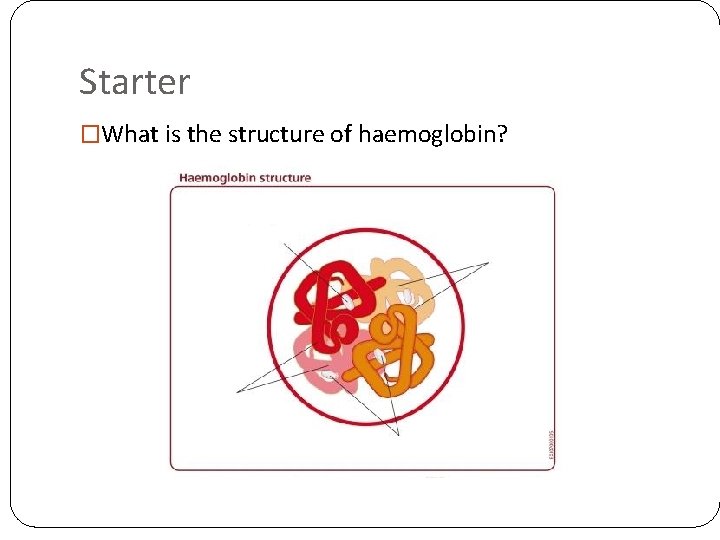
Starter �What is the structure of haemoglobin?
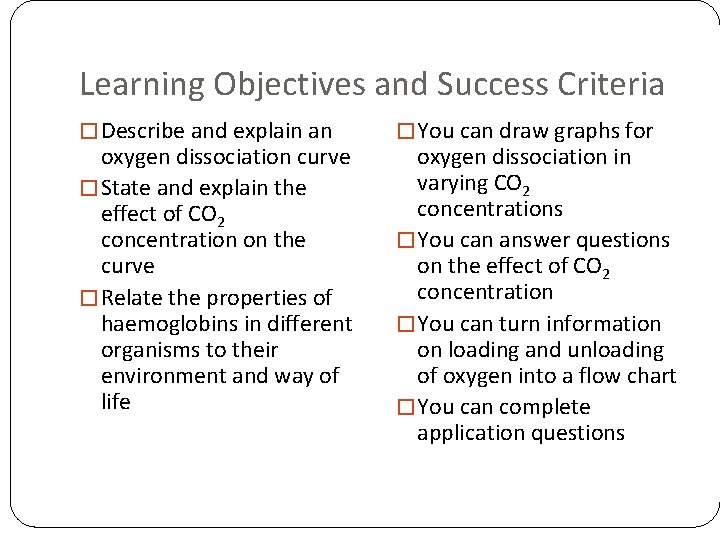
Learning Objectives and Success Criteria � Describe and explain an oxygen dissociation curve � State and explain the effect of CO 2 concentration on the curve � Relate the properties of haemoglobins in different organisms to their environment and way of life � You can draw graphs for oxygen dissociation in varying CO 2 concentrations � You can answer questions on the effect of CO 2 concentration � You can turn information on loading and unloading of oxygen into a flow chart � You can complete application questions
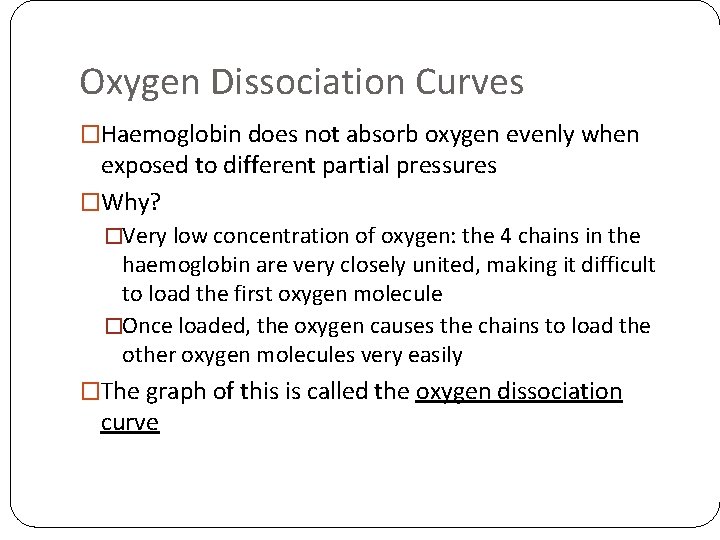
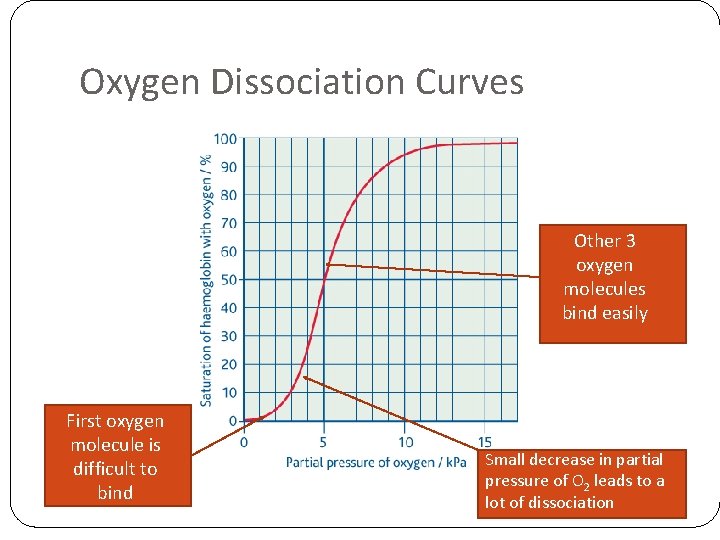
Oxygen Dissociation Curves �Haemoglobin does not absorb oxygen evenly when exposed to different partial pressures �Why? �Very low concentration of oxygen: the 4 chains in the haemoglobin are very closely united, making it difficult to load the first oxygen molecule �Once loaded, the oxygen causes the chains to load the other oxygen molecules very easily �The graph of this is called the oxygen dissociation curve
Oxygen Dissociation Curves Other 3 oxygen molecules bind easily First oxygen molecule is difficult to bind Small decrease in partial pressure of O 2 leads to a lot of dissociation
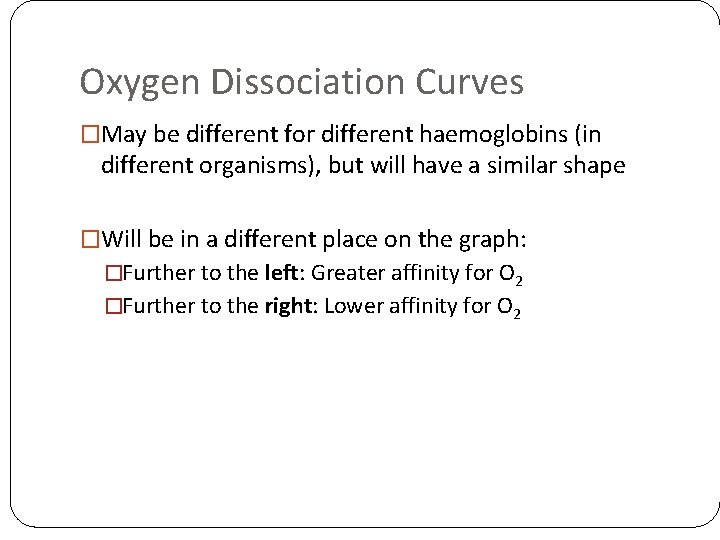
Oxygen Dissociation Curves �May be different for different haemoglobins (in different organisms), but will have a similar shape �Will be in a different place on the graph: �Further to the left: Greater affinity for O 2 �Further to the right: Lower affinity for O 2
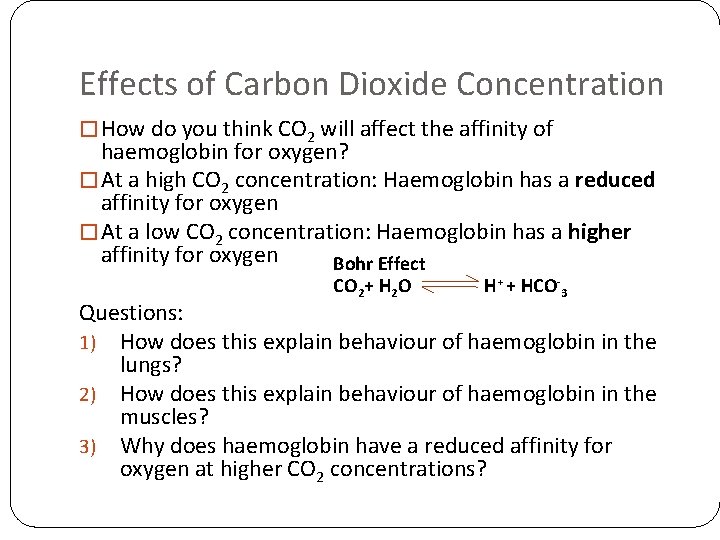
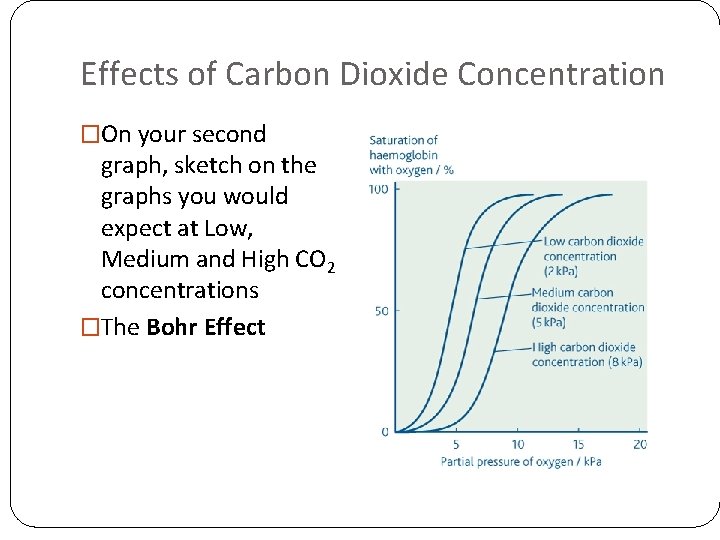
Effects of Carbon Dioxide Concentration � How do you think CO 2 will affect the affinity of haemoglobin for oxygen? � At a high CO 2 concentration: Haemoglobin has a reduced affinity for oxygen � At a low CO 2 concentration: Haemoglobin has a higher affinity for oxygen Bohr Effect CO 2+ H 2 O H+ + HCO-3 Questions: 1) How does this explain behaviour of haemoglobin in the lungs? 2) How does this explain behaviour of haemoglobin in the muscles? 3) Why does haemoglobin have a reduced affinity for oxygen at higher CO 2 concentrations?
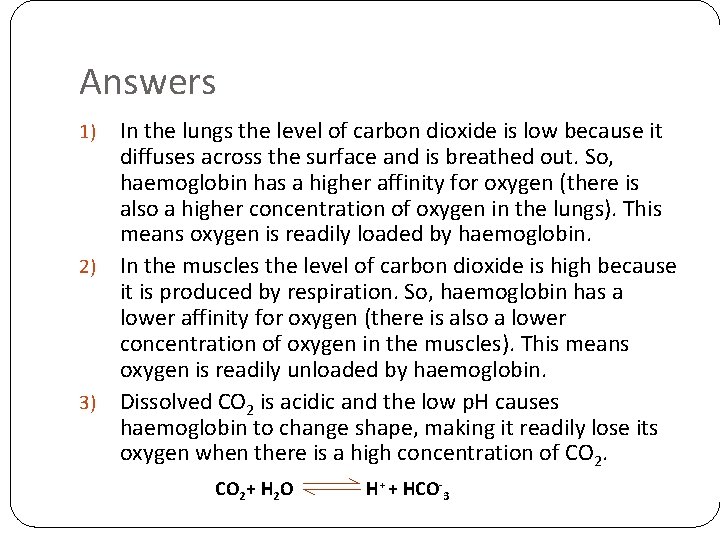
Answers In the lungs the level of carbon dioxide is low because it diffuses across the surface and is breathed out. So, haemoglobin has a higher affinity for oxygen (there is also a higher concentration of oxygen in the lungs). This means oxygen is readily loaded by haemoglobin. 2) In the muscles the level of carbon dioxide is high because it is produced by respiration. So, haemoglobin has a lower affinity for oxygen (there is also a lower concentration of oxygen in the muscles). This means oxygen is readily unloaded by haemoglobin. 3) Dissolved CO 2 is acidic and the low p. H causes haemoglobin to change shape, making it readily lose its oxygen when there is a high concentration of CO 2. 1) CO 2+ H 2 O H+ + HCO-3
Effects of Carbon Dioxide Concentration �On your second graph, sketch on the graphs you would expect at Low, Medium and High CO 2 concentrations �The Bohr Effect
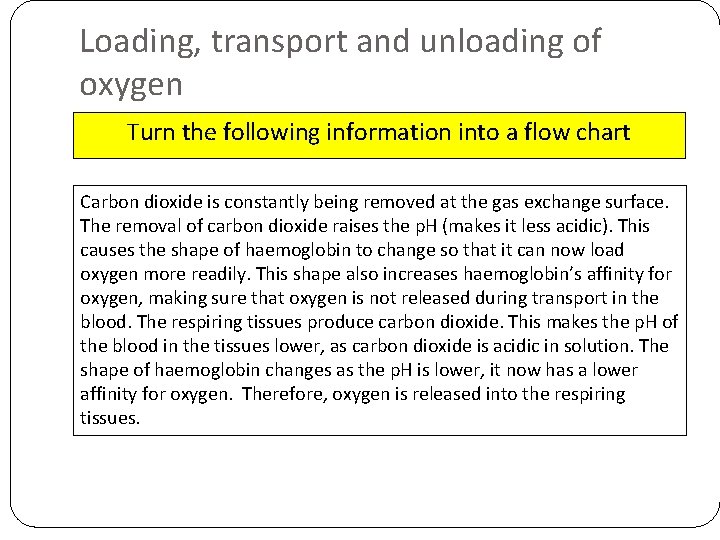
Loading, transport and unloading of oxygen Turn the following information into a flow chart Carbon dioxide is constantly being removed at the gas exchange surface. The removal of carbon dioxide raises the p. H (makes it less acidic). This causes the shape of haemoglobin to change so that it can now load oxygen more readily. This shape also increases haemoglobin’s affinity for oxygen, making sure that oxygen is not released during transport in the blood. The respiring tissues produce carbon dioxide. This makes the p. H of the blood in the tissues lower, as carbon dioxide is acidic in solution. The shape of haemoglobin changes as the p. H is lower, it now has a lower affinity for oxygen. Therefore, oxygen is released into the respiring tissues.
Application Questions �Read and complete Application questions on pages 153 – 155.
Application Questions - Answers At this partial pressure of oxygen, lugworm haemoglobin is 90% saturated, more than enough to supply sufficient oxygen to the tissues of a relatively inactive organism. Human haemoglobin is only 10% saturated – insufficient to supply enough oxygen to keep tissues alive. 2. The dissociation curve of the lugworm is shifted far to the left. This means it is fully loaded with oxygen even when there is very little available in its environment. 1.
Application Questions - Answers 3. ‘The lugworm is not very active’. This means that it requires less oxygen and therefore what little there is in its burrow when the tide is out is sufficient to supply its needs. Hence it survives. 4. Respiration produces carbon dioxide. This builds up in the burrow when the tide is out. If lugworm haemoglobin exhibited the Bohr effect, it would not be able to absorb oxygen when it was present in only very low concentrations in the burrow.