1 PRECIPITIMETRIC TITRATIONS Ashraf M Mahmoud Profes Theory


![Application of precipitimetry Why…? 1] Conc. of pot. Chromate is critical ? To prevent](https://slidetodoc.com/presentation_image/235cfd2eda8c6bfbf0417b2e2bd5db6e/image-13.jpg "Application of precipitimetry Why…? 1] Conc. of pot. Chromate is critical ? To prevent")
![Application of precipitimetry 2 -Determination of Bromide by Volhard’s method 1] Silver can be](https://slidetodoc.com/presentation_image/235cfd2eda8c6bfbf0417b2e2bd5db6e/image-14.jpg "Application of precipitimetry 2 -Determination of Bromide by Volhard’s method 1] Silver can be")
![Application of precipitimetry NOTES Why…? 1] Acidic med. ? ♠ favorable to formation of](https://slidetodoc.com/presentation_image/235cfd2eda8c6bfbf0417b2e2bd5db6e/image-16.jpg "Application of precipitimetry NOTES Why…? 1] Acidic med. ? ♠ favorable to formation of")
![Application of precipitimetry 4] If applied to chloride , Ag. Cl should be removed](https://slidetodoc.com/presentation_image/235cfd2eda8c6bfbf0417b2e2bd5db6e/image-17.jpg "Application of precipitimetry 4] If applied to chloride , Ag. Cl should be removed")

- Slides: 21
1 PRECIPITIMETRIC TITRATIONS Ashraf M. Mahmoud, Profes
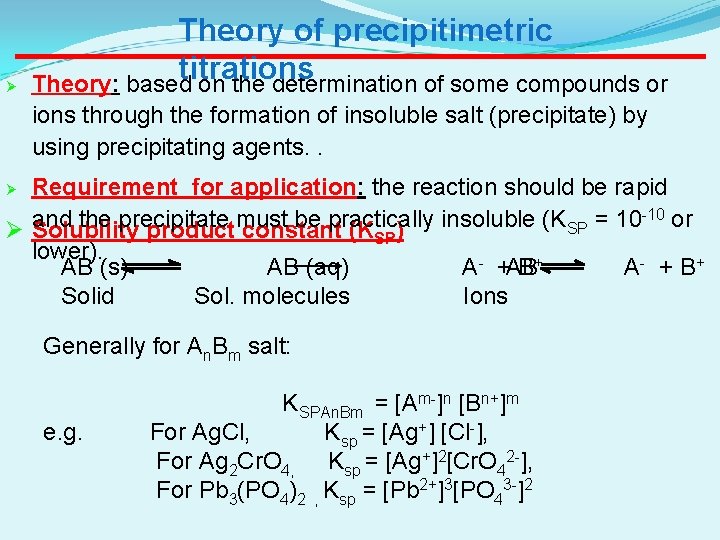
Ø Theory of precipitimetric titrations Theory: based on the determination of some compounds or ions through the formation of insoluble salt (precipitate) by using precipitating agents. . Requirement for application: the reaction should be rapid -10 or and the precipitate must be practically insoluble (K = 10 SP Ø Solubility product constant (KSP) lower). + - + B+ AB (s) AB (aq) A - + B AB A Solid Sol. molecules Ions Ø Generally for An. Bm salt: K SPAn. Bm = [Am-]n [Bn+]m e. g. For Ag. Cl, Ksp = [Ag+] [Cl-], For Ag 2 Cr. O 4, Ksp = [Ag+]2[Cr. O 42 -], For Pb 3(PO 4)2 , Ksp = [Pb 2+]3[PO 43 -]2
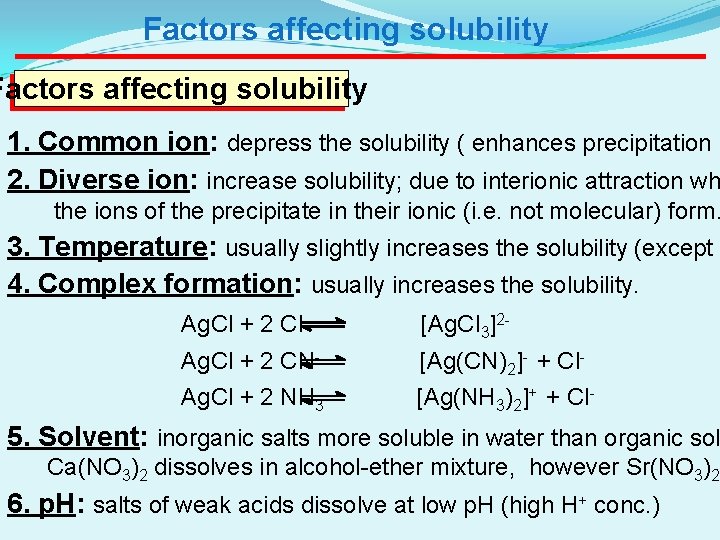
Factors affecting solubility 1. Common ion: depress the solubility ( enhances precipitation. 2. Diverse ion: increase solubility; due to interionic attraction wh the ions of the precipitate in their ionic (i. e. not molecular) form. 3. Temperature: usually slightly increases the solubility (except P 4. Complex formation: usually increases the solubility. Ag. Cl + 2 Cl- [Ag. Cl 3]2 Ag. Cl + 2 CN- [Ag(CN)2]- + Cl- Ag. Cl + 2 NH 3 [Ag(NH 3)2]+ + Cl- 5. Solvent: inorganic salts more soluble in water than organic sol Ca(NO 3)2 dissolves in alcohol-ether mixture, however Sr(NO 3)2 6. p. H: salts of weak acids dissolve at low p. H (high H+ conc. )
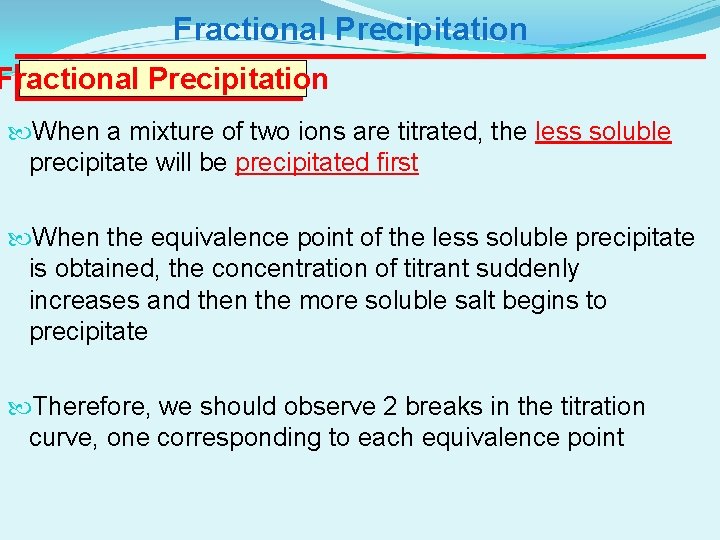
Fractional Precipitation When a mixture of two ions are titrated, the less soluble precipitate will be precipitated first When the equivalence point of the less soluble precipitate is obtained, the concentration of titrant suddenly increases and then the more soluble salt begins to precipitate Therefore, we should observe 2 breaks in the titration curve, one corresponding to each equivalence point
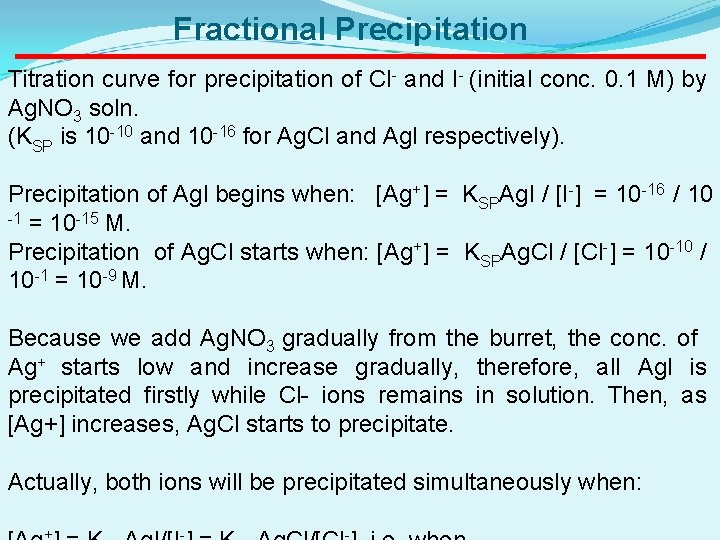
Fractional Precipitation Titration curve for precipitation of Cl- and I- (initial conc. 0. 1 M) by Ag. NO 3 soln. (KSP is 10 -10 and 10 -16 for Ag. Cl and Agl respectively). Precipitation of Agl begins when: [Ag+] = KSPAg. I / [I-] = 10 -16 / 10 -1 = 10 -15 M. Precipitation of Ag. Cl starts when: [Ag+] = KSPAg. Cl / [Cl-] = 10 -10 / 10 -1 = 10 -9 M. Because we add Ag. NO 3 gradually from the burret, the conc. of Ag+ starts low and increase gradually, therefore, all Agl is precipitated firstly while Cl- ions remains in solution. Then, as [Ag+] increases, Ag. Cl starts to precipitate. Actually, both ions will be precipitated simultaneously when:
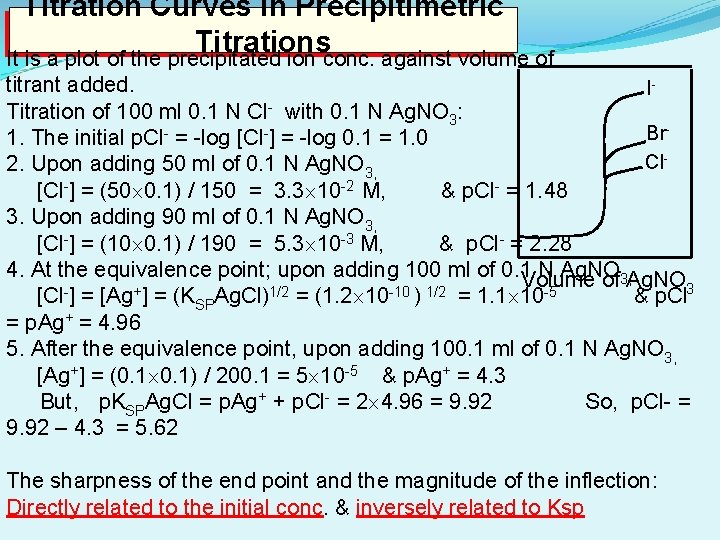
Titration Curves in Precipitimetric Titrations It is a plot of the precipitated ion conc. against volume of titrant added. ITitration of 100 ml 0. 1 N Cl- with 0. 1 N Ag. NO 3: Br 1. The initial p. Cl- = -log [Cl-] = -log 0. 1 = 1. 0 Cl 2. Upon adding 50 ml of 0. 1 N Ag. NO 3, [Cl-] = (50 0. 1) / 150 = 3. 3 10 -2 M, & p. Cl- = 1. 48 3. Upon adding 90 ml of 0. 1 N Ag. NO 3, [Cl-] = (10 0. 1) / 190 = 5. 3 10 -3 M, & p. Cl- = 2. 28 4. At the equivalence point; upon adding 100 ml of 0. 1 N Ag. NO 3, Volume of Ag. NO [Cl-] = [Ag+] = (KSPAg. Cl)1/2 = (1. 2 10 -10 ) 1/2 = 1. 1 10 -5 & p. Cl 3 - = p. Ag+ = 4. 96 5. After the equivalence point, upon adding 100. 1 ml of 0. 1 N Ag. NO 3, [Ag+] = (0. 1) / 200. 1 = 5 10 -5 & p. Ag+ = 4. 3 But, p. KSPAg. Cl = p. Ag+ + p. Cl- = 2 4. 96 = 9. 92 So, p. Cl- = 9. 92 – 4. 3 = 5. 62 The sharpness of the end point and the magnitude of the inflection: Directly related to the initial conc. & inversely related to Ksp
Examples M * V / n = M* V / n [X] = [initial conc. of X ]* [dilution] Example [1]: in a titration of 25. 0 m. L of 0. 1 M [I- ] with 0. 05 M Ag+ and monitor Ag+: Ag+ + I- = Ag. I (ppt) The expected equivalence volume of titrant Veq. point : M * V / n = M* V / n M I- * V I- / n = M Ag+ * V Ag+ / n V eq. point = 25 x 0. 1 / 0. 05 = 50 m. L
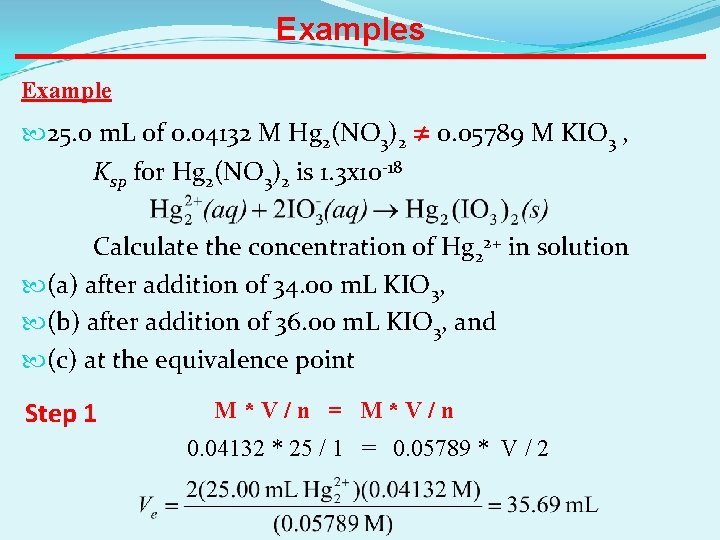
Examples Example 25. 0 m. L of 0. 04132 M Hg 2(NO 3)2 ≠ 0. 05789 M KIO 3 , Ksp for Hg 2(NO 3)2 is 1. 3 x 10 -18 Calculate the concentration of Hg 22+ in solution (a) after addition of 34. 00 m. L KIO 3, (b) after addition of 36. 00 m. L KIO 3, and (c) at the equivalence point Step 1 M * V / n = M* V / n 0. 04132 * 25 / 1 = 0. 05789 * V / 2
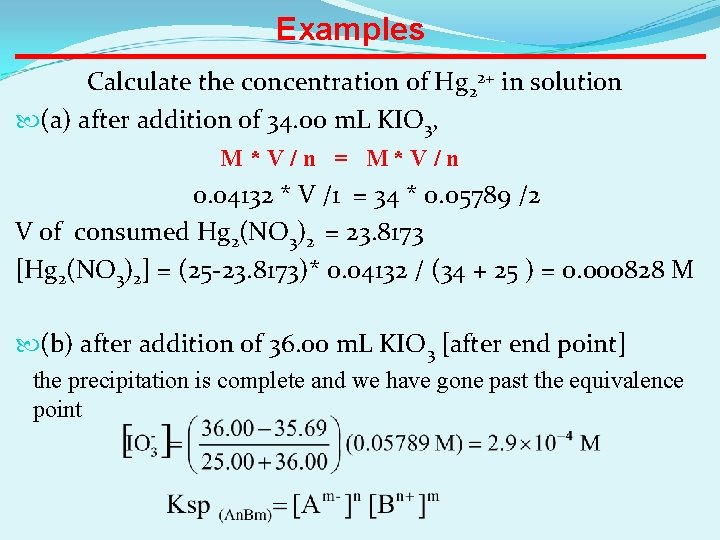
Examples Calculate the concentration of Hg 22+ in solution (a) after addition of 34. 00 m. L KIO 3, M * V / n = M* V / n 0. 04132 * V /1 = 34 * 0. 05789 /2 V of consumed Hg 2(NO 3)2 = 23. 8173 [Hg 2(NO 3)2] = (25 -23. 8173)* 0. 04132 / (34 + 25 ) = 0. 000828 M (b) after addition of 36. 00 m. L KIO 3 [after end point] the precipitation is complete and we have gone past the equivalence point
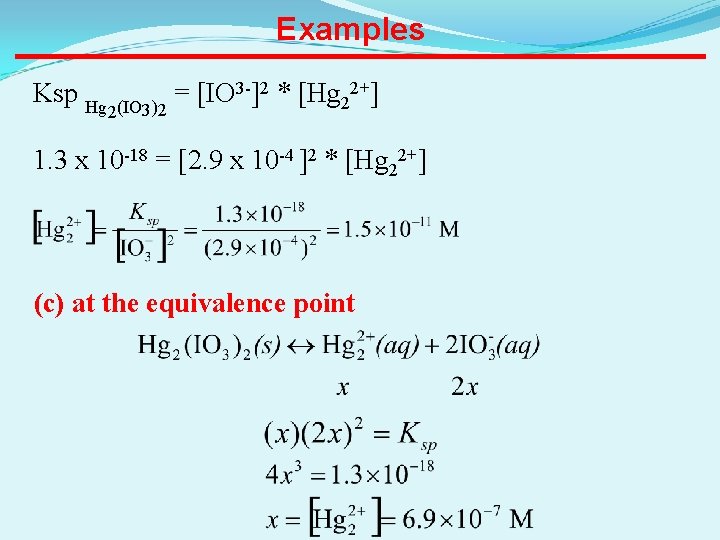
Examples Ksp Hg 2(IO 3)2 = [IO 3 -]2 * [Hg 22+] 1. 3 x 10 -18 = [2. 9 x 10 -4 ]2 * [Hg 22+] (c) at the equivalence point
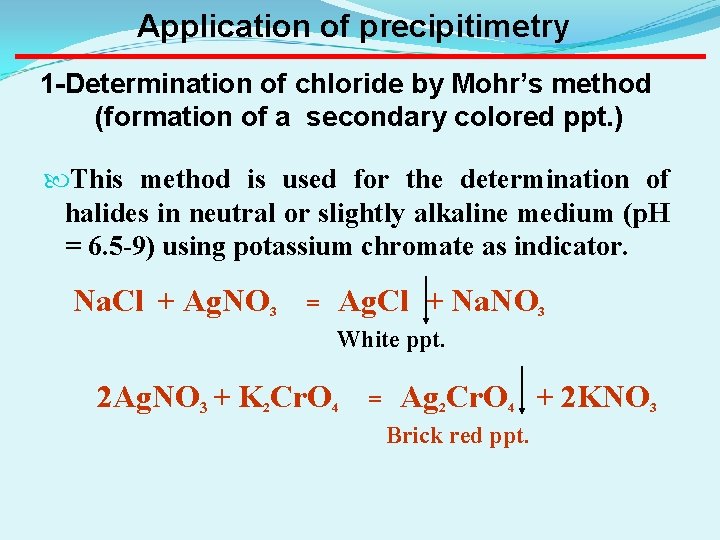
Application of precipitimetry 1 -Determination of chloride by Mohr’s method (formation of a secondary colored ppt. ) This method is used for the determination of halides in neutral or slightly alkaline medium (p. H = 6. 5 -9) using potassium chromate as indicator. Na. Cl + Ag. NO 3 = Ag. Cl + Na. NO 3 White ppt. n 2 Ag. NO 3 + K 2 Cr. O 4 = Ag 2 Cr. O 4 + 2 KNO 3 Brick red ppt.
Application of precipitimetry Why…? 1] Conc. of pot. Chromate is critical ? To prevent precipitation of silver chromate until complete precipitation of Ag. Cl as Ksp of silver chromate is less than Ksp of Ag. Cl. 2] not acidic medium? To prevent Formation of Ag 2 Cr 2 O 7 (Soluble). 3] not strong alkaline medium? To prevent Formation of Ag. OH (silver hydroxide) then Ag 2 O (silver oxide, black ppt) which may be precipitated before Ag 2 Cr. O 4 and interfere with E. p. detection 4] If ammonium salts present, p. H sholdn’t exceed 8? Free NH 3 will be produced and dissolve Ag. Cl forming Ag[NH 3]2 Cl complex.
Application of precipitimetry 2 -Determination of Bromide by Volhard’s method 1] Silver can be determined in acidic med. [nitric acid] with thiocyanate as a titrante and ferric alum as indicator. [ Volhard‛s method]. 2] In this method, can applied halides & cyanide in acidic medium. 3] For bromide, treating it with excess Ag. NO 3 and back titrated Ag. NO 3 with thiocyanate.
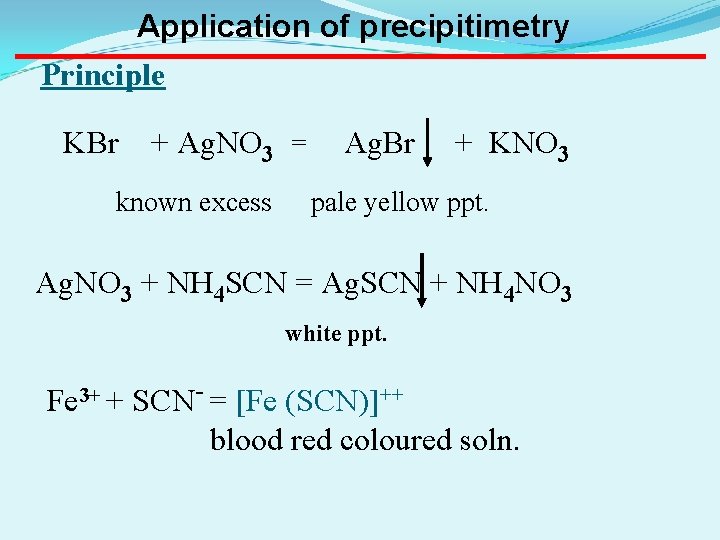
Application of precipitimetry Principle KBr + Ag. NO 3 = known excess Ag. Br + KNO 3 pale yellow ppt. Ag. NO 3 + NH 4 SCN = Ag. SCN + NH 4 NO 3 white ppt. Fe 3+ + SCN- = [Fe (SCN)]++ blood red coloured soln.
Application of precipitimetry NOTES Why…? 1] Acidic med. ? ♠ favorable to formation of the blood red complex. ♠ to dissolve the silver salts of carbonate and phosphate. 2] Not HCl ? Due to formation of Ag. Cl ppt. or H 2 SO 4 ? Form. of slightly dissociate Ag 2 SO 4 3] Not basic med. ? Form. of Ag. OH then Ag 2 O [ black ppt. ]
Application of precipitimetry 4] If applied to chloride , Ag. Cl should be removed prevent reaction of thiocyanate with it [ Ksp of Ag. SCN < Ksp of Ag. Cl]. Removed by one of these three methods: 1 - Filtered off. 2 - Boiling to co-agulate 3 - Addition of nitrobenzene, act as a coating sub. arround Ag. Cl ppt. to
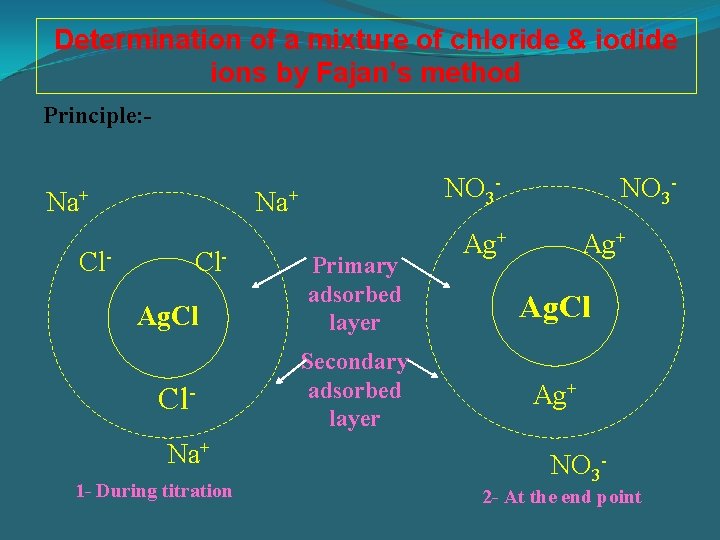
Determination of a mixture of chloride & iodide ions by Fajan’s method Principle: - Na+ Cl- NO 3 - Na+ Cl. Ag. Cl Cl. Na+ 1 - During titration Primary adsorbed layer Secondary adsorbed layer NO 3 - Ag+ Ag. Cl Ag+ NO 3 - 2 - At the end point
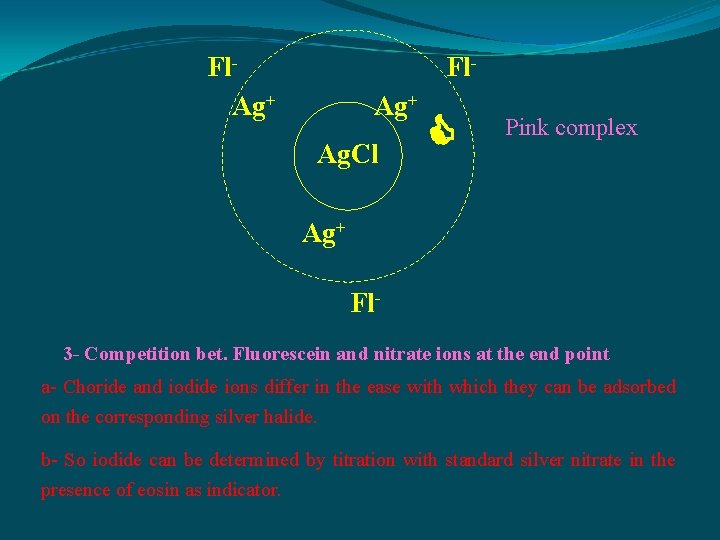
Fl. Ag+ Ag. Cl Pink complex Ag+ Fl 3 - Competition bet. Fluorescein and nitrate ions at the end point a- Choride and iodide ions differ in the ease with which they can be adsorbed on the corresponding silver halide. b- So iodide can be determined by titration with standard silver nitrate in the presence of eosin as indicator.
c- Total can be determined by a similar titration in the presence of fluorescein as indicator. d- Chloride is obtained by difference. Notes 1] Anionic part of the indicator will compete with nitrate ion in forming the secondary layer. Why? As its silver salt is less soluble in water than silver nitrate and so it is preferentially adsorbed and forms a colored complex with silver ion on the surface of the precipitate. 2] Eosin cannot be used for detn. of chloride: Because eosinate anion is strongly adsorbed by Ag. Cl ppt. Before the equivalence point.