
Buffers and Titrations SSS 3 Class 3 Materials
Buffers and Titrations SSS 3 Class 3
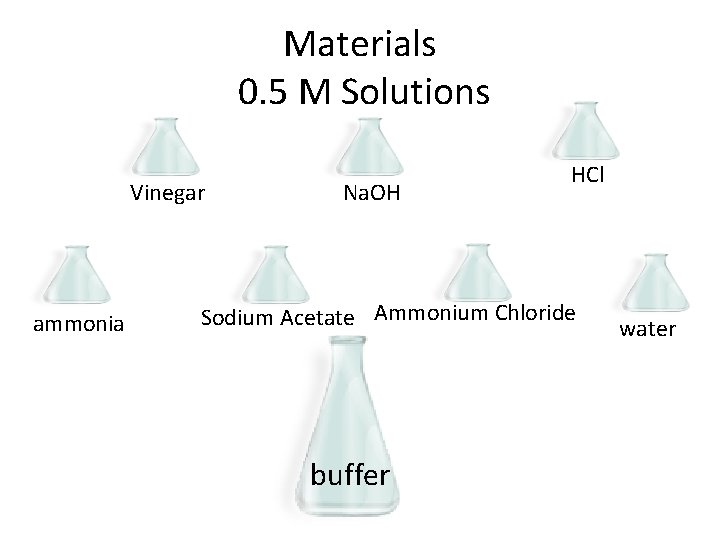
Materials 0. 5 M Solutions Vinegar ammonia Na. OH HCl Sodium Acetate Ammonium Chloride buffer water
Buffers • What is a Buffer? – A Solution made of a weak acid and salt of weak acid ( ion is the acid’s conjugate base) or weak base and salt of weak base ( ion is the base’s conjugate acid) • What are the advantages of having a Buffer? – Solution will not significantly change in p. H when an acid or base are added.
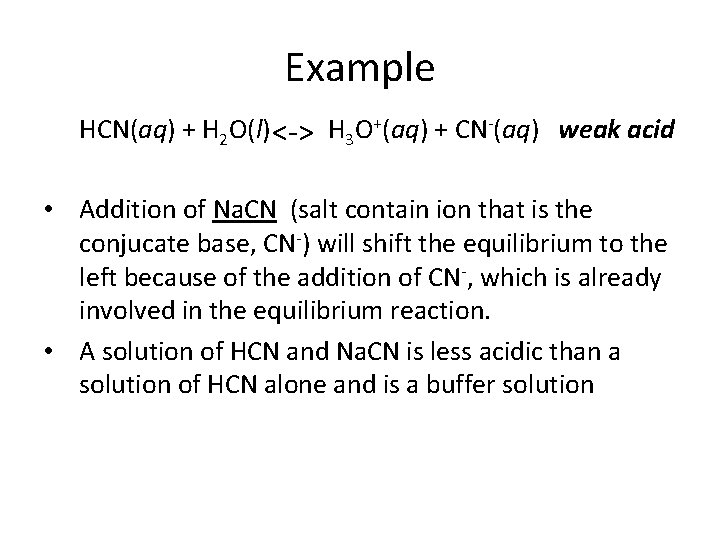
Example HCN(aq) + H 2 O(l) H < > 3 O+(aq) + CN (aq) weak acid • Addition of Na. CN (salt contain ion that is the conjucate base, CN ) will shift the equilibrium to the left because of the addition of CN , which is already involved in the equilibrium reaction. • A solution of HCN and Na. CN is less acidic than a solution of HCN alone and is a buffer solution
Buffers demonstrate the Common Ion Effect • Shift in equilibrium position that occurs because of the addition of an ion already involved in the equilibrium reaction. • The salt dissociates to produce an ion that is the same as the ion that is a product in the weak acid reaction with water • An application of Le Châtelier’s principle. Copyright © Cengage Learning. All rights reserved 5
Identifying a Buffer 1. Write the net ionic equation for the reaction or solution 2. Look for a weak acid and conjugate base ion or weak base and conjugate acid ion 3. At equilibrium is there a concentration for the reactant( Weak Acid or Weak base) and product ( conjugate base or acid)
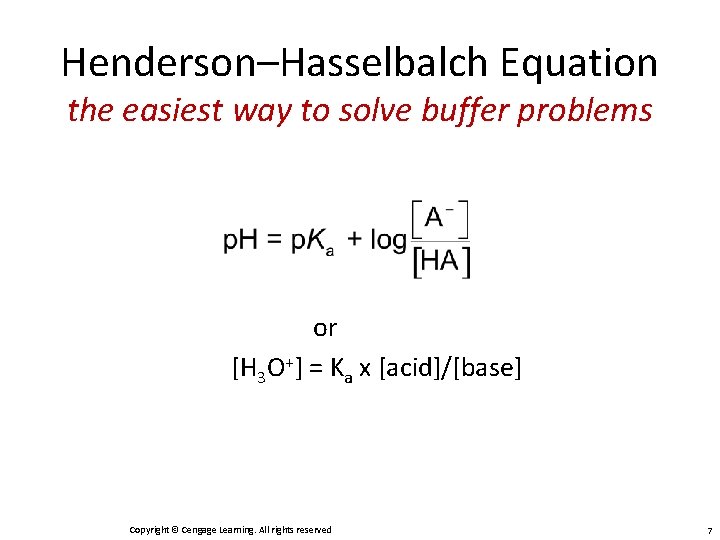
Henderson–Hasselbalch Equation the easiest way to solve buffer problems or [H 3 O+] = Ka x [acid]/[base] Copyright © Cengage Learning. All rights reserved 7
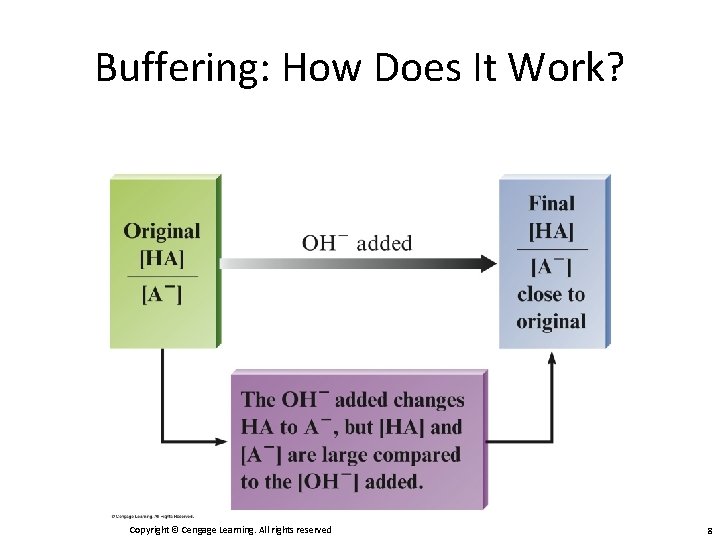
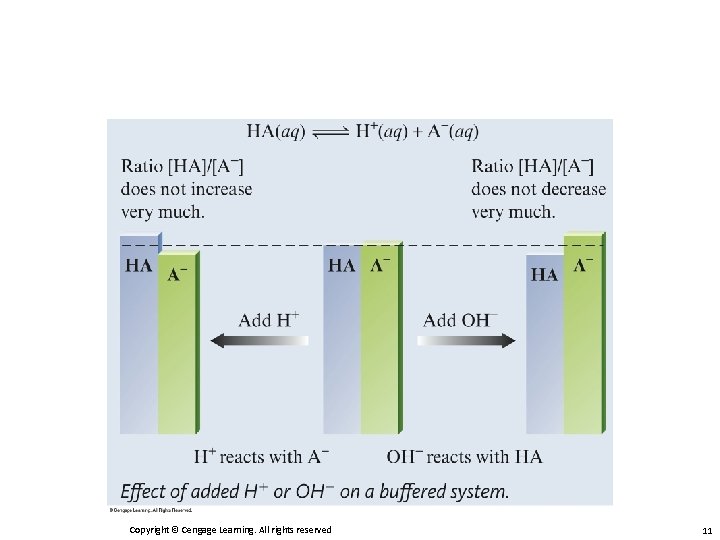
Buffering: How Does It Work? Copyright © Cengage Learning. All rights reserved 8
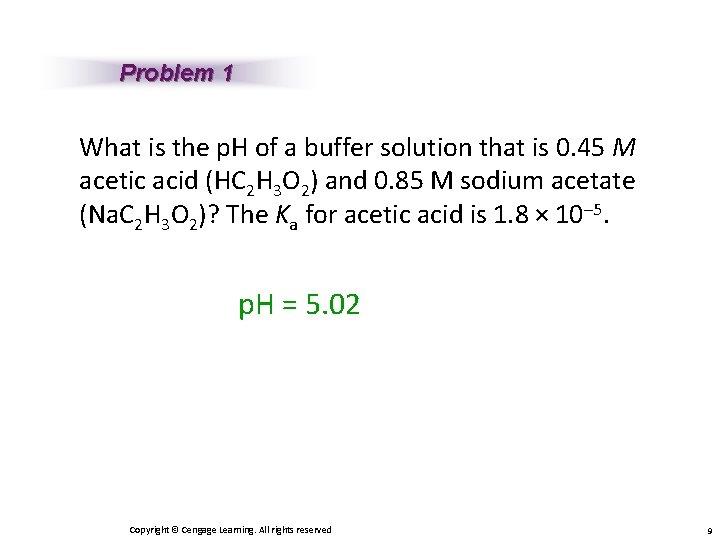
Problem 1 What is the p. H of a buffer solution that is 0. 45 M acetic acid (HC 2 H 3 O 2) and 0. 85 M sodium acetate (Na. C 2 H 3 O 2)? The Ka for acetic acid is 1. 8 × 10– 5. p. H = 5. 02 Copyright © Cengage Learning. All rights reserved 9
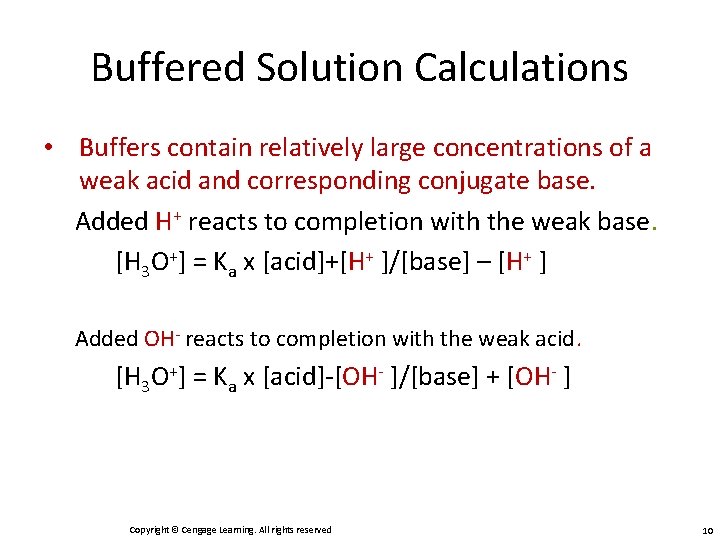
Buffered Solution Calculations • Buffers contain relatively large concentrations of a weak acid and corresponding conjugate base. Added H+ reacts to completion with the weak base. [H 3 O+] = Ka x [acid]+[H+ ]/[base] – [H+ ] Added OH reacts to completion with the weak acid. [H 3 O+] = Ka x [acid] [OH ]/[base] + [OH ] Copyright © Cengage Learning. All rights reserved 10
Copyright © Cengage Learning. All rights reserved 11
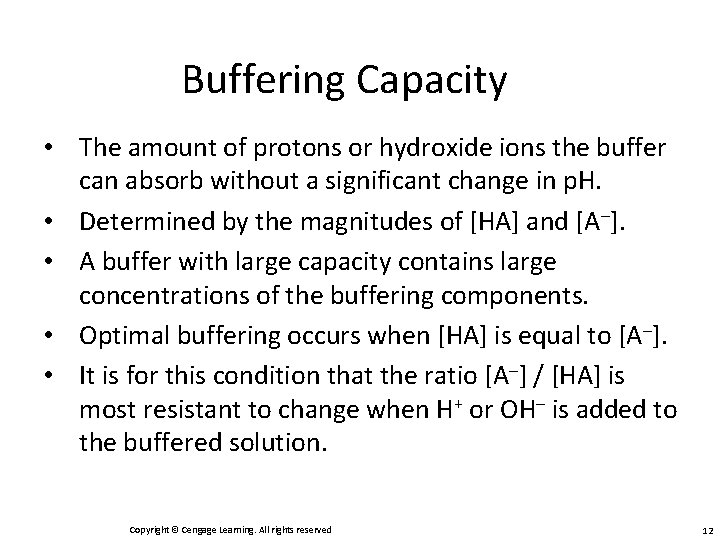
Buffering Capacity • The amount of protons or hydroxide ions the buffer can absorb without a significant change in p. H. • Determined by the magnitudes of [HA] and [A–]. • A buffer with large capacity contains large concentrations of the buffering components. • Optimal buffering occurs when [HA] is equal to [A–]. • It is for this condition that the ratio [A–] / [HA] is most resistant to change when H+ or OH– is added to the buffered solution. Copyright © Cengage Learning. All rights reserved 12
Choosing a Buffer • p. Ka of the weak acid to be used in the buffer should be as close as possible to the desired p. H. Copyright © Cengage Learning. All rights reserved 13
Titration • • • Laboratory procedure used to determine the concentration of a solution or molar mass of a unknown substance by reacting unknown with known concentration of a solution Can only be used if the stoichiometric endpoint can be monitored (color change, conductivity or p. H graph) Plotting the p. H of the solution being analyzed as a function of the amount of titrant added. Equivalence (Stoichiometric) Point – point in the titration when enough titrant has been added to react exactly with the substance in solution being titrated. Endpoint is point of color change with indicator Copyright © Cengage Learning. All rights reserved 14
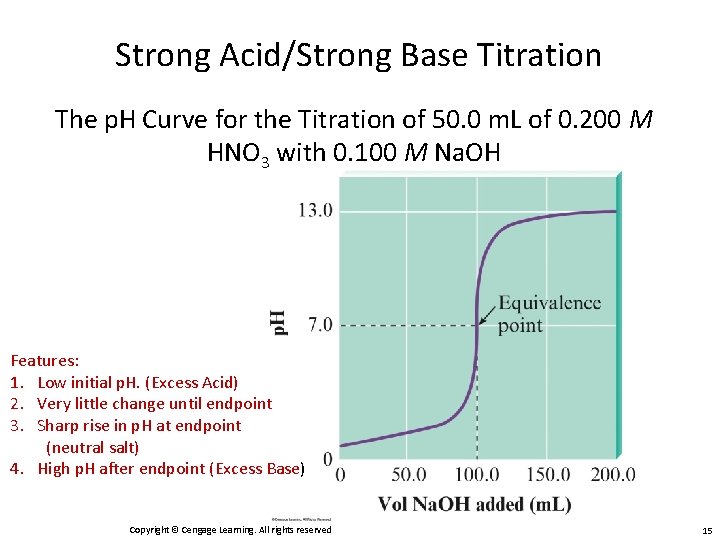
Strong Acid/Strong Base Titration The p. H Curve for the Titration of 50. 0 m. L of 0. 200 M HNO 3 with 0. 100 M Na. OH Features: 1. Low initial p. H. (Excess Acid) 2. Very little change until endpoint 3. Sharp rise in p. H at endpoint (neutral salt) 4. High p. H after endpoint (Excess Base) Copyright © Cengage Learning. All rights reserved 15
Strong Acid/Strong Base Titration A stoichiometry problem (reaction is assumed to run to completion) then determine concentration of acid or base remaining. The salt formed is neutral. HCl + Na. OH H 2 O + Na. Cl I C E Work in Moles! Then calculate concentration (Molarity)! You will need this for p. H.
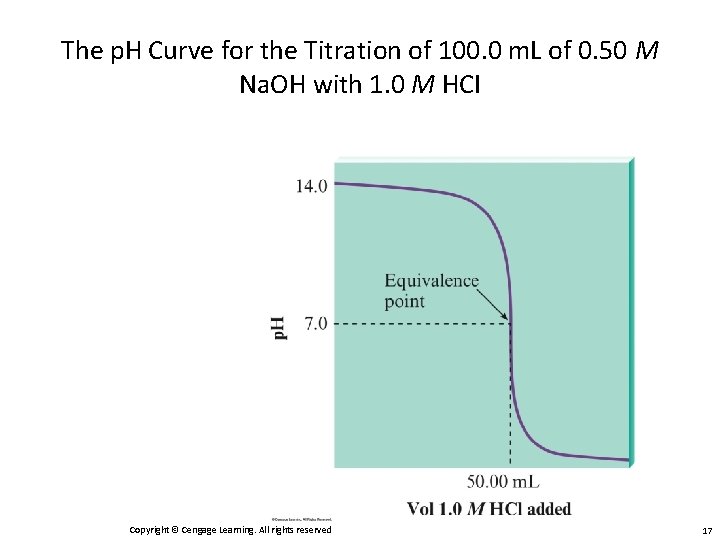
The p. H Curve for the Titration of 100. 0 m. L of 0. 50 M Na. OH with 1. 0 M HCI Copyright © Cengage Learning. All rights reserved 17

Weak Acid /Strong Base The p. H Curve for the Titration of 50. 0 m. L of 0. 100 M HC 2 H 3 O 2 with 0. 100 M Na. OH Features: 1. Higher initial p. H (Weak Acid) 2. As base is added the p. H climbs slightly (Buffering) 3. Equivalence point is greater than 7. 0 (basic salt) 4. p. H rises rapidly after equivalence point (Excess base) 5. p. H = p. Ka ½ distance to equivalence point Copyright © Cengage Learning. All rights reserved 18
Weak Acid–Strong Base Titration Step 1: A stoichiometry problem (reaction is assumed to run to completion) then determine concentration of acid remaining, conjugate base formed, or excess base added. At the end you will have : weak acid, buffer, salt or, excess base Step 2: An equilibrium problem is next if you have weak acid, buffer, or a salt. Determine Molarity of Hydronium ions or hydroxide ions and then calculate p. H Copyright © Cengage Learning. All rights reserved 19
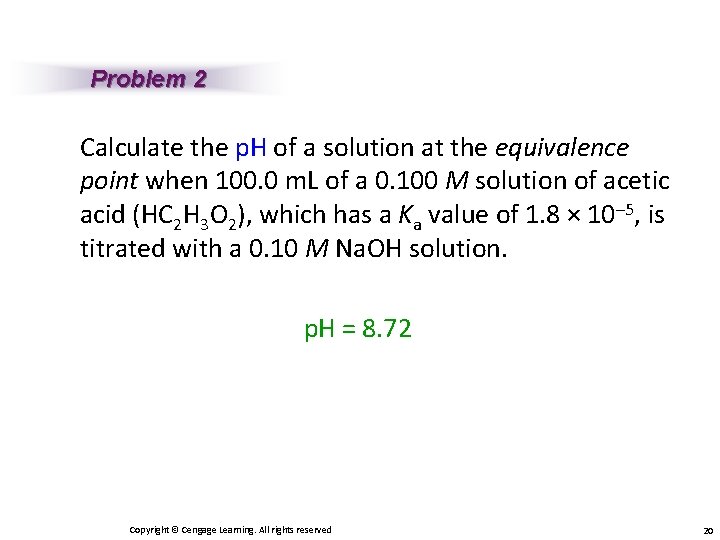
Problem 2 Calculate the p. H of a solution at the equivalence point when 100. 0 m. L of a 0. 100 M solution of acetic acid (HC 2 H 3 O 2), which has a Ka value of 1. 8 × 10– 5, is titrated with a 0. 10 M Na. OH solution. p. H = 8. 72 Copyright © Cengage Learning. All rights reserved 20
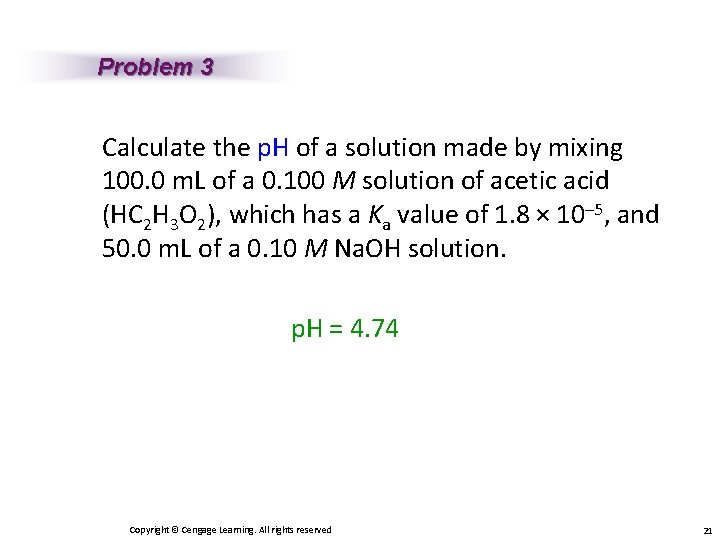
Problem 3 Calculate the p. H of a solution made by mixing 100. 0 m. L of a 0. 100 M solution of acetic acid (HC 2 H 3 O 2), which has a Ka value of 1. 8 × 10– 5, and 50. 0 m. L of a 0. 10 M Na. OH solution. p. H = 4. 74 Copyright © Cengage Learning. All rights reserved 21
Indicators • Weak acids or bases that change color when equilibrium shifts • Marks the end point of a titration by changing color. • The equivalence point is not necessarily the same as the end point (but they are ideally as close as possible). • Choose a indicator that has a p. Ka close to p. H at the endpoint in the titration. Copyright © Cengage Learning. All rights reserved 22
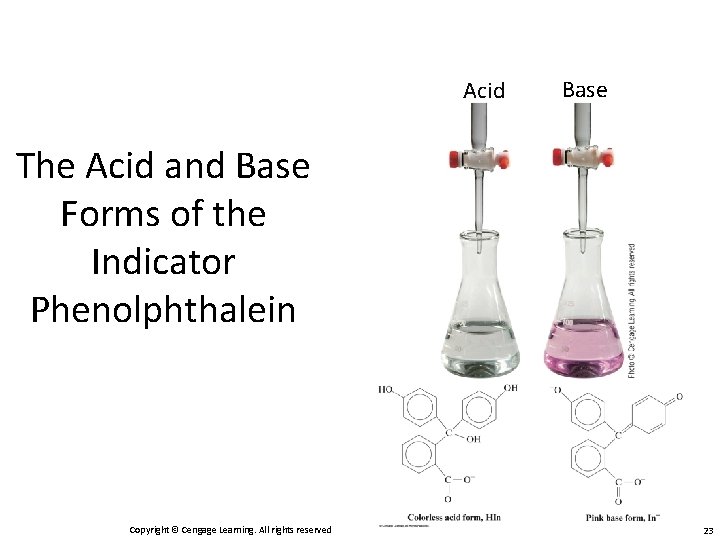
Acid Base The Acid and Base Forms of the Indicator Phenolphthalein Copyright © Cengage Learning. All rights reserved 23
Multiple Choice 1 • In the titration of a weak acid of unknown concentration with a standard solution of a strong base, a p. H meter was used to follow the progress of the titration. Which of the following is true for this experiment? • (A) The p. H is 7 at the equivalence point. (B) The p. H at the equivalence point depends on the indicator used. (C) The graph of p. H versus volume of base added rises gradually at first and then much more rapidly. (D) The graph of p. H versus volume of base added shows no sharp rise. (E) The [H+] at the equivalence point equals the ionization constant of the acid.
Multiple Choice 2 Questions 1 5 refer to aqueous solutions containing 1: 1 mole ratios of the following pairs of substances. Assume all concentrations are 1 M. (A) NH 3 and NH 4 Cl (B) H 3 PO 4 and Na. H 2 PO 4 (C) HCl and Na. Cl 1. C 2. E (D) Na. OH and NH 3 3. A (E) NH 3 and HC 2 H 3 O 2 (acetic acid) 4. B 1. The solution with the lowest p. H 2. The most nearly neutral solution 3. A buffer at a p. H > 8 4. A buffer at a p. H < 6
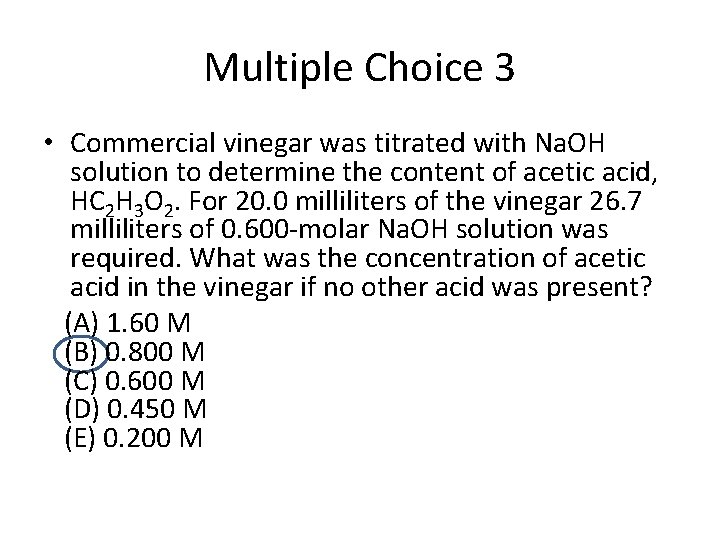
Multiple Choice 3 • Commercial vinegar was titrated with Na. OH solution to determine the content of acetic acid, HC 2 H 3 O 2. For 20. 0 milliliters of the vinegar 26. 7 milliliters of 0. 600 molar Na. OH solution was required. What was the concentration of acetic acid in the vinegar if no other acid was present? (A) 1. 60 M (B) 0. 800 M (C) 0. 600 M (D) 0. 450 M (E) 0. 200 M
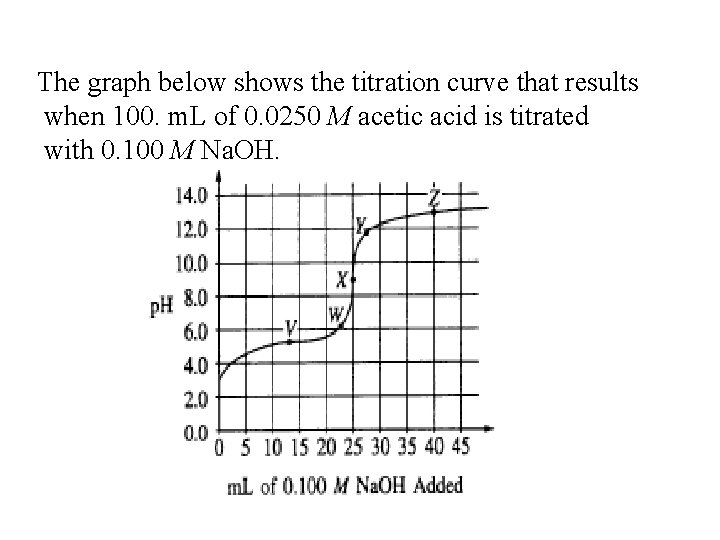
The graph below shows the titration curve that results when 100. m. L of 0. 0250 M acetic acid is titrated with 0. 100 M Na. OH.
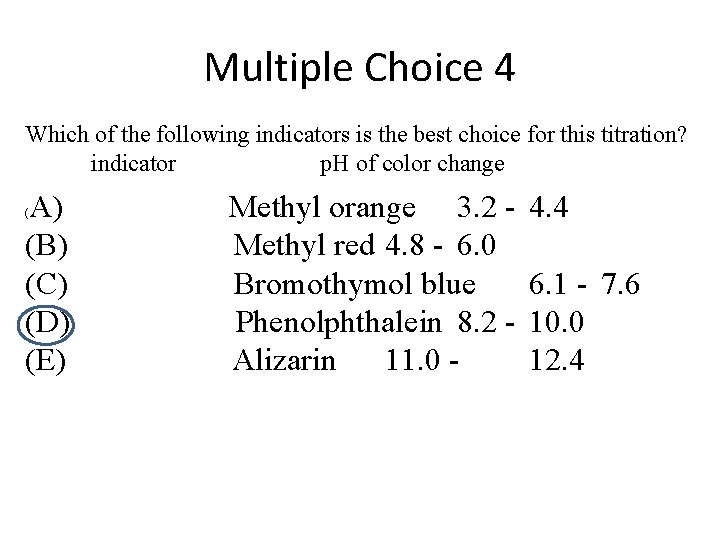
Multiple Choice 4 Which of the following indicators is the best choice for this titration? indicator p. H of color change A) (B) (C) (D) (E) ( Methyl orange 3. 2 Methyl red 4. 8 - 6. 0 Bromothymol blue Phenolphthalein 8. 2 Alizarin 11. 0 - 4. 4 6. 1 - 7. 6 10. 0 12. 4
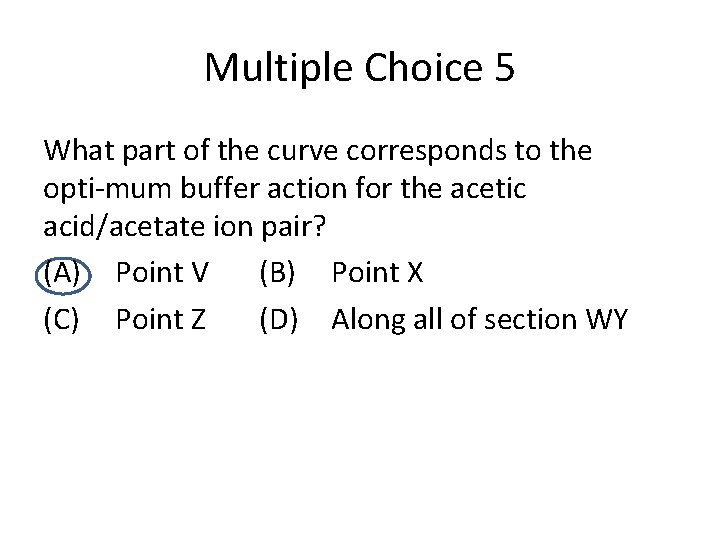
Multiple Choice 5 What part of the curve corresponds to the opti mum buffer action for the acetic acid/acetate ion pair? (A) Point V (B) Point X (C) Point Z (D) Along all of section WY
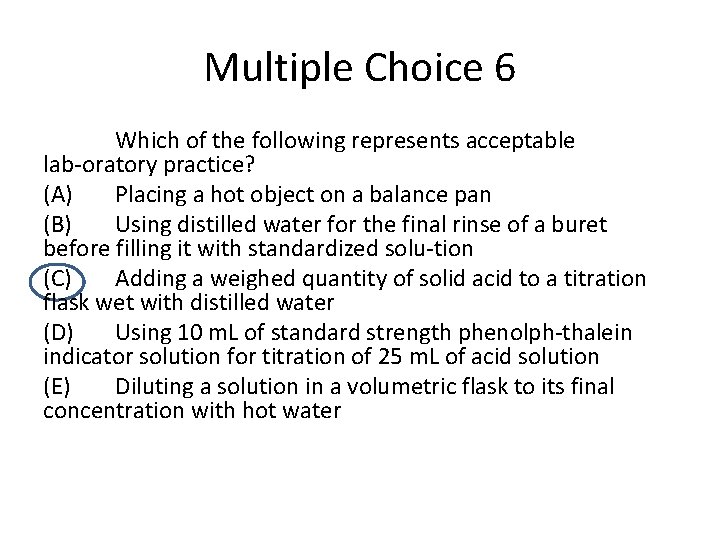
Multiple Choice 6 Which of the following represents acceptable lab oratory practice? (A) Placing a hot object on a balance pan (B) Using distilled water for the final rinse of a buret before filling it with standardized solu tion (C) Adding a weighed quantity of solid acid to a titration flask wet with distilled water (D) Using 10 m. L of standard strength phenolph thalein indicator solution for titration of 25 m. L of acid solution (E) Diluting a solution in a volumetric flask to its final concentration with hot water
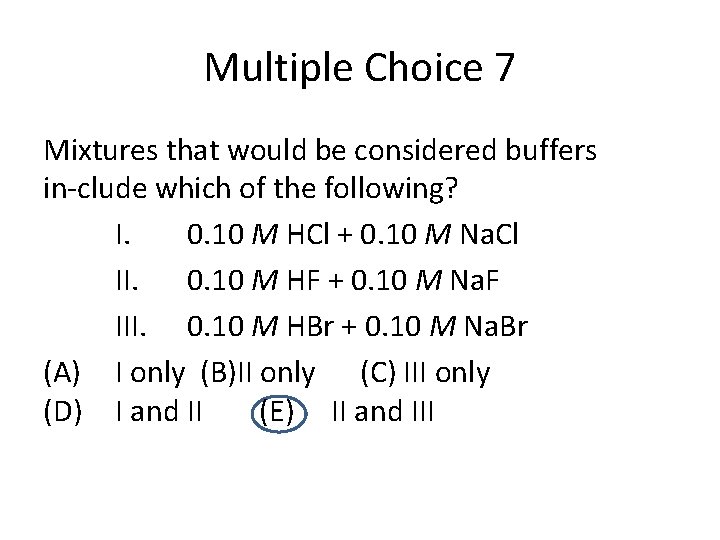
Multiple Choice 7 Mixtures that would be considered buffers in clude which of the following? I. 0. 10 M HCl + 0. 10 M Na. Cl II. 0. 10 M HF + 0. 10 M Na. F III. 0. 10 M HBr + 0. 10 M Na. Br (A) I only (B)II only (C) III only (D) I and II (E) II and III
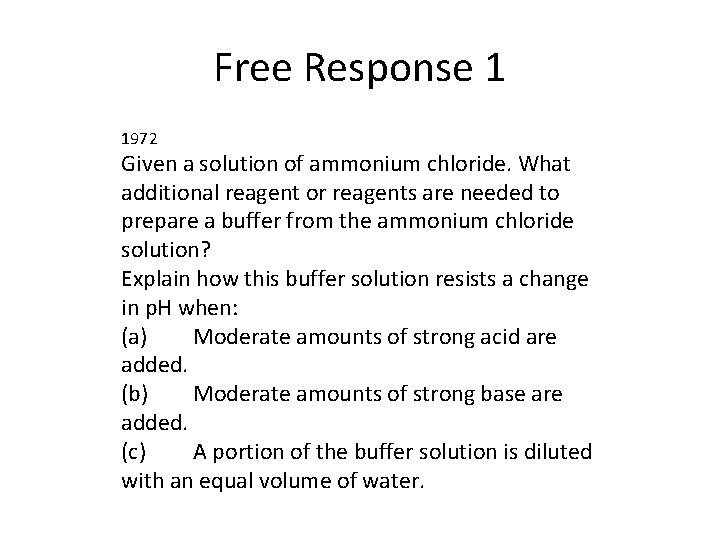
Free Response 1 1972 Given a solution of ammonium chloride. What additional reagent or reagents are needed to prepare a buffer from the ammonium chloride solution? Explain how this buffer solution resists a change in p. H when: (a) Moderate amounts of strong acid are added. (b) Moderate amounts of strong base are added. (c) A portion of the buffer solution is diluted with an equal volume of water.
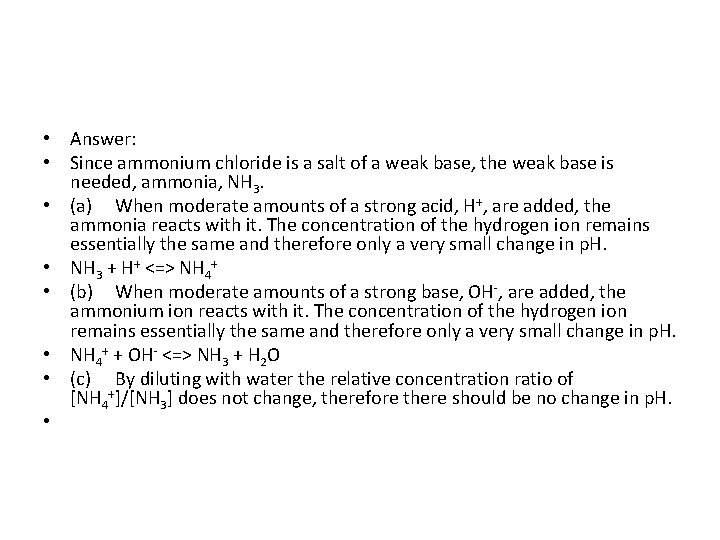
• Answer: • Since ammonium chloride is a salt of a weak base, the weak base is needed, ammonia, NH 3. • (a) When moderate amounts of a strong acid, H+, are added, the ammonia reacts with it. The concentration of the hydrogen ion remains essentially the same and therefore only a very small change in p. H. • NH 3 + H+ <=> NH 4+ • (b) When moderate amounts of a strong base, OH , are added, the ammonium ion reacts with it. The concentration of the hydrogen ion remains essentially the same and therefore only a very small change in p. H. • NH 4+ + OH <=> NH 3 + H 2 O • (c) By diluting with water the relative concentration ratio of [NH 4+]/[NH 3] does not change, therefore there should be no change in p. H. •
Free Response 2 A sample of 40. 0 milliliters of a 0. 100 molar HC 2 H 3 O 2 solution is titrated with a 0. 150 molar Na. OH solution. Ka for acetic acid = 1. 8 x 10 5 (a) What volume of Na. OH is used in the titration in order to reach the equivalence point? (b) What is the molar concentration of C 2 H 3 O 2 at the equivalence point? (c) What is the p. H of the solution at the equivalence point?
Answer: (a) Ma. Va=Mb. Vb (0. 100 M)(40. 0 m. L) = (0. 150 M)(Vb) Vb = 26. 7 m. L (b) acetate ion is a weak base with Kb=Kw/Ka = 1. 0 10 14/1. 8 10 5 = 5. 6 10 10 [CH 3 COO ]eq = 0. 600 M X [OH ] = [CH 3 COOH] = X 0. 0600 M 9. 66 10 5 M = 0. 0599 M [CH 3 COO ]eq (c) p. H = log [H+] = log(1. 04 10 10) = 9. 98
- Slides: 35