1 Margin Squeeze under EC Competition Law organized




- Slides: 22
1 Margin Squeeze under EC Competition Law organized by GCLC and BT London, 10 December 2004 The Economics of Margin Squeeze A short history of nearly everything Dr. Jorge Padilla Managing Director LECG Europe Brussels-London-Madrid-Paris 1
2 Introduction § Positive economics: ü What is a margin squeeze? § Normative economics: ü What is the impact on consumer welfare? § Using economics to design administrable intervention rules: ü How to catch an anti-competitive margin squeeze? 2
3 Positive economics 3
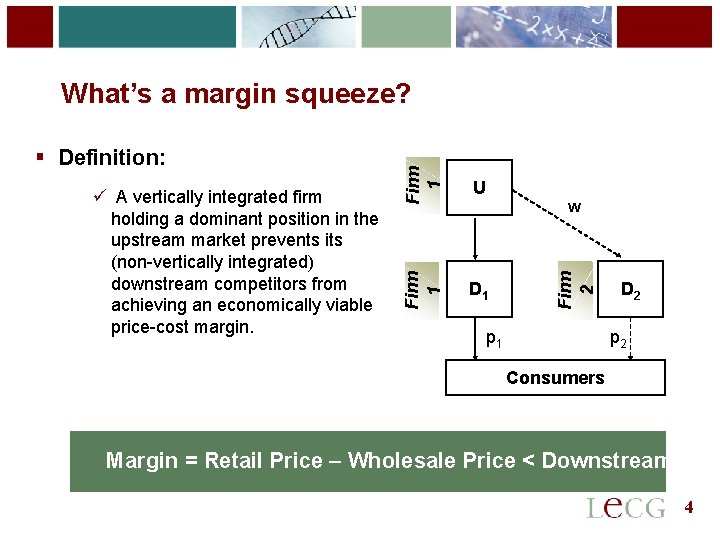
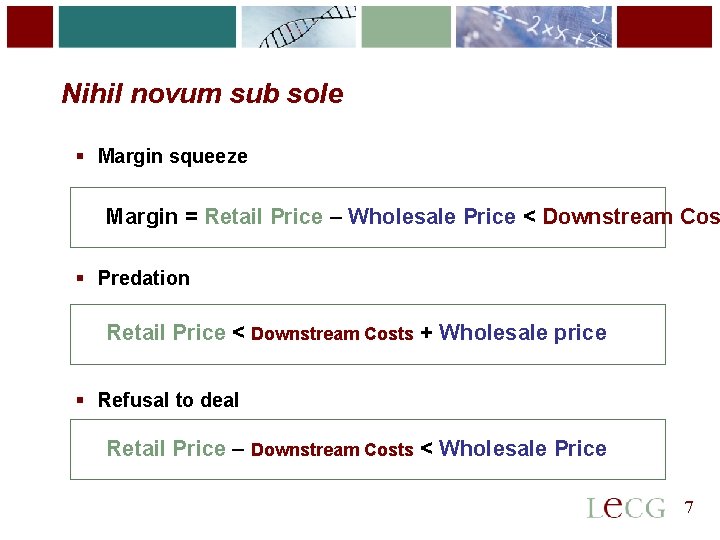
4 U D 1 w Firm 2 ü A vertically integrated firm holding a dominant position in the upstream market prevents its (non-vertically integrated) downstream competitors from achieving an economically viable price-cost margin. Firm 1 § Definition: Firm 1 What’s a margin squeeze? p 1 D 2 p 2 Consumers Margin = Retail Price – Wholesale Price < Downstream Cos 4
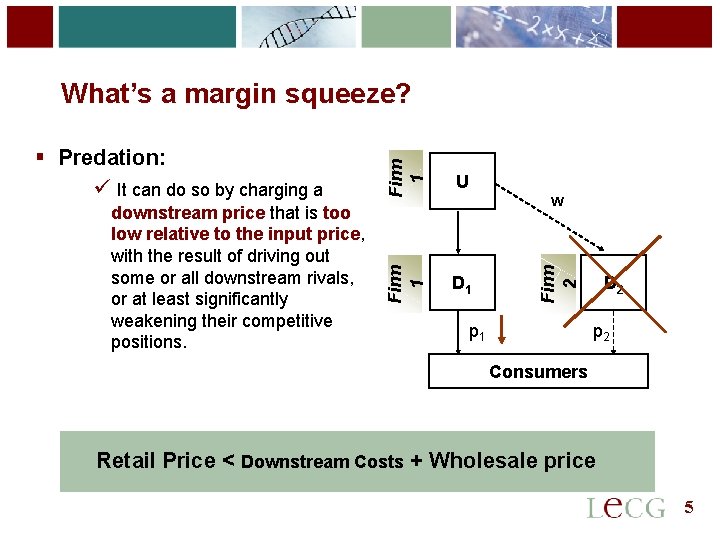
5 U D 1 w Firm 2 downstream price that is too low relative to the input price, with the result of driving out some or all downstream rivals, or at least significantly weakening their competitive positions. Firm 1 § Predation: ü It can do so by charging a Firm 1 What’s a margin squeeze? p 1 D 2 p 2 Consumers Retail Price < Downstream Costs + Wholesale price 5
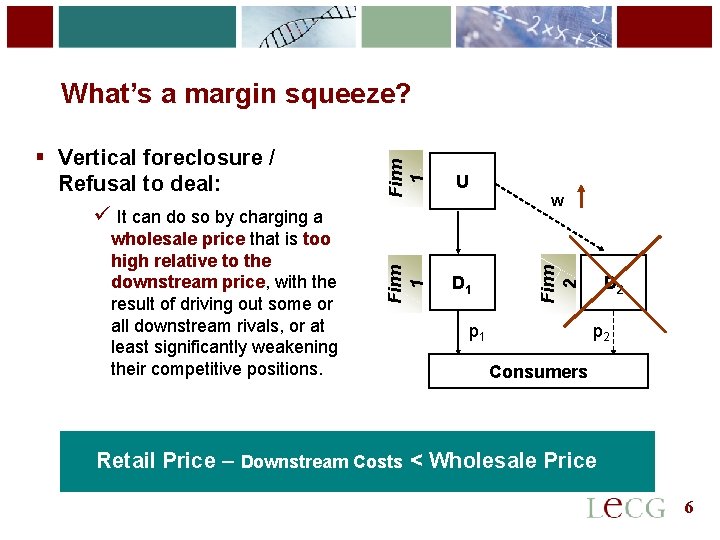
6 U D 1 w Firm 2 wholesale price that is too high relative to the downstream price, with the result of driving out some or all downstream rivals, or at least significantly weakening their competitive positions. Firm 1 § Vertical foreclosure / Refusal to deal: ü It can do so by charging a Firm 1 What’s a margin squeeze? p 1 D 2 p 2 Consumers Retail Price – Downstream Costs < Wholesale Price 6
7 Nihil novum sub sole § Margin squeeze Margin = Retail Price – Wholesale Price < Downstream Cos § Predation Retail Price < Downstream Costs + Wholesale price § Refusal to deal Retail Price – Downstream Costs < Wholesale Price 7
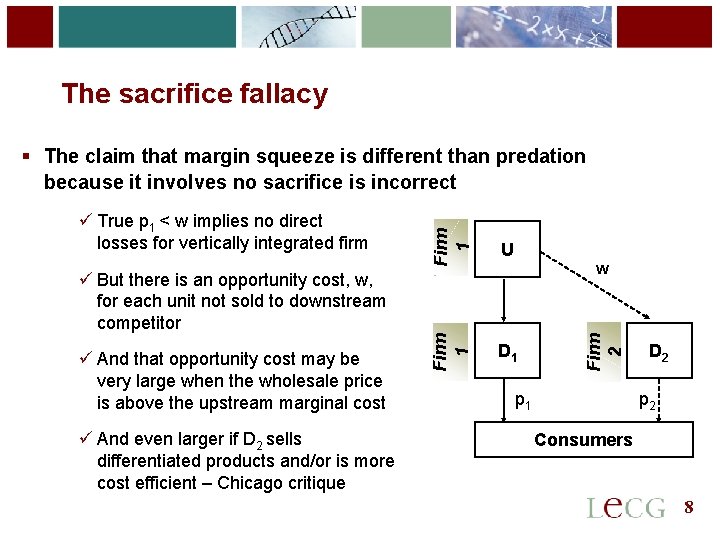
8 The sacrifice fallacy Firm 1 U D 1 w ü But there is an opportunity cost, w, for each unit not sold to downstream competitor ü And that opportunity cost may be very large when the wholesale price is above the upstream marginal cost ü And even larger if D 2 sells differentiated products and/or is more cost efficient – Chicago critique Firm 2 ü True p 1 < w implies no direct losses for vertically integrated firm Firm 1 § The claim that margin squeeze is different than predation because it involves no sacrifice is incorrect p 1 D 2 p 2 Consumers 8
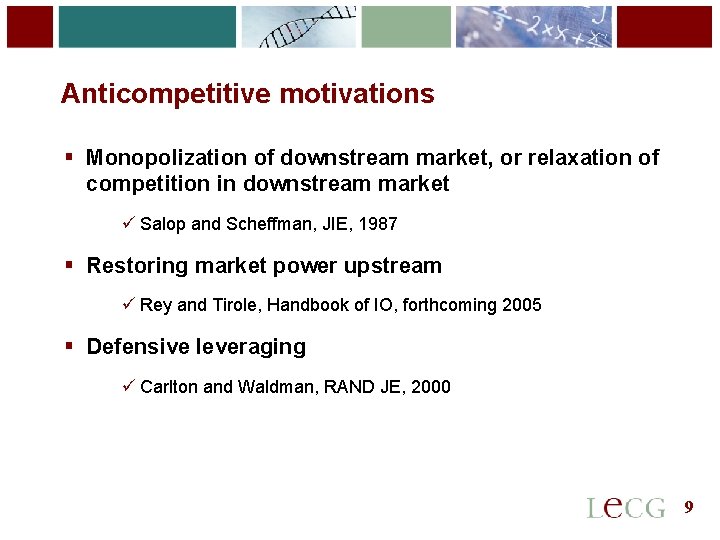
9 Anticompetitive motivations § Monopolization of downstream market, or relaxation of competition in downstream market ü Salop and Scheffman, JIE, 1987 § Restoring market power upstream ü Rey and Tirole, Handbook of IO, forthcoming 2005 § Defensive leveraging ü Carlton and Waldman, RAND JE, 2000 9
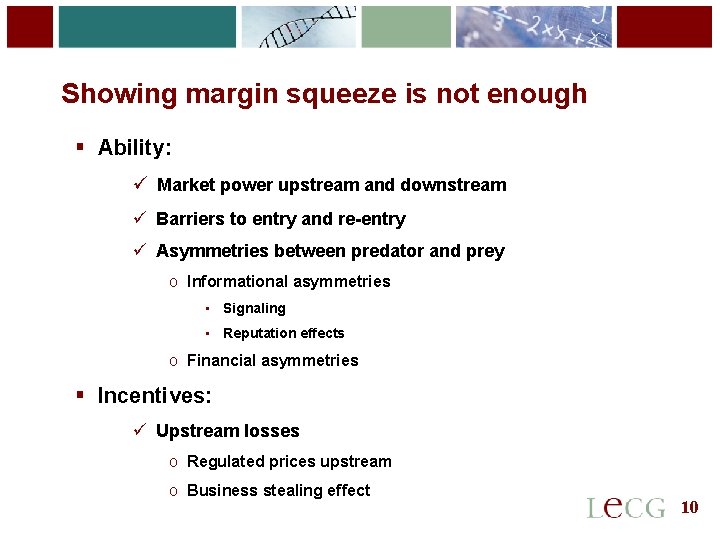
10 Showing margin squeeze is not enough § Ability: ü Market power upstream and downstream ü Barriers to entry and re-entry ü Asymmetries between predator and prey o Informational asymmetries • Signaling • Reputation effects o Financial asymmetries § Incentives: ü Upstream losses o Regulated prices upstream o Business stealing effect 10
11 Pro-competitive justifications § Predation: ü Aggressive competition – meeting the competition ü Dynamic pricing in markets with switching costs, network externalities, experience or credence goods … § Refusal to deal: ü Static efficiency – free riding in the provision of services, quality certification, etc. ü Dynamic efficiency – profitability of ex ante investments 11
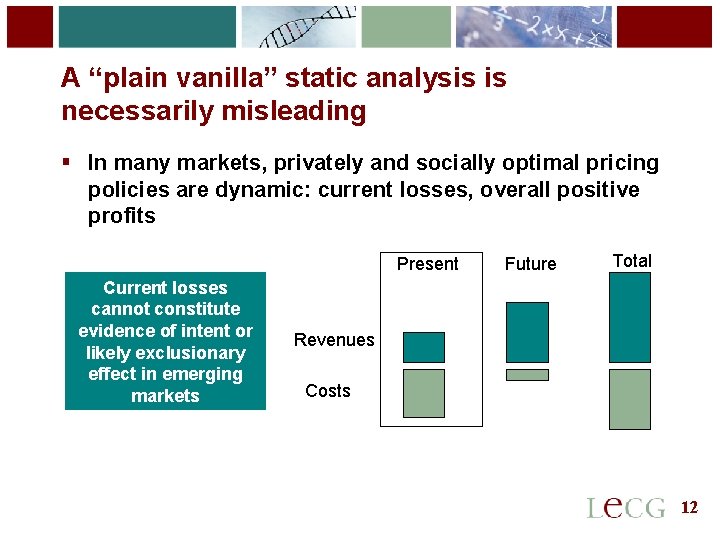
12 A “plain vanilla” static analysis is necessarily misleading § In many markets, privately and socially optimal pricing policies are dynamic: current losses, overall positive profits Present Current losses cannot constitute evidence of intent or likely exclusionary effect in emerging markets Future Total Revenues Costs 12
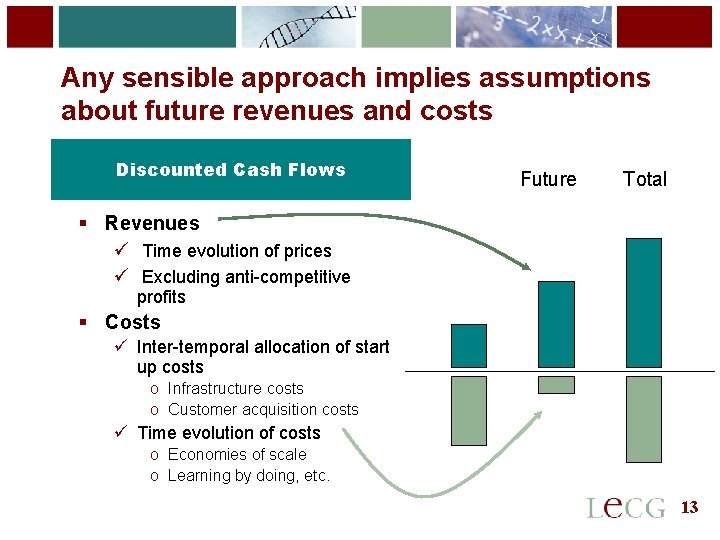
13 Any sensible approach implies assumptions about future revenues and costs Discounted Cash Flows Future Total § Revenues ü Time evolution of prices ü Excluding anti-competitive profits § Costs ü Inter-temporal allocation of start up costs o Infrastructure costs o Customer acquisition costs ü Time evolution of costs o Economies of scale o Learning by doing, etc. 13
14 Normative economics 14
15 Welfare implications § Allocative versus productive efficiency ü It may be efficient to exclude “as efficient” competitors and exclude “as efficient” entrants o Excessive entry, excessive variety ü But it may also be efficient to allow entry of “inefficient” competitors § Static versus dynamic efficiency ü Ex ante incentives to innovate and invest 15
16 Designing administrable rules 16
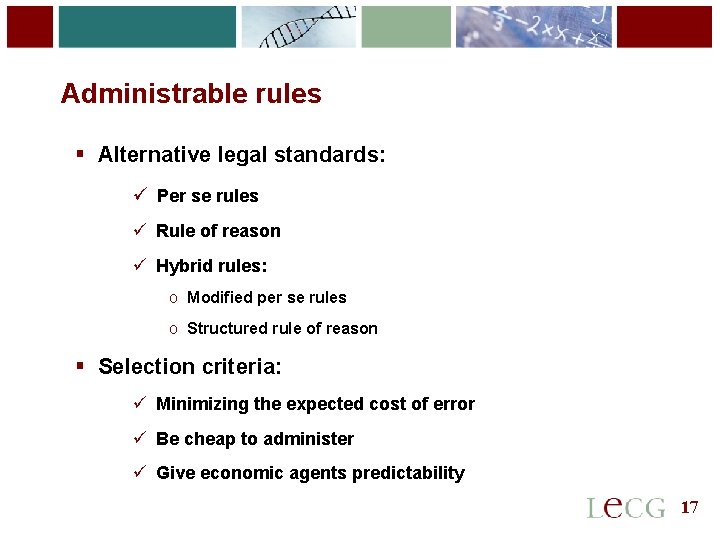
17 Administrable rules § Alternative legal standards: ü Per se rules ü Rule of reason ü Hybrid rules: o Modified per se rules o Structured rule of reason § Selection criteria: ü Minimizing the expected cost of error ü Be cheap to administer ü Give economic agents predictability 17
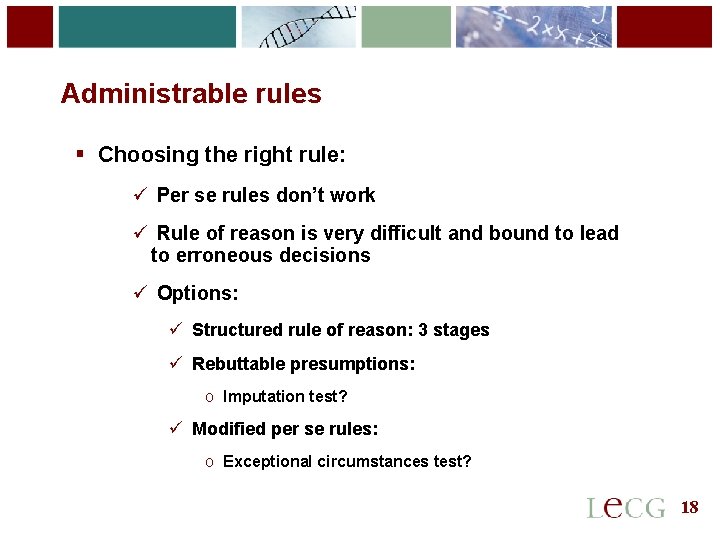
18 Administrable rules § Choosing the right rule: ü Per se rules don’t work ü Rule of reason is very difficult and bound to lead to erroneous decisions ü Options: ü Structured rule of reason: 3 stages ü Rebuttable presumptions: o Imputation test? ü Modified per se rules: o Exceptional circumstances test? 18
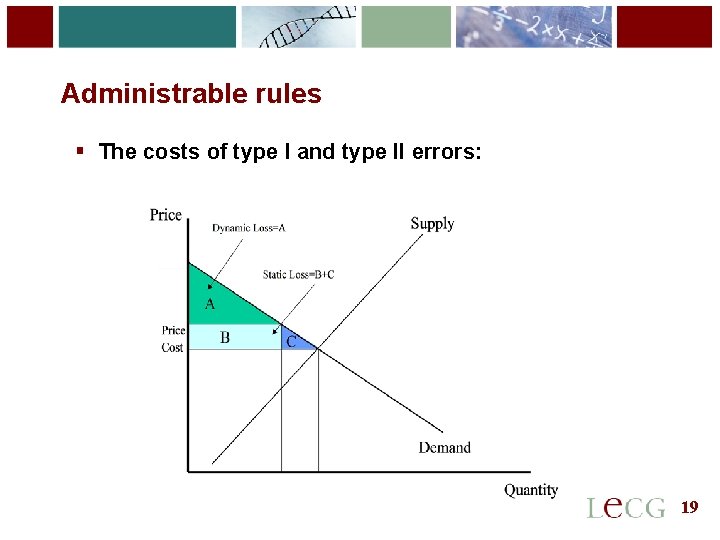
19 Administrable rules § The costs of type I and type II errors: 19
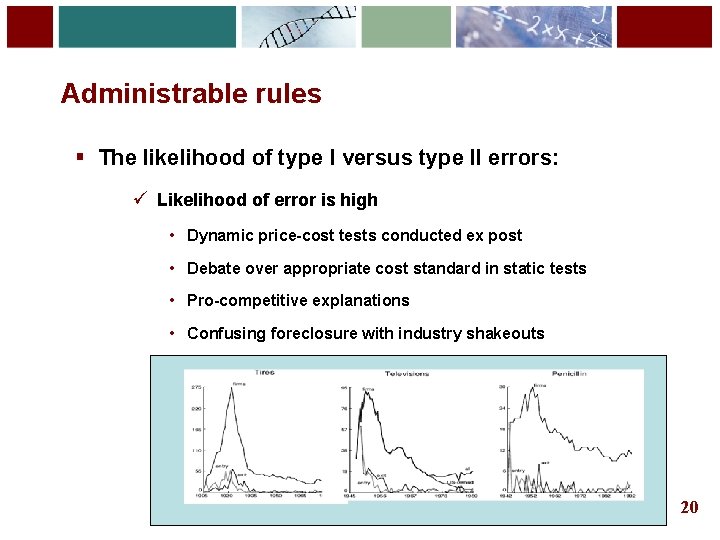
20 Administrable rules § The likelihood of type I versus type II errors: ü Likelihood of error is high • Dynamic price-cost tests conducted ex post • Debate over appropriate cost standard in static tests • Pro-competitive explanations • Confusing foreclosure with industry shakeouts 20
21 Conclusions § Nihil Novum Sub Sole § Any sensible approach implies assumptions about future revenues and costs § From a competition policy perspective, showing a price squeeze is not enough § There is a need for clear, efficient and administrable rules; economics has a role to play in this process 21
22 The Economics of Margin Squeeze A short history of nearly everything Dr. Jorge Padilla Managing Director jpadilla@lecg. com LECG Europe Brussels: +32 2 517 6070 London: + 44 207 269 0500 Madrid: + 34 91 594 7979 Paris: + 33 1 5 568 1280 www. lecgcp. com 22