You Did or Didnt Get a PPP Loan

- Slides: 24
You Did (or Didn’t) Get a PPP Loan – Now What? Presented to OMEP June 5, 2020
The material appearing in this presentation is for informational purposes only and should not be construed as advice of any kind, including, without limitation, legal, accounting, or investment advice. This information is not intended to create, and receipt does not constitute, a legal relationship, including, but not limited to, an accountant-client relationship. Although this information may have been prepared by professionals, it should not be used as a substitute for professional services. If legal, accounting, investment, or other professional advice is required, the services of a professional should be sought. Assurance, tax, and consulting offered through Moss Adams LLP. Investment advisory offered through Moss Adams Wealth Advisors LLC. Investment banking offered through Moss Adams Capital LLC. 2
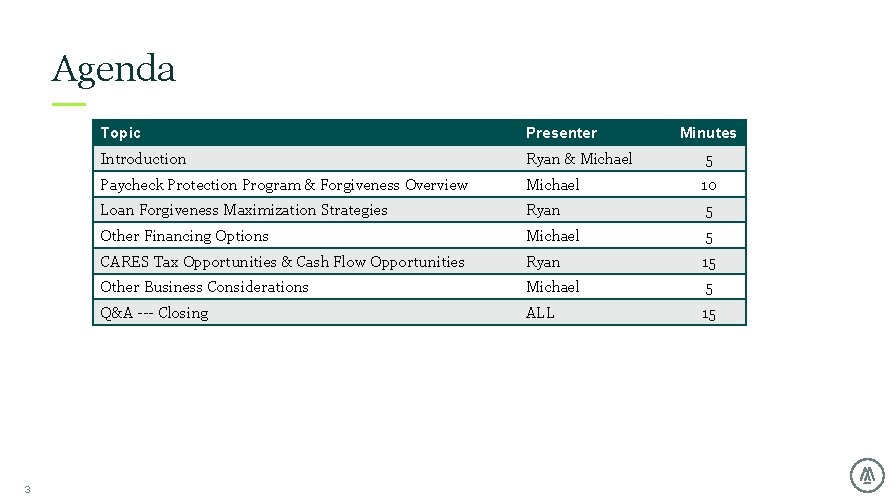
Agenda 3 Topic Presenter Minutes Introduction Ryan & Michael 5 Paycheck Protection Program & Forgiveness Overview Michael 10 Loan Forgiveness Maximization Strategies Ryan 5 Other Financing Options Michael 5 CARES Tax Opportunities & Cash Flow Opportunities Ryan 15 Other Business Considerations Michael 5 Q&A --- Closing ALL 15
Paycheck Protection Program & Loan Forgiveness Maximization Strategies 4
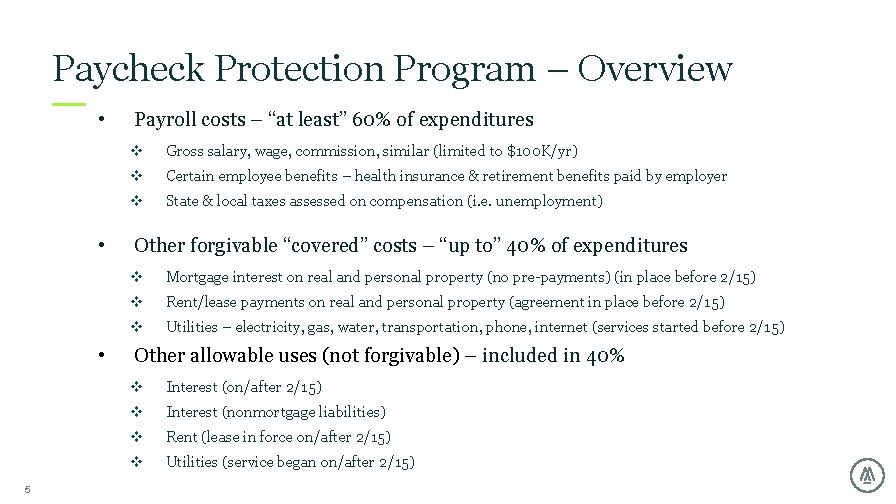
Paycheck Protection Program – Overview • • • 5 Payroll costs – “at least” 60% of expenditures v Gross salary, wage, commission, similar (limited to $100 K/yr) v Certain employee benefits – health insurance & retirement benefits paid by employer v State & local taxes assessed on compensation (i. e. unemployment) Other forgivable “covered” costs – “up to” 40% of expenditures v Mortgage interest on real and personal property (no pre-payments) (in place before 2/15) v Rent/lease payments on real and personal property (agreement in place before 2/15) v Utilities – electricity, gas, water, transportation, phone, internet (services started before 2/15) Other allowable uses (not forgivable) – included in 40% v Interest (on/after 2/15) v Interest (nonmortgage liabilities) v Rent (lease in force on/after 2/15) v Utilities (service began on/after 2/15)
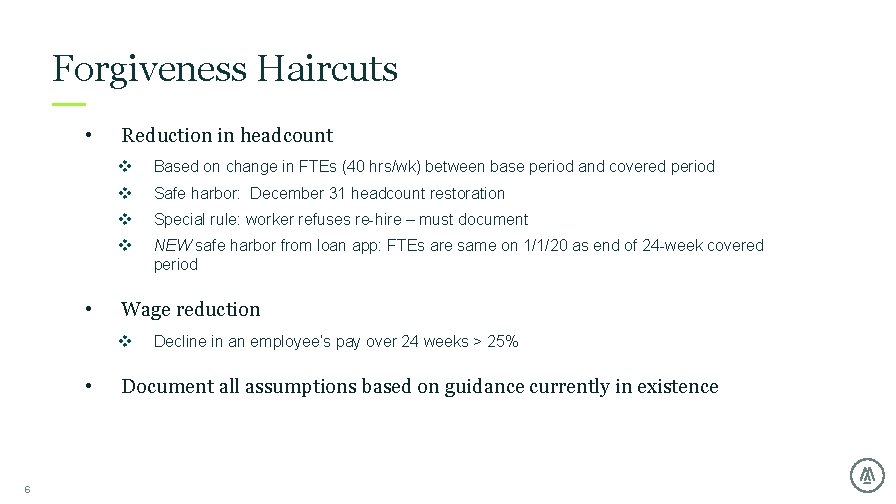
Forgiveness Haircuts • • Reduction in headcount v Based on change in FTEs (40 hrs/wk) between base period and covered period v Safe harbor: December 31 headcount restoration v Special rule: worker refuses re-hire – must document v NEW safe harbor from loan app: FTEs are same on 1/1/20 as end of 24 -week covered period Wage reduction v • 6 Decline in an employee’s pay over 24 weeks > 25% Document all assumptions based on guidance currently in existence
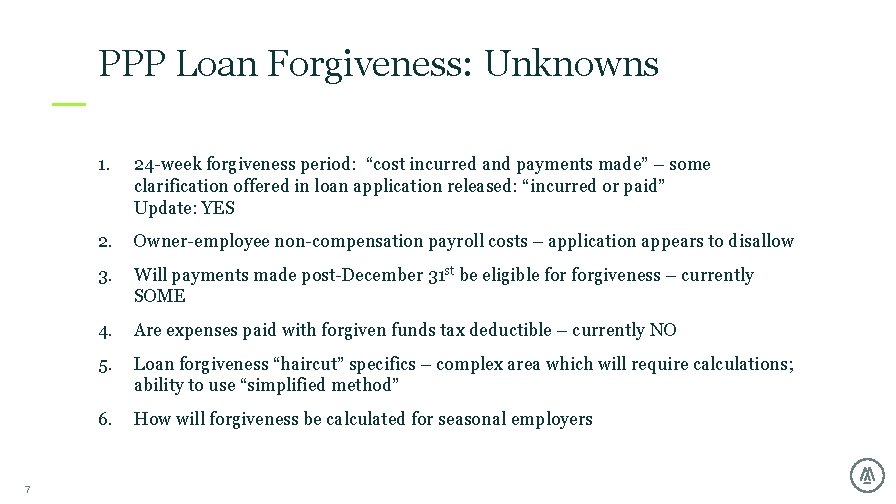
PPP Loan Forgiveness: Unknowns 7 1. 24 -week forgiveness period: “cost incurred and payments made” – some clarification offered in loan application released: “incurred or paid” Update: YES 2. Owner-employee non-compensation payroll costs – application appears to disallow 3. Will payments made post-December 31 st be eligible forgiveness – currently SOME 4. Are expenses paid with forgiven funds tax deductible – currently NO 5. Loan forgiveness “haircut” specifics – complex area which will require calculations; ability to use “simplified method” 6. How will forgiveness be calculated for seasonal employers
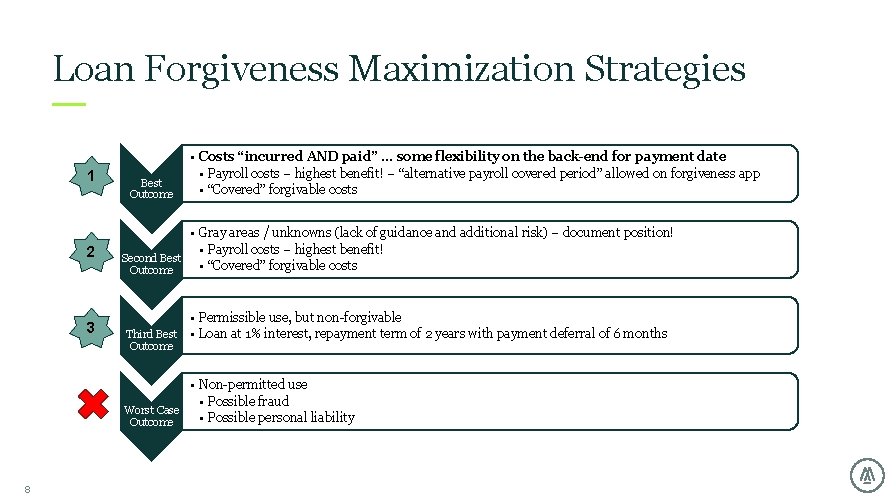
Loan Forgiveness Maximization Strategies 1 Best Outcome • Costs “incurred AND paid” … some flexibility on the back-end for payment date • Payroll costs – highest benefit! – “alternative payroll covered period” allowed on forgiveness app • “Covered” forgivable costs 2 • Gray areas / unknowns (lack of guidance and additional risk) – document position! • Payroll costs – highest benefit! Second Best • “Covered” forgivable costs Outcome 3 • Permissible use, but non-forgivable Third Best • Loan at 1% interest, repayment term of 2 years with payment deferral of 6 months Outcome • Non-permitted use • Possible fraud Worst Case • Possible personal liability Outcome 8
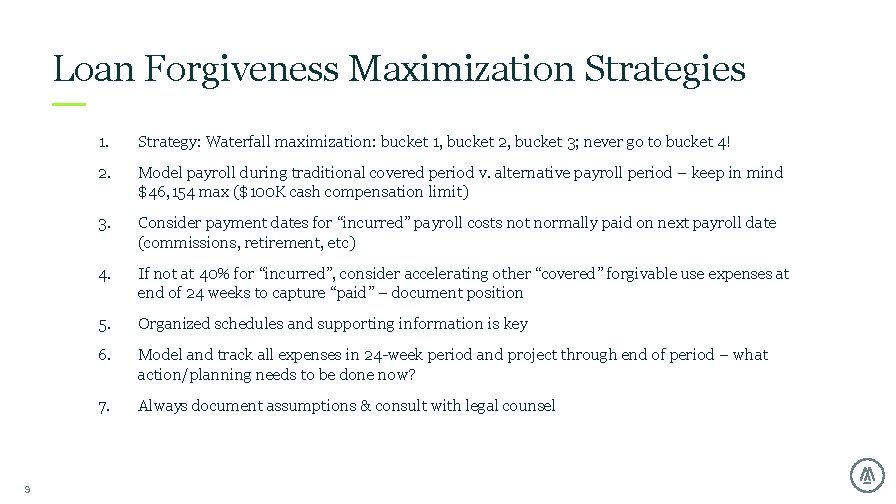
Loan Forgiveness Maximization Strategies 9 1. Strategy: Waterfall maximization: bucket 1, bucket 2, bucket 3; never go to bucket 4! 2. Model payroll during traditional covered period v. alternative payroll period – keep in mind $46, 154 max ($100 K cash compensation limit) 3. Consider payment dates for “incurred” payroll costs not normally paid on next payroll date (commissions, retirement, etc) 4. If not at 40% for “incurred”, consider accelerating other “covered” forgivable use expenses at end of 24 weeks to capture “paid” – document position 5. Organized schedules and supporting information is key 6. Model and track all expenses in 24 -week period and project through end of period – what action/planning needs to be done now? 7. Always document assumptions & consult with legal counsel
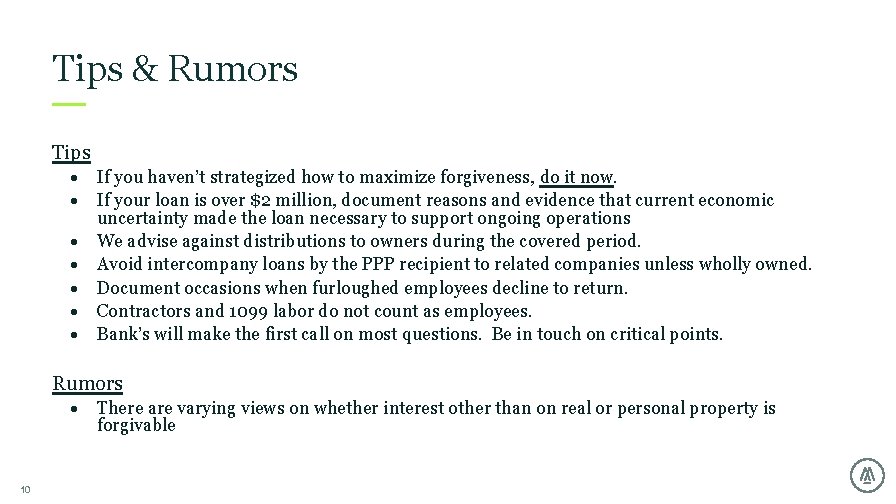
Tips & Rumors Tips If you haven’t strategized how to maximize forgiveness, do it now. If your loan is over $2 million, document reasons and evidence that current economic uncertainty made the loan necessary to support ongoing operations We advise against distributions to owners during the covered period. Avoid intercompany loans by the PPP recipient to related companies unless wholly owned. Document occasions when furloughed employees decline to return. Contractors and 1099 labor do not count as employees. Bank’s will make the first call on most questions. Be in touch on critical points. Rumors 10 There are varying views on whether interest other than on real or personal property is forgivable
Main Street Lending Program and Economic Injury Disaster Loans 11
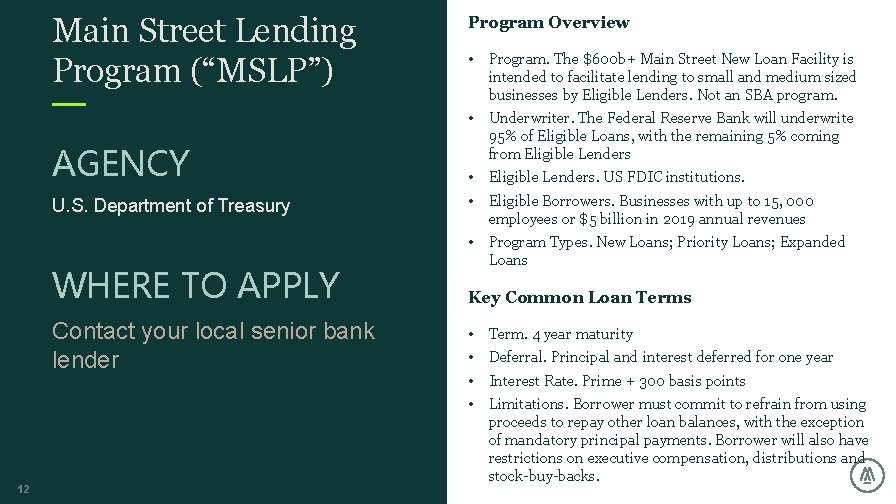
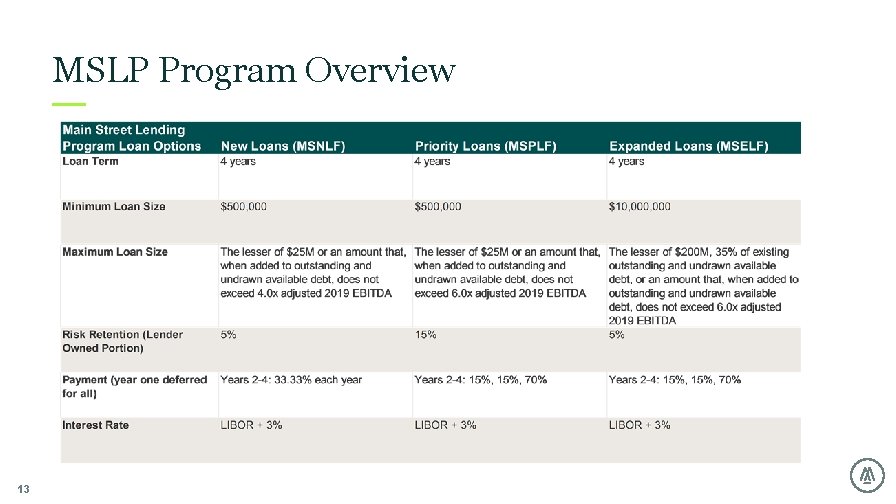
Main Street Lending Program (“MSLP”) • Program. The $600 b+ Main Street New Loan Facility is intended to facilitate lending to small and medium sized businesses by Eligible Lenders. Not an SBA program. • AGENCY Underwriter. The Federal Reserve Bank will underwrite 95% of Eligible Loans, with the remaining 5% coming from Eligible Lenders • Eligible Lenders. US FDIC institutions. U. S. Department of Treasury • Eligible Borrowers. Businesses with up to 15, 000 employees or $5 billion in 2019 annual revenues • Program Types. New Loans; Priority Loans; Expanded Loans WHERE TO APPLY Contact your local senior bank lender 12 Program Overview Key Common Loan Terms • Term. 4 year maturity • Deferral. Principal and interest deferred for one year • Interest Rate. Prime + 300 basis points • Limitations. Borrower must commit to refrain from using proceeds to repay other loan balances, with the exception of mandatory principal payments. Borrower will also have restrictions on executive compensation, distributions and stock-buy-backs.
MSLP Program Overview 13
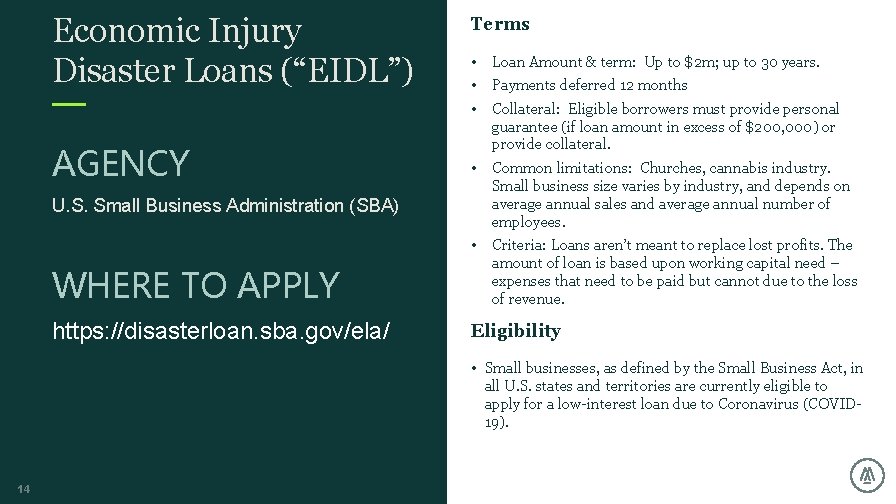
Economic Injury Disaster Loans (“EIDL”) AGENCY Terms • Loan Amount & term: Up to $2 m; up to 30 years. • Payments deferred 12 months • Collateral: Eligible borrowers must provide personal guarantee (if loan amount in excess of $200, 000) or provide collateral. • Common limitations: Churches, cannabis industry. Small business size varies by industry, and depends on average annual sales and average annual number of employees. • Criteria: Loans aren’t meant to replace lost profits. The amount of loan is based upon working capital need – expenses that need to be paid but cannot due to the loss of revenue. U. S. Small Business Administration (SBA) WHERE TO APPLY https: //disasterloan. sba. gov/ela/ Eligibility • Small businesses, as defined by the Small Business Act, in all U. S. states and territories are currently eligible to apply for a low-interest loan due to Coronavirus (COVID 19). 14
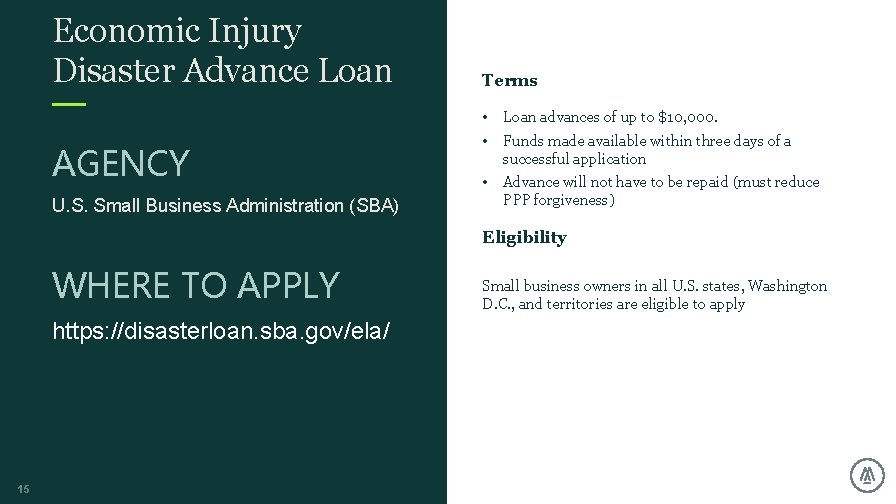
Economic Injury Disaster Advance Loan AGENCY U. S. Small Business Administration (SBA) Terms • Loan advances of up to $10, 000. • Funds made available within three days of a successful application • Advance will not have to be repaid (must reduce PPP forgiveness) Eligibility WHERE TO APPLY https: //disasterloan. sba. gov/ela/ 15 Small business owners in all U. S. states, Washington D. C. , and territories are eligible to apply
CARES Act – Tax Credits & Other Considerations 16
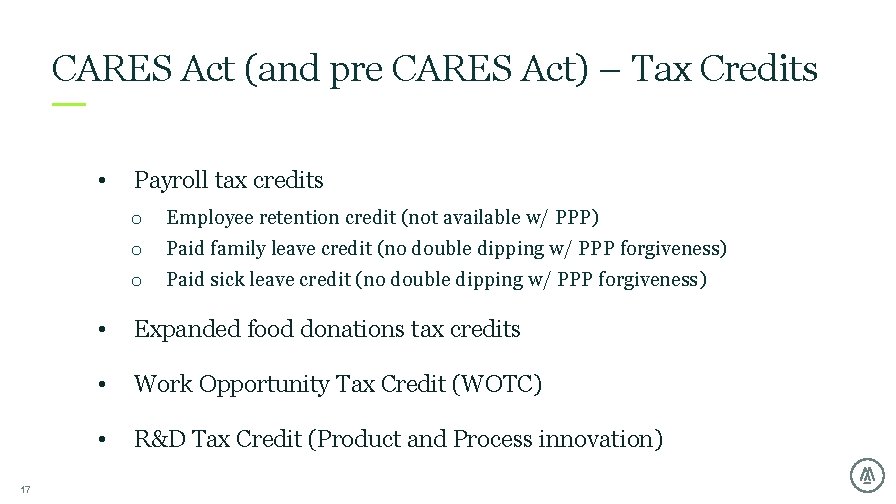
CARES Act (and pre CARES Act) – Tax Credits • 17 Payroll tax credits o Employee retention credit (not available w/ PPP) o Paid family leave credit (no double dipping w/ PPP forgiveness) o Paid sick leave credit (no double dipping w/ PPP forgiveness) • Expanded food donations tax credits • Work Opportunity Tax Credit (WOTC) • R&D Tax Credit (Product and Process innovation)
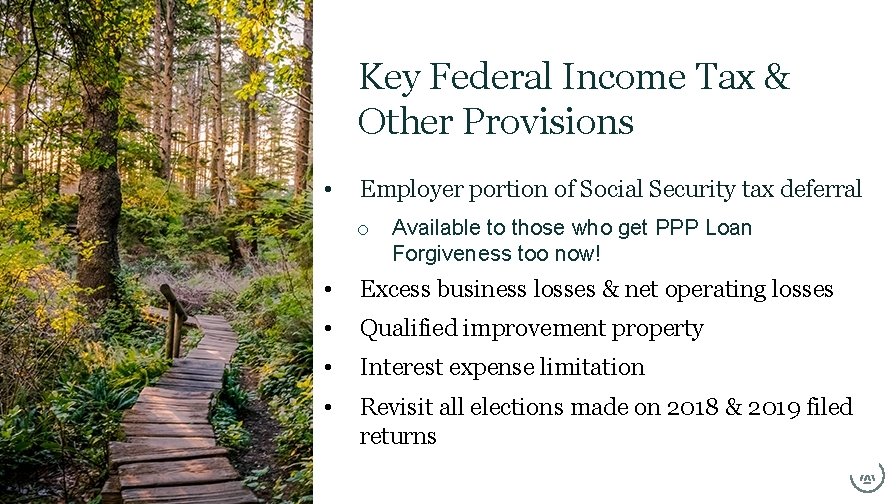
Key Federal Income Tax & Other Provisions • Employer portion of Social Security tax deferral o 18 Available to those who get PPP Loan Forgiveness too now! • Excess business losses & net operating losses • Qualified improvement property • Interest expense limitation • Revisit all elections made on 2018 & 2019 filed returns
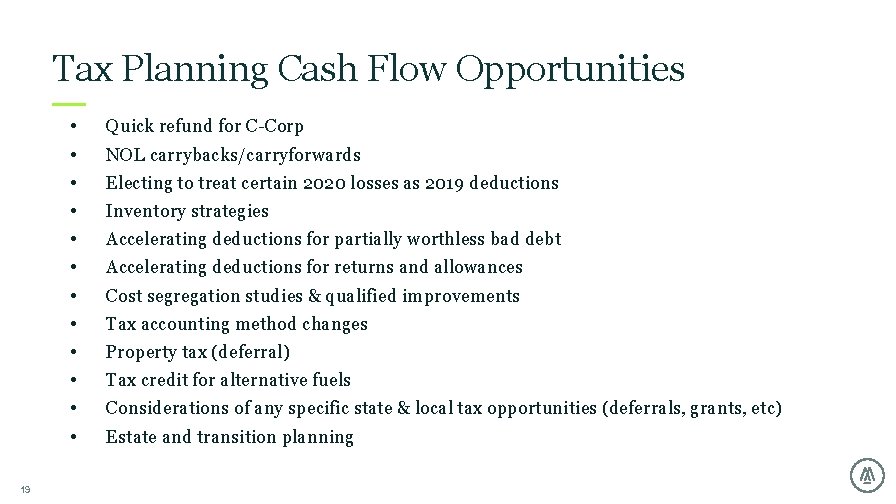
Tax Planning Cash Flow Opportunities • • • 19 Quick refund for C-Corp NOL carrybacks/carryforwards Electing to treat certain 2020 losses as 2019 deductions Inventory strategies Accelerating deductions for partially worthless bad debt Accelerating deductions for returns and allowances Cost segregation studies & qualified improvements Tax accounting method changes Property tax (deferral) Tax credit for alternative fuels Considerations of any specific state & local tax opportunities (deferrals, grants, etc) Estate and transition planning
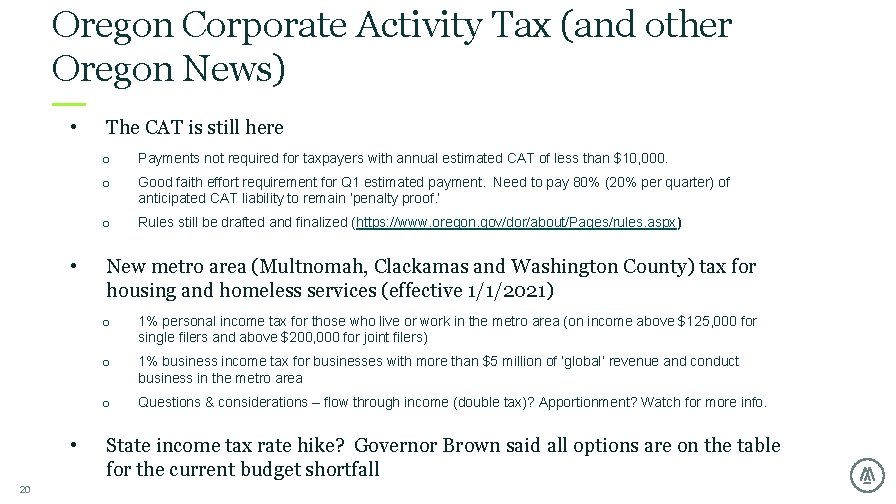
Oregon Corporate Activity Tax (and other Oregon News) • • • 20 The CAT is still here o Payments not required for taxpayers with annual estimated CAT of less than $10, 000. o Good faith effort requirement for Q 1 estimated payment. Need to pay 80% (20% per quarter) of anticipated CAT liability to remain ‘penalty proof. ’ o Rules still be drafted and finalized (https: //www. oregon. gov/dor/about/Pages/rules. aspx) New metro area (Multnomah, Clackamas and Washington County) tax for housing and homeless services (effective 1/1/2021) o 1% personal income tax for those who live or work in the metro area (on income above $125, 000 for single filers and above $200, 000 for joint filers) o 1% business income tax for businesses with more than $5 million of ‘global’ revenue and conduct business in the metro area o Questions & considerations – flow through income (double tax)? Apportionment? Watch for more info. State income tax rate hike? Governor Brown said all options are on the table for the current budget shortfall
Other Business Considerations 21
Plan for the Future • Tone at the Top • Agility is necessary – lots of “wait and see” • Shifting consumer demands & volatility • Long-term shifts in business model considerations • “What if” analyses • Balance sheet management • Continuity planning 22
We are here to help Ryan Kuenzi, CPA Michael Smoot, CPA Tax Partner Assurance Senior Manager ryan. kuenzi@mossadams. com michael. smoot@mossadams. com 503 -478 -2119 503 -478 -2115 HELPING YOU ADAPT TO UNCERTAIN TIMES Find more information and resources here: https: //mossadams. com/covid-19 -implications 23
The material appearing in this presentation is for informational purposes only and should not be construed as advice of any kind, including, without limitation, legal, accounting, or investment advice. This information is not intended to create, and receipt does not constitute, a legal relationship, including, but not limited to, an accountant-client relationship. Although this information may have been prepared by professionals, it should not be used as a substitute for professional services. If legal, accounting, investment, or other professional advice is required, the services of a professional should be sought. Assurance, tax, and consulting offered through Moss Adams LLP. Investment advisory offered through Moss Adams Wealth Advisors LLC. Investment banking offered through Moss Adams Capital LLC. 24