Working Group 3 Summary Coconveners David Alesini Reinhard
- Slides: 21
Working Group 3 Summary Co-conveners: David Alesini Reinhard Brinkmann
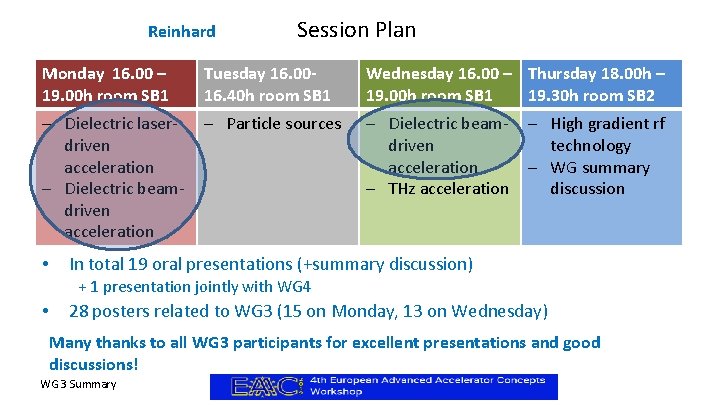
Reinhard Session Plan Monday 16. 00 – 19. 00 h room SB 1 Tuesday 16. 0016. 40 h room SB 1 Wednesday 16. 00 – Thursday 18. 00 h – 19. 00 h room SB 1 19. 30 h room SB 2 - Dielectric laserdriven acceleration - Dielectric beamdriven acceleration - Particle sources - Dielectric beamdriven acceleration - THz acceleration • - High gradient rf technology - WG summary discussion In total 19 oral presentations (+summary discussion) + 1 presentation jointly with WG 4 • 28 posters related to WG 3 (15 on Monday, 13 on Wednesday) Many thanks to all WG 3 participants for excellent presentations and good discussions! WG 3 Summary
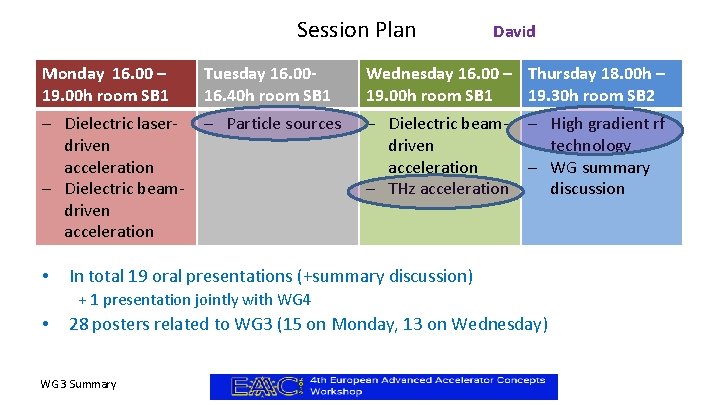
Session Plan David Monday 16. 00 – 19. 00 h room SB 1 Tuesday 16. 0016. 40 h room SB 1 Wednesday 16. 00 – Thursday 18. 00 h – 19. 00 h room SB 1 19. 30 h room SB 2 - Dielectric laserdriven acceleration - Dielectric beamdriven acceleration - Particle sources - Dielectric beamdriven acceleration - THz acceleration • - High gradient rf technology - WG summary discussion In total 19 oral presentations (+summary discussion) + 1 presentation jointly with WG 4 • 28 posters related to WG 3 (15 on Monday, 13 on Wednesday) WG 3 Summary
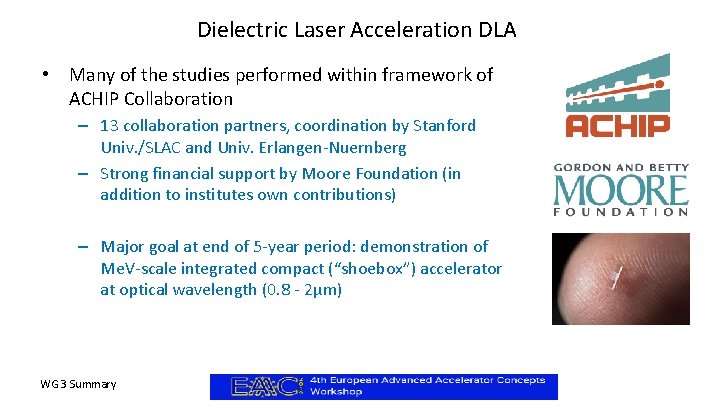
Dielectric Laser Acceleration DLA • Many of the studies performed within framework of ACHIP Collaboration – 13 collaboration partners, coordination by Stanford Univ. /SLAC and Univ. Erlangen-Nuernberg – Strong financial support by Moore Foundation (in addition to institutes own contributions) – Major goal at end of 5 -year period: demonstration of Me. V-scale integrated compact (“shoebox”) accelerator at optical wavelength (0. 8 - 2µm) WG 3 Summary
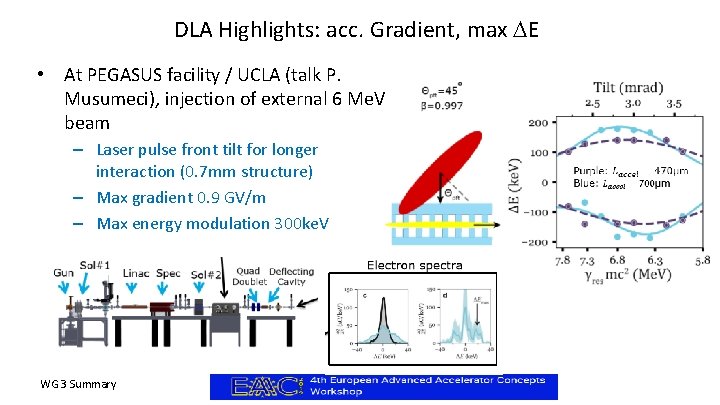
DLA Highlights: acc. Gradient, max E • At PEGASUS facility / UCLA (talk P. Musumeci), injection of external 6 Me. V beam – Laser pulse front tilt for longer interaction (0. 7 mm structure) – Max gradient 0. 9 GV/m – Max energy modulation 300 ke. V WG 3 Summary
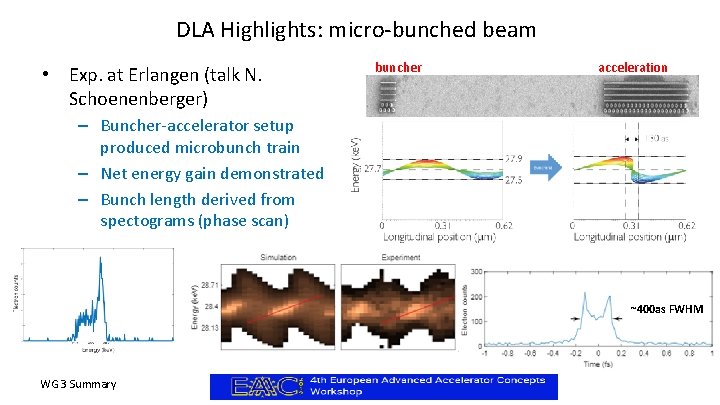
DLA Highlights: micro-bunched beam • Exp. at Erlangen (talk N. Schoenenberger) buncher acceleration – Buncher-accelerator setup produced microbunch train – Net energy gain demonstrated – Bunch length derived from spectograms (phase scan) ~400 as FWHM WG 3 Summary
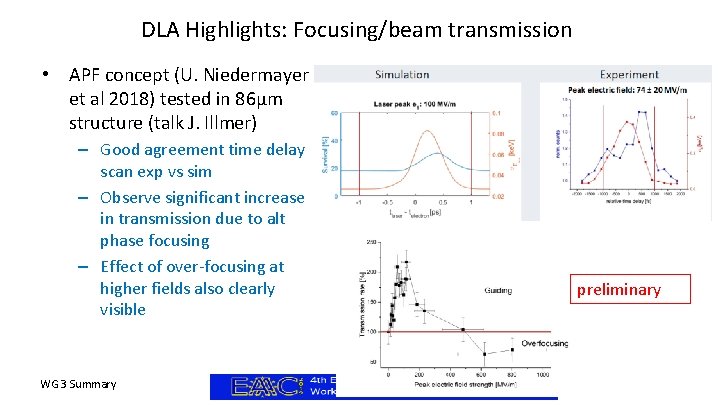
DLA Highlights: Focusing/beam transmission • APF concept (U. Niedermayer et al 2018) tested in 86µm structure (talk J. Illmer) – Good agreement time delay scan exp vs sim – Observe significant increase in transmission due to alt phase focusing – Effect of over-focusing at higher fields also clearly visible WG 3 Summary preliminary
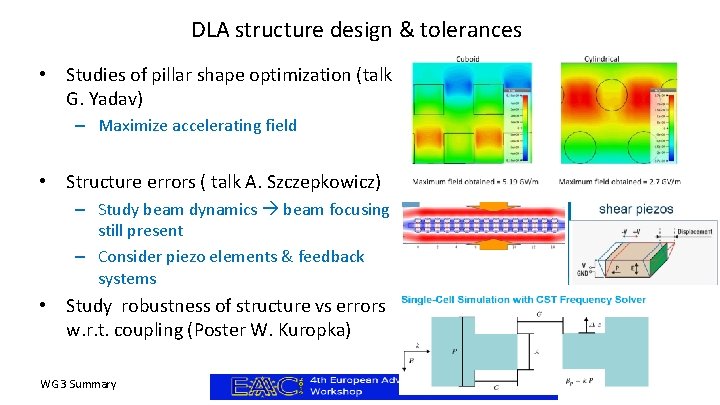
DLA structure design & tolerances • Studies of pillar shape optimization (talk G. Yadav) – Maximize accelerating field • Structure errors ( talk A. Szczepkowicz) – Study beam dynamics beam focusing still present – Consider piezo elements & feedback systems • Study robustness of structure vs errors w. r. t. coupling (Poster W. Kuropka) WG 3 Summary
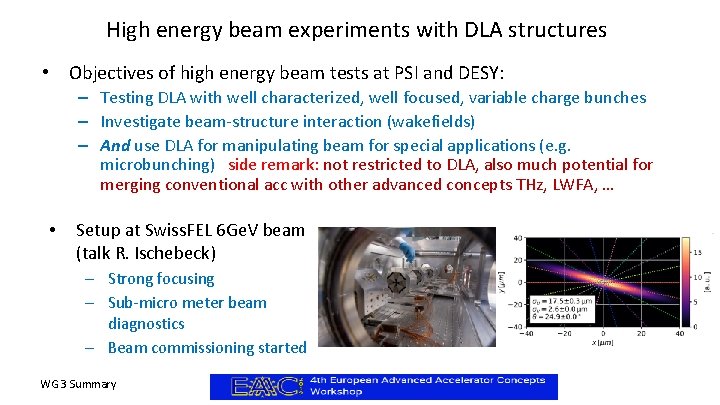
High energy beam experiments with DLA structures • Objectives of high energy beam tests at PSI and DESY: – Testing DLA with well characterized, well focused, variable charge bunches – Investigate beam-structure interaction (wakefields) – And use DLA for manipulating beam for special applications (e. g. microbunching) side remark: not restricted to DLA, also much potential for merging conventional acc with other advanced concepts THz, LWFA, … • Setup at Swiss. FEL 6 Ge. V beam (talk R. Ischebeck) – Strong focusing – Sub-micro meter beam diagnostics – Beam commissioning started WG 3 Summary
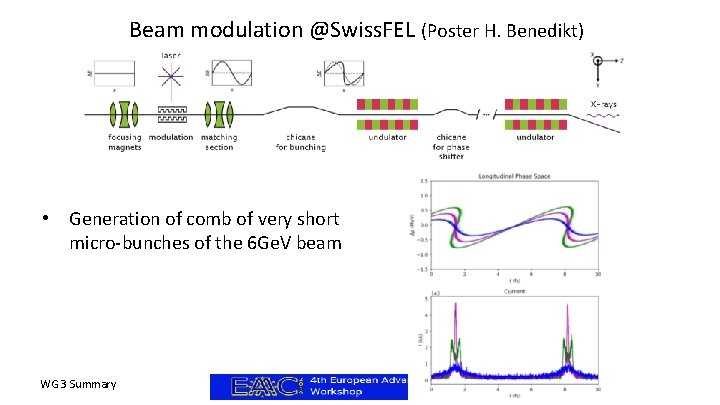
Beam modulation @Swiss. FEL (Poster H. Benedikt) • Generation of comb of very short micro-bunches of the 6 Ge. V beam WG 3 Summary
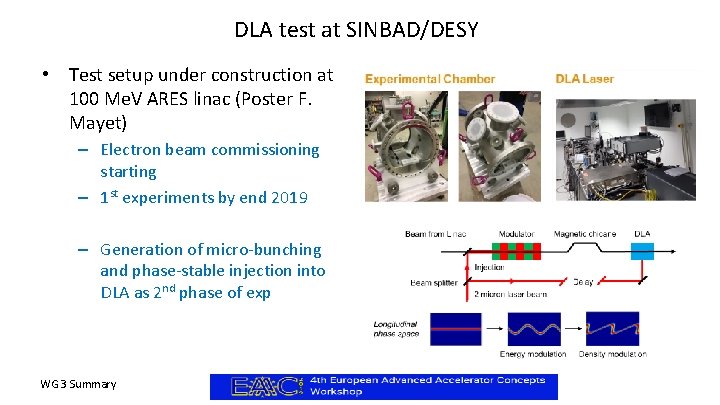
DLA test at SINBAD/DESY • Test setup under construction at 100 Me. V ARES linac (Poster F. Mayet) – Electron beam commissioning starting – 1 st experiments by end 2019 – Generation of micro-bunching and phase-stable injection into DLA as 2 nd phase of exp WG 3 Summary
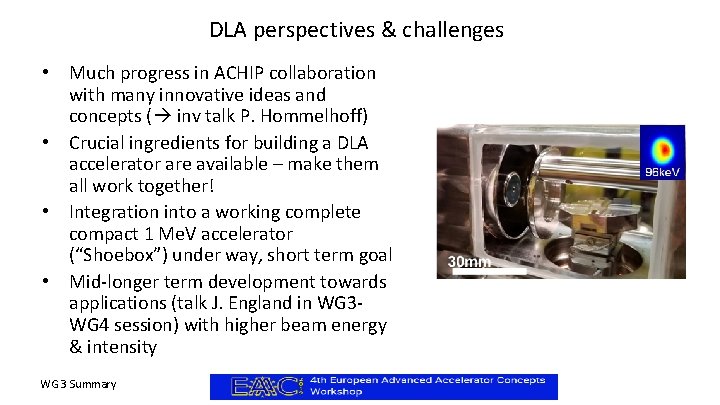
DLA perspectives & challenges • Much progress in ACHIP collaboration with many innovative ideas and concepts ( inv talk P. Hommelhoff) • Crucial ingredients for building a DLA accelerator are available – make them all work together! • Integration into a working complete compact 1 Me. V accelerator (“Shoebox”) under way, short term goal • Mid-longer term development towards applications (talk J. England in WG 3 WG 4 session) with higher beam energy & intensity WG 3 Summary
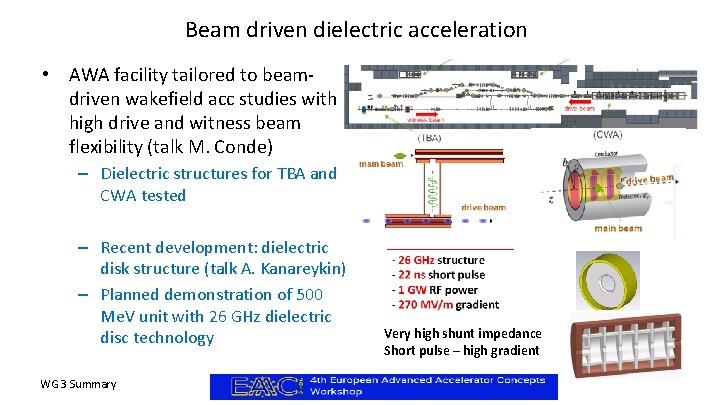
Beam driven dielectric acceleration • AWA facility tailored to beamdriven wakefield acc studies with high drive and witness beam flexibility (talk M. Conde) – Dielectric structures for TBA and CWA tested – Recent development: dielectric disk structure (talk A. Kanareykin) – Planned demonstration of 500 Me. V unit with 26 GHz dielectric disc technology WG 3 Summary Very high shunt impedance Short pulse – high gradient
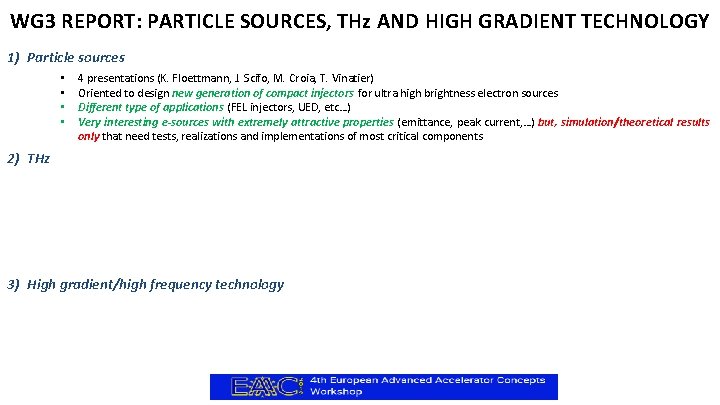
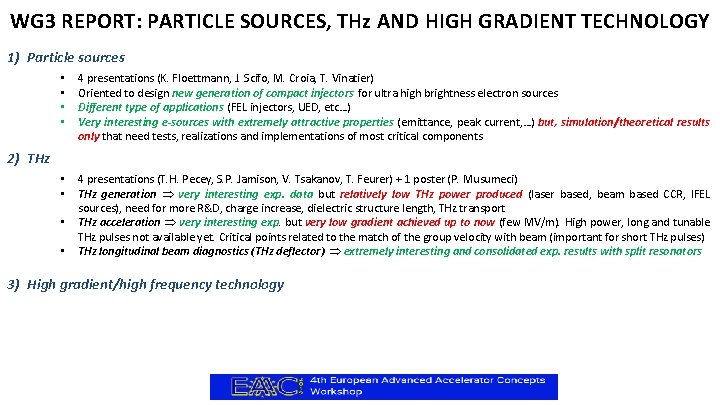
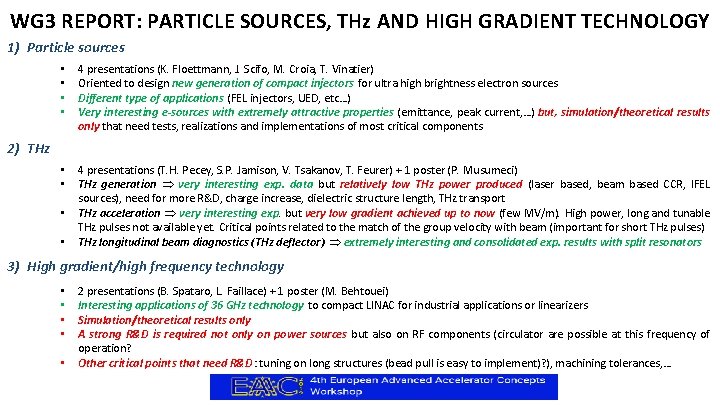
WG 3 REPORT: PARTICLE SOURCES, THz AND HIGH GRADIENT TECHNOLOGY 1) Particle sources • • 4 presentations (K. Floettmann, J. Scifo, M. Croia, T. Vinatier) Oriented to design new generation of compact injectors for ultra high brightness electron sources Different type of applications (FEL injectors, UED, etc…) Very interesting e-sources with extremely attractive properties (emittance, peak current, …) but, simulation/theoretical results only that need tests, realizations and implementations of most critical components 2) THz 3) High gradient/high frequency technology
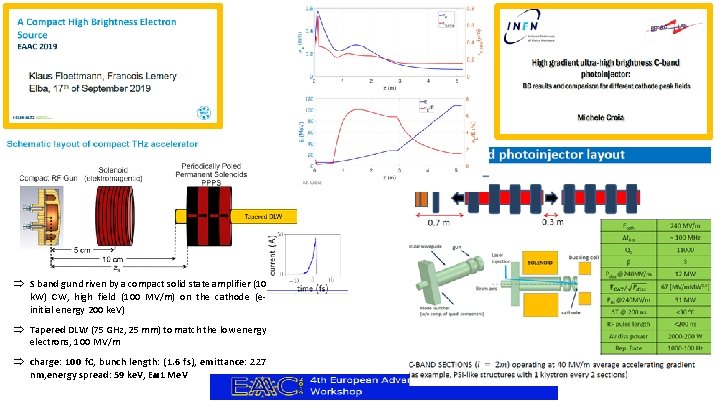
S band gun driven by a compact solid state amplifier (10 k. W) CW, high field (100 MV/m) on the cathode (einitial energy 200 ke. V) Tapered DLW (75 GHz, 25 mm) to match the low energy electrons, 100 MV/m charge: 100 f. C, bunch length: (1. 6 fs), emittance: 227 nm, energy spread: 59 ke. V, E 1 Me. V
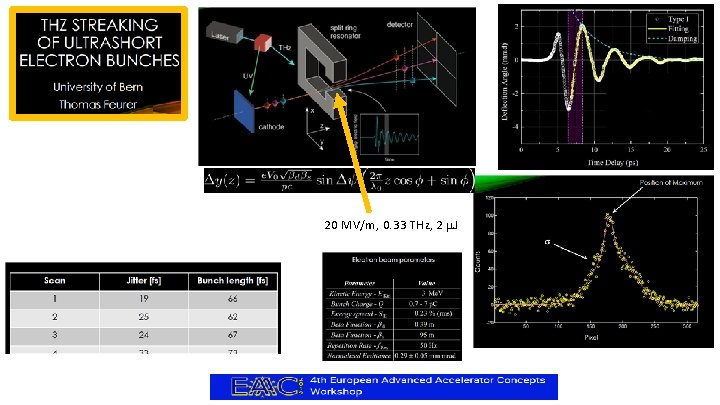
WG 3 REPORT: PARTICLE SOURCES, THz AND HIGH GRADIENT TECHNOLOGY 1) Particle sources • • 4 presentations (K. Floettmann, J. Scifo, M. Croia, T. Vinatier) Oriented to design new generation of compact injectors for ultra high brightness electron sources Different type of applications (FEL injectors, UED, etc…) Very interesting e-sources with extremely attractive properties (emittance, peak current, …) but, simulation/theoretical results only that need tests, realizations and implementations of most critical components • • 4 presentations (T. H. Pecey, S. P. Jamison, V. Tsakanov, T. Feurer) + 1 poster (P. Musumeci) THz generation very interesting exp. data but relatively low THz power produced (laser based, beam based CCR, IFEL sources), need for more R&D, charge increase, dielectric structure length, THz transport THz acceleration very interesting exp. but very low gradient achieved up to now (few MV/m). High power, long and tunable THz pulses not available yet. Critical points related to the match of the group velocity with beam (important for short THz pulses) THz longitudinal beam diagnostics (THz deflector) extremely interesting and consolidated exp. results with split resonators 2) THz • • 3) High gradient/high frequency technology
20 MV/m, 0. 33 THz, 2 J
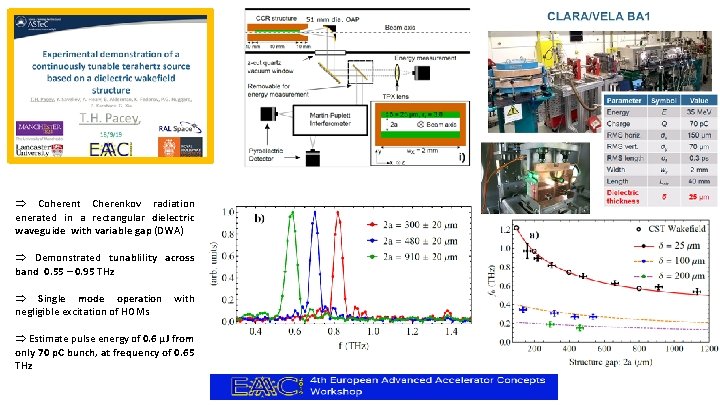
Coherent Cherenkov radiation enerated in a rectangular dielectric waveguide with variable gap (DWA) Demonstrated tunablility across band 0. 55 – 0. 95 THz Single mode operation negligible excitation of HOMs with Estimate pulse energy of 0. 6 µJ from only 70 p. C bunch, at frequency of 0. 65 THz
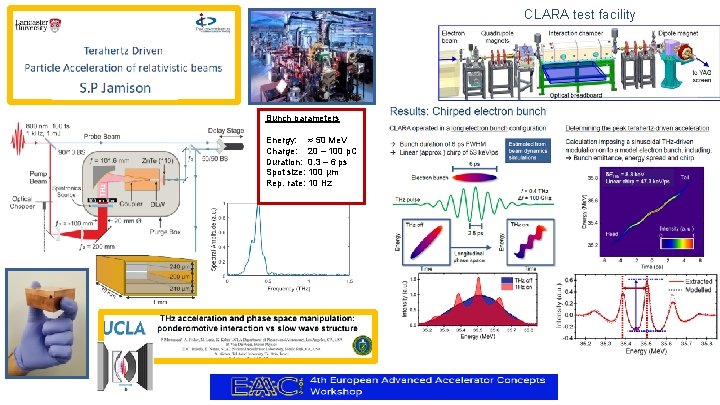
CLARA test facility Bunch parameters Energy: Charge: Duration: Spot size: Rep. rate: ≈ 50 Me. V 20 – 100 p. C 0. 3 – 6 ps 100 µm 10 Hz
WG 3 REPORT: PARTICLE SOURCES, THz AND HIGH GRADIENT TECHNOLOGY 1) Particle sources • • 4 presentations (K. Floettmann, J. Scifo, M. Croia, T. Vinatier) Oriented to design new generation of compact injectors for ultra high brightness electron sources Different type of applications (FEL injectors, UED, etc…) Very interesting e-sources with extremely attractive properties (emittance, peak current, …) but, simulation/theoretical results only that need tests, realizations and implementations of most critical components • • 4 presentations (T. H. Pecey, S. P. Jamison, V. Tsakanov, T. Feurer) + 1 poster (P. Musumeci) THz generation very interesting exp. data but relatively low THz power produced (laser based, beam based CCR, IFEL sources), need for more R&D, charge increase, dielectric structure length, THz transport THz acceleration very interesting exp. but very low gradient achieved up to now (few MV/m). High power, long and tunable THz pulses not available yet. Critical points related to the match of the group velocity with beam (important for short THz pulses) THz longitudinal beam diagnostics (THz deflector) extremely interesting and consolidated exp. results with split resonators 2) THz • • 3) High gradient/high frequency technology • • • 2 presentations (B. Spataro, L. Faillace) + 1 poster (M. Behtouei) Interesting applications of 36 GHz technology to compact LINAC for industrial applications or linearizers Simulation/theoretical results only A strong R&D is required not only on power sources but also on RF components (circulator are possible at this frequency of operation? Other critical points that need R&D: tuning on long structures (bead pull is easy to implement)? ), machining tolerances, …
THANK YOU FOR YOUR ATTENTION!