
DRG payment Reinhard Busse Prof Dr med MPH
DRG payment Reinhard Busse, Prof. Dr. med. MPH FFPH Department of Health Care Management, Berlin University of Technology (WHO Collaborating Centre for Health Systems Research and Management) & European Observatory on Health Systems and Policies 24 January 2012 European Health Summit: DRG payment 1

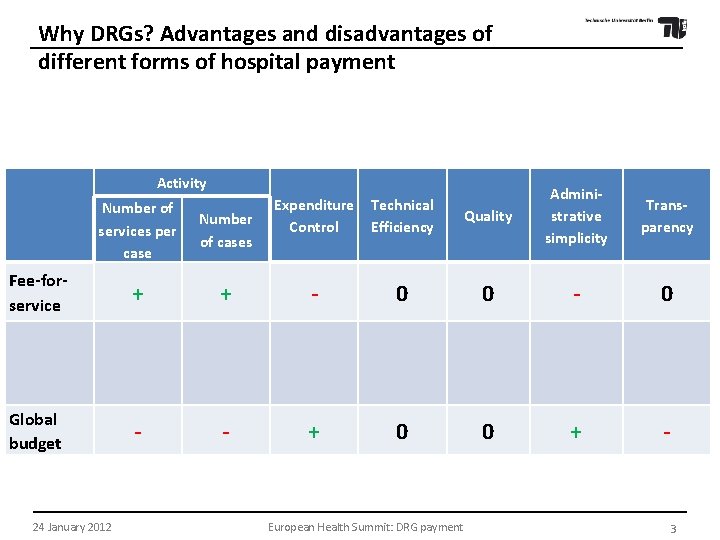
Hospital payment systems Why DRGs? Advantages and disadvantages of different forms of hospital payment Activity Expenditure Control Technical Efficiency Quality Administrative simplicity Transparency Number of services per case Number of cases Fee-forservice + + - 0 0 - 0 Global budget - - + 0 0 + - 24 January 2012 European Health Summit: DRG payment 3
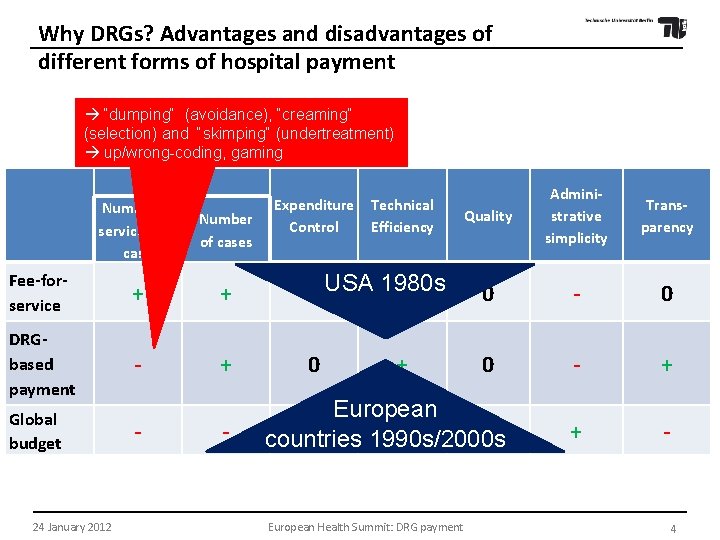
Hospital payment systems Why DRGs? Advantages and disadvantages of different forms of hospital payment “dumping“ (avoidance), “creaming“ (selection) and “skimping“ (undertreatment) up/wrong-coding, gaming Activity Expenditure Control Technical Efficiency Quality Administrative simplicity Transparency Number of services per case Number of cases Fee-forservice + + - USA 1980 s 0 0 - 0 DRGbased payment - + 0 0 - + Global budget - + - 24 January 2012 - + European + 0 0 countries 1990 s/2000 s European Health Summit: DRG payment 4
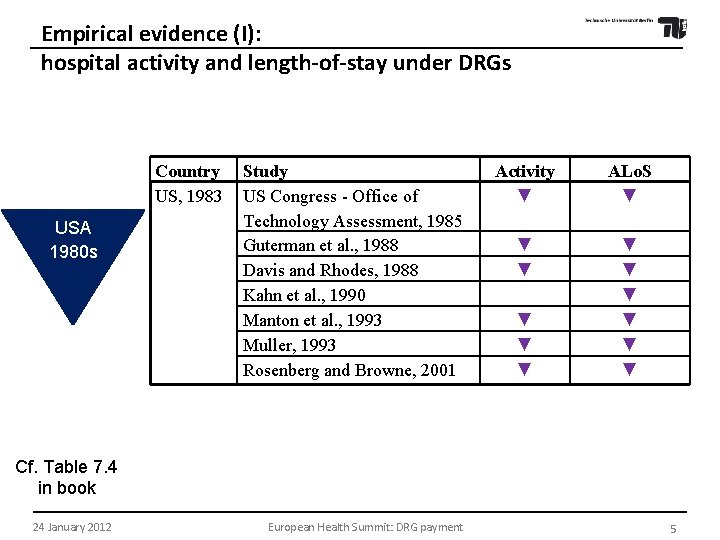
Empirical evidence (I): hospital activity and length-of-stay under DRGs Country US, 1983 USA 1980 s Study US Congress - Office of Technology Assessment, 1985 Guterman et al. , 1988 Davis and Rhodes, 1988 Kahn et al. , 1990 Manton et al. , 1993 Muller, 1993 Rosenberg and Browne, 2001 Activity ▼ ALo. S ▼ ▼ ▼ Cf. Table 7. 4 in book 24 January 2012 European Health Summit: DRG payment 5
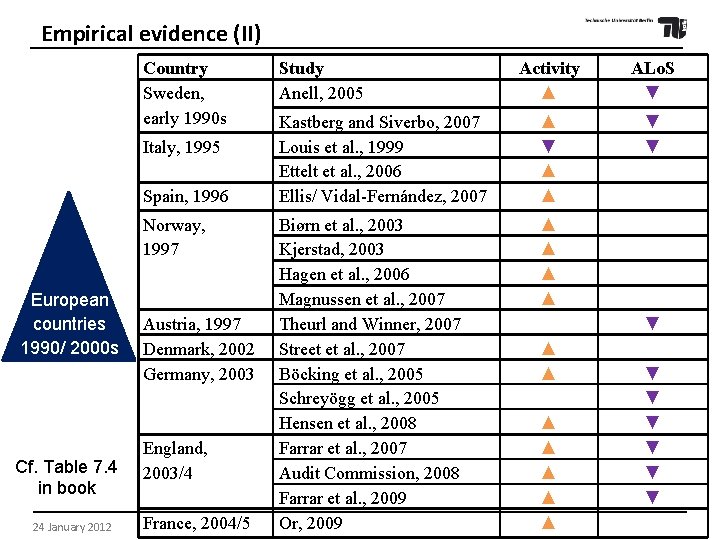
Empirical evidence (II) Country Sweden, early 1990 s Italy, 1995 Spain, 1996 Norway, 1997 European countries 1990/ 2000 s Cf. Table 7. 4 in book 24 January 2012 Austria, 1997 Denmark, 2002 Germany, 2003 England, 2003/4 France, 2004/5 Study Anell, 2005 Activity ▲ ALo. S ▼ Kastberg and Siverbo, 2007 Louis et al. , 1999 Ettelt et al. , 2006 Ellis/ Vidal-Fernández, 2007 ▲ ▼ ▲ ▲ ▼ ▼ Biørn et al. , 2003 Kjerstad, 2003 Hagen et al. , 2006 Magnussen et al. , 2007 Theurl and Winner, 2007 Street et al. , 2007 Böcking et al. , 2005 Schreyögg et al. , 2005 Hensen et al. , 2008 Farrar et al. , 2007 Audit Commission, 2008 Farrar et al. , 2009 Or, 2009 ▲ ▲ ▼ ▲ ▲ ▲ ▲ ▼ ▼ ▼
So then, why DRGs? To get a common “currency” of hospital activity for • transparency efficiency benchmarking & performance measurement (protect/ improve quality), • budget allocation (or division among providers), • planning of capacities, • payment ( efficiency) Exact reasons, expectations and DRG usage differ among countries – due to (de)centralisation, one vs. multiple payers, public vs. mixed ownership. 24 January 2012 European Health Summit: DRG payment 7
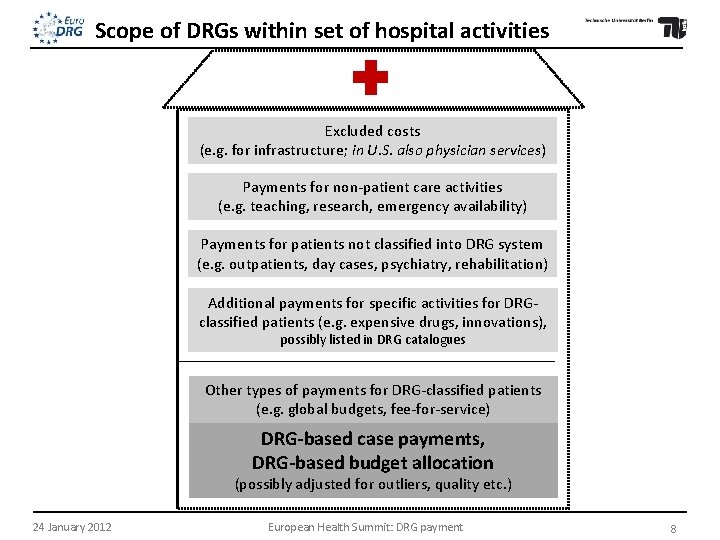
Scope of DRGs within set of hospital activities Excluded costs (e. g. for infrastructure; in U. S. also physician services) Payments for non-patient care activities (e. g. teaching, research, emergency availability) Payments for patients not classified into DRG system (e. g. outpatients, day cases, psychiatry, rehabilitation) Additional payments for specific activities for DRGclassified patients (e. g. expensive drugs, innovations), possibly listed in DRG catalogues Other types of payments for DRG-classified patients (e. g. global budgets, fee-for-service) DRG-based case payments, DRG-based budget allocation (possibly adjusted for outliers, quality etc. ) 24 January 2012 European Health Summit: DRG payment 8
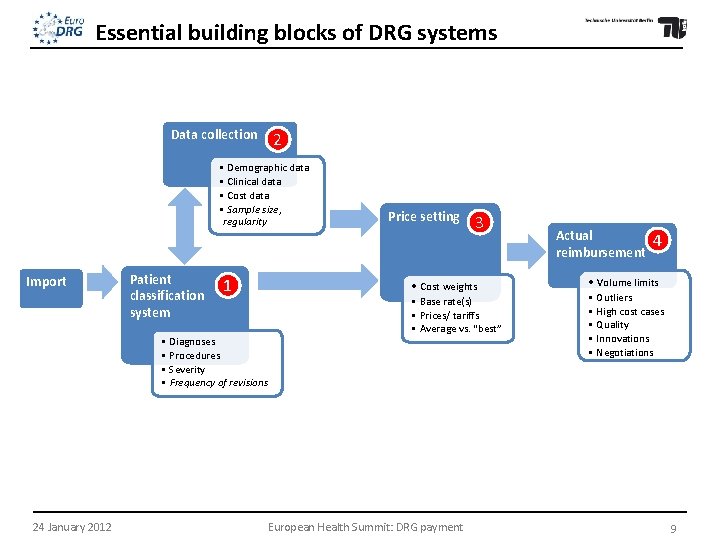
Essential building blocks of DRG systems Data collection 2 • Demographic data • Clinical data • Cost data • Sample size, regularity Import Patient classification system 1 3 • Cost weights • Diagnoses • Procedures • Severity • Frequency of revisions 24 January 2012 Price setting • Base rate(s) • Prices/ tariffs • Average vs. “best” European Health Summit: DRG payment Actual reimbursement 4 • Volume limits • Outliers • High cost cases • Quality • Innovations • Negotiations 9
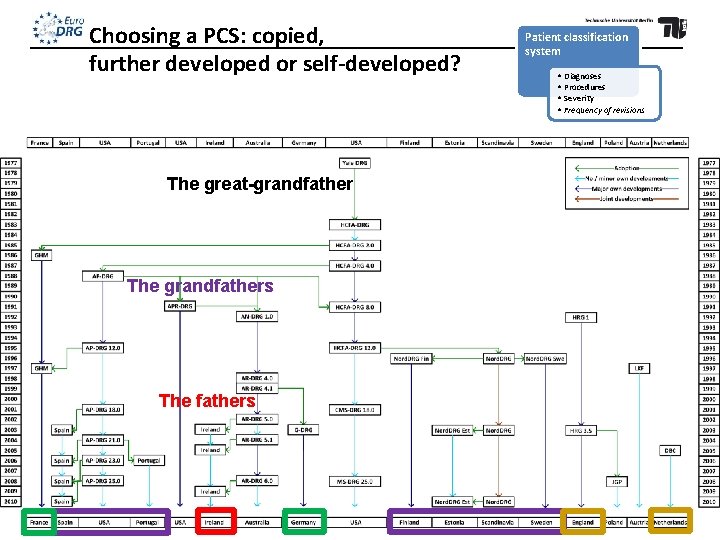
Choosing a PCS: copied, further developed or self-developed? The great-grandfather The grandfathers The fathers Patient classification system • Diagnoses • Procedures • Severity • Frequency of revisions
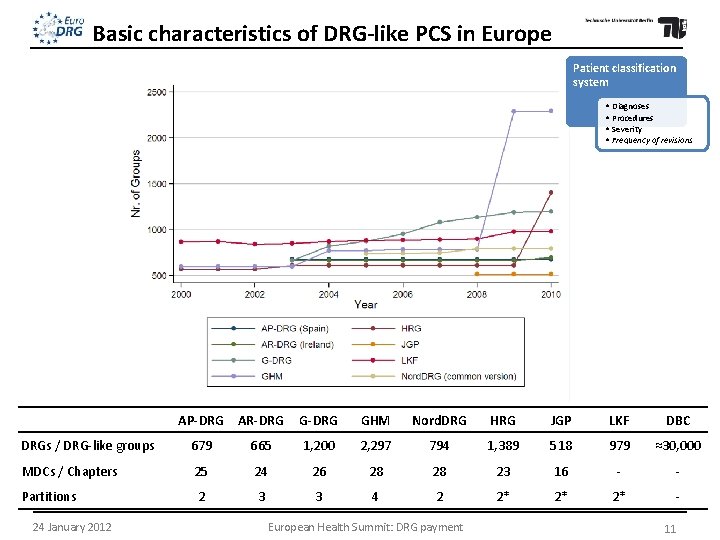
Basic characteristics of DRG-like PCS in Europe Patient classification system • Diagnoses • Procedures • Severity • Frequency of revisions AP-DRG AR-DRG GHM Nord. DRG HRG JGP LKF DBC DRGs / DRG-like groups 679 665 1, 200 2, 297 794 1, 389 518 979 ≈30, 000 MDCs / Chapters 25 24 26 28 28 23 16 - - Partitions 2 3 3 4 2 2* 2* 2* - 24 January 2012 European Health Summit: DRG payment 11
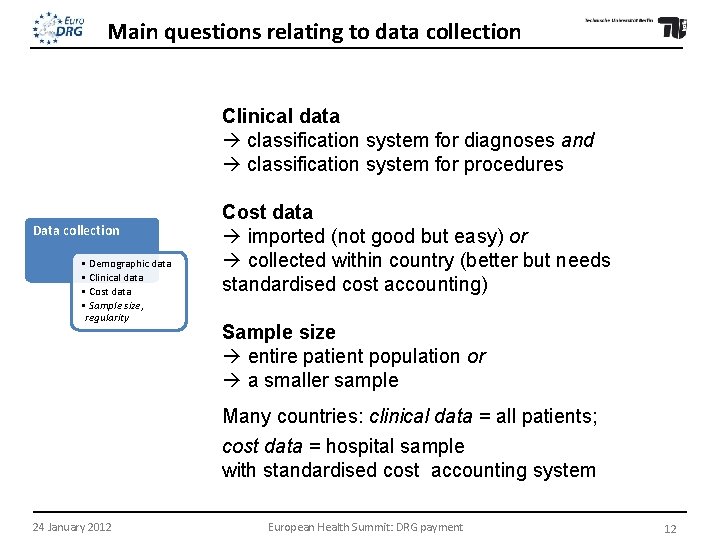
Main questions relating to data collection Clinical data classification system for diagnoses and classification system for procedures Data collection • Demographic data • Clinical data • Cost data • Sample size, regularity Cost data imported (not good but easy) or collected within country (better but needs standardised cost accounting) Sample size entire patient population or a smaller sample Many countries: clinical data = all patients; cost data = hospital sample with standardised cost accounting system 24 January 2012 European Health Summit: DRG payment 12
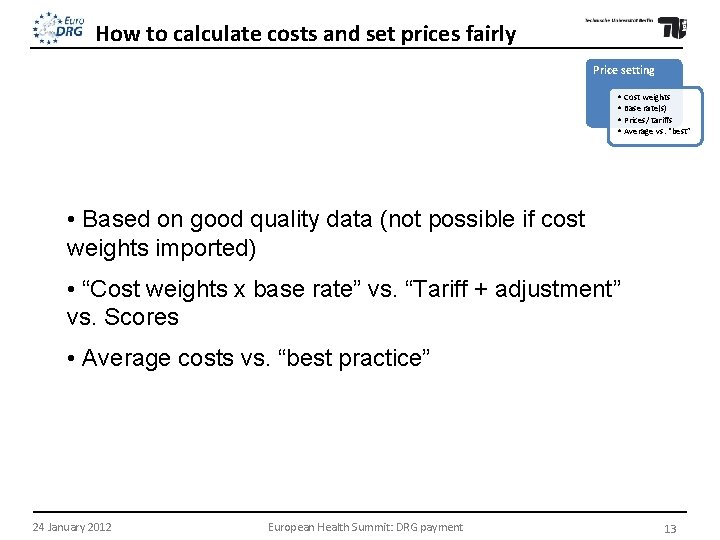
How to calculate costs and set prices fairly Price setting • Cost weights • Base rate(s) • Prices/ tariffs • Average vs. “best” • Based on good quality data (not possible if cost weights imported) • “Cost weights x base rate” vs. “Tariff + adjustment” vs. Scores • Average costs vs. “best practice” 24 January 2012 European Health Summit: DRG payment 13
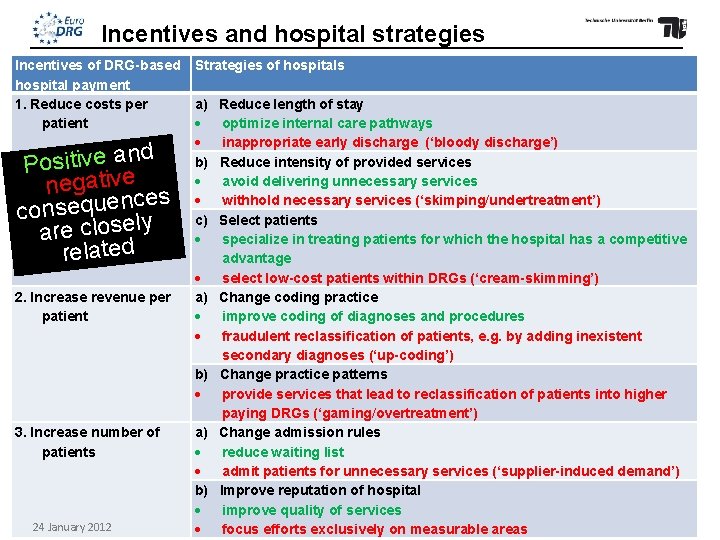
Incentives and hospital strategies Incentives of DRG-based hospital payment 1. Reduce costs per patient d Positive an negative s ce n e u q e s n o c are closely related 2. Increase revenue per patient Strategies of hospitals a) b) c) a) b) 3. Increase number of patients 24 January 2012 a) b) Reduce length of stay optimize internal care pathways inappropriate early discharge (‘bloody discharge’) Reduce intensity of provided services avoid delivering unnecessary services withhold necessary services (‘skimping/undertreatment’) Select patients specialize in treating patients for which the hospital has a competitive advantage select low-cost patients within DRGs (‘cream-skimming’) Change coding practice improve coding of diagnoses and procedures fraudulent reclassification of patients, e. g. by adding inexistent secondary diagnoses (‘up-coding’) Change practice patterns provide services that lead to reclassification of patients into higher paying DRGs (‘gaming/overtreatment’) Change admission rules reduce waiting list admit patients for unnecessary services (‘supplier-induced demand’) Improve reputation of hospital improve quality of services European Health Summit: DRG payment 14 focus efforts exclusively on measurable areas
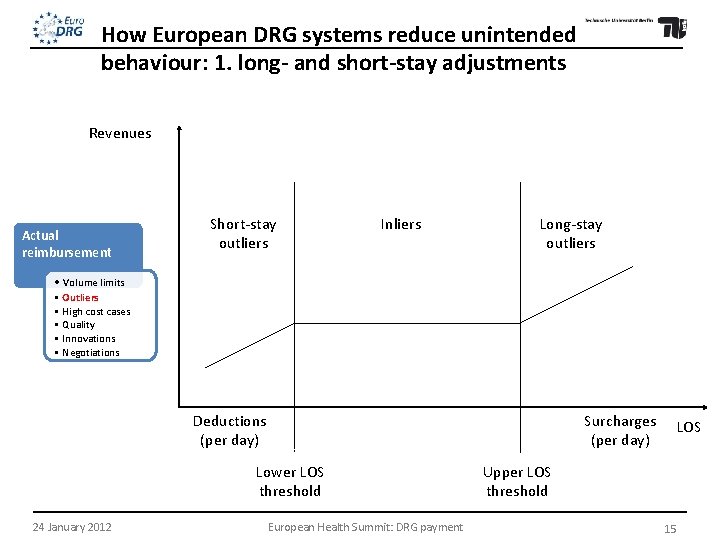
How European DRG systems reduce unintended behaviour: 1. long- and short-stay adjustments Revenues Actual reimbursement Short-stay outliers Inliers Long-stay outliers • Volume limits • Outliers • High cost cases • Quality • Innovations • Negotiations Deductions (per day) Surcharges (per day) Lower LOS threshold 24 January 2012 European Health Summit: DRG payment LOS Upper LOS threshold 15
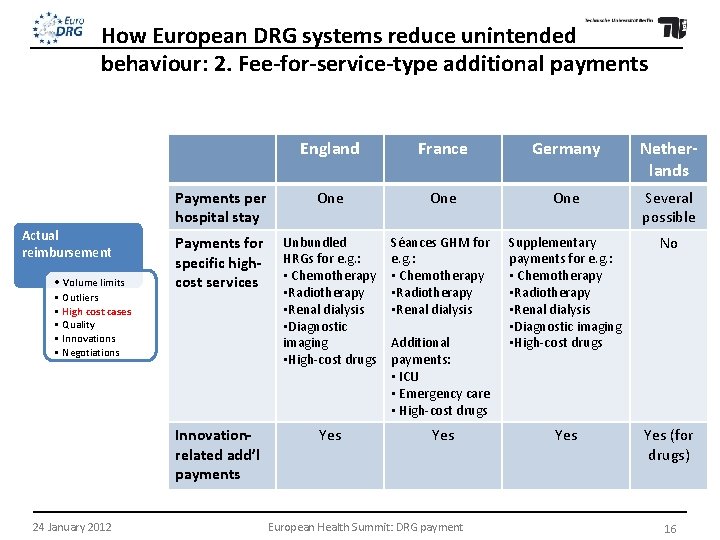
How European DRG systems reduce unintended behaviour: 2. Fee-for-service-type additional payments Actual reimbursement • Volume limits • Outliers • High cost cases • Quality • Innovations • Negotiations England France Germany Netherlands Payments per hospital stay One One Several possible Payments for specific highcost services Unbundled HRGs for e. g. : • Chemotherapy • Radiotherapy • Renal dialysis • Diagnostic imaging • High-cost drugs Séances GHM for e. g. : • Chemotherapy • Radiotherapy • Renal dialysis Supplementary payments for e. g. : • Chemotherapy • Radiotherapy • Renal dialysis • Diagnostic imaging • High-cost drugs No Yes Yes (for drugs) Innovationrelated add’l payments 24 January 2012 Additional payments: • ICU • Emergency care • High-cost drugs European Health Summit: DRG payment 16
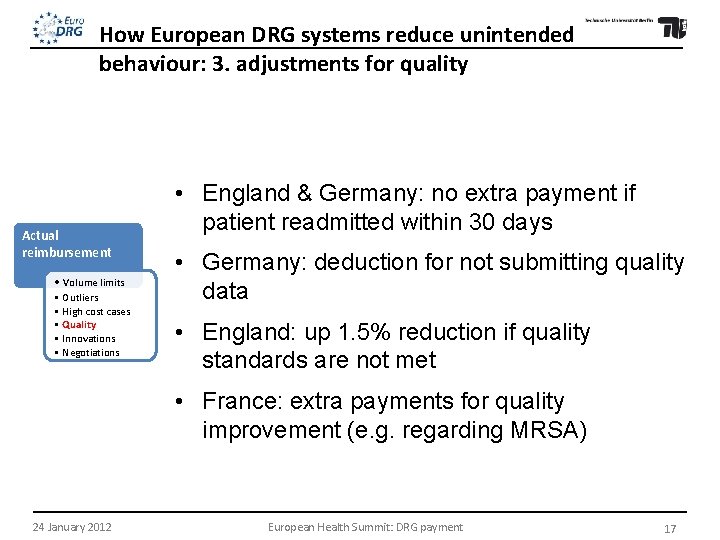
How European DRG systems reduce unintended behaviour: 3. adjustments for quality Actual reimbursement • Volume limits • Outliers • High cost cases • Quality • Innovations • Negotiations • England & Germany: no extra payment if patient readmitted within 30 days • Germany: deduction for not submitting quality data • England: up 1. 5% reduction if quality standards are not met • France: extra payments for quality improvement (e. g. regarding MRSA) 24 January 2012 European Health Summit: DRG payment 17
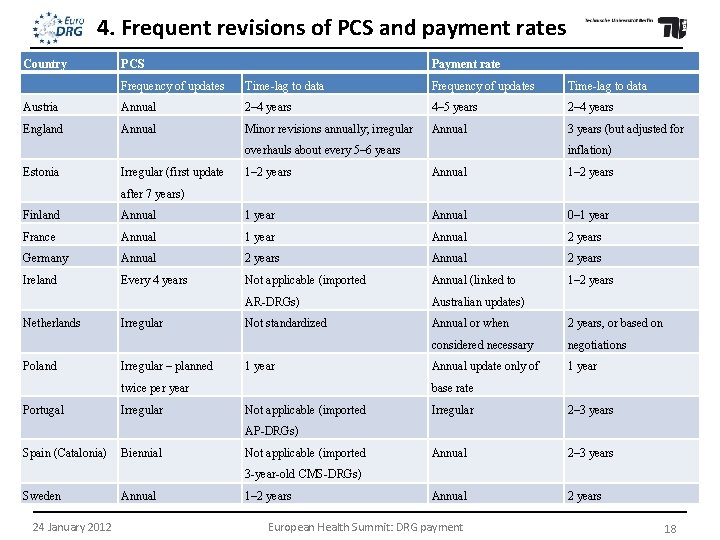
4. Frequent revisions of PCS and payment rates Country PCS Payment rate Frequency of updates Time-lag to data Austria Annual 2– 4 years 4– 5 years 2– 4 years England Annual Minor revisions annually; irregular Annual 3 years (but adjusted for overhauls about every 5– 6 years Estonia Irregular (first update inflation) 1– 2 years Annual 1– 2 years after 7 years) Finland Annual 1 year Annual 0– 1 year France Annual 1 year Annual 2 years Germany Annual 2 years Ireland Every 4 years Not applicable (imported Annual (linked to 1– 2 years AR-DRGs) Australian updates) Not standardized Annual or when 2 years, or based on considered necessary negotiations Annual update only of 1 year Netherlands Poland Irregular – planned 1 year twice per year Portugal Irregular base rate Not applicable (imported Irregular 2– 3 years Annual 2 years AP-DRGs) Spain (Catalonia) Biennial Not applicable (imported 3 -year-old CMS-DRGs) Sweden 24 January 2012 Annual 1– 2 years European Health Summit: DRG payment 18
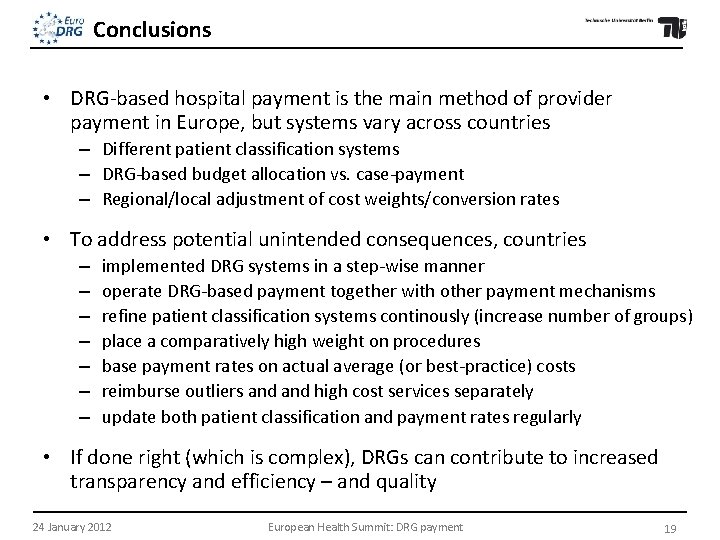
Conclusions • DRG-based hospital payment is the main method of provider payment in Europe, but systems vary across countries – Different patient classification systems – DRG-based budget allocation vs. case-payment – Regional/local adjustment of cost weights/conversion rates • To address potential unintended consequences, countries – – – – implemented DRG systems in a step-wise manner operate DRG-based payment together with other payment mechanisms refine patient classification systems continously (increase number of groups) place a comparatively high weight on procedures base payment rates on actual average (or best-practice) costs reimburse outliers and high cost services separately update both patient classification and payment rates regularly • If done right (which is complex), DRGs can contribute to increased transparency and efficiency – and quality 24 January 2012 European Health Summit: DRG payment 19
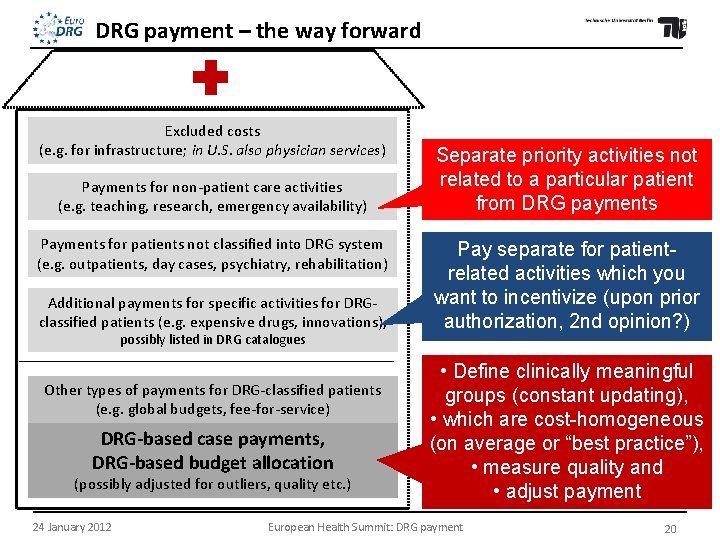
DRG payment – the way forward Excluded costs (e. g. for infrastructure; in U. S. also physician services) Payments for non-patient care activities (e. g. teaching, research, emergency availability) Payments for patients not classified into DRG system (e. g. outpatients, day cases, psychiatry, rehabilitation) Additional payments for specific activities for DRGclassified patients (e. g. expensive drugs, innovations), possibly listed in DRG catalogues Other types of payments for DRG-classified patients (e. g. global budgets, fee-for-service) DRG-based case payments, DRG-based budget allocation (possibly adjusted for outliers, quality etc. ) 24 January 2012 Separate priority activities not related to a particular patient from DRG payments Pay separate for patientrelated activities which you want to incentivize (upon prior authorization, 2 nd opinion? ) • Define clinically meaningful groups (constant updating), • which are cost-homogeneous (on average or “best practice”), • measure quality and • adjust payment European Health Summit: DRG payment 20
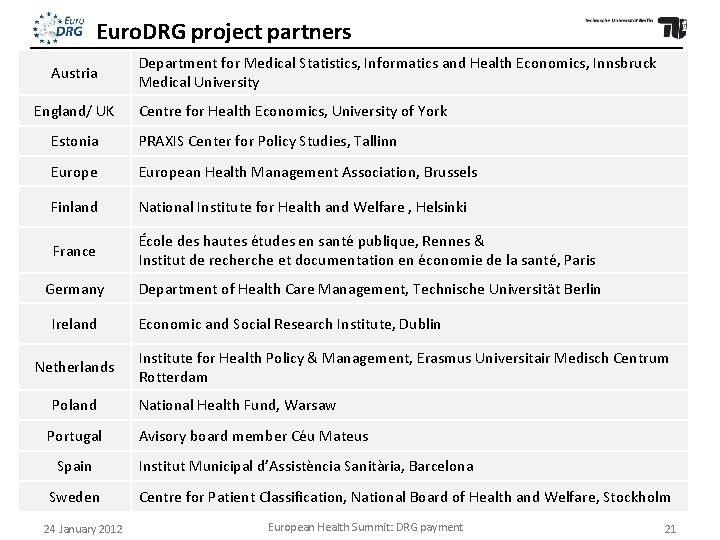
Euro. DRG project partners Austria England/ UK Department for Medical Statistics, Informatics and Health Economics, Innsbruck Medical University Centre for Health Economics, University of York Estonia PRAXIS Center for Policy Studies, Tallinn European Health Management Association, Brussels Finland National Institute for Health and Welfare , Helsinki France École des hautes études en santé publique, Rennes & Institut de recherche et documentation en économie de la santé, Paris Germany Department of Health Care Management, Technische Universität Berlin Ireland Netherlands Poland Portugal Spain Sweden 24 January 2012 Economic and Social Research Institute, Dublin Institute for Health Policy & Management, Erasmus Universitair Medisch Centrum Rotterdam National Health Fund, Warsaw Avisory board member Céu Mateus Institut Municipal d’Assistència Sanitària, Barcelona Centre for Patient Classification, National Board of Health and Welfare, Stockholm European Health Summit: DRG payment 21
- Slides: 21