Why use Forensic Geoscience exercises as part of
- Slides: 25
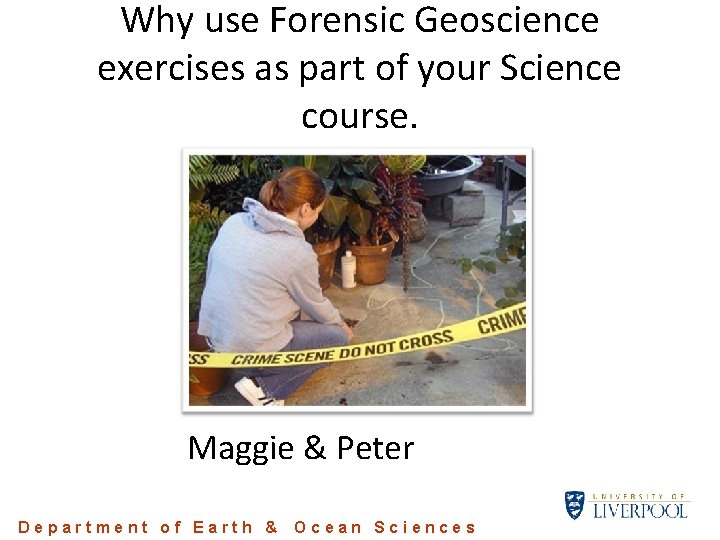
Why use Forensic Geoscience exercises as part of your Science course. Maggie & Peter Department of Earth & Ocean Sciences
What is Forensic Geoscience? “Forensic Geoscience uses evidence from geological materials at the scene of a crime to support or defend against a prosecution in court. ” Department of Earth & Ocean Sciences
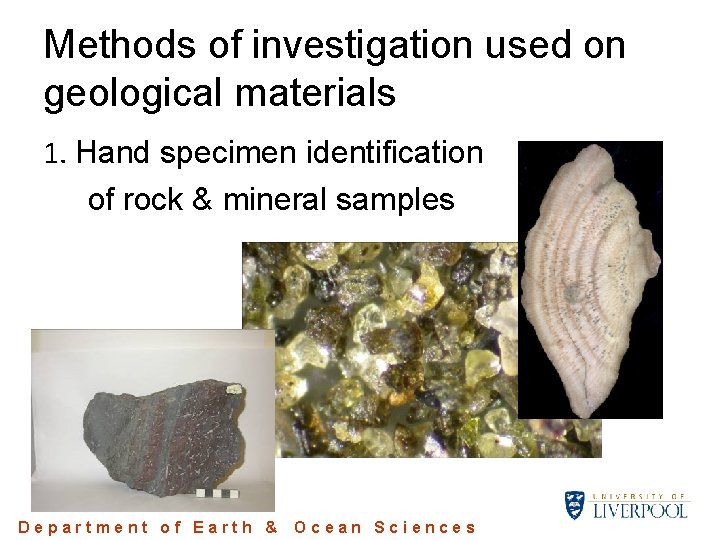
Methods of investigation used on geological materials 1. Hand specimen identification of rock & mineral samples Department of Earth & Ocean Sciences
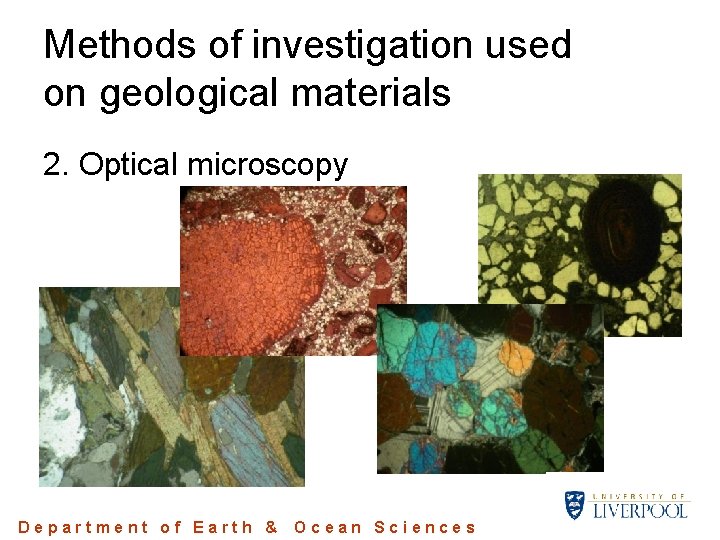
Methods of investigation used on geological materials 2. Optical microscopy Department of Earth & Ocean Sciences
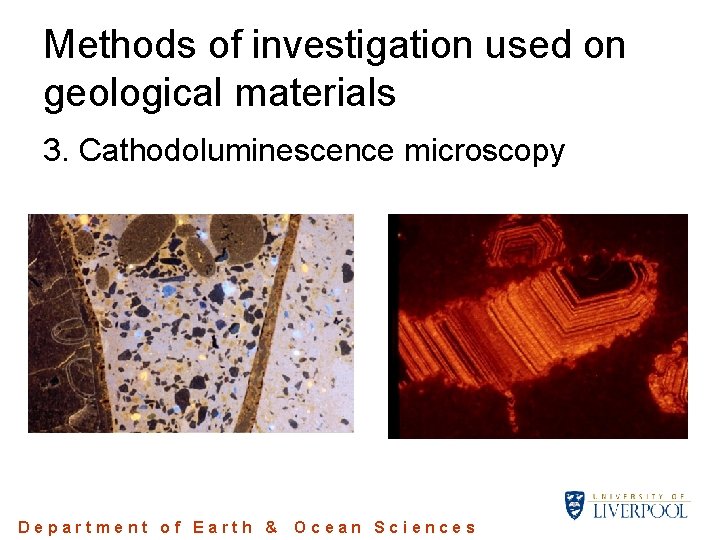
Methods of investigation used on geological materials 3. Cathodoluminescence microscopy Department of Earth & Ocean Sciences
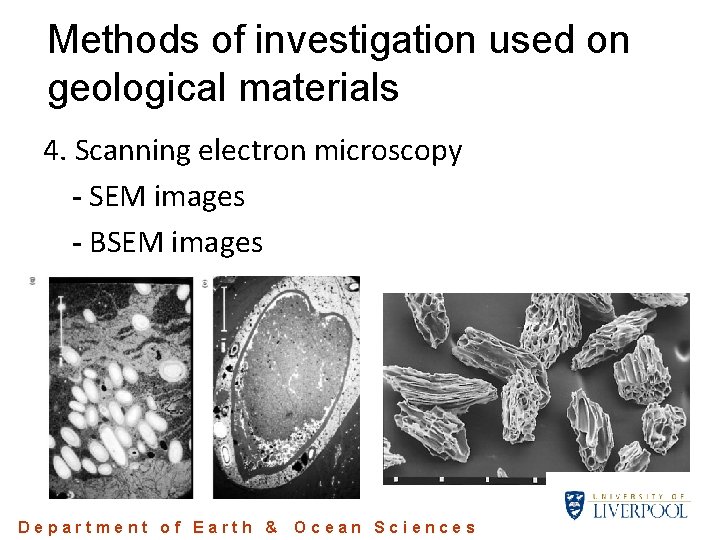
Methods of investigation used on geological materials 4. Scanning electron microscopy - SEM images - BSEM images Department of Earth & Ocean Sciences
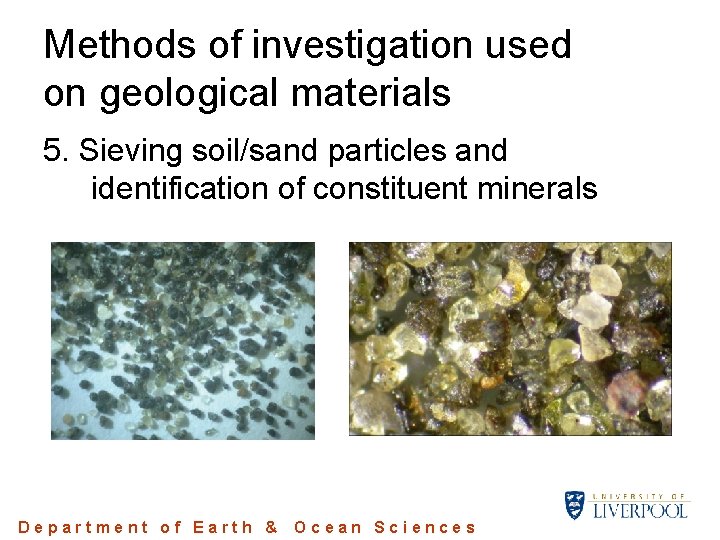
Methods of investigation used on geological materials 5. Sieving soil/sand particles and identification of constituent minerals Department of Earth & Ocean Sciences
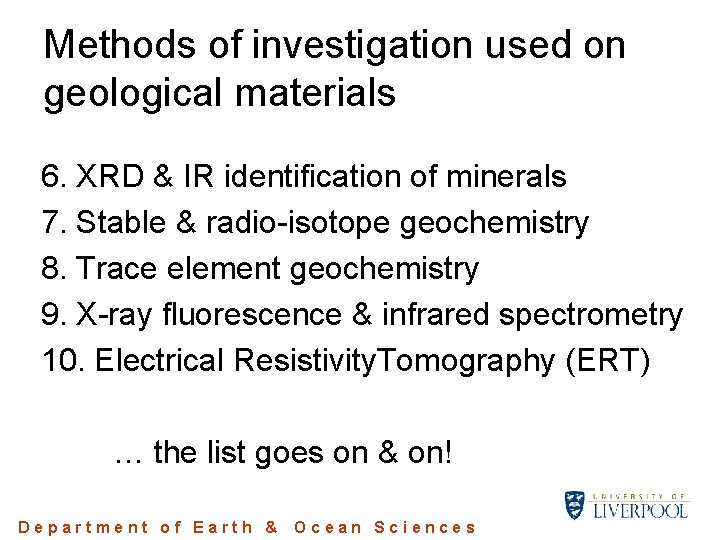
Methods of investigation used on geological materials 6. XRD & IR identification of minerals 7. Stable & radio-isotope geochemistry 8. Trace element geochemistry 9. X-ray fluorescence & infrared spectrometry 10. Electrical Resistivity. Tomography (ERT) … the list goes on & on! Department of Earth & Ocean Sciences
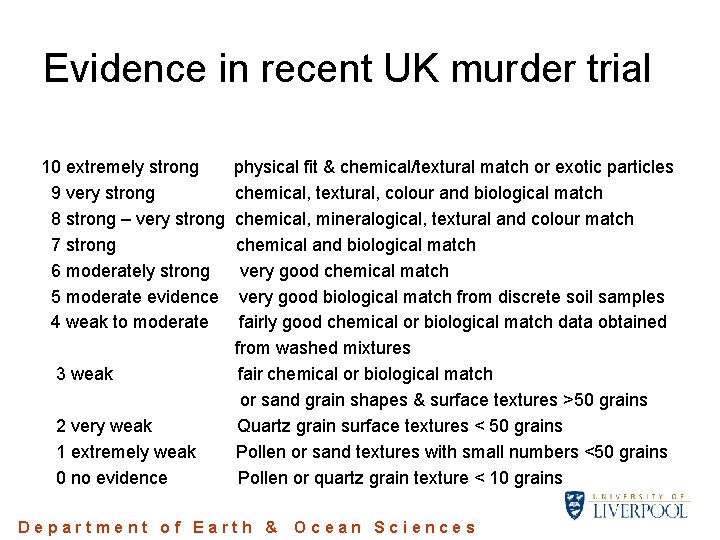
Evidence in recent UK murder trial 10 extremely strong 9 very strong 8 strong – very strong 7 strong 6 moderately strong 5 moderate evidence 4 weak to moderate 3 weak 2 very weak 1 extremely weak 0 no evidence physical fit & chemical/textural match or exotic particles chemical, textural, colour and biological match chemical, mineralogical, textural and colour match chemical and biological match very good chemical match very good biological match from discrete soil samples fairly good chemical or biological match data obtained from washed mixtures fair chemical or biological match or sand grain shapes & surface textures >50 grains Quartz grain surface textures < 50 grains Pollen or sand textures with small numbers <50 grains Pollen or quartz grain texture < 10 grains Department of Earth & Ocean Sciences
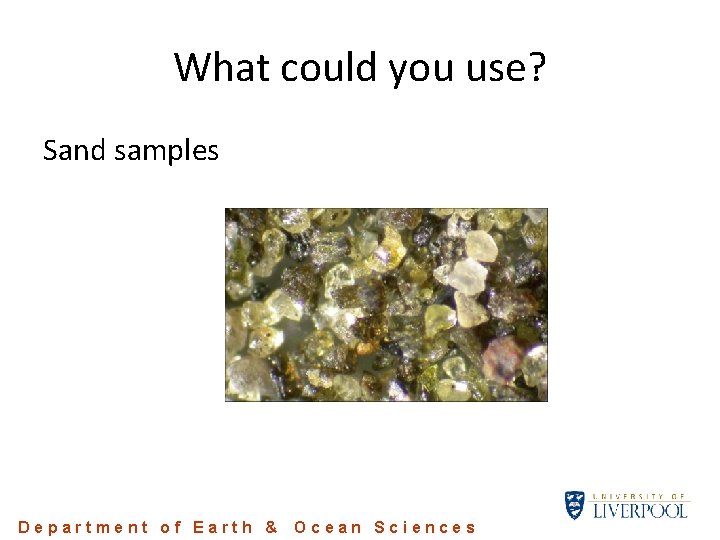
What could you use? Sand samples Department of Earth & Ocean Sciences
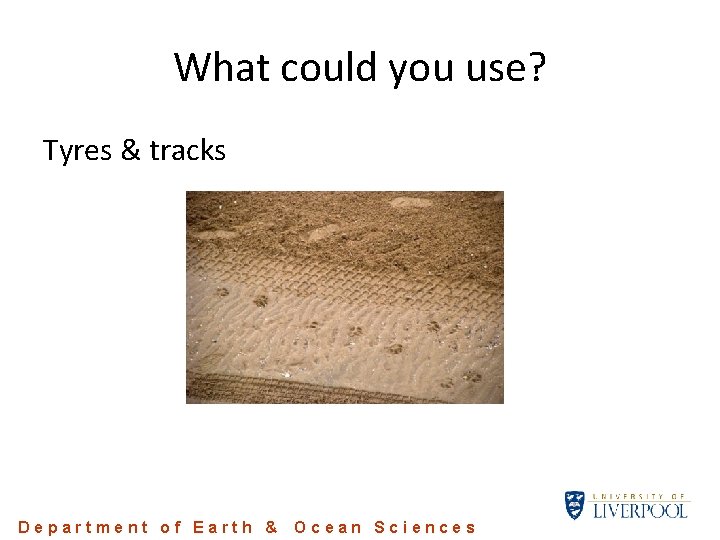
What could you use? Tyres & tracks Department of Earth & Ocean Sciences
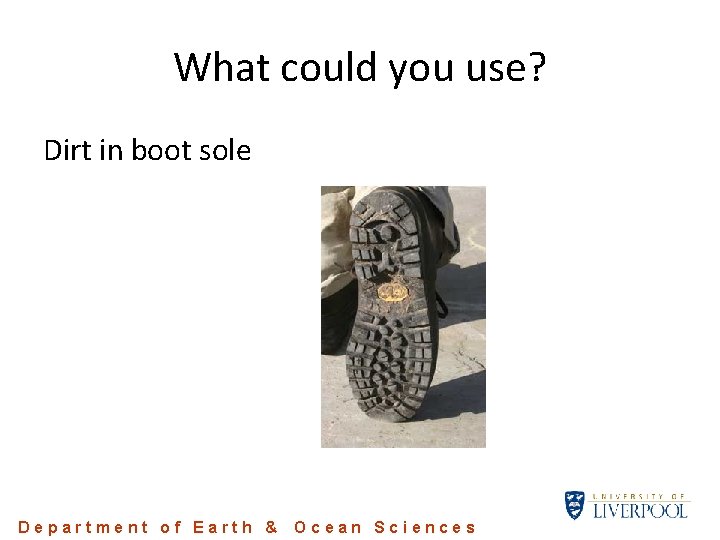
What could you use? Dirt in boot sole Department of Earth & Ocean Sciences
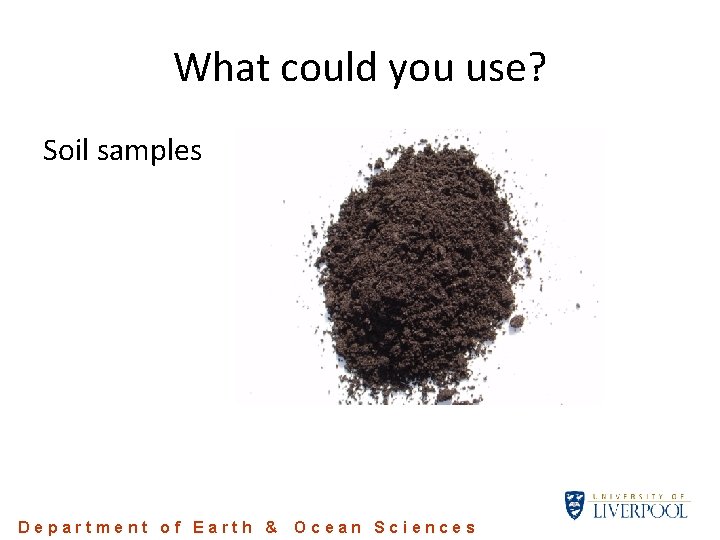
What could you use? Soil samples Department of Earth & Ocean Sciences
Why use Forensic Geoscience exercises as part of your Science course. • Involves students in active learning and encourages them to develop problem solving skills • It teaches students that a negative result eliminating someone or something is still a valuable result • It is adaptable to different age groups and abilities Department of Earth & Ocean Sciences
Why use Forensic Geoscience exercises as part of your Science course. • It touches on the nature of evidence – what is needed to prove something is true (or false) • It is adaptable to local conditions – local samples of materials (soil or sand or rocks), local suspect (head teacher? ) • It teaches a social message, criminals need to be caught, people who look bad are not always guilty, people who have a criminal record might be innocent • It is fun Department of Earth & Ocean Sciences
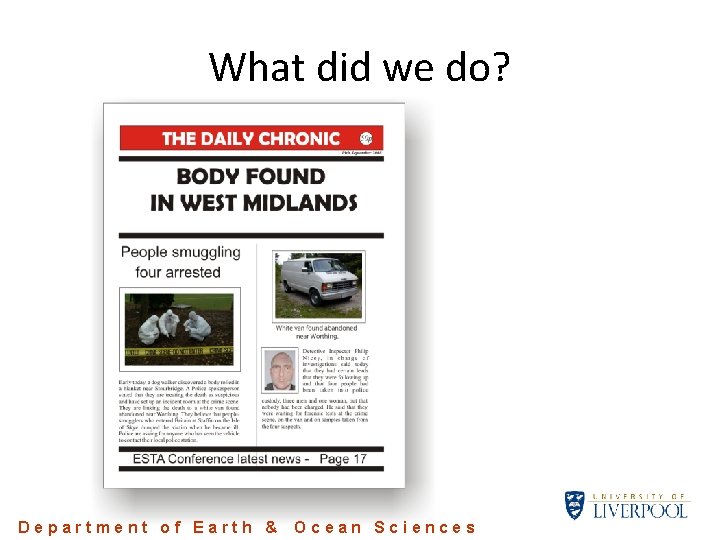
What did we do? Department of Earth & Ocean Sciences
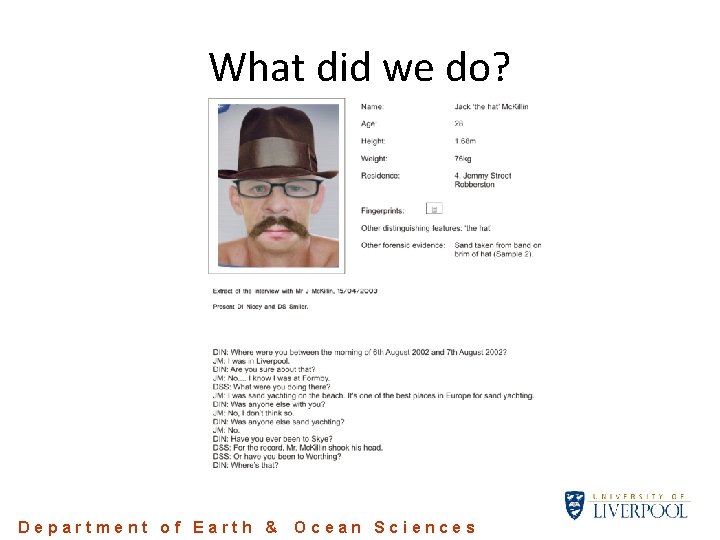
What did we do? Department of Earth & Ocean Sciences
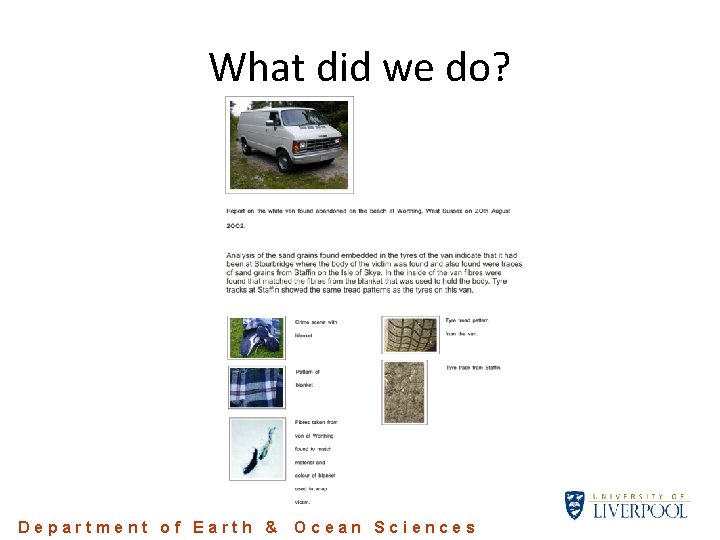
What did we do? Department of Earth & Ocean Sciences
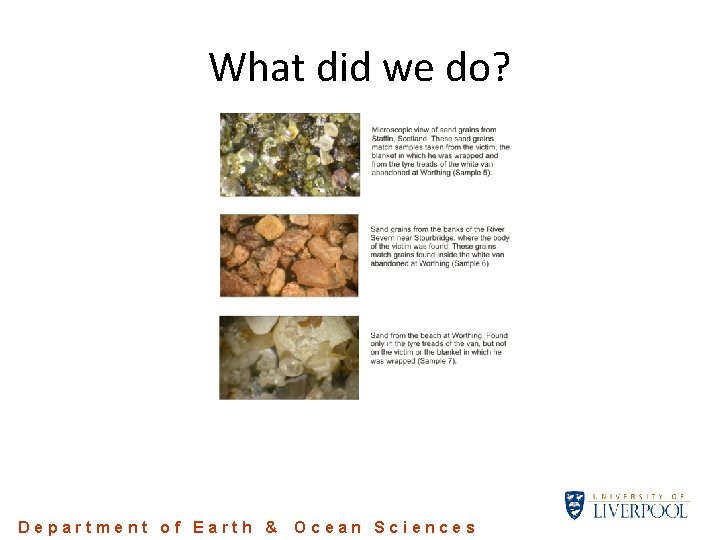
What did we do? Department of Earth & Ocean Sciences
What are you going to do? If you have not tried the exercise before: have a go now. If you have tried the exercise then why not think up your own crime scene using the sand samples that are here for you to take away. Department of Earth & Ocean Sciences
True scenarios. Drug traffickers Traffickers caught in coastal southern England linked to a location in the Netherlands where a boat carrying their consignment departed. Why were they convicted? The particle distribution of the sand samples did not compare with the English location the traffickers were arrested in, denying the alibi that suggested the sand to be English not Dutch. Department of Earth & Ocean Sciences
True scenarios. Badger baiting Spades & boots (with abundant soil adhering) were seized from suspects & their vehicles following reports of digging at badger setts. Why were they convicted? Particle size distribution and composition of mineral grains in the soil on the spades & boots matched those in the soil at the site of the badger setts. Department of Earth & Ocean Sciences
True scenarios. Stolen Scotch A person working for the Scotch distributor was suspected of stealing expensive Scotch after cases of Scotch opened in a store in Canada were found to contain blocks of limestone and not bottle of whiskey. Why was he convicted? The limestone in the cases was from a particular quarry in Central England. The suspect had access to the quarry and had often been seen taking home samples from the quarry. Department of Earth & Ocean Sciences
True scenarios. Soham murder Why was Ian Huntley convicted? Sand found in a vacuum cleaner belonging to the suspect contained the same combination of quartz grains as was found where the bodies of his victims (Holly Wells & Jessica Chapman) were found. Department of Earth & Ocean Sciences
Other references. Evidence from the Earth: Forensic Geology & Criminal Investigation, Raymond C Murray, Mountain Press Publishing Co. , 2004 Forensic Geoscience: Principles, Techniques & Applications, Pye K & Croft DJ, Geol. Soc. , London, Special Publication 232, 2004 Geoforensics, Alastair Ruffell and Jennifer Mc. Kinley, Wiley. Blackwell, Chichester, 2008 Department of Earth & Ocean Sciences