
Engineering and Geoscience Professions Act Updating Authentication Practices
- Slides: 86
Engineering and Geoscience Professions Act Updating Authentication Practices Improved Public Interest APEGA is updating its requirements for authenticating professional documents given the advances in technology and the widespread use of electronic documents.
Engineering and Geoscience Professions Act Outline the Responsibilities of a Permit to Practice Improved Regulatory Effectiveness and Efficiency As part of improving the practice of engineering and geoscience for the safety and benefit of Albertans, it is in the public interest that the requirements and obligations of Permit Holders and Responsible Members be clearly defined.
Engineering and Geoscience Professions Act Initiating Professional Liability Insurance Improved Public Interest To ensure that the interests of the public are protected in the event of errors or omissions by Members or Permit Holders, APEGA must have the ability to mandate primary professional liability insurance for Members and Permit Holders who provide consulting services.
Engineering and Geoscience Professions Act Introducing Creative Sanctions Improved Public Interest Improved Regulatory Effectiveness and Efficiencies To better protect the public interest, creative sanction provisions should be added to the Engineering and Geoscience Professions Act (EGP Act) to provide social justice options for the decision-making authorities who can make orders.
Engineering and Geoscience Professions Act Updating Tools for Statutory Entities Improved Public Interest Improved Regulatory Effectiveness and Efficiencies A number of changes are proposed to the Engineering and Geoscience Professions Act to provide APEGA’s five statutory entities (Investigative Committee, Discipline Committee, Practice Review Board, Board of Examiners, and Appeal Board) with more tools and options to manage their proceedings
Engineering and Geoscience Professions Act Allowing for a Custodian of Practice Improved Public Interest To better protect the public, APEGA should have the ability, in certain cases, to apply to the court for an order appointing a Professional Member to act as the custodian of another Member’s engineering or geoscience practice.
Engineering and Geoscience Professions Act Refining the Continuing Professional Development Program Improved Public Interest Improved Regulatory Effectiveness and Efficiencies To better protect the public on a continual basis, it is essential for professionals to engage in lifelong learning.
Engineering and Geoscience Professions Act Membership Category – Provisional Licensee Improved Public Interest It is in the public interest that confusing and unnecessary category designations be removed from the General Regulation.
Engineering and Geoscience Professions Act Geoscience: Changes to the Definition of the Practice of Geoscience Improved Public Interest To better protect the public interest, the definition of the practice of geoscience should be updated in the Engineering and Geoscience Professions Act to reflect current practice areas and advances in technology.
Background • As a result of technological advances, the practice of geoscience has changed since the current Act was introduced in the early 1980 s. • Prior to 2011, the Act contained definitions for the practice of geology and practice of geoscience. When the Act was changed to consolidate geology and geophysics into geoscience, the definition of the practice of geoscience did not capture all the required elements from the two previous definitions. • The current definition does not encompass new areas that involve the practice of geoscience and that should be regulated in the public interest.
Why is this Important? • The practice of geoscience has changed in the past 30 years, and in order to protect the public interest, the definition should be updated to reflect these changes. • Geoscience modelling (and the authentication of those models) is an activity that should be included in the definition of practice. This is important as these models are now widely used for decision making and risk assessment. • Geo-hazard risk assessment is an emerging activity in the field of geoscience and should also be included in the definition.
Proposed Legislative Change It is recommended the Act be amended to update the definition of the practice of geoscience to read: “practice of geoscience” means: (i) acquiring, investigating, analyzing, processing, interpreting, evaluating, consulting, applying, modelling, assessing, managing or reporting related to any activity.
Proposed Legislative Change • that relates to the earth sciences or the environment, • that is aimed at the understanding of Earth materials, geobodies, natural resources, energy fields, geohazard risks, or processes, and • that requires, in that acquiring, investigating, analyzing, processing, interpreting, evaluating, consulting, applying, managing or reporting, the professional application of the principles of geology, geophysics, chemistry, mathematics or biology, or (ii) teaching geoscience at a university.
Effect of Proposed Change The updated definition will more accurately reflect the modern day practice of geoscience, and will allow APEGA to better regulate that practice in the public interest.
Engineering and Geoscience Professions Act Geoscience: Changes to the Description of Geoscience Work Products Improved Public Interest To better protect the public interest, the description of the types of geoscience documents and work products that need authentication should be updated in the Engineering and Geoscience Professions Act to reflect current practice and technology.
Background • This topic supplements the Updating Authentication Practices briefing note that also forms part of the fall 2016 consultations. • Under the existing Act, authentication is required for a “map, geoscientific cross-section, specification, report, or other document or a reproduction of any of them. ”
Why is this Important? • As a result of technological advances, the types of work products produced by geoscientists have changed since the current Act was introduced in the early 1980 s. • Current geoscience work products include much more than the paper-based products described in the existing Act and include processed data, 3 D models, and other professional documents in electronic form.
Proposed Legislative Change It is recommended the Act be amended to update the description of the types of geoscience documents and work products that need to be authenticated to read: “…professional documents…”
Proposed Legislative Change It is also recommended the Act be amended to update the description of the types of geoscience documents and work products that need to be authenticated to read: “…map, geoscientific cross-section, specification, report, or other geoscientific work product in any form or medium or a reproduction of any of them…”
Effect of Proposed Change The updated description will more accurately reflect the modern day practice of geoscience, and will allow APEGA to better regulate that practice in the public interest.
Engineering and Geoscience Professions Act Geoscience: Changes to Exemptions Improved Public Interest To better protect the public interest, amendments are needed to some of the geoscience related exemptions contained in the Engineering and Geoscience Professions Act.
Background Currently, the Act includes a number of exemptions relating to the practice of geoscience including: • prospectors engaged in any activities that are normally associated with the business of prospecting. • people conducting routine geoscientific surveys or preparing routine geoscience reports where the specifications and standards for the survey or report have been prepared or approved by a professional geoscientist or licensee. • people engaged in the routine reduction or plotting of geoscientific data under the supervision and control of a professional geoscientist or licensee.
Why is this Important? • Eliminating the prospecting exemption will not impair a person’s rights or ability to earn a livelihood if their activities do not constitute the practice of geoscience. • The exemption relating to conducting geoscientific surveys or preparing reports applies where they have been prepared or approved by a professional geoscientist.
Why is this Important? • These recommendations may affect the geoscientific survey data, which in turn may negatively affect the public that may rely on that analysis or reports. • The reduction and plotting of geoscientific data has evolved from the paper based process in use at the time the existing Act was enacted.
Proposed Legislative Change It is recommended the legislation be amended to: • Remove the exemption relating to prospecting. • Amend the existing exemption related to geoscientific surveys and reports to read: “a person conducting routine geoscientific surveys or preparing routine geoscience reports where the specifications and standards and any subsequent changes to the field parameters for the survey or report have been prepared or approved by a professional geoscientist or licensee.
Proposed Legislative Change Amend the existing exemption related to data reduction and plotting to include routine data management to read: “a person engaged in routine data management, reduction or plotting of geoscientific data under the supervision and control of a professional geoscientist”
Effect of the Proposed Change The updated exemption will more accurately reflect the modern day practice of geoscience, and will allow APEGA to better regulate that practice in the public interest.
Engineering and Geoscience Professions Act Investigator Authority Improved Public Interest Improved Regulatory Effectiveness and Efficiency To better protect the public, APEGA investigators must have the ability to properly investigate allegations of unskilled practice of unprofessional conduct by it’s Member and Permit Holders, and to report suspected criminal activity to the proper authorities.
Background During the fall 2015 consultations, recommendations on Modernizing the Investigation Process included expanding the ability of investigators to conduct thorough investigations by being able to compel interviews with witnesses, compel production of documents, and enter premises, if necessary.
Background (continued) • Members requested detail on the authority of investigators to compel witnesses and produce documents. • Members also expressed concern over the recommendation to enter premises and asked for further clarification.
Background (continued) The current legislation does not explicitly require or enable APEGA’s statutory entities to report criminal activity. Although there is nothing preventing Members of statutory entities from reporting such activity, it should be a legislated requirement that any criminal activity discovered in the course of an investigation or review be reported.
Why is this Important? • Investigators need to be able to gather relevant documents and information from all possible witnesses and sources to have a complete investigation from which the investigative panel may make decisions. • The authority of investigators to conduct those investigations needs to be clearly stated in the legislation. • It is in the public interest that criminal activity be reported to the Minister of Justice and Solicitor General, or the police.
Proposed Legislative Change It is recommended the legislation be amended to: • Explicitly enable APEGA to apply to the court, on reasonable grounds, for an order authorizing investigators, accompanied by police as necessary, to enter and search buildings, dwellings or places for documents, media, or other records as part of an investigation. • Require APEGA’s statutory entities to report suspected criminal activity if found in the course of an investigation or practice review. • Statutory entities would advise the Registrar, who would inform the Minister of Justice and Solicitor General or police of the concern.
Examples of Relevant Existing Legislation Ability to Obtain Court Orders to Enter Premises Section 53. 2 Health Professions Act, Alberta. Section 33(4) Professional Engineers Act, Ontario. Ability to Advise of Criminal Offences Sections 68(8), 74(12), and 94(2) Chartered Professional Accountants Act, Alberta. Section 80(2) Health Professions Act, Alberta. Ability to Interview Witnesses and Obtain Documents Section 24 (5) and (6) Engineering and Geoscience Professions Act ASET Regulation, Alberta, (also found in the Professional Technologists Regulation, Section 16). Section 78 Chartered Professional Accountants Act, Alberta. Please refer to the briefing note for more details.
Engineering and Geoscience Professions Act Authority of Practice Reviewers Conducting Practice Reviews Improved Public Interest Improved Regulatory Effectiveness and Efficiency To improve regulatory effectiveness and protect the public interest, practice reviewers must have the appropriate authority to conduct practice reviews to assess the health of professional practice against established standards.
Background • Proposed changes to the existing Practice Review Board are described in a set of briefing notes related to the Practice Review Committee, which were presented in the winter 2016 legislative review consultations. • The briefing note specific to the Authority of Practice Reviewers to Make Recommendations proposed that practice reviewers would have the same authority in conducting practice reviews as investigators have in conducting investigations and practice reviewers will conduct practice reviews as prescribed in the regulations. ”
Background (continued) • The current EGP Act and General Regulation are silent on the authority of APEGA practice reviewers to conduct practice reviews for Professional Engineers and Geoscientists.
Why is this Important? • Practice reviewers must have the appropriate authority to effectively and efficiently exercise their mandate. • This requires having the ability to obtain relevant information from appropriate sources.
Proposed Legislative Change It is recommended that the legislation be amended to explicitly give APEGA practice reviewers the authority to conduct practice reviews similar to the authority contained in the ASET Regulation the Professional Technologists Regulation, or the Chartered Professional Accountants Act, Alberta.
Examples of Relevant Existing Legislation • Section 24 of the ASET Regulation and Section 16 of the Professional Technologist Regulation. • Section 61 of the Chartered Professional Accountants Act. Please refer to the briefing note for more details.
Engineering and Geoscience Professions Act Enforcement Review Committee Improved Regulatory Effectiveness and Efficiency To better protect the public, APEGA needs appropriate tools to effectively and efficiently address unauthorized practice and title violations by unlicensed individuals and companies.
Background • One of APEGA’s regulatory responsibilities is to protect the public from unlicensed individuals and companies, who are illegally practising engineering or geoscience, or are using titles or presenting themselves as being qualified to practise when they are not licensed to practise. • The current Engineering and Geoscience Professions Act (EGP Act) allows APEGA Council to apply to the court for an injunction order to enjoin anyone from doing anything that contravenes the title and practice prohibitions.
Background (continued) • The current EGP Act also allows the court to order fines and possible imprisonment against violators. • APEGA Council has established an Enforcement Review Committee through the EGP General Regulation, and has delegated matters respecting enforcement activities against unlicensed practice and title use.
Why is this Important? APEGA’s authority to undertake enforcement activities is clearly established in the EGP Act. These enforcement activities can be carried out effectively and efficiently as an administrative function of APEGA, with advice and support from a team of Professional Member subject-matter-expert volunteers, as needed, to consider issues related to scope of practice and title, to determine whethere is a violation, and whether enforcement action is warranted.
Why is this Important? (continued) As part of streamlining, simplifying and modernizing the General Regulation, the Enforcement Review Committee can be removed from the General Regulation and instead be established through a Terms of Reference approved by Council.
Proposed Legislative Change It is recommended the legislation be amended to remove the establishment of the Enforcement Review Committee from the General Regulation.
Effects of Proposed Changes • APEGA’s authority to take enforcement action related to title and practice violations will not change. • The current committee will continue to be available and will be constituted through terms of reference approved by Council. • This will align with other constituent associations in Canada and professional associations in Alberta in how they manage enforcement issues
Engineering and Geoscience Professions Act Mediated Settlements Improved Public Interest Improved Regulatory Effectiveness and Efficiency In the public interest, if it is deemed necessary to do so, to authorize the Registrar to proceed to an investigation, even if the complaint is settled or withdrawn.
Background • Although the nature of some complaints may lend themselves to resolution without the need for a full investigation or hearing, it is important that the approval of such settlements still ensure that the public interest is protected. • There may be cases when it is still appropriate to proceed with an investigation in the public interest, even if the complainant and person complained against settle the complaint or the complaint is withdrawn. • The Government of Alberta has specifically asked for this authority to be given to the Registrar
Why is this Important? There may be cases when it is still appropriates to proceed with an investigation in the public interest, even if the complainant and the person complained against settles the complaint or the complaint is withdrawn
Proposed Legislative Change It is recommended that the Engineering and Geoscience Professions Act be amended to authorize the Registrar to proceed to an investigation, even if the complaint is settled or is withdrawn, if it is deemed necessary to do so in the public interest.
Engineering and Geoscience Professions Act Consent Orders Improved Public Interest Improved Regulatory Effectiveness and Efficiency To better protect the public, APEGA must have the ability to quickly and efficiently impose appropriate sanctions on Members and Permit Holders that have admitted to unskilled practice or unprofessional conduct.
Background • This topic is an amendment to the Recommended Discipline Orders recommendations that were presented and endorsed by Council as part of the fall 2015 consultations. • Input received during the fall 2015 consultations led to a further review of the proposed recommendations on Recommended Discipline Orders.
Why is this Important? At times, the nature of some complaints lend themselves to resolution without the need for a full discipline hearing.
Proposed Legislative Change It is recommended that the legislation be amended as follows: • The term consent order will replace the current recommended order terminology. • A consent order will be approved by a discipline panel, rather than the Registrar, as previously recommended.
Examples of Relevant Existing Legislation • Sections 32. 1 & 32. 2 Engineers and Geoscientists Act, British Columbia. • Section 51. 1 Architects Act, British Columbia. • Section 71 of the Chartered Professional Accountants Act, Alberta. Please refer to the briefing note for more details.
Engineering and Geoscience Professions Act Obligation to Comply and Cooperate Improved Public Interest Improved Regulatory Effectiveness and Efficiency To better protect the public, APEGA’s legislation should contain clear language to require Members and Permit Holders to comply with the governing legislation and related standards and policies, and to cooperate with and provide documents or information requested by APEGA as part of exercising its regulatory mandate under the legislation.
Background Currently: • There is an implied obligation for Members and Permit Holders to comply with the Engineering and Geoscience Professions (EGP) Act, General Regulation, Bylaws, and Code of Ethics. • The General Regulation includes specific provisions requiring compliance with the payment of annual dues, Continuous Professional Development Program and the Code of Ethics. • The Code of Ethics states that Members and Permit Holders must comply with applicable statutes, regulations, and bylaws in their professional practices.
Background (continued) • Failure to comply with the EGP Act, General Regulation, or Bylaws or conduct that contravenes the Code of Ethics that is of a serious nature may constitute unprofessional conduct. • Current tools available in response to a failure to comply or cooperate include treating the matter as a complaint and proceeding through the disciplinary process, or conducting a practice review.
Why is this Important? • It is in the public interest that Members and Permit Holders comply with the Act, Regulation, Bylaws, Code of Ethics, Practice Standards, Practice Bulletins and policies established by the government and Council and provide APEGA with documents or other information requested by APEGA in carrying out its regulatory mandate. • These obligations should be explicitly stated in the legislation so the public as well as Members and Permit Holders know what is expected and that there are consequences for failing to do so.
Why is this Important? (continued) • In cases not involving discipline matters, APEGA can improve regulatory efficiencies and effectiveness by having other tools available in order to ensure compliance and cooperation.
Proposed Legislative Change It is recommended that the legislation be amended to explicitly state that: Members and Permit Holders must: o comply with the EGP Act, General Regulation, Bylaws, Code of Ethics, Practice Standards, Practice Bulletins and policies established by Council. o cooperate with requests to provide all documents or other information made by APEGA as part of exercising its regulatory mandate under the legislation.
Proposed Legislative Change (continued) • There are consequences for failing to comply or cooperate which could include suspending, canceling, imposing restrictions or not issuing or renewing a licence or permit to practice.
Examples of Relevant Existing Legislation Obligation to Comply Sections 5 & 6 Chartered Professional Accountants Act, Alberta. Consequences of Failing to Comply and Cooperate Section 14 Engineers and Geoscientists Act, British Columbia. Section 54(2) Chartered Professional Accountants Act, Alberta. Application to Court Section 39(1)Professional Engineers Act, Ontario. Section 64 The Engineering and Geoscientific Professions Act, Manitoba. Section 8 Chartered Professional Accountants Act, Alberta. Please refer to the briefing note for more details.
Engineering and Geoscience Professions Act Establishing Time Frames for Notices and Discipline Matters Improved Public Interest Improved Regulatory Effectiveness and Efficiency It is in the interest of the public, Members and Permit Holders that a complaint and discipline matters are addressed in a reasonable and consistent amount of time.
Background Under the current Engineers and Geoscience Professions Act (EGP Act) • The time to reach a mediated settlement is 30 days. • The Registrar shall ‘forthwith” send a notice to an investigated person the a preliminary investigation is being conducted. • When a consent order is recommended to the Discipline committee there is not time frame specified in which to reach an agreement. • The Registrar shall serve notice for a formal discipline hearing but no time frame is specified for this notice.
Background (continued) • When a consent order is recommended to the Discipline committee there is not time frame specified in which to reach an agreement. • The Registrar shall serve notice for a formal discipline hearing but no time frame is specified for this notice. • The Discipline Committee shall hold the hearing “forthwith” and shall “within a reasonable time” after the conclusion of the hearing, make a written decision on the matter.
Background (continued) • A matter is appealed to the Appeal Board, a notice shall be served on all relevant parties, but not time frame is specified. • The Appeal Board shall hear the appeal “forthwith” and shall after the conclusion of the hear make a decision on the matter “forthwith”.
Why is this Important? • It is in the public interest, as well as the interest of fairness to Members and Permit Holders, the complaint and discipline processes proceed expeditiously and that decisions are rendered in a timely manner. • Establishing set time frames provide clear expectations.
Proposed Legislative Change It is recommended the legislation be amended to specify certain time frames: • To send notice of a preliminary investigation within 30 day of receiving a complaint. • An investigated person must respond to the notice within 30 days or longer if agreed to. • An investigative panel must render a decision within 90 days after the conclusion of a preliminary investigation. • The time frame to reach a consent order is 90 days or longer if agreed to.
Proposed Legislative Change (continued) • The Registrar must within 90 days after receiving a referral to the Discipline Committee, set a date for the hearing and give all parties notice. • All parties must, within 30 days of receipt of the notice of discipline hearing, respond to the Registrar confirming availability. • A discipline panel must, within 120 days after conclusion of the discipline hearing render a written decision.
Proposed Legislative Change (continued) • The Registrar must within 90 days after receiving a a notice to appeal, set a date for the hearing and give all parties notice. • All parties must, within 30 days of receipt of the notice of an appeal hearing, respond to the Registrar confirming availability. • An appeal panel must, within 120 days after conclusion of the appeal hearing render a written decision.
Proposed Legislative Change (continued) Time frame extensions • If an investigative, discipline or appeal panel has not rendered a written decision within the required time frame, it must at the end of that period inform the parties, in writing, of the progress of the decision every 30 days
Effects of Proposed Changes • Time frames for various regulatory activities will be established for which presently there are none. • The Registrar’s office with coordinate the scheduling of hearing and issuance of notices within an established time frame. • All information related to time frame expectations will be located in one part of the legislation.
Engineering and Geoscience Professions Act Member Category – Restricted Practitioners Improved Regulatory Effectiveness and Efficiency To improve regulatory effectiveness and efficiency, provisions related to restricted practitioners as a Member category can be removed from the Engineering and Geoscience Professions Act, the General Regulation and APEGA Bylaws.
Background • Currently, APEGA legislation states that the Joint Board of Practice may recommend to Council that a certificate of authorization to practice engineering be issued to a Registered Architect. • Similarly, Architects Act of Alberta states that restricted practitioners who practice architecture are Professional Engineers who, for historical reasons, have been granted the right to practise certain restricted parts of the scope of the practice of architecture.
Background (continued) • These membership categories were only available to Professional Engineers and Registered Architects who applied for the certificate before October 1, 1982. • Alberta is the only province in Canada with this membership category.
Why is this Important? Provisions related to restricted practitioners are no longer applicable or necessary.
Proposed legislative change It is recommended that the legislation be amended to remove the restricted practitioner category from the legislation.
Effect of the Proposed Change The legislation will be simplified by removing a Member category that is no longer used.
Engineering and Geoscience Professions Act Membership Category - University Student Improved Regulatory Effectiveness and Efficiency To improve regulatory effectiveness and efficiency, provisions for university students as a Member category can be included in APEGA’s Bylaws rather than the Engineering and Geoscience Professions Act General Regulation.
Background • The EGP Act states that Council may make regulations to establish categories and conditions regarding the enrolment (Section 19(1)(a)). • One category of students under the current legislation encompasses individuals enrolled in a full-time program at a university in Alberta leading to an undergraduate degree in engineering or geoscience. • Provisions related to University Students are currently found in Sections 6 and 7 of the EGP Act General Regulation, which deals with eligibility and striking from the record.
Why is this Important? • A University Student is not a regulated Member. University Students are a category of membership that is allowed to be associated with APEGA. • Provisions that can be appropriately addressed in APEGA’s Bylaws should not be included in the Act or EGP General Regulation.
Proposed legislative change • It is recommended that the legislation be amended to remove provisions regarding University Students from the EGP General Regulation and include them in the Bylaws. • Sections 19 and 20 of the EGP Act, regarding Regulation- and Bylaw-making powers, should also be amended to reflect this change.
Effects of Proposed Legislative Change • It will streamline the legislation by removing provisions that need not appear in the EGP General Regulation and that can be effectively and appropriately addressed through APEGA Bylaws. • This aligns with the majority of constituent associations in Canada, most of which do not have a university student category in their legislation.
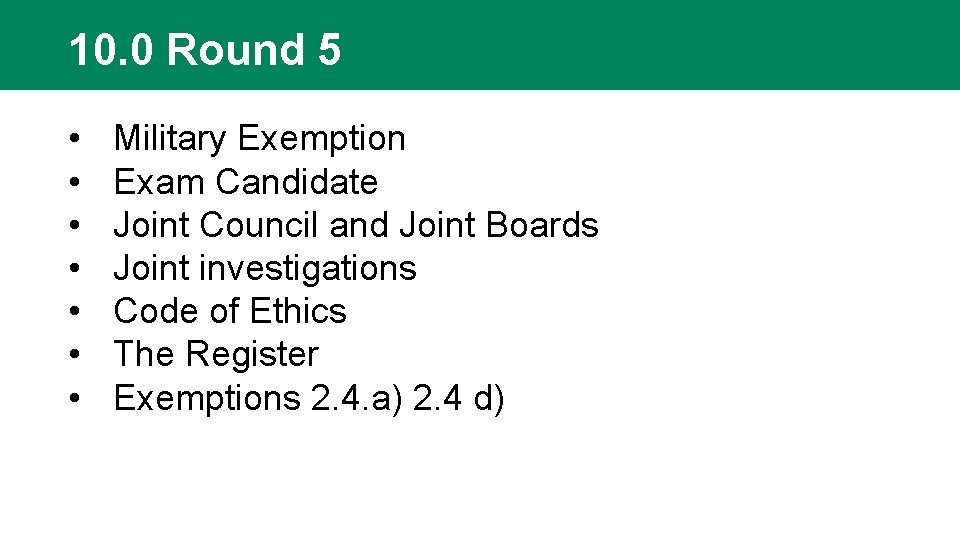
10. 0 Round 5 • • Military Exemption Exam Candidate Joint Council and Joint Boards Joint investigations Code of Ethics The Register Exemptions 2. 4. a) 2. 4 d)