WHY DO PORN FILMS SUCK THE PARADOX OF



- Slides: 36
WHY DO PORN FILMS SUCK?
THE PARADOX OF PORN • Pornographic films are rarely classified as art. • Yet, pornographic films share much in common with works that are classified as art. • That is puzzling and cries out for explanation.
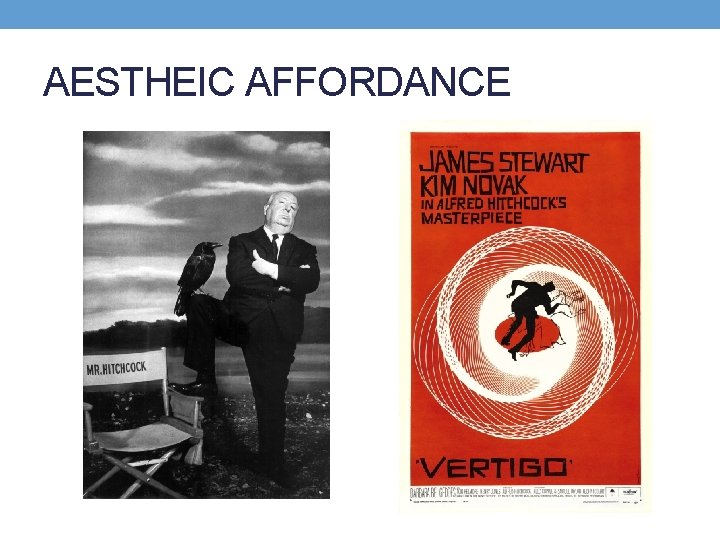
AESTHEIC AFFORDANCE
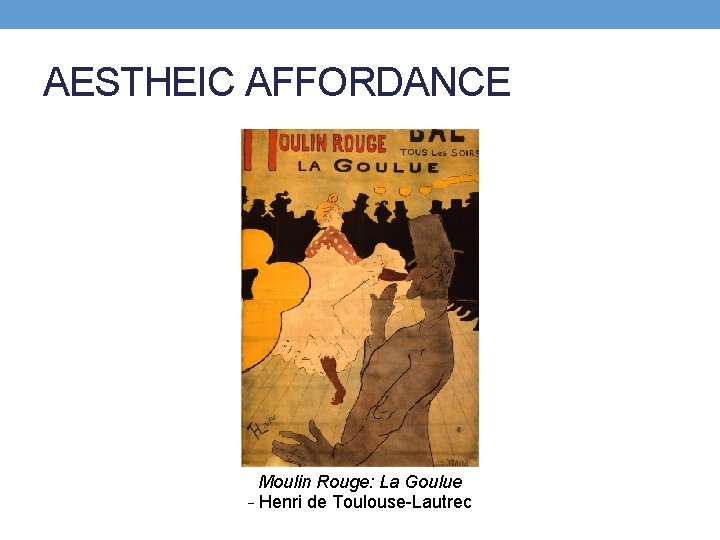
AESTHEIC AFFORDANCE Moulin Rouge: La Goulue – Henri de Toulouse-Lautrec
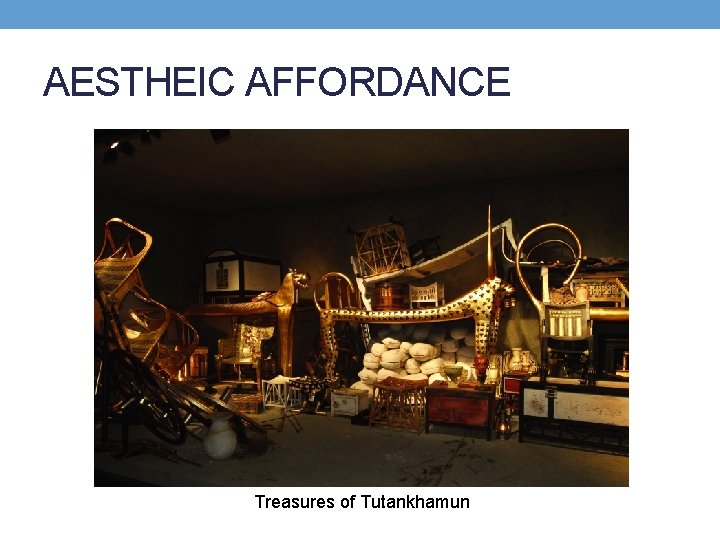
AESTHEIC AFFORDANCE Treasures of Tutankhamun
ART RECOGNITION • Cluster theories of art - There a number of prototypical features that count toward something being art. - Possessing an appropriate subset of these features is sufficient for something to be art. - The essence of art and what counts as evidence that something is art coincide. • Traditional theories of art - There is a single feature that is both necessary and sufficient for something to be art. - The essence of art and what counts as evidence that something is art are distinct.
PROTYPICAL CHARACTERISTICS 1. Artworks tend to be created in pre-established media 2. 3. 4. 5. 6. (painting, sculpture, film). Artworks tend to have aesthetic properties (beauty, gracefulness, balance). Artworks tend to be exercises of the imagination. Artworks tend to be executed with skill; they are usually meant to impress. Artworks tend to operate within identifiable genres and to obey genre conventions; otherwise, they are meant to violate those conventions. Artworks tend to engage us emotionally.
ART FILMS 1. Art films tend to have non-narrative structures and counter-normative themes. 2. Some art films challenge the illusionism of conventional cinema: they have “amateurish” production values and feature “Brechtian” acting. 3. Other art films present life “in a way that is gritty and uncensored, capturing aspects of life that might be hidden from view in films made for mass consumption” (164)
PORNOGRAPHIC FILMS 1. Pornographic films are made in a standard artistic 2. 3. 4. 5. 6. medium. It is not uncommon to deploy aesthetic concepts when watching pornographic films (“beautiful, ” “gorgeous”). Pornography tends to be imaginative in that it departs from everyday life. Performances in pornographic films show considerable skill, such as athleticism and stamina. Pornographic films operate within an identifiable genre. Pornographic films arouse strong emotions.
PORNOGRAPHIC FILMS 7. Pornographic films tend to downplay narrative. 8. Pornographic films often challenge conventional morality. 9. Pornographic films are often gritty in a way that is characteristic of realism (such as cinéma vérité).
THE PARADOX OF PORN • Pornographic films are rarely classified as art. • Yet, pornographic films share much in common with works that are classified as art. • That is puzzling and cries out for explanation. • “A solution to this paradox would specify why, in light of all the similarities, we don’t tend to classify porn as art, much less as good art. What prevents us from doing so? ” (166– 67).
INCOMPATIBILITY THEORIES • According to these theories, it should come as no surprise that pornographic films are rarely classified as art. • It is a priori that art and pornography are incompatible.
THE OPPOSITIONAL THEORY • According to the oppositional theory, “[A]rt is concerned with suggestion, beauty, contemplation, complexity, originality, imagination, or a combination of these properties, whereas pornography is explicit, ugly, simple, repetitive, and invites us into the realm of lust and fantasy” (168). • The oppositional theory faces a number of initial problems. - It defines art and pornography too narrowly. - It conflates art with good art. - It reflects a limited knowledge of pornography. - It appears to be based on a “moralistic desire to protect art from pornography’s bad taste” (169).
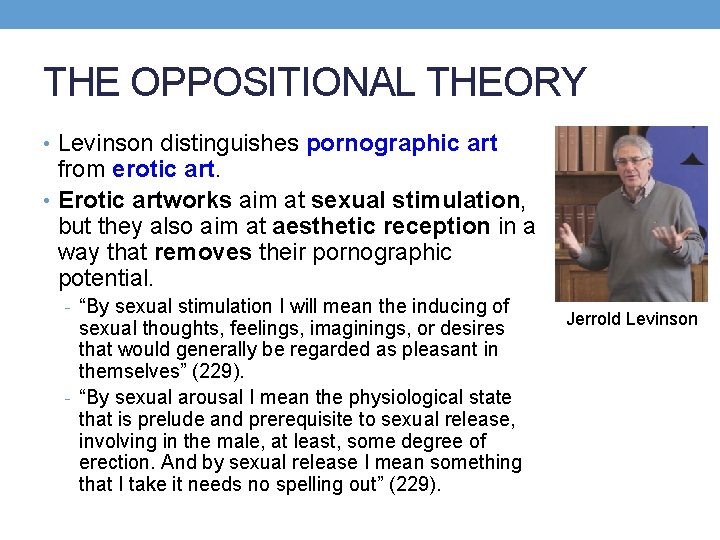
THE OPPOSITIONAL THEORY • Levinson distinguishes pornographic art from erotic art. • Erotic artworks aim at sexual stimulation, but they also aim at aesthetic reception in a way that removes their pornographic potential. - “By sexual stimulation I will mean the inducing of sexual thoughts, feelings, imaginings, or desires that would generally be regarded as pleasant in themselves” (229). - “By sexual arousal I mean the physiological state that is prelude and prerequisite to sexual release, involving in the male, at least, some degree of erection. And by sexual release I mean something that I take it needs no spelling out” (229). Jerrold Levinson
THE OPPOSITIONAL THEORY 1) Erotic art consists of images centrally aimed at a certain sort 2) 3) 4) 5) of reception R 1. Pornography consists of images centrally aimed at a certain sort of reception R 2. R 1 essentially involves attention to form/vehicle/medium/manner, and so entails treating images as in part opaque. R 2 essentially excludes attention to form/vehicle/medium/manner, and so entails treating images as wholly transparent. R 1 and R 2 are incompatible. 6) So: nothing can be both erotic art and pornography; or at the least, nothing can be coherently projected as both erotic art and pornography; or at the very least, nothing can succeed
THE OPPOSITIONAL THEORY • It is far from clear that so-called “erotic art” consists of images that are centrally aimed at a reception that essentially involves attention to form/vehicle/medium/manner. • Some erotic artworks appear to have such a reception as a secondary aim and the reception at which pornography allegedly aims as a primary aim. • There is no reason to think that the very same film can’t afford both R 1 and R 2 (depending on the audience or scene). • This suggests that the conclusion of the argument must be significantly weakened to the claim that certain kinds of experience are incompatible.
THE OPPOSITIONAL THEORY • Why think that pornographic films must aim at producing wholly transparent images? • It is possible for a pornographic film to aim at producing partially opaque images. • “Concretely this means that in art the troubling experience of brute carnality (pleasure, violence, disgust. . . ) can enhance or even constitute the core of the aesthetic reception” (173).
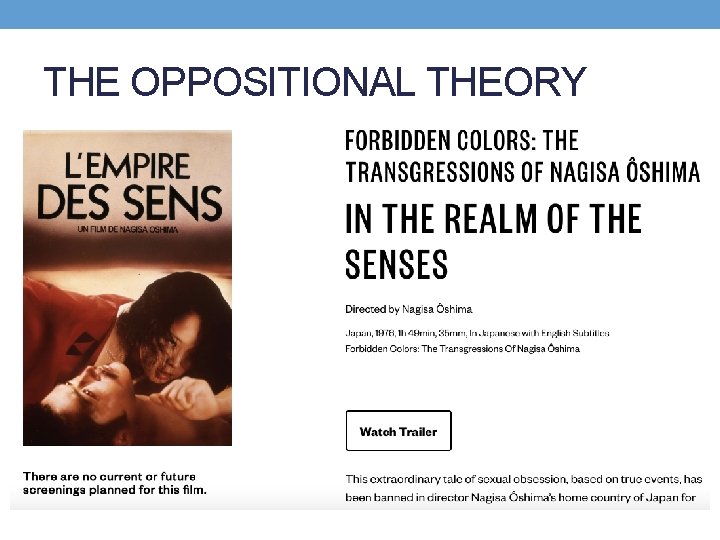
THE OPPOSITIONAL THEORY • Some Japanese films within the “pink film” genre were originally aimed (to some extent? ) at sexual arousal. • Some of these films are now screened in “art house” contexts (appropriated as art? ). • If a work cannot aim at both kinds of reception (R 1 and R 2), this should have been impossible!
THE OPPOSITIONAL THEORY
THE OPPOSITIONAL THEORY • The claim that pornography primarily aims at reception R 2 (which essentially excludes attention to form/vehicle/medium/manner) is unfairly limited. • Levinson’s characterization of sexual arousal is both limited and exclusionary. • Even if it characterized the primary reception of (most) pornography, it isn’t plausible to think that such a reception is essential to pornography or that it is a priori that pornography must aim at this reception.
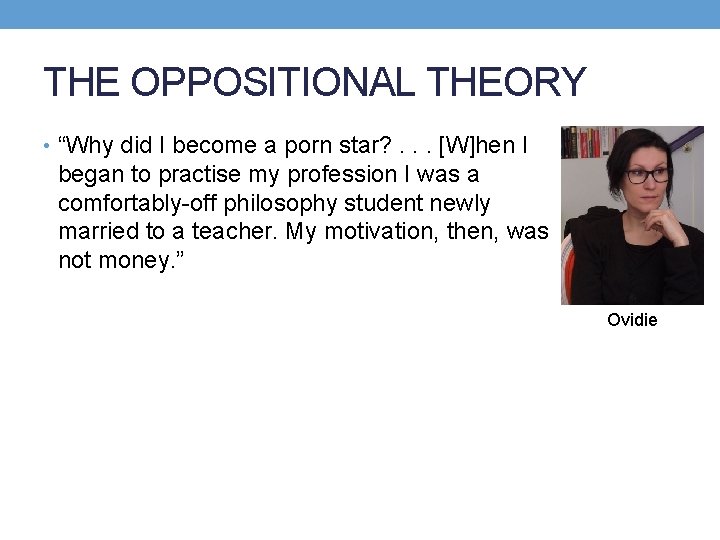
THE OPPOSITIONAL THEORY • “Why did I become a porn star? . . . [W]hen I began to practise my profession I was a comfortably-off philosophy student newly married to a teacher. My motivation, then, was not money. ” Ovidie
THE OPPOSITIONAL THEORY • “Why did I decide to act in these movies? I began to think that feminism and pornography might not be incompatible after all. Since feminists’ battleground is sexuality, they have to become involved in its representation - and therefore in pornographic movies. All these new ideas led me into a world where these women whom I had once pitied now seemed admirable and impressive. I wanted to have an equally powerful sexual image. ” Ovidie
THE OPPOSITIONAL THEORY • “The other reason was my fascination with the body, as a keen amateur dancer and choreographer interested in the whole area of movement. I see a pornographic scene as a piece of choreography that involves the whole body, in which one must show the emotions by moving, by tensing one's muscles, by trembling and by letting go. It's a very interesting exercise in physical expression. ” Ovidie
THE ARGUMENT FROM EMOTION • Some artistic genres centrally aim at arousing certain kinds of emotions. - Tragedy aims at provoking sadness. - Horror aims at provoking fear and disgust. - Mystery aims at provoking curiosity and surprise. • So why shouldn’t there be an artistic genre that centrally aims at provoking sexual arousal? • It might be objected that this is the job for erotic art, which doesn’t aim at release. • But that seems completely arbitrary.
REDRESSING THE PARADOX • Most pornographic films cause sexual arousal in an “automatic” way. • This renders these films “cheap” and “superficial. ” • “Consider, by analogy, a mainstream director who manipulates strong emotions by using overpowering music, or a tight close-up of a crying face. A tearjerker is less impressive when the director uses such simple tricks” (178). • This suggestion may be close to right, but it rules too much out.
REDRESSING THE PARADOX • Another suggestion is that the artistically relevant features of many pornographic films aren’t intentional (in the right sort of way). - It may be possible to appropriate these pornographic films into an artworld context and subsequently view them as works of art. - “But this would be an ironic gesture, since these films are not [originally? ] meant to be viewed this way” (180). • What if we discovered that a pornographic artist did have the relevant intentions?
REDRESSING THE PARADOX • The most comprehensive explanation is that pornographic films simply fail to afford an aesthetic stance, despite exhibiting a large number of features that ordinarily count toward art-status. Why? • They fail to manifest an aspiration to excellence in exhibiting those features. - They set up “artistic problems” that are unimpressive to solve— such as provoking sexual arousal in an “automatic” way—and they don’t show any interest in compensating for this cheapness. - They fail to exhibit distinctive styles. - They emphasize content over form, which is why many of them prompt transparent receptions.
REDRESSING THE PARADOX • “Standard porn films don’t impress us, they don’t make us tremble and fear, they don’t inspire us with awe or capture us by surprise: we are not impressed or unsettled by the way this sexual gratification came about. Good pornographic art should be like good sex, artful sex: we are not only sexually satisfied but also dazzled by this sexual satisfaction” (183– 84).
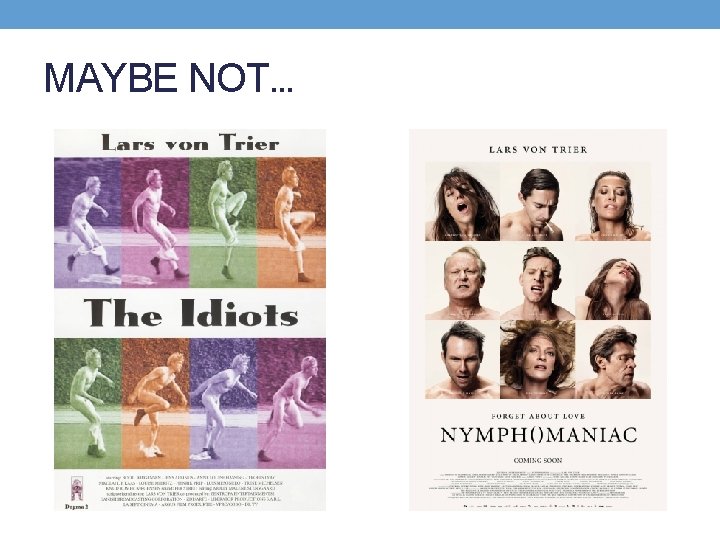
HOW PORN COULD BE BETTER 1. Pornographic artists could attempt to provoke sexual arousal in new and interesting ways. 2. They could create scenes that are emotionally complex. 3. They could impose distinctive styles upon their films. 4. They could set out to violate genre conventions.
EXAMPLES?
MAYBE NOT…
MAYBE NOT…
MAYBE NOT…
PERHAPS
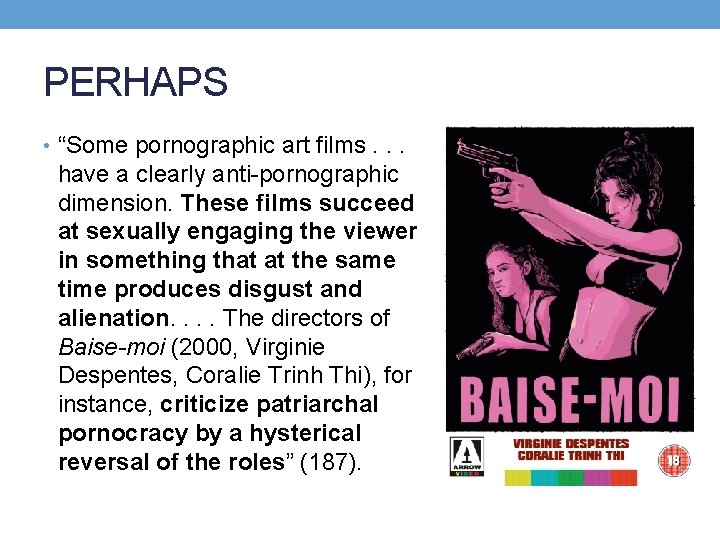
PERHAPS • “Some pornographic art films. . . have a clearly anti-pornographic dimension. These films succeed at sexually engaging the viewer in something that at the same time produces disgust and alienation. . The directors of Baise-moi (2000, Virginie Despentes, Coralie Trinh Thi), for instance, criticize patriarchal pornocracy by a hysterical reversal of the roles” (187).
PRACTICAL IMPLICATIONS • “We want to note, in closing, that there is a further reason for producing artistic pornography. Artistic porn is less morally problematic than conventional porn. . 1. [I]t gives voice to sexualities that have been deemed deviant and silenced. 2. [I]t would be less objectifying for performers; when porn is made for artistic expression rather than mere gratification, those involved can see themselves as part of a creative process rather than as a mere means to gratification. 3. [T]o the extent that viewing conventional pornography promotes mistreatment of women, viewing art porn might help promote more progressive attitudes, by, for example, reversing traditional gender roles or otherwise complicating gender dichotomies that fuel patriarchy” (188– 89).