Wait Events in RAC Session 362 Arup Nanda
- Slides: 25
Wait Events in RAC Session 362 Arup Nanda Longtime Oracle DBA arup. blogspot. com
What is This? • RAC Performance Tuning – I teach a course – Performance Tuning in RAC • Wait events are useful for understanding the bottlenecks • All single instance wait events are applicable to RAC • RAC has some special cases • This session talks about those RAC-specific wait events • This is just a subset of the events; not a comprehensive list Wait Events in RAC 2
What’s a Wait? • A process in Oracle can only be in three states – Doing something Useful (consuming CPU) …. . U – Idle, waiting for some work to be assigned …. . I – Waiting for something, e. g. …. . W • a block from disk • a lock • a latch (could be waiting on CPU) • Response time = U + I + W • We must accurately measure each component time before we decide what and how to tune Wait Events in RAC 3
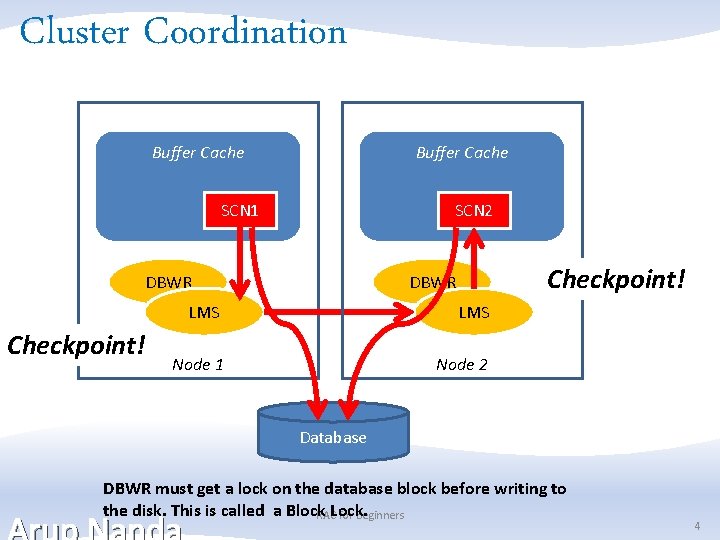
Cluster Coordination Buffer Cache SCN 1 SCN 2 DBWR Checkpoint! DBWR LMS Node 1 Node 2 Database DBWR must get a lock on the database block before writing to the disk. This is called a Block RACLock. for Beginners 4
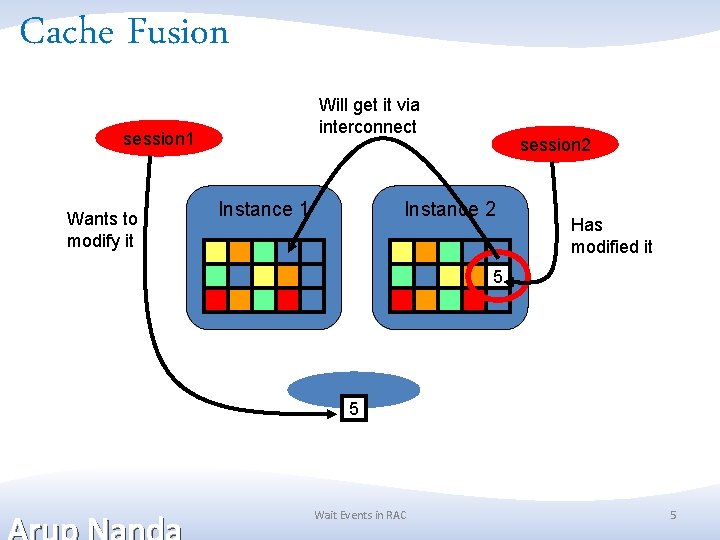
Cache Fusion Will get it via interconnect session 1 Wants to modify it Instance 1 session 2 Instance 2 Has modified it 5 5 Wait Events in RAC 5
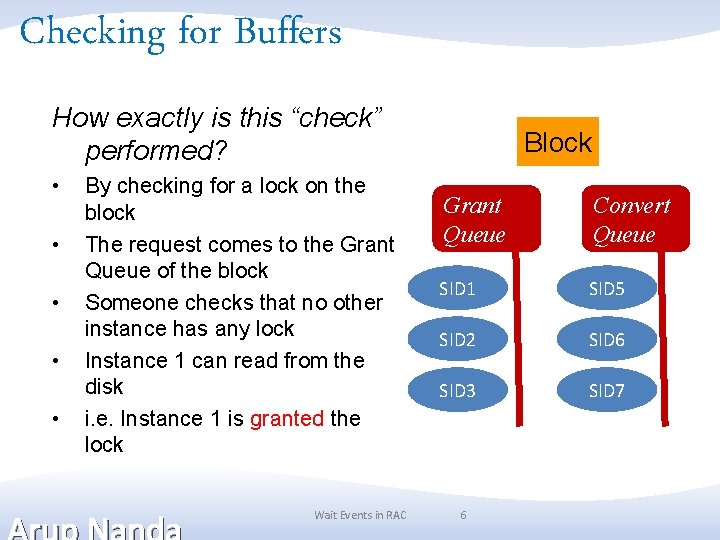
Checking for Buffers How exactly is this “check” performed? • • • By checking for a lock on the block The request comes to the Grant Queue of the block Someone checks that no other instance has any lock Instance 1 can read from the disk i. e. Instance 1 is granted the lock Wait Events in RAC Block Grant Queue Convert Queue SID 1 SID 5 SID 2 SID 6 SID 3 SID 7 6
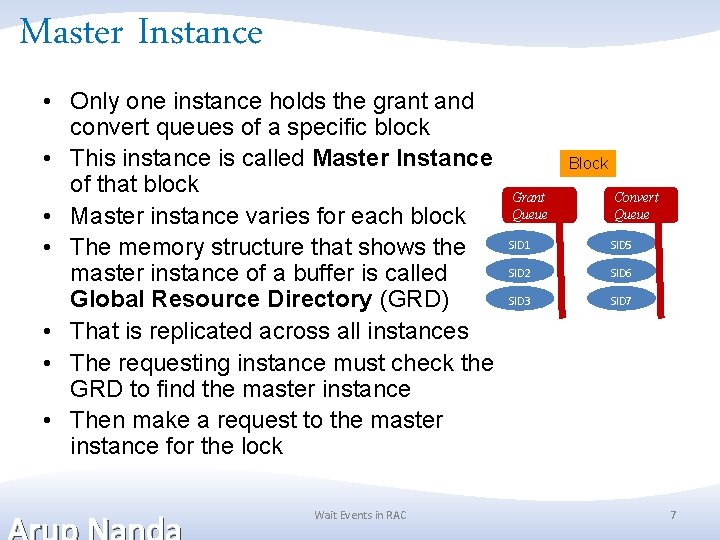
Master Instance • Only one instance holds the grant and convert queues of a specific block • This instance is called Master Instance of that block • Master instance varies for each block • The memory structure that shows the master instance of a buffer is called Global Resource Directory (GRD) • That is replicated across all instances • The requesting instance must check the GRD to find the master instance • Then make a request to the master instance for the lock Wait Events in RAC Block Grant Queue Convert Queue SID 1 SID 5 SID 2 SID 6 SID 3 SID 7 7
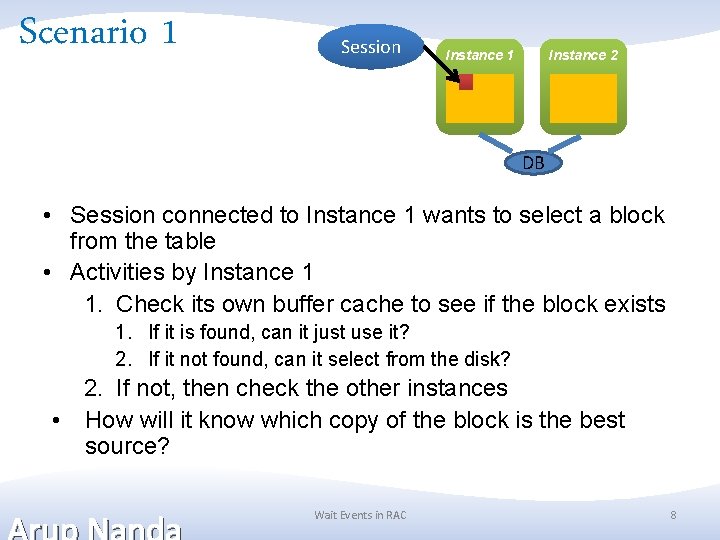
Scenario 1 Session Instance 1 Instance 2 DB • Session connected to Instance 1 wants to select a block from the table • Activities by Instance 1 1. Check its own buffer cache to see if the block exists 1. If it is found, can it just use it? 2. If it not found, can it select from the disk? 2. If not, then check the other instances • How will it know which copy of the block is the best source? Wait Events in RAC 8
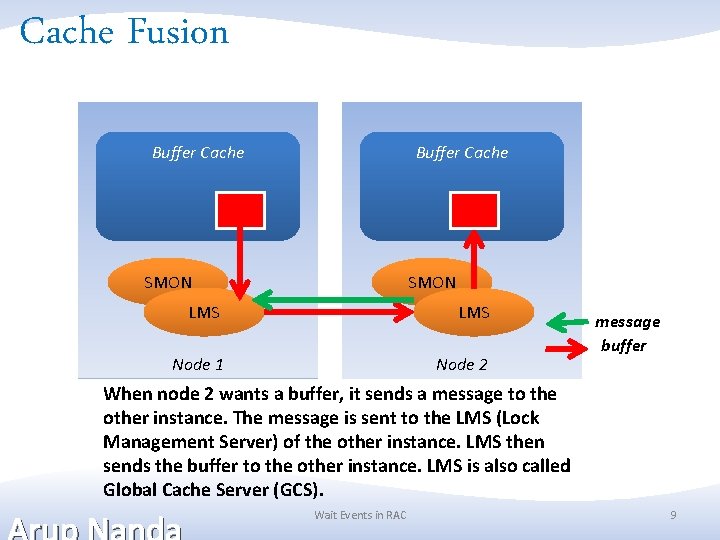
Cache Fusion Buffer Cache SMON LMS Node 1 Node 2 message buffer When node 2 wants a buffer, it sends a message to the other instance. The message is sent to the LMS (Lock Management Server) of the other instance. LMS then sends the buffer to the other instance. LMS is also called Global Cache Server (GCS). Wait Events in RAC 9
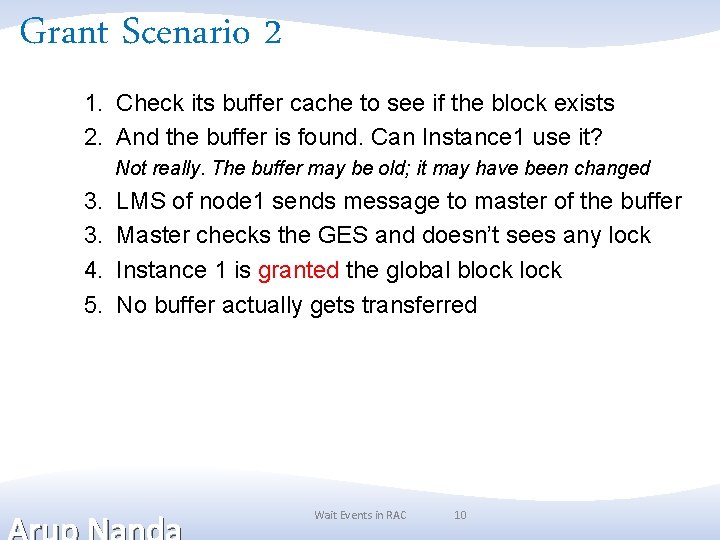
Grant Scenario 2 1. Check its buffer cache to see if the block exists 2. And the buffer is found. Can Instance 1 use it? Not really. The buffer may be old; it may have been changed 3. 3. 4. 5. LMS of node 1 sends message to master of the buffer Master checks the GES and doesn’t sees any lock Instance 1 is granted the global block No buffer actually gets transferred Wait Events in RAC 10
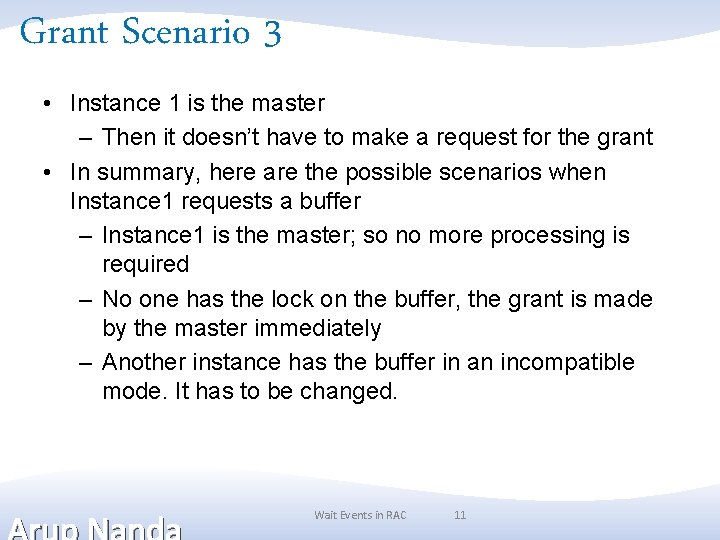
Grant Scenario 3 • Instance 1 is the master – Then it doesn’t have to make a request for the grant • In summary, here are the possible scenarios when Instance 1 requests a buffer – Instance 1 is the master; so no more processing is required – No one has the lock on the buffer, the grant is made by the master immediately – Another instance has the buffer in an incompatible mode. It has to be changed. Wait Events in RAC 11
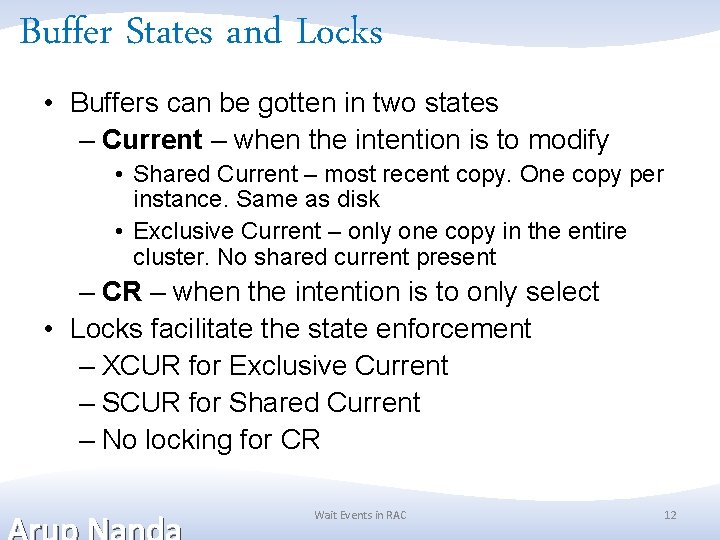
Buffer States and Locks • Buffers can be gotten in two states – Current – when the intention is to modify • Shared Current – most recent copy. One copy per instance. Same as disk • Exclusive Current – only one copy in the entire cluster. No shared current present – CR – when the intention is to only select • Locks facilitate the state enforcement – XCUR for Exclusive Current – SCUR for Shared Current – No locking for CR Wait Events in RAC 12
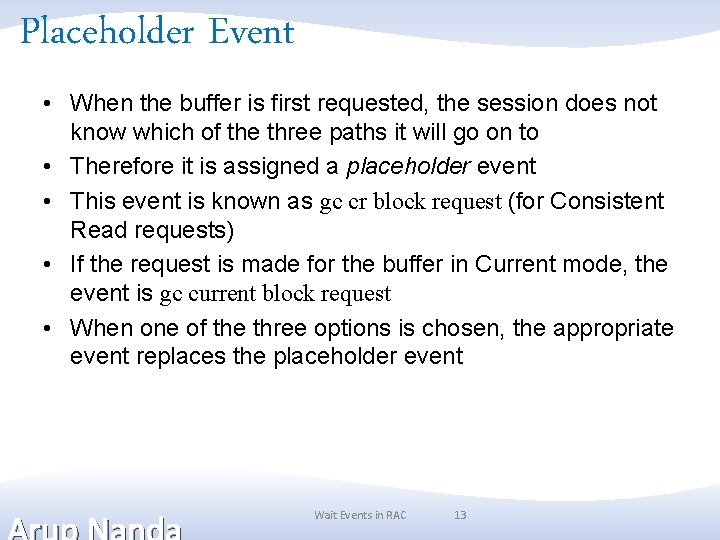
Placeholder Event • When the buffer is first requested, the session does not know which of the three paths it will go on to • Therefore it is assigned a placeholder event • This event is known as gc cr block request (for Consistent Read requests) • If the request is made for the buffer in Current mode, the event is gc current block request • When one of the three options is chosen, the appropriate event replaces the placeholder event Wait Events in RAC 13
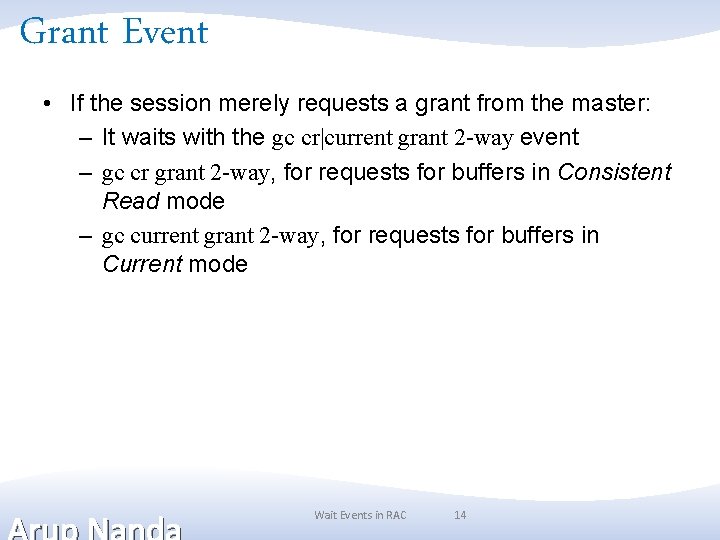
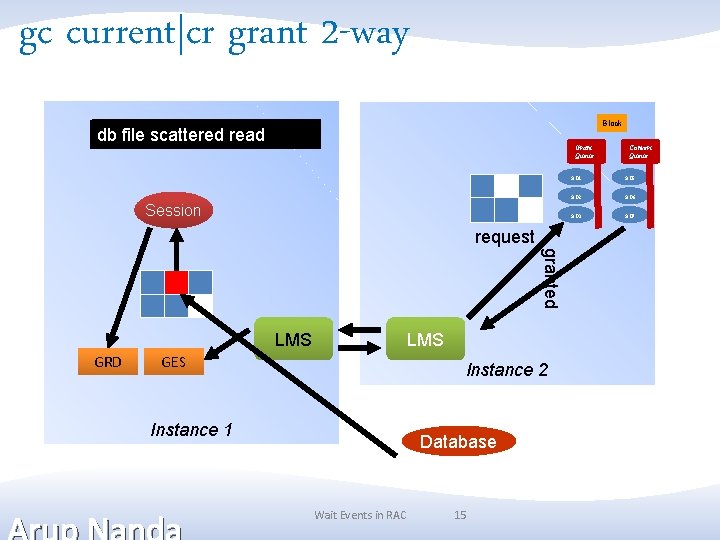
Grant Event • If the session merely requests a grant from the master: – It waits with the gc cr|current grant 2 -way event – gc cr grant 2 -way, for requests for buffers in Consistent Read mode – gc current grant 2 -way, for requests for buffers in Current mode Wait Events in RAC 14
gc current|cr grant 2 -way Block gc file current block read grant 2 -way request db scattered Grant Queue Session request granted LMS GRD LMS GES Instance 2 Instance 1 Database Wait Events in RAC 15 Convert Queue SID 1 SID 5 SID 2 SID 6 SID 3 SID 7
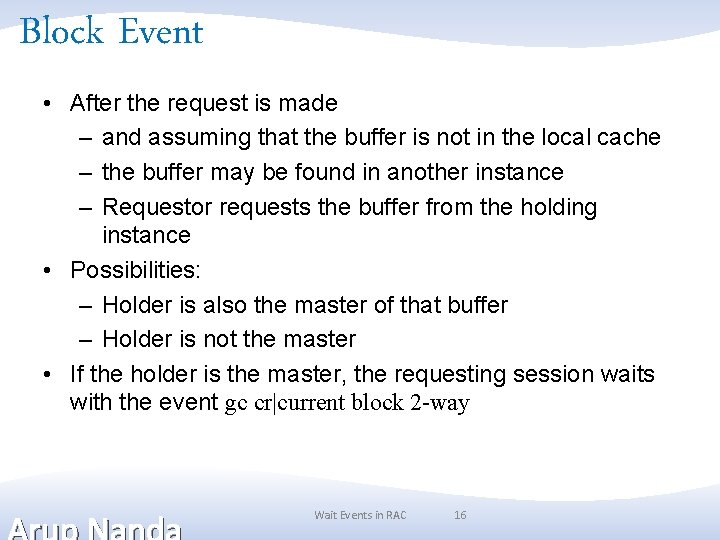
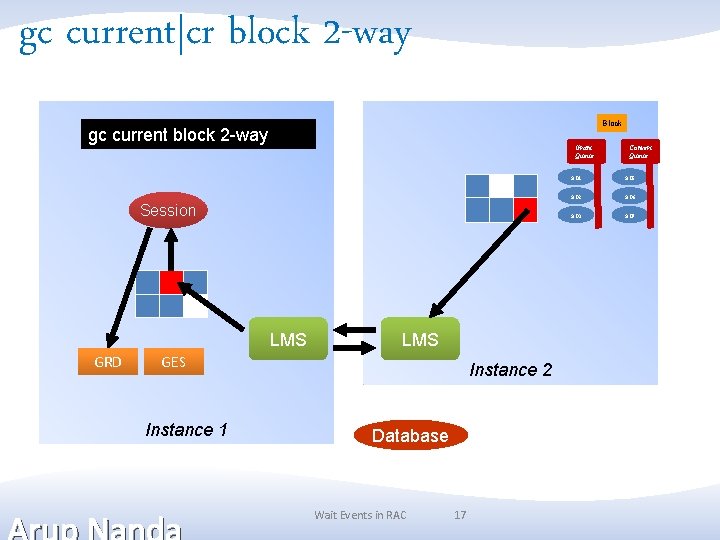
Block Event • After the request is made – and assuming that the buffer is not in the local cache – the buffer may be found in another instance – Requestor requests the buffer from the holding instance • Possibilities: – Holder is also the master of that buffer – Holder is not the master • If the holder is the master, the requesting session waits with the event gc cr|current block 2 -way Wait Events in RAC 16
gc current|cr block 2 -way Block gc gccurrentblock 2 -way request Grant Queue Session LMS GRD LMS GES Instance 1 Instance 2 Database Wait Events in RAC 17 Convert Queue SID 1 SID 5 SID 2 SID 6 SID 3 SID 7
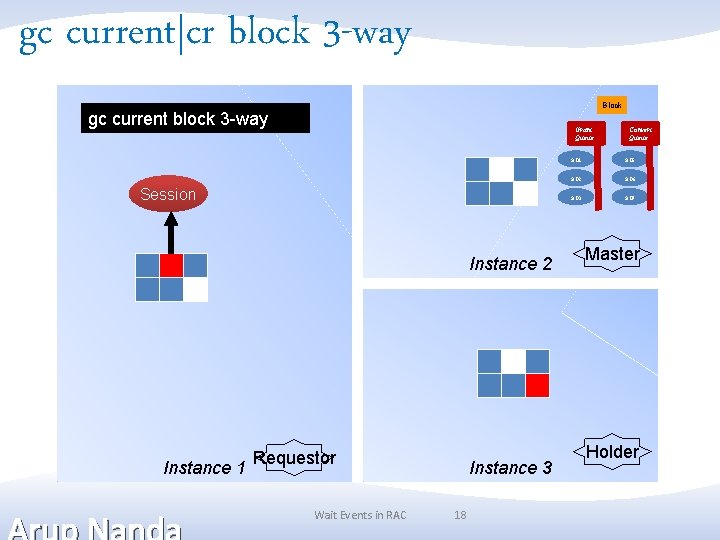
gc current|cr block 3 -way Block gc current block 3 -way Grant Queue Session Instance 2 Instance 1 Requestor Wait Events in RAC Instance 3 18 Convert Queue SID 1 SID 5 SID 2 SID 6 SID 3 SID 7 Master Holder
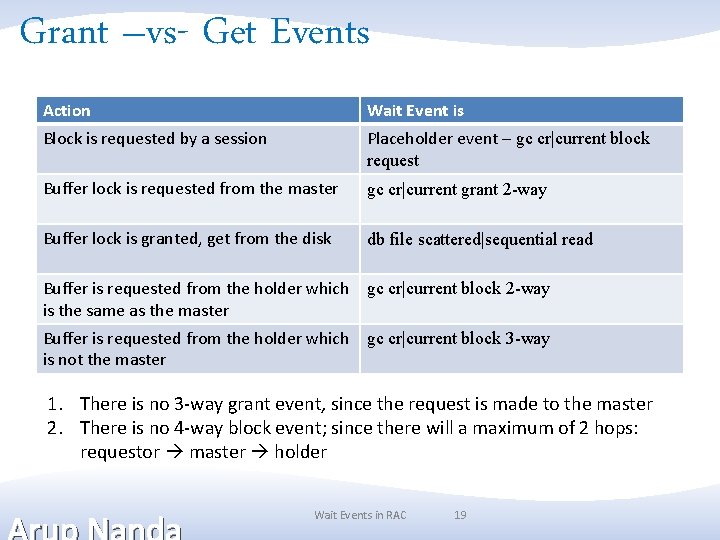
Grant –vs- Get Events Action Wait Event is Block is requested by a session Placeholder event – gc cr|current block request Buffer lock is requested from the master gc cr|current grant 2 -way Buffer lock is granted, get from the disk db file scattered|sequential read Buffer is requested from the holder which gc cr|current block 2 -way is the same as the master Buffer is requested from the holder which gc cr|current block 3 -way is not the master 1. There is no 3 -way grant event, since the request is made to the master 2. There is no 4 -way block event; since there will a maximum of 2 hops: requestor master holder Wait Events in RAC 19
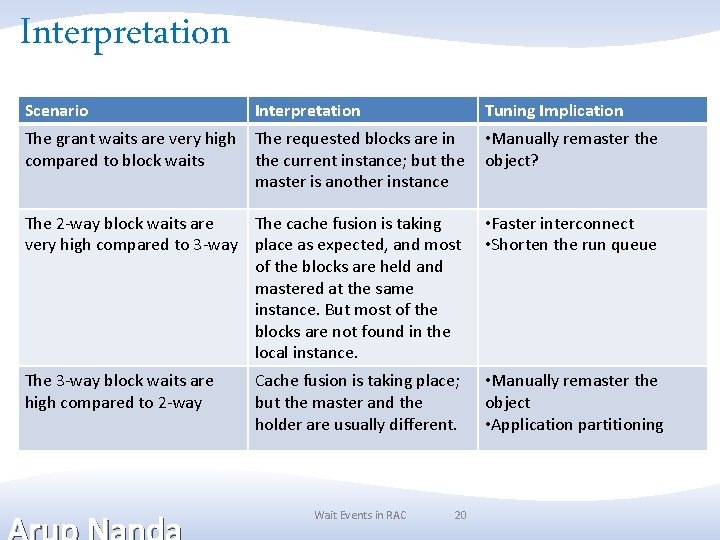
Interpretation Scenario Interpretation Tuning Implication The grant waits are very high compared to block waits The requested blocks are in the current instance; but the master is another instance • Manually remaster the object? The 2 -way block waits are The cache fusion is taking very high compared to 3 -way place as expected, and most of the blocks are held and mastered at the same instance. But most of the blocks are not found in the local instance. • Faster interconnect • Shorten the run queue The 3 -way block waits are high compared to 2 -way • Manually remaster the object • Application partitioning Cache fusion is taking place; but the master and the holder are usually different. Wait Events in RAC 20
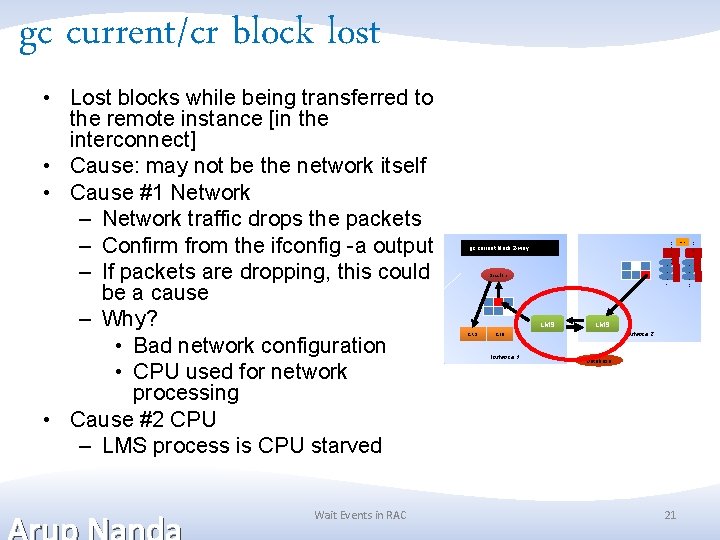
gc current/cr block lost • Lost blocks while being transferred to the remote instance [in the interconnect] • Cause: may not be the network itself • Cause #1 Network – Network traffic drops the packets – Confirm from the ifconfig -a output – If packets are dropping, this could be a cause – Why? • Bad network configuration • CPU used for network processing • Cause #2 CPU – LMS process is CPU starved Wait Events in RAC gc gccurrentblock 2 -way request S I D 1 S I D 2 S I D 3 Session LMS GRD LMS Instance 2 GES Instance 1 G r a n t Q u e Database 21 Block S I D 5 S I D 6 S I D 7 C o n v e r t Q u e
gc current/cr block busy • What it Means – Session wants a block from the remote instance – Remote instance delays preparing the block to fulfill the request [CR or current] read • Cause: – Local delay on the remote instance – Most likely: an I/O bottleneck on the remote instance • block is being accessed by some session which is CPU starved • LGWR has not written a buffer to redo yet – Less likely: CPU starvation Wait Events in RAC 22
gc current/cr block congested • Meaning – The instance has requested block from remote instance. – Remote instance has prepared the block and shipped it • but it has not reached the requesting instance within 1 ms. • What could be cause – network bottleneck? • Not necessarily. Causes: – Long run queues, causing the LMS process to be delayed in processing the incoming block – Heavy paging due to memory deficiency. This causes the blocks to be paged in before being processed. Wait Events in RAC 23
Putting it All Together • Every Oracle process is either – Doing some productive work – Waiting for some work to be given (idle) – Waiting for some resource • Understand the reason for the wait – Devise a plan accordingly • RAC related wait events are manifestations of these issues mostly • Caused by – Network issues – LMS being overloaded – Blocks busy Wait Events in RAC 24
Thank You! Session 362 • More Information: – Blog: arup. blogspot. com • 100 Things You Probably Didn't Know About Oracle Database http: //bit. ly/evr 05 e – Twitter: arupnanda Wait Events in RAC 25