
Problem 11 29 p 362 For the examination
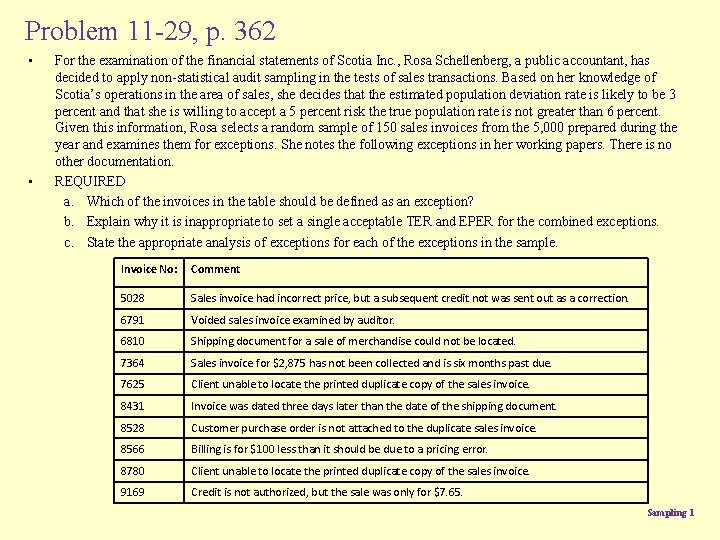
Problem 11 -29, p. 362 • • For the examination of the financial statements of Scotia Inc. , Rosa Schellenberg, a public accountant, has decided to apply non-statistical audit sampling in the tests of sales transactions. Based on her knowledge of Scotia’s operations in the area of sales, she decides that the estimated population deviation rate is likely to be 3 percent and that she is willing to accept a 5 percent risk the true population rate is not greater than 6 percent. Given this information, Rosa selects a random sample of 150 sales invoices from the 5, 000 prepared during the year and examines them for exceptions. She notes the following exceptions in her working papers. There is no other documentation. REQUIRED a. Which of the invoices in the table should be defined as an exception? b. Explain why it is inappropriate to set a single acceptable TER and EPER for the combined exceptions. c. State the appropriate analysis of exceptions for each of the exceptions in the sample. Invoice No: Comment 5028 Sales invoice had incorrect price, but a subsequent credit not was sent out as a correction. 6791 Voided sales invoice examined by auditor. 6810 Shipping document for a sale of merchandise could not be located. 7364 Sales invoice for $2, 875 has not been collected and is six months past due. 7625 Client unable to locate the printed duplicate copy of the sales invoice. 8431 Invoice was dated three days later than the date of the shipping document. 8528 Customer purchase order is not attached to the duplicate sales invoice. 8566 Billing is for $100 less than it should be due to a pricing error. 8780 Client unable to locate the printed duplicate copy of the sales invoice. 9169 Credit is not authorized, but the sale was only for $7. 65. Sampling 1
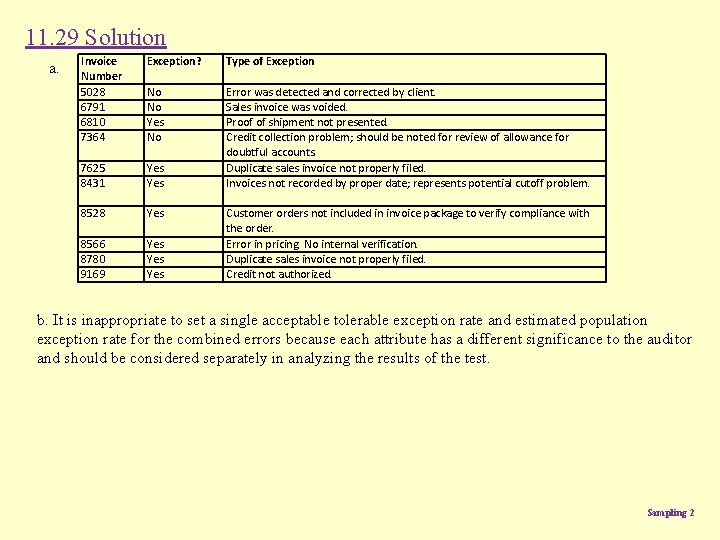
11. 29 Solution a. Invoice Number 5028 6791 6810 7364 Exception? Type of Exception No No Yes No 7625 8431 Yes Error was detected and corrected by client. Sales invoice was voided. Proof of shipment not presented. Credit collection problem; should be noted for review of allowance for doubtful accounts. Duplicate sales invoice not properly filed. Invoices not recorded by proper date; represents potential cutoff problem. 8528 Yes 8566 8780 9169 Yes Yes Customer orders not included in invoice package to verify compliance with the order. Error in pricing. No internal verification. Duplicate sales invoice not properly filed. Credit not authorized. b. It is inappropriate to set a single acceptable tolerable exception rate and estimated population exception rate for the combined errors because each attribute has a different significance to the auditor and should be considered separately in analyzing the results of the test. Sampling 2
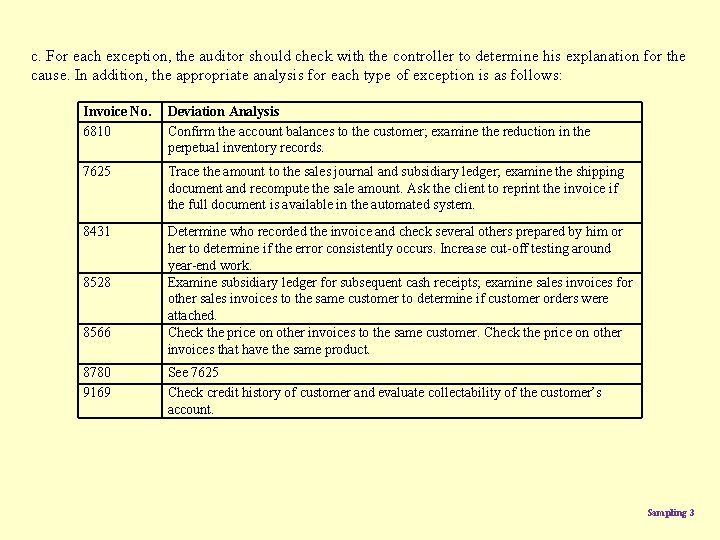
c. For each exception, the auditor should check with the controller to determine his explanation for the cause. In addition, the appropriate analysis for each type of exception is as follows: Invoice No. 6810 Deviation Analysis Confirm the account balances to the customer; examine the reduction in the perpetual inventory records. 7625 Trace the amount to the sales journal and subsidiary ledger; examine the shipping document and recompute the sale amount. Ask the client to reprint the invoice if the full document is available in the automated system. 8431 Determine who recorded the invoice and check several others prepared by him or her to determine if the error consistently occurs. Increase cut-off testing around year-end work. Examine subsidiary ledger for subsequent cash receipts; examine sales invoices for other sales invoices to the same customer to determine if customer orders were attached. Check the price on other invoices to the same customer. Check the price on other invoices that have the same product. 8528 8566 8780 9169 See 7625 Check credit history of customer and evaluate collectability of the customer’s account. Sampling 3
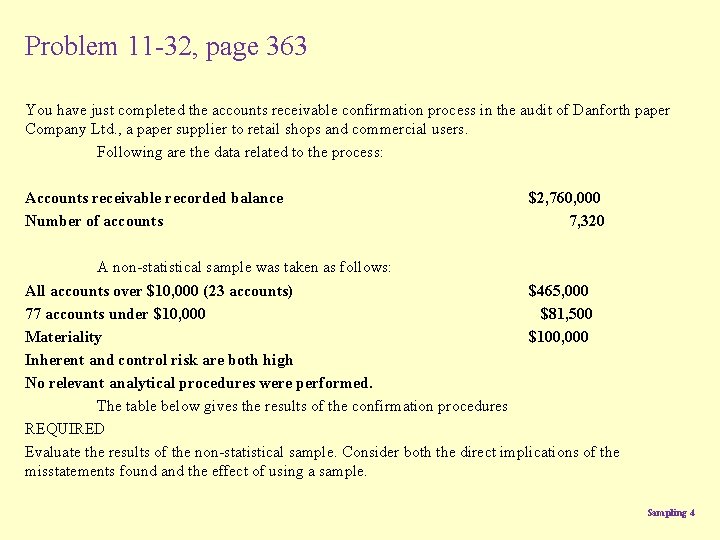
Problem 11 -32, page 363 You have just completed the accounts receivable confirmation process in the audit of Danforth paper Company Ltd. , a paper supplier to retail shops and commercial users. Following are the data related to the process: Accounts receivable recorded balance Number of accounts $2, 760, 000 7, 320 A non-statistical sample was taken as follows: All accounts over $10, 000 (23 accounts) $465, 000 77 accounts under $10, 000 $81, 500 Materiality $100, 000 Inherent and control risk are both high No relevant analytical procedures were performed. The table below gives the results of the confirmation procedures REQUIRED Evaluate the results of the non-statistical sample. Consider both the direct implications of the misstatements found and the effect of using a sample. Sampling 4
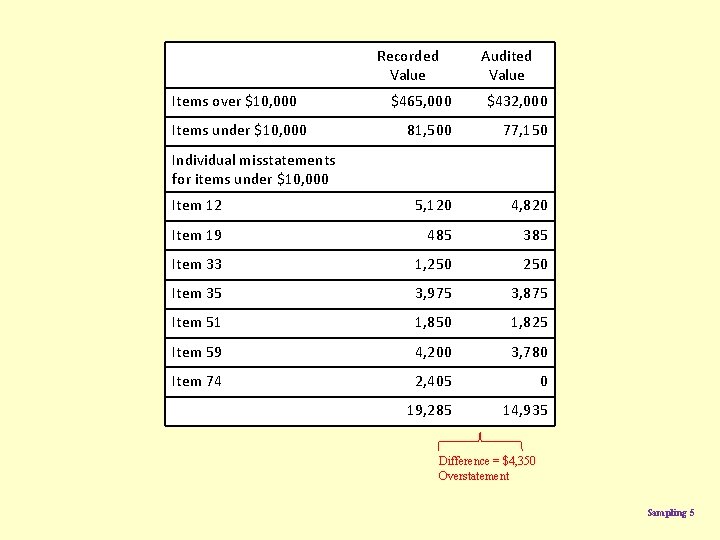
Recorded Value Items over $10, 000 Audited Value $465, 000 $432, 000 81, 500 77, 150 Item 12 5, 120 4, 820 Item 19 485 385 Item 33 1, 250 Item 35 3, 975 3, 875 Item 51 1, 850 1, 825 Item 59 4, 200 3, 780 Item 74 2, 405 0 19, 285 14, 935 Items under $10, 000 Individual misstatements for items under $10, 000 Difference = $4, 350 Overstatement Sampling 5
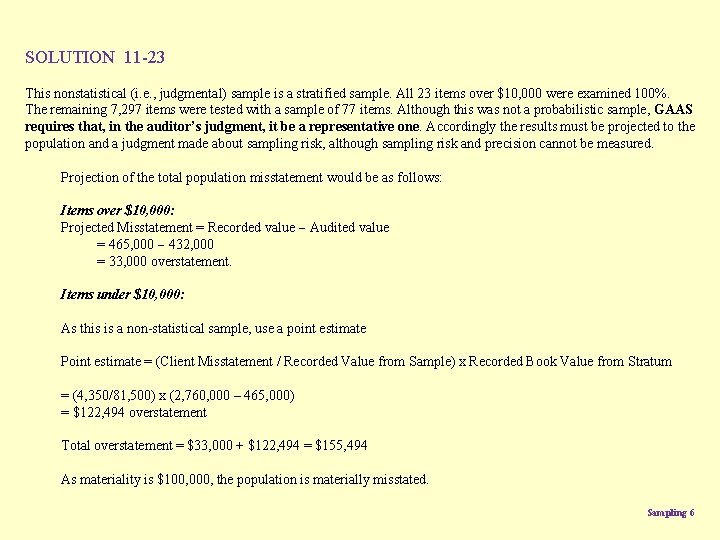
SOLUTION 11 -23 This nonstatistical (i. e. , judgmental) sample is a stratified sample. All 23 items over $10, 000 were examined 100%. The remaining 7, 297 items were tested with a sample of 77 items. Although this was not a probabilistic sample, GAAS requires that, in the auditor’s judgment, it be a representative one. Accordingly the results must be projected to the population and a judgment made about sampling risk, although sampling risk and precision cannot be measured. Projection of the total population misstatement would be as follows: Items over $10, 000: Projected Misstatement = Recorded value Audited value = 465, 000 432, 000 = 33, 000 overstatement. Items under $10, 000: As this is a non-statistical sample, use a point estimate Point estimate = (Client Misstatement / Recorded Value from Sample) x Recorded Book Value from Stratum = (4, 350/81, 500) x (2, 760, 000 – 465, 000) = $122, 494 overstatement Total overstatement = $33, 000 + $122, 494 = $155, 494 As materiality is $100, 000, the population is materially misstated. Sampling 6
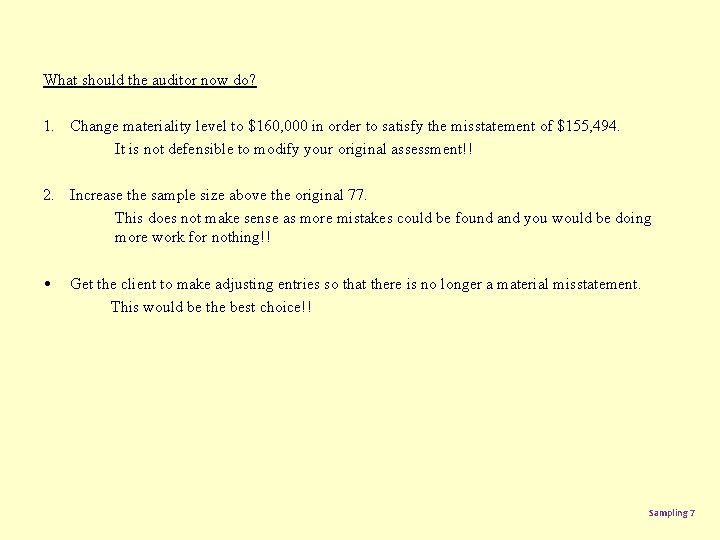
What should the auditor now do? 1. Change materiality level to $160, 000 in order to satisfy the misstatement of $155, 494. It is not defensible to modify your original assessment!! 2. Increase the sample size above the original 77. This does not make sense as more mistakes could be found and you would be doing more work for nothing!! • Get the client to make adjusting entries so that there is no longer a material misstatement. This would be the best choice!! Sampling 7
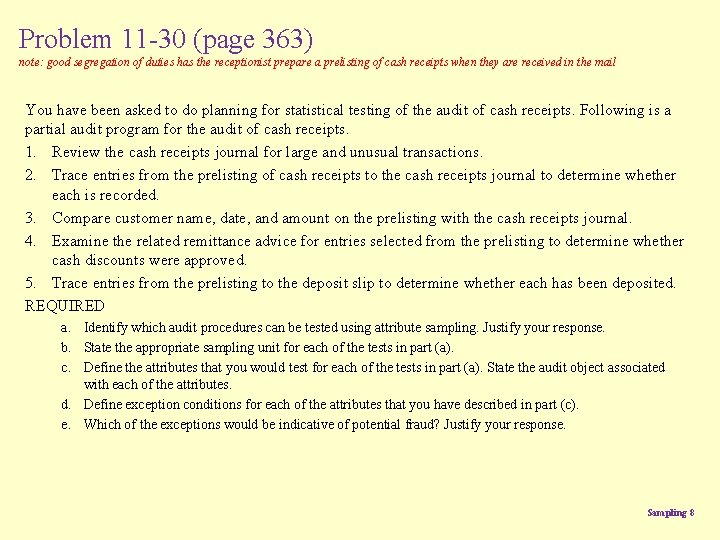
Problem 11 -30 (page 363) note: good segregation of duties has the receptionist prepare a prelisting of cash receipts when they are received in the mail You have been asked to do planning for statistical testing of the audit of cash receipts. Following is a partial audit program for the audit of cash receipts. 1. Review the cash receipts journal for large and unusual transactions. 2. Trace entries from the prelisting of cash receipts to the cash receipts journal to determine whether each is recorded. 3. Compare customer name, date, and amount on the prelisting with the cash receipts journal. 4. Examine the related remittance advice for entries selected from the prelisting to determine whether cash discounts were approved. 5. Trace entries from the prelisting to the deposit slip to determine whether each has been deposited. REQUIRED a. Identify which audit procedures can be tested using attribute sampling. Justify your response. b. State the appropriate sampling unit for each of the tests in part (a). c. Define the attributes that you would test for each of the tests in part (a). State the audit object associated with each of the attributes. d. Define exception conditions for each of the attributes that you have described in part (c). e. Which of the exceptions would be indicative of potential fraud? Justify your response. Sampling 8
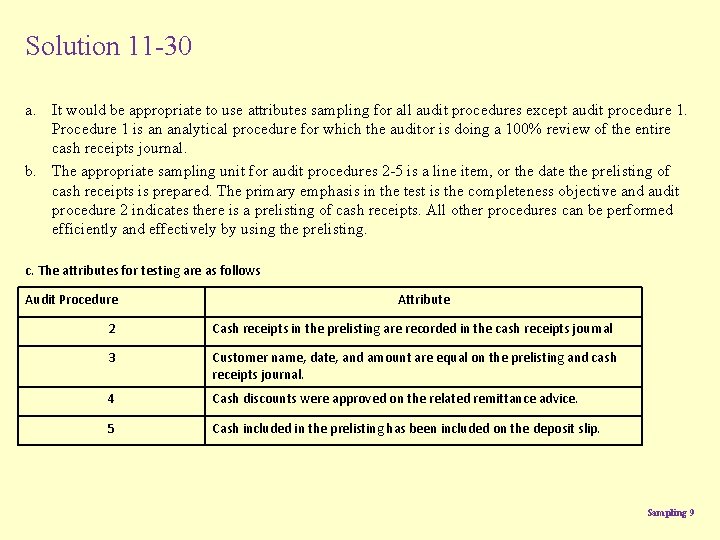
Solution 11 -30 a. It would be appropriate to use attributes sampling for all audit procedures except audit procedure 1. Procedure 1 is an analytical procedure for which the auditor is doing a 100% review of the entire cash receipts journal. b. The appropriate sampling unit for audit procedures 2 -5 is a line item, or the date the prelisting of cash receipts is prepared. The primary emphasis in the test is the completeness objective and audit procedure 2 indicates there is a prelisting of cash receipts. All other procedures can be performed efficiently and effectively by using the prelisting. c. The attributes for testing are as follows Audit Procedure Attribute 2 Cash receipts in the prelisting are recorded in the cash receipts journal 3 Customer name, date, and amount are equal on the prelisting and cash receipts journal. 4 Cash discounts were approved on the related remittance advice. 5 Cash included in the prelisting has been included on the deposit slip. Sampling 9
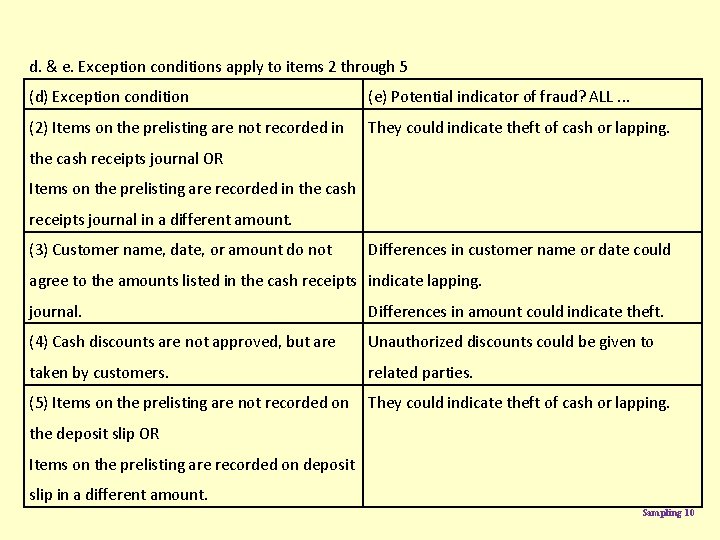
d. & e. Exception conditions apply to items 2 through 5 (d) Exception condition (e) Potential indicator of fraud? ALL. . . (2) Items on the prelisting are not recorded in They could indicate theft of cash or lapping. the cash receipts journal OR Items on the prelisting are recorded in the cash receipts journal in a different amount. (3) Customer name, date, or amount do not Differences in customer name or date could agree to the amounts listed in the cash receipts indicate lapping. journal. Differences in amount could indicate theft. (4) Cash discounts are not approved, but are Unauthorized discounts could be given to taken by customers. related parties. (5) Items on the prelisting are not recorded on They could indicate theft of cash or lapping. the deposit slip OR Items on the prelisting are recorded on deposit slip in a different amount. Sampling 10
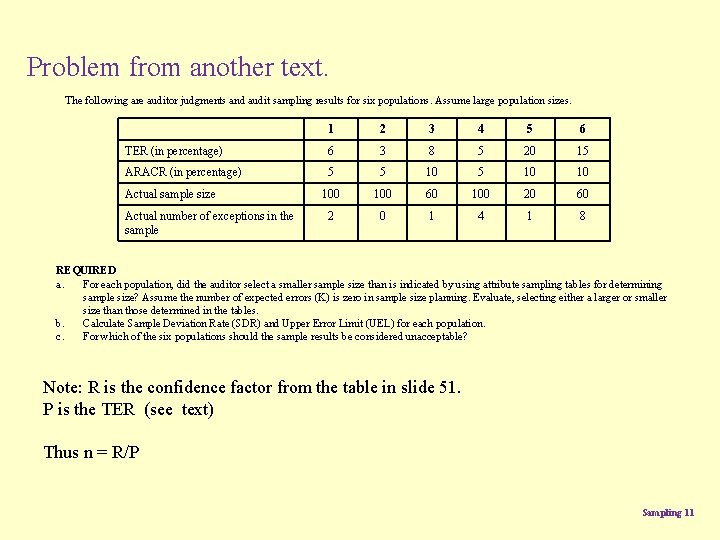
Problem from another text. The following are auditor judgments and audit sampling results for six populations. Assume large population sizes. 1 2 3 4 5 6 TER (in percentage) 6 3 8 5 20 15 ARACR (in percentage) 5 5 10 10 100 60 100 20 60 2 0 1 4 1 8 Actual sample size Actual number of exceptions in the sample REQUIRED a. For each population, did the auditor select a smaller sample size than is indicated by using attribute sampling tables for determining sample size? Assume the number of expected errors (K) is zero in sample size planning. Evaluate, selecting either a larger or smaller size than those determined in the tables. b. Calculate Sample Deviation Rate (SDR) and Upper Error Limit (UEL) for each population. c. For which of the six populations should the sample results be considered unacceptable? Note: R is the confidence factor from the table in slide 51. P is the TER (see text) Thus n = R/P Sampling 11
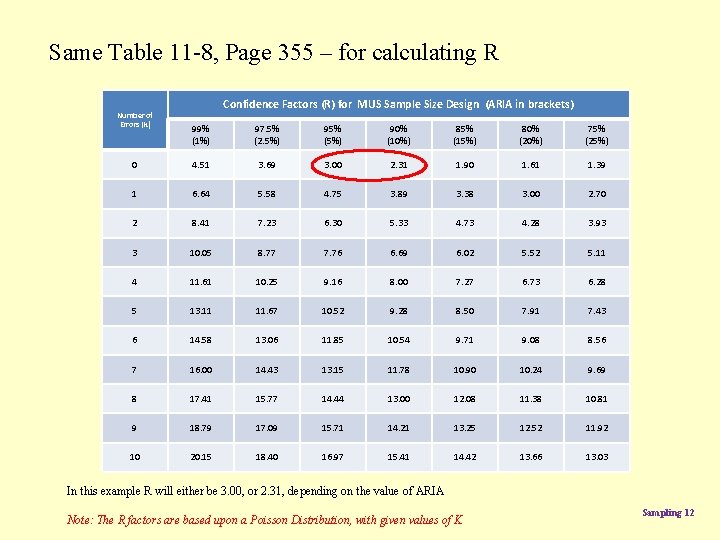
Same Table 11 -8, Page 355 – for calculating R Number of Errors (k) Confidence Factors (R) for MUS Sample Size Design (ARIA in brackets) 99% (1%) 97. 5% (2. 5%) 95% (5%) 90% (10%) 85% (15%) 80% (20%) 75% (25%) 0 4. 51 3. 69 3. 00 2. 31 1. 90 1. 61 1. 39 1 6. 64 5. 58 4. 75 3. 89 3. 38 3. 00 2. 70 2 8. 41 7. 23 6. 30 5. 33 4. 73 4. 28 3. 93 3 10. 05 8. 77 7. 76 6. 69 6. 02 5. 52 5. 11 4 11. 61 10. 25 9. 16 8. 00 7. 27 6. 73 6. 28 5 13. 11 11. 67 10. 52 9. 28 8. 50 7. 91 7. 43 6 14. 58 13. 06 11. 85 10. 54 9. 71 9. 08 8. 56 7 16. 00 14. 43 13. 15 11. 78 10. 90 10. 24 9. 69 8 17. 41 15. 77 14. 44 13. 00 12. 08 11. 38 10. 81 9 18. 79 17. 09 15. 71 14. 21 13. 25 12. 52 11. 92 10 20. 15 18. 40 16. 97 15. 41 14. 42 13. 66 13. 03 In this example R will either be 3. 00, or 2. 31, depending on the value of ARIA Note: The R factors are based upon a Poisson Distribution, with given values of K Sampling 12
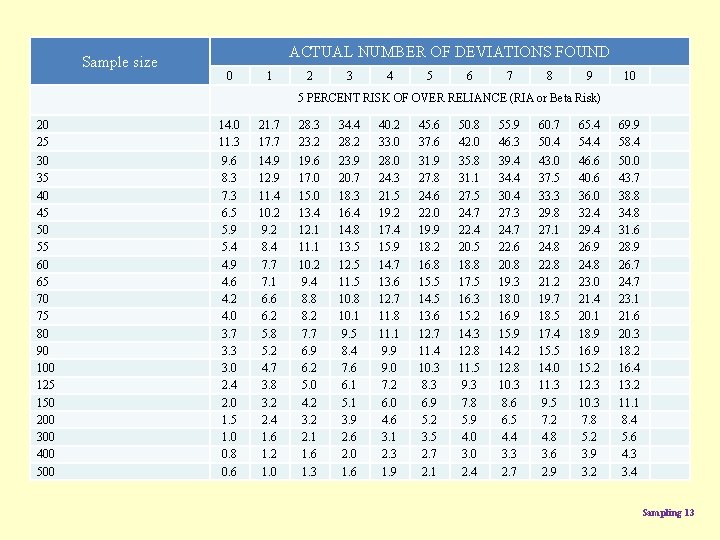
Sample size ACTUAL NUMBER OF DEVIATIONS FOUND 0 1 2 3 4 5 6 7 8 9 10 5 PERCENT RISK OF OVER RELIANCE (RIA or Beta Risk) 20 25 14. 0 11. 3 21. 7 17. 7 28. 3 23. 2 34. 4 28. 2 40. 2 33. 0 45. 6 37. 6 50. 8 42. 0 55. 9 46. 3 60. 7 50. 4 65. 4 54. 4 69. 9 58. 4 30 35 40 45 50 55 60 65 70 75 80 90 100 125 150 200 300 400 500 9. 6 8. 3 7. 3 6. 5 5. 9 5. 4 4. 9 4. 6 4. 2 4. 0 3. 7 3. 3 3. 0 2. 4 2. 0 1. 5 1. 0 0. 8 0. 6 14. 9 12. 9 11. 4 10. 2 9. 2 8. 4 7. 7 7. 1 6. 6 6. 2 5. 8 5. 2 4. 7 3. 8 3. 2 2. 4 1. 6 1. 2 1. 0 19. 6 17. 0 15. 0 13. 4 12. 1 11. 1 10. 2 9. 4 8. 8 8. 2 7. 7 6. 9 6. 2 5. 0 4. 2 3. 2 2. 1 1. 6 1. 3 23. 9 20. 7 18. 3 16. 4 14. 8 13. 5 12. 5 11. 5 10. 8 10. 1 9. 5 8. 4 7. 6 6. 1 5. 1 3. 9 2. 6 2. 0 1. 6 28. 0 24. 3 21. 5 19. 2 17. 4 15. 9 14. 7 13. 6 12. 7 11. 8 11. 1 9. 9 9. 0 7. 2 6. 0 4. 6 3. 1 2. 3 1. 9 31. 9 27. 8 24. 6 22. 0 19. 9 18. 2 16. 8 15. 5 14. 5 13. 6 12. 7 11. 4 10. 3 8. 3 6. 9 5. 2 3. 5 2. 7 2. 1 35. 8 31. 1 27. 5 24. 7 22. 4 20. 5 18. 8 17. 5 16. 3 15. 2 14. 3 12. 8 11. 5 9. 3 7. 8 5. 9 4. 0 3. 0 2. 4 39. 4 34. 4 30. 4 27. 3 24. 7 22. 6 20. 8 19. 3 18. 0 16. 9 15. 9 14. 2 12. 8 10. 3 8. 6 6. 5 4. 4 3. 3 2. 7 43. 0 37. 5 33. 3 29. 8 27. 1 24. 8 22. 8 21. 2 19. 7 18. 5 17. 4 15. 5 14. 0 11. 3 9. 5 7. 2 4. 8 3. 6 2. 9 46. 6 40. 6 36. 0 32. 4 29. 4 26. 9 24. 8 23. 0 21. 4 20. 1 18. 9 16. 9 15. 2 12. 3 10. 3 7. 8 5. 2 3. 9 3. 2 50. 0 43. 7 38. 8 34. 8 31. 6 28. 9 26. 7 24. 7 23. 1 21. 6 20. 3 18. 2 16. 4 13. 2 11. 1 8. 4 5. 6 4. 3 3. 4 Sampling 13
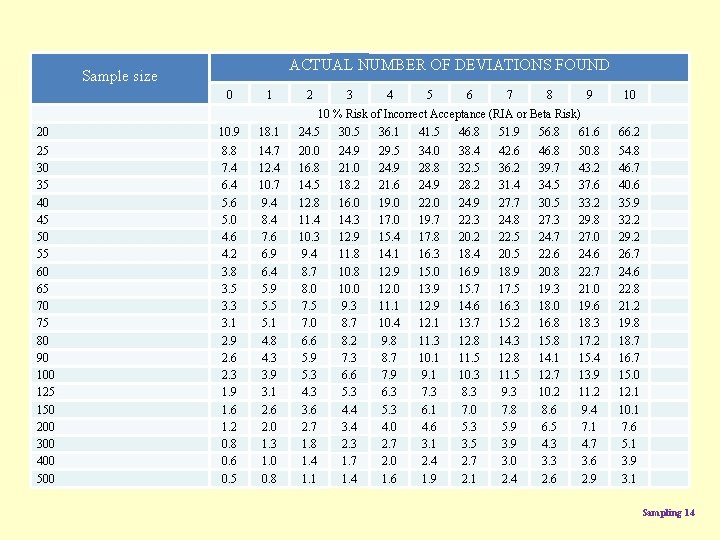
ACTUAL NUMBER OF DEVIATIONS FOUND Sample size 0 1 2 3 4 5 6 7 8 9 20 10. 9 18. 1 10 % Risk of Incorrect Acceptance (RIA or Beta Risk) 24. 5 30. 5 36. 1 41. 5 46. 8 51. 9 56. 8 61. 6 25 30 35 40 45 50 55 60 65 70 75 80 90 100 125 150 200 300 400 500 8. 8 7. 4 6. 4 5. 6 5. 0 4. 6 4. 2 3. 8 3. 5 3. 3 3. 1 2. 9 2. 6 2. 3 1. 9 1. 6 1. 2 0. 8 0. 6 0. 5 14. 7 12. 4 10. 7 9. 4 8. 4 7. 6 6. 9 6. 4 5. 9 5. 5 5. 1 4. 8 4. 3 3. 9 3. 1 2. 6 2. 0 1. 3 1. 0 0. 8 20. 0 16. 8 14. 5 12. 8 11. 4 10. 3 9. 4 8. 7 8. 0 7. 5 7. 0 6. 6 5. 9 5. 3 4. 3 3. 6 2. 7 1. 8 1. 4 1. 1 24. 9 21. 0 18. 2 16. 0 14. 3 12. 9 11. 8 10. 0 9. 3 8. 7 8. 2 7. 3 6. 6 5. 3 4. 4 3. 4 2. 3 1. 7 1. 4 29. 5 24. 9 21. 6 19. 0 17. 0 15. 4 14. 1 12. 9 12. 0 11. 1 10. 4 9. 8 8. 7 7. 9 6. 3 5. 3 4. 0 2. 7 2. 0 1. 6 34. 0 28. 8 24. 9 22. 0 19. 7 17. 8 16. 3 15. 0 13. 9 12. 1 11. 3 10. 1 9. 1 7. 3 6. 1 4. 6 3. 1 2. 4 1. 9 38. 4 32. 5 28. 2 24. 9 22. 3 20. 2 18. 4 16. 9 15. 7 14. 6 13. 7 12. 8 11. 5 10. 3 8. 3 7. 0 5. 3 3. 5 2. 7 2. 1 42. 6 36. 2 31. 4 27. 7 24. 8 22. 5 20. 5 18. 9 17. 5 16. 3 15. 2 14. 3 12. 8 11. 5 9. 3 7. 8 5. 9 3. 0 2. 4 46. 8 39. 7 34. 5 30. 5 27. 3 24. 7 22. 6 20. 8 19. 3 18. 0 16. 8 15. 8 14. 1 12. 7 10. 2 8. 6 6. 5 4. 3 3. 3 2. 6 50. 8 43. 2 37. 6 33. 2 29. 8 27. 0 24. 6 22. 7 21. 0 19. 6 18. 3 17. 2 15. 4 13. 9 11. 2 9. 4 7. 1 4. 7 3. 6 2. 9 10 66. 2 54. 8 46. 7 40. 6 35. 9 32. 2 29. 2 26. 7 24. 6 22. 8 21. 2 19. 8 18. 7 16. 7 15. 0 12. 1 10. 1 7. 6 5. 1 3. 9 3. 1 Sampling 14
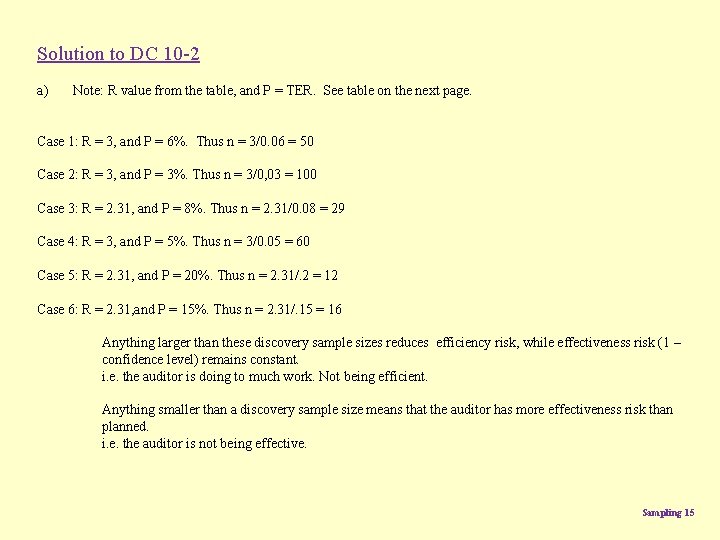
Solution to DC 10 -2 a) Note: R value from the table, and P = TER. See table on the next page. Case 1: R = 3, and P = 6%. Thus n = 3/0. 06 = 50 Case 2: R = 3, and P = 3%. Thus n = 3/0, 03 = 100 Case 3: R = 2. 31, and P = 8%. Thus n = 2. 31/0. 08 = 29 Case 4: R = 3, and P = 5%. Thus n = 3/0. 05 = 60 Case 5: R = 2. 31, and P = 20%. Thus n = 2. 31/. 2 = 12 Case 6: R = 2. 31, and P = 15%. Thus n = 2. 31/. 15 = 16 Anything larger than these discovery sample sizes reduces efficiency risk, while effectiveness risk (1 – confidence level) remains constant. i. e. the auditor is doing to much work. Not being efficient. Anything smaller than a discovery sample size means that the auditor has more effectiveness risk than planned. i. e. the auditor is not being effective. Sampling 15
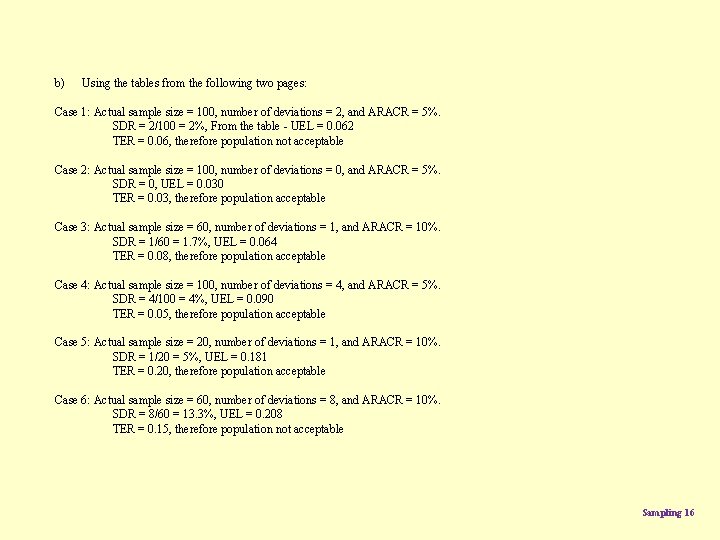
b) Using the tables from the following two pages: Case 1: Actual sample size = 100, number of deviations = 2, and ARACR = 5%. SDR = 2/100 = 2%, From the table - UEL = 0. 062 TER = 0. 06, therefore population not acceptable Case 2: Actual sample size = 100, number of deviations = 0, and ARACR = 5%. SDR = 0, UEL = 0. 030 TER = 0. 03, therefore population acceptable Case 3: Actual sample size = 60, number of deviations = 1, and ARACR = 10%. SDR = 1/60 = 1. 7%, UEL = 0. 064 TER = 0. 08, therefore population acceptable Case 4: Actual sample size = 100, number of deviations = 4, and ARACR = 5%. SDR = 4/100 = 4%, UEL = 0. 090 TER = 0. 05, therefore population acceptable Case 5: Actual sample size = 20, number of deviations = 1, and ARACR = 10%. SDR = 1/20 = 5%, UEL = 0. 181 TER = 0. 20, therefore population acceptable Case 6: Actual sample size = 60, number of deviations = 8, and ARACR = 10%. SDR = 8/60 = 13. 3%, UEL = 0. 208 TER = 0. 15, therefore population not acceptable Sampling 16
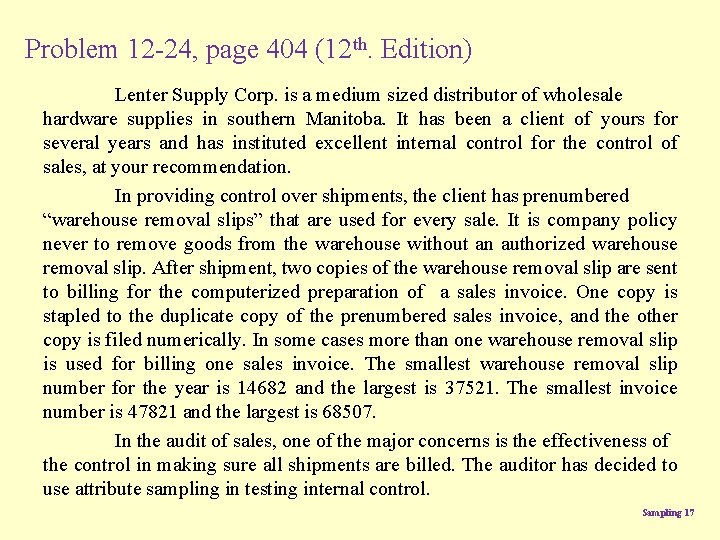
Problem 12 -24, page 404 (12 th. Edition) Lenter Supply Corp. is a medium sized distributor of wholesale hardware supplies in southern Manitoba. It has been a client of yours for several years and has instituted excellent internal control for the control of sales, at your recommendation. In providing control over shipments, the client has prenumbered “warehouse removal slips” that are used for every sale. It is company policy never to remove goods from the warehouse without an authorized warehouse removal slip. After shipment, two copies of the warehouse removal slip are sent to billing for the computerized preparation of a sales invoice. One copy is stapled to the duplicate copy of the prenumbered sales invoice, and the other copy is filed numerically. In some cases more than one warehouse removal slip is used for billing one sales invoice. The smallest warehouse removal slip number for the year is 14682 and the largest is 37521. The smallest invoice number is 47821 and the largest is 68507. In the audit of sales, one of the major concerns is the effectiveness of the control in making sure all shipments are billed. The auditor has decided to use attribute sampling in testing internal control. Sampling 17
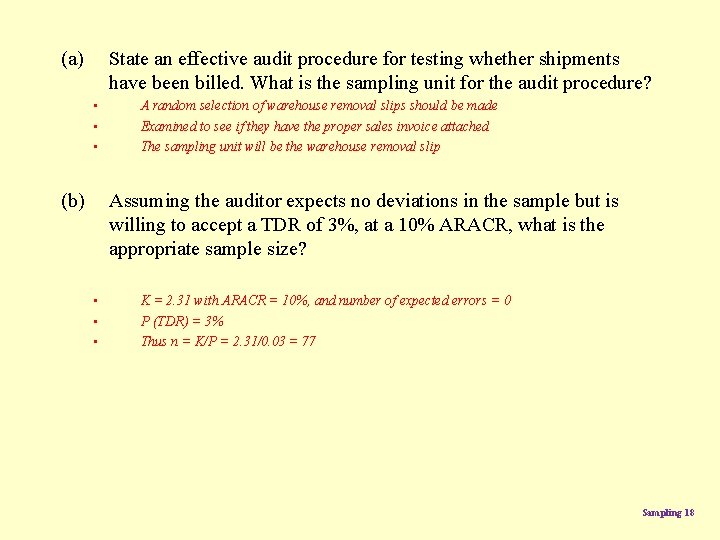
(a) State an effective audit procedure for testing whether shipments have been billed. What is the sampling unit for the audit procedure? • • • (b) A random selection of warehouse removal slips should be made Examined to see if they have the proper sales invoice attached The sampling unit will be the warehouse removal slip Assuming the auditor expects no deviations in the sample but is willing to accept a TDR of 3%, at a 10% ARACR, what is the appropriate sample size? • • • K = 2. 31 with ARACR = 10%, and number of expected errors = 0 P (TDR) = 3% Thus n = K/P = 2. 31/0. 03 = 77 Sampling 18

Effect of population size -Initial sample size only -Possible to make adjustment to initial sample size based on overall population size -Finite correction factor n = n’ 1 + n’/N n = revised sample size n’ = initial sample size N = population size Sampling 19
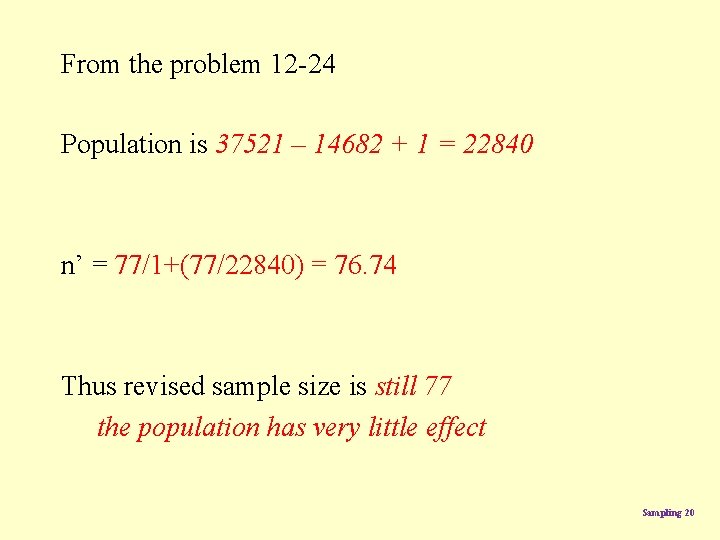
From the problem 12 -24 Population is 37521 – 14682 + 1 = 22840 n’ = 77/1+(77/22840) = 76. 74 Thus revised sample size is still 77 the population has very little effect Sampling 20
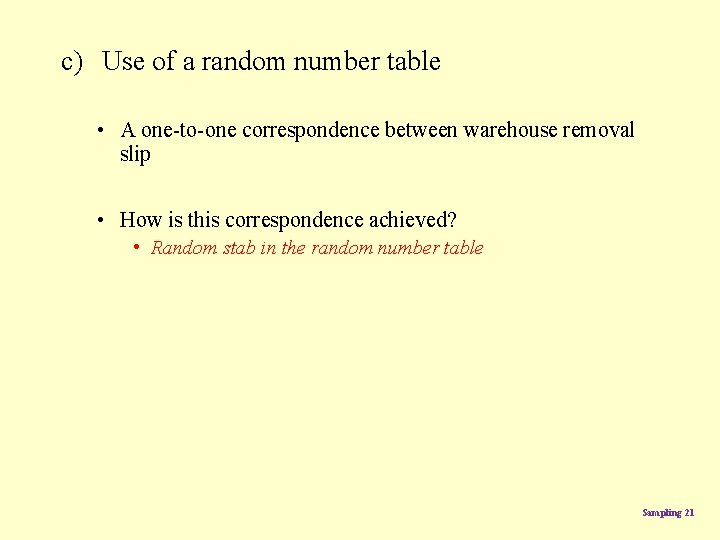
c) Use of a random number table • A one-to-one correspondence between warehouse removal slip • How is this correspondence achieved? • Random stab in the random number table Sampling 21
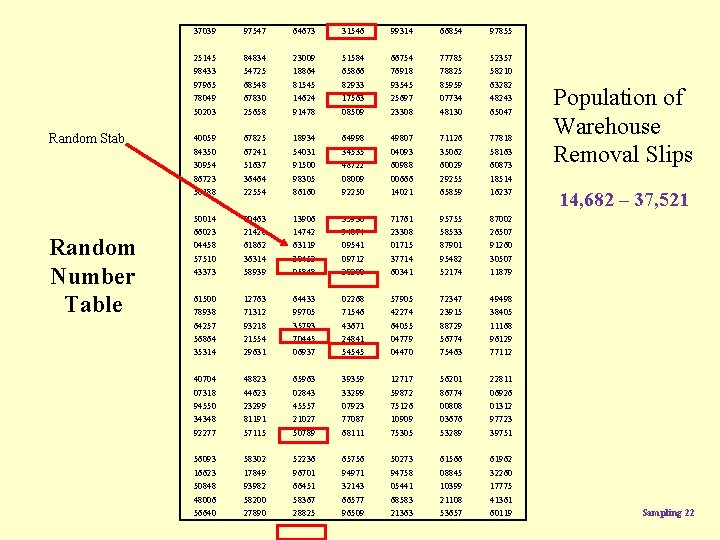
Random Stab Random Number Table 37039 97547 64673 31546 99314 66854 97855 25145 98433 97965 78049 50203 84834 54725 68548 67830 25658 23009 18864 81545 14624 91478 51584 65866 82933 17563 08509 66754 76918 93545 25697 23308 77785 78825 85959 07734 48130 52357 58210 63282 48243 65047 40059 84350 30954 86723 50188 67825 67241 51637 36464 22554 18934 54031 91500 98305 86160 64998 34535 48722 08009 92250 49807 04093 60988 00666 14021 71126 35062 60029 29255 65859 77818 58163 60873 18514 16237 50014 66023 04458 57510 43373 00463 21428 61862 36314 58939 13906 14742 63119 30452 95848 35936 94874 09541 09712 28288 71761 23308 01715 37714 60341 95755 58533 87901 95482 52174 87002 26507 91260 30507 11879 61500 78938 64257 56864 35314 12763 71312 93218 21554 29631 64433 99705 35793 70445 06937 02268 71546 43671 24841 54545 57905 42274 64055 04779 04470 72347 23915 88729 56774 75463 49498 38405 11168 96129 77112 40704 07318 94550 34348 92277 48823 44623 23299 81191 57115 65963 02843 45557 21027 50789 39359 33299 07923 77087 68111 12717 59872 75126 10909 75305 56201 86774 00808 03676 53289 22811 06926 01312 97723 39751 56093 16623 50848 48006 56640 58302 17849 93982 58200 27890 52236 96701 66451 58367 28825 65756 94971 32143 66577 96509 50273 94758 05441 68583 21363 61566 08845 10399 21108 53657 61962 32260 17775 41361 60119 Population of Warehouse Removal Slips 14, 682 – 37, 521 Sampling 22
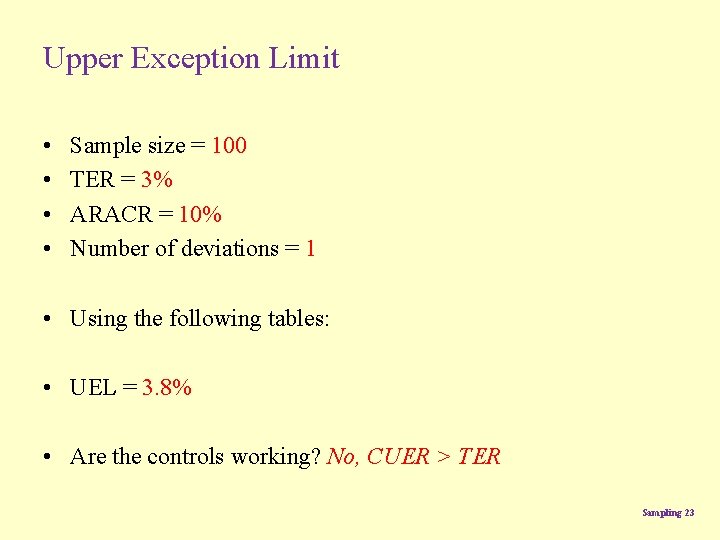
Upper Exception Limit • • Sample size = 100 TER = 3% ARACR = 10% Number of deviations = 1 • Using the following tables: • UEL = 3. 8% • Are the controls working? No, CUER > TER Sampling 23
Problem 13 -21, Page 439, Canadian 11 th. Edition a. For each of the following independent problems, design an unbiased random sampling plan using an electronic spreadsheet or a random number generator. The plan should include defining the sampling unit and establishing a numbering system for the population. After the plan has been designed, select the sample using the computer. Assume that the sample size is 50 for each od (1) thorough (4). 1. 2. 3. 4. b. Prenumbered sales invoices in a sales journal where the lowest number is 1 and the highest is 6, 211. Prenumbered bills of lading where the lowest document number is 21, 926 and the highest is 28, 511 Accounts receivable on 10 pages with 60 lines per page except the last page, which has only 36 full lines. Each line has a customer name and an amount receivable. Prenumbered invoices in a sales journal where each month starts over with number 1. (Invoices for each month are designated by the month and the document number. There is a maximum of 20 pages per month with a total of 185 pages for the year. All pages have 75 invoices except for the last page for each month. Using systematic sampling, select the first five sample items for population (1). Sampling 24
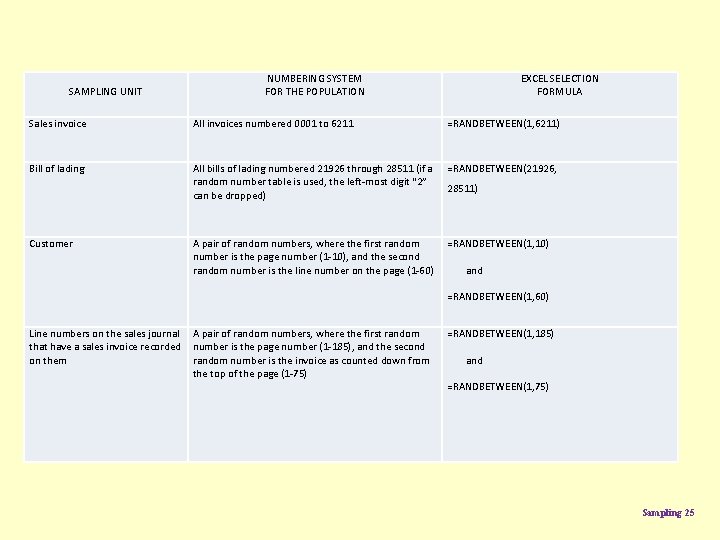
SAMPLING UNIT NUMBERING SYSTEM FOR THE POPULATION EXCEL SELECTION FORMULA Sales invoice All invoices numbered 0001 to 6211 =RANDBETWEEN(1, 6211) Bill of lading All bills of lading numbered 21926 through 28511 (if a random number table is used, the left-most digit “ 2” can be dropped) =RANDBETWEEN(21926, Customer A pair of random numbers, where the first random number is the page number (1 -10), and the second random number is the line number on the page (1 -60) =RANDBETWEEN(1, 10) and =RANDBETWEEN(1, 60) Line numbers on the sales journal that have a sales invoice recorded on them A pair of random numbers, where the first random number is the page number (1 -185), and the second random number is the invoice as counted down from the top of the page (1 -75) =RANDBETWEEN(1, 185) and =RANDBETWEEN(1, 75) 28511) Sampling 25
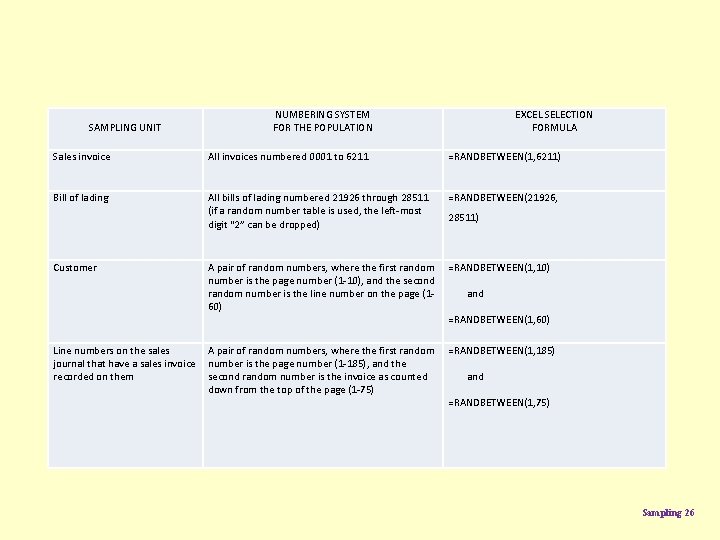
SAMPLING UNIT NUMBERING SYSTEM FOR THE POPULATION EXCEL SELECTION FORMULA Sales invoice All invoices numbered 0001 to 6211 =RANDBETWEEN(1, 6211) Bill of lading All bills of lading numbered 21926 through 28511 (if a random number table is used, the left-most digit “ 2” can be dropped) =RANDBETWEEN(21926, Customer A pair of random numbers, where the first random =RANDBETWEEN(1, 10) number is the page number (1 -10), and the second random number is the line number on the page (1 and 60) =RANDBETWEEN(1, 60) Line numbers on the sales journal that have a sales invoice recorded on them A pair of random numbers, where the first random number is the page number (1 -185), and the second random number is the invoice as counted down from the top of the page (1 -75) 28511) =RANDBETWEEN(1, 185) and =RANDBETWEEN(1, 75) Sampling 26
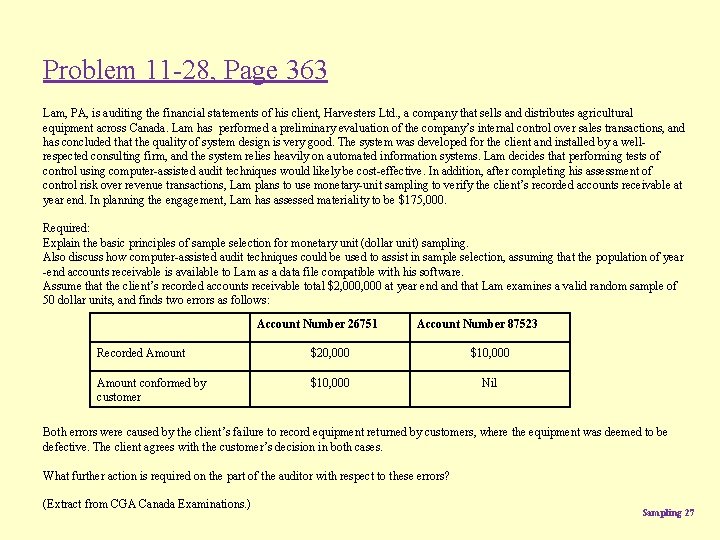
Problem 11 -28, Page 363 Lam, PA, is auditing the financial statements of his client, Harvesters Ltd. , a company that sells and distributes agricultural equipment across Canada. Lam has performed a preliminary evaluation of the company’s internal control over sales transactions, and has concluded that the quality of system design is very good. The system was developed for the client and installed by a wellrespected consulting firm, and the system relies heavily on automated information systems. Lam decides that performing tests of control using computer-assisted audit techniques would likely be cost-effective. In addition, after completing his assessment of control risk over revenue transactions, Lam plans to use monetary-unit sampling to verify the client’s recorded accounts receivable at year end. In planning the engagement, Lam has assessed materiality to be $175, 000. Required: Explain the basic principles of sample selection for monetary unit (dollar unit) sampling. Also discuss how computer-assisted audit techniques could be used to assist in sample selection, assuming that the population of year -end accounts receivable is available to Lam as a data file compatible with his software. Assume that the client’s recorded accounts receivable total $2, 000 at year end and that Lam examines a valid random sample of 50 dollar units, and finds two errors as follows: Account Number 26751 Account Number 87523 Recorded Amount $20, 000 $10, 000 Amount conformed by customer $10, 000 Nil Both errors were caused by the client’s failure to record equipment returned by customers, where the equipment was deemed to be defective. The client agrees with the customer’s decision in both cases. What further action is required on the part of the auditor with respect to these errors? (Extract from CGA Canada Examinations. ) Sampling 27
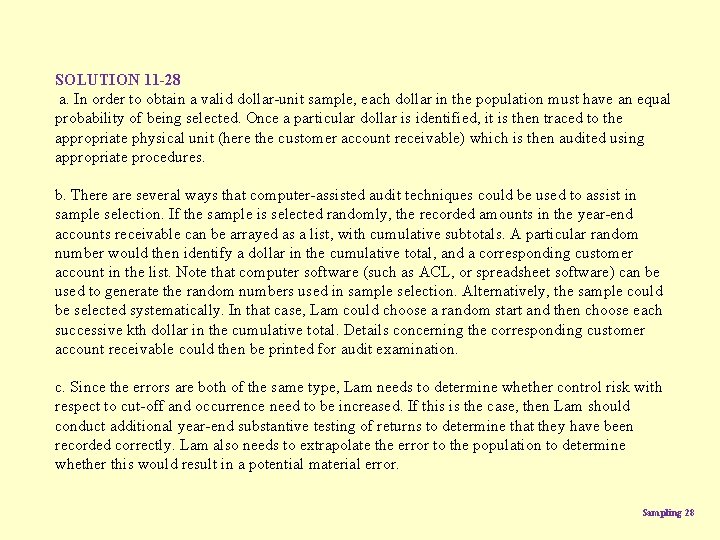
SOLUTION 11 -28 a. In order to obtain a valid dollar-unit sample, each dollar in the population must have an equal probability of being selected. Once a particular dollar is identified, it is then traced to the appropriate physical unit (here the customer account receivable) which is then audited using appropriate procedures. b. There are several ways that computer-assisted audit techniques could be used to assist in sample selection. If the sample is selected randomly, the recorded amounts in the year-end accounts receivable can be arrayed as a list, with cumulative subtotals. A particular random number would then identify a dollar in the cumulative total, and a corresponding customer account in the list. Note that computer software (such as ACL, or spreadsheet software) can be used to generate the random numbers used in sample selection. Alternatively, the sample could be selected systematically. In that case, Lam could choose a random start and then choose each successive kth dollar in the cumulative total. Details concerning the corresponding customer account receivable could then be printed for audit examination. c. Since the errors are both of the same type, Lam needs to determine whether control risk with respect to cut-off and occurrence need to be increased. If this is the case, then Lam should conduct additional year-end substantive testing of returns to determine that they have been recorded correctly. Lam also needs to extrapolate the error to the population to determine whether this would result in a potential material error. Sampling 28
- Slides: 28