Virginia Department of Education Division of Teacher Education

- Slides: 25
Virginia Department of Education Division of Teacher Education and Licensure Teacher Evaluation Institute July 23, 2013 1
Critiquing High School Goals 2
Afternoon Agenda • Critiquing goals using the SMART criteria • Creating goals using the SMART criteria 3
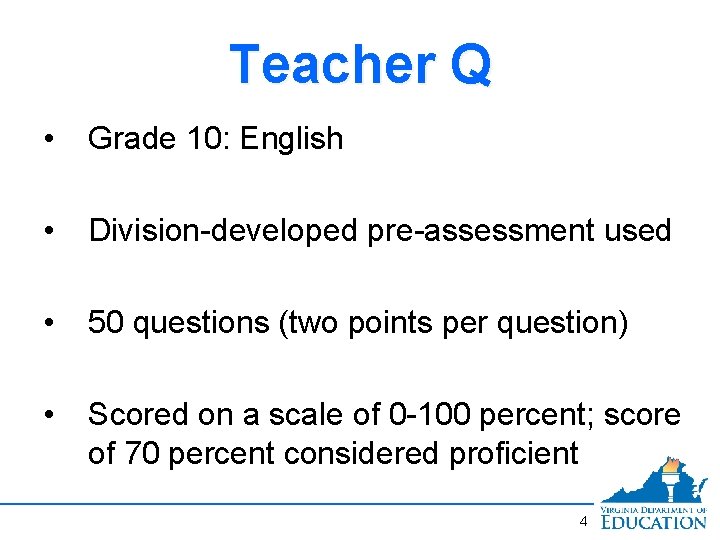
Teacher Q • Grade 10: English • Division-developed pre-assessment used • 50 questions (two points per question) • Scored on a scale of 0 -100 percent; score of 70 percent considered proficient 4
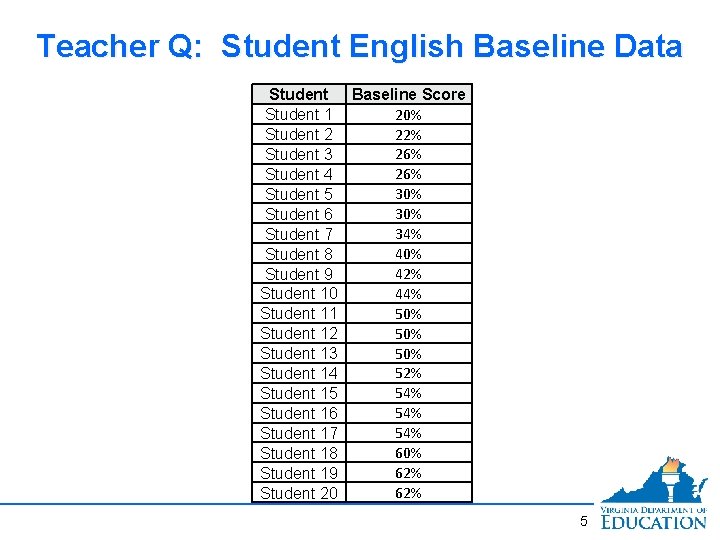
Teacher Q: Student English Baseline Data Student Baseline Score 20% Student 1 22% Student 2 26% Student 3 26% Student 4 30% Student 5 30% Student 6 34% Student 7 40% Student 8 42% Student 9 44% Student 10 50% Student 11 50% Student 12 50% Student 13 52% Student 14 54% Student 15 54% Student 16 54% Student 17 60% Student 18 62% Student 19 62% Student 20 5
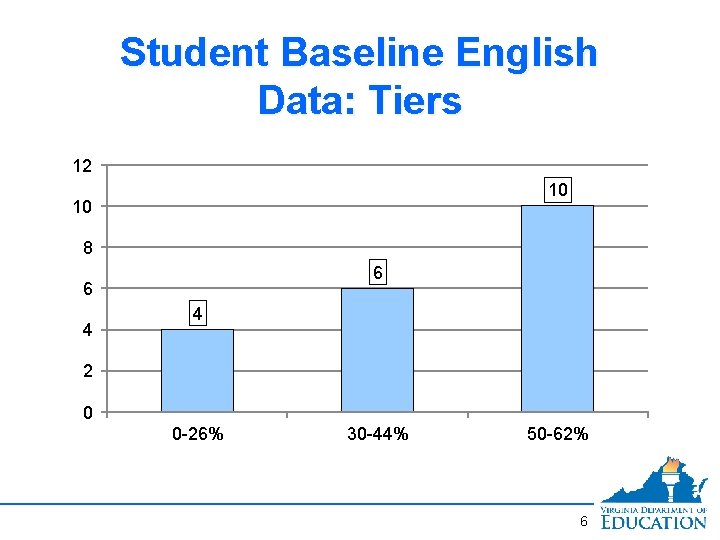
Student Baseline English Data: Tiers 12 10 10 8 6 6 4 4 2 0 0 -26% 30 -44% 50 -62% 6
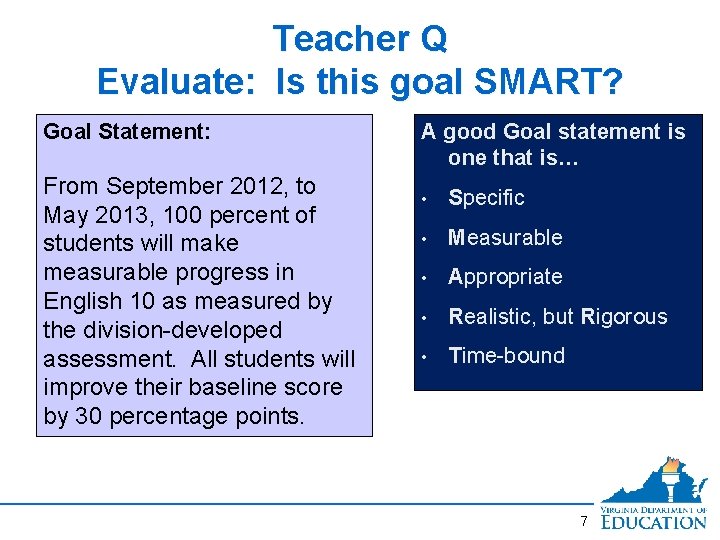
Teacher Q Evaluate: Is this goal SMART? Goal Statement: From September 2012, to May 2013, 100 percent of students will make measurable progress in English 10 as measured by the division-developed assessment. All students will improve their baseline score by 30 percentage points. A good Goal statement is one that is… • Specific • Measurable • Appropriate • Realistic, but Rigorous • Time-bound 7
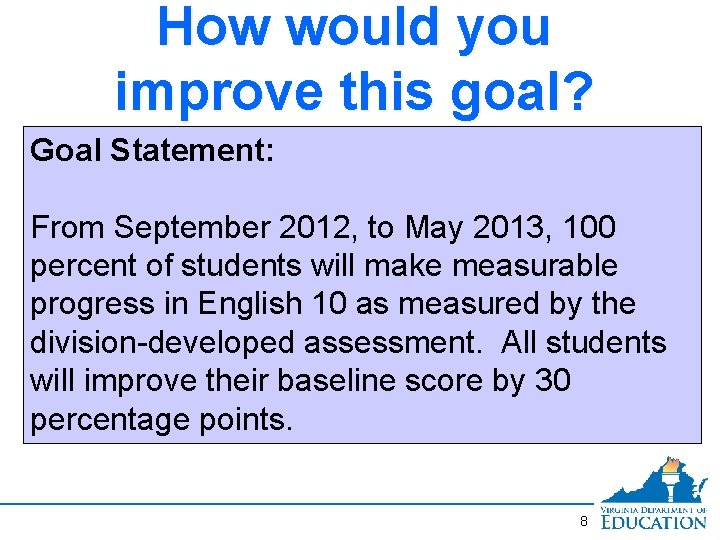
How would you improve this goal? Goal Statement: From September 2012, to May 2013, 100 percent of students will make measurable progress in English 10 as measured by the division-developed assessment. All students will improve their baseline score by 30 percentage points. 8
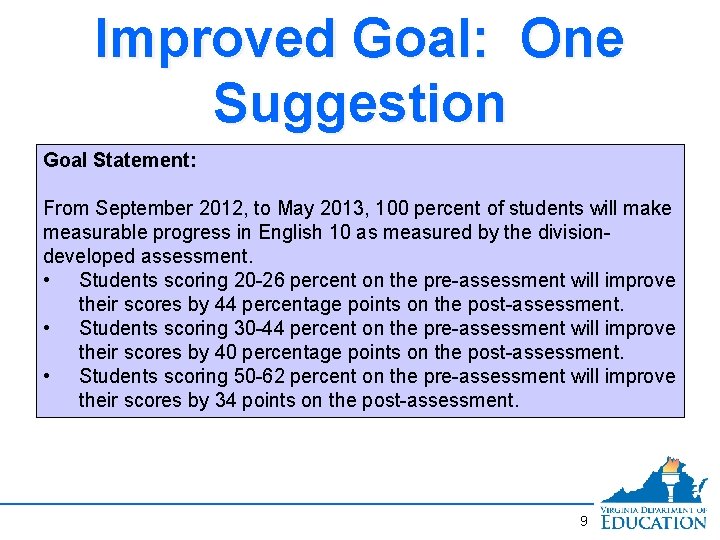
Improved Goal: One Suggestion Goal Statement: From September 2012, to May 2013, 100 percent of students will make measurable progress in English 10 as measured by the divisiondeveloped assessment. • Students scoring 20 -26 percent on the pre-assessment will improve their scores by 44 percentage points on the post-assessment. • Students scoring 30 -44 percent on the pre-assessment will improve their scores by 40 percentage points on the post-assessment. • Students scoring 50 -62 percent on the pre-assessment will improve their scores by 34 points on the post-assessment. 9
Goals for Students with Disabilities 10
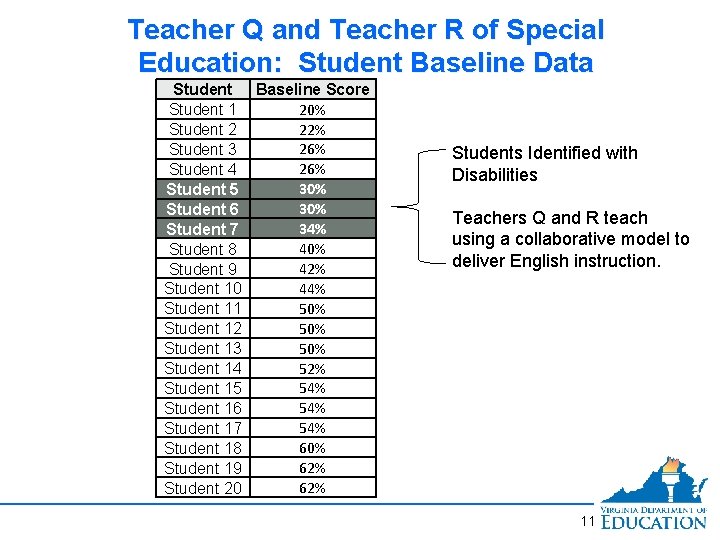
Teacher Q and Teacher R of Special Education: Student Baseline Data Student Baseline Score 20% Student 1 22% Student 2 26% Student 3 26% Student 4 30% Student 5 30% Student 6 34% Student 7 40% Student 8 42% Student 9 44% Student 10 50% Student 11 50% Student 12 50% Student 13 52% Student 14 54% Student 15 54% Student 16 54% Student 17 60% Student 18 62% Student 19 62% Student 20 Students Identified with Disabilities Teachers Q and R teach using a collaborative model to deliver English instruction. 11
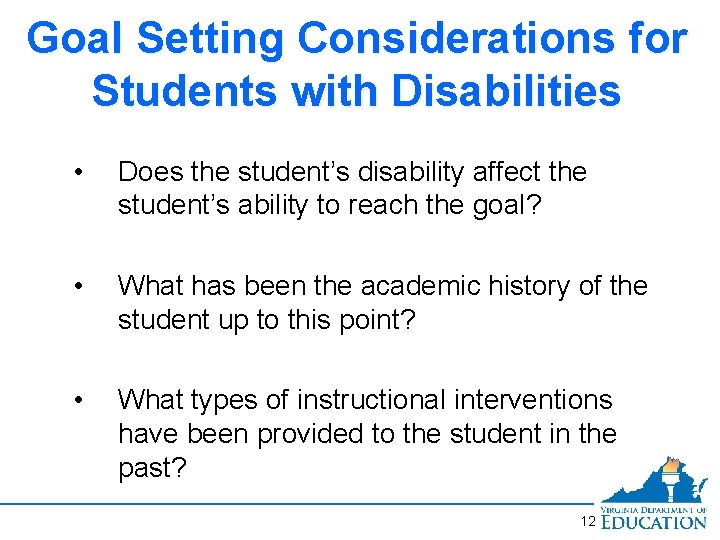
Goal Setting Considerations for Students with Disabilities • Does the student’s disability affect the student’s ability to reach the goal? • What has been the academic history of the student up to this point? • What types of instructional interventions have been provided to the student in the past? 12
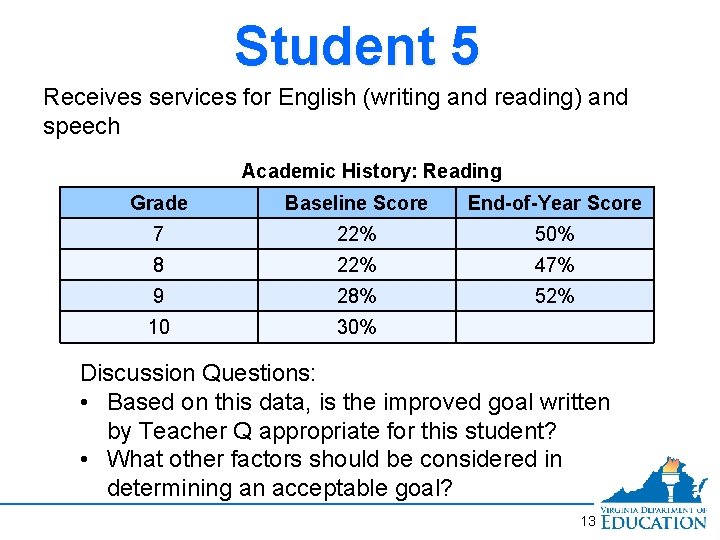
Student 5 Receives services for English (writing and reading) and speech Academic History: Reading Grade Baseline Score End-of-Year Score 7 22% 50% 8 22% 47% 9 28% 52% 10 30% Discussion Questions: • Based on this data, is the improved goal written by Teacher Q appropriate for this student? • What other factors should be considered in determining an acceptable goal? 13
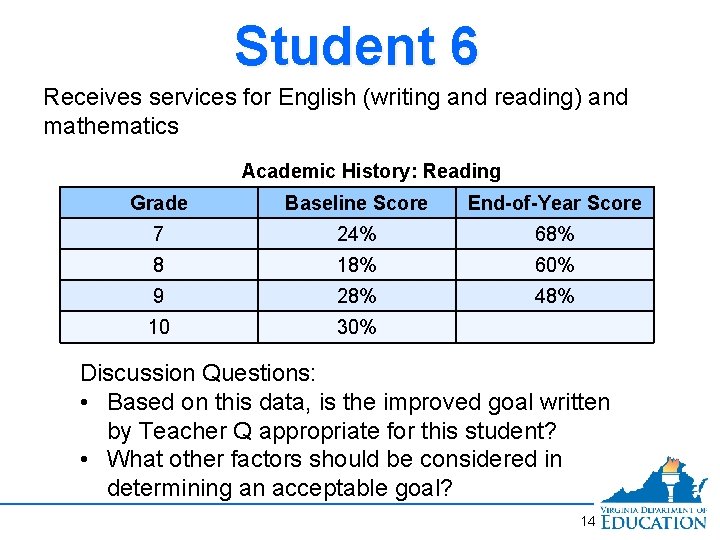
Student 6 Receives services for English (writing and reading) and mathematics Academic History: Reading Grade Baseline Score End-of-Year Score 7 24% 68% 8 18% 60% 9 28% 48% 10 30% Discussion Questions: • Based on this data, is the improved goal written by Teacher Q appropriate for this student? • What other factors should be considered in determining an acceptable goal? 14
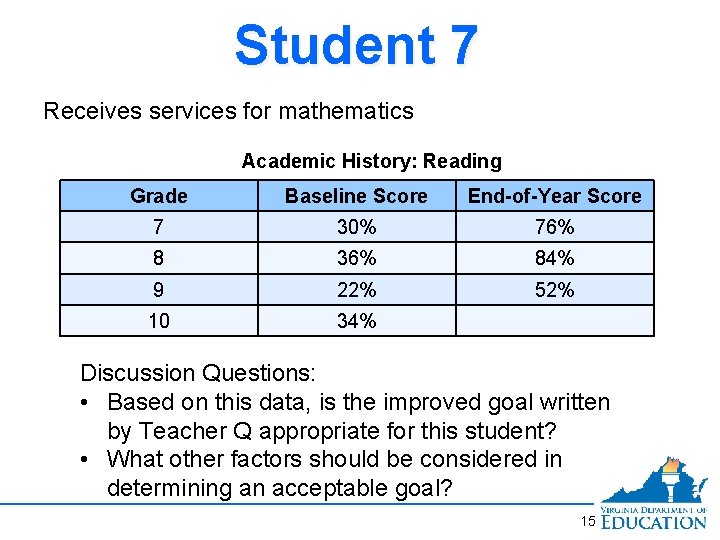
Student 7 Receives services for mathematics Academic History: Reading Grade Baseline Score End-of-Year Score 7 30% 76% 8 36% 84% 9 22% 52% 10 34% Discussion Questions: • Based on this data, is the improved goal written by Teacher Q appropriate for this student? • What other factors should be considered in determining an acceptable goal? 15
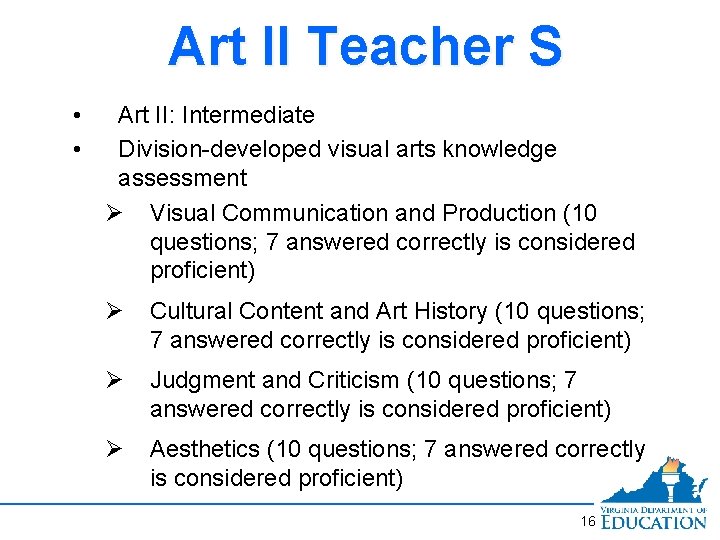
Art II Teacher S • • Art II: Intermediate Division-developed visual arts knowledge assessment Ø Visual Communication and Production (10 questions; 7 answered correctly is considered proficient) Ø Cultural Content and Art History (10 questions; 7 answered correctly is considered proficient) Ø Judgment and Criticism (10 questions; 7 answered correctly is considered proficient) Ø Aesthetics (10 questions; 7 answered correctly is considered proficient) 16
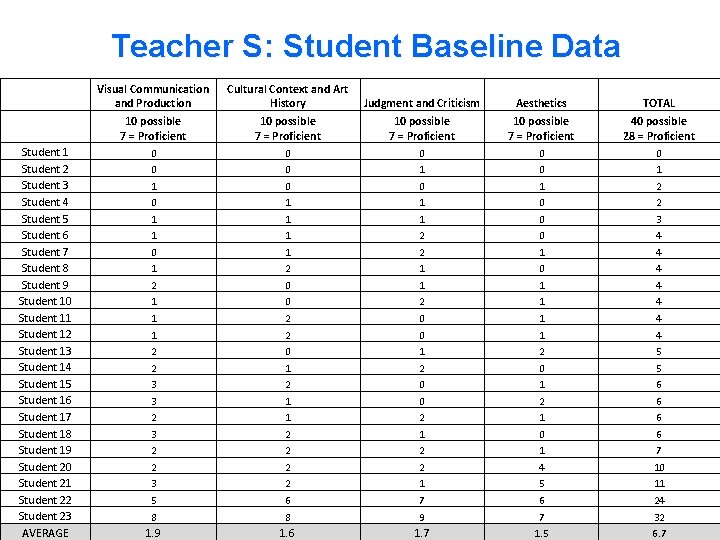
Teacher S: Student Baseline Data Student 1 Student 2 Student 3 Student 4 Student 5 Student 6 Student 7 Student 8 Student 9 Student 10 Student 11 Student 12 Student 13 Student 14 Student 15 Student 16 Student 17 Student 18 Student 19 Student 20 Student 21 Student 22 Student 23 AVERAGE Visual Communication and Production Cultural Context and Art History Judgment and Criticism Aesthetics TOTAL 10 possible 7 = Proficient 40 possible 28 = Proficient 0 0 0 0 1 1 0 0 1 2 0 1 1 0 2 1 1 1 0 3 1 1 2 0 4 0 1 2 1 4 1 2 1 0 4 2 0 1 1 4 1 0 2 1 4 1 2 0 1 4 2 0 1 2 5 2 1 2 0 5 3 2 0 1 6 3 1 0 2 6 2 1 6 3 2 1 0 6 2 2 2 1 7 2 2 2 4 10 3 2 1 5 11 5 6 7 6 24 8 8 9 7 1. 9 1. 6 1. 7 1. 5 17 32 6. 7
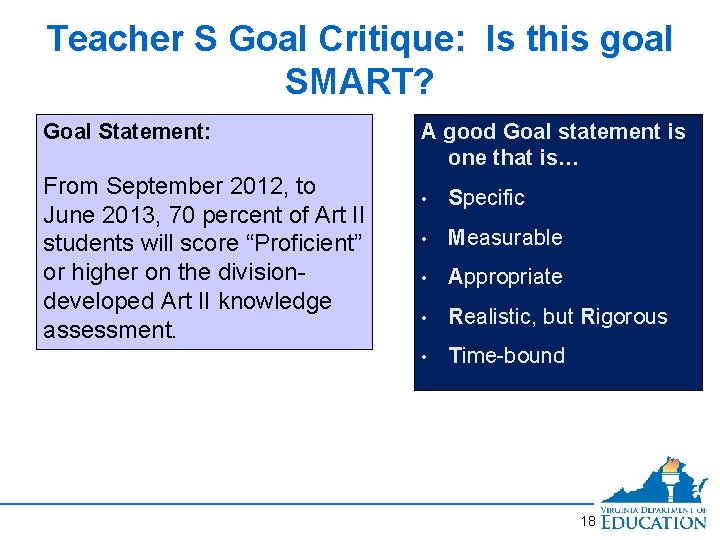
Teacher S Goal Critique: Is this goal SMART? Goal Statement: From September 2012, to June 2013, 70 percent of Art II students will score “Proficient” or higher on the divisiondeveloped Art II knowledge assessment. A good Goal statement is one that is… • Specific • Measurable • Appropriate • Realistic, but Rigorous • Time-bound 18
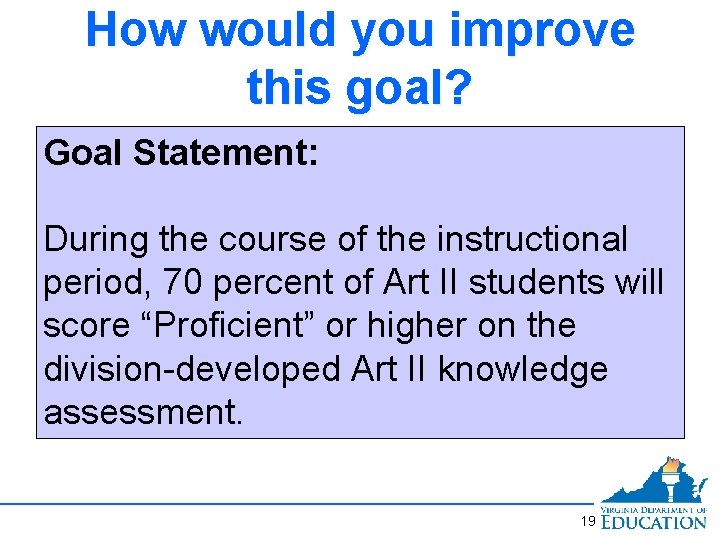
How would you improve this goal? Goal Statement: During the course of the instructional period, 70 percent of Art II students will score “Proficient” or higher on the division-developed Art II knowledge assessment. 19
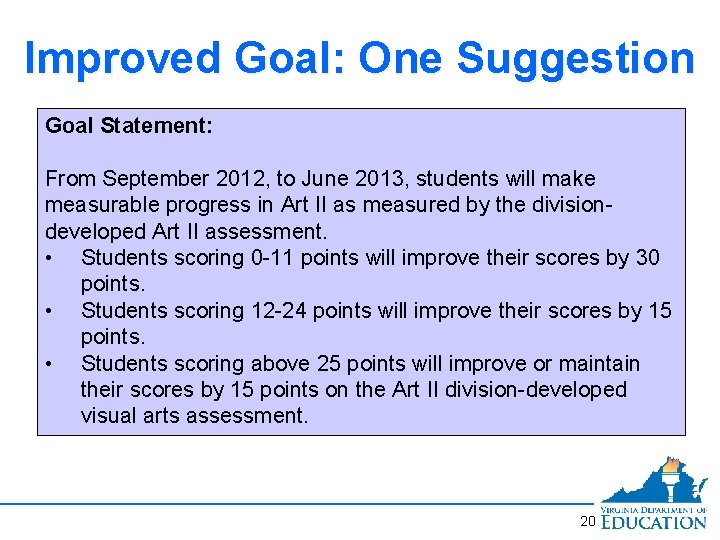
Improved Goal: One Suggestion Goal Statement: From September 2012, to June 2013, students will make measurable progress in Art II as measured by the divisiondeveloped Art II assessment. • Students scoring 0 -11 points will improve their scores by 30 points. • Students scoring 12 -24 points will improve their scores by 15 points. • Students scoring above 25 points will improve or maintain their scores by 15 points on the Art II division-developed visual arts assessment. 20
Creating Goals 21
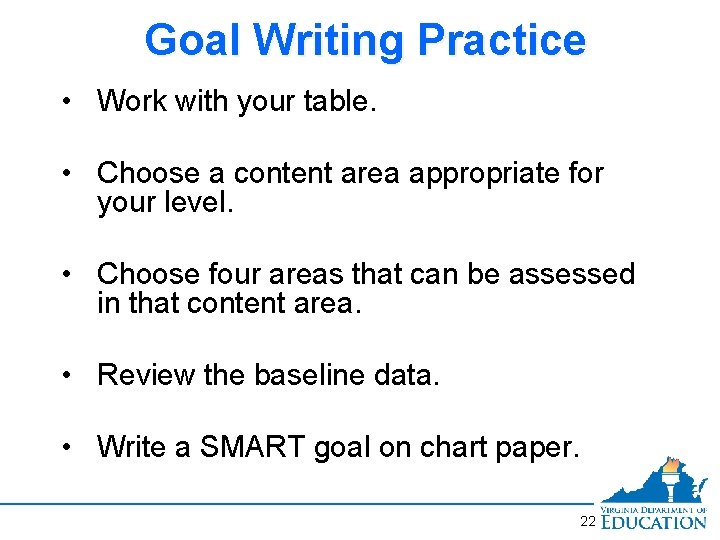
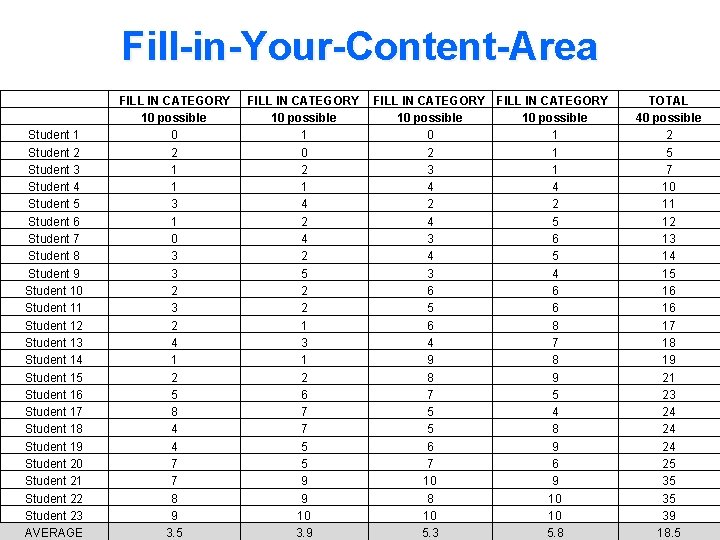
Goal Writing Practice • Work with your table. • Choose a content area appropriate for your level. • Choose four areas that can be assessed in that content area. • Review the baseline data. • Write a SMART goal on chart paper. 22
Fill-in-Your-Content-Area Student 1 Student 2 Student 3 Student 4 Student 5 Student 6 Student 7 Student 8 Student 9 Student 10 Student 11 Student 12 Student 13 Student 14 Student 15 Student 16 Student 17 Student 18 Student 19 Student 20 Student 21 Student 22 Student 23 AVERAGE FILL IN CATEGORY 10 possible 0 2 1 1 3 1 0 3 3 2 4 1 2 5 8 4 4 7 7 8 9 3. 5 FILL IN CATEGORY 10 possible 1 0 2 1 4 2 5 2 2 1 3 1 2 6 7 7 5 5 9 9 10 3. 9 FILL IN CATEGORY 10 possible 0 1 2 1 3 1 4 4 2 2 4 5 3 6 4 5 3 4 6 6 5 6 6 8 4 7 9 8 8 9 7 5 5 4 5 8 6 9 7 6 10 9 8 10 10 10 23 5. 8 TOTAL 40 possible 2 5 7 10 11 12 13 14 15 16 16 17 18 19 21 23 24 24 24 25 35 35 39 18. 5
Directions • Trade goals with the other table to which you are assigned. • Evaluate the goal for the SMART criteria. • Provide feedback. • When it’s time to trade back goals, send one person back with the other table’s goal to explain the feedback. • Afterward, rewrite your goal based on the comments. 24
Final Thoughts • 3 important things to keep in mind when setting goals • 2 things that worked well in this training • 1 question you still have 25