Vela X1 Flares Off States West Orange High

- Slides: 25
Vela X-1: Flares & Off States West Orange High School Manthan Kothari, Lucy Zipf, Neil Savalia, Brian Meise, Krish Pillai
IN TODAY’S PRESENTATION, WE WILL: 1. Discuss how we chose our project. 2. Describe the Vela X-1 system. 3. Present the Characteristics & Models for flaring behavior for the 20 -40 ke. V range. 4. Present the Characteristics & Models for “offstates for the 20 -40 ke. V range. 5. Present our findings regarding flares and offstates for the 1 -10 ke. V range.
Why Flares & Off States? • Literature Review – Kreykenbohm et al. , 2008 Discusses flaring behavior of Vela X-1 for 20 -40 ke. V X-Ray energy range based on data from the INTEGRAL (International Gamma-Ray Astrophysics Laboratory, Launched in 2002) satellite. • RAI: We look at X-Rays in the 1 -10 ke. V range from the Exosat (European Space Agency X-Ray Observatory, finished its mission in 1986). So, we decided to compare Vela X-1’s flaring behavior in this energy range versus Kreykenbohm’s findings.
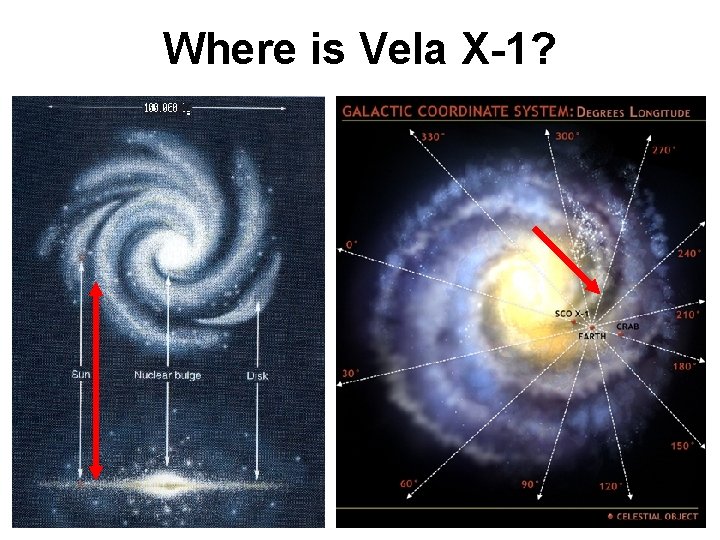
Where is Vela X-1?
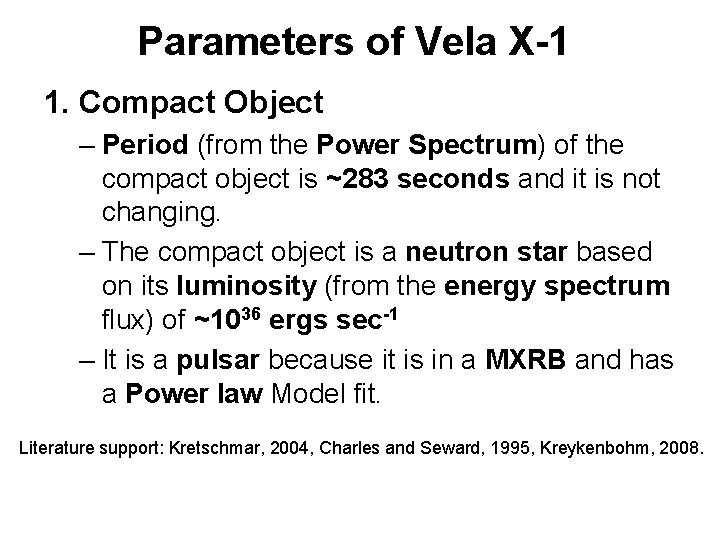
Parameters of Vela X-1 1. Compact Object – Period (from the Power Spectrum) of the compact object is ~283 seconds and it is not changing. – The compact object is a neutron star based on its luminosity (from the energy spectrum flux) of ~1036 ergs sec-1 – It is a pulsar because it is in a MXRB and has a Power law Model fit. Literature support: Kretschmar, 2004, Charles and Seward, 1995, Kreykenbohm, 2008.
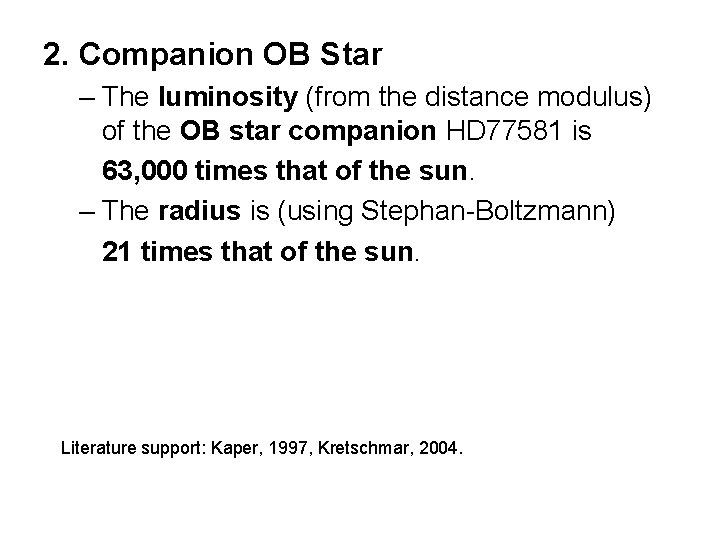
2. Companion OB Star – The luminosity (from the distance modulus) of the OB star companion HD 77581 is 63, 000 times that of the sun. – The radius is (using Stephan-Boltzmann) 21 times that of the sun. Literature support: Kaper, 1997, Kretschmar, 2004.
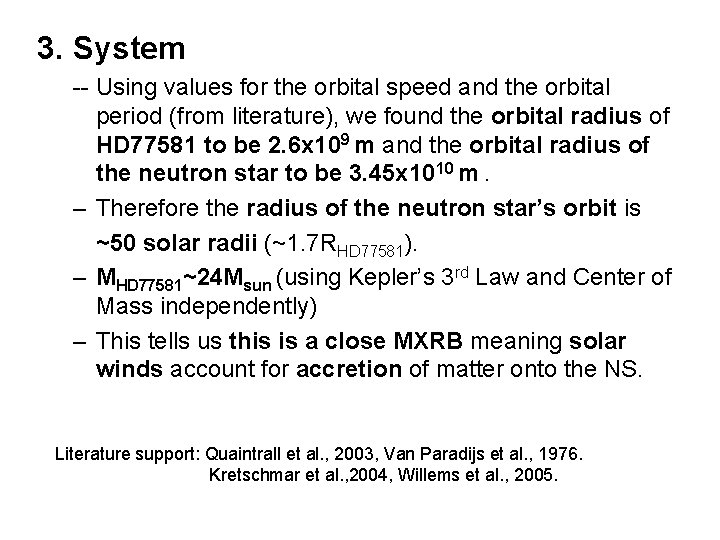
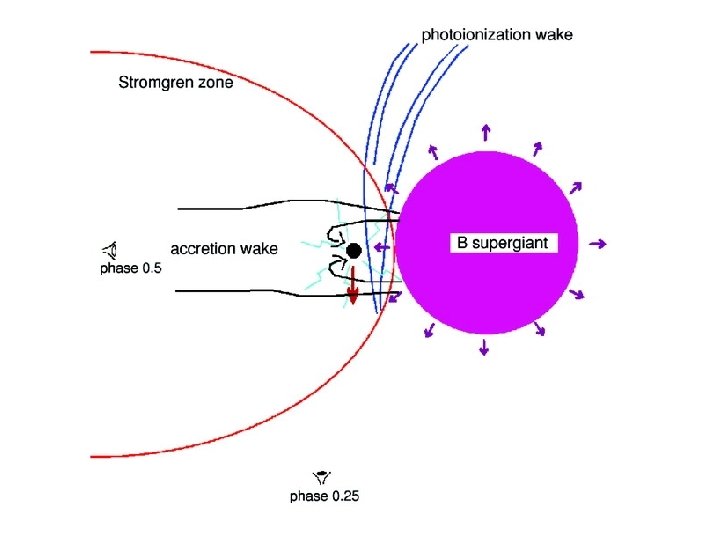
3. System -- Using values for the orbital speed and the orbital period (from literature), we found the orbital radius of HD 77581 to be 2. 6 x 10⁹ m and the orbital radius of the neutron star to be 3. 45 x 1010 m. – Therefore the radius of the neutron star’s orbit is ~50 solar radii (~1. 7 RHD 77581). – MHD 77581~24 Msun (using Kepler’s 3 rd Law and Center of Mass independently) – This tells us this is a close MXRB meaning solar winds account for accretion of matter onto the NS. Literature support: Quaintrall et al. , 2003, Van Paradijs et al. , 1976. Kretschmar et al. , 2004, Willems et al. , 2005.
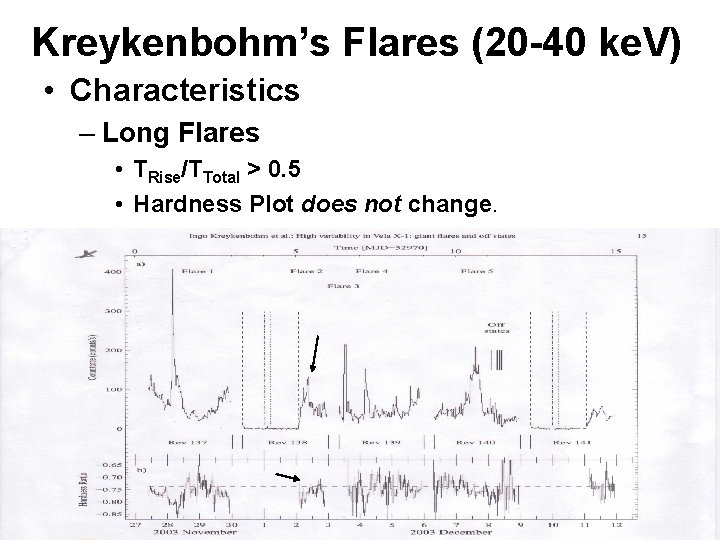
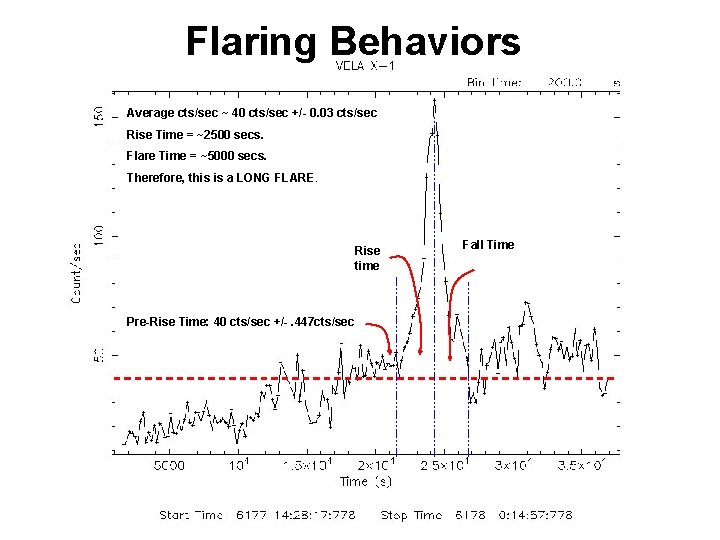
Kreykenbohm’s Flares (20 -40 ke. V) • Characteristics – Long Flares • TRise/TTotal > 0. 5 • Hardness Plot does not change.
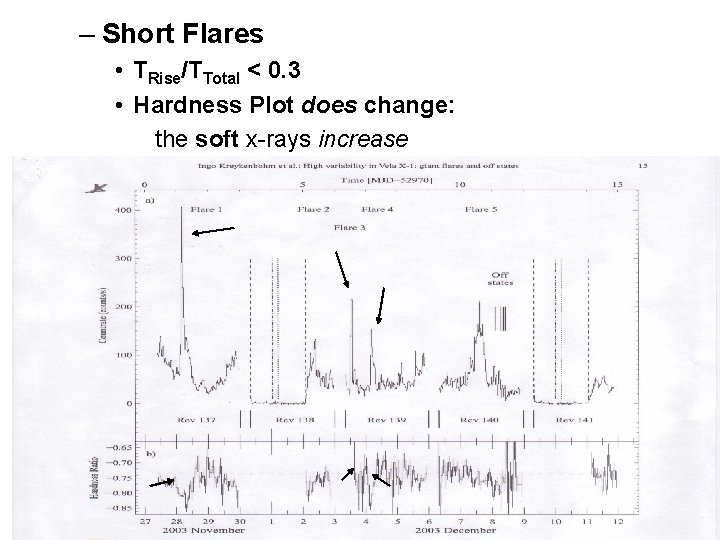
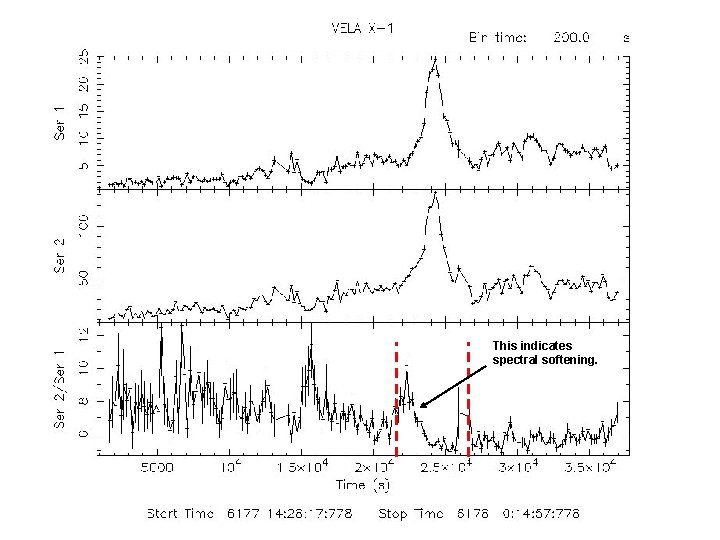
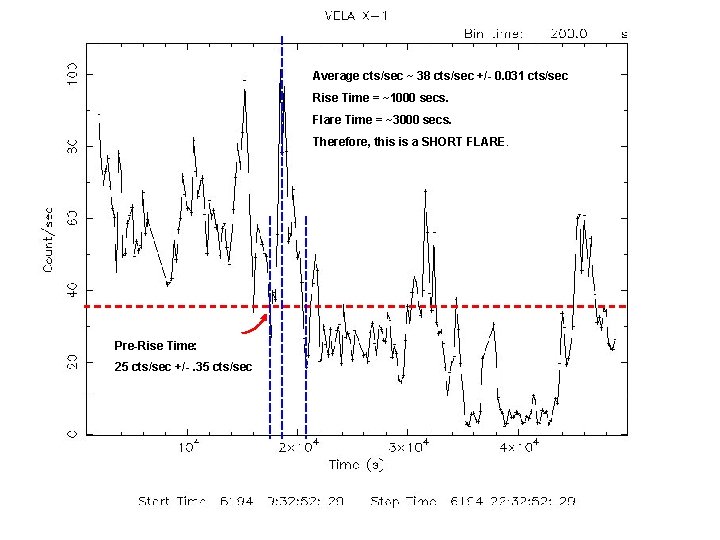
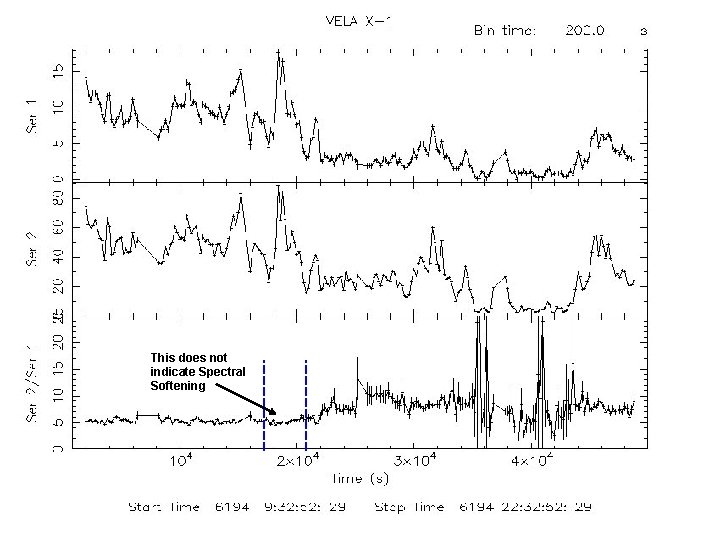
– Short Flares • TRise/TTotal < 0. 3 • Hardness Plot does change: the soft x-rays increase
Kreykenbohm’s Flare Models Flip-Flop Instability The Lucy Situation
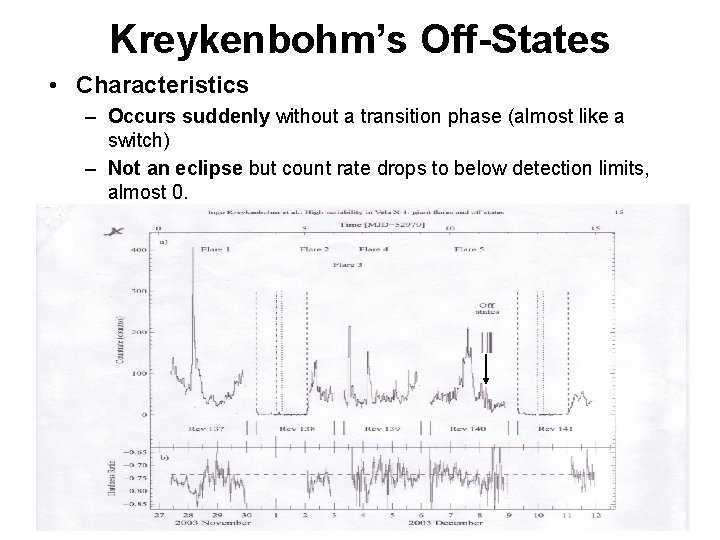
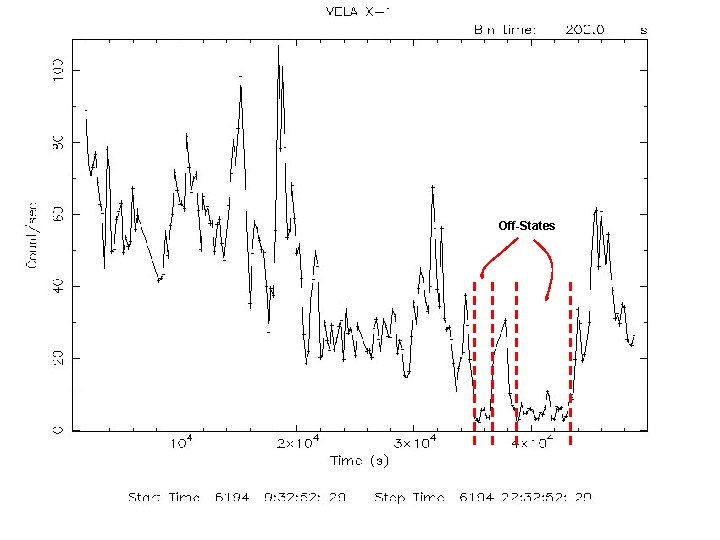
Kreykenbohm’s Off-States • Characteristics – Occurs suddenly without a transition phase (almost like a switch) – Not an eclipse but count rate drops to below detection limits, almost 0.
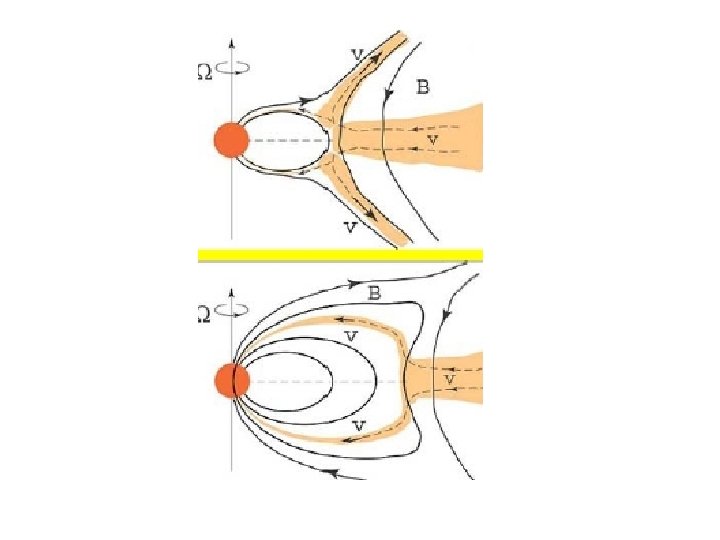
Kreykenbohm’s Off-State Models • The “Biggest Loser” Model – Dense blobs of stellar winds (thanks to the close binary) • Propeller Effect – Inhibition of Accretion via balancing of infalling ram pressure and the magnetic pressure.
Our Research Questions • Do light curves in the 1 -10 ke. V range exhibit flaring and off-state behaviors? • If these behaviors are present, do they have the same characteristics as in the 2040 ke. V range? • If they’re present but with different characteristics, what model(s) might account for the difference?
Flaring Behaviors Average cts/sec ~ 40 cts/sec +/- 0. 03 cts/sec Rise Time = ~2500 secs. Flare Time = ~5000 secs. Therefore, this is a LONG FLARE. Rise time Pre-Rise Time: 40 cts/sec +/-. 447 cts/sec Fall Time
This indicates spectral softening.
Average cts/sec ~ 38 cts/sec +/- 0. 031 cts/sec Rise Time = ~1000 secs. Flare Time = ~3000 secs. Therefore, this is a SHORT FLARE. Pre-Rise Time: 25 cts/sec +/-. 35 cts/sec
This does not indicate Spectral Softening
Off-States
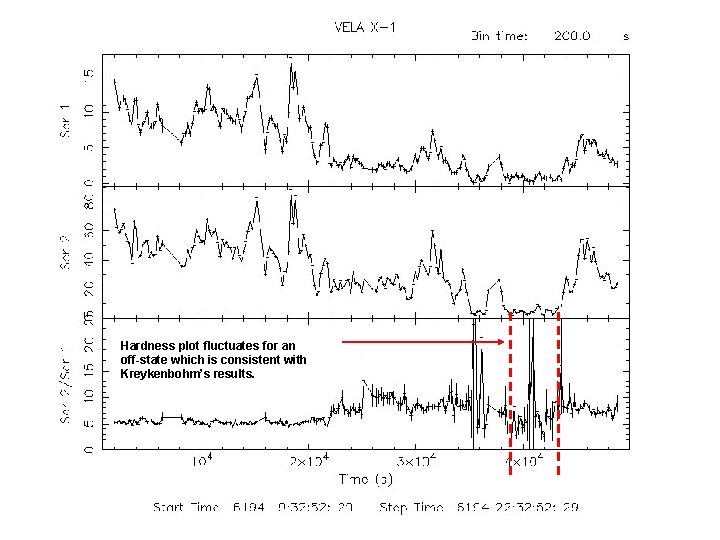
Hardness plot fluctuates for an off-state which is consistent with Kreykenbohm’s results.
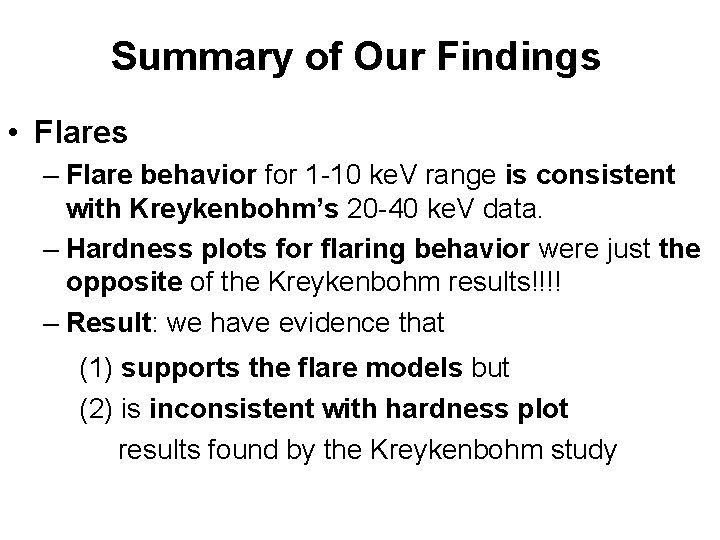
Summary of Our Findings • Flares – Flare behavior for 1 -10 ke. V range is consistent with Kreykenbohm’s 20 -40 ke. V data. – Hardness plots for flaring behavior were just the opposite of the Kreykenbohm results!!!! – Result: we have evidence that (1) supports the flare models but (2) is inconsistent with hardness plot results found by the Kreykenbohm study
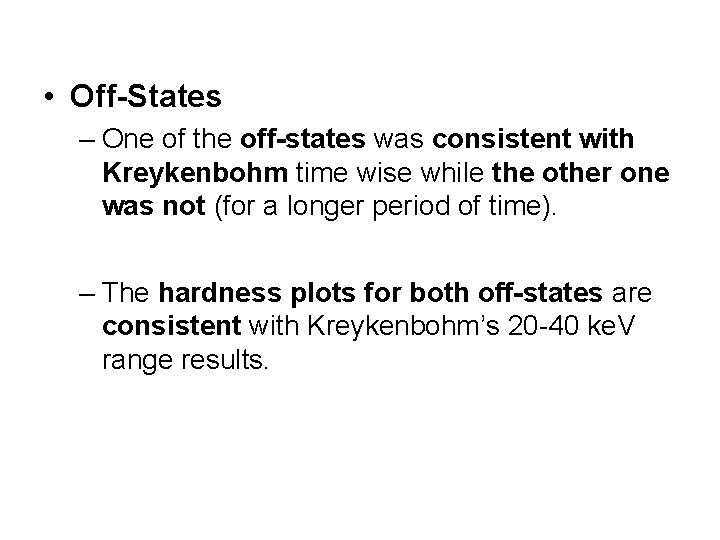
• Off-States – One of the off-states was consistent with Kreykenbohm time wise while the other one was not (for a longer period of time). – The hardness plots for both off-states are consistent with Kreykenbohm’s 20 -40 ke. V range results.
Future Research • Write a paper presenting our findings • Look at other MXRB to compare Vela X-1 flaring behaviors with those sources.