
School Resource Officer Program Israel Vela Chief School
- Slides: 11
School Resource Officer Program Israel Vela, Chief School Operations and Academic Support Officer Randy Heath, Executive Director of Student & Family Support Services Timothy Kovich, Safety Services Assistant Director September 12, 2020
Outcomes and Agenda • • School Resource Officer (SRO) Program SSHB 1216 legislative intent and program requirements Training requirements Questions and discussion
Kent School Districts Partnerships: Kent School District has maintained positive relationships with local law enforcement for the past several decades. These relationships have expanded to represent our schools in these cities and jurisdictions, The City of Kent, City of Covington and King County. KSD has worked with these community partners to ensure student, staff and visitor safety in and around our schools. The role of the School Resource Officers has grown over these years to become a valued part of the TEAM KSD.
School Resource Officer Program Current Contracting Summary: Kent Police provides two City of Kent Resource Officers at a cost sharing with the Kent School District. KSD pays 60% and the City of Kent Pay for 40% for a total estimated cost to KSD for 2020 -2021 school year of $191, 708 City of Covington provides one SRO at a cost sharing with the Kent School District. KSD pays 60% and the City of Covington Pays for 40% for a total estimated cost to KSD for 2020 -2021 school year of $120, 653 King County provides one SRO to Kent School District. KSD pays 100% for a total estimated cost to KSD for 2020 -2021 school year of $146, 663
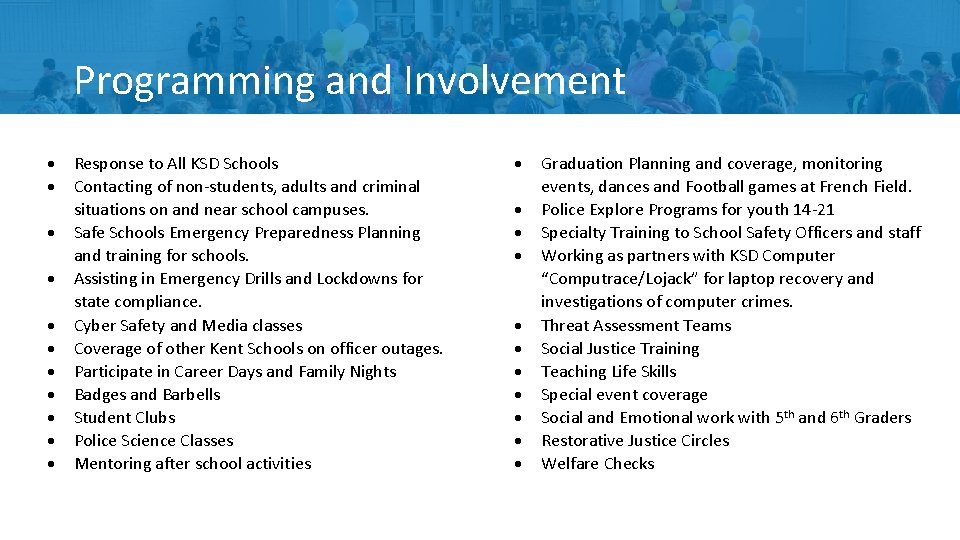
Programming and Involvement Response to All KSD Schools Contacting of non-students, adults and criminal situations on and near school campuses. Safe Schools Emergency Preparedness Planning and training for schools. Assisting in Emergency Drills and Lockdowns for state compliance. Cyber Safety and Media classes Coverage of other Kent Schools on officer outages. Participate in Career Days and Family Nights Badges and Barbells Student Clubs Police Science Classes Mentoring after school activities Graduation Planning and coverage, monitoring events, dances and Football games at French Field. Police Explore Programs for youth 14 -21 Specialty Training to School Safety Officers and staff Working as partners with KSD Computer “Computrace/Lojack” for laptop recovery and investigations of computer crimes. Threat Assessment Teams Social Justice Training Teaching Life Skills Special event coverage Social and Emotional work with 5 th and 6 th Graders Restorative Justice Circles Welfare Checks
OSPI School Resource Officer Program As defined in legislation, a School Resource Officer (SRO) is a commissioned law enforcement officer in the state of Washington with sworn authority to make arrests, deployed in community-oriented policing, and assigned by the employing police department or sheriff's office to work in schools to address crime and disorder problems, gangs, and drug activities affecting or occurring in or around K-12 schools. School resource officers should focus on keeping students out of the criminal justice system when possible and should not be used to attempt to impose criminal sanctions in matters that are more appropriately handled within the educational system.
Legislative Intent With SSHB 1216 (2019 -20), the legislature stated its intent to create statewide school resource officers (SRO) program. While it is not the intent of the legislature to require school resource officers in schools, SRO programs must ensure that district policies are in place and that there are clear agreements between school districts and the local law enforcement agencies which provide SROs. In addition, such a program must ensure consistency through minimum training requirements for SROs. These requirements are in place to establish effective partnerships which protect the health and safety of all students.
Program Requirements • Confirmation that every school resource officer has received training on 12 mandated topic areas; • A clear statement regarding school resource officer duties and responsibilities related to student behavior and discipline including: • • • Prohibition of a school resource officer from becoming involved in formal school discipline situations that are the responsibility of school administrators; Acknowledgement of the role of a school resource officer as a teacher, informal counselor, and law enforcement officer; Recognition that a trained school resource officer knows when to informally interact with students to reinforce school rules and when to enforce the law; • School district policy and procedures that clarify the circumstances under which teachers and school administrators may ask an officer to intervene with a student; • Annual collection and reporting of data regarding calls for law enforcement service and the outcome of each call, including student arrest and referral for prosecution. Data must be disaggregated by school, offense type, race, gender, age, and students who have an individualized education program or 504 plan; • A process for families to file complaints with the school and local law enforcement agency related to school resource officers and a process for investigating and responding to complaints;
New Training Requirements For statewide consistency around minimum, mandatory training requirements, the legislation specifies that school resource officers must receive training in the following 12 topic areas: 1. Constitutional and civil rights of children in schools, including state law governing search and interrogation of youth in schools; 2. Child and adolescent development; 3. Trauma-informed approaches to working with youth; 4. Recognizing and responding to youth mental health issues; 5. Educational rights of students with disabilities, the relationship of disability to behavior, and best practices for interacting with students with disabilities;
New Training Requirements (Continued) 6. Collateral consequences of arrest, referral for prosecution, and court involvement; 7. Resources available in the community that serve as alternatives to arrest and prosecution and pathways for youth to access services without court or criminal justice involvement; 8. Local and national disparities in the use of force and arrests of children; 9. De-escalation techniques when working with youth or groups of youth; 10. State law regarding restraint and isolation in schools, including RCW 28 A. 600. 485; 11. Bias-free policing and cultural competency, including best practices for interacting with students with diverse backgrounds including race, religion, English learners, LGBTQ, and varying nationalities. 12. The federal family educational rights and privacy act, FERPA.
Questions & Discussion