Validation of alcohol consumption selfreports in the Munich
- Slides: 28
Validation of alcohol consumption selfreports in the Munich Composite International Diagnostic Interview (M-CIDI) Sören Kuitunen-Paul *, Gerhard Bühringer, Jürgen Rehm, Jakob Manthey, Dirk W. Lachenmeier, Hans-Ulrich Wittchen * Institute of Clinical Psychology and Psychotherapy, TU Dresden, Germany 2 nd European Conference on Addictive Behaviours and Dependencies, Lisbon, Portugal, 24. 10. 2017
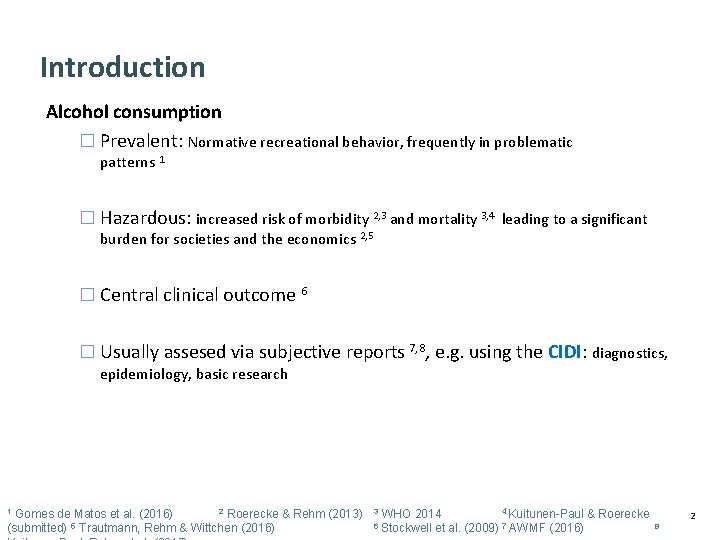
Introduction Alcohol consumption � Prevalent: Normative recreational behavior, frequently in problematic patterns 1 � Hazardous: increased risk of morbidity 2, 3 and mortality 3, 4 leading to a significant burden for societies and the economics 2, 5 � Central clinical outcome 6 � Usually assesed via subjective reports 7, 8, e. g. using the CIDI: diagnostics, epidemiology, basic research 1 Gomes de Matos et al. (2016) 2 Roerecke & Rehm (2013) 3 WHO 2014 (submitted) 5 Trautmann, Rehm & Wittchen (2016) 4 Kuitunen-Paul & Roerecke 6 Stockwell et al. (2009) 7 AWMF (2016) 2 8
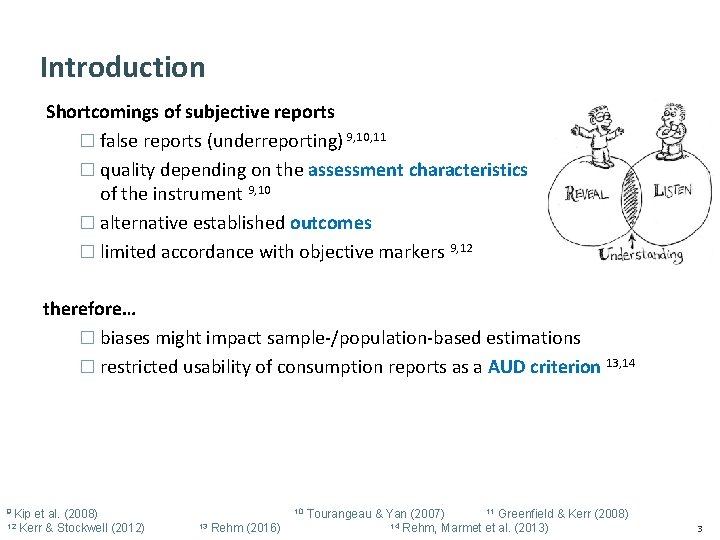
Introduction Shortcomings of subjective reports � false reports (underreporting) 9, 10, 11 � quality depending on the assessment characteristics of the instrument 9, 10 � alternative established outcomes � limited accordance with objective markers 9, 12 therefore… � biases might impact sample‐/population‐based estimations � restricted usability of consumption reports as a AUD criterion 13, 14 9 Kip et al. (2008) 12 Kerr & Stockwell (2012) 10 Tourangeau & Yan (2007) 13 Rehm (2016) 11 Greenfield & Kerr (2008) 14 Rehm, Marmet et al. (2013) 3
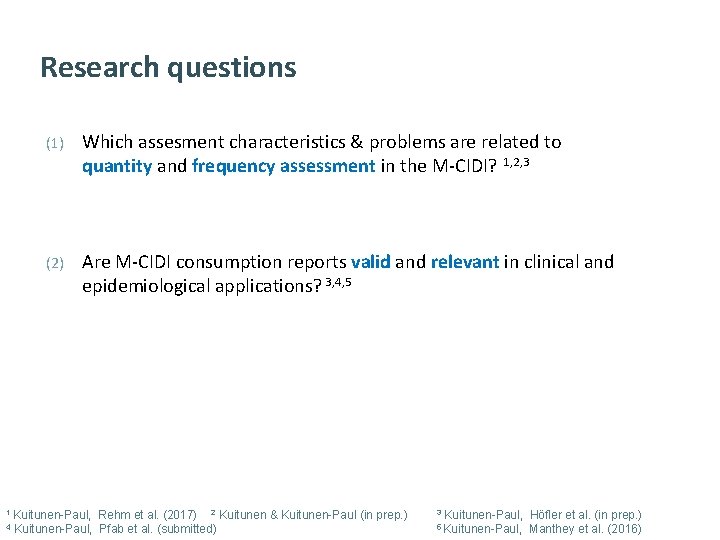
Research questions (1) Which assesment characteristics & problems are related to quantity and frequency assessment in the M‐CIDI? 1, 2, 3 (2) Are M‐CIDI consumption reports valid and relevant in clinical and epidemiological applications? 3, 4, 5 1 Kuitunen-Paul, Rehm et al. (2017) 2 Kuitunen & Kuitunen-Paul (in prep. ) 4 Kuitunen-Paul, Pfab et al. (submitted) 3 Kuitunen-Paul, Höfler et al. (in prep. ) 5 Kuitunen-Paul, Manthey et al. (2016)
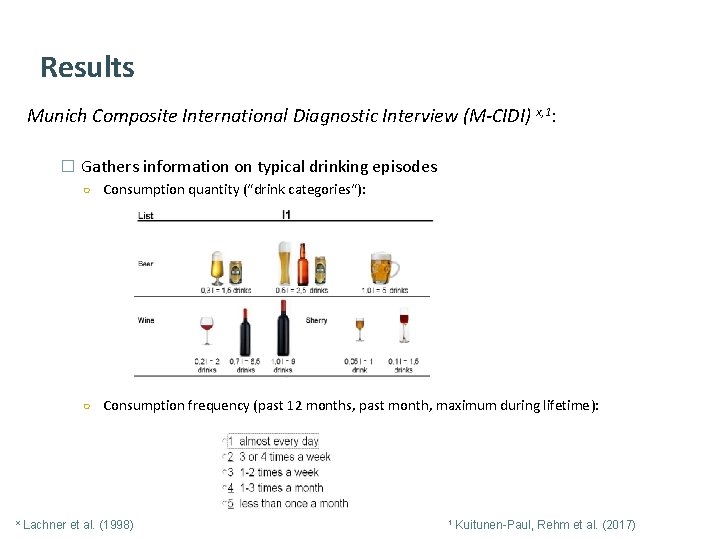
Results Munich Composite International Diagnostic Interview (M-CIDI) x, 1: � Gathers information on typical drinking episodes ○ Consumption quantity (“drink categories“): ○ Consumption frequency (past 12 months, past month, maximum during lifetime): x Lachner et al. (1998) 1 Kuitunen-Paul, Rehm et al. (2017)
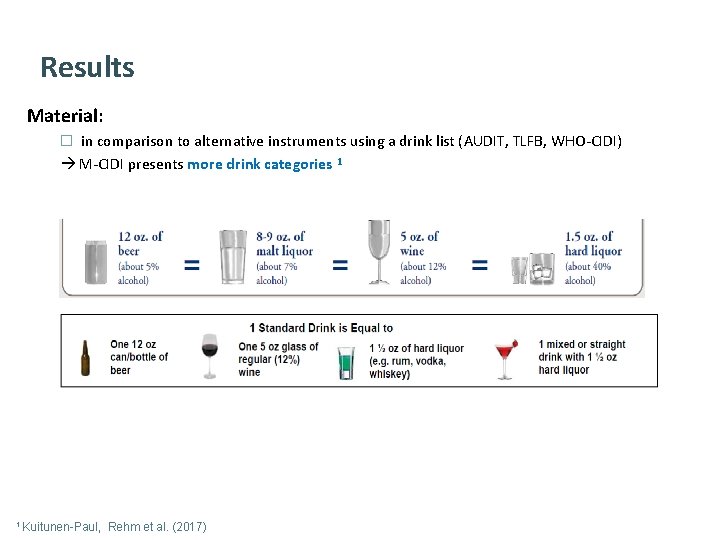
Results Material: � in comparison to alternative instruments using a drink list (AUDIT, TLFB, WHO‐CIDI) M‐CIDI presents more drink categories 1 1 Kuitunen-Paul, Rehm et al. (2017)
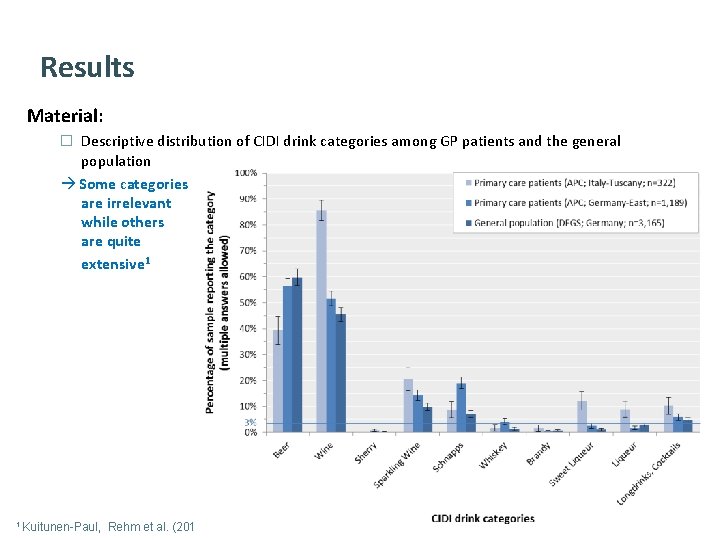
Results Material: � Descriptive distribution of CIDI drink categories among GP patients and the general population Some categories are irrelevant while others are quite extensive 1 1 Kuitunen-Paul, Rehm et al. (2017)
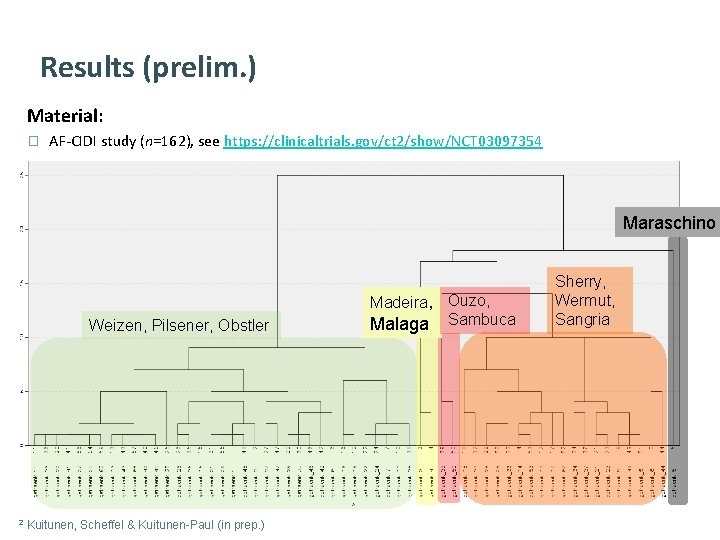
Results (prelim. ) Material: � AF‐CIDI study (n=162), see https: //clinicaltrials. gov/ct 2/show/NCT 03097354 Maraschino Weizen, Pilsener, Obstler 2 Kuitunen, Scheffel & Kuitunen-Paul (in prep. ) Madeira, Ouzo, Malaga Sambuca Sherry, Wermut, Sangria
Results Quantity assessment: � Comparing % vol‐specifications between real beverages and M‐CIDI‐conventions in relation to drink category and serving size � data from k=22, 503 alcoholic beverages sold in Germany in 2010‐ 2016 1 Kuitunen-Paul, Rehm et al. (2017)
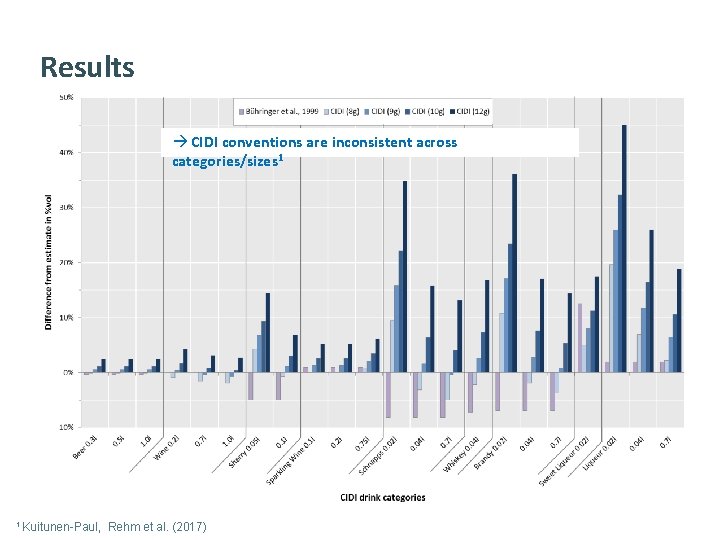
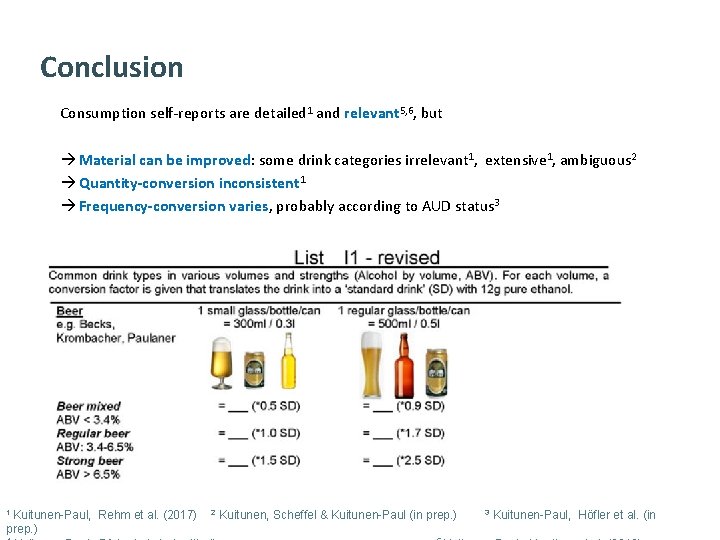
Results CIDI conventions are inconsistent across categories/sizes 1 1 Kuitunen-Paul, Rehm et al. (2017)
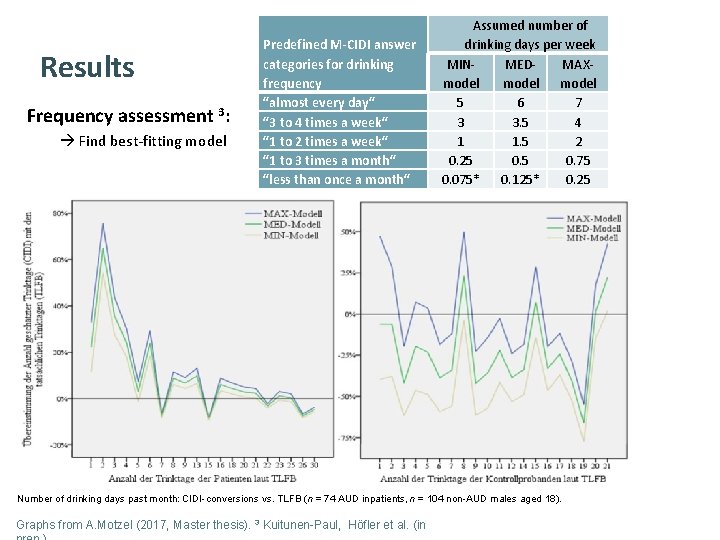
Results Frequency assessment 3: Find best‐fitting model Predefined M-CIDI answer categories for drinking frequency “almost every day“ “ 3 to 4 times a week“ “ 1 to 2 times a week“ “ 1 to 3 times a month“ “less than once a month“ Assumed number of drinking days per week MIN‐ MED‐ MAX‐ model 5 6 7 3 3. 5 4 1 1. 5 2 0. 25 0. 75 0. 075* 0. 125* 0. 25 Number of drinking days past month: CIDI-conversions vs. TLFB (n = 74 AUD inpatients, n = 104 non-AUD males aged 18). Graphs from A. Motzel (2017, Master thesis). 3 Kuitunen-Paul, Höfler et al. (in
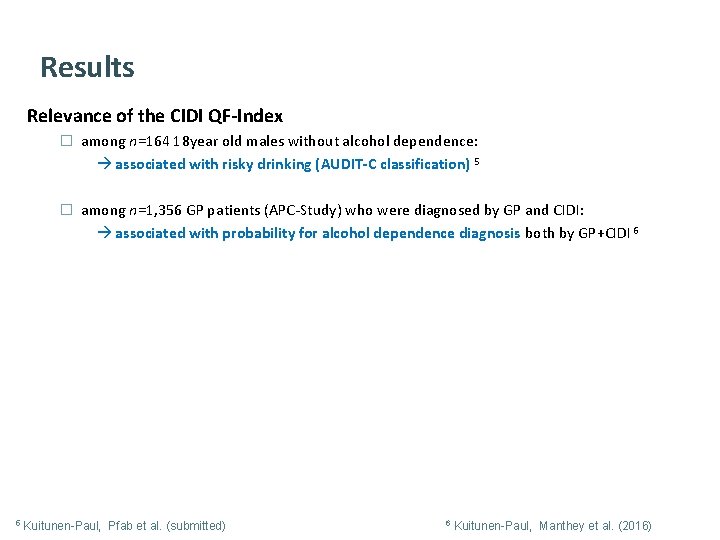
Results Relevance of the CIDI QF-Index � among n=164 18 year old males without alcohol dependence: associated with risky drinking (AUDIT-C classification) 5 � among n=1, 356 GP patients (APC‐Study) who were diagnosed by GP and CIDI: associated with probability for alcohol dependence diagnosis both by GP+CIDI 6 5 Kuitunen-Paul, Pfab et al. (submitted) 6 Kuitunen-Paul, Manthey et al. (2016)
Conclusion Consumption self‐reports are detailed 1 and relevant 5, 6, but Material can be improved: some drink categories irrelevant 1, extensive 1, ambiguous 2 Quantity-conversion inconsistent 1 Frequency-conversion varies, probably according to AUD status 3 1 Kuitunen-Paul, Rehm et al. (2017) prep. ) 2 Kuitunen, Scheffel & Kuitunen-Paul (in prep. ) 3 Kuitunen-Paul, Höfler et al. (in
Discussion Strengths: � Multicenter studies � Multiple methods used (FTIR, self‐reports, thirt‐person reports) � Controlling for several influencing factors Limitations: � Samples from one country (%vol) or two countries (patients) only � Unknown acceptance, feasibility, and time demands of the revised supplementary sheet � Diagnostic relevance Broader implications: � retrospective self reports inferior to EMA or transdermal measurement? 16 � Consumption as AUD criterion 13, 14, 15 13 Rehm (2016) 14 Rehm, Marmet et al. (2013) 15 Saha et al. (2007) 16 Morgenstern et al. (2014)
Principal investigators � � � � � Katja Beesdo‐Baum Gerhard Bühringer Andreas Heinz Dirk W. Lachenmeier Michael A. Rapp Jürgen Rehm Michael N. Smolka Hans‐Ulrich Wittchen Ulrich S. Zimmermann � � � � � Anne Beck Silke Behrendt Julian Birkenstock Robin Frank Eva Friedel Maria Garbusow Michael Höfler Anja Kräplin Jakob Manthey Stephan Nebe Elisabeth Obst Mirjam Petersen � � � � Student assistants � � Research staff Lars Pieper Oana G. Rus Lucie Scholl Miriam Sebold Christian Sommer Jens Strehle Sebastian Trautmann � � � � Ute Böttner Eva Grunenberg Lucia Hämmerl Firdeus Kadric Özlem‐Feray Kayali Julia Kleindienst Elisabeth Kluge Francie Kriegel Paula T. Kuitunen Eva Maaßen Dave Möwisch Elisabeth Mühlfeld Cornelia Neumann Luise Olbricht Sioned Pfab � � Karoline Sauer Lara Seefeld Christoph Scheffel Gianna Spitta Katrin Staab Anja Tritt Anna‐Maria Walter‐Daume Jean Wendt Jurij Wiede Monique Zobel Thesis candidates � � � Franziska Bender Erren Hua Danielle Jackson Robin Jadkowski Lucia Kuipers Franziska Koch Alexandra Motzel Theresa Müller Annika Pielenz Anna Rademacher Britta Röwer Lena Schulz Supported by the German Research Foundation DFG (fundings WI 709/10‐ 1, WI 709/10‐ 2, and others) www. lead‐studie. de soeren. kuitunen‐paul@tu‐dresden. de
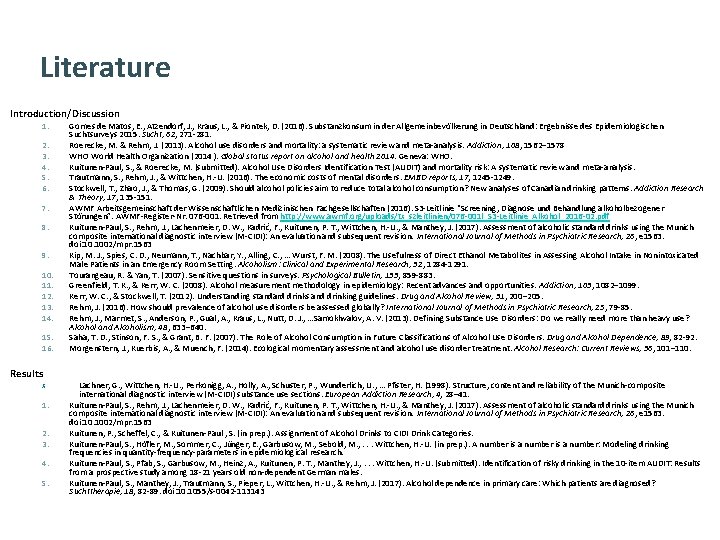
Literature Introduction/Discussion 1. 2. 3. 4. 5. 6. 7. 8. 9. 10. 11. 12. 13. 14. 15. 16. Results x 1. 2. 3. 4. 5. Gomes de Matos, E. , Atzendorf, J. , Kraus, L. , & Piontek, D. (2016). Substanzkonsum in der Allgemeinbevölkerung in Deutschland: Ergebnisse des Epidemiologischen Suchtsurveys 2015. Sucht, 62, 271‐ 281. Roerecke, M. & Rehm, J. (2013). Alcohol use disorders and mortality: a systematic review and meta‐analysis. Addiction, 108, 1562– 1578 WHO World Health Organization (2014 ). Global status report on alcohol and health 2014. Geneva: WHO. Kuitunen‐Paul, S. , & Roerecke, M. (submitted). Alcohol Use Disorders Identification Test (AUDIT) and mortality risk: A systematic review and meta‐analysis. Trautmann, S. , Rehm, J. , & Wittchen, H. ‐U. (2016). The economic costs of mental disorders. EMBO reports, 17, 1245‐ 1249. Stockwell, T. , Zhao, J. , & Thomas, G. (2009). Should alcohol policies aim to reduce total alcohol consumption? New analyses of Canadian drinking patterns. Addiction Research & Theory, 17, 135‐ 151. AWMF Arbeitsgemeinschaft der Wissenschaftlichen Medizinischen Fachgesellschaften (2016). S 3‐Leitlinie “Screening, Diagnose und Behandlung alkoholbezogener Störungen”. AWMF‐Register‐Nr. 076‐ 001. Retrieved from http: //www. awmf. org/uploads/tx_szleitlinien/076‐ 001 l_S 3‐Leitlinie_Alkohol_2016‐ 02. pdf Kuitunen‐Paul, S. , Rehm, J. , Lachenmeier, D. W. , Kadrić, F. , Kuitunen, P. T. , Wittchen, H. ‐U. , & Manthey, J. (2017). Assessment of alcoholic standard drinks using the Munich composite international diagnostic interview (M‐CIDI): An evaluation and subsequent revision. International Journal of Methods in Psychiatric Research, 26, e 1563. doi: 10. 1002/mpr. 1563 Kip, M. J. , Spies, C. D. , Neumann, T. , Nachbar, Y. , Alling, C. , … Wurst, F. M. (2008). The Usefulness of Direct Ethanol Metabolites in Assessing Alcohol Intake in Nonintoxicated Male Patients in an Emergency Room Setting. Alcoholism: Clinical and Experimental Research, 32, 1284‐ 1291. Tourangeau, R. & Yan, T. (2007). Sensitive questions in surveys. Psychological Bulletin, 133, 859‐ 883. Greenfield, T. K. , & Kerr, W. C. (2008). Alcohol measurement methodology in epidemiology: Recent advances and opportunities. Addiction, 103, 1082– 1099. Kerr, W. C. , & Stockwell, T. (2012). Understanding standard drinks and drinking guidelines. Drug and Alcohol Review, 31, 200– 205. Rehm, J. (2016). How should prevalence of alcohol use disorders be assessed globally? International Journal of Methods in Psychiatric Research, 25, 79‐ 85. Rehm, J. , Marmet, S. , Anderson, P. , Gual, A. , Kraus, L. , Nutt, D. J. , …Samokhvalov, A. V. (2013). Defining Substance Use Disorders: Do we really need more than heavy use? Alcohol and Alcoholism, 48, 633– 640. Saha, T. D. , Stinson, F. S. , & Grant, B. F. (2007). The Role of Alcohol Consumption in Future Classifications of Alcohol Use Disorders. Drug and Alcohol Dependence, 89, 82‐ 92. Morgenstern, J. , Kuerbis, A. , & Muench, F. (2014). Ecological momentary assessment and alcohol use disorder treatment. Alcohol Research: Current Reviews, 36, 101– 110. Lachner, G. , Wittchen, H. ‐U. , Perkonigg, A. , Holly, A. , Schuster, P. , Wunderlich, U. , … Pfister, H. (1998). Structure, content and reliability of the Munich‐composite international diagnostic interview (M‐CIDI) substance use sections. European Addiction Research, 4, 28– 41. Kuitunen‐Paul, S. , Rehm, J. , Lachenmeier, D. W. , Kadrić, F. , Kuitunen, P. T. , Wittchen, H. ‐U. , & Manthey, J. (2017). Assessment of alcoholic standard drinks using the Munich composite international diagnostic interview (M‐CIDI): An evaluation and subsequent revision. International Journal of Methods in Psychiatric Research, 26, e 1563. doi: 10. 1002/mpr. 1563 Kuitunen, P. , Scheffel, C. , & Kuitunen‐Paul , S. (in prep. ). Assignment of Alcohol Drinks to CIDI Drink Categories. Kuitunen‐Paul, S. , Höfler, M. , Sommer, C. , Jünger, E. , Garbusow, M. , Sebold, M. , . . . Wittchen, H. ‐U. (in prep. ). A number is a number: Modeling drinking frequencies in quantity‐frequency‐parameters in epidemiological research. Kuitunen‐Paul, S. , Pfab, S. , Garbusow, M. , Heinz, A. , Kuitunen, P. T. , Manthey, J. , . . . Wittchen, H. ‐U. (submitted). Identification of risky drinking in the 10‐item AUDIT: Results from a prospective study among 18‐ 21 years old non‐dependent German males. Kuitunen‐Paul, S. , Manthey, J. , Trautmann, S. , Pieper, L. , Wittchen, H. ‐U. , & Rehm, J. (2017). Alcohol dependence in primary care: Which patients are diagnosed? Suchttherapie, 18, 82‐ 89. doi: 10. 1055/s‐ 0042‐ 113143
Validation of alcohol consumption selfreports in the Munich Composite International Diagnostic Interview (M-CIDI) Sören Kuitunen-Paul et al. Institute of Clinical Psychology and Psychotherapy, TU Dresden, Germany 2 nd European Conference on Addictive Behaviours and Dependencies, Lisbon, Portugal, 24. 10. 2017
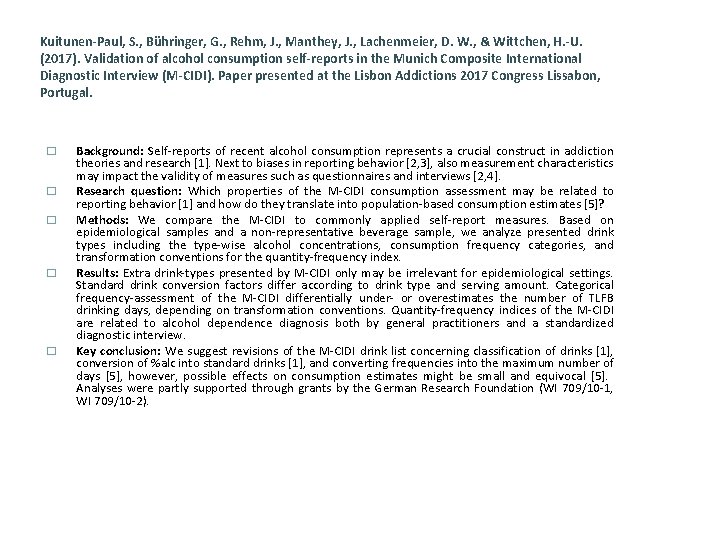
Kuitunen-Paul, S. , Bühringer, G. , Rehm, J. , Manthey, J. , Lachenmeier, D. W. , & Wittchen, H. -U. (2017). Validation of alcohol consumption self-reports in the Munich Composite International Diagnostic Interview (M-CIDI). Paper presented at the Lisbon Addictions 2017 Congress Lissabon, Portugal. � � � Background: Self‐reports of recent alcohol consumption represents a crucial construct in addiction theories and research [1]. Next to biases in reporting behavior [2, 3], also measurement characteristics may impact the validity of measures such as questionnaires and interviews [2, 4]. Research question: Which properties of the M‐CIDI consumption assessment may be related to reporting behavior [1] and how do they translate into population‐based consumption estimates [5]? Methods: We compare the M‐CIDI to commonly applied self‐report measures. Based on epidemiological samples and a non‐representative beverage sample, we analyze presented drink types including the type‐wise alcohol concentrations, consumption frequency categories, and transformation conventions for the quantity‐frequency index. Results: Extra drink‐types presented by M‐CIDI only may be irrelevant for epidemiological settings. Standard drink conversion factors differ according to drink type and serving amount. Categorical frequency‐assessment of the M‐CIDI differentially under‐ or overestimates the number of TLFB drinking days, depending on transformation conventions. Quantity‐frequency indices of the M‐CIDI are related to alcohol dependence diagnosis both by general practitioners and a standardized diagnostic interview. Key conclusion: We suggest revisions of the M‐CIDI drink list concerning classification of drinks [1], conversion of %alc into standard drinks [1], and converting frequencies into the maximum number of days [5], however, possible effects on consumption estimates might be small and equivocal [5]. Analyses were partly supported through grants by the German Research Foundation (WI 709/10‐ 1, WI 709/10‐ 2).
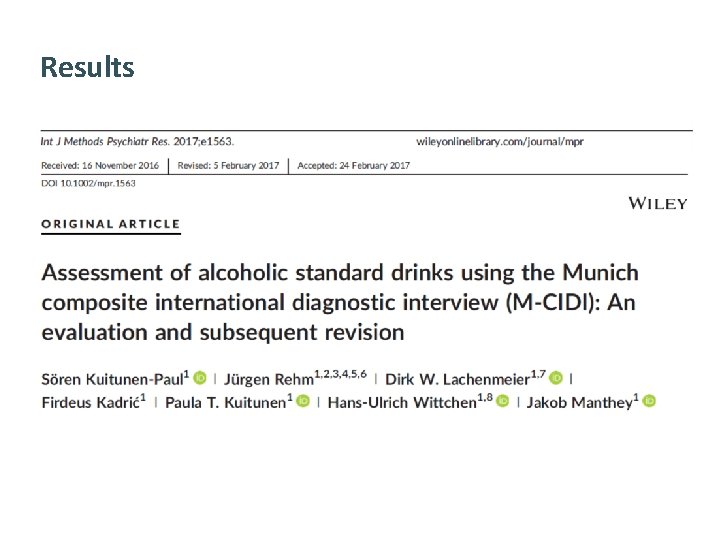
Results
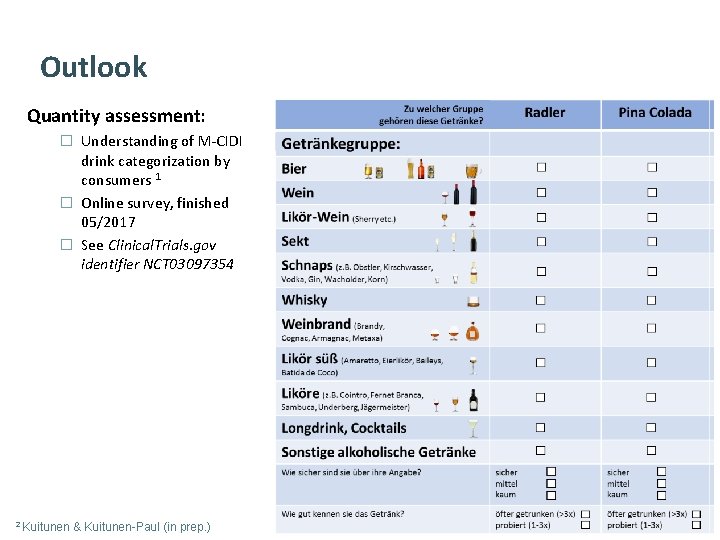
Outlook Quantity assessment: � Understanding of M‐CIDI drink categorization by consumers 1 � Online survey, finished 05/2017 � See Clinical. Trials. gov identifier NCT 03097354 2 Kuitunen & Kuitunen-Paul (in prep. )
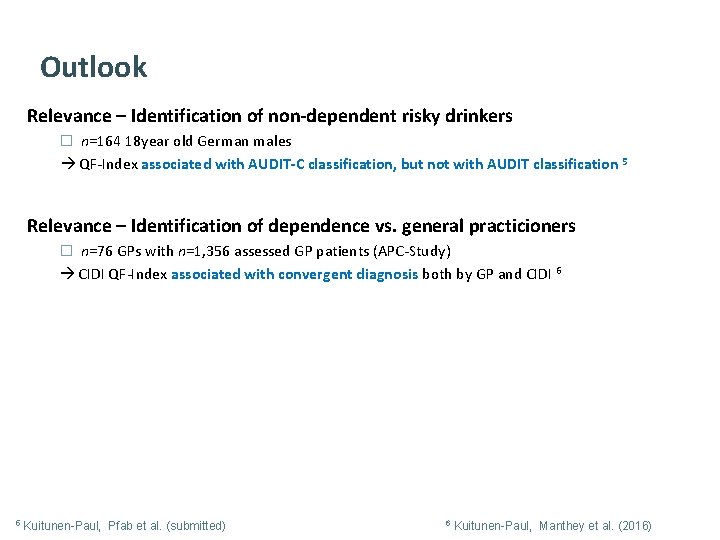
Outlook Relevance – Identification of non-dependent risky drinkers � n=164 18 year old German males QF‐Index associated with AUDIT-C classification, but not with AUDIT classification 5 Relevance – Identification of dependence vs. general practicioners � n=76 GPs with n=1, 356 assessed GP patients (APC‐Study) CIDI QF‐Index associated with convergent diagnosis both by GP and CIDI 6 5 Kuitunen-Paul, Pfab et al. (submitted) 6 Kuitunen-Paul, Manthey et al. (2016)
Abstract Objectives: Quantity and frequency of alcohol consumption are important in risk assessment as well as epidemiological and clinical research. Over the past decades, several large‐scale studies have used the Munich Composite International Diagnostic Interview (M‐ CIDI) to assess drinking amounts. However, the accuracy of this assessment has rarely been evaluated. Methods: We evaluated the relevance of drink categories and pouring sizes, and the factors used to convert actual drinks into standard drinks. We compare the M‐CIDI to alternative drink assessment instruments. Drink categories were empirically validated using primary care samples (n=322 from Italy, n=1, 189 from Germany), a general population sample (n=3, 165 from Germany) and a non‐representative set of k=22, 503 alcoholic beverages sold in Germany in 2010‐ 2016. Results: The M‐CIDI supplement sheet displays more categories than other instruments (AUDIT, TLFB, WHO‐CIDI). Beer, wine, and spirits represent the most prevalent categories in population samples. Previous standard drink conversion factors were inconsistent for different pouring sizes of the same drink and, to a smaller extent, across drink categories. Conclusions: For the use in Germany and Italy, we propose to limit M‐CIDI drink categories and pouring sizes, and a revision of the standard drink conversion. We further suggest corresponding examinations and revisions in other cultures. Analyses were partly supported through grants by the German Research Foundation (WI 709/10‐ 1, WI 709/10‐ 2).
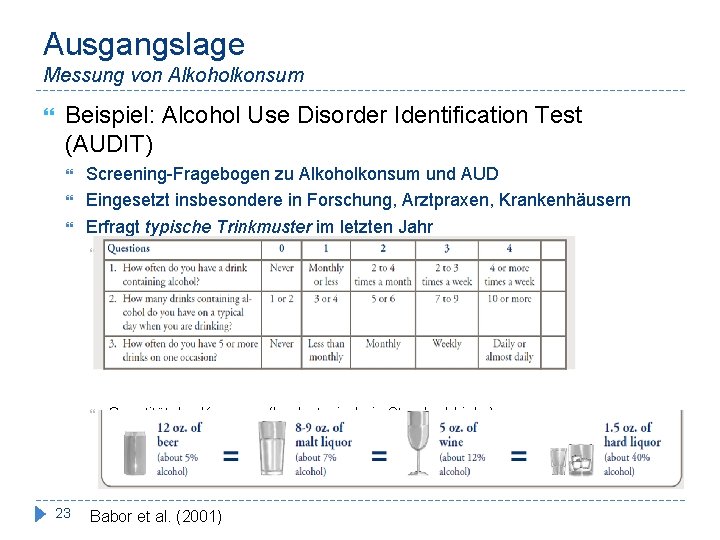
Ausgangslage Messung von Alkoholkonsum Beispiel: Alcohol Use Disorder Identification Test (AUDIT) 23 Screening-Fragebogen zu Alkoholkonsum und AUD Eingesetzt insbesondere in Forschung, Arztpraxen, Krankenhäusern Erfragt typische Trinkmuster im letzten Jahr Frequenz des Konsums: Quantität des Konsums (landestypisch, in Standarddrinks): Babor et al. (2001)
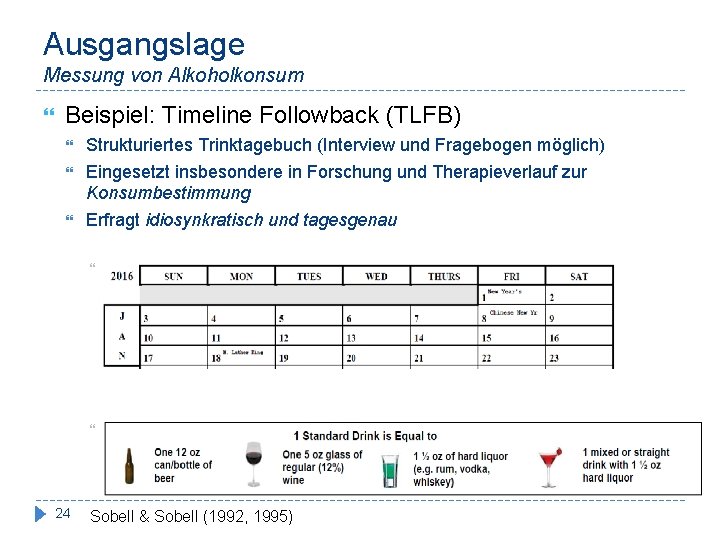
Ausgangslage Messung von Alkoholkonsum Beispiel: Timeline Followback (TLFB) 24 Strukturiertes Trinktagebuch (Interview und Fragebogen möglich) Eingesetzt insbesondere in Forschung und Therapieverlauf zur Konsumbestimmung Erfragt idiosynkratisch und tagesgenau Frequenz des Konsums (variabel, meist: letzte 45 Tage): Quantität des Konsums (landestypisch, in Standarddrinks): Sobell & Sobell (1992, 1995)
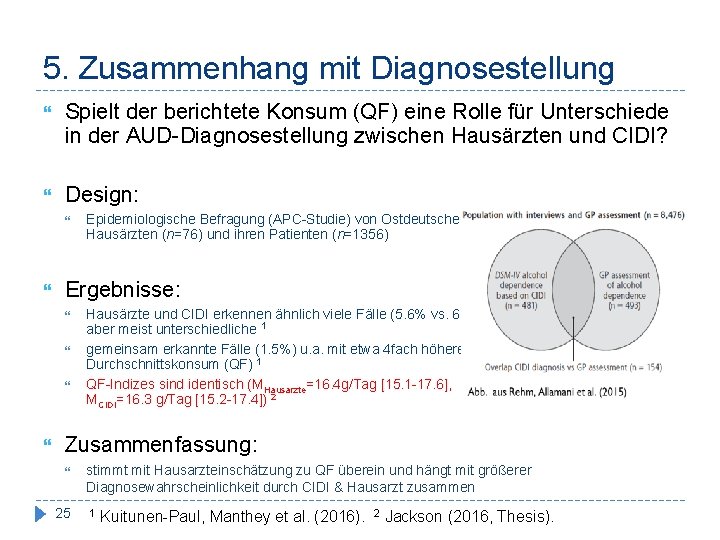
5. Zusammenhang mit Diagnosestellung Spielt der berichtete Konsum (QF) eine Rolle für Unterschiede in der AUD-Diagnosestellung zwischen Hausärzten und CIDI? Design: Ergebnisse: Epidemiologische Befragung (APC-Studie) von Ostdeutschen Hausärzten (n=76) und ihren Patienten (n=1356) Hausärzte und CIDI erkennen ähnlich viele Fälle (5. 6% vs. 6. 9%), aber meist unterschiedliche 1 gemeinsam erkannte Fälle (1. 5%) u. a. mit etwa 4 fach höherem Durchschnittskonsum (QF) 1 QF-Indizes sind identisch (MHausärzte=16. 4 g/Tag [15. 1 -17. 6], MCIDI=16. 3 g/Tag [15. 2 -17. 4]) 2 Zusammenfassung: 25 stimmt mit Hausarzteinschätzung zu QF überein und hängt mit größerer Diagnosewahrscheinlichkeit durch CIDI & Hausarzt zusammen 1 Kuitunen-Paul, Manthey et al. (2016). 2 Jackson (2016, Thesis).
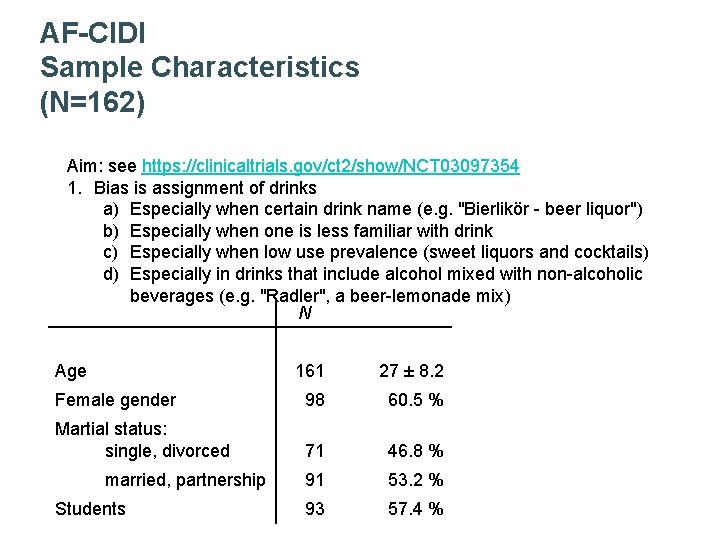
AF-CIDI Sample Characteristics (N=162) Aim: see https: //clinicaltrials. gov/ct 2/show/NCT 03097354 1. Bias is assignment of drinks a) Especially when certain drink name (e. g. "Bierlikör - beer liquor") b) Especially when one is less familiar with drink c) Especially when low use prevalence (sweet liquors and cocktails) d) Especially in drinks that include alcohol mixed with non-alcoholic beverages (e. g. "Radler", a beer-lemonade mix) N Age 161 27 ± 8. 2 Female gender 98 60. 5 % Martial status: single, divorced 71 46. 8 % married, partnership 91 53. 2 % Students 93 57. 4 %
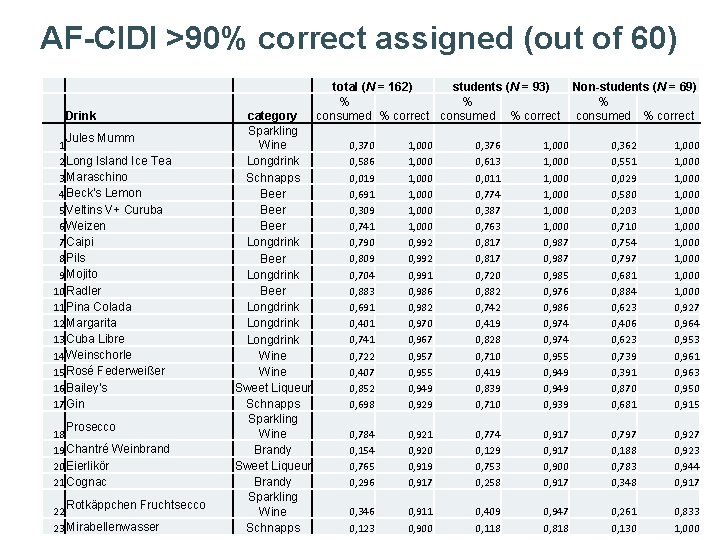
AF-CIDI >90% correct assigned (out of 60) Drink Jules Mumm 1 2 Long Island Ice Tea 3 Maraschino 4 Beck’s Lemon 5 Veltins V+ Curuba 6 Weizen 7 Caipi 8 Pils 9 Mojito 10 Radler 11 Pina Colada 12 Margarita 13 Cuba Libre 14 Weinschorle 15 Rosé Federweißer 16 Bailey‘s 17 Gin Prosecco 18 19 Chantré Weinbrand 20 Eierlikör 21 Cognac Rotkäppchen Fruchtsecco 22 23 Mirabellenwasser category Sparkling Wine Longdrink Schnapps Beer Longdrink Beer Longdrink Wine Sweet Liqueur Schnapps Sparkling Wine Brandy Sweet Liqueur Brandy Sparkling Wine Schnapps total (N = 162) students (N = 93) Non-students (N = 69) % % % consumed % correct 0, 370 0, 586 0, 019 0, 691 0, 309 0, 741 0, 790 0, 809 0, 704 0, 883 0, 691 0, 401 0, 741 0, 722 0, 407 0, 852 0, 698 1, 000 1, 000 0, 992 0, 991 0, 986 0, 982 0, 970 0, 967 0, 955 0, 949 0, 929 0, 376 0, 613 0, 011 0, 774 0, 387 0, 763 0, 817 0, 720 0, 882 0, 742 0, 419 0, 828 0, 710 0, 419 0, 839 0, 710 1, 000 1, 000 0, 987 0, 985 0, 976 0, 986 0, 974 0, 955 0, 949 0, 939 0, 362 0, 551 0, 029 0, 580 0, 203 0, 710 0, 754 0, 797 0, 681 0, 884 0, 623 0, 406 0, 623 0, 739 0, 391 0, 870 0, 681 1, 000 1, 000 1, 000 0, 927 0, 964 0, 953 0, 961 0, 963 0, 950 0, 915 0, 784 0, 154 0, 765 0, 296 0, 921 0, 920 0, 919 0, 917 0, 774 0, 129 0, 753 0, 258 0, 917 0, 900 0, 917 0, 797 0, 188 0, 783 0, 348 0, 927 0, 923 0, 944 0, 917 0, 346 0, 123 0, 911 0, 900 0, 409 0, 118 0, 947 0, 818 0, 261 0, 130 0, 833 1, 000
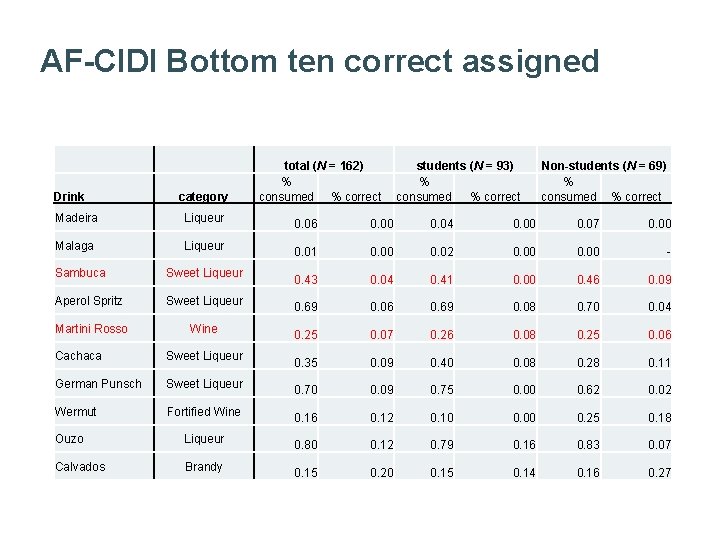
AF-CIDI Bottom ten correct assigned Drink category Madeira Liqueur Malaga Liqueur Sambuca Sweet Liqueur Aperol Spritz Sweet Liqueur Martini Rosso Wine Cachaca Sweet Liqueur German Punsch Sweet Liqueur Wermut Fortified Wine Ouzo Liqueur Calvados Brandy total (N = 162) % consumed % correct students (N = 93) % consumed % correct Non-students (N = 69) % consumed % correct 0. 06 0. 00 0. 04 0. 00 0. 07 0. 00 0. 01 0. 00 0. 02 0. 00 - 0. 43 0. 04 0. 41 0. 00 0. 46 0. 09 0. 69 0. 06 0. 69 0. 08 0. 70 0. 04 0. 25 0. 07 0. 26 0. 08 0. 25 0. 06 0. 35 0. 09 0. 40 0. 08 0. 28 0. 11 0. 70 0. 09 0. 75 0. 00 0. 62 0. 02 0. 16 0. 12 0. 10 0. 00 0. 25 0. 18 0. 80 0. 12 0. 79 0. 16 0. 83 0. 07 0. 15 0. 20 0. 15 0. 14 0. 16 0. 27