UNITS OF MEASUREMEN T The metric system CHEMISTRY
- Slides: 33
UNITS OF MEASUREMEN T The metric system
CHEMISTRY You will be studying chemistry Chemistry is defines as “the study of matter and its reactions” Chemistry is a physical science so we need to discuss how we measure things
WHAT ARE UNITS OF MEASUREMENT? Units describe what aspect of matter is being measured Qualitative: something that is described Quantitative: something that is measured Examples: Unit of distance – mile Unit of volume – gallon Unit of time – hour Unit of weight - pound
SI UNITS OF MEASUREMENT SI – Standards International Set of units that are recognized by the scientific community In science (unlike math), you need a unit for EVERY NUMBER These are the units we will be using in this class – not English units
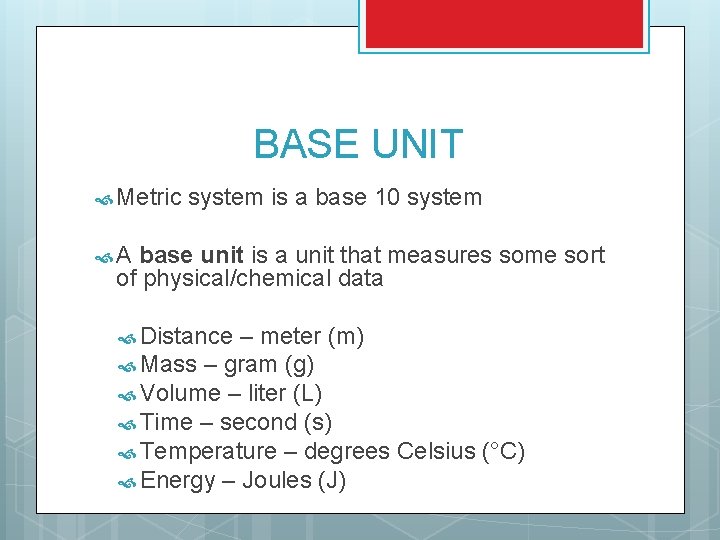
BASE UNIT Metric system is a base 10 system A base unit is a unit that measures some sort of physical/chemical data Distance – meter (m) Mass – gram (g) Volume – liter (L) Time – second (s) Temperature – degrees Celsius (°C) Energy – Joules (J)
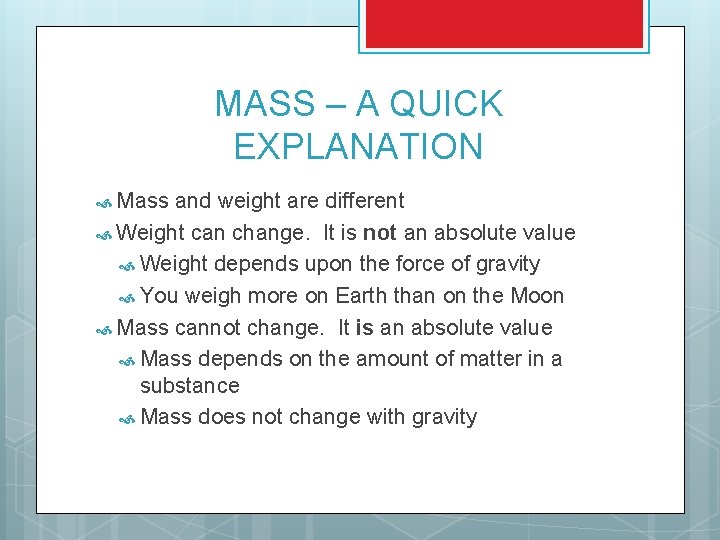
MASS – A QUICK EXPLANATION Mass and weight are different Weight can change. It is not an absolute value Weight depends upon the force of gravity You weigh more on Earth than on the Moon Mass cannot change. It is an absolute value Mass depends on the amount of matter in a substance Mass does not change with gravity
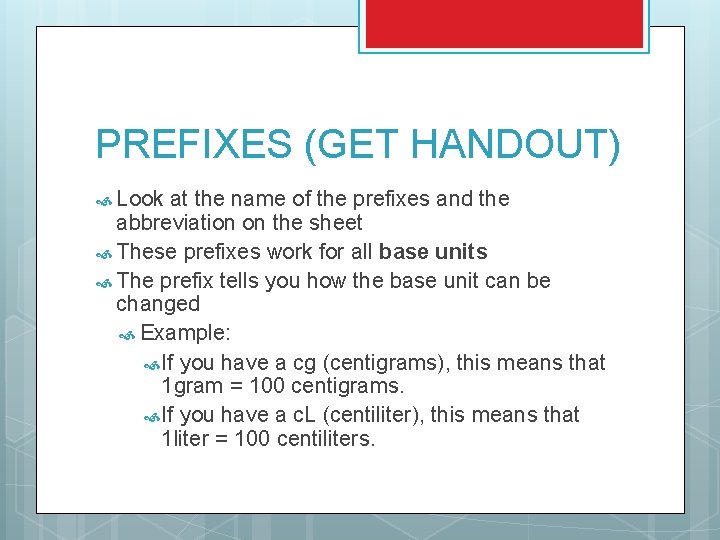
PREFIXES (GET HANDOUT) Look at the name of the prefixes and the abbreviation on the sheet These prefixes work for all base units The prefix tells you how the base unit can be changed Example: If you have a cg (centigrams), this means that 1 gram = 100 centigrams. If you have a c. L (centiliter), this means that 1 liter = 100 centiliters.
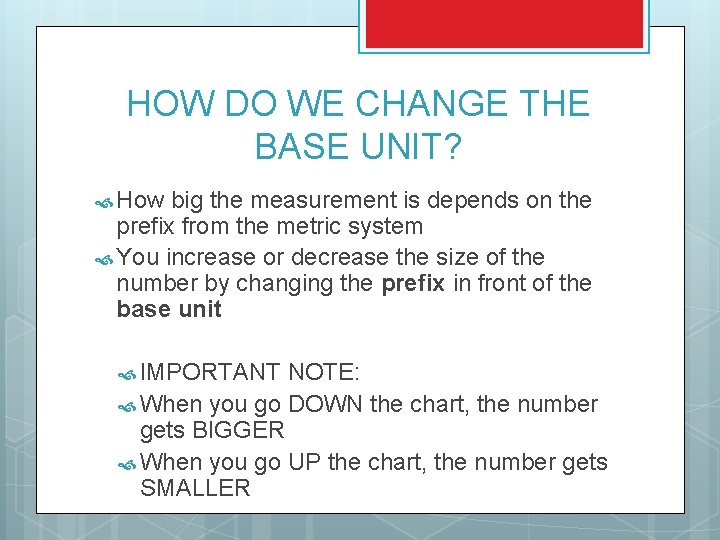
HOW DO WE CHANGE THE BASE UNIT? How big the measurement is depends on the prefix from the metric system You increase or decrease the size of the number by changing the prefix in front of the base unit IMPORTANT NOTE: When you go DOWN the chart, the number gets BIGGER When you go UP the chart, the number gets SMALLER
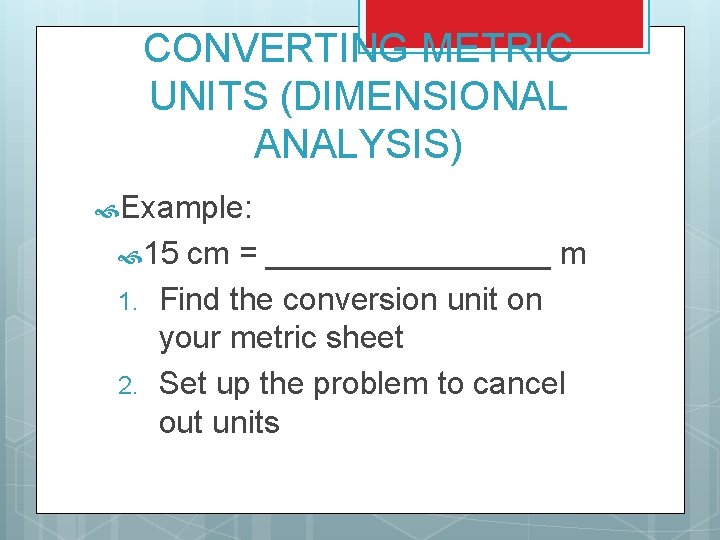
CONVERTING METRIC UNITS (DIMENSIONAL ANALYSIS) Example: 15 1. 2. cm = ________ m Find the conversion unit on your metric sheet Set up the problem to cancel out units
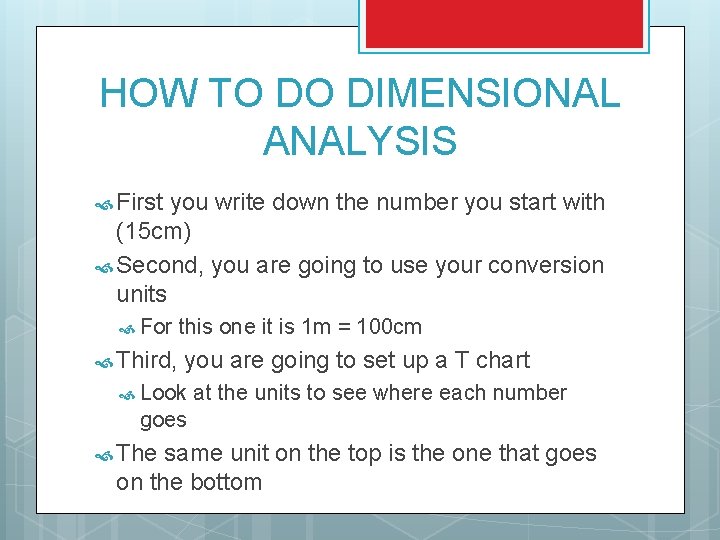
HOW TO DO DIMENSIONAL ANALYSIS First you write down the number you start with (15 cm) Second, you are going to use your conversion units For Third, this one it is 1 m = 100 cm you are going to set up a T chart Look at the units to see where each number goes The same unit on the top is the one that goes on the bottom
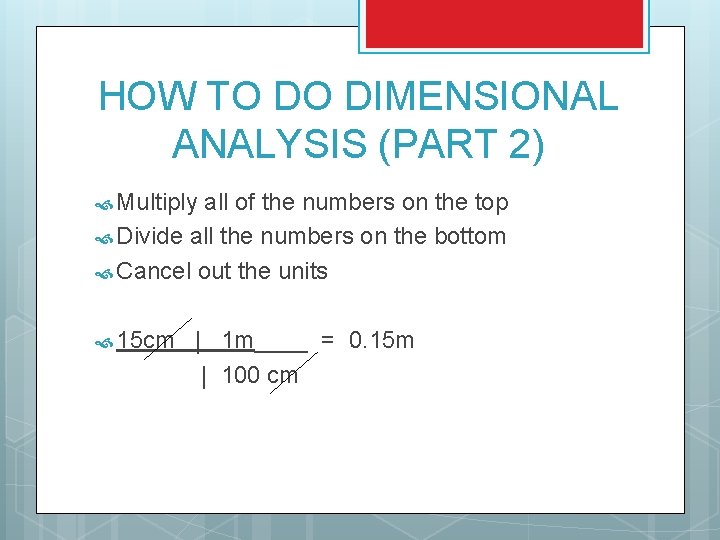
HOW TO DO DIMENSIONAL ANALYSIS (PART 2) Multiply all of the numbers on the top Divide all the numbers on the bottom Cancel out the units 15 cm | 1 m____ = 0. 15 m | 100 cm
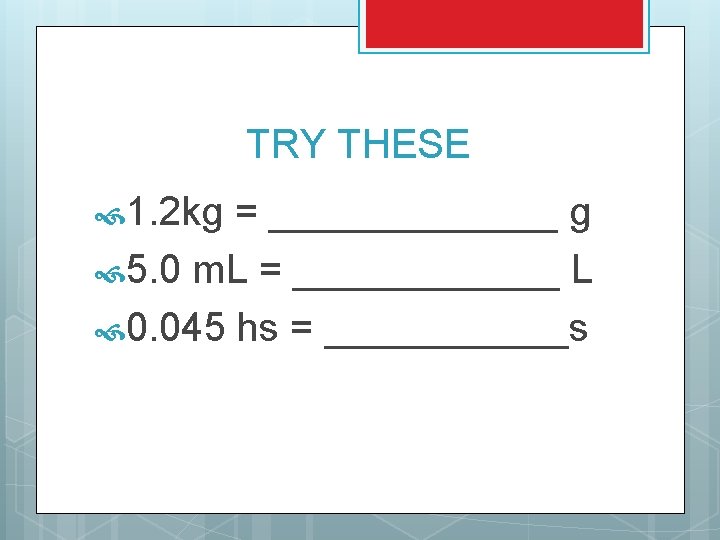
TRY THESE 1. 2 kg = _______ g 5. 0 m. L = ______ L 0. 045 hs = ______s
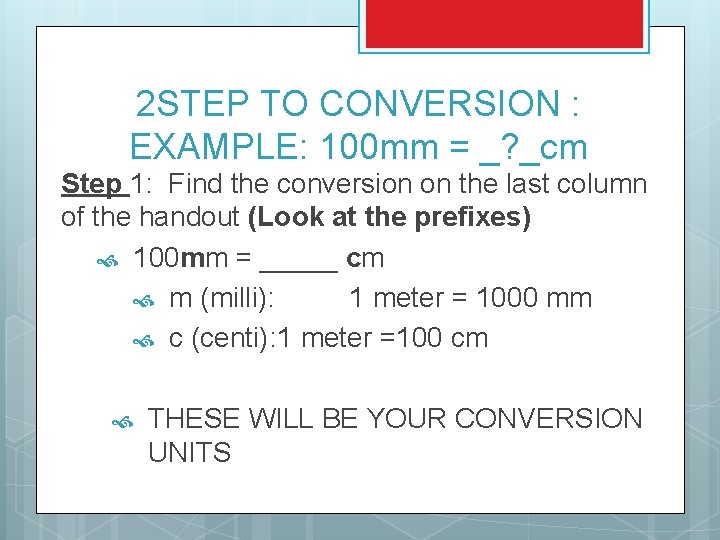
2 STEP TO CONVERSION : EXAMPLE: 100 mm = _? _cm Step 1: Find the conversion on the last column of the handout (Look at the prefixes) 100 mm = _____ cm m (milli): 1 meter = 1000 mm c (centi): 1 meter =100 cm THESE WILL BE YOUR CONVERSION UNITS
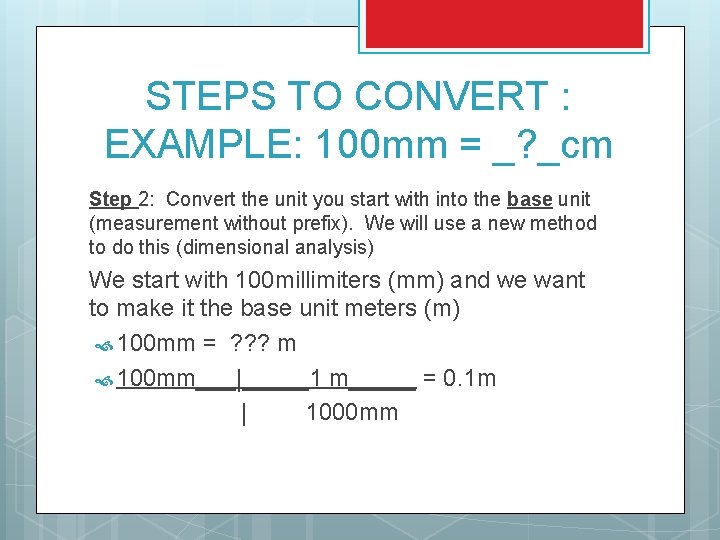
STEPS TO CONVERT : EXAMPLE: 100 mm = _? _cm Step 2: Convert the unit you start with into the base unit (measurement without prefix). We will use a new method to do this (dimensional analysis) We start with 100 millimiters (mm) and we want to make it the base unit meters (m) 100 mm = ? ? ? m 100 mm___|_____1 m_____ = 0. 1 m | 1000 mm
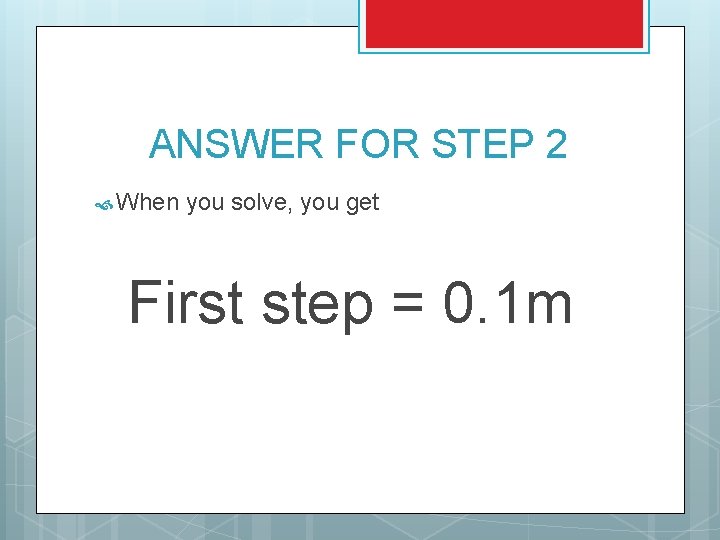
ANSWER FOR STEP 2 When you solve, you get First step = 0. 1 m
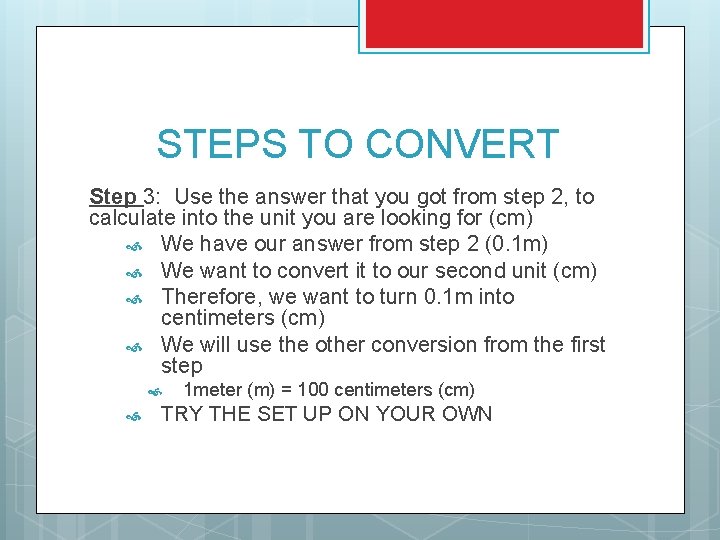
STEPS TO CONVERT Step 3: Use the answer that you got from step 2, to calculate into the unit you are looking for (cm) We have our answer from step 2 (0. 1 m) We want to convert it to our second unit (cm) Therefore, we want to turn 0. 1 m into centimeters (cm) We will use the other conversion from the first step 1 meter (m) = 100 centimeters (cm) TRY THE SET UP ON YOUR OWN
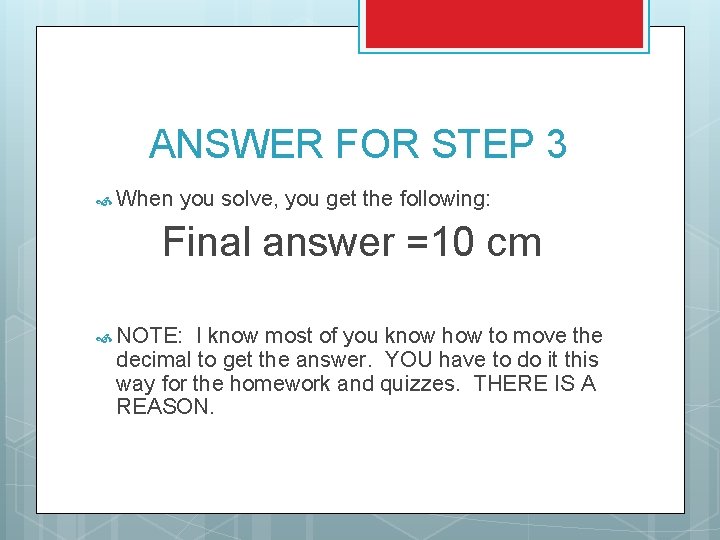
ANSWER FOR STEP 3 When you solve, you get the following: Final answer =10 cm NOTE: I know most of you know how to move the decimal to get the answer. YOU have to do it this way for the homework and quizzes. THERE IS A REASON.
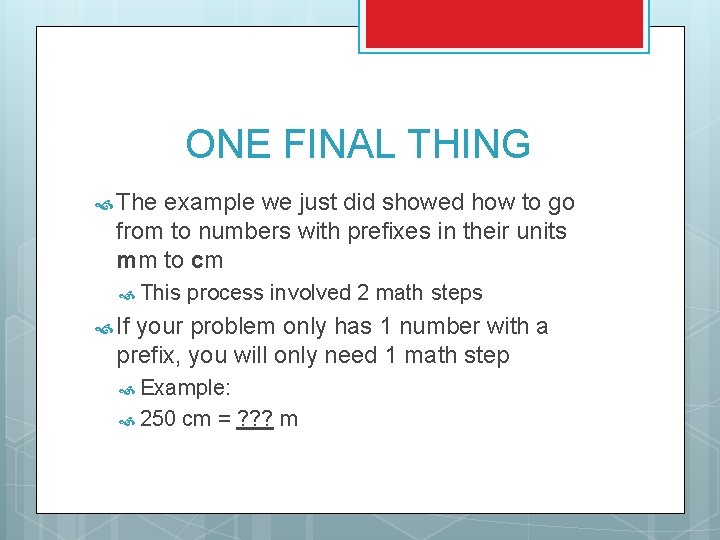
ONE FINAL THING The example we just did showed how to go from to numbers with prefixes in their units mm to cm This process involved 2 math steps If your problem only has 1 number with a prefix, you will only need 1 math step Example: 250 cm = ? ? ? m
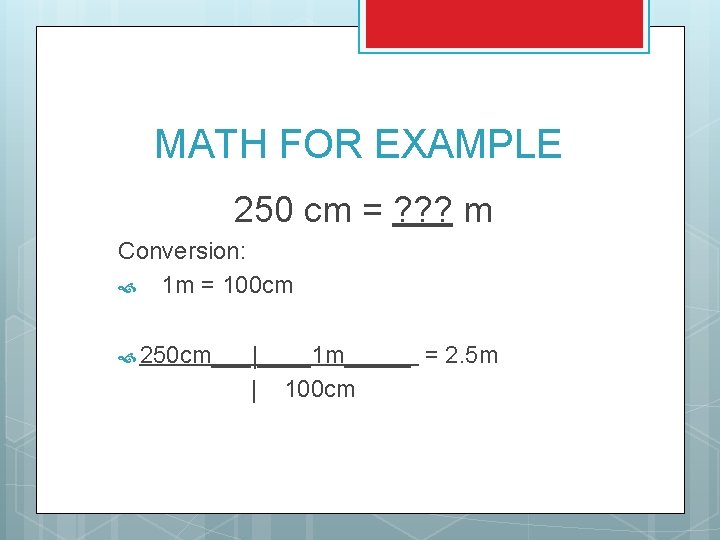
MATH FOR EXAMPLE 250 cm = ? ? ? m Conversion: 1 m = 100 cm 250 cm___|____1 m_____ | 100 cm = 2. 5 m
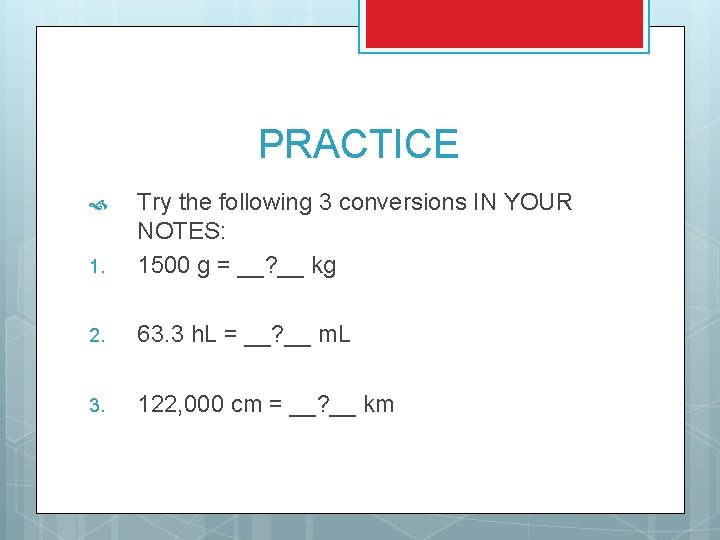
PRACTICE 1. Try the following 3 conversions IN YOUR NOTES: 1500 g = __? __ kg 2. 63. 3 h. L = __? __ m. L 3. 122, 000 cm = __? __ km
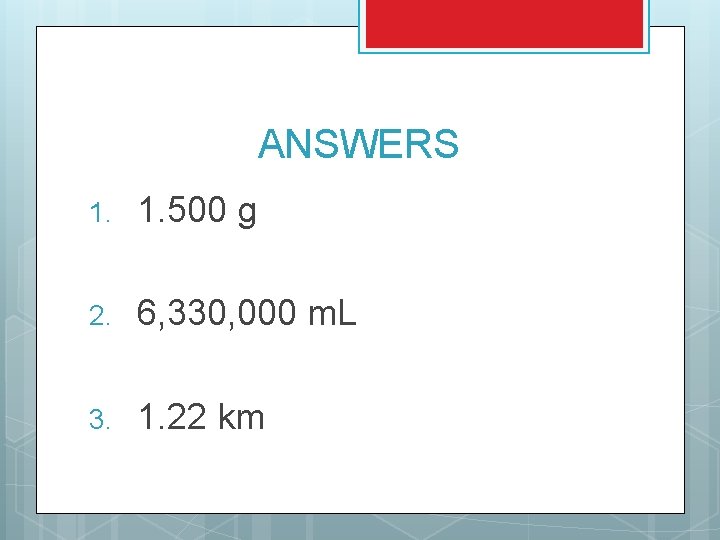
ANSWERS 1. 500 g 2. 6, 330, 000 m. L 3. 1. 22 km
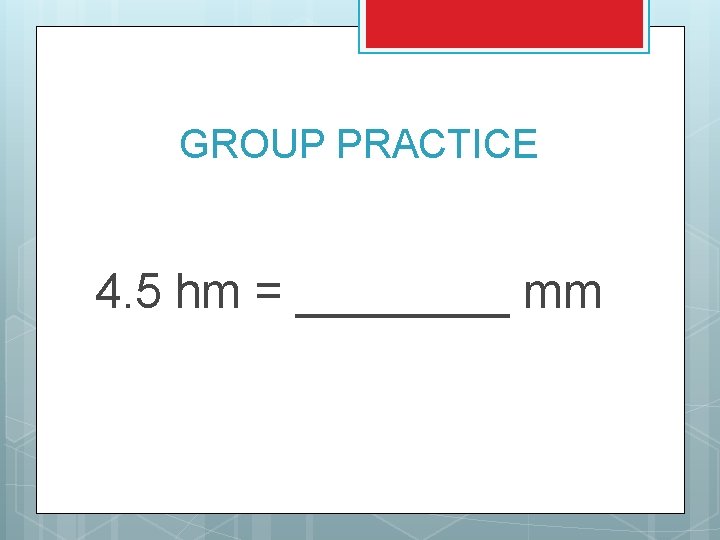
GROUP PRACTICE 4. 5 hm = ____ mm
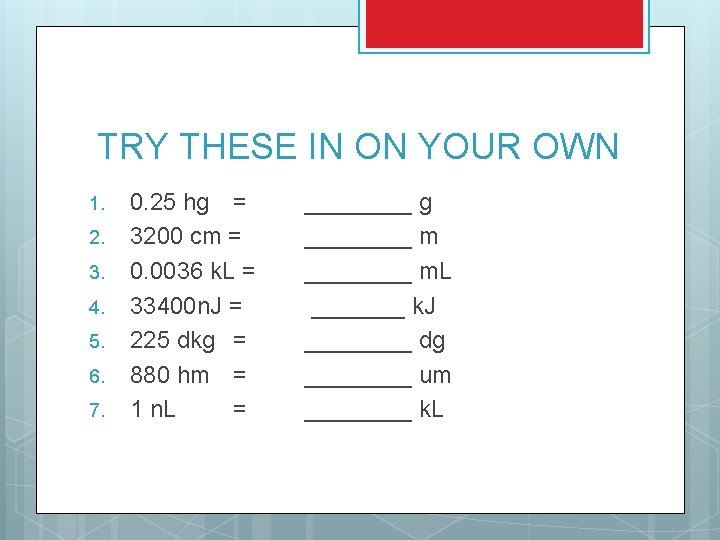
TRY THESE IN ON YOUR OWN 1. 2. 3. 4. 5. 6. 7. 0. 25 hg = 3200 cm = 0. 0036 k. L = 33400 n. J = 225 dkg = 880 hm = 1 n. L = ____ g ________ m. L _______ k. J ____ dg ____ um ____ k. L
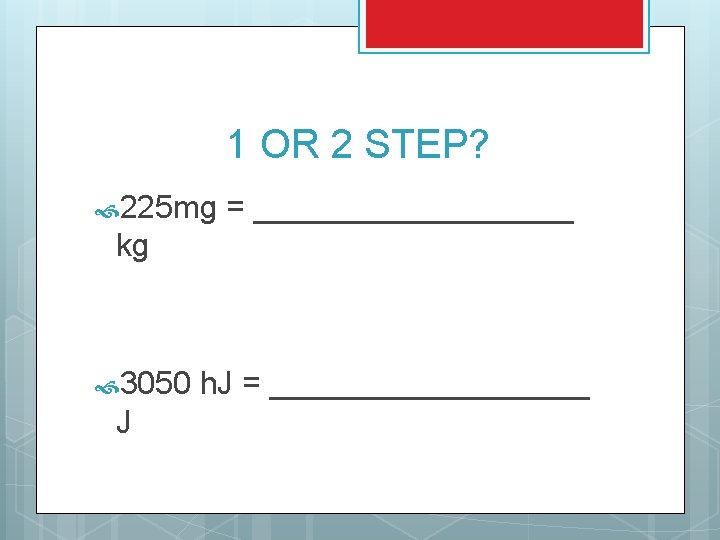
1 OR 2 STEP? 225 mg = _________ kg 3050 J h. J = _________
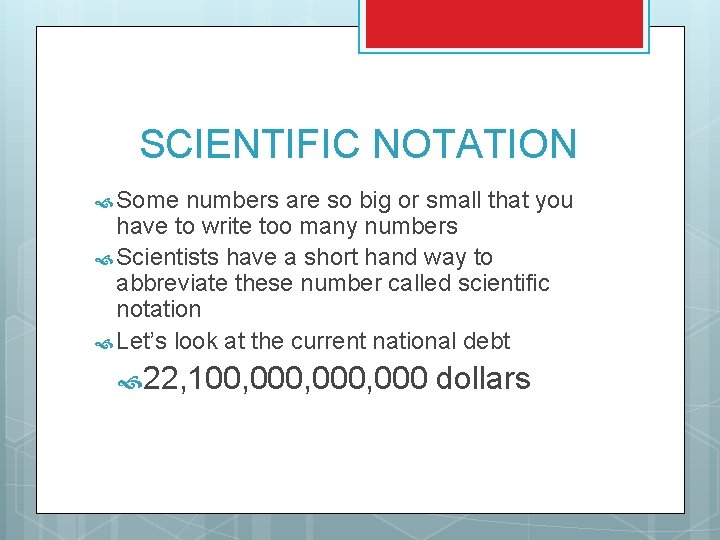
SCIENTIFIC NOTATION Some numbers are so big or small that you have to write too many numbers Scientists have a short hand way to abbreviate these number called scientific notation Let’s look at the current national debt 22, 100, 000, 000 dollars
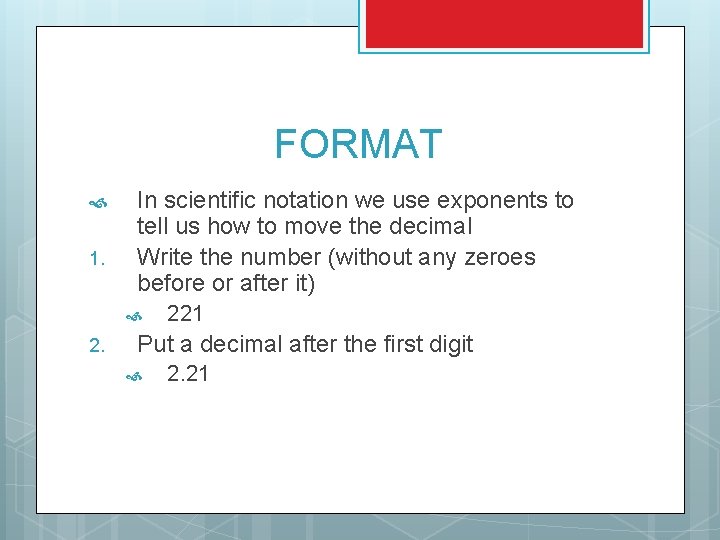
FORMAT 1. In scientific notation we use exponents to tell us how to move the decimal Write the number (without any zeroes before or after it) 2. 221 Put a decimal after the first digit 2. 21
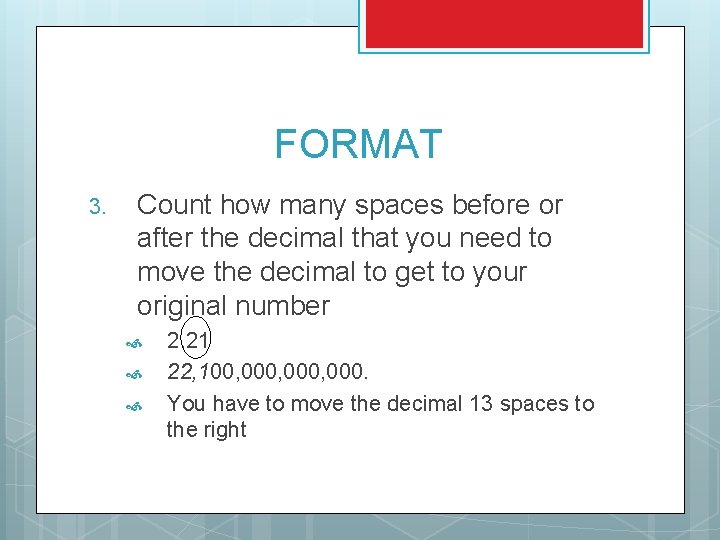
FORMAT 3. Count how many spaces before or after the decimal that you need to move the decimal to get to your original number 2. 21 22, 100, 000, 000. You have to move the decimal 13 spaces to the right
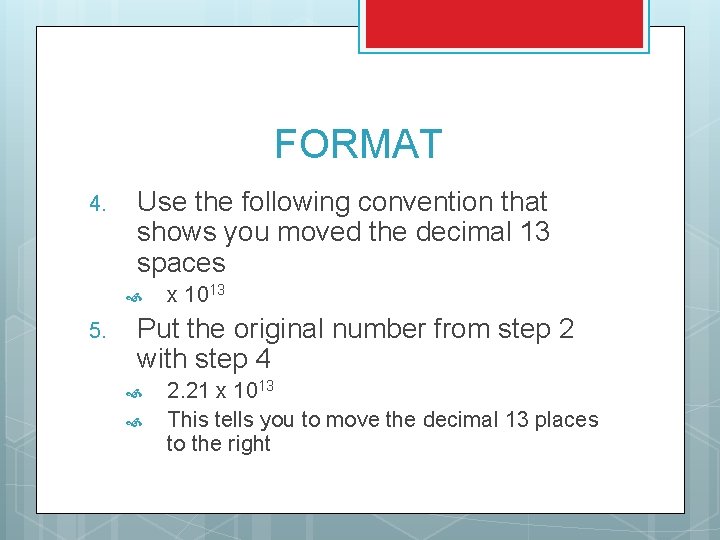
FORMAT 4. Use the following convention that shows you moved the decimal 13 spaces 5. x 1013 Put the original number from step 2 with step 4 2. 21 x 1013 This tells you to move the decimal 13 places to the right
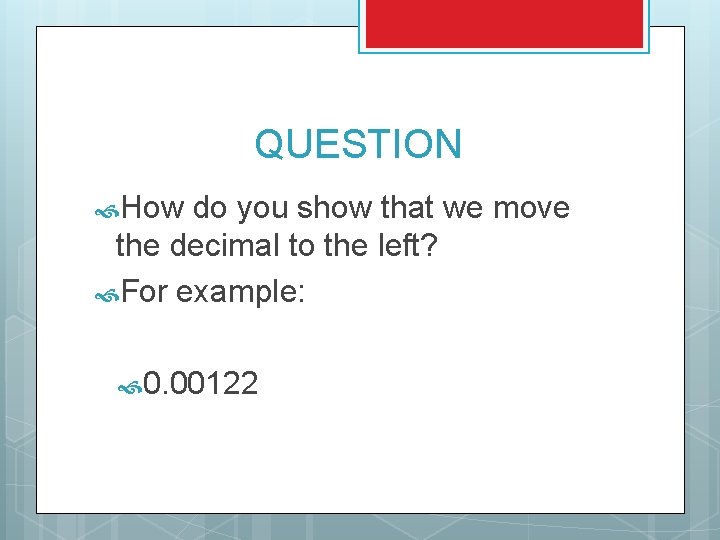
QUESTION How do you show that we move the decimal to the left? For example: 0. 00122
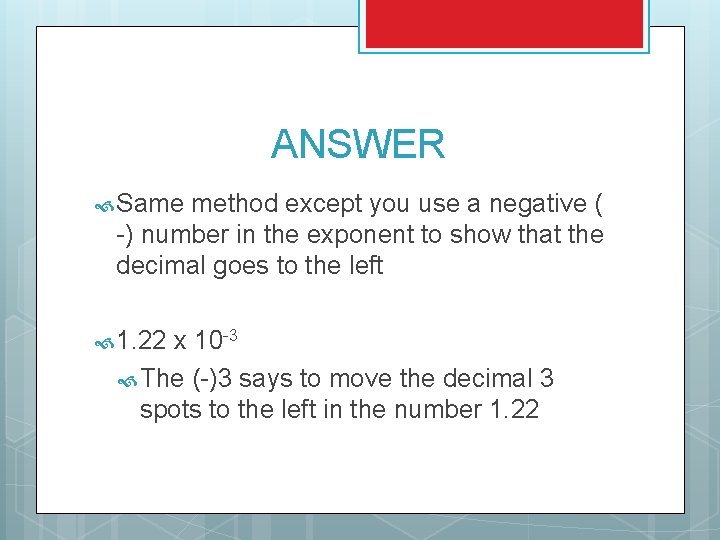
ANSWER Same method except you use a negative ( -) number in the exponent to show that the decimal goes to the left 1. 22 x 10 -3 The (-)3 says to move the decimal 3 spots to the left in the number 1. 22
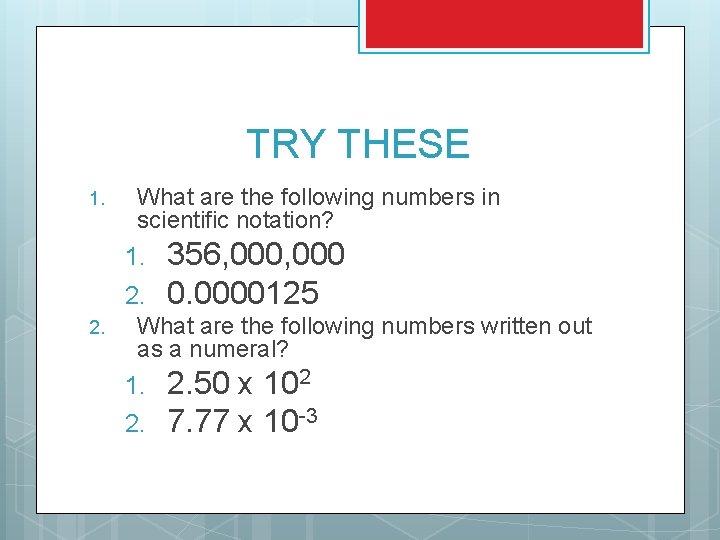
TRY THESE 1. What are the following numbers in scientific notation? 1. 2. 356, 000 0. 0000125 2. What are the following numbers written out as a numeral? 1. 2. 50 x 102 2. 7. 77 x 10 -3
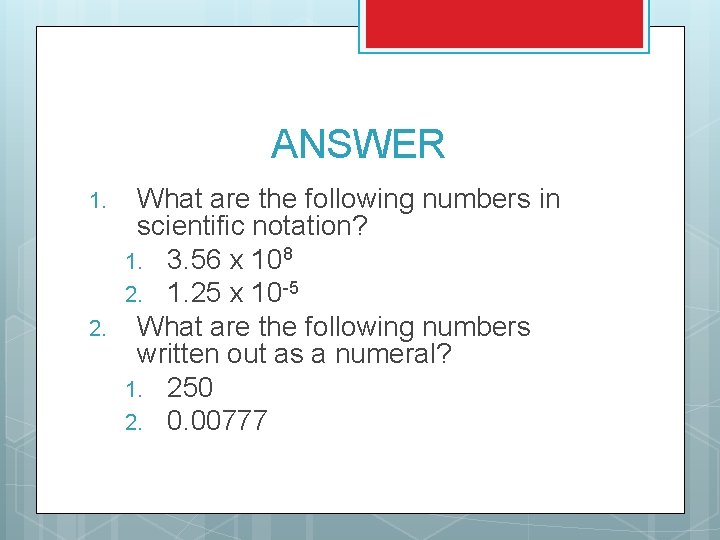
ANSWER 1. 2. What are the following numbers in scientific notation? 1. 3. 56 x 108 2. 1. 25 x 10 -5 What are the following numbers written out as a numeral? 1. 250 2. 0. 00777
PRACTICE WITH CALCULATORS You will need to know how to read and enter scientific notation on calculators After receiving a calculator, we will practice some on the board.