United States Lactation Consultant Association Pursuing The Surgeon






- Slides: 62
United States Lactation Consultant Association Pursuing The Surgeon General's Call to Action to Support Breastfeeding 1
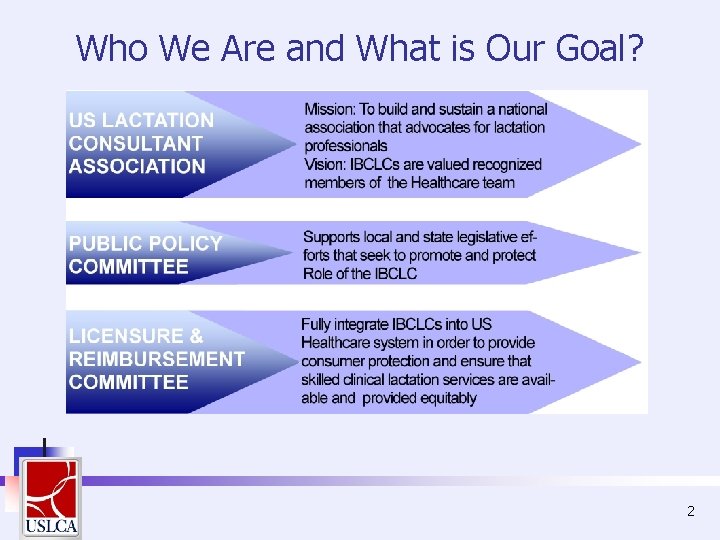
Who We Are and What is Our Goal? 2
IBCLC Professionals n n 27 year old profession Stand alone or added to existing profession 12, 969 IBCLCs in the United States Work in a variety of clinical, governmental, and research areas 3
Professional Standards for IBCLCs • Clinical Competencies for IBCLC Practice • Code of Conduct for IBCLCs • Documentation Guidelines • IBLCE Disciplinary Procedures • Scope of Practice • Standards of Practice • Available at http: //www. iblce. org/resources
IBCLC Qualifications n n n 500 -1000 clinical experience hours 90 hours of didactic education 8 college level health science courses 6 health related continuing education courses Pass an independent, criterion-referenced exam Must recertify every 5 years by continuing education or exam 5
If 90% of US families could comply with medical recommendations to breastfeed exclusively for 6 months, the United States would save $13 billion per year and prevent an excess 911 deaths, nearly all of which would be in infants ($10. 5 billion and 741 deaths at 80% compliance). 6
Breastfeeding is Primary Health Care Prevention n Institute of Medicine Consensus Report Clinical Preventive Services for Women: Closing the Gaps US DHHS National Prevention Strategy United States Preventive Services Task Force recommends “interventions during pregnancy and after birth to promote and support breastfeeding” 7
A National Health Priority n n Healthy People 2020 CDC Breastfeeding Report Card and Maternity Practices in Infant Nutrition and Care Survey White House Task Force on Childhood Obesity Report to the President USDA WIC Food Packages n IRS “breast pumps and other nursing supplies could qualify for tax breaks” HRSA Office of Women’s Health Business Case for n Affordable Care Act n Breastfeeding 8
Policy Support for Breastfeeding n n n Joint Commission Perinatal Core Measures NICHQ Best Fed Beginnings Bright Futures, an initiative of the Maternal and Child Health Bureau / AAP adopted United States Preventive Services Task Force breastfeeding recommendations 9
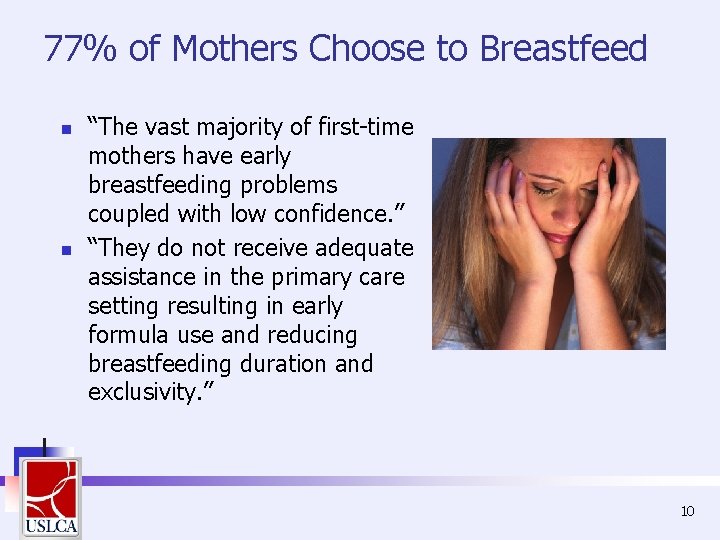
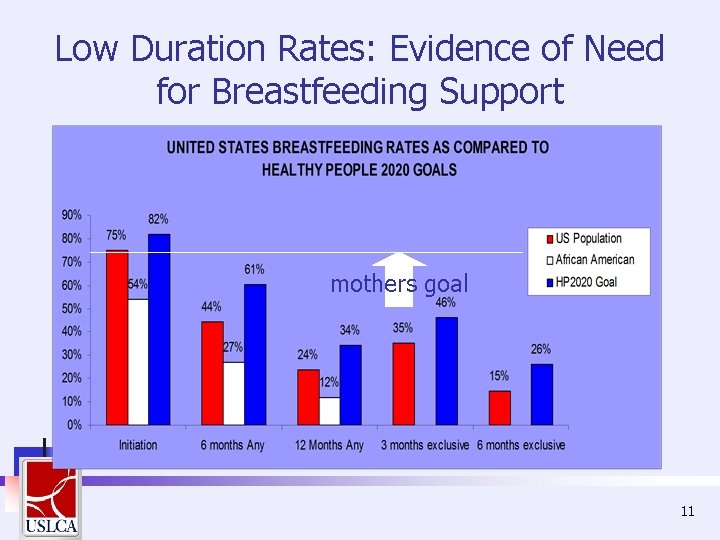
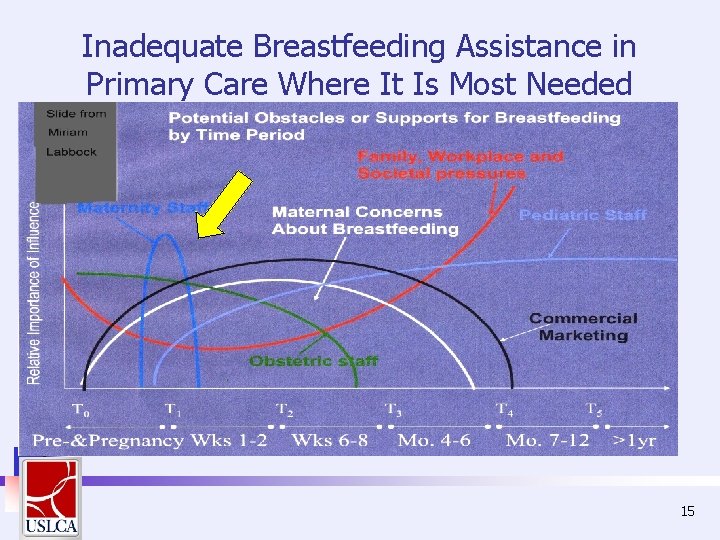
77% of Mothers Choose to Breastfeed n n “The vast majority of first-time mothers have early breastfeeding problems coupled with low confidence. ” “They do not receive adequate assistance in the primary care setting resulting in early formula use and reducing breastfeeding duration and exclusivity. ” 10
Low Duration Rates: Evidence of Need for Breastfeeding Support mothers goal 11
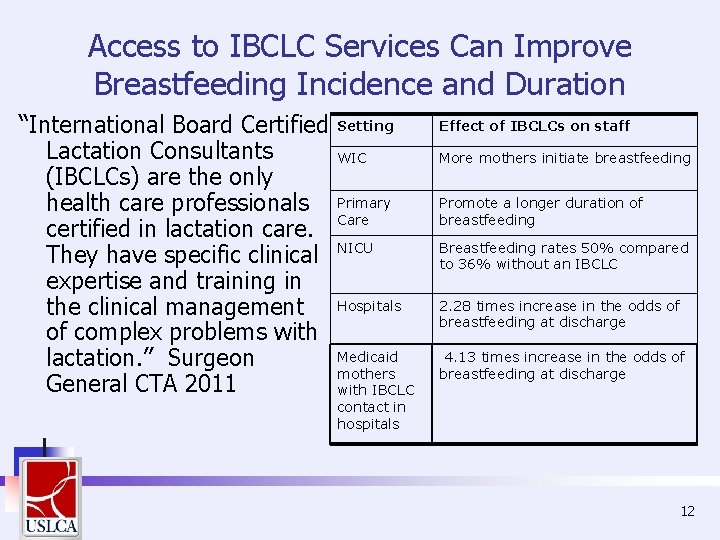
Access to IBCLC Services Can Improve Breastfeeding Incidence and Duration “International Board Certified Setting Lactation Consultants WIC (IBCLCs) are the only health care professionals Primary certified in lactation care. Care They have specific clinical NICU expertise and training in the clinical management Hospitals of complex problems with Medicaid lactation. ” Surgeon mothers General CTA 2011 with IBCLC Effect of IBCLCs on staff More mothers initiate breastfeeding Promote a longer duration of breastfeeding Breastfeeding rates 50% compared to 36% without an IBCLC 2. 28 times increase in the odds of breastfeeding at discharge 4. 13 times increase in the odds of breastfeeding at discharge contact in hospitals 12
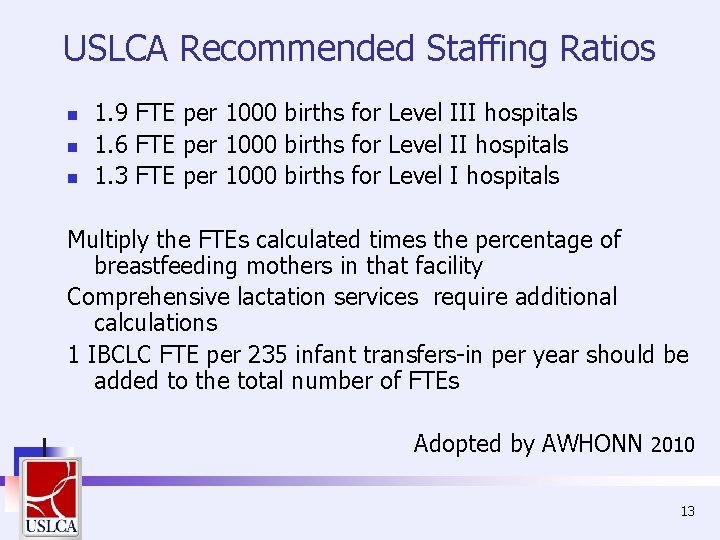
USLCA Recommended Staffing Ratios n n n 1. 9 FTE per 1000 births for Level III hospitals 1. 6 FTE per 1000 births for Level II hospitals 1. 3 FTE per 1000 births for Level I hospitals Multiply the FTEs calculated times the percentage of breastfeeding mothers in that facility Comprehensive lactation services require additional calculations 1 IBCLC FTE per 235 infant transfers-in per year should be added to the total number of FTEs Adopted by AWHONN 2010 13
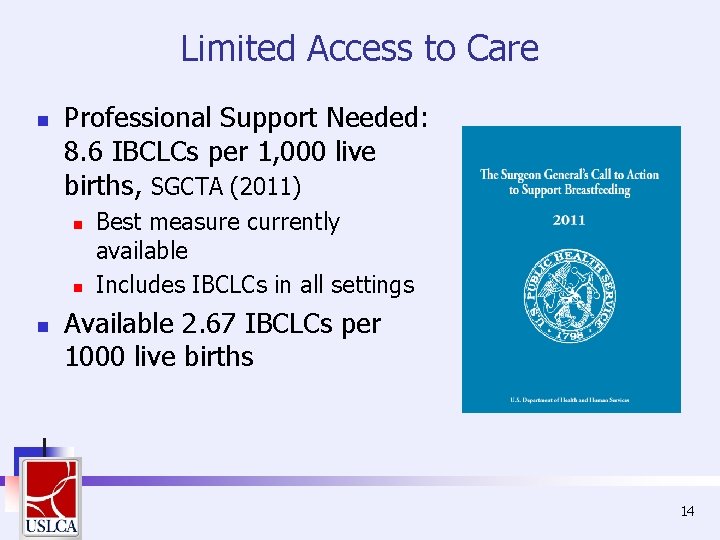
Limited Access to Care n Professional Support Needed: 8. 6 IBCLCs per 1, 000 live births, SGCTA (2011) n n n Best measure currently available Includes IBCLCs in all settings Available 2. 67 IBCLCs per 1000 live births 14
Inadequate Breastfeeding Assistance in Primary Care Where It Is Most Needed 15
2011 Survey on the Recognition of IBCLCs by Third Party Payers n n n Survey sent through IBLCE to all IBCLCs in the United States via email Response rate: 29% (n=2637) or 1 out of 4 IBCLCs in the United States (in 2011) Research Question: n What are IBCLCs currently doing to facilitate their clients being reimbursed for lactation consult services? And how well is it working? 16
2011 IBCLC Demographics Based on Survey Responses n n n n 87 % were non-Hispanic White 1. 6 % were non-Hispanic Black 67 % were 40 -59 years old 41 % had been certified for <5 years 41% had been certified for 6 -15 years Average pay per hour $36. 77 / hour SD $14. 95 Half worked part-time or per diem One third receive differential pay for their IBCLC Certification 17
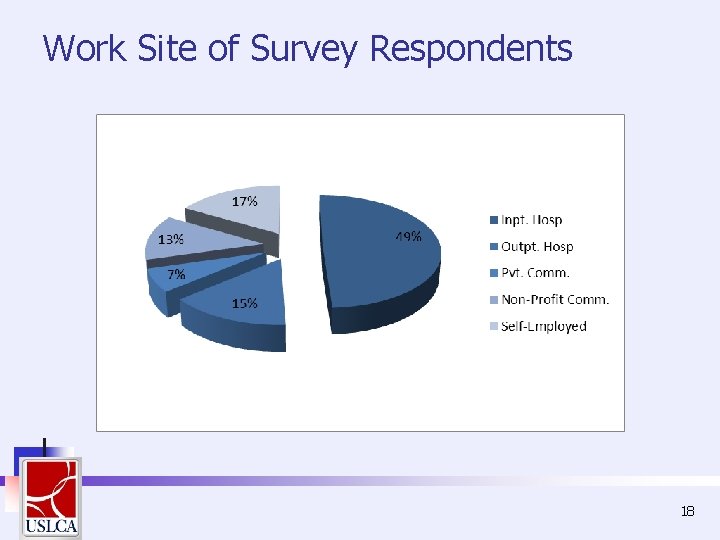
Work Site of Survey Respondents 18
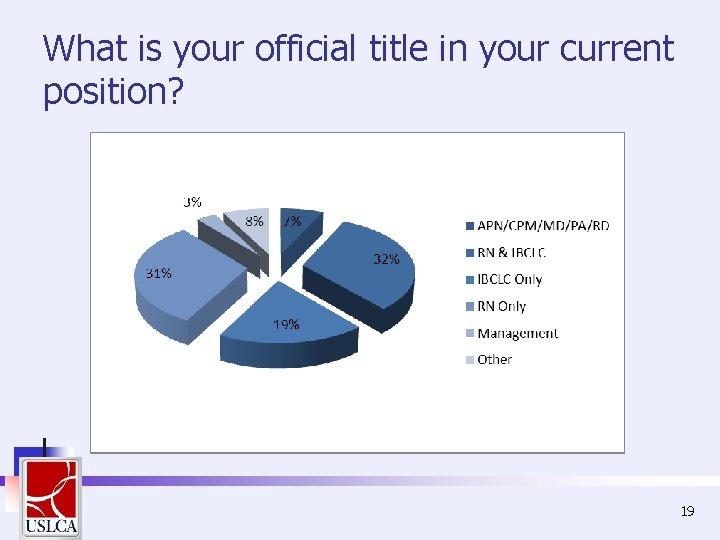
What is your official title in your current position? 19
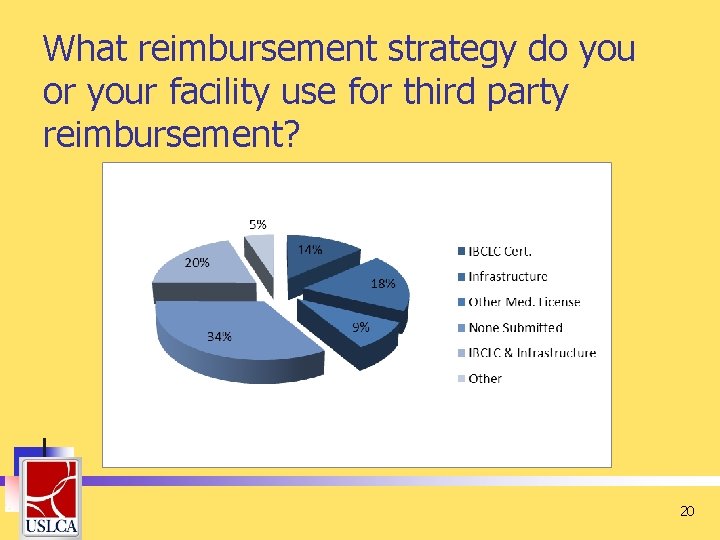
What reimbursement strategy do you or your facility use for third party reimbursement? 20
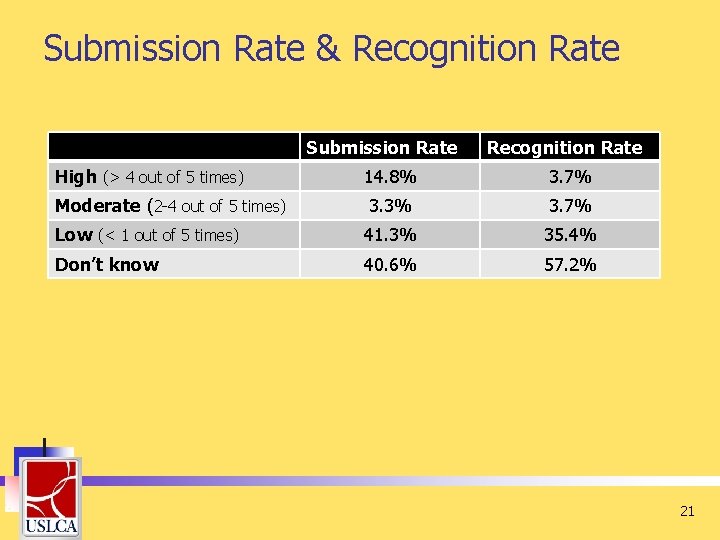
Submission Rate & Recognition Rate Submission Rate Recognition Rate High (> 4 out of 5 times) 14. 8% 3. 7% Moderate (2 -4 out of 5 times) 3. 3% 3. 7% Low (< 1 out of 5 times) 41. 3% 35. 4% Don’t know 40. 6% 57. 2% 21
Submission & Recognition by Work Site, Job Classification, and Reimbursement Strategy 22
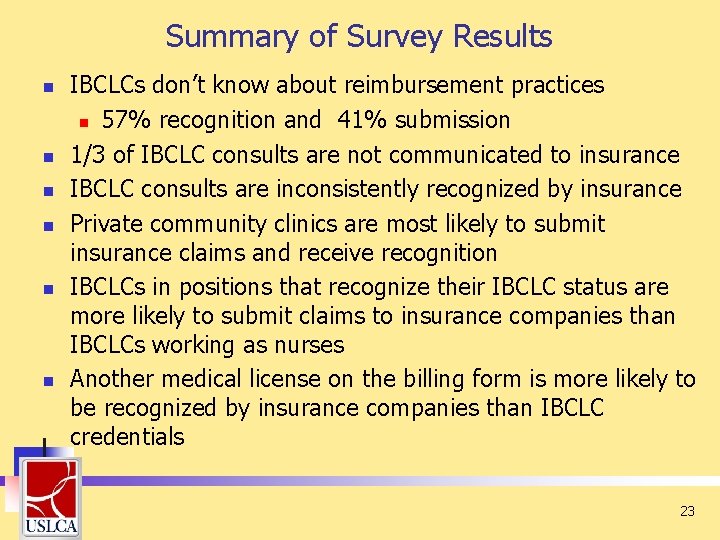
Summary of Survey Results n n n IBCLCs don’t know about reimbursement practices n 57% recognition and 41% submission 1/3 of IBCLC consults are not communicated to insurance IBCLC consults are inconsistently recognized by insurance Private community clinics are most likely to submit insurance claims and receive recognition IBCLCs in positions that recognize their IBCLC status are more likely to submit claims to insurance companies than IBCLCs working as nurses Another medical license on the billing form is more likely to be recognized by insurance companies than IBCLC credentials 23
Other Health Care Providers have Limited Ability to Support Breastfeeding n n n Includes all disciplines Insufficient formal training in lactation Qualified to make preliminary assessments and treat routine problems Physicians feel uncomfortable/ inadequately prepared to support breastfeeding Requires long term, time intensive strategies prohibited by health resource constraints 10 11 12 13 14 15 24
The Solution: USLCA Recommends n n Recognition of the IBCLC certification as the preferred provider of lactation care and services Delineation of IBCLC-provided lactation services as distinct from other health care services in the medical system “Credentialing of IBCLCs” in order to standardize proven qualifications, identify sound practice strategies, and maintain appropriate oversight Reimbursement of skilled breastfeeding support provided by the IBCLC 25
Advocacy Required n n At least now everyone knows benefits of breastfeeding Must educate with all stakeholders, especially n n n IBCLCs – many misunderstandings about licensure and reimbursement Other Health Care Professionals – think we are encroaching on their Scope Public, Legislators, Insurers 26
History of Licensure Efforts n n n n Documented efforts since 1997, Texas ILCA Taskforce in 2005 -06 Texas and Massachusetts Bills USLCA Committee 2006 Licensure Toolkit Published in 2007 New Committee formed August 2009 Affordable Care Act 2010 – preventive health Efforts reinforced by SGCTA 2011 27
Action 9. Provide education and training in breastfeeding for all health professionals who care for women and children. n n n Improve the breastfeeding content in undergraduate and graduate education and training for health professionals. Establish and incorporate minimum requirements for competency in lactation care into health professional credentialing, licensing, and certification processes. Increase opportunities for continuing education on the management of lactation to ensure the maintenance of minimum competencies and skills.
Action 11. Ensure access to services provided by International Board Certified Lactation Consultants. n Include support for lactation as an essential medical service for pregnant women, breastfeeding mothers, and children. n n n Standard coverage for IBCLCs as “covered providers” Provide reimbursement for IBCLCs independent of their having other professional certification or licensure. n Alternatively, developing state licensure of lactation consultants Work to increase the number of racial and ethnic minority IBCLCs to better mirror the U. S. population. 29
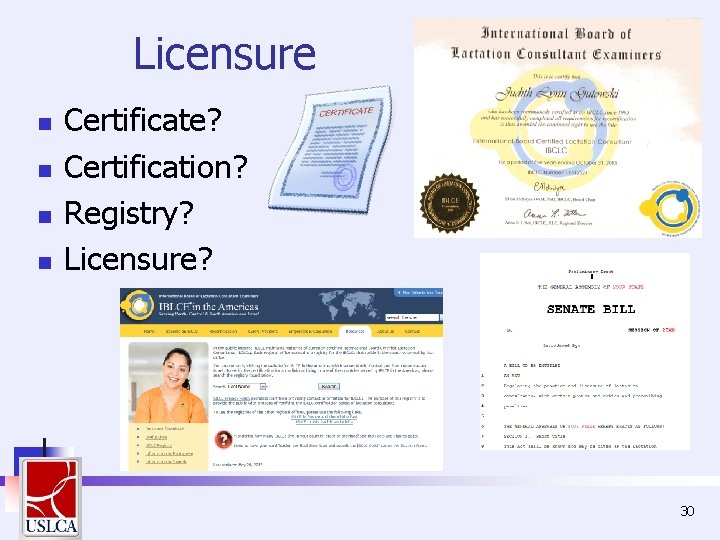
Licensure n n Certificate? Certification? Registry? Licensure? 30
Certificate Holder - One who completes a professional certificate program n n Training program on a topic Not as defensible to use for regulatory purposes as compared to a professional certification May become quickly outdated 3 types of certificate programs n knowledge-based certificate n n n curriculum-based certificate n n n generic, narrow scope of specialized knowledge used in performing duties issued after passing an assessment instrument completes a course(s) and passessment instrument content may not be completely representative of professional practice certificate of attendance or participation n no knowledge assessment or demonstration of competence
Certificant holder of a Professional Certification (IBCLC) n Independent assessment of knowledge or skills n n “Credentialing agency” does not provide training Voluntary, Non-governmental process Time-limited recognition and use of credential Must meet predetermined criteria developed through a consensus driven process to be eligible based on legal and psychometric requirements 32
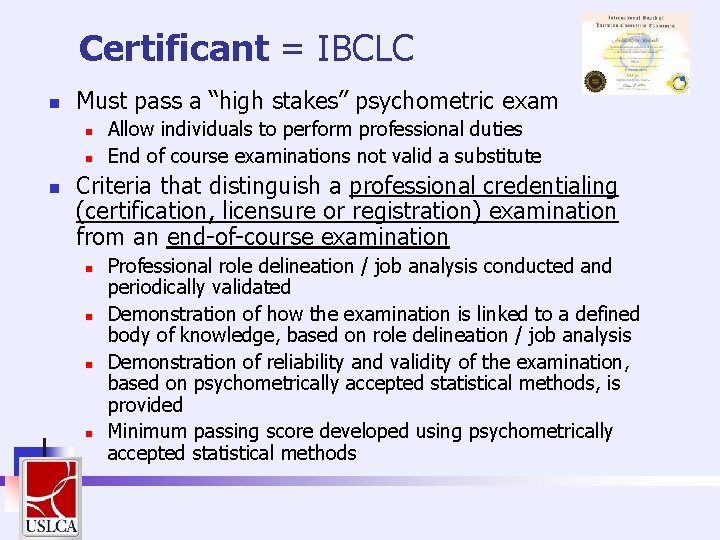
Certificant = IBCLC n Must pass a “high stakes” psychometric exam n n n Allow individuals to perform professional duties End of course examinations not valid a substitute Criteria that distinguish a professional credentialing (certification, licensure or registration) examination from an end-of-course examination n n Professional role delineation / job analysis conducted and periodically validated Demonstration of how the examination is linked to a defined body of knowledge, based on role delineation / job analysis Demonstration of reliability and validity of the examination, based on psychometrically accepted statistical methods, is provided Minimum passing score developed using psychometrically accepted statistical methods
Confusion with Non-IBCLC Breastfeeding Support Providers n n n n Lactation Care Specialist Community Breastfeeding Educator Early Breastfeeding Care Specialist / Doula Breastfeeding Training Certified Lactation Counselor WIC Peer Counselor Certified Lactation Educator La Leche League Leader n n n Certified Breastfeeding Specialist Certified Lactation Specialist Counselor Breastfeeding Educator Lactation Educator Counselor 34
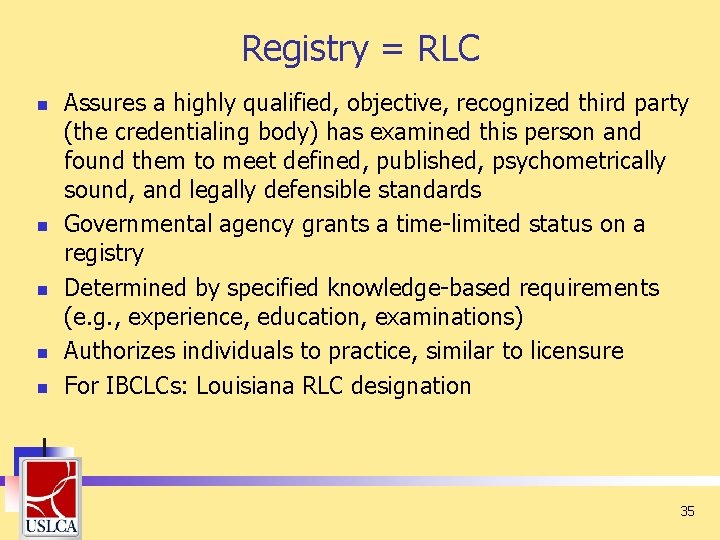
Registry = RLC n n n Assures a highly qualified, objective, recognized third party (the credentialing body) has examined this person and found them to meet defined, published, psychometrically sound, and legally defensible standards Governmental agency grants a time-limited status on a registry Determined by specified knowledge-based requirements (e. g. , experience, education, examinations) Authorizes individuals to practice, similar to licensure For IBCLCs: Louisiana RLC designation 35
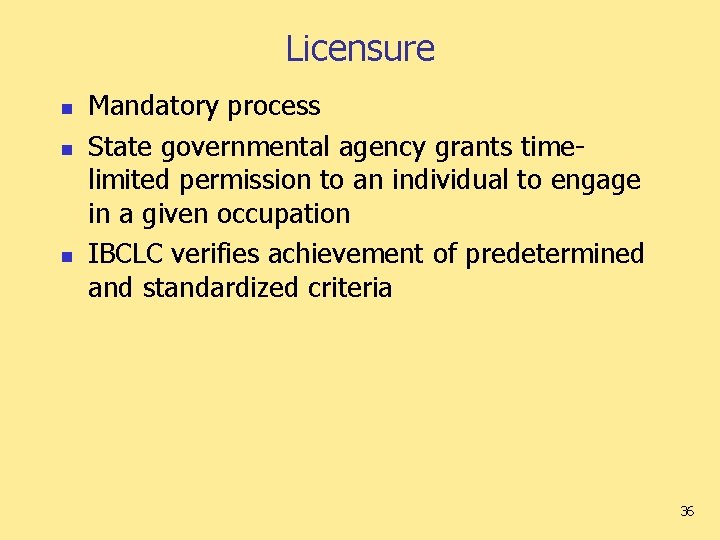
Licensure n n n Mandatory process State governmental agency grants timelimited permission to an individual to engage in a given occupation IBCLC verifies achievement of predetermined and standardized criteria 36
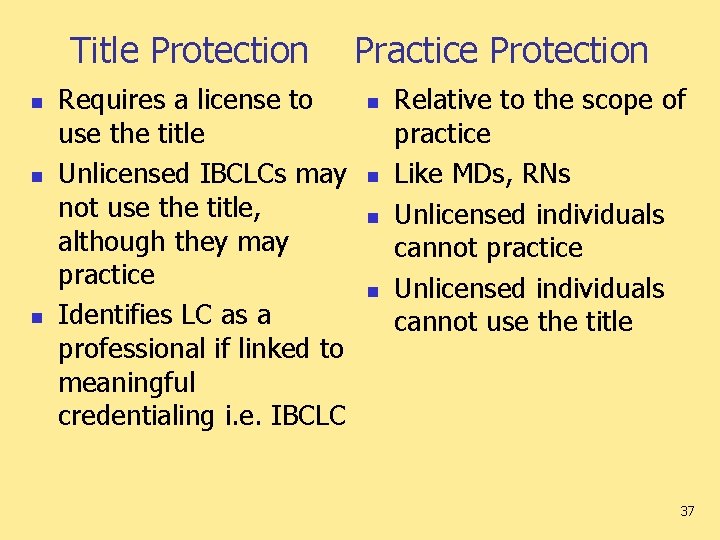
Title Protection Practice Protection n Requires a license to use the title Unlicensed IBCLCs may not use the title, although they may practice Identifies LC as a professional if linked to meaningful credentialing i. e. IBCLC n n Relative to the scope of practice Like MDs, RNs Unlicensed individuals cannot practice Unlicensed individuals cannot use the title 37
Purposes - Identification n n Mechanism to be known by the public, employers, policy makers and insurers Links IBCLC to a meaningful process of examination Accredited as legally defensible Delineates entry level standards and continuing competence Professional credibility, aligns with other regulated health professionals 38
Purposes – Public Protection n n Insures competence and ethics in the profession Differentiates IBCLCs from other breastfeeding support providers Assures consumers that professionals have met standards of practice Ensure that consumers have access to care 39
Challenges n n n Must be carried out in 50 states Requires support of legislator(s) States don’t want new boards or registries n Government does not want to spend money on regulation Public perception of regulation as ineffective or corrupt Creating a new board is cost prohibitive 40
Advocacy: Lobbyist – Scott Harshman n Licensure Legislation n Draft of model bill completed n Lessons learned document complete n Licensure FAQs for IBCLCs n Licensure Summary for Physicians 41
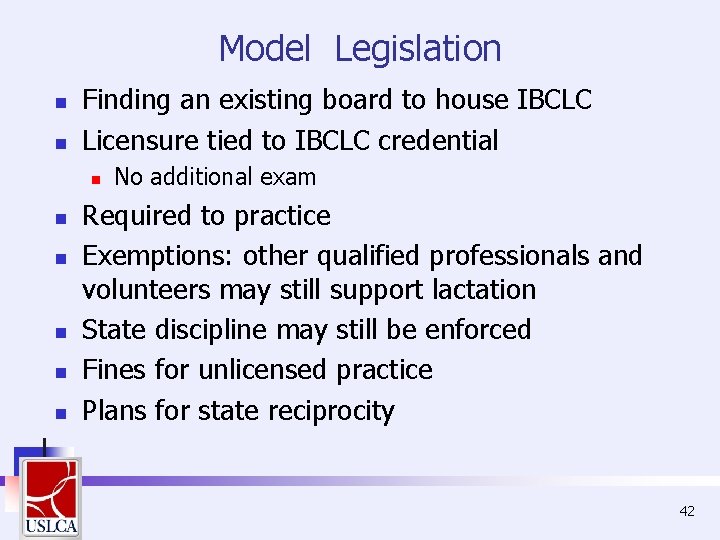
Model Legislation n n Finding an existing board to house IBCLC Licensure tied to IBCLC credential n n n No additional exam Required to practice Exemptions: other qualified professionals and volunteers may still support lactation State discipline may still be enforced Fines for unlicensed practice Plans for state reciprocity 42
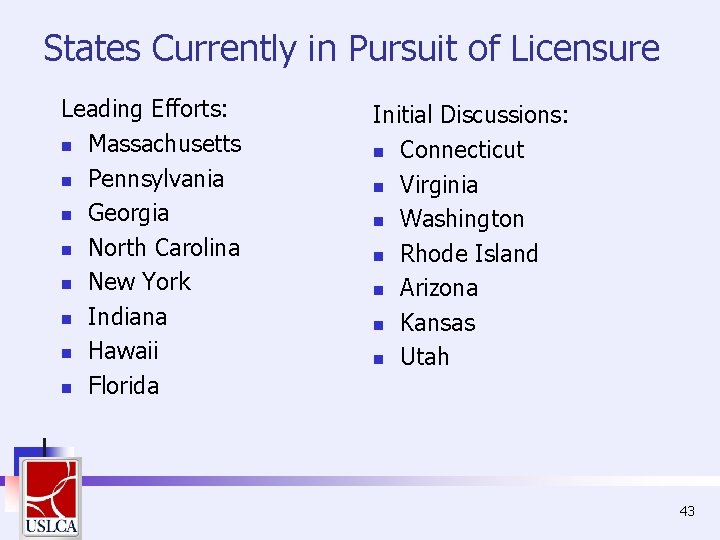
States Currently in Pursuit of Licensure Leading Efforts: n Massachusetts n Pennsylvania n Georgia n North Carolina n New York n Indiana n Hawaii n Florida Initial Discussions: n Connecticut n Virginia n Washington n Rhode Island n Arizona n Kansas n Utah 43
Reimbursement 44
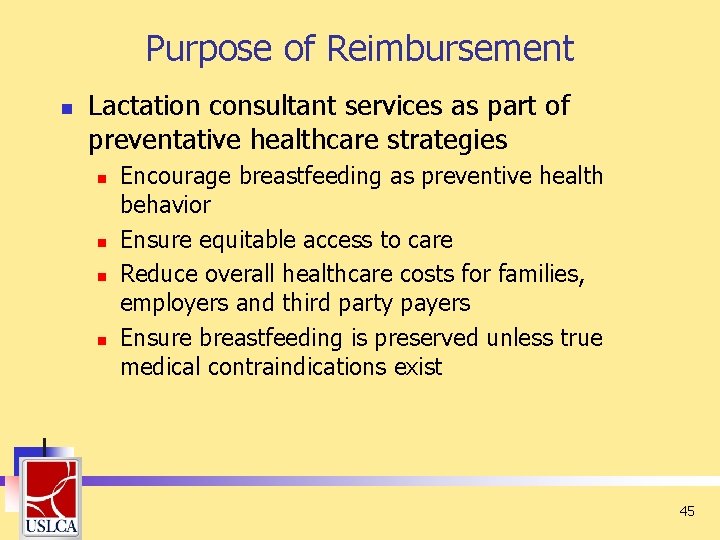
Purpose of Reimbursement n Lactation consultant services as part of preventative healthcare strategies n n Encourage breastfeeding as preventive health behavior Ensure equitable access to care Reduce overall healthcare costs for families, employers and third party payers Ensure breastfeeding is preserved unless true medical contraindications exist 45
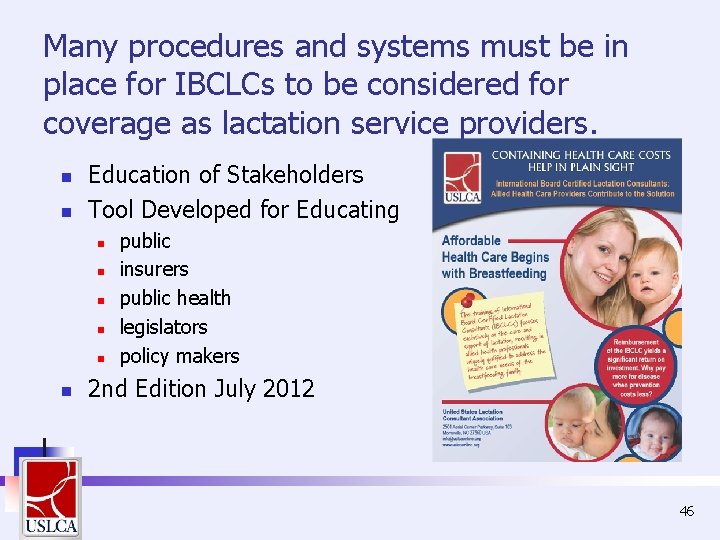
Many procedures and systems must be in place for IBCLCs to be considered for coverage as lactation service providers. n n Education of Stakeholders Tool Developed for Educating n n n public insurers public health legislators policy makers 2 nd Edition July 2012 46
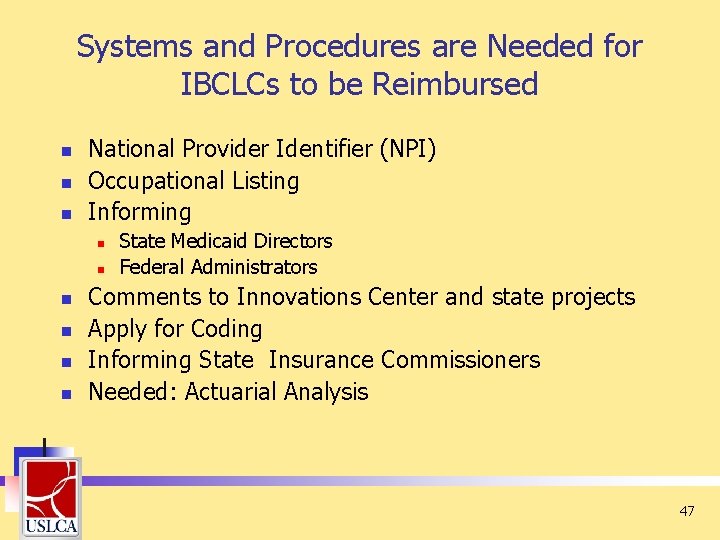
Systems and Procedures are Needed for IBCLCs to be Reimbursed n n n National Provider Identifier (NPI) Occupational Listing Informing n n n State Medicaid Directors Federal Administrators Comments to Innovations Center and state projects Apply for Coding Informing State Insurance Commissioners Needed: Actuarial Analysis 47
Hogan Lovells US LLP Columbia Square 555 Thirteenth Street, NW Washington, DC 20004 n n Erin Hertzog Lindsey Murtagh Craig Smith David Robbins 48
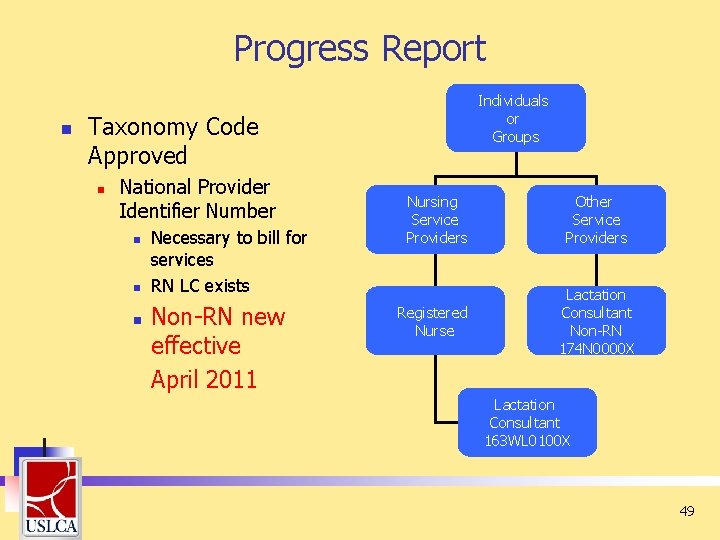
Progress Report n Individuals or Groups Taxonomy Code Approved n National Provider Identifier Number n n n Necessary to bill for services RN LC exists Non-RN new effective April 2011 Nursing Service Providers Other Service Providers Registered Nurse Lactation Consultant Non-RN 174 N 0000 X Lactation Consultant 163 WL 0100 X 49
US Department of Labor Occupational Analysis n n n 1106 Occupations listed for 2009 Many kinds of nurses Nothing for lactation or breastfeeding in database Completed and submitted an occupational analysis Assigned a code as “health educator” Appealing this designation 50
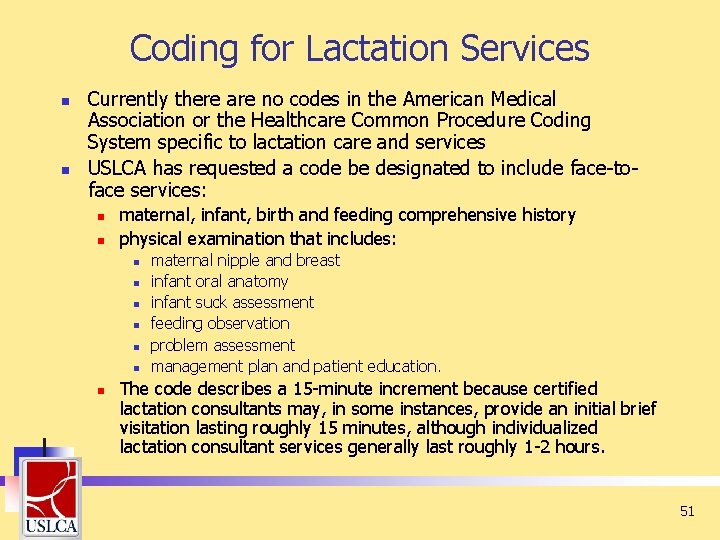
Coding for Lactation Services n n Currently there are no codes in the American Medical Association or the Healthcare Common Procedure Coding System specific to lactation care and services USLCA has requested a code be designated to include face-toface services: n n maternal, infant, birth and feeding comprehensive history physical examination that includes: n n n n maternal nipple and breast infant oral anatomy infant suck assessment feeding observation problem assessment management plan and patient education. The code describes a 15 -minute increment because certified lactation consultants may, in some instances, provide an initial brief visitation lasting roughly 15 minutes, although individualized lactation consultant services generally last roughly 1 -2 hours. 51
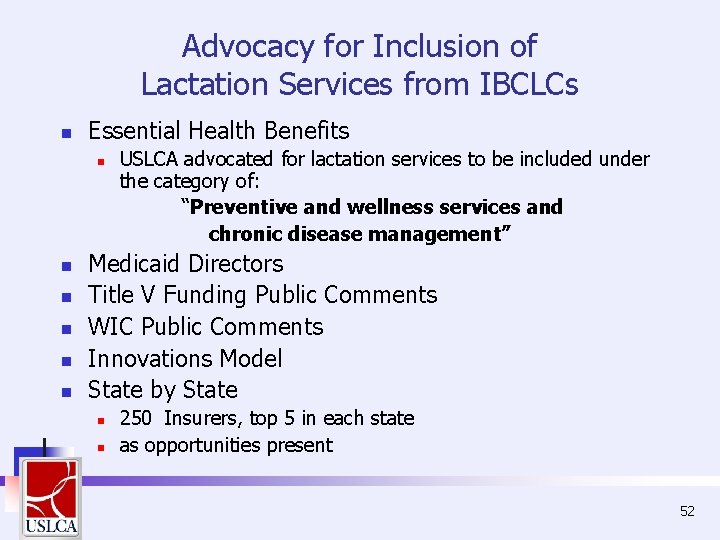
Advocacy for Inclusion of Lactation Services from IBCLCs n Essential Health Benefits n n n USLCA advocated for lactation services to be included under the category of: “Preventive and wellness services and chronic disease management” Medicaid Directors Title V Funding Public Comments WIC Public Comments Innovations Model State by State n n 250 Insurers, top 5 in each state as opportunities present 52
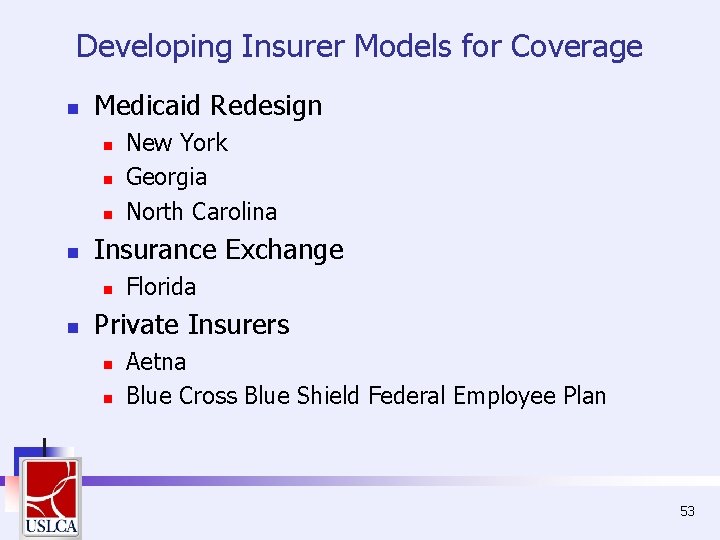
Developing Insurer Models for Coverage n Medicaid Redesign n n Insurance Exchange n n New York Georgia North Carolina Florida Private Insurers n n Aetna Blue Cross Blue Shield Federal Employee Plan 53
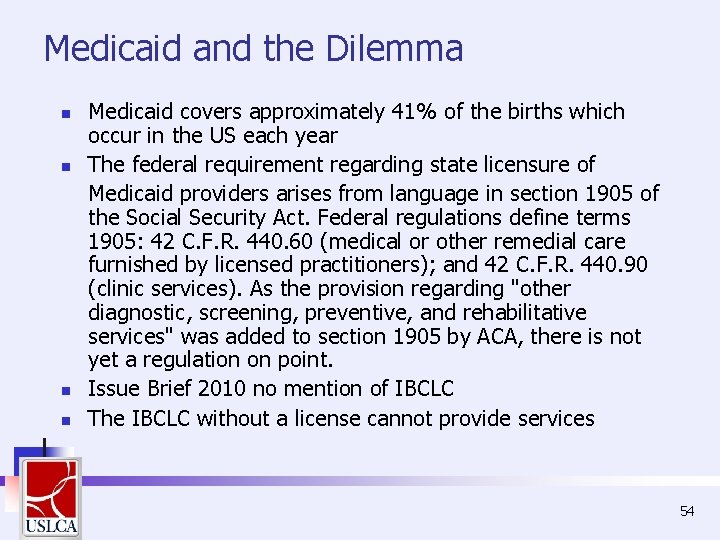
Medicaid and the Dilemma n n Medicaid covers approximately 41% of the births which occur in the US each year The federal requirement regarding state licensure of Medicaid providers arises from language in section 1905 of the Social Security Act. Federal regulations define terms 1905: 42 C. F. R. 440. 60 (medical or other remedial care furnished by licensed practitioners); and 42 C. F. R. 440. 90 (clinic services). As the provision regarding "other diagnostic, screening, preventive, and rehabilitative services" was added to section 1905 by ACA, there is not yet a regulation on point. Issue Brief 2010 no mention of IBCLC The IBCLC without a license cannot provide services 54
Current State Medicaid Coverage of Lactation Services n State Medicaid Coverage of Perinatal Services: Kaiser Family Foundation Report, Usha (2009) n n n 39 States offer individual lactation counseling 22/50 States Breastfeeding Education Services 14/50 USLCA Survey States Lactation Consultation n n Only 1 Medicaid provider in Rhode Island authorizes the IBCLC as a provider Oklahoma requires nurse or dietician with license 55
Patient Protection and Affordable Care Act (ACA) Section 2713: “Coverage of Preventive Health Services” • Requires coverage: “Comprehensive lactation support and counseling, by a trained provider during pregnancy and/or in the postpartum period, and costs for renting breastfeeding equipment. In conjunction with each birth. ” n 56
ACA - Early Prevention Screening Diagnosis and Treatment (EPSDT) State Medicaid programs are required to cover under their benefit “any service which [they] are permitted to cover under Medicaid that is necessary to treat or ameliorate a defect, physical and mental illness, or a condition identified by a screen. . . regardless of whether the service or item is included in [the state’s] Medicaid state plan. ” States will be required to provide coverage for primary care preventions to promote breastfeeding under its EPSDT benefit category as of 2013. 57
ACA - Medicaid “benchmark plans, ” n These “essential health benefits” are defined to include “preventive and wellness services. ” While the term “preventive and wellness services” is not defined by the statute, the Institute of Medicine (IOM) recently issued guidelines with respect to preventive services for women for purposes of the “essential health benefits. ” These recommendations, which have been endorsed by the U. S. Department of Health and Human Services, recommend coverage for “lactation counseling and equipment to help women who choose to breastfeed do so successfully. ” 58
Private Insurers and Insurance Exchanges n n n May choose to “credential” IBCLCs without an additional license This must be done with each individual insurer Insurers must be educated about the IBCLC Council for Affordable Quality Healthcare Universal Credentialing Data. Source Coding and Fees must be negotiated 59
Ongoing Research and Communication n Compiling supportive research for need and effectiveness of IBCLC in healthcare setting n n n >50 references Web links provided for all research Webpage on USLCA site n n n Includes a link to recruit volunteers Includes informative articles from e. News Includes publications 60
Questions 61
Contact Us n n n Laurie A Beck RN, MSN, IBCLC, RLC laurie. beck@dchstx. org Marsha Walker, RN, BSN, IBCLC, RLC marshalact@gmail. com Judith L. Gutowski, BA, IBCLC, RLC Email: jlgutowski@comcast. net Ellen Chetwynd, RN BSN IBCLC, RLC, MPH ellenchetwynd@gmail. com United States Lactation Consultant Association WWW. USLCA. ORG 2501 Aerial Center Parkway, Suite 103 Morrisville, NC 27560 USA Phone: 919 -861 -4543 Email: Info@uslca. org 62