
Ancient Near Eastern Art Sumer Ancient Sumer Hunter
- Slides: 86
Ancient Near Eastern Art
Sumer
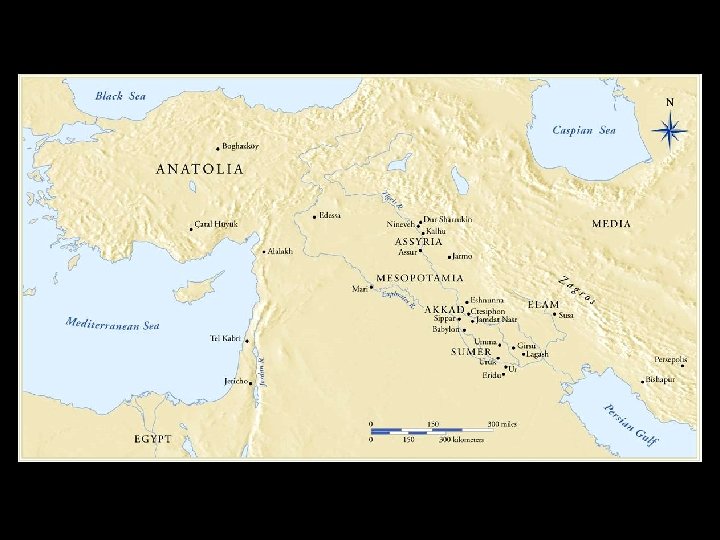
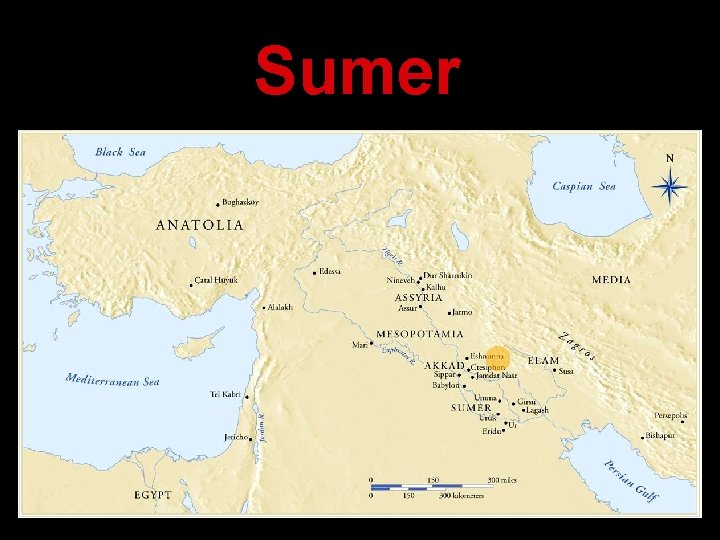
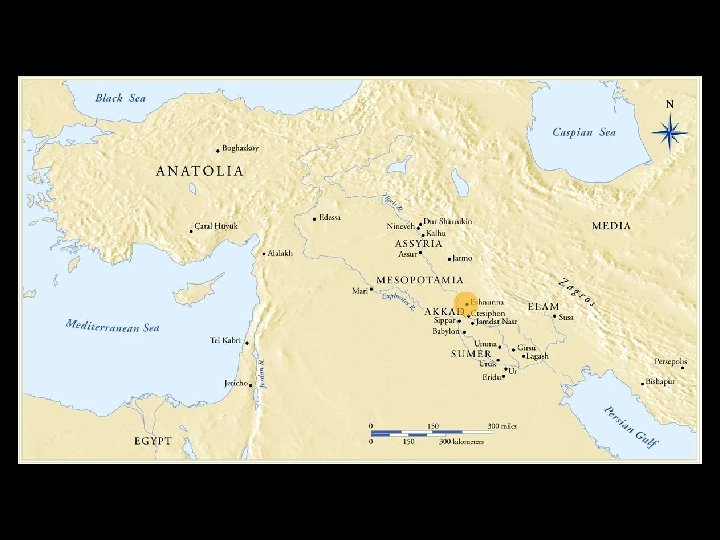
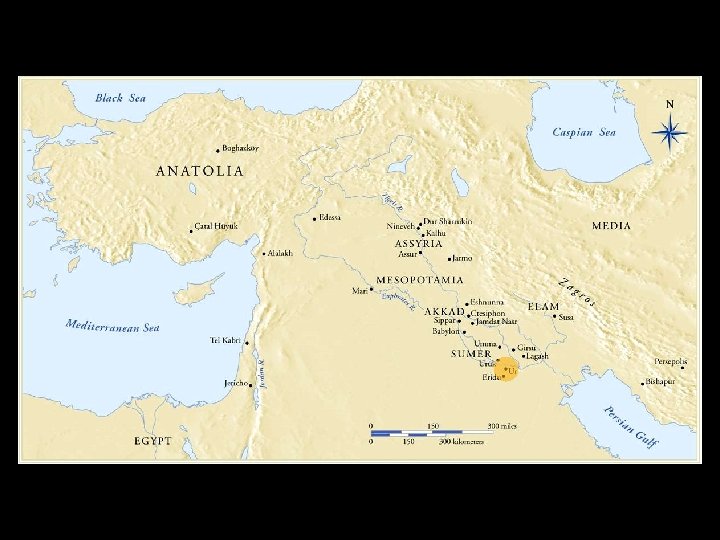
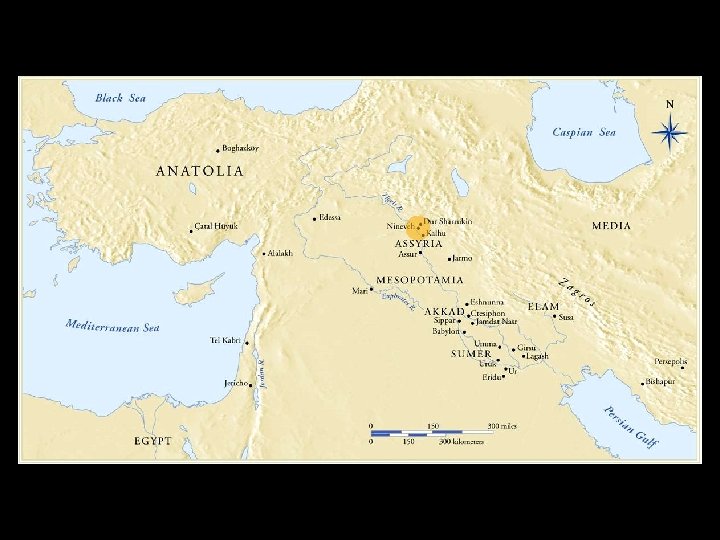
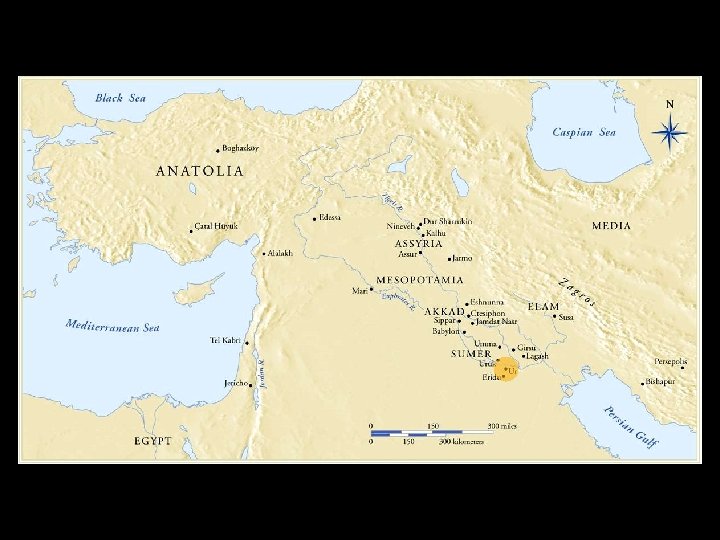
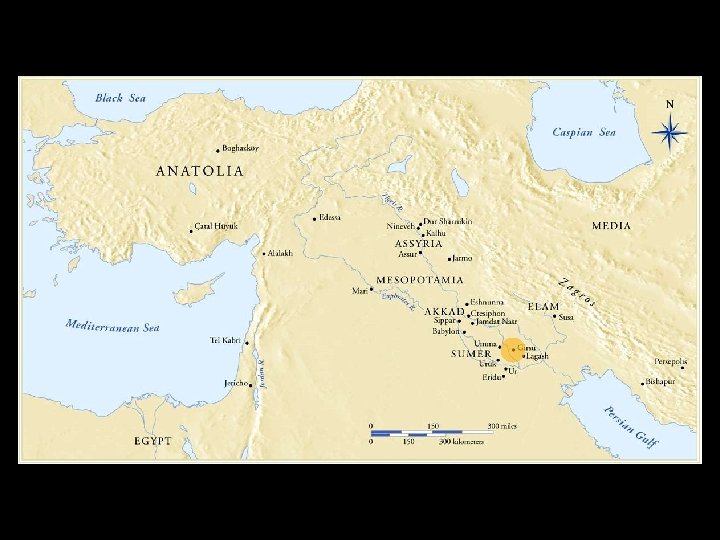
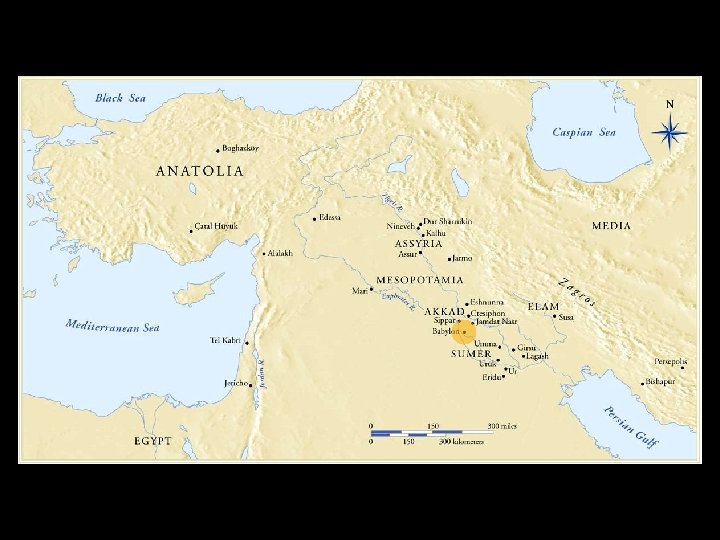
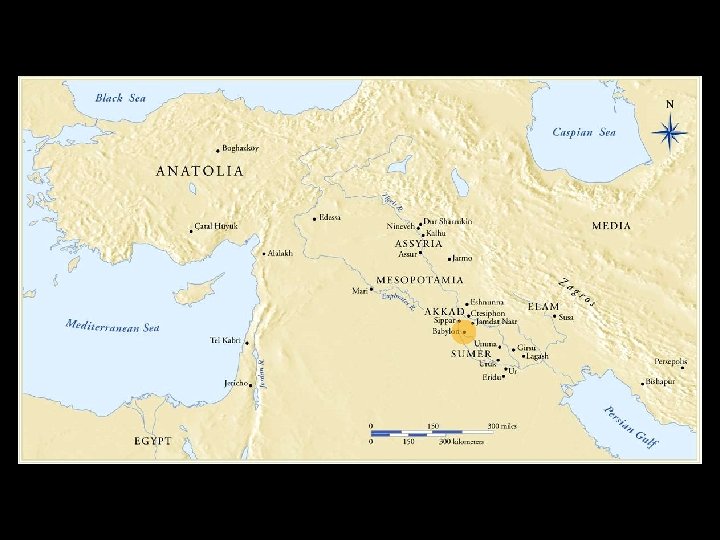
Ancient Sumer • Hunter and gathers change to farmers and herders; this change first took place in Mesopotamia • Mesopotamia – Greek word that means the land between the Tigris and Euphrates • Fertile crescent – the land mass between Turkey and Syria on one side and Iran and Iraq on the other • Giant, lush oasis • Only a portion of society needed to farm while the others could focus on manufacturing, trade, administration • Complex urban society
Developments • Writing developed as cuneiform – wedgeshaped signs • The nation was not unified, but rather, was a dozen or so city-states • Rulers were thought to be the gods’ representatives on earth • Rulers and priest directed daily activities • The community began to defend and protect against the weather
Religion • Local god played a central role in daily life • The god’s temple was the nucleus of the city and was economic and administrative center • The god was the protector of the citystate • The temple was a city within a city where priests and scribes carried on official business
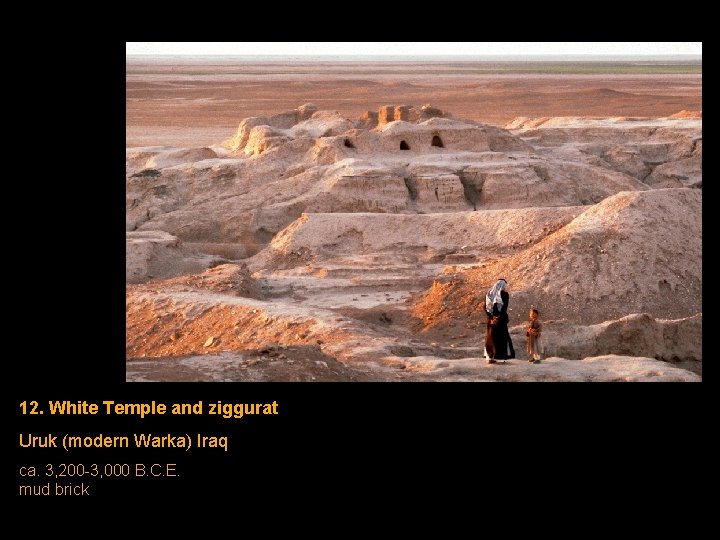
12. White Temple and ziggurat Uruk (modern Warka) Iraq ca. 3, 200 -3, 000 B. C. E. mud brick
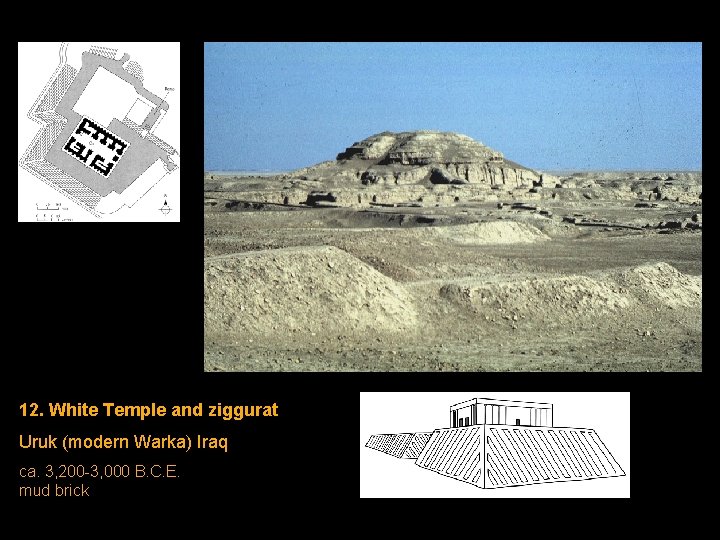
12. White Temple and ziggurat Uruk (modern Warka) Iraq ca. 3, 200 -3, 000 B. C. E. mud brick
The White Temple: • The temple was home to the legendary Gilgamesh • Temple was made of mud brick that is white washed • Corners were oriented to cardinal points of the compass • Made to accommodate only a select few worshippers (61 x 16 feet) • Temple has several chambers • Central hall or cella was for the divinity • Temple waiting rooms – wait for the deity to appear (Tallest ziggurat – Tower of Babel – 270 ft. high)
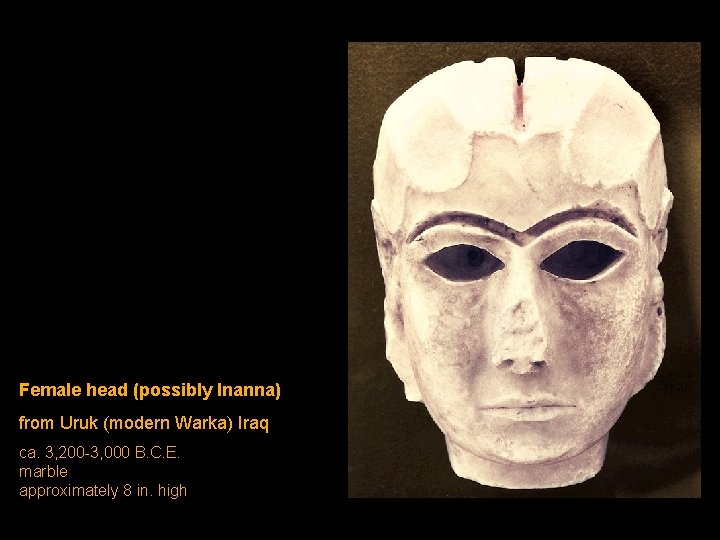
Female head (possibly Inanna) from Uruk (modern Warka) Iraq ca. 3, 200 -3, 000 B. C. E. marble approximately 8 in. high
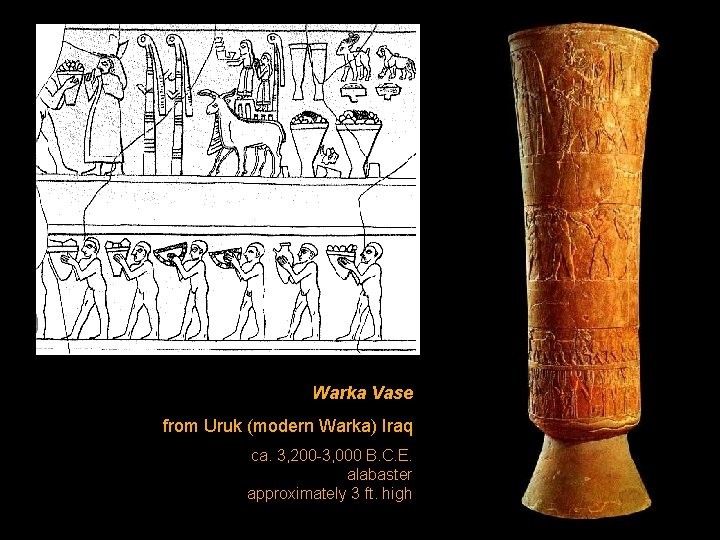
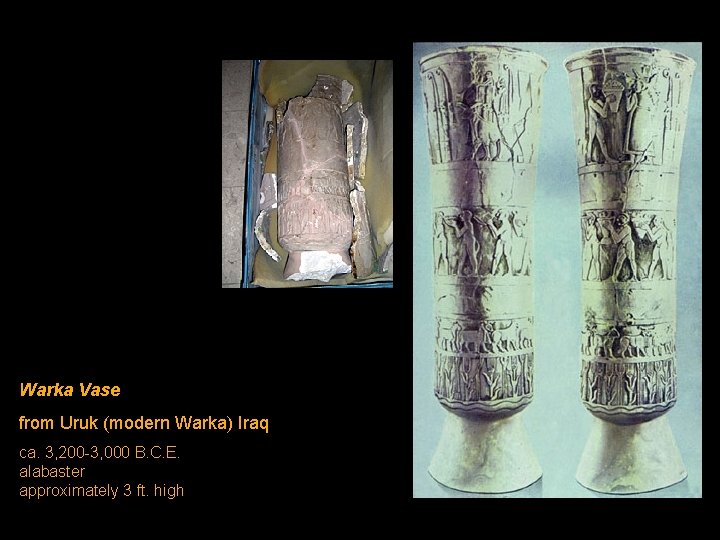
Warka Vase from Uruk (modern Warka) Iraq ca. 3, 200 -3, 000 B. C. E. alabaster approximately 3 ft. high
Warka Vase from Uruk (modern Warka) Iraq ca. 3, 200 -3, 000 B. C. E. alabaster approximately 3 ft. high
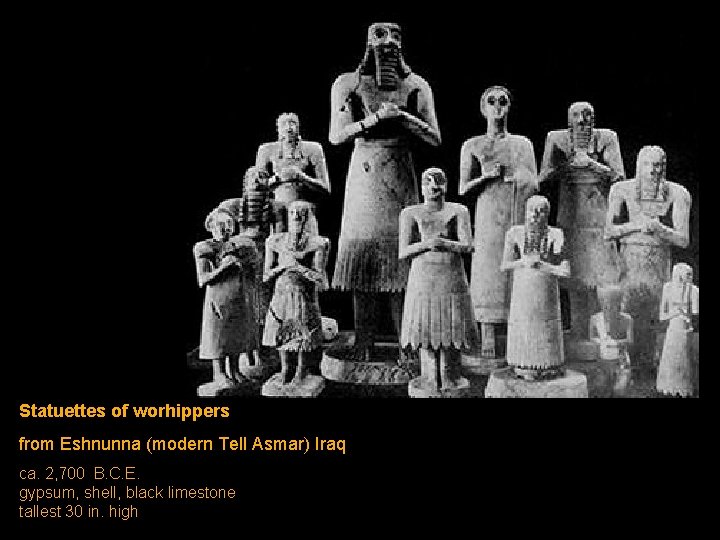
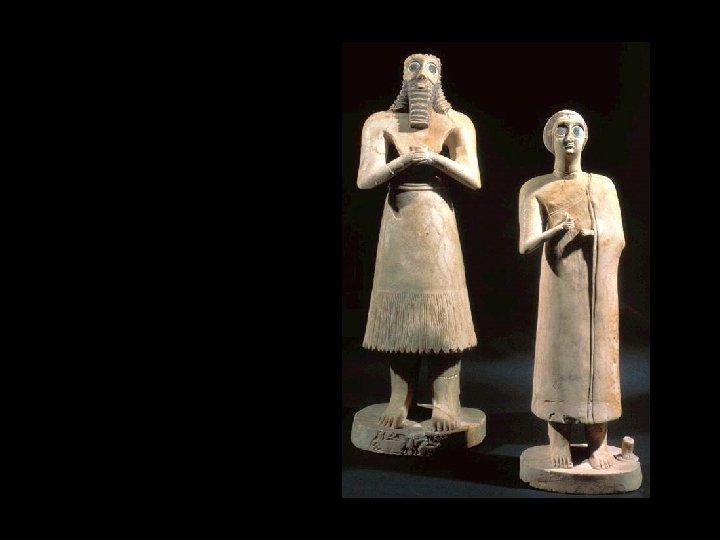
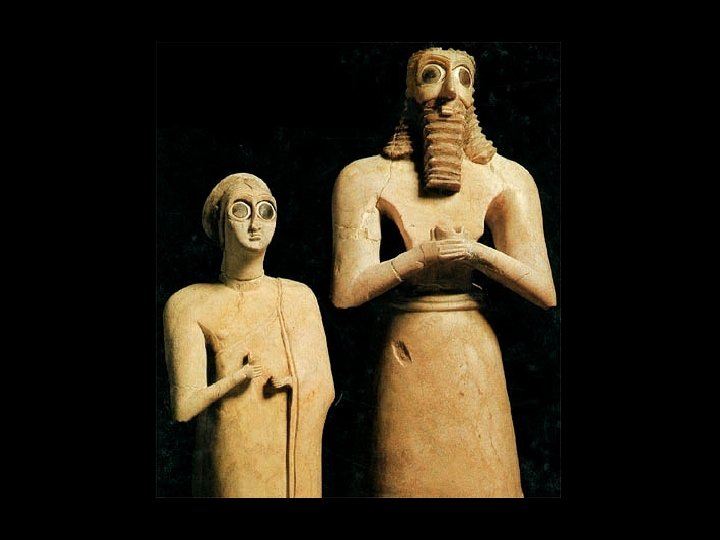
Statuettes of worhippers from Eshnunna (modern Tell Asmar) Iraq ca. 2, 700 B. C. E. gypsum, shell, black limestone tallest 30 in. high
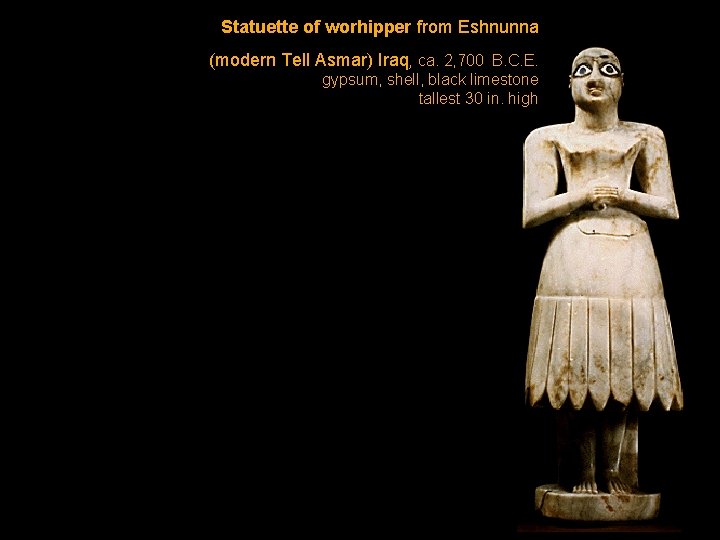
Statuette of worhipper from Eshnunna (modern Tell Asmar) Iraq, ca. 2, 700 B. C. E. gypsum, shell, black limestone tallest 30 in. high
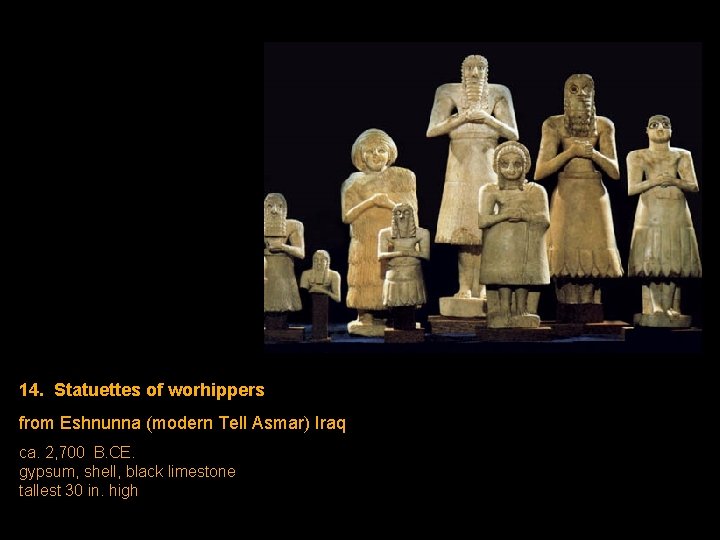
14. Statuettes of worhippers from Eshnunna (modern Tell Asmar) Iraq ca. 2, 700 B. CE. gypsum, shell, black limestone tallest 30 in. high
Statues of Votive Figures • Soft gypsum statuettes inlaid with shells and black limestone • Two largest figures represent mortals in gesture of prayer holding small beakers used in Sumerian rites • Some have fringed skirts, belts, beards and shoulder length hair • Heads tilted upward in “waiting room” waiting for divinity to appear • Big eyes compared to hands – eternal wakefulness for prayer/devotion
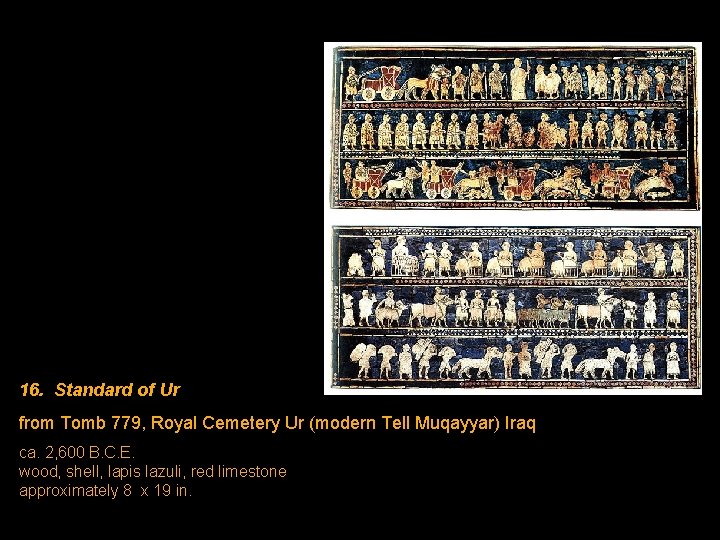
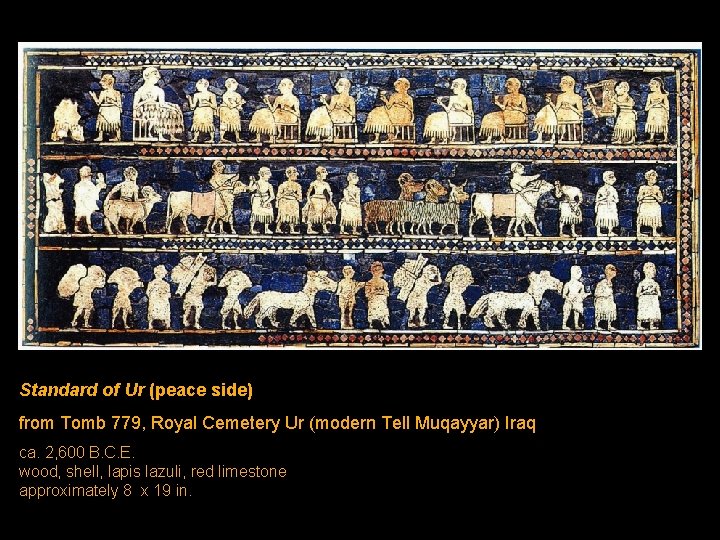
16. Standard of Ur from Tomb 779, Royal Cemetery Ur (modern Tell Muqayyar) Iraq ca. 2, 600 B. C. E. wood, shell, lapis lazuli, red limestone approximately 8 x 19 in.
Stanard of Ur • Rectangular box inlaid with shell, lapis lazuli and red limestone • Perhaps mounted on a pole as a military standard
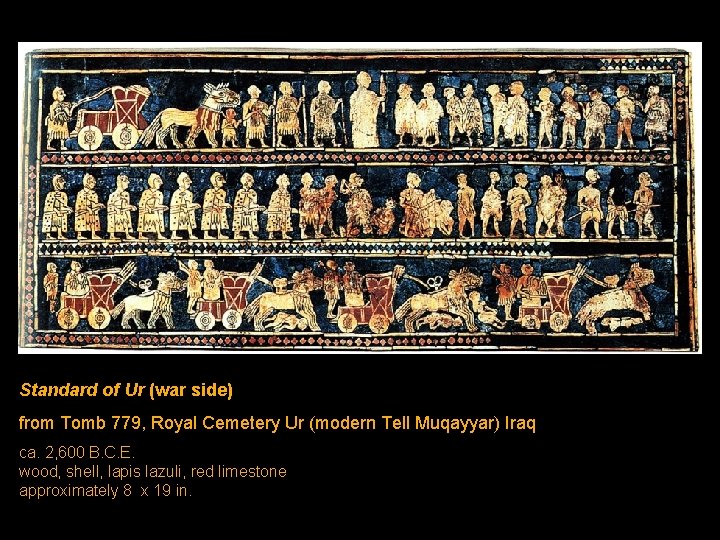
Standard of Ur (war side) from Tomb 779, Royal Cemetery Ur (modern Tell Muqayyar) Iraq ca. 2, 600 B. C. E. wood, shell, lapis lazuli, red limestone approximately 8 x 19 in.
War Side • Donkey-drawn chariots mow down enemies • Capture enemies
Standard of Ur (peace side) from Tomb 779, Royal Cemetery Ur (modern Tell Muqayyar) Iraq ca. 2, 600 B. C. E. wood, shell, lapis lazuli, red limestone approximately 8 x 19 in.
Peace Side • Men carry provisions, maybe war booty on backs • Spoils of war – fish for a great banquet • Larger than life king, lyre player and singer • No inscription, however, early example of narrative
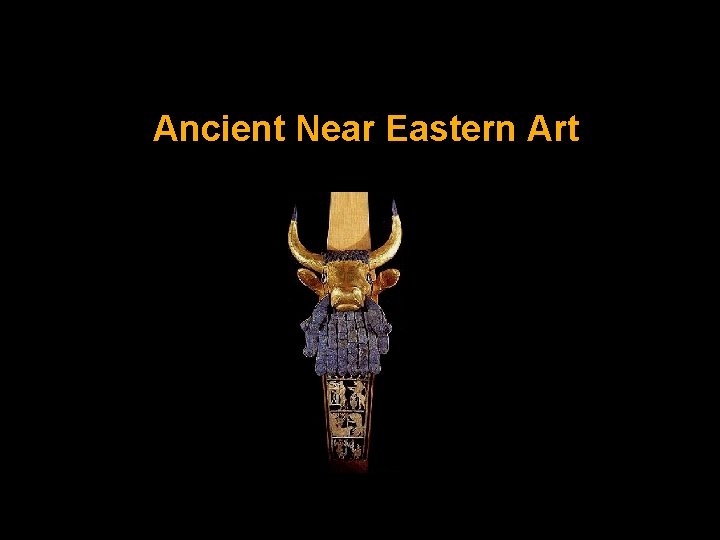
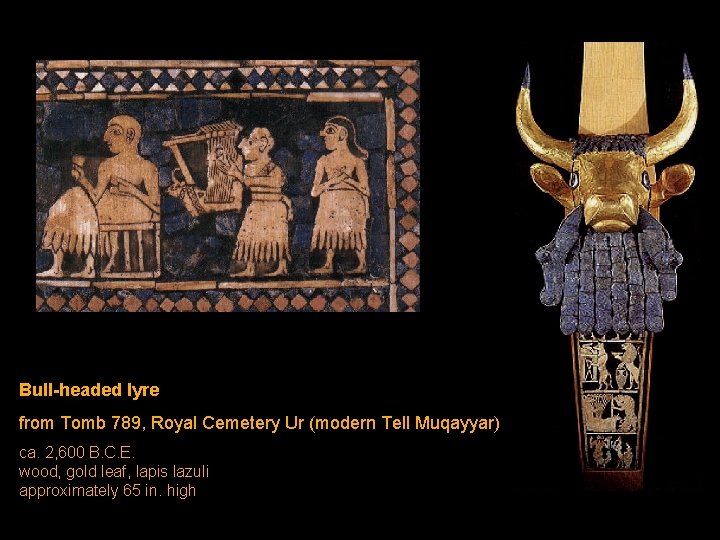
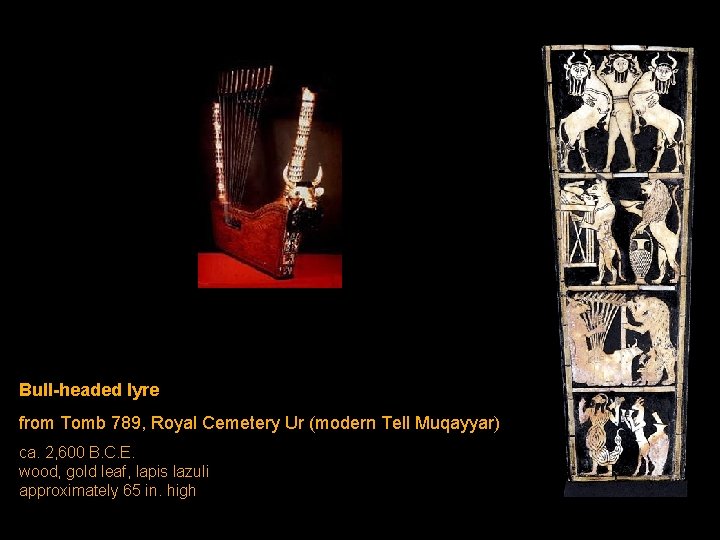
Bull-headed lyre from Tomb 789, Royal Cemetery Ur (modern Tell Muqayyar) ca. 2, 600 B. C. E. wood, gold leaf, lapis lazuli approximately 65 in. high
Bull-headed lyre from Tomb 789, Royal Cemetery Ur (modern Tell Muqayyar) ca. 2, 600 B. C. E. wood, gold leaf, lapis lazuli approximately 65 in. high
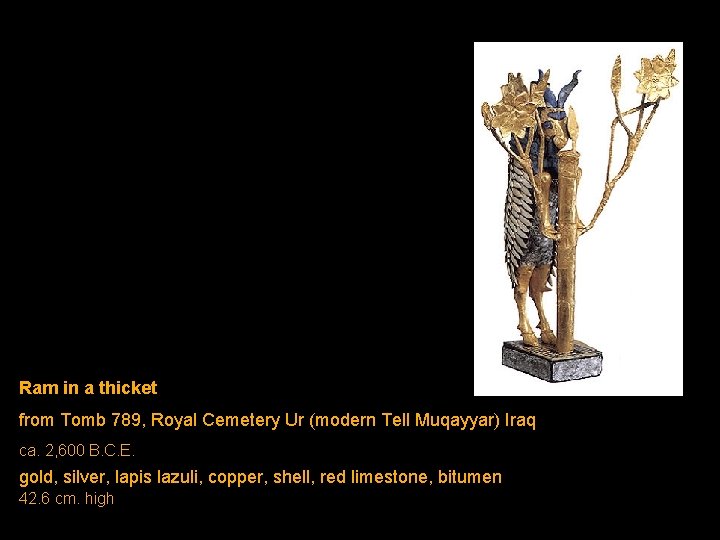
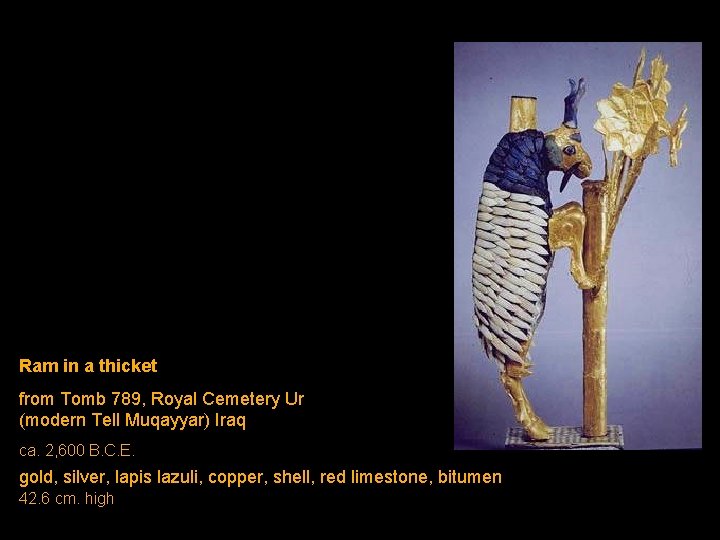
Ram in a thicket from Tomb 789, Royal Cemetery Ur (modern Tell Muqayyar) Iraq ca. 2, 600 B. C. E. gold, silver, lapis lazuli, copper, shell, red limestone, bitumen 42. 6 cm. high
Ram in a thicket from Tomb 789, Royal Cemetery Ur (modern Tell Muqayyar) Iraq ca. 2, 600 B. C. E. gold, silver, lapis lazuli, copper, shell, red limestone, bitumen 42. 6 cm. high
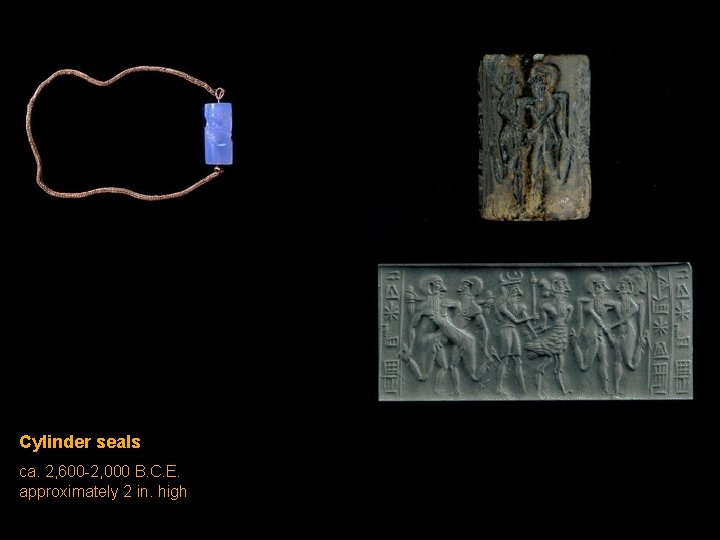
Cylinder seals ca. 2, 600 -2, 000 B. C. E. approximately 2 in. high
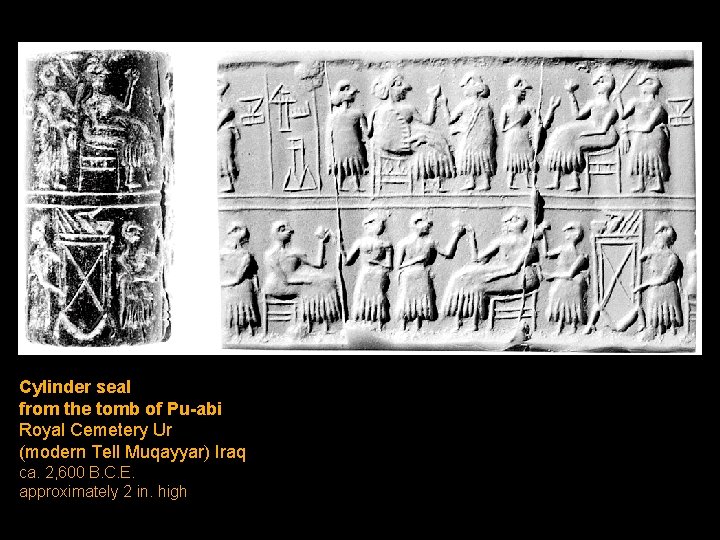
Cylinder seal from the tomb of Pu-abi Royal Cemetery Ur (modern Tell Muqayyar) Iraq ca. 2, 600 B. C. E. approximately 2 in. high
Akkadian Art
• In 2334 B. C. E, cities in Sumer came under rule of Sargon of Akkad which was in the vicinity of Babylon • New concept of loyalty to the king • Governors of city-state became servants to the king
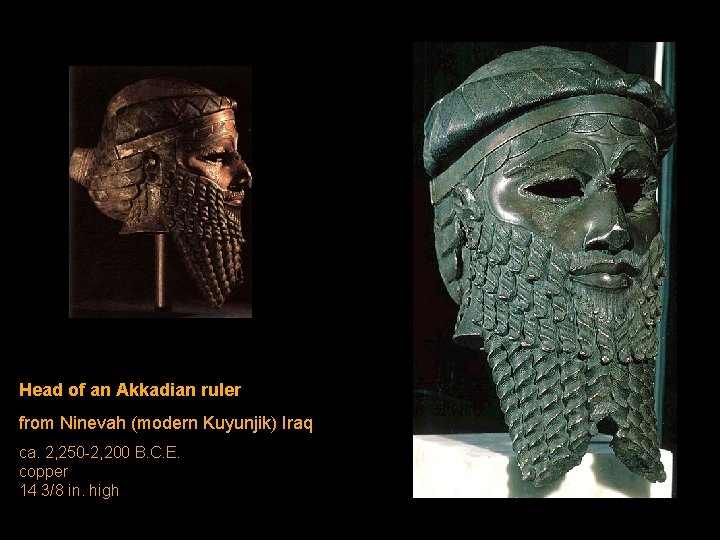
Head of an Akkadian ruler from Ninevah (modern Kuyunjik) Iraq ca. 2, 250 -2, 200 B. C. E. copper 14 3/8 in. high
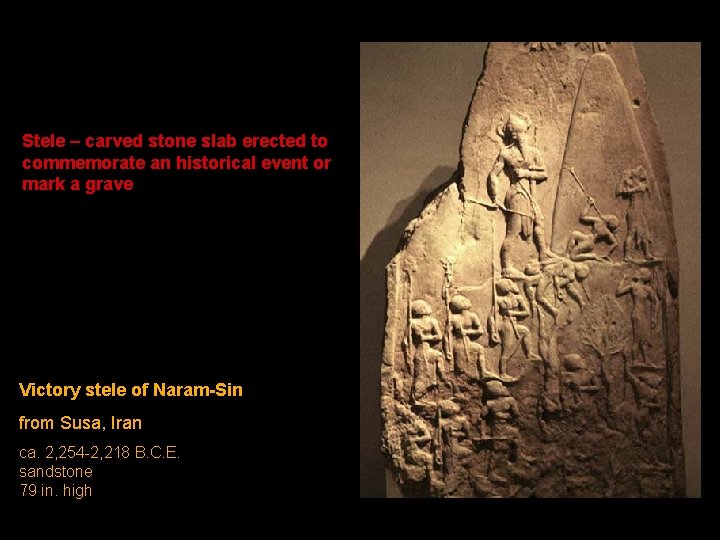
Stele – carved stone slab erected to commemorate an historical event or mark a grave Victory stele of Naram-Sin from Susa, Iran ca. 2, 254 -2, 218 B. C. E. sandstone 79 in. high
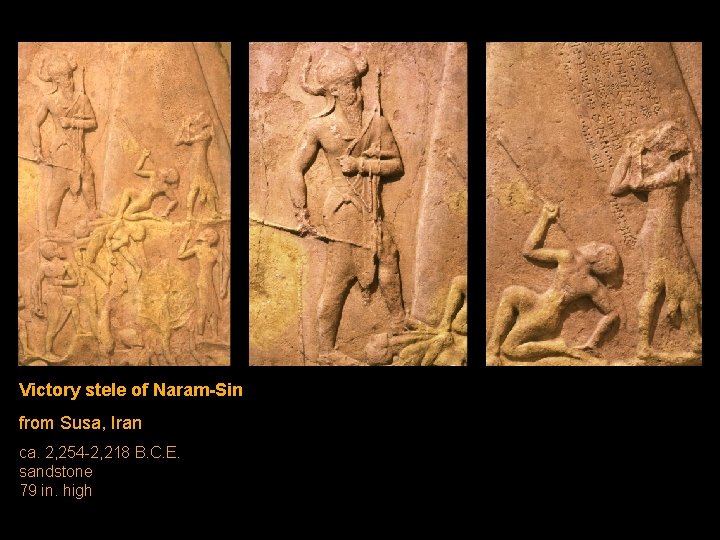
Victory stele of Naram-Sin from Susa, Iran ca. 2, 254 -2, 218 B. C. E. sandstone 79 in. high
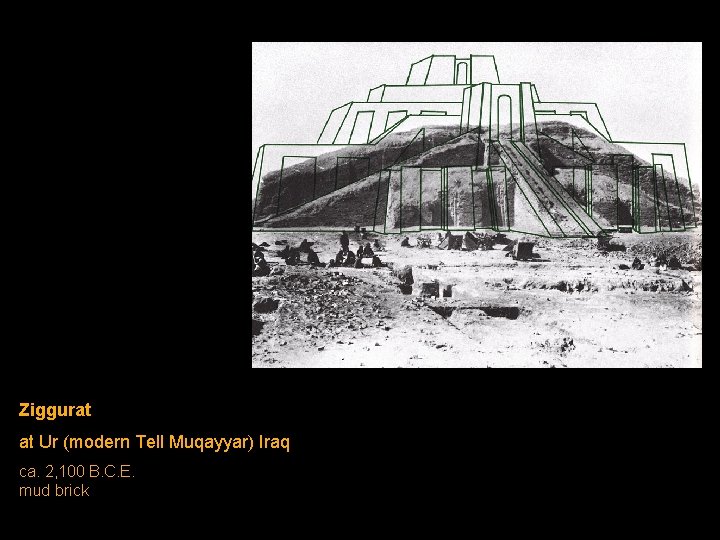
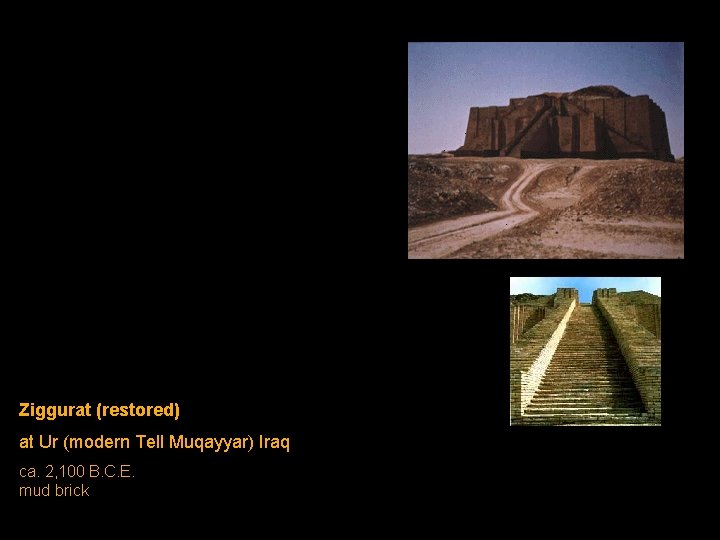
Ziggurat at Ur (modern Tell Muqayyar) Iraq ca. 2, 100 B. C. E. mud brick
Ziggurat (restored) at Ur (modern Tell Muqayyar) Iraq ca. 2, 100 B. C. E. mud brick
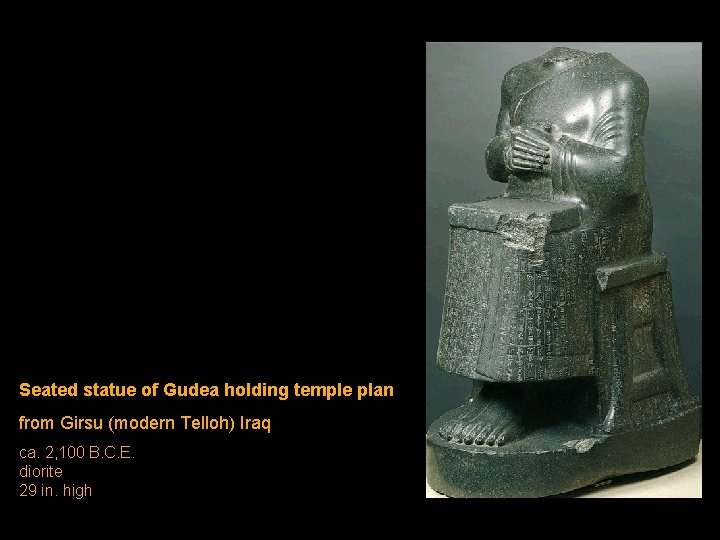
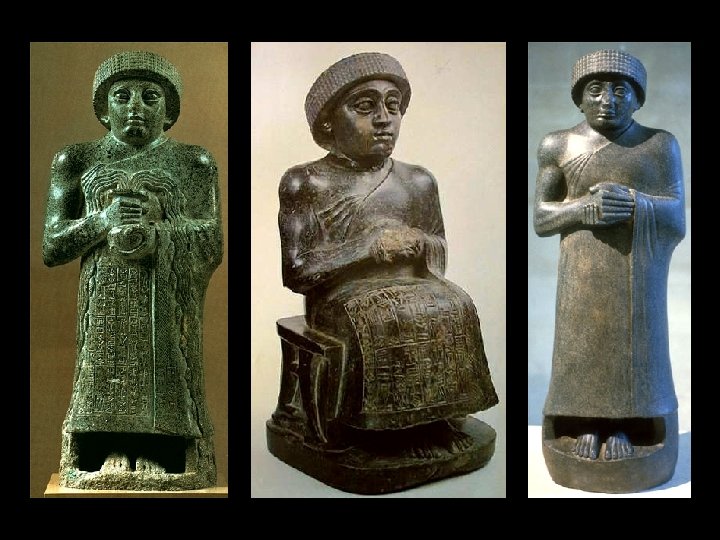
Seated statue of Gudea holding temple plan from Girsu (modern Telloh) Iraq ca. 2, 100 B. C. E. diorite 29 in. high
Babylonian Art
Neo-Sumerian Art • In 2150 B. C. E. mountain people called the Gutians brought the end to Akkadian power • Cities of Sumer drove the Guitians out of Mesopotamia established a Neo-Sumerian state Ruled by the King of Ur • Babylon was established as a city-state with Centralized government which ruled southern Part of Mesopotamia • The most powerful king was Hammurabi
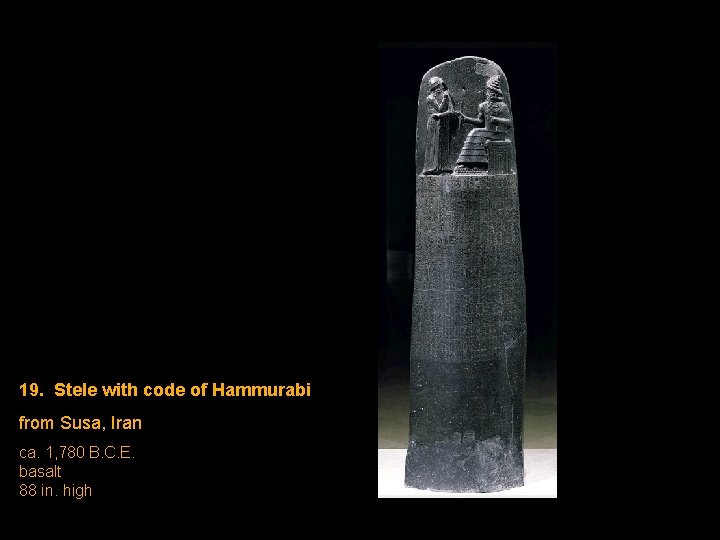
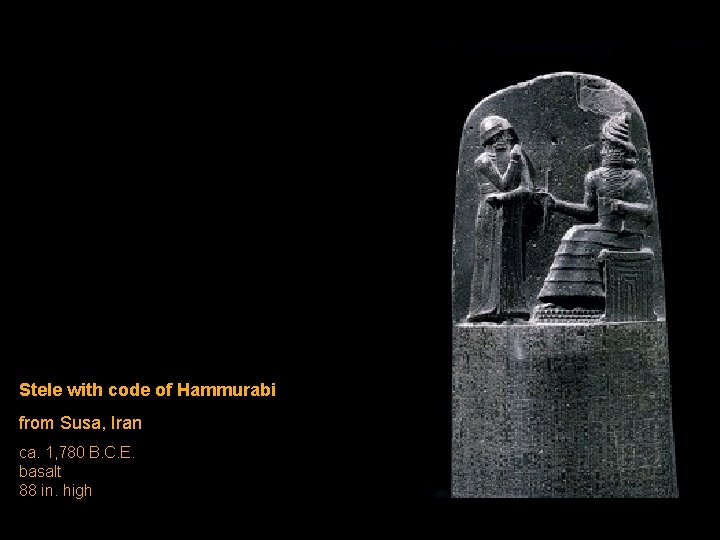
19. Stele with code of Hammurabi from Susa, Iran ca. 1, 780 B. C. E. basalt 88 in. high
Stele with code of Hammurabi from Susa, Iran ca. 1, 780 B. C. E. basalt 88 in. high
• Law code inscribed on stele with 3500 cuneiform characters • Lists penalties for adultery, murder to cutting down neighbors trees • Top of the stele is Hammurabi with flameshouldered sun god, Shamash • The king raises his hand in respect • The god extens a rod and ring to Hammurabi for his authority • Symbols include measuring tools such as rods and ropes showing the king’s ability to built society order, measure people’s lives and render judgement
• The artist attempts foreshortening on the beard • The sun god Shamesh is depicted in both front and side views, yet god’ headdress is in true profile
Assyrian Art
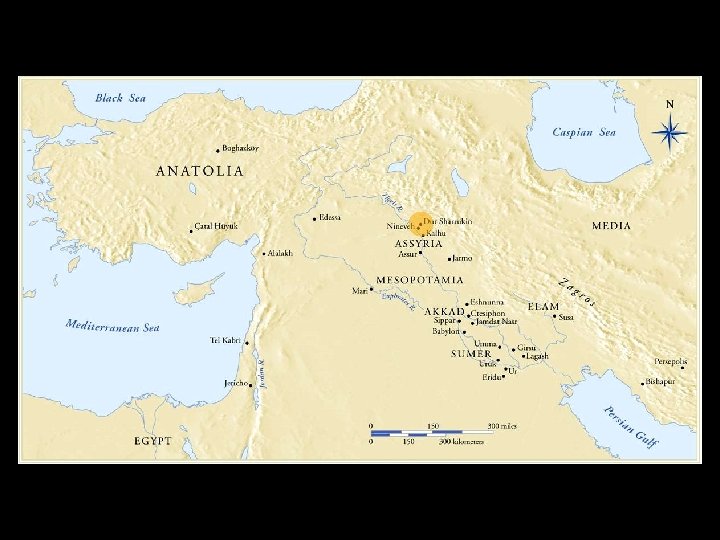
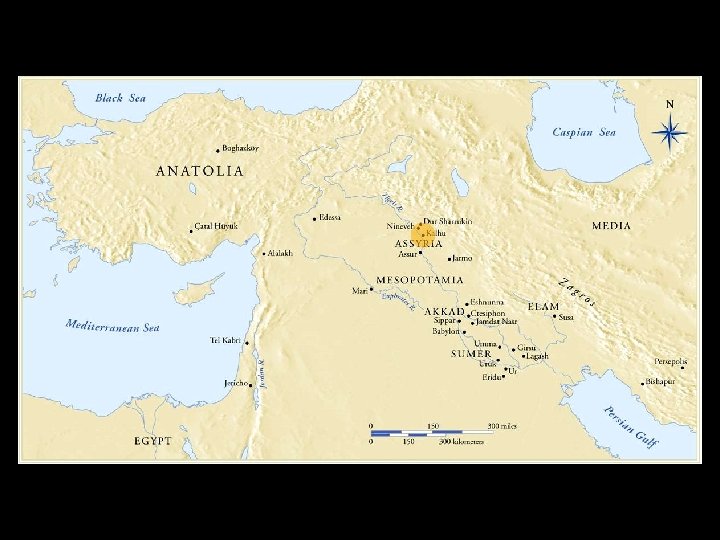
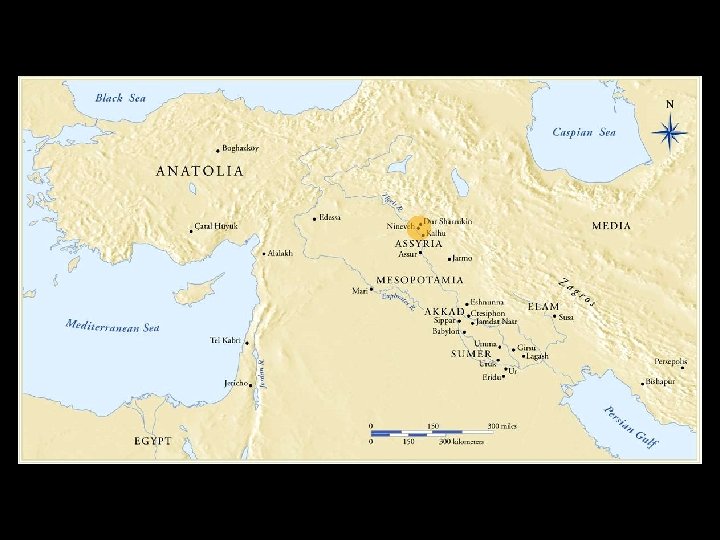
Assyrian Culture • Babylonians were toppled by the Hitties, an Anatolian people who subsequently went home • By 900 B. C. E. , Mesopotamia was taken over by Assyrians • Name comes from Assur, the city of the god Asur on the Tigris river
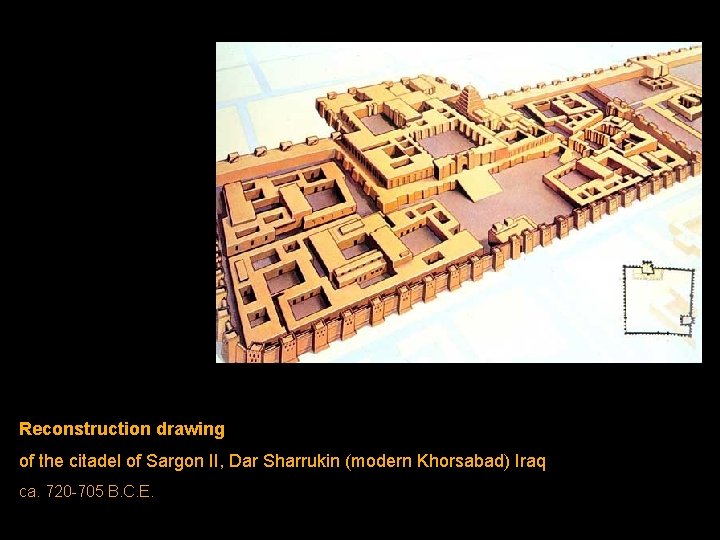
Reconstruction drawing of the citadel of Sargon II, Dar Sharrukin (modern Khorsabad) Iraq ca. 720 -705 B. C. E.
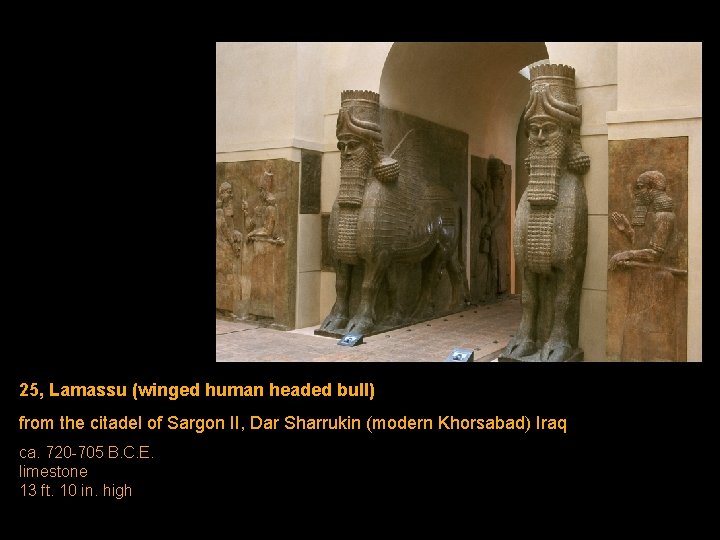
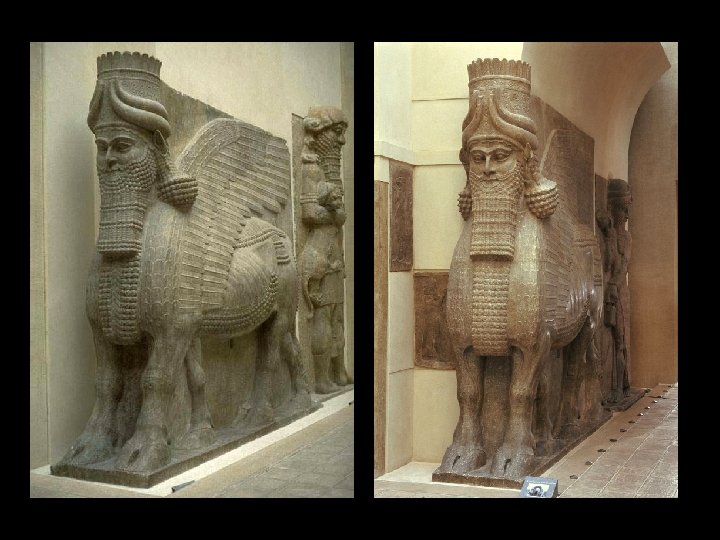
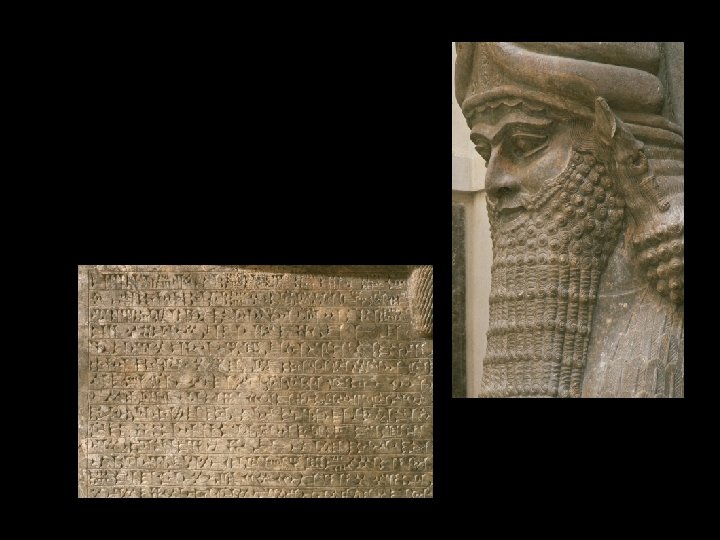
25, Lamassu (winged human headed bull) from the citadel of Sargon II, Dar Sharrukin (modern Khorsabad) Iraq ca. 720 -705 B. C. E. limestone 13 ft. 10 in. high
• The Citadel of Sargon II was guarded by limestone monsters called – Lamassu • Winged, man-headed bulls • 5 legs *not optical view
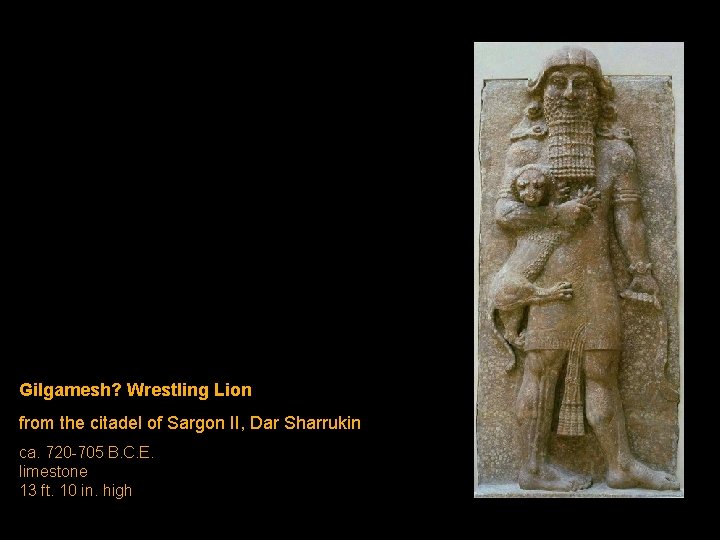
Gilgamesh? Wrestling Lion from the citadel of Sargon II, Dar Sharrukin ca. 720 -705 B. C. E. limestone 13 ft. 10 in. high
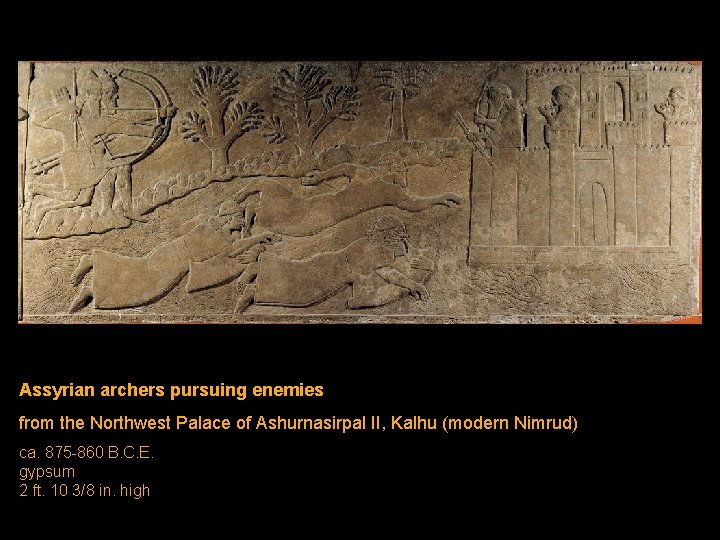
Assyrian archers pursuing enemies from the Northwest Palace of Ashurnasirpal II, Kalhu (modern Nimrud) ca. 875 -860 B. C. E. gypsum 2 ft. 10 3/8 in. high
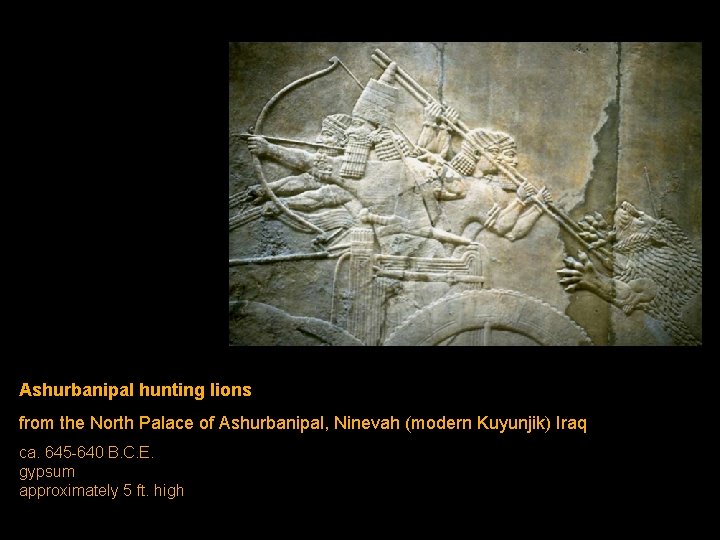
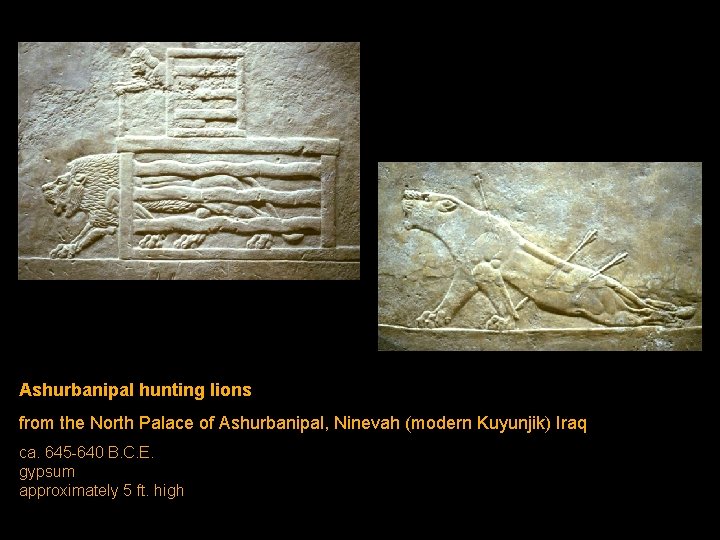
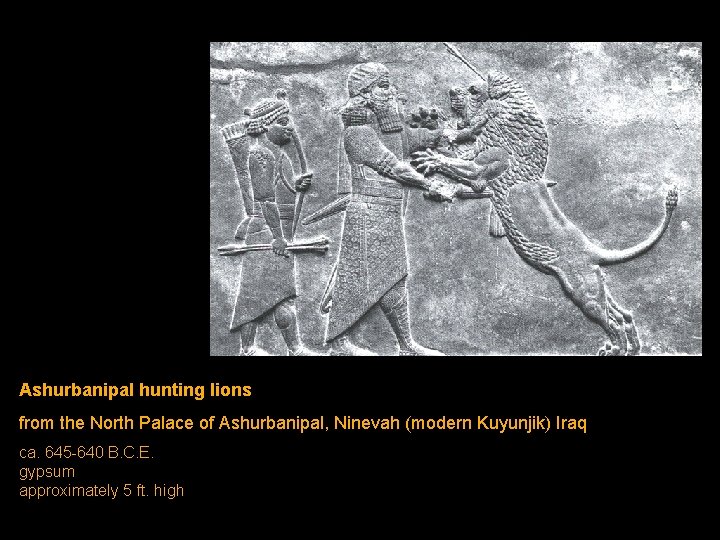
Ashurbanipal hunting lions from the North Palace of Ashurbanipal, Ninevah (modern Kuyunjik) Iraq ca. 645 -640 B. C. E. gypsum approximately 5 ft. high
Ashurbanipal hunting lions from the North Palace of Ashurbanipal, Ninevah (modern Kuyunjik) Iraq ca. 645 -640 B. C. E. gypsum approximately 5 ft. high
Ashurbanipal hunting lions from the North Palace of Ashurbanipal, Ninevah (modern Kuyunjik) Iraq ca. 645 -640 B. C. E. gypsum approximately 5 ft. high
Neo-Babylonian Art
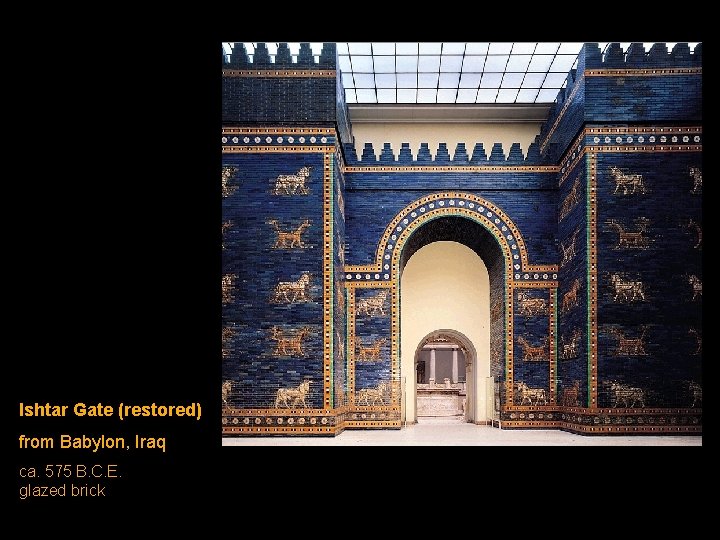
Ishtar Gate (restored) from Babylon, Iraq ca. 575 B. C. E. glazed brick
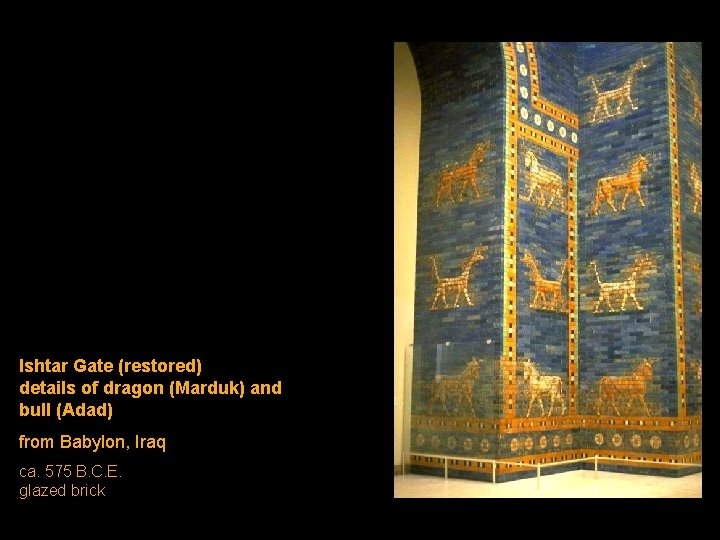
Ishtar Gate (restored) details of dragon (Marduk) and bull (Adad) from Babylon, Iraq ca. 575 B. C. E. glazed brick
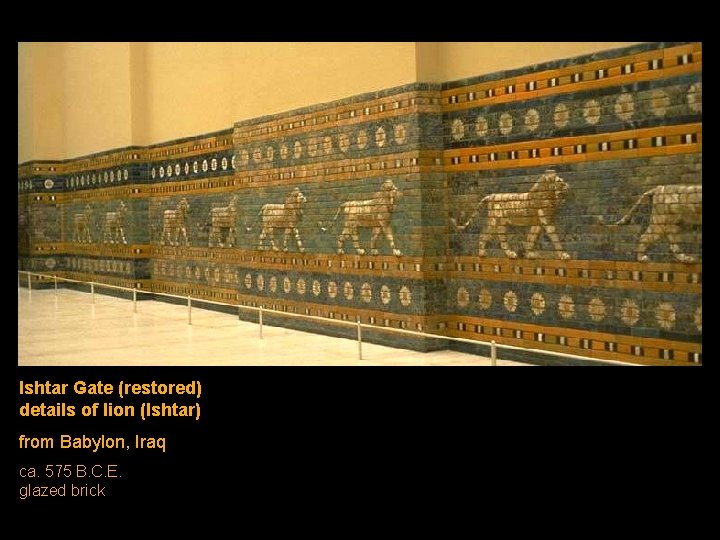
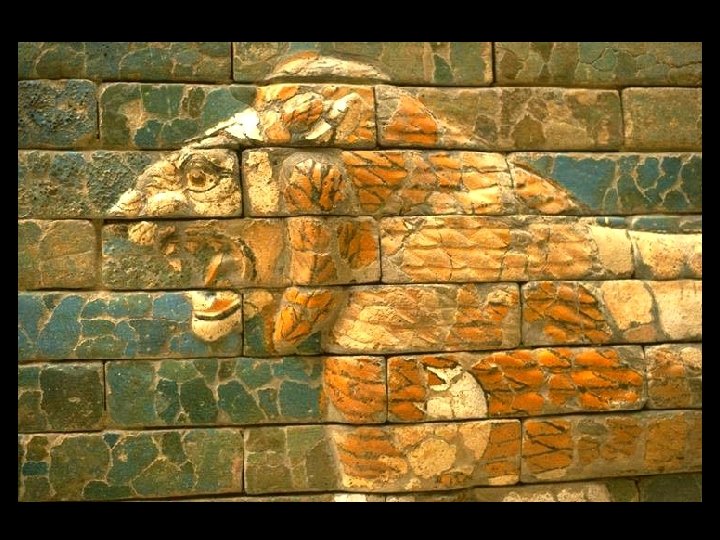
Ishtar Gate (restored) details of lion (Ishtar) from Babylon, Iraq ca. 575 B. C. E. glazed brick
Achaemenid Persian Art
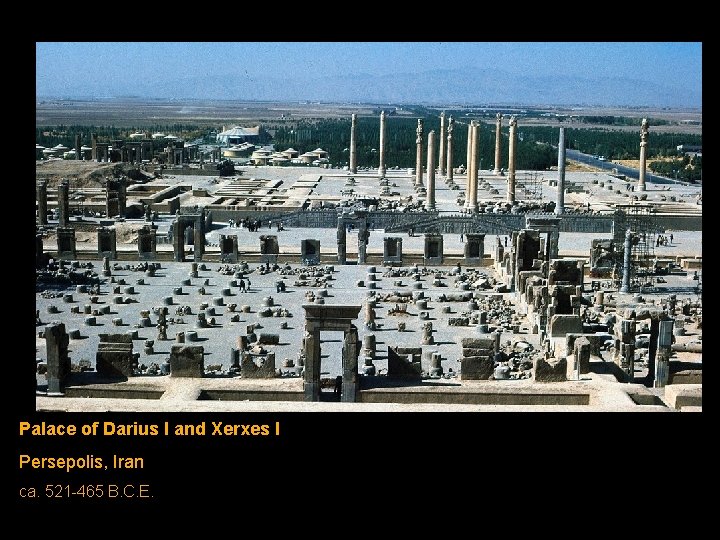
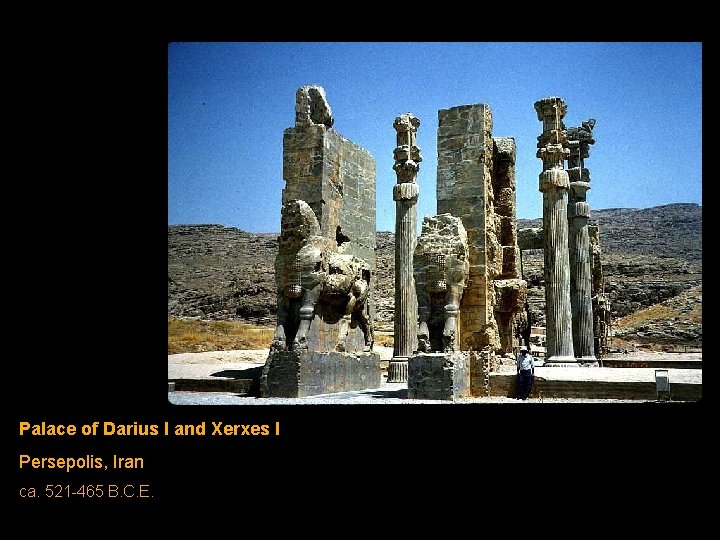
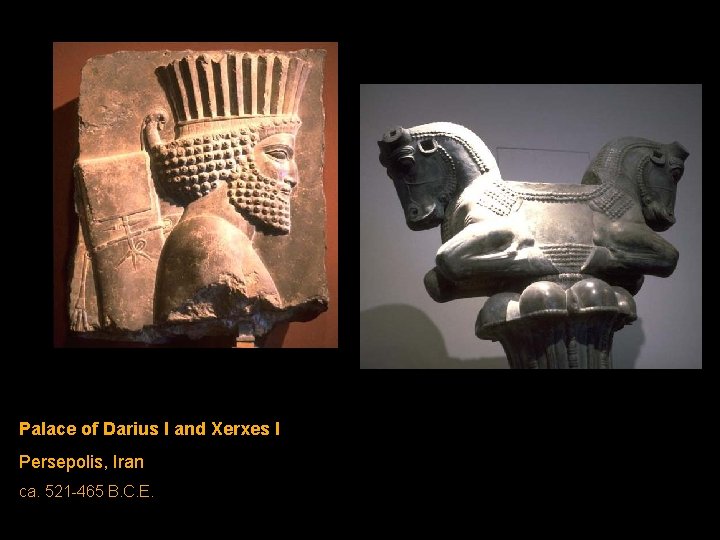
Palace of Darius I and Xerxes I Persepolis, Iran ca. 521 -465 B. C. E.
Palace of Darius I and Xerxes I Persepolis, Iran ca. 521 -465 B. C. E.
Palace of Darius I and Xerxes I Persepolis, Iran ca. 521 -465 B. C. E.
Sasanian Art
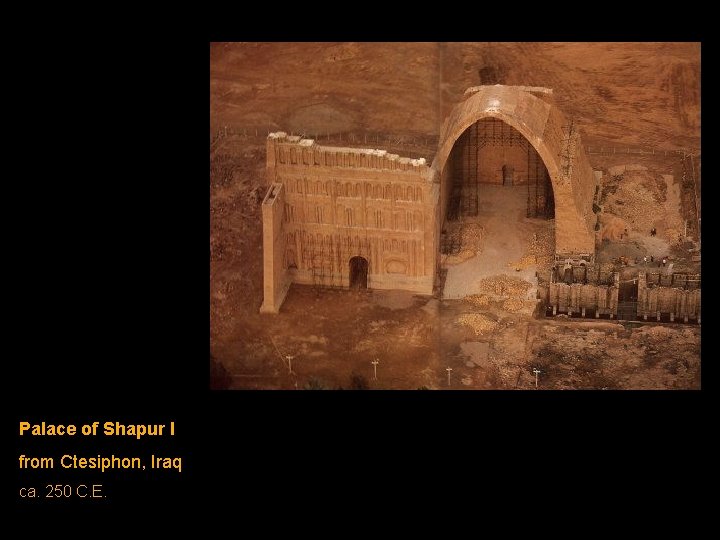
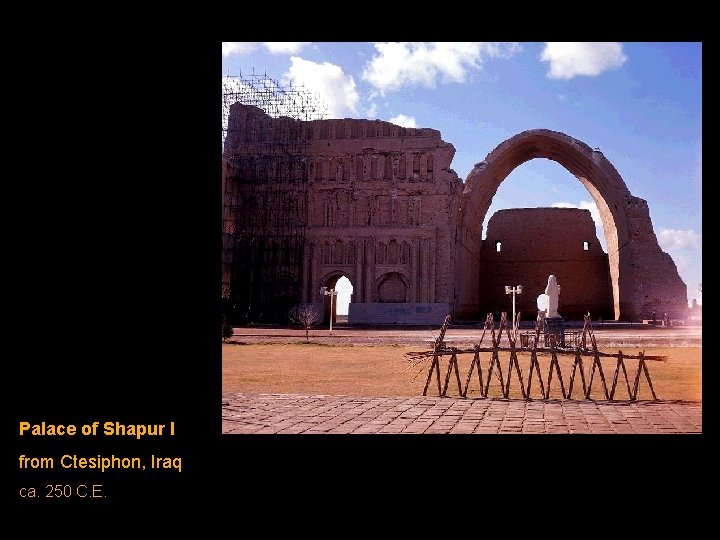
Palace of Shapur I from Ctesiphon, Iraq ca. 250 C. E.
Palace of Shapur I from Ctesiphon, Iraq ca. 250 C. E.
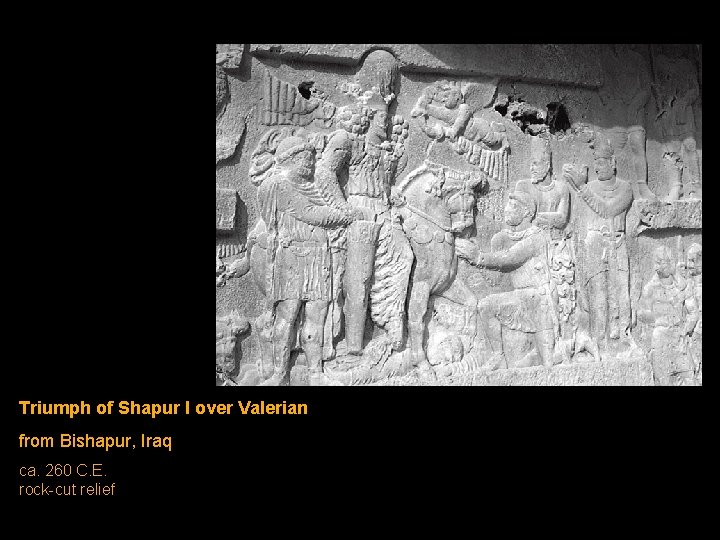
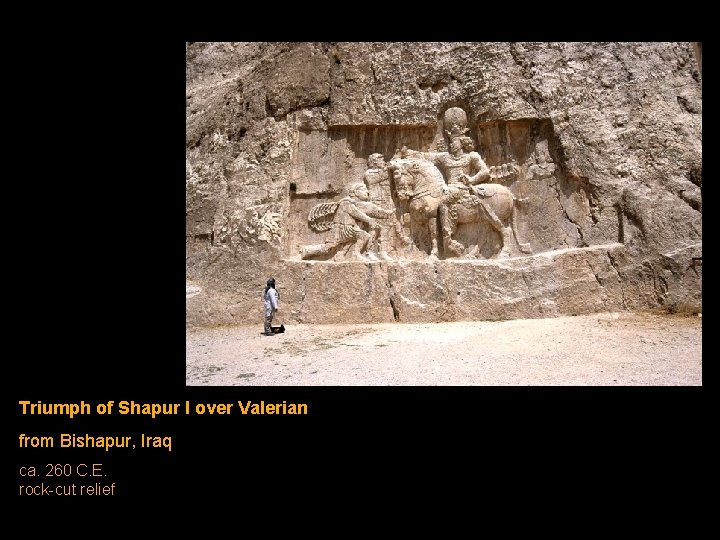
Triumph of Shapur I over Valerian from Bishapur, Iraq ca. 260 C. E. rock-cut relief
Triumph of Shapur I over Valerian from Bishapur, Iraq ca. 260 C. E. rock-cut relief
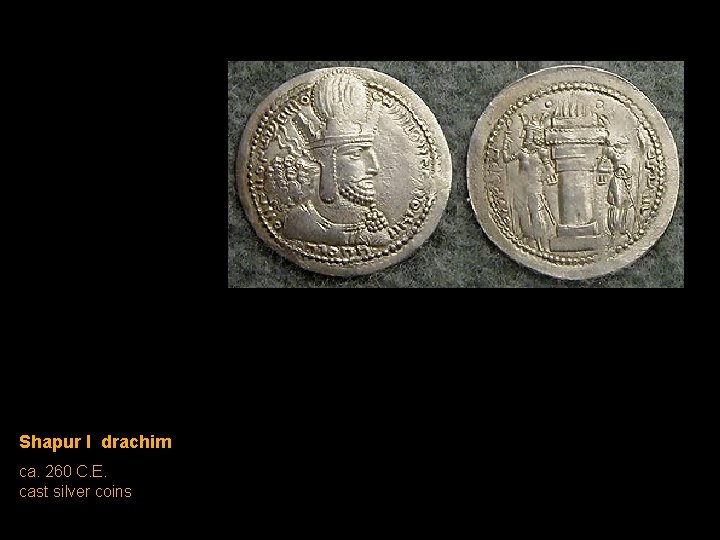
Shapur I drachim ca. 260 C. E. cast silver coins
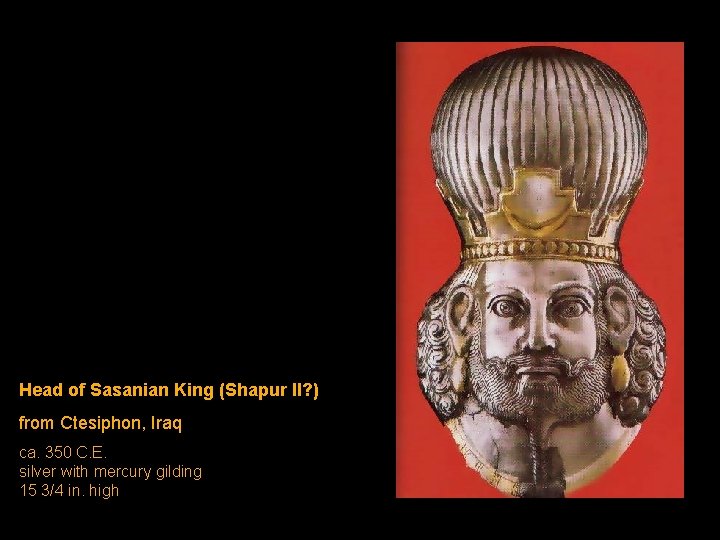
Head of Sasanian King (Shapur II? ) from Ctesiphon, Iraq ca. 350 C. E. silver with mercury gilding 15 3/4 in. high