Unitary Fermi gas in the expansion Yusuke Nishida

- Slides: 30
Unitary Fermi gas in the expansion Yusuke Nishida 18 January 2007 Contents of this talk 1. Fermi gas at infinite scattering length 2. Formulation of expansions 3. in terms of 4 -d and d-2 3. LO & NLO results at zero T & dm 4. Summary and outlook
Contents of thesis 1. Introduction 2. Two-body scattering in vacuum 3. Unitary Fermi gas around d=4 4. Phase structure of polarized Fermi gas 5. Fermions with unequal masses 6. Expansions around d=2 7. Matching of expansions at d=4 and d=2 8. Thermodynamics below Tc 9. Thermodynamics above Tc 10. Summary and concluding remarks
3 Introduction : Fermi gas at infinite scattering length
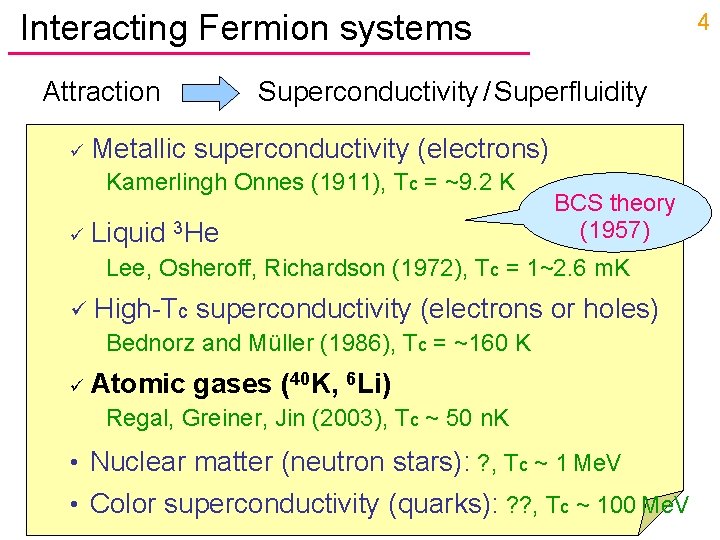
Interacting Fermion systems Attraction ü Superconductivity / Superfluidity Metallic superconductivity (electrons) Kamerlingh Onnes (1911), Tc = ~9. 2 K ü 4 Liquid 3 He BCS theory (1957) Lee, Osheroff, Richardson (1972), Tc = 1~2. 6 m. K ü High-Tc superconductivity (electrons or holes) Bednorz and Müller (1986), Tc = ~160 K ü Atomic gases (40 K, 6 Li) Regal, Greiner, Jin (2003), Tc ~ 50 n. K • Nuclear matter (neutron stars): ? , Tc ~ 1 Me. V • Color superconductivity (quarks): ? ? , Tc ~ 100 Me. V
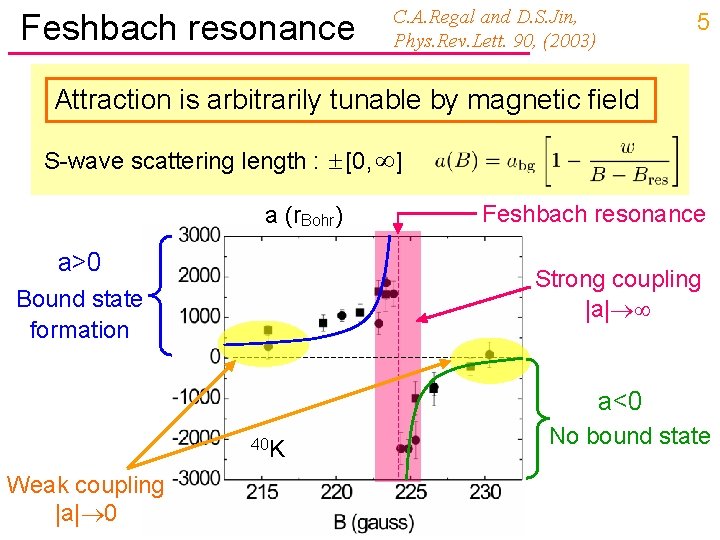
Feshbach resonance C. A. Regal and D. S. Jin, Phys. Rev. Lett. 90, (2003) 5 Attraction is arbitrarily tunable by magnetic field S-wave scattering length : [0, ] a (r. Bohr) a>0 Feshbach resonance Strong coupling |a| Bound state formation a<0 40 K Weak coupling |a| 0 No bound state
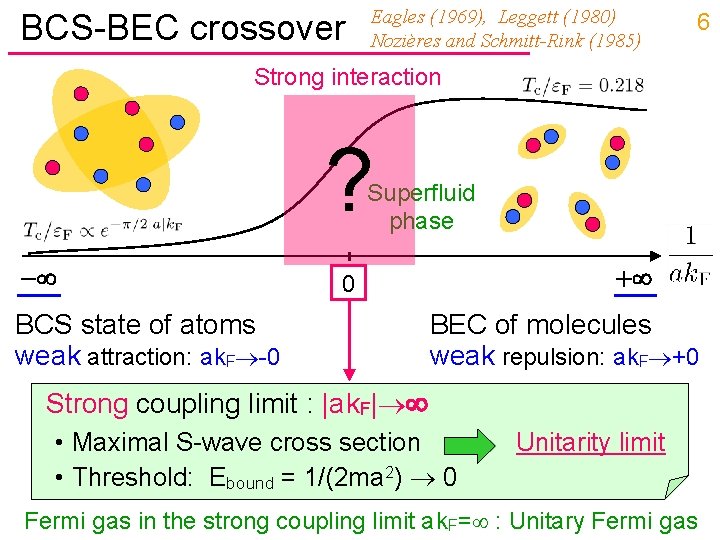
BCS-BEC crossover Eagles (1969), Leggett (1980) Nozières and Schmitt-Rink (1985) 6 Strong interaction ? Superfluid phase - + 0 BCS state of atoms weak attraction: ak. F -0 -B BEC of molecules weak repulsion: ak. F +0 Strong coupling limit : |a k. F| • Maximal S-wave cross section • Threshold: Ebound = 1/(2 ma 2) 0 Unitarity limit Fermi gas in the strong coupling limit a k. F= : Unitary Fermi gas
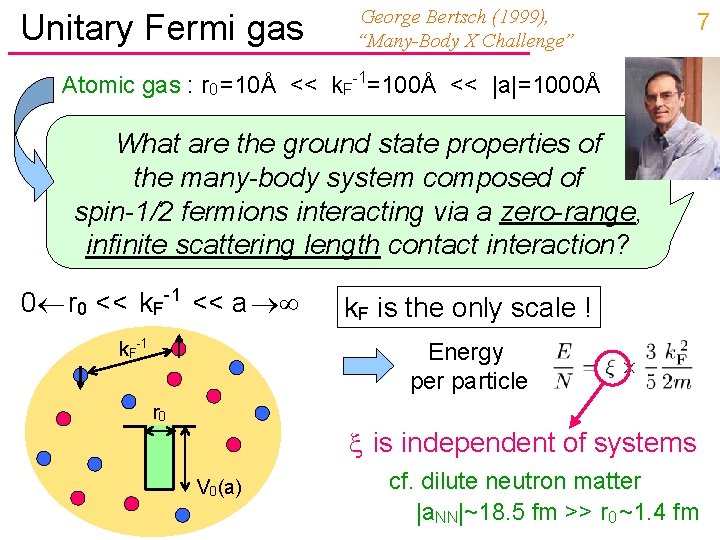
Unitary Fermi gas George Bertsch (1999), “Many-Body X Challenge” 7 Atomic gas : r 0 =10Å << k. F-1=100Å << |a|=1000Å What are the ground state properties of the many-body system composed of spin-1/2 fermions interacting via a zero-range, infinite scattering length contact interaction? 0 r 0 << k. F-1 << a k. F-1 k. F is the only scale ! Energy per particle r 0 x is independent of systems V 0(a) cf. dilute neutron matter |a. NN|~18. 5 fm >> r 0 ~1. 4 fm
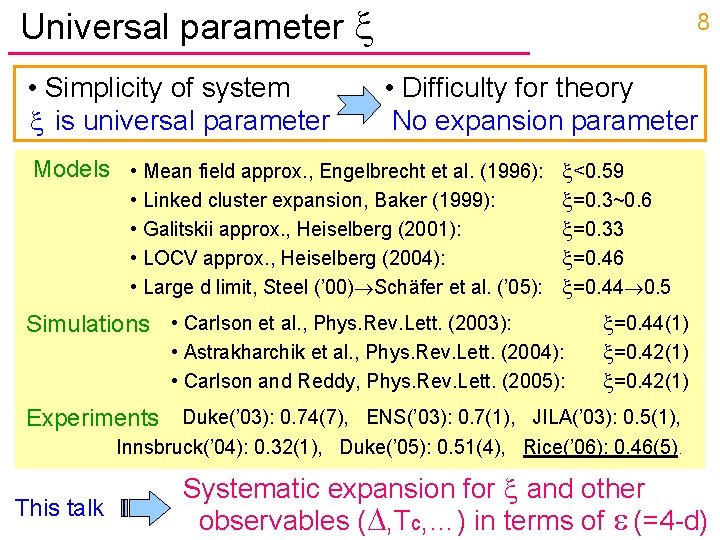
Universal parameter x • Simplicity of system x is universal parameter 8 • Difficulty for theory No expansion parameter Models • Mean field approx. , Engelbrecht et al. (1996): x<0. 59 • Linked cluster expansion, Baker (1999): • Galitskii approx. , Heiselberg (2001): • LOCV approx. , Heiselberg (2004): • Large d limit, Steel (’ 00) Schäfer et al. (’ 05): x=0. 3~0. 6 x=0. 33 x=0. 46 x=0. 44 0. 5 Simulations • Carlson et al. , Phys. Rev. Lett. (2003): • Astrakharchik et al. , Phys. Rev. Lett. (2004): • Carlson and Reddy, Phys. Rev. Lett. (2005): x=0. 44(1) x=0. 42(1) Experiments Duke(’ 03): 0. 74(7), ENS(’ 03): 0. 7(1), JILA(’ 03): 0. 5(1), Innsbruck(’ 04): 0. 32(1), Duke(’ 05): 0. 51(4), Rice(’ 06): 0. 46(5). This talk Systematic expansion for x and other observables (D, Tc, …) in terms of (=4 -d)
9 Formulation of expansion =4 -d <<1 : d=spatial dimensions
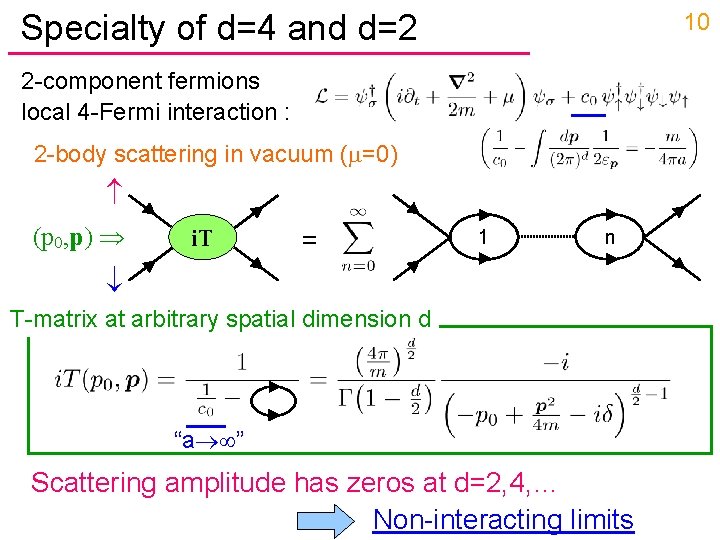
Specialty of d=4 and d=2 10 2 -component fermions local 4 -Fermi interaction : 2 -body scattering in vacuum (m=0) (p 0, p) i. T = 1 n T-matrix at arbitrary spatial dimension d “a ” Scattering amplitude has zeros at d=2, 4, … Non-interacting limits
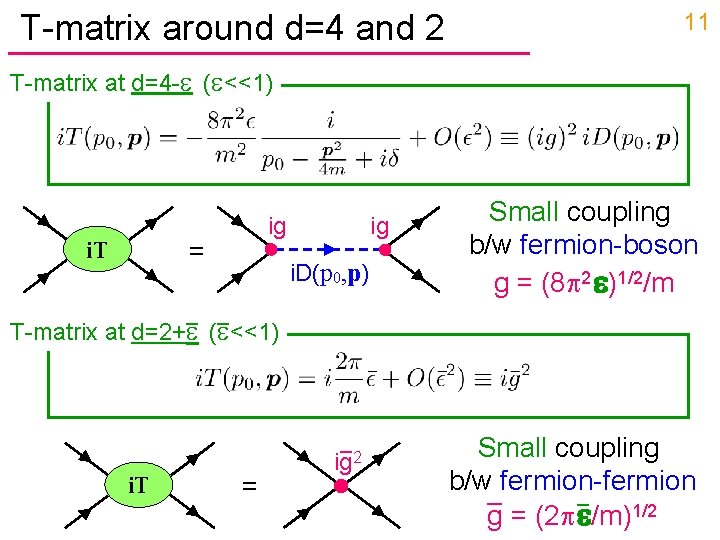
T-matrix around d=4 and 2 11 T-matrix at d=4 - ( <<1) ig = i. T ig i. D(p 0, p) Small coupling b/w fermion-boson g = (8 p 2 e)1/2/m T-matrix at d=2+ ( <<1) i. T = ig 2 Small coupling b/w fermion-fermion g = (2 p e/m)1/2
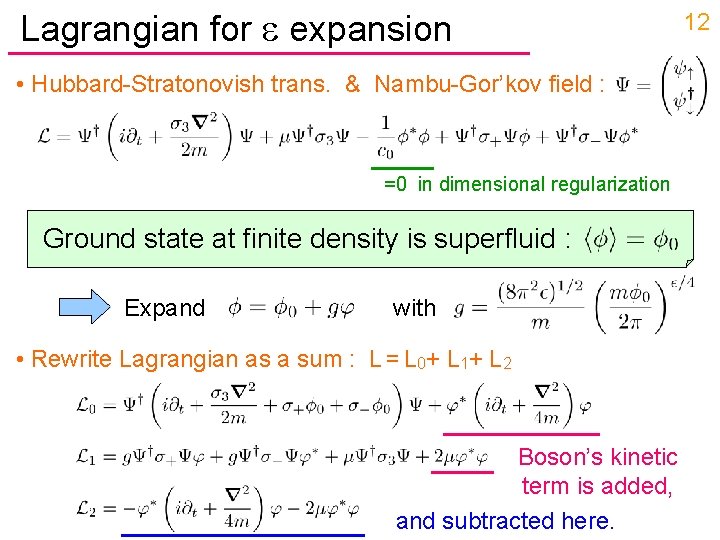
Lagrangian for expansion • Hubbard-Stratonovish trans. & Nambu-Gor’kov field : =0 in dimensional regularization Ground state at finite density is superfluid : Expand with • Rewrite Lagrangian as a sum : L = L 0+ L 1+ L 2 Boson’s kinetic term is added, and subtracted here. 12
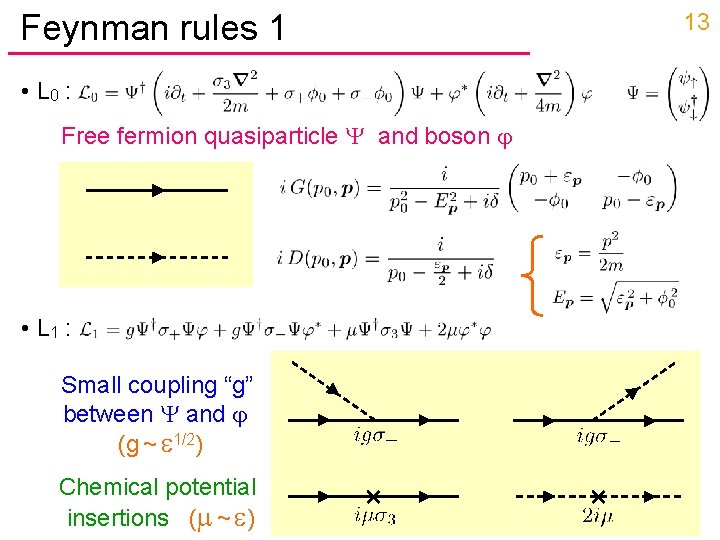
Feynman rules 1 • L 0 : Free fermion quasiparticle and boson • L 1 : Small coupling “g” between and (g ~ 1/2) Chemical potential insertions (m ~ ) 13
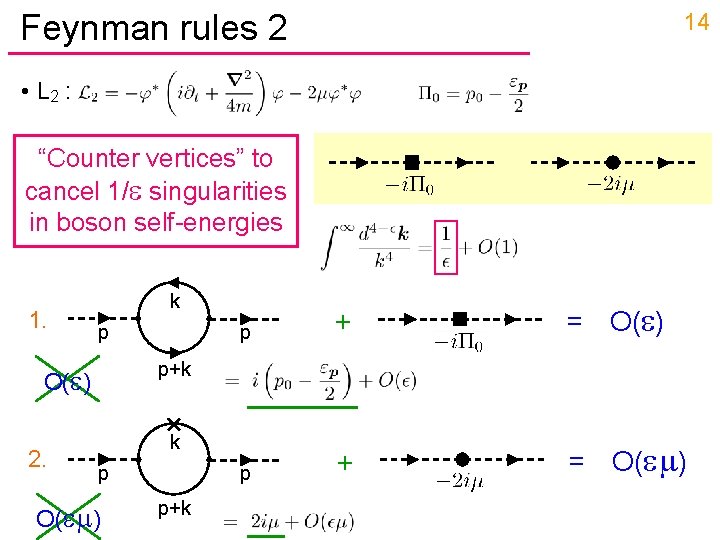
Feynman rules 2 14 • L 2 : “Counter vertices” to cancel 1/ singularities in boson self-energies 1. k p + = O( ) p + = O( m) p+k O( ) 2. p k p O( m) p+k
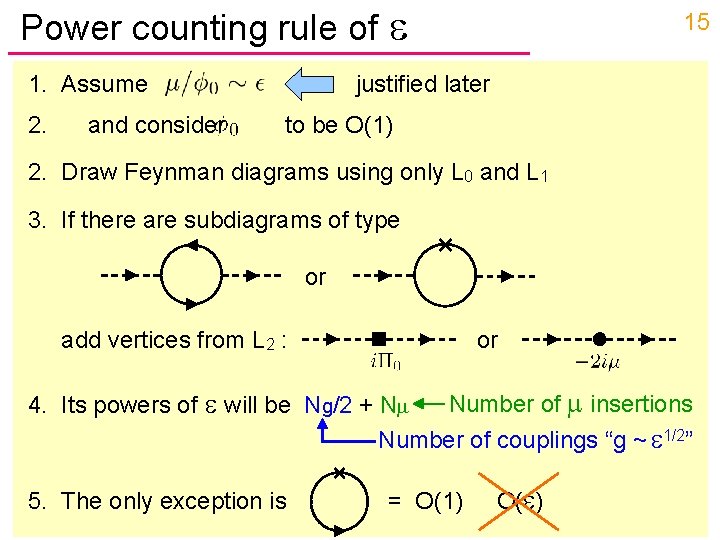
Power counting rule of 1. Assume 2. 15 justified later and consider to be O(1) 2. Draw Feynman diagrams using only L 0 and L 1 3. If there are subdiagrams of type or add vertices from L 2 : 4. Its powers of or will be Ng/2 + Nm Number of m insertions Number of couplings “g ~ 1/2” 5. The only exception is = O(1) O( )
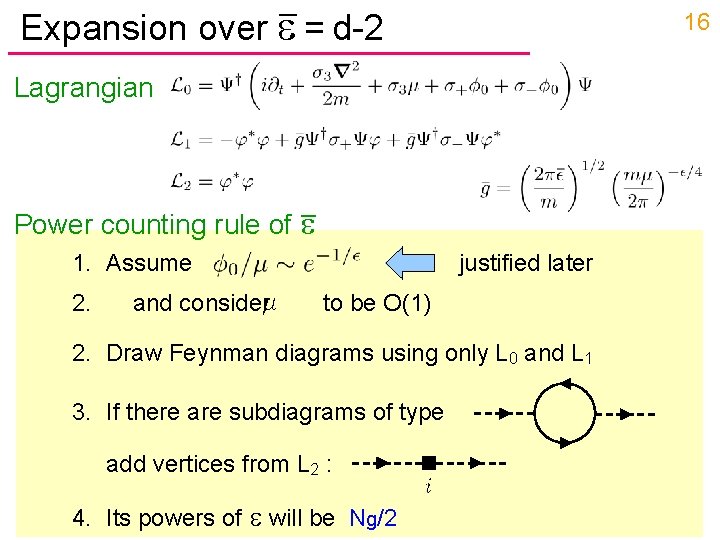
Expansion over = d-2 16 Lagrangian Power counting rule of 1. Assume 2. justified later and consider to be O(1) 2. Draw Feynman diagrams using only L 0 and L 1 3. If there are subdiagrams of type add vertices from L 2 : 4. Its powers of will be Ng/2
17 Results at zero temperature Leading and next-to-leading orders
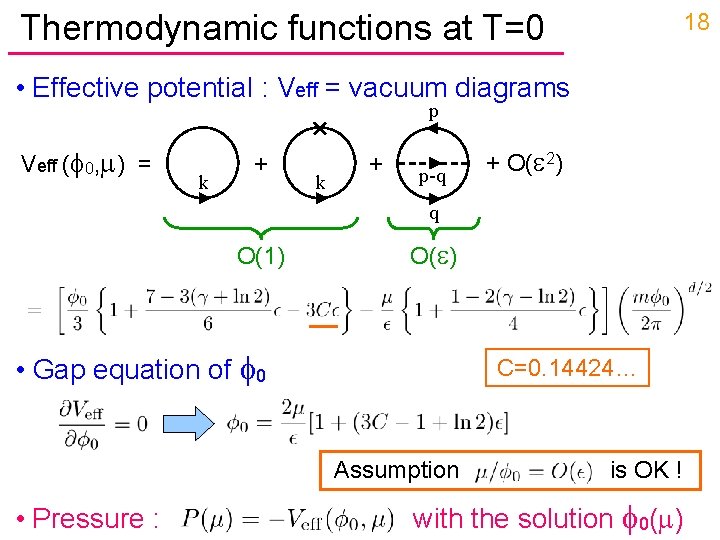
Thermodynamic functions at T=0 18 • Effective potential : Veff = vacuum diagrams p Veff ( 0, m) = k + p-q + O( 2) q O(1) O( ) • Gap equation of 0 C=0. 14424… Assumption • Pressure : is OK ! with the solution 0(m)
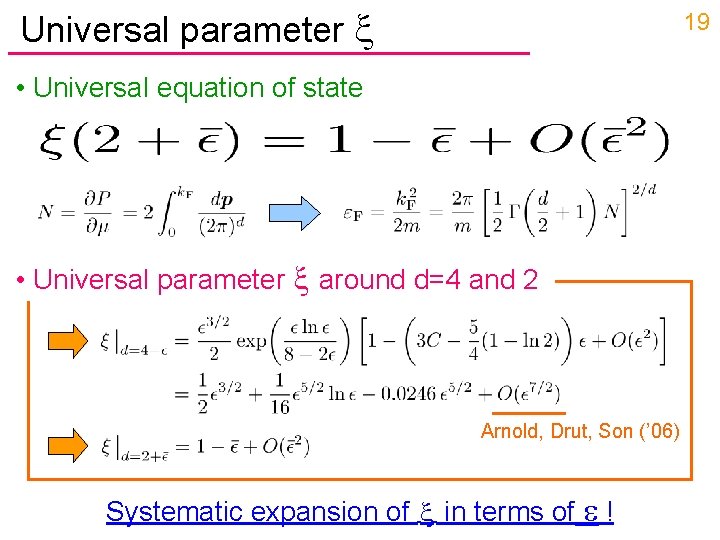
Universal parameter x 19 • Universal equation of state • Universal parameter x around d=4 and 2 Arnold, Drut, Son (’ 06) Systematic expansion of x in terms of !
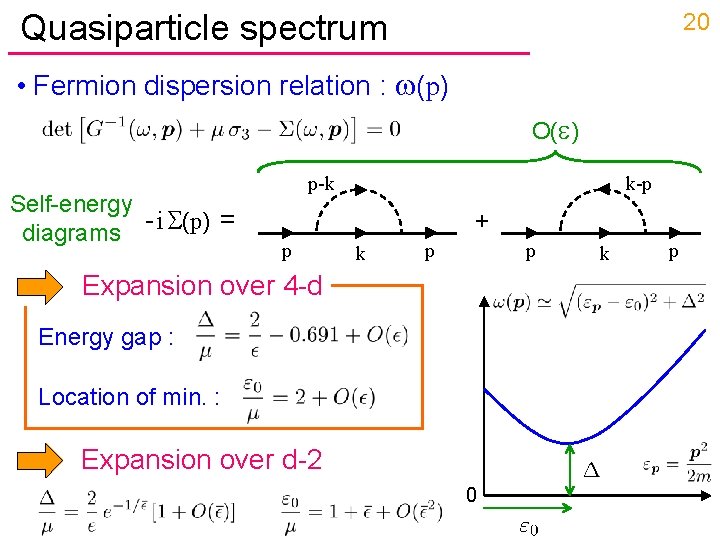
Quasiparticle spectrum 20 • Fermion dispersion relation : w(p) O( ) Self-energy - i S(p) = diagrams p-k k-p + p k p p Expansion over 4 -d Energy gap : Location of min. : Expansion over d-2 0 k p
Extrapolation to d=3 from d=4 - 21 • Keep LO & NLO results and extrapolate to =1 NLO corrections are small 5 ~ 35 % Good agreement with recent Monte Carlo data J. Carlson and S. Reddy, Phys. Rev. Lett. 95, (2005) cf. extrapolations from d=2+ NLO are 100 %
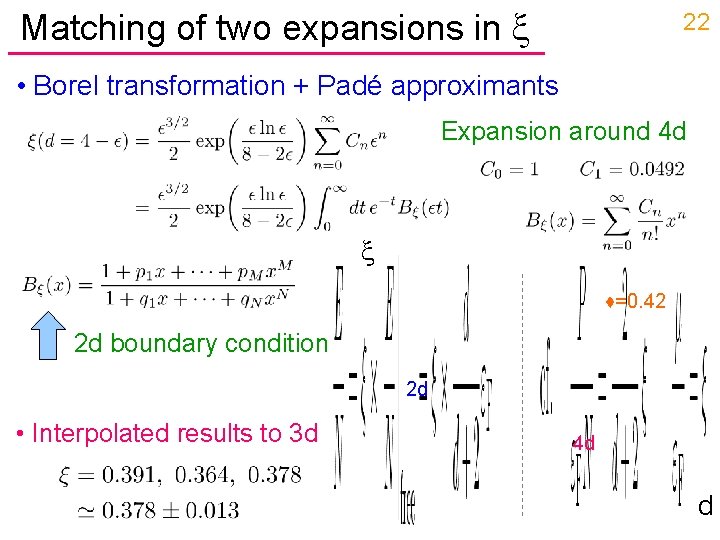
Matching of two expansions in x 22 • Borel transformation + Padé approximants Expansion around 4 d x ♦=0. 42 2 d boundary condition 2 d • Interpolated results to 3 d 4 d d
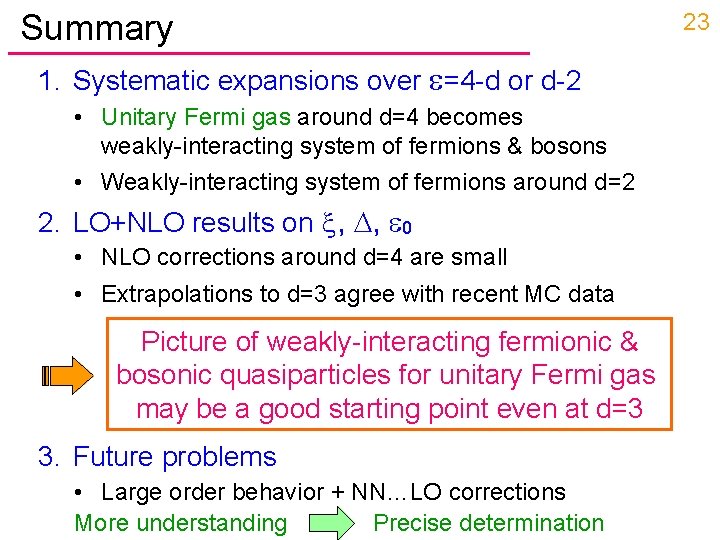
Summary 1. Systematic expansions over =4 -d or d-2 • Unitary Fermi gas around d=4 becomes weakly-interacting system of fermions & bosons • Weakly-interacting system of fermions around d=2 2. LO+NLO results on x, D, 0 • NLO corrections around d=4 are small • Extrapolations to d=3 agree with recent MC data Picture of weakly-interacting fermionic & bosonic quasiparticles for unitary Fermi gas may be a good starting point even at d=3 3. Future problems • Large order behavior + NN…LO corrections More understanding Precise determination 23
24 Back up slides
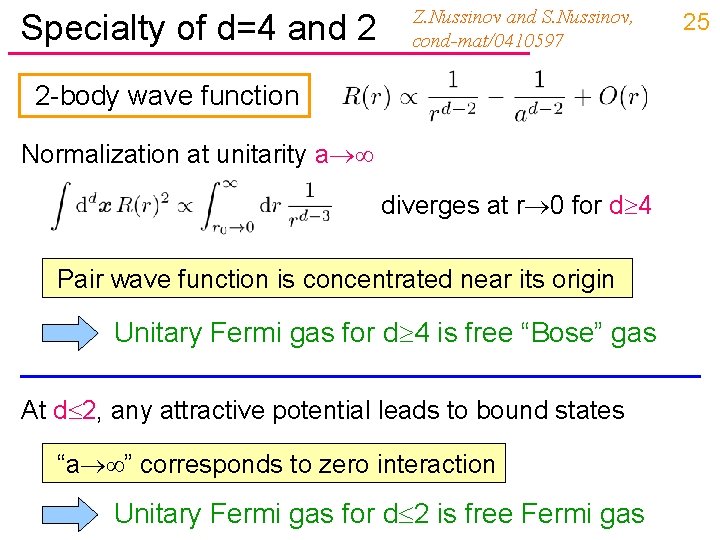
Specialty of d=4 and 2 Z. Nussinov and S. Nussinov, cond-mat/0410597 2 -body wave function Normalization at unitarity a diverges at r 0 for d 4 Pair wave function is concentrated near its origin Unitary Fermi gas for d 4 is free “Bose” gas At d 2, any attractive potential leads to bound states “a ” corresponds to zero interaction Unitary Fermi gas for d 2 is free Fermi gas 25
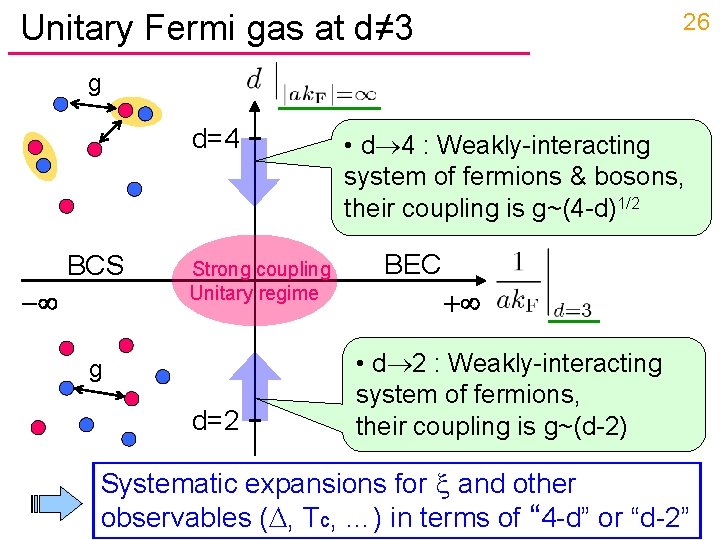
Unitary Fermi gas at d≠ 3 26 g d=4 BCS - Strong coupling Unitary regime g d=2 • d 4 : Weakly-interacting system of fermions & bosons, their coupling is g~(4 -d)1/2 BEC + • d 2 : Weakly-interacting system of fermions, their coupling is g~(d-2) Systematic expansions for x and other observables (D, Tc, …) in terms of “ 4 -d” or “d-2”
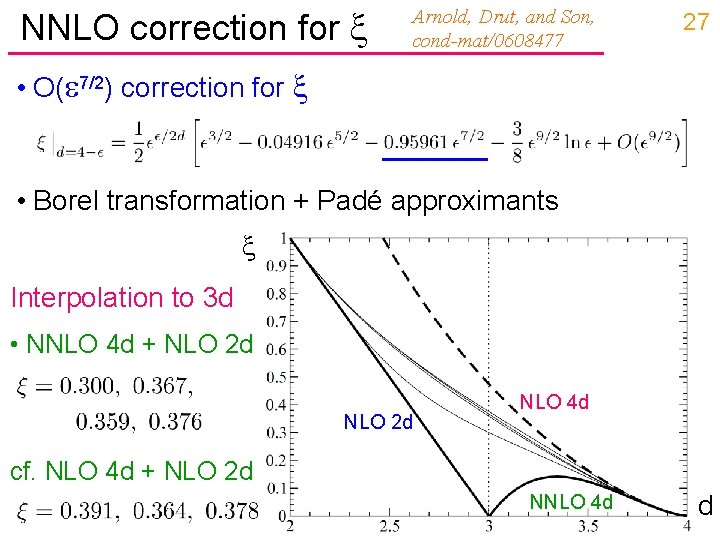
NNLO correction for x Arnold, Drut, and Son, cond-mat/0608477 27 • O( 7/2) correction for x • Borel transformation + Padé approximants x Interpolation to 3 d • NNLO 4 d + NLO 2 d NLO 4 d cf. NLO 4 d + NLO 2 d NNLO 4 d d
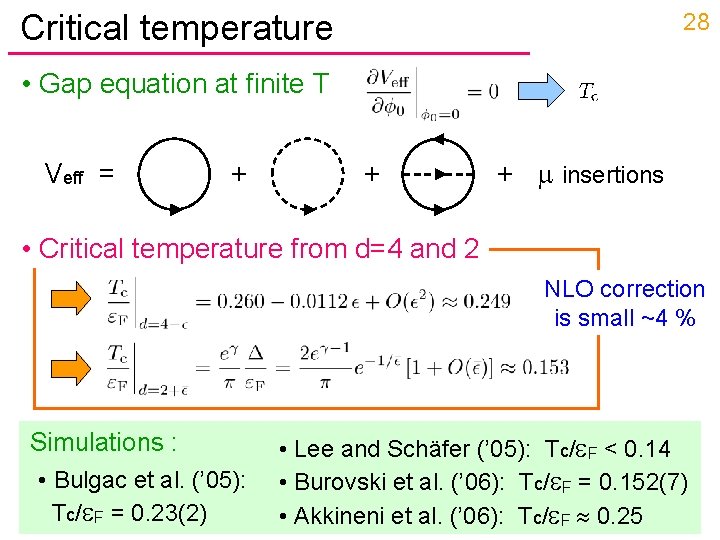
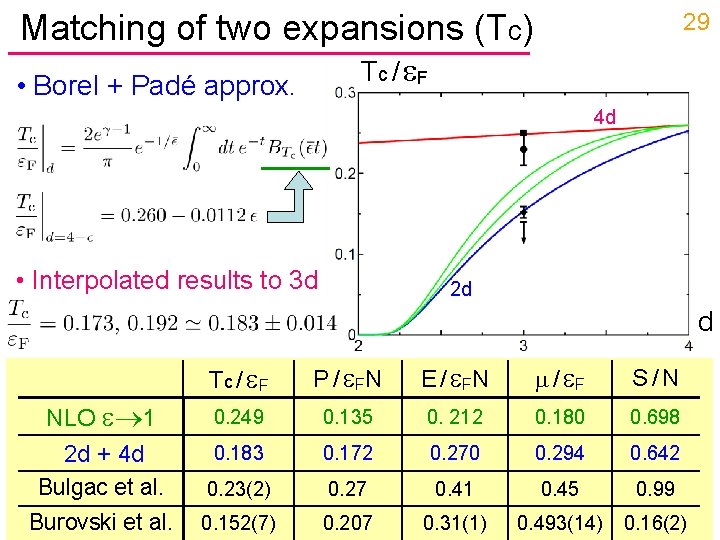
Critical temperature 28 • Gap equation at finite T Veff = + + + m insertions • Critical temperature from d=4 and 2 NLO correction is small ~4 % Simulations : • Bulgac et al. (’ 05): Tc/ F = 0. 23(2) • Lee and Schäfer (’ 05): Tc/ F < 0. 14 • Burovski et al. (’ 06): Tc/ F = 0. 152(7) • Akkineni et al. (’ 06): Tc/ F 0. 25
Matching of two expansions (Tc) 29 Tc / F • Borel + Padé approx. 4 d • Interpolated results to 3 d 2 d d NLO 1 2 d + 4 d Bulgac et al. Burovski et al. Tc / F P / FN E / FN m / F S/N 0. 249 0. 135 0. 212 0. 180 0. 698 0. 183 0. 172 0. 270 0. 294 0. 642 0. 23(2) 0. 27 0. 41 0. 45 0. 99 0. 152(7) 0. 207 0. 31(1) 0. 493(14) 0. 16(2)
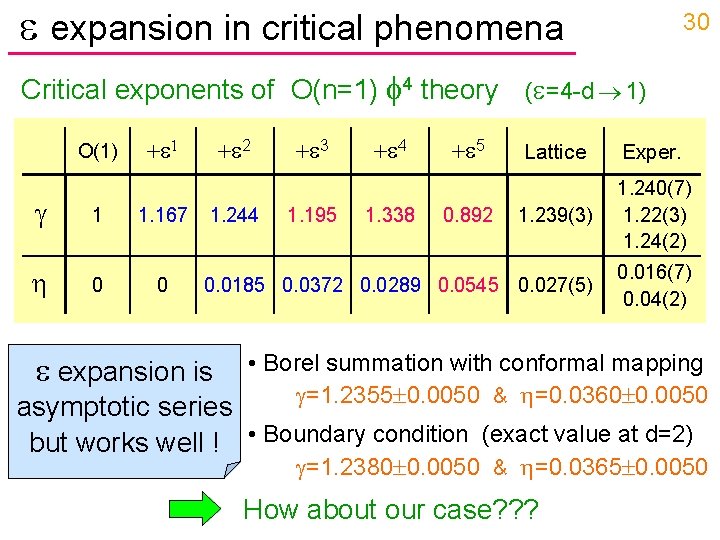
expansion in critical phenomena 30 Critical exponents of O(n=1) 4 theory ( =4 -d 1) O(1) g 1 0 + 1 1. 167 0 + 2 + 3 + 4 + 5 Lattice Exper. 1. 239(3) 1. 240(7) 1. 22(3) 1. 24(2) 0. 0185 0. 0372 0. 0289 0. 0545 0. 027(5) 0. 016(7) 0. 04(2) 1. 244 expansion is 1. 195 1. 338 0. 892 • Borel summation with conformal mapping g=1. 2355 0. 0050 & =0. 0360 0. 0050 asymptotic series but works well ! • Boundary condition (exact value at d=2) g=1. 2380 0. 0050 & =0. 0365 0. 0050 How about our case? ? ?