
Path 1 P i P f at start


- Slides: 16
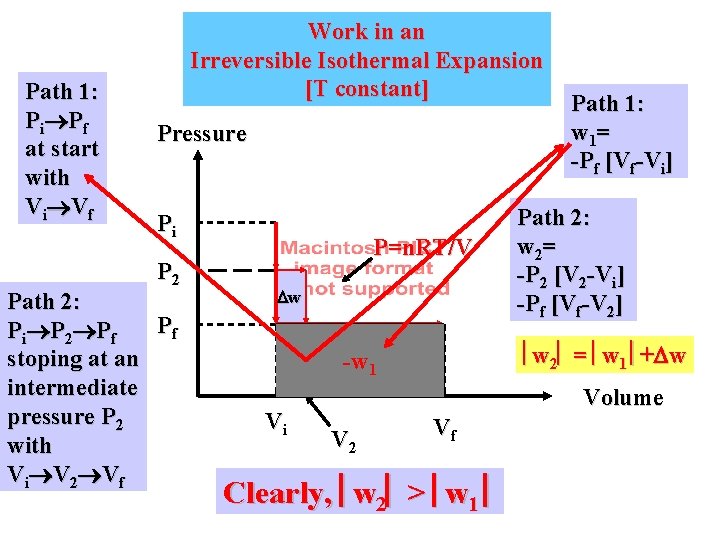
Path 1: P i P f at start with Vi Vf Work in an Irreversible Isothermal Expansion [T constant] Pressure Pi P 2 Path 2: Pf Pi P 2 Pf stoping at an intermediate pressure P 2 with Vi V 2 Vf P=n. RT/V w Path 2: w 2= -P 2 [V 2 -Vi] -Pf [Vf-V 2] w 2 = w 1 + w -w 1 Vi Path 1: w 1= -Pf [Vf-Vi] Volume V 2 Vf Clearly, w 2 > w 1
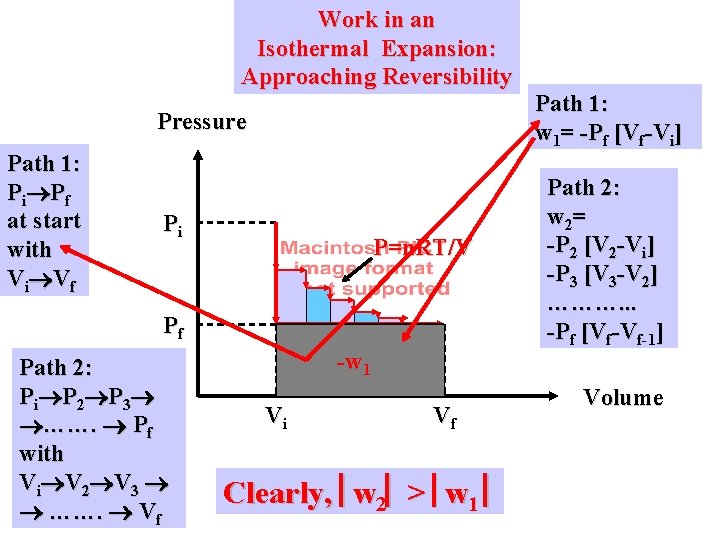
Work in an Isothermal Expansion: Approaching Reversibility Pressure Path 1: P i P f at start with Vi Vf Pi P=n. RT/V Pf Path 2: Pi P 2 P 3 ……. Pf with Vi V 2 V 3 ……. Vf -w -w 11 Vi Vf Clearly, w 2 > w 1 Path 1: w 1= -Pf [Vf-Vi] Path 2: w 2= -P 2 [V 2 -Vi] -P 3 [V 3 -V 2] ………. . . -Pf [Vf-Vf-1] Volume
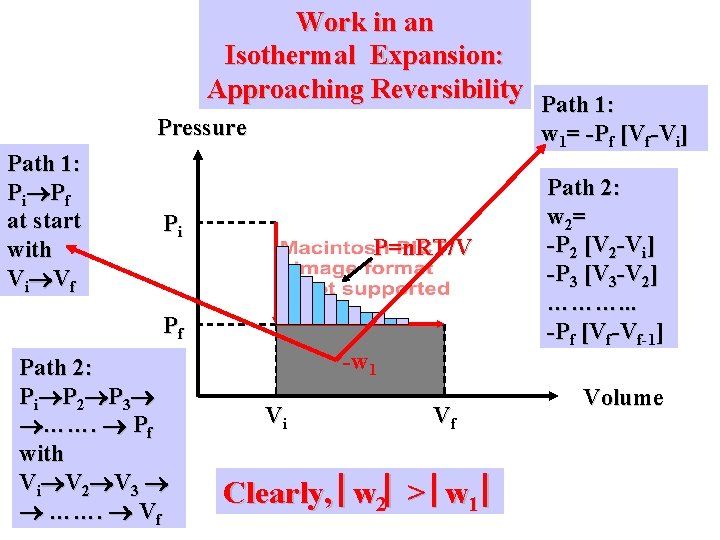
Work in an Isothermal Expansion: Approaching Reversibility Path 1: Pressure Path 1: P i P f at start with Vi Vf w 1= -Pf [Vf-Vi] Pi P=n. RT/V Pf Path 2: Pi P 2 P 3 ……. Pf with Vi V 2 V 3 ……. Vf -w 1 Vi Vf Clearly, w 2 > w 1 Path 2: w 2= -P 2 [V 2 -Vi] -P 3 [V 3 -V 2] ………. . . -Pf [Vf-Vf-1] Volume
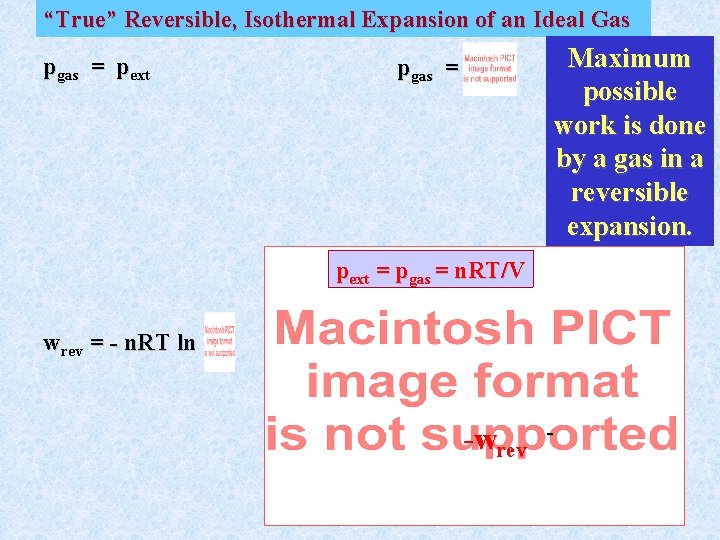
“True” Reversible, Isothermal Expansion of an Ideal Gas pgas = pext Maximum possible work is done by a gas in a reversible expansion. pgas = pext = pgas = n. RT/V wrev = - n. RT ln -wrev -
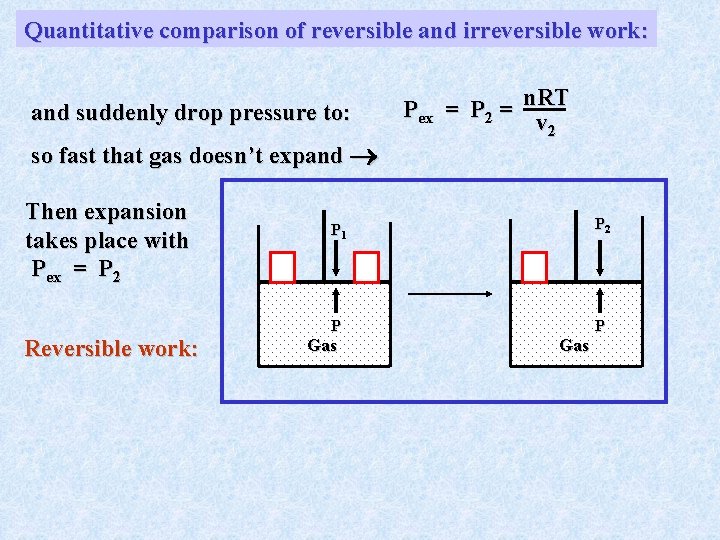
Quantitative comparison of reversible and irreversible work: and suddenly drop pressure to: so fast that gas doesn’t expand Then expansion takes place with Pex = P 2 Reversible work: Pex = P 2 = n. RT v 2 P 1 P 2 P P Gas
Bonus * Bonus * Bonus
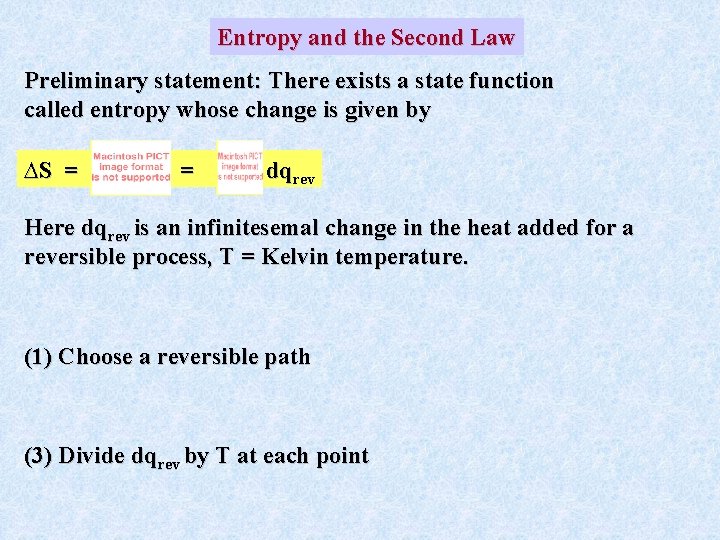
Entropy and the Second Law Preliminary statement: There exists a state function called entropy whose change is given by ∆S = = dqrev Here dqrev is an infinitesemal change in the heat added for a reversible process, T = Kelvin temperature. (1) Choose a reversible path (3) Divide dqrev by T at each point
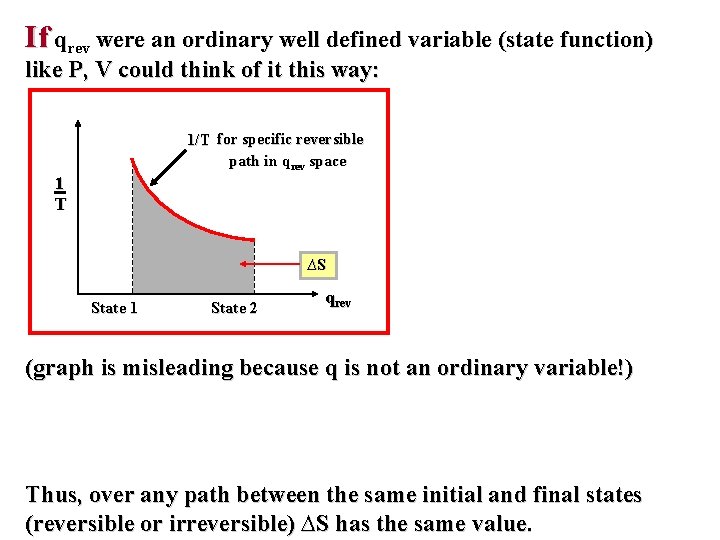
If qrev were an ordinary well defined variable (state function) like P, V could think of it this way: 1/T for specific reversible path in qrev space 1 T ∆S State 1 State 2 qrev (graph is misleading because q is not an ordinary variable!) Thus, over any path between the same initial and final states (reversible or irreversible) ∆S has the same value.
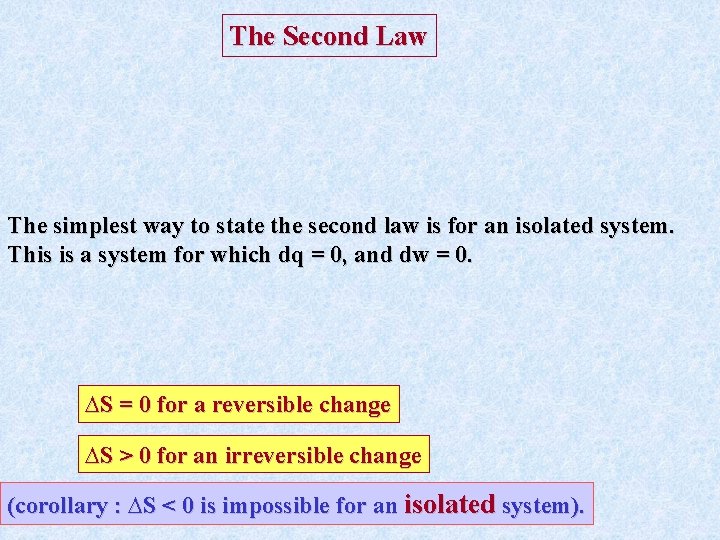
The Second Law The simplest way to state the second law is for an isolated system. This is a system for which dq = 0, and dw = 0. ∆S = 0 for a reversible change ∆S > 0 for an irreversible change (corollary : ∆S < 0 is impossible for an isolated system).
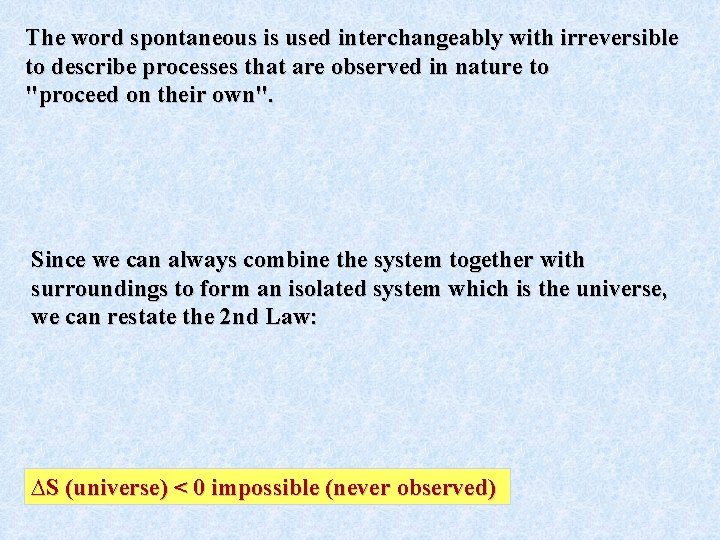
The word spontaneous is used interchangeably with irreversible to describe processes that are observed in nature to "proceed on their own". Since we can always combine the system together with surroundings to form an isolated system which is the universe, we can restate the 2 nd Law: ∆S (universe) < 0 impossible (never observed)
Entropy Calculations 1) Cardinal Rule: Can only calculate entropy change if choose a reversible path. 3) ∆S for isothermal process (reversible) T = const
dqrev = sum of heat changes over path. Total is qrev or heat added going from state 1 to 2 over reversible path. For an ideal monatomic gas E = (3/2) RT ∆E = q + w = 0 w = - q For an ideal gas, P= In a reversible process, P=Pext and V is not constant.
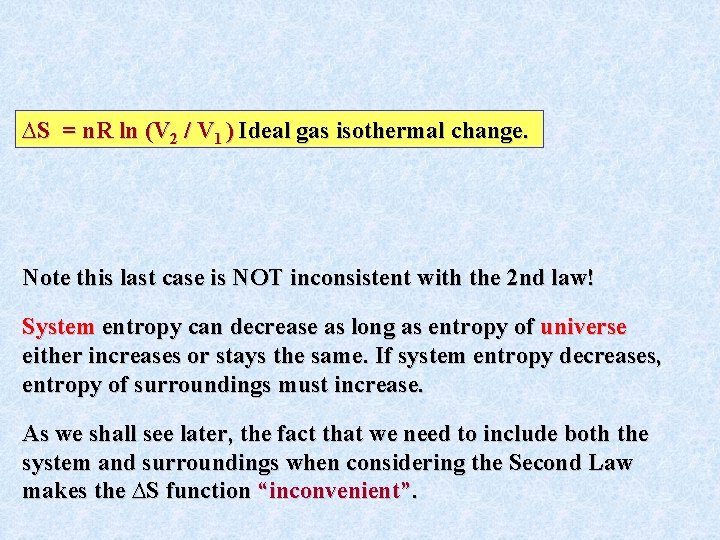
∆S = n. R ln (V 2 / V 1 ) Ideal gas isothermal change. Note this last case is NOT inconsistent with the 2 nd law! System entropy can decrease as long as entropy of universe either increases or stays the same. If system entropy decreases, entropy of surroundings must increase. As we shall see later, the fact that we need to include both the system and surroundings when considering the Second Law makes the ∆S function “inconvenient”.
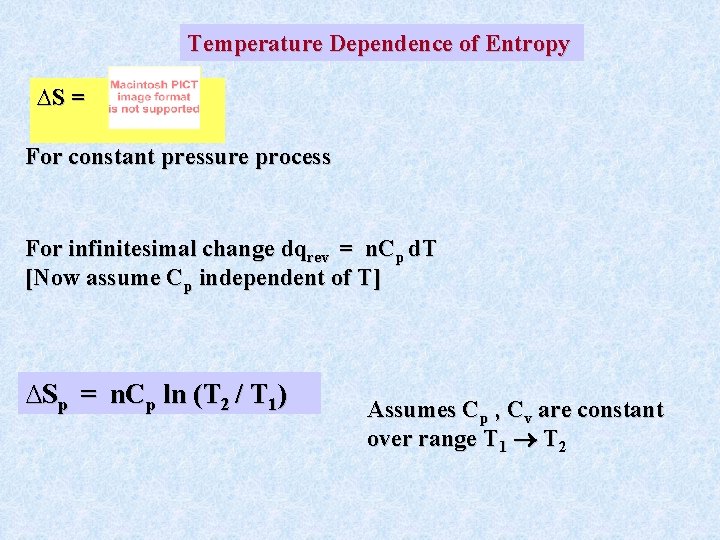
Temperature Dependence of Entropy ∆S = For constant pressure process For infinitesimal change dqrev = n. Cp d. T [Now assume Cp independent of T] ∆Sp = n. Cp ln (T 2 / T 1) Assumes Cp , Cv are constant over range T 1 T 2
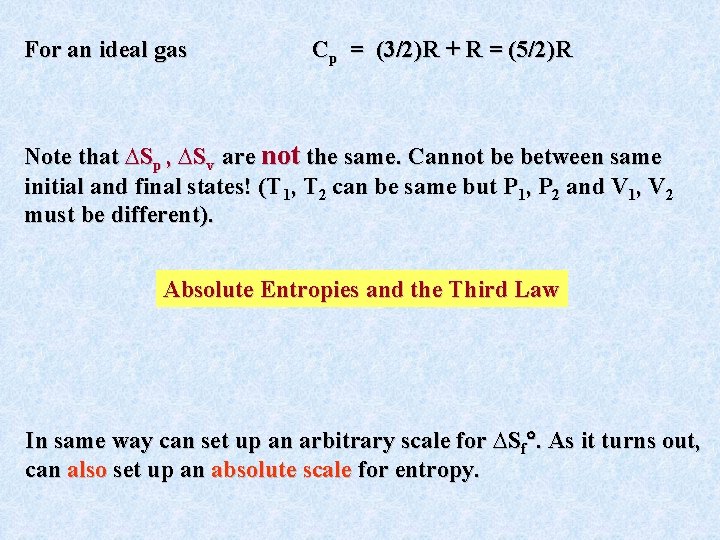
For an ideal gas Cp = (3/2)R + R = (5/2)R Note that ∆Sp , ∆Sv are not the same. Cannot be between same initial and final states! (T 1, T 2 can be same but P 1, P 2 and V 1, V 2 must be different). Absolute Entropies and the Third Law In same way can set up an arbitrary scale for ∆Sf. As it turns out, can also set up an absolute scale for entropy.
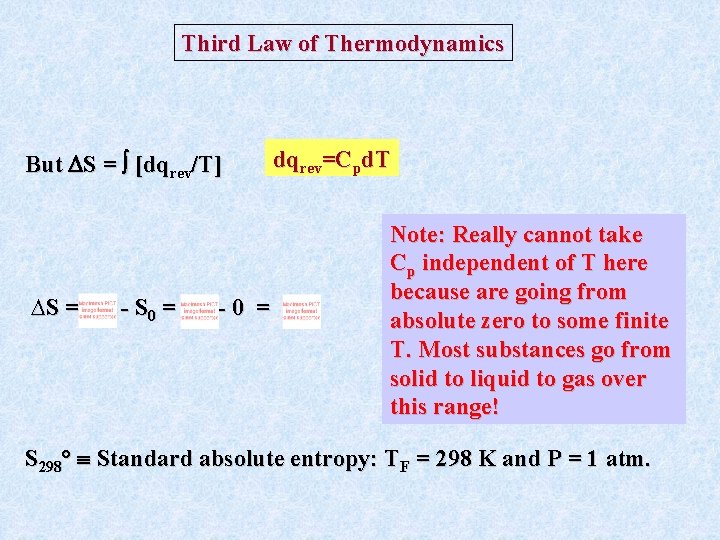
Third Law of Thermodynamics But S = [dqrev/T] ∆S = - S 0 = -0 = dqrev=Cpd. T Note: Really cannot take Cp independent of T here because are going from absolute zero to some finite T. Most substances go from solid to liquid to gas over this range! S 298° Standard absolute entropy: TF = 298 K and P = 1 atm.