Understanding and Using CONCURRENT PLANNING To Achieve Permanency

- Slides: 35
Understanding and Using CONCURRENT PLANNING To Achieve Permanency for Children and Youth ABA Conference Best Practices to Implement ASFA: Creative Strategies for Practitioners 1
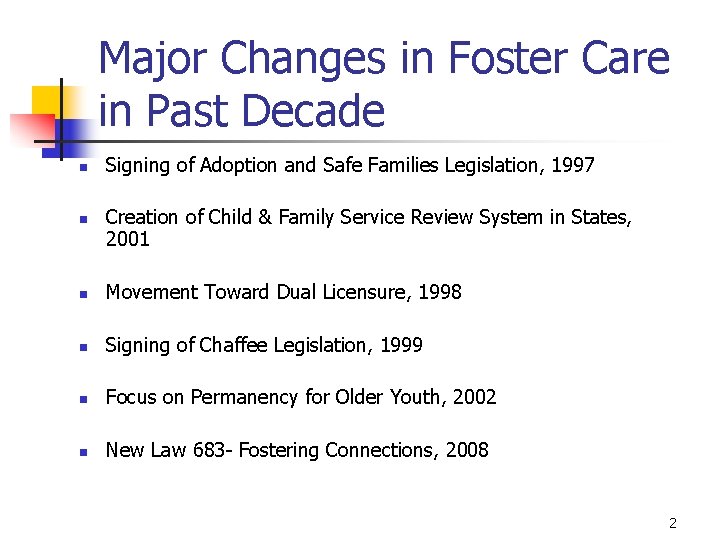
Major Changes in Foster Care in Past Decade n n Signing of Adoption and Safe Families Legislation, 1997 Creation of Child & Family Service Review System in States, 2001 n Movement Toward Dual Licensure, 1998 n Signing of Chaffee Legislation, 1999 n Focus on Permanency for Older Youth, 2002 n New Law 683 - Fostering Connections, 2008 2
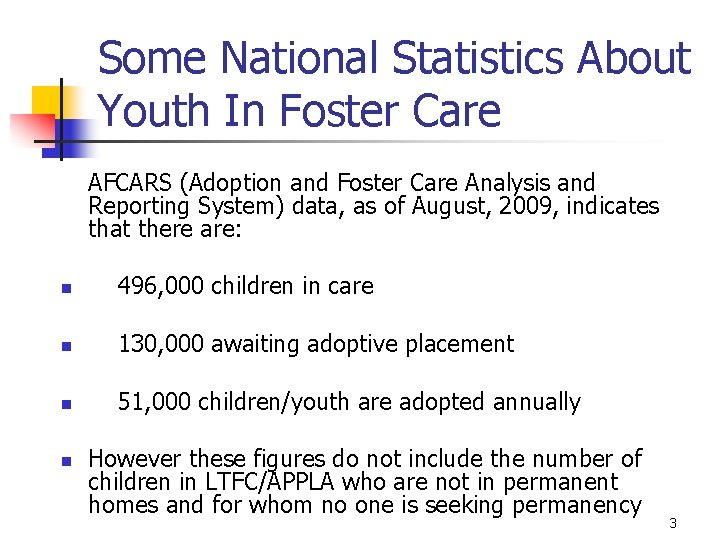
Some National Statistics About Youth In Foster Care AFCARS (Adoption and Foster Care Analysis and Reporting System) data, as of August, 2009, indicates that there are: n 496, 000 children in care n 130, 000 awaiting adoptive placement n 51, 000 children/youth are adopted annually n However these figures do not include the number of children in LTFC/APPLA who are not in permanent homes and for whom no one is seeking permanency 3
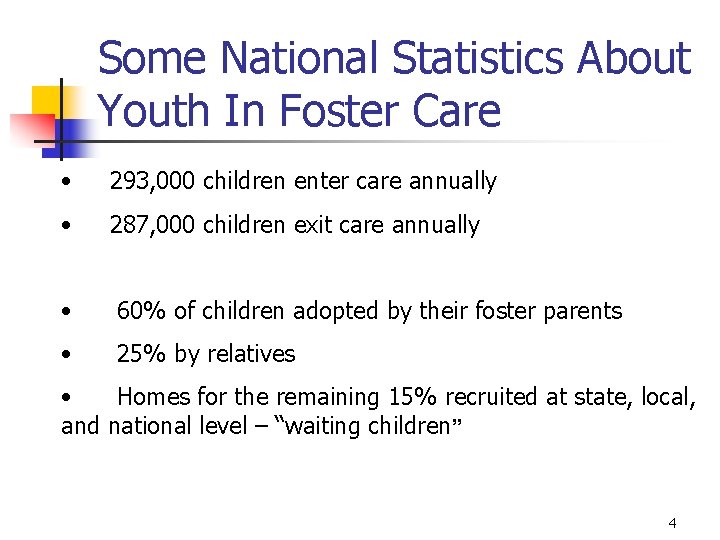
Some National Statistics About Youth In Foster Care • 293, 000 children enter care annually • 287, 000 children exit care annually • 60% of children adopted by their foster parents • 25% by relatives • Homes for the remaining 15% recruited at state, local, and national level – “waiting children” 4
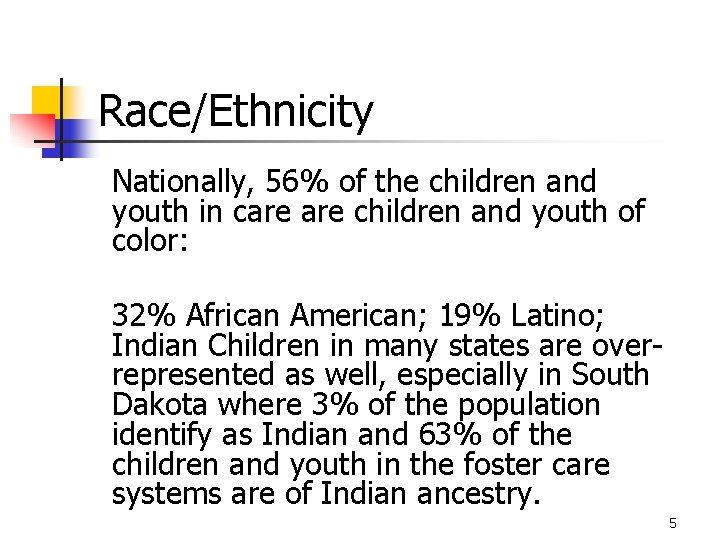
Race/Ethnicity Nationally, 56% of the children and youth in care children and youth of color: 32% African American; 19% Latino; Indian Children in many states are overrepresented as well, especially in South Dakota where 3% of the population identify as Indian and 63% of the children and youth in the foster care systems are of Indian ancestry. 5
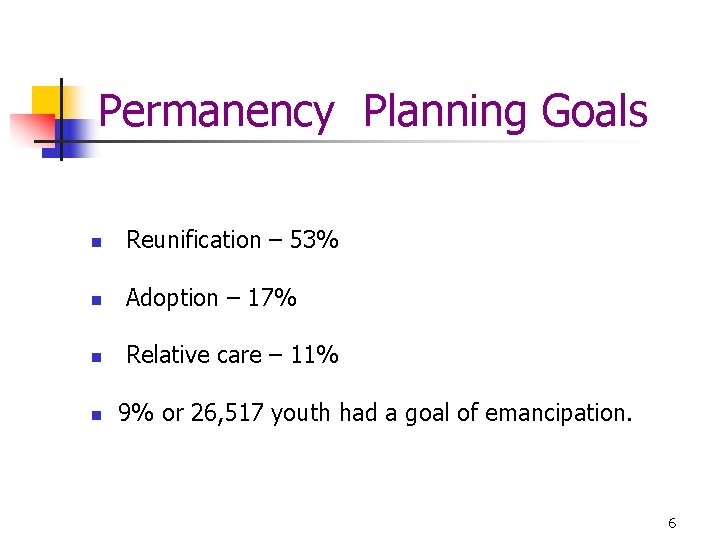
Permanency Planning Goals n Reunification – 53% n Adoption – 17% n Relative care – 11% n 9% or 26, 517 youth had a goal of emancipation. 6
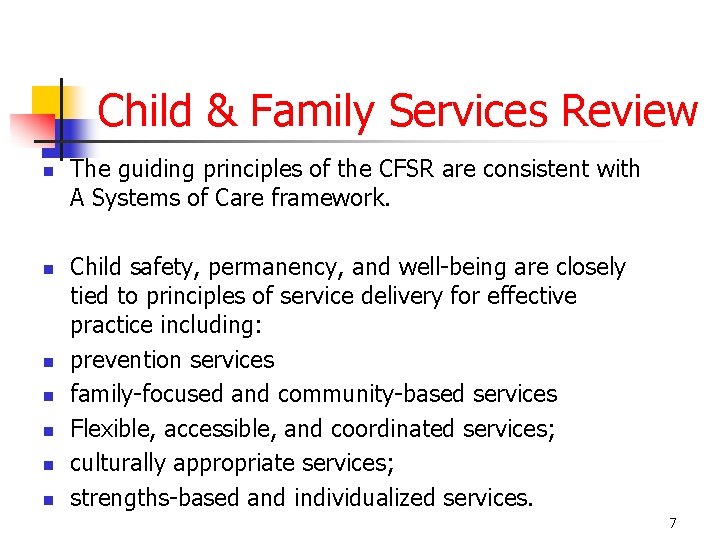
Child & Family Services Review n n n n The guiding principles of the CFSR are consistent with A Systems of Care framework. Child safety, permanency, and well-being are closely tied to principles of service delivery for effective practice including: prevention services family-focused and community-based services Flexible, accessible, and coordinated services; culturally appropriate services; strengths-based and individualized services. 7
Defining Permanency Permanence is not a philosophical process, a plan, or a foster care placement, nor is it intended to be a family relationship that lasts only until the child turns age 18. 8
Defining Permanency Permanence is about locating and supporting a lifetime family. For young people in out-of home placement, planning for permanence should begin at entry into care, and be youth-driven, family-focused, culturally competent, continuous, and approached with the highest degree of urgency. 9
Defining Permanency Child welfare agencies, in partnership with the larger community, have a moral and professional responsibility to find a permanent family relationship for each child and young person in foster care. 10
Defining Permanency Permanence should bring physical, legal and emotional safety and security within the context of a family relationship and allow multiple relationships with a variety of caring adults. 11
Defining Permanency Permanence is achieved with a family relationship that offers safe, stable, and committed parenting, unconditional love and lifelong support, and legal family membership status. 12
Defining Permanency Permanence can be the result of preservation of the family, reunification with birth family; or legal guardianship or adoption by kin, fictive kin, or other caring and committed adults. 13
Definition of Concurrent Planning n n To work towards family reunification while, at the same time, developing an alternative permanent plan. Concurrent rather than sequential planning. It involves a mix of family centered casework and legal strategies aimed at achieving timely reunification, while at the same time establishing a concurrent permanency plan if reunification cannot be accomplished. It is not a fast track to adoption, but to permanency 14
Pathways to Permanency for Youth n Youth are reunified safely with their parents or relatives n Youth are adopted by relatives or other families n Youth permanently reside with relatives or other families as legal guardians n Youth are connected to permanent resources via fictive kinship or customary adoption networks n Youth are safely placed in another planned alternative permanent living arrangement which is closely reviewed for appropriateness every six months 15
Goals of Concurrent Planning n n promote safety, permanency, wellbeing of children; achieve early permanency; reduce # of moves; continue significant relationships 16
Goals of Concurrent Planning q q q To develop a network of foster parents (relatives and non-relatives) who can work toward reunification and also serve as permanency resource families for children and youth To engage families in early case planning, case review, and decision-making about the array of permanency options to meet children and youth’s urgent need for stability and continuity in their family relationships To maintain continuity in children’ and Youth’s family, siblings, and community relationships 17
Why Concurrent Planning Now? n n Children are spending too much time in foster care Response to Adoption Assistance and Child Welfare Act of 1980 – PL: 96 -272 Response to Adoption and Safe Families Act of 1997 ASFA Major strategy used for child welfare agencies to meet National Outcomes and Performance Standards (Children and Family Service Reviews) 18
Success Redefined n Permanency is the Goal. Reunification is a primary but only one of several acceptable permanency goals. n 19
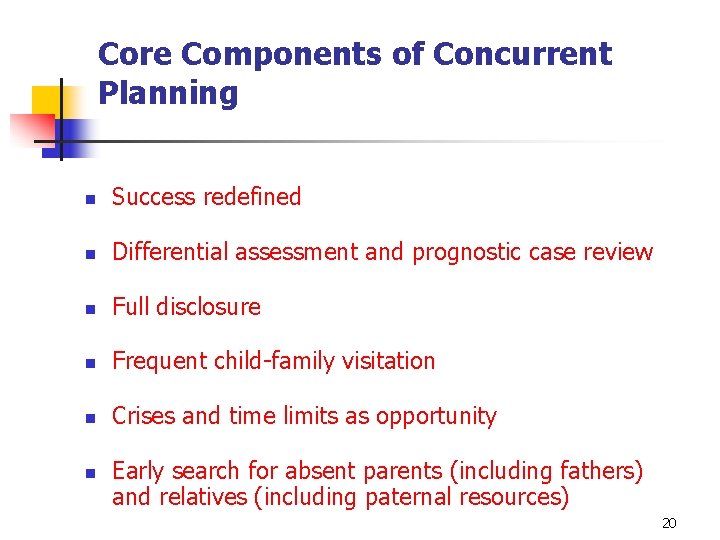
Core Components of Concurrent Planning n Success redefined n Differential assessment and prognostic case review n Full disclosure n Frequent child-family visitation n Crises and time limits as opportunity n Early search for absent parents (including fathers) and relatives (including paternal resources) 20
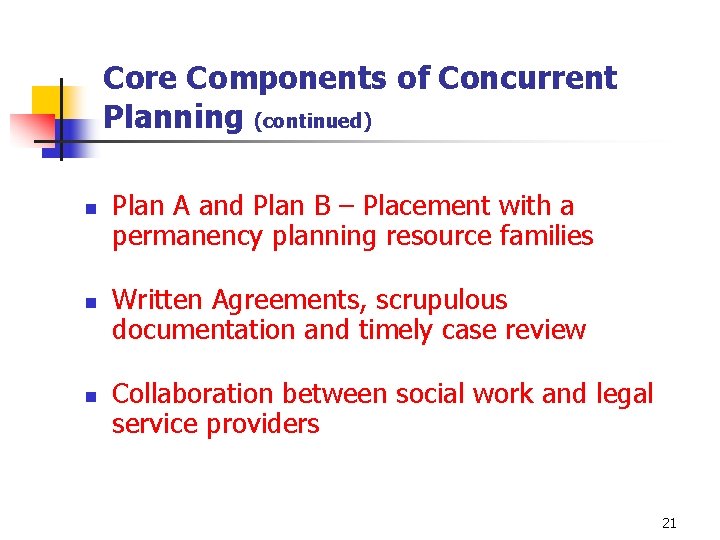
Core Components of Concurrent Planning (continued) n n n Plan A and Plan B – Placement with a permanency planning resource families Written Agreements, scrupulous documentation and timely case review Collaboration between social work and legal service providers 21
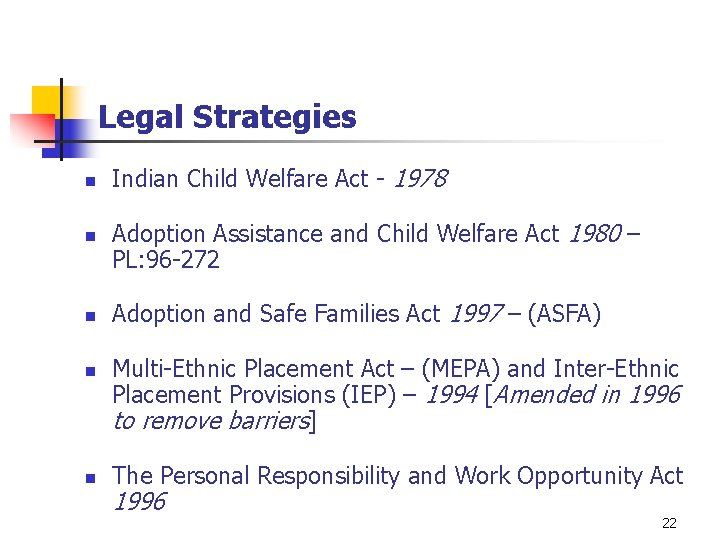
Legal Strategies n n n Indian Child Welfare Act - 1978 Adoption Assistance and Child Welfare Act 1980 – PL: 96 -272 Adoption and Safe Families Act 1997 – (ASFA) Multi-Ethnic Placement Act – (MEPA) and Inter-Ethnic Placement Provisions (IEP) – 1994 [Amended in 1996 to remove barriers] The Personal Responsibility and Work Opportunity Act 1996 22
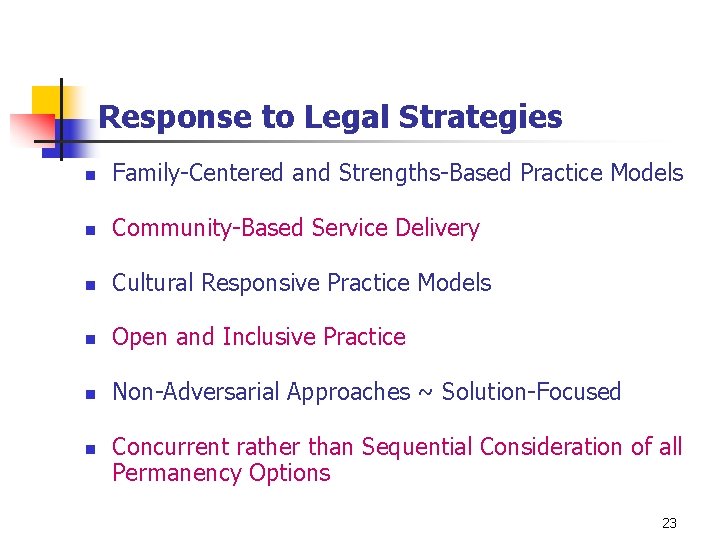
Response to Legal Strategies n Family-Centered and Strengths-Based Practice Models n Community-Based Service Delivery n Cultural Responsive Practice Models n Open and Inclusive Practice n Non-Adversarial Approaches ~ Solution-Focused n Concurrent rather than Sequential Consideration of all Permanency Options 23
Principles of Strengths/Needs Based Practice n n n Children belong in families, and need nurturing relationship with adults Children should be helped to stay with (or return to) their families People can change with the right services, education and supports Families (biological, foster and adoptive) should be viewed as partners Foster care and other placements used for family support 24
Principles of Strengths/Needs Based Practice n n n Child’s attachment needs can be addressed through strengthening family resources Comprehensive and individualized services focused on family empowerment – considering family strengths and underlying needs in developing individualized family service plans Culturally responsive services 25
Differential Assessment Is a Process of: n Individualizing our understanding of the individual, family, or group in the context of their present circumstances, past experiences, and potential for future functioning n Deepening our family-centered understanding of the child in the context of their family, culture, and community n Strengthening our understanding of the personal, interpersonal, and environmental context in which children and families live and interact. 26
Differential Assessment (continued) • Engaging families in culturally competent, early comprehensive assessments, case planning and services needed to achieve timely permanency – reunification or an alternative plan b • Engaging in a “Differential Prognostic Assessment” process to identify family situations in which a concurrent permanency plan/placement with a resource family is needed. 27
Differential Assessment (continued) • Using the crisis of placement as a motivator to engage families in case planning and to make behavioral changes. • Increasing birth and foster parent partnerships in case planning 28
Differential Assessment (continued) • Recruiting, training, and supporting permanency planning resource families in addition to other types of foster families. • Engaging in discussions with foster families about the need for a concurrent permanency plan and their interest in serving as a back-up permanency resource for children who may not return to their birth parents. 29
Differential Assessment (continued) • Identifying relatives and tribal resources who can be placement/permanency resources early on in the case planning process. • Respectfully using full disclosure with birth families and foster/adoptive families throughout the life of the case. 30
Differential Assessment (continued) • Collaborating with courts, attorneys, and service providers to better serve children and families. • Determining when to pursue the alternative permanency plan such as adoption or guardianship when it is clear the parent(s) can not or will not care for their children. 31
Benefits To the child n n Reduced placements Earlier permanency through reunification or other permanency option To the Parent n n n Creates sense of urgency Parent benefits from early accessible services outcome is determined by parent. When outcome is not reunification, lays the groundwork for openness with permanent caregiver 32
Current Challenges n n n Decision-Making when child is placed early and attached to non related caregiver and relative requests placement Foster Parents intervening when reunification planning occurs Continued training needs: staff turnover 33
Reflections n n n Consider and normalize the language in concurrent planning, i. e. assessment, backup plan, resource foster families Collaborating with courts, attorneys, and service providers to better serve children and families Determining when to pursue the alternative permanency plan such as adoption or guardianship when it is clear the parent(s) can not or will not care for their children. Early Potentially Permanent Kinship Placements Use concurrent planning for all forms of permanency, not only adoption 34
Gerald P. Mallon, DSW Professor and Executive Director National Resource Center for Family Centered Practice and Permanency Planning at the Hunter College School of Social Work A Service of the Children’s BureauACFDHHS 129 East 79 th Street, Suite 801 New York, New York 10075 (212) 452 -7043 – Private line (212) 452 -7051 - fax gmallon@hunter. cuny. edu - Email www. nrcfcppp. org 35