
Permanency and Normalcy What disability rights advocates need
Permanency and Normalcy What disability rights advocates need to know about the child welfare system Natane Eaddy and Lisa Swaminathan May 18, 2017
Today’s Agenda Introduction • Purpose of webinar Child Welfare 101 • Basics of the child welfare system Normalcy • What is it? • Barriers to achieving normalcy • Strategies for supporting and informing normalcy efforts Permanency • What is it? • Barriers to achieving permanency • Strategies for supporting and informing permanency efforts 2
Who We Are Lisa Natane 3
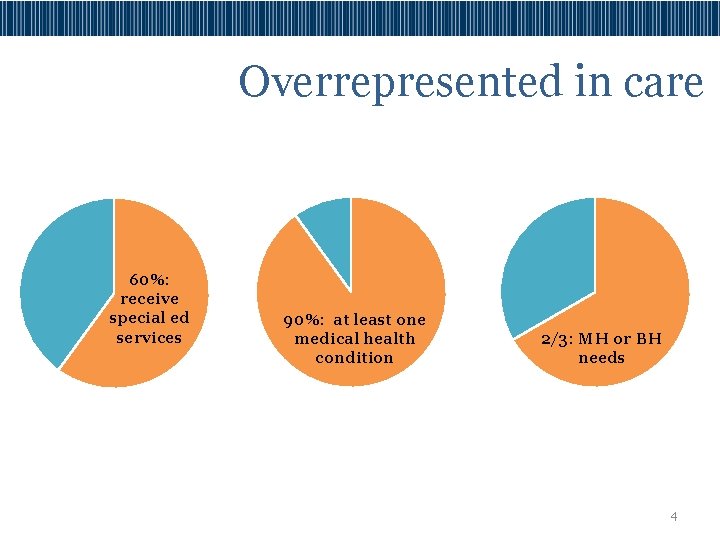
Overrepresented in care 60%: receive special ed services 90%: at least one medical health condition 2/3: MH or BH needs 4
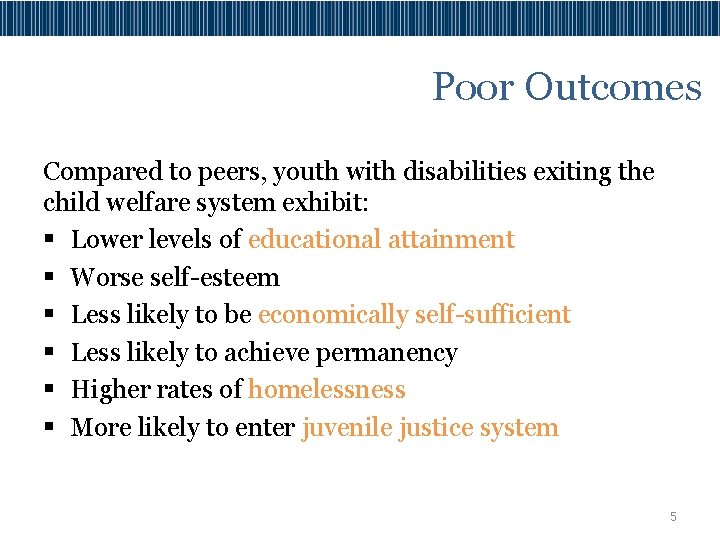
Poor Outcomes Compared to peers, youth with disabilities exiting the child welfare system exhibit: § Lower levels of educational attainment § Worse self-esteem § Less likely to be economically self-sufficient § Less likely to achieve permanency § Higher rates of homelessness § More likely to enter juvenile justice system 5
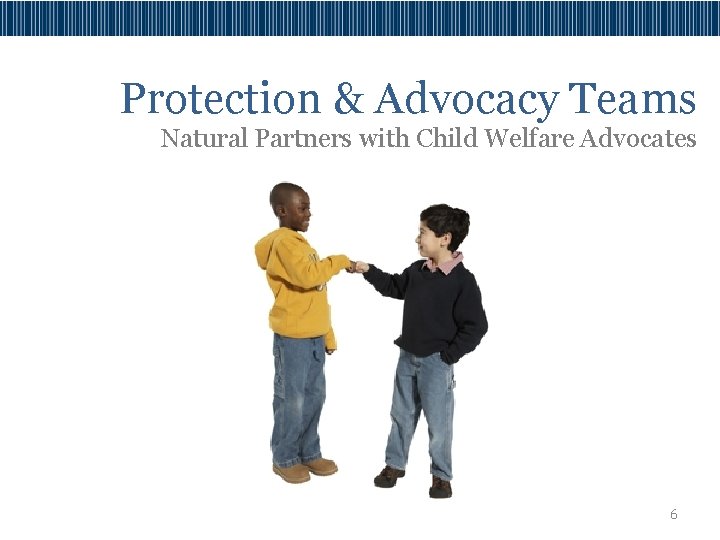
Protection & Advocacy Teams Natural Partners with Child Welfare Advocates 6
Today’s Agenda Introduction • Purpose of webinar Child Welfare 101 • Basics of the child welfare system Normalcy • What is it? • Barriers to achieving normalcy • Strategies for supporting and informing normalcy efforts Permanency • What is it? • Barriers to achieving permanency • Strategies for supporting and informing permanency efforts 7
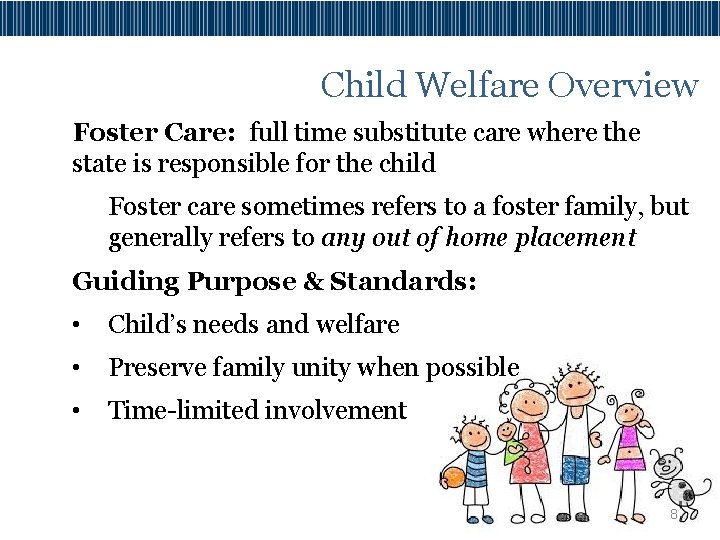
Child Welfare Overview Foster Care: full time substitute care where the state is responsible for the child Foster care sometimes refers to a foster family, but generally refers to any out of home placement Guiding Purpose & Standards: • Child’s needs and welfare • Preserve family unity when possible • Time-limited involvement 8
The Child § Child is central to proceeding § Represented by some adult advocate o Guardian ad litem (GAL)/Attorney ad litem (AAL) o Client-directed counsel o Court appointed special advocate (CASA) 9
The State § Department of social services, public welfare, human services, or child and family services – sometimes referred to as the “Department” or the “Agency” § Department/Agency contracts with private child welfare agencies and community-based organizations to provide services to children and families § Role: o Investigate reports of possible child abuse and neglect o Provide services to families that need assistance in the protection and care of their children o Take custody of children who cannot safely live at home o Develop and execute permanency plans for children in their custody 10
The Parent § May or may not have custody of child § May retain rights to make decisions on child’s behalf § All rights may be terminated 11
How Children Enter Child Welfare System § Child maltreatment § Harm that parent does not or cannot prevent § Absence of parents § Delinquent behavior or juvenile status offense (very young) 12
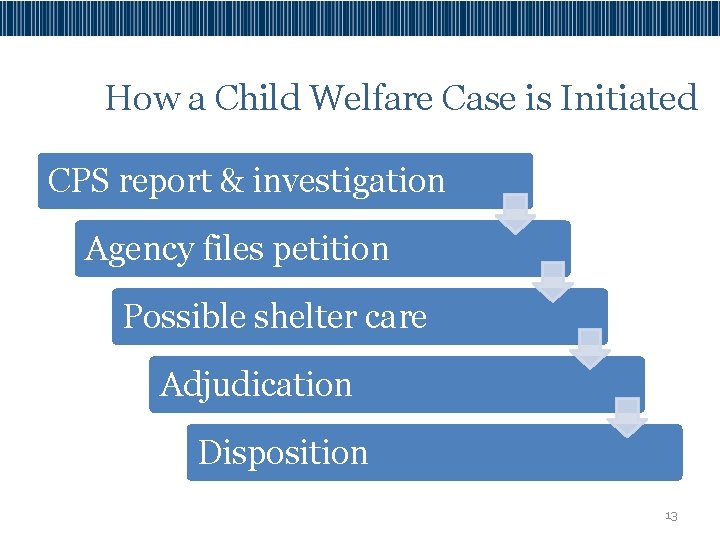
How a Child Welfare Case is Initiated CPS report & investigation Agency files petition Possible shelter care Adjudication Disposition 13
Case Planning Requirements § Must be in writing § Updated every 6 months § Generally created when child is placed in care, case is opened for services, or child is adjudicated dependent § Components include: o Health care planning o Placement planning o Permanency planning o Transition planning 14
Meeting Health Care Needs § States must meet health care needs, including mental health, of youth in care § Case plan must include child’s health records § Fostering Connections imposes specific requirements for individualized health care plan 15
Placement and Service Obligations § Family: Placement should be “a safe setting that is the least restrictive (most family like) and most appropriate setting available. ” § Youth-Centered: Services should be provided to find a placement resource who is skilled in meeting the youth’s needs. § Community: Services should be provided to meet treatment needs in the community based setting. 16
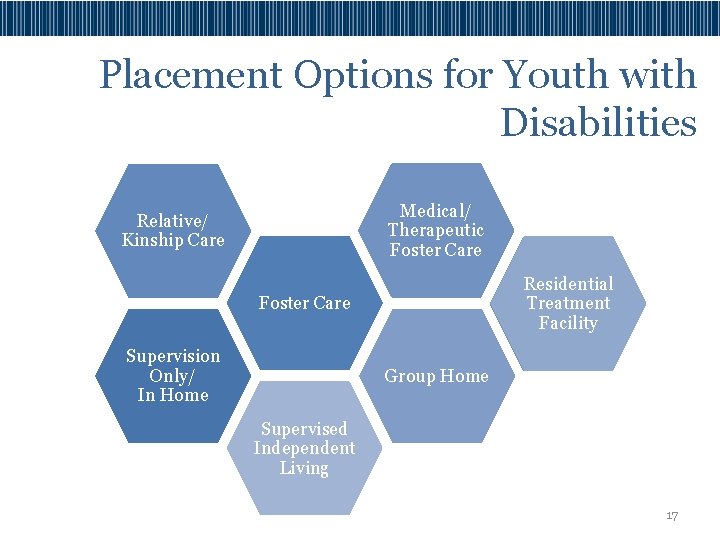
Placement Options for Youth with Disabilities Medical/ Therapeutic Foster Care Relative/ Kinship Care Residential Treatment Facility Foster Care Supervision Only/ In Home Group Home Supervised Independent Living 17
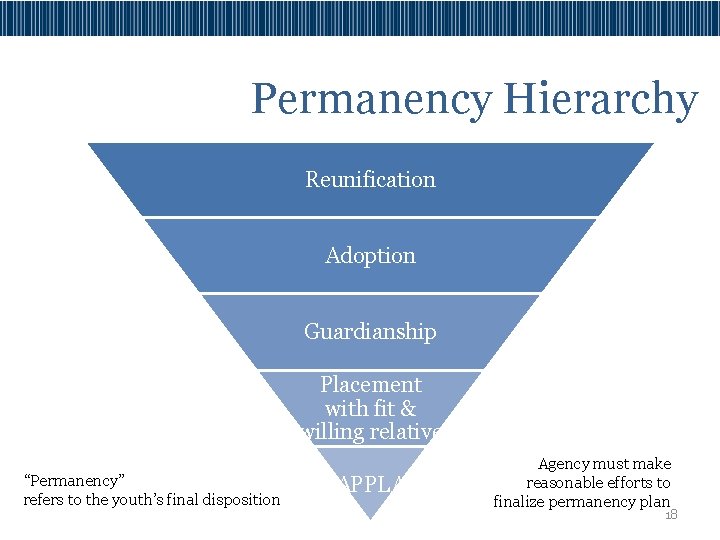
Permanency Hierarchy Reunification Adoption Guardianship Placement with fit & willing relative “Permanency” refers to the youth’s final disposition APPLA Agency must make reasonable efforts to finalize permanency plan 18
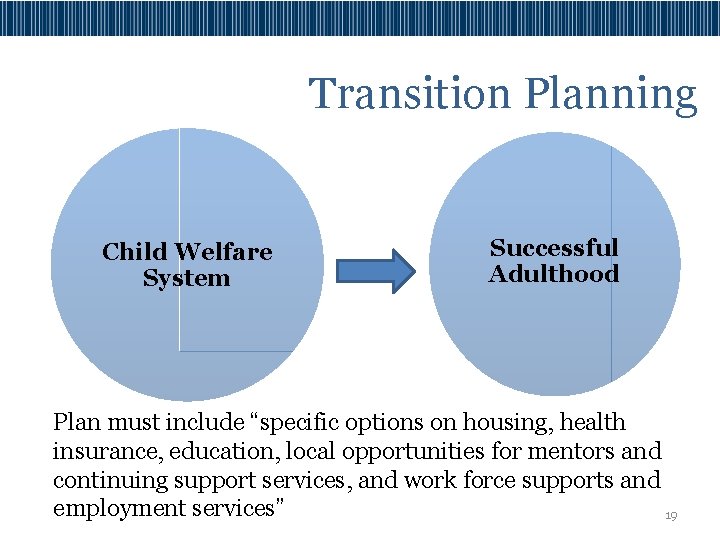
Transition Planning Child Welfare System Successful Adulthood Plan must include “specific options on housing, health insurance, education, local opportunities for mentors and continuing support services, and work force supports and employment services” 19
Court Oversight § Status of each child in placement must be reviewed at least once every 6 months § Parties, including the youth, must receive notice and opportunity to be heard § Courts have broad dispositional authority to enter orders in youth’s best interest 20
Today’s Agenda Introduction • Purpose of webinar Child Welfare 101 • Basics of the child welfare system Normalcy • What is it? • Barriers to achieving normalcy • Strategies for supporting and informing normalcy efforts Permanency • What is it? • Barriers to achieving permanency • Strategies for supporting and informing permanency efforts 21

NORMALCY 22
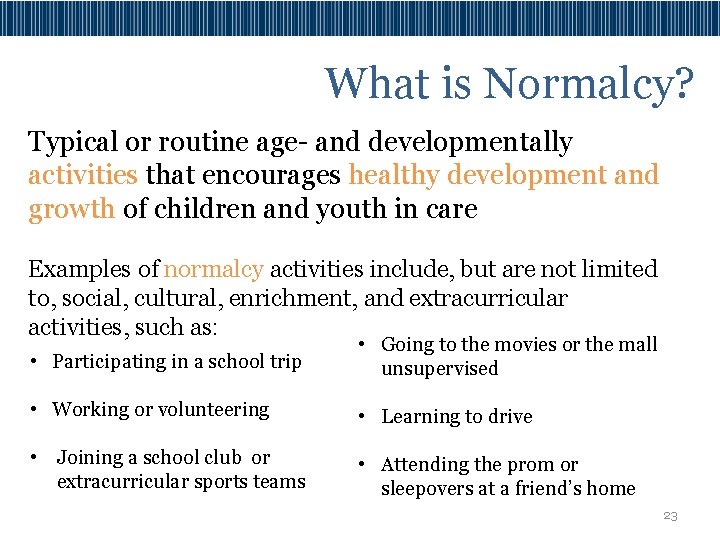
What is Normalcy? Typical or routine age- and developmentally activities that encourages healthy development and growth of children and youth in care Examples of normalcy activities include, but are not limited to, social, cultural, enrichment, and extracurricular activities, such as: • Participating in a school trip • Going to the movies or the mall unsupervised • Working or volunteering • Learning to drive • Joining a school club or extracurricular sports teams • Attending the prom or sleepovers at a friend’s home 23
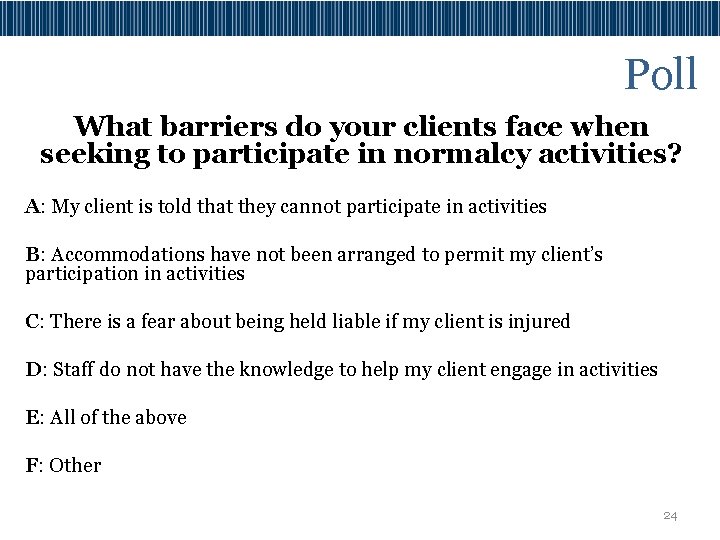
Poll What barriers do your clients face when seeking to participate in normalcy activities? A: My client is told that they cannot participate in activities B: Accommodations have not been arranged to permit my client’s participation in activities C: There is a fear about being held liable if my client is injured D: Staff do not have the knowledge to help my client engage in activities E: All of the above F: Other 24
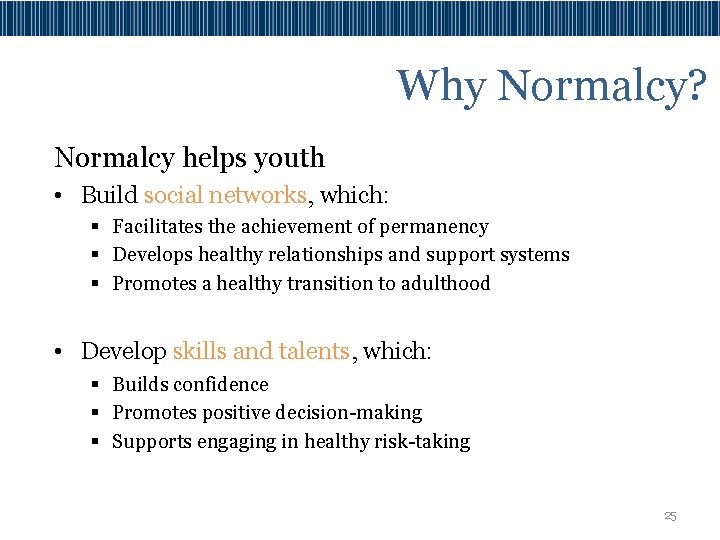
Why Normalcy? Normalcy helps youth • Build social networks, which: § Facilitates the achievement of permanency § Develops healthy relationships and support systems § Promotes a healthy transition to adulthood • Develop skills and talents, which: § Builds confidence § Promotes positive decision-making § Supports engaging in healthy risk-taking 25
Normalcy Legal Requirements In addition to providing youth with ongoing opportunities to participate in age- and developmentally- appropriate activities, the law requires that: • A designated adult, including facility staff, must be trained and given the authority to use the reasonable and prudent parent standard to make decisions about normalcy activities • Normalcy must be addressed in case plan and at every status and permanency review hearing 26
Poll Do you know the facility staff member designated to use the reasonable and prudent parent standard to permit your client to participate in normalcy activities? A: Yes B: No 27
Normalcy Reasonable and Prudent Parent Standard Requires the use of careful and sensible parental decision-making when determining whether to permit a child or youth’s participation in extracurricular, enrichment, cultural, and social activities The standard was developed to: o Maintain the health, safety, and best interests of the child or youth o Encourage the emotional and developmental growth of the child or youth 28
Normalcy Caregivers and the Reasonable Prudent Parent Standard Factors that caregivers may use to help guide their decisions under the reasonable and prudent parent standard include, but are not limited to: • The potential risk factors to the • Encouraging the child or youth’s formation of healthy age- and child or youth and others developmentally- appropriate relationships • The history of the child or youth and his or her ability to safely • Supporting the child or youth in participate in the proposed developing skills to successfully activity transition to adulthood 29
Promoting Normalcy Caregiver Liability Provisions • States are required to provide liability protection to caregivers who use the reasonable and prudent parent standard appropriately • Liability provisions encourage caregivers to permit children and youth participation in normalcy activities without fear of being held legally responsible if an injury results from such activity 30
Promoting Normalcy Agency Responsibilities • Offer opportunities to engage in normalcy activities to all children and youth in care • Provide reasonable accommodations for children and youth to access activities to the greatest extent possible • Help enhance a child or youth’s participation in activities by consulting and partnering with service providers 31
Promoting Normalcy P&A: Tips for Advocacy • Investigations § Intervene when necessary § File grievances in individual cases • Individual Advocacy § Work directly with the child or youth, caregivers, and the agency to obtain accommodations § Empower youth to advocate for themselves § Work with the child or youth’s lawyer to draft orders that promote and address barriers to participation 32
Normalcy Questions to ask • Are reasonable accommodations available to support the child or youth’s participation in activities in the community? • Have reasonable accommodations been requested by the caregiver and provided by the agency? • If opportunities are not being provided or taken advantage of, what are the barriers? • When necessary, can a court order address and resolve the barriers to the child or youth’s participation in the activity? 33
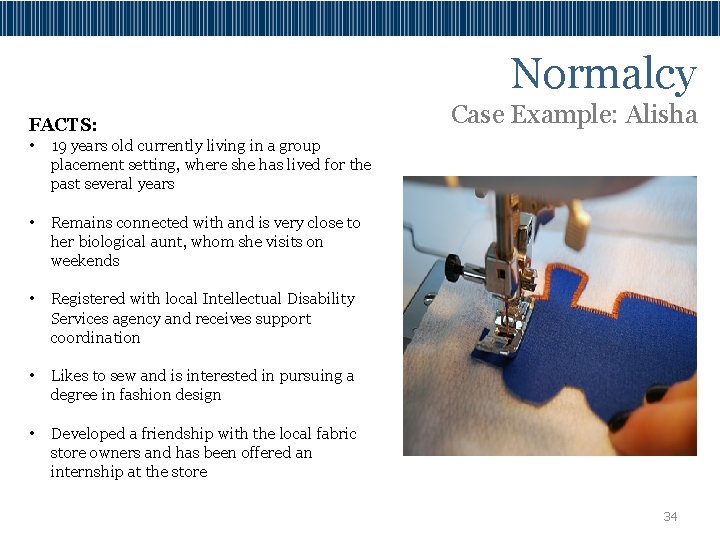
Normalcy FACTS: • 19 years old currently living in a group placement setting, where she has lived for the past several years • Remains connected with and is very close to her biological aunt, whom she visits on weekends • Registered with local Intellectual Disability Services agency and receives support coordination • Likes to sew and is interested in pursuing a degree in fashion design • Developed a friendship with the local fabric store owners and has been offered an internship at the store Case Example: Alisha 34
Normalcy Case Example: Alisha BARRIERS: • No reliable transportation to the fabric store • Alisha does not know which staff member at the group placement has been designated to make decisions SUPPORTS: • Alisha is familiar with the local bus routes because she rides the bus with her aunt on the weekends • Biological aunt and fabric store owners believe the internship will help Alisha pursue her interest and develop skills 35
Normalcy Case Example: Alisha What are some creative ways you can advocate for Alisha to participate in the internship? • Speak with Alisha to determine: § Who helps or works with her at the group facility § The type of accommodation she would need to fully participate in the internship § Whether aunt or the fabric store owners would be willing to transport her to the fabric store • Reach out to the facility, Alisha’s caseworker, or her attorney to find out who is designated to act using the reasonable and prudent parent standard • Other ideas? 36
Normalcy P&A Engagement FACTS: • 14 year old client currently living in a residential placement • Wants to play basketball • The activity has been determined to be age- and developmentally- appropriate • There is a staff member on-site who is designated to make decisions based on the reasonable and prudent parent standard BARRIER: • The facility does not have the staff to supervise the activity • The facility’s basketball court is in need of minor repairs 37
Normalcy P&A Engagement ADVOCACY: • How does the Strengthening Families Act help you advocate for your client? • What are some ways you can work to ensure that your client can participate in this normalcy activity? 38
Normalcy Creating Opportunities for Youth Resource Highlights: • Teen Success Agreement § Document created by youth for older youth, caregivers, and social workers to provide older youth age-appropriate activities and opportunities § www. jlc. org/sites/default/files/publication_pdfs/Teen. Success. Agre ement. FINAL_0. pdf • Advancing SFA: Normalcy Provisions § Toolkit to help child welfare practitioners implement SFA’s normalcy provisions § http: //www. aecf. org/resources/advancing-sfa/ 39
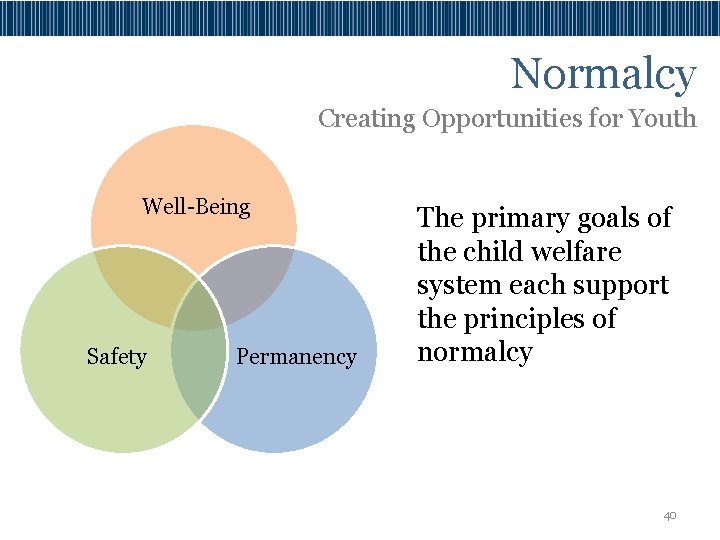
Normalcy Creating Opportunities for Youth Well-Being Safety Permanency The primary goals of the child welfare system each support the principles of normalcy 40
Today’s Agenda Introduction • Purpose of webinar Child Welfare 101 • Basics of the child welfare system Normalcy • What is it? • Barriers to achieving normalcy • Strategies for supporting and informing normalcy efforts Permanency • What is it? • Barriers to achieving permanency • Strategies for supporting and informing permanency efforts 41

PERMANENCY 42
What is Permanency? § Youth have a stable living environment that is the least restrictive possible § Youth establish a network of relationships that provide the support of family § All special and general needs are met § Older youth are prepared for adulthood 43
Right to Permanency Agency must make reasonable efforts to: § Prevent removal; and § Return child home; or § Achieve another permanency plan. 44
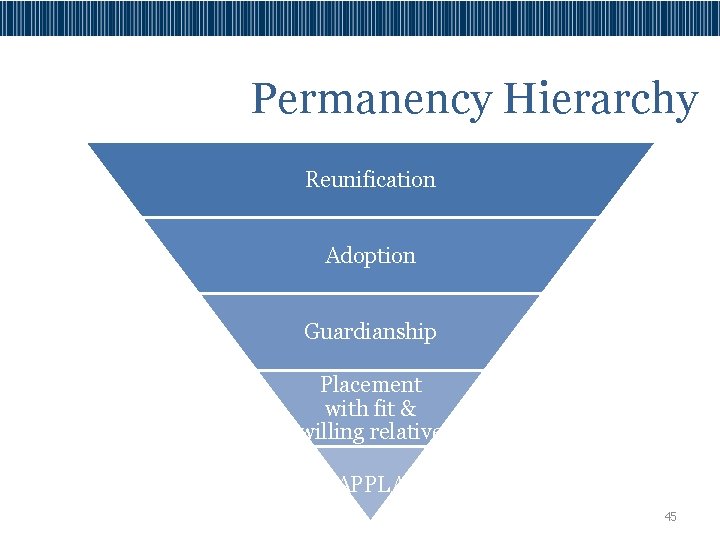
Permanency Hierarchy Reunification Adoption Guardianship Placement with fit & willing relative APPLA 45
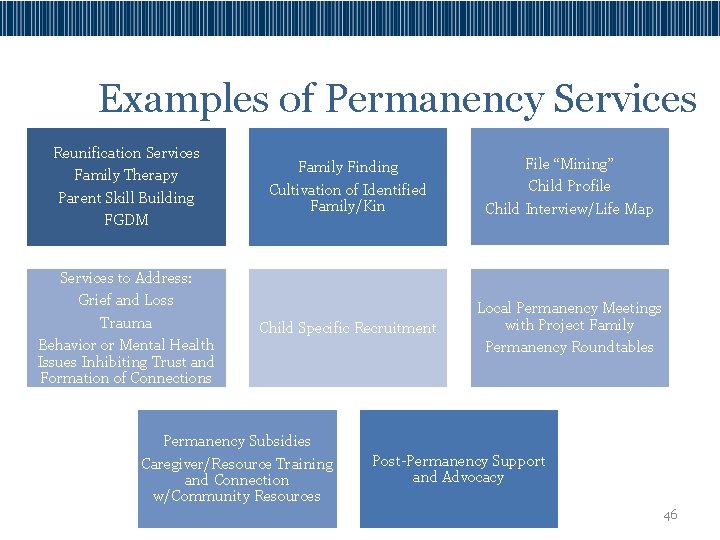
Examples of Permanency Services Reunification Services Family Therapy Parent Skill Building FGDM Services to Address: Grief and Loss Trauma Family Finding Cultivation of Identified Family/Kin Child Specific Recruitment Behavior or Mental Health Issues Inhibiting Trust and Formation of Connections Permanency Subsidies Caregiver/Resource Training and Connection w/Community Resources File “Mining” Child Profile Child Interview/Life Map Local Permanency Meetings with Project Family Permanency Roundtables Post-Permanency Support and Advocacy 46
Permanency Challenges for Youth with Disabilities § Youth with disabilities may be labeled early on as “unadoptable” § Family may require more or costly services to keep child safely at home § Child welfare team may confuse placement with permanency 47
Achieving Permanency for Youth with Disabilities § Judicial review of permanency plan is required for finalization and at each permanency hearing § Discuss treatment needs separately from permanency needs § Participation in normal activities promotes permanency 48
Avoiding APPLA § Prohibited for youth under age 16 § Court must find that: o Compelling reasons rule out other permanency plans o Agency documents intensive, ongoing, unsuccessful efforts to achieve another permanency plan o APPLA is in youth’s best interest § Court must also: o Ask youth about desired permanency outcome o Confirm that agency is taking steps to ensure normalcy § Child welfare team must engage in concurrent planning 49
Making APPLA Work § Youth must have other permanent connections § Youth must be connected to resources before exiting child welfare system § Take advantage of extended foster care, care re-entry, and extended permanency subsidies where available 50
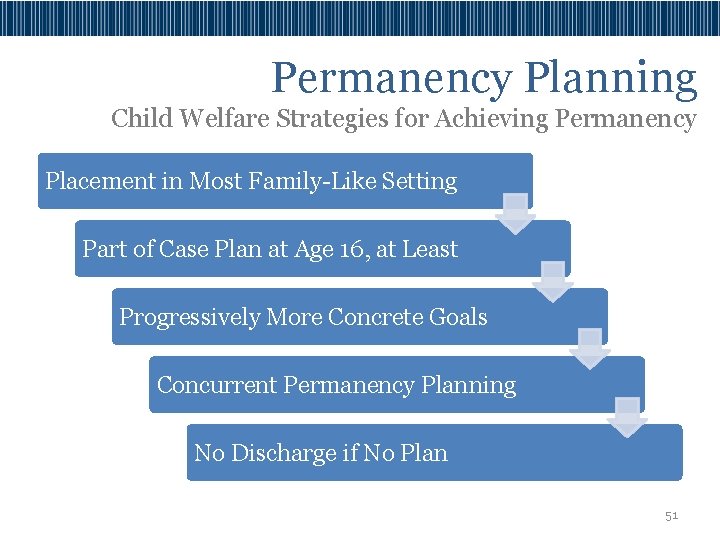
Permanency Planning Child Welfare Strategies for Achieving Permanency Placement in Most Family-Like Setting Part of Case Plan at Age 16, at Least Progressively More Concrete Goals Concurrent Permanency Planning No Discharge if No Plan 51
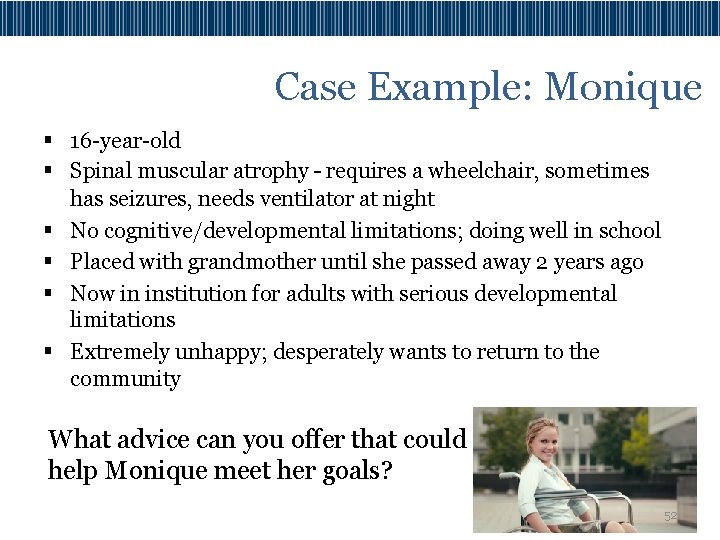
Case Example: Monique § 16 -year-old § Spinal muscular atrophy – requires a wheelchair, sometimes has seizures, needs ventilator at night § No cognitive/developmental limitations; doing well in school § Placed with grandmother until she passed away 2 years ago § Now in institution for adults with serious developmental limitations § Extremely unhappy; desperately wants to return to the community What advice can you offer that could help Monique meet her goals? 52
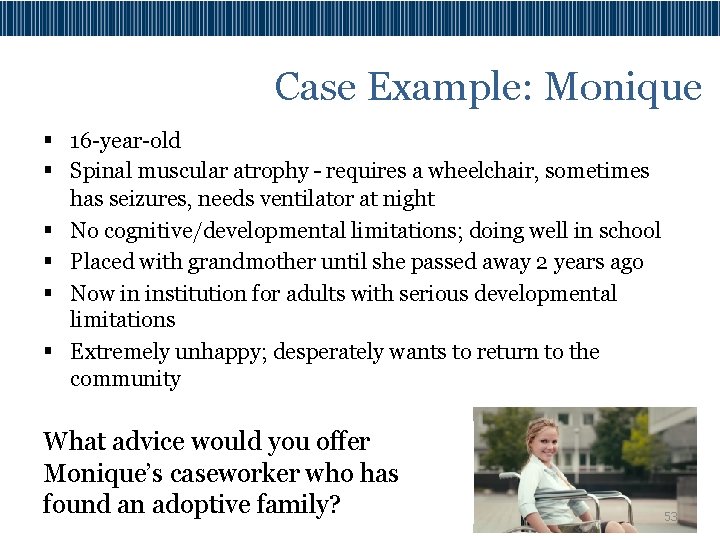
Case Example: Monique § 16 -year-old § Spinal muscular atrophy – requires a wheelchair, sometimes has seizures, needs ventilator at night § No cognitive/developmental limitations; doing well in school § Placed with grandmother until she passed away 2 years ago § Now in institution for adults with serious developmental limitations § Extremely unhappy; desperately wants to return to the community What advice can you offer that could What advice would you offer help Monique meet her goals? Monique’s caseworker who has found an adoptive family? 53
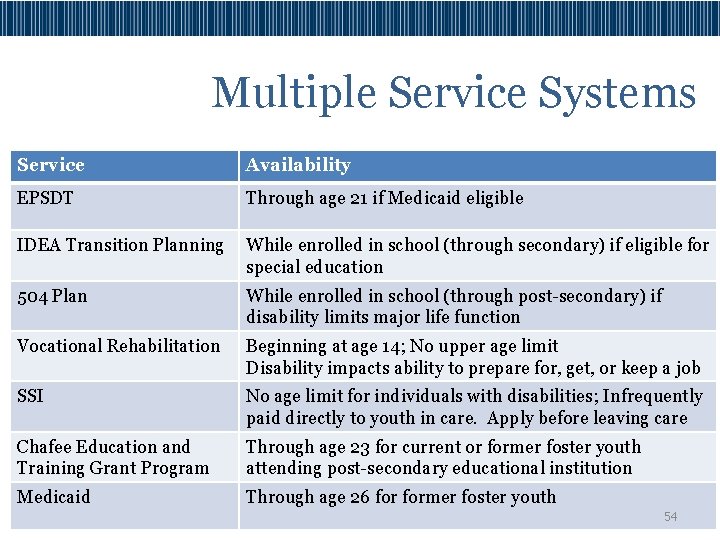
Multiple Service Systems Service Availability EPSDT Through age 21 if Medicaid eligible IDEA Transition Planning While enrolled in school (through secondary) if eligible for special education 504 Plan While enrolled in school (through post-secondary) if disability limits major life function Vocational Rehabilitation Beginning at age 14; No upper age limit Disability impacts ability to prepare for, get, or keep a job SSI No age limit for individuals with disabilities; Infrequently paid directly to youth in care. Apply before leaving care Chafee Education and Training Grant Program Through age 23 for current or former foster youth attending post-secondary educational institution Medicaid Through age 26 former foster youth 54
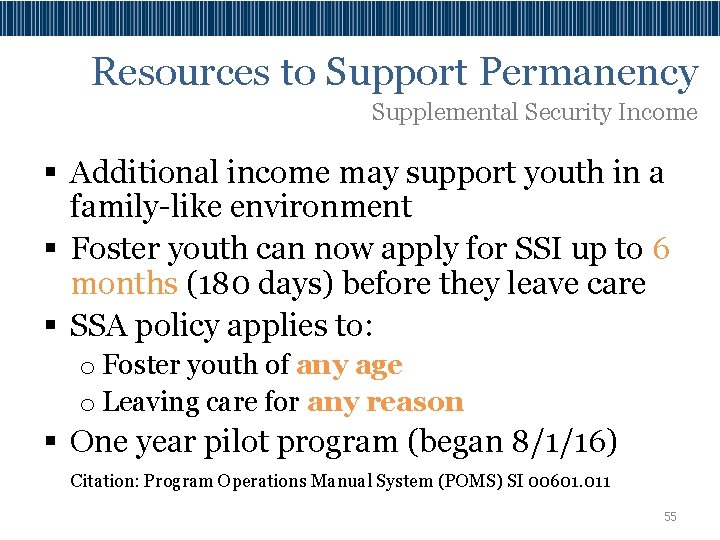
Resources to Support Permanency Supplemental Security Income § Additional income may support youth in a family-like environment § Foster youth can now apply for SSI up to 6 months (180 days) before they leave care § SSA policy applies to: o Foster youth of any age o Leaving care for any reason § One year pilot program (began 8/1/16) Citation: Program Operations Manual System (POMS) SI 00601. 011 55
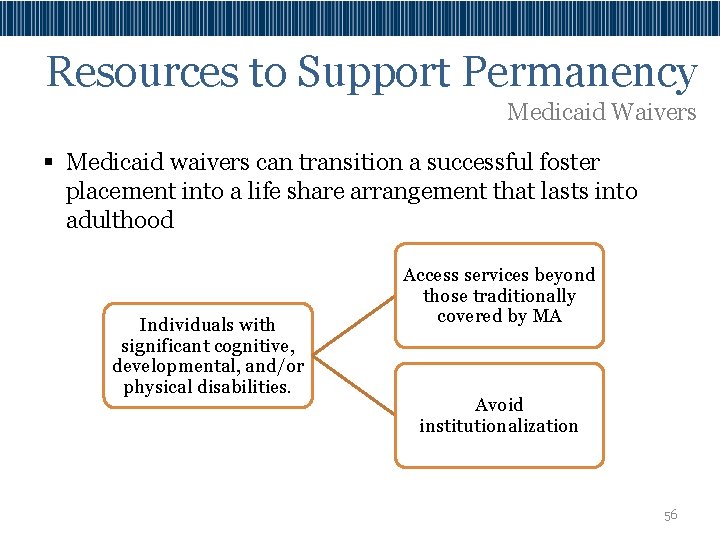
Resources to Support Permanency Medicaid Waivers § Medicaid waivers can transition a successful foster placement into a life share arrangement that lasts into adulthood Individuals with significant cognitive, developmental, and/or physical disabilities. Access services beyond those traditionally covered by MA Avoid institutionalization 56
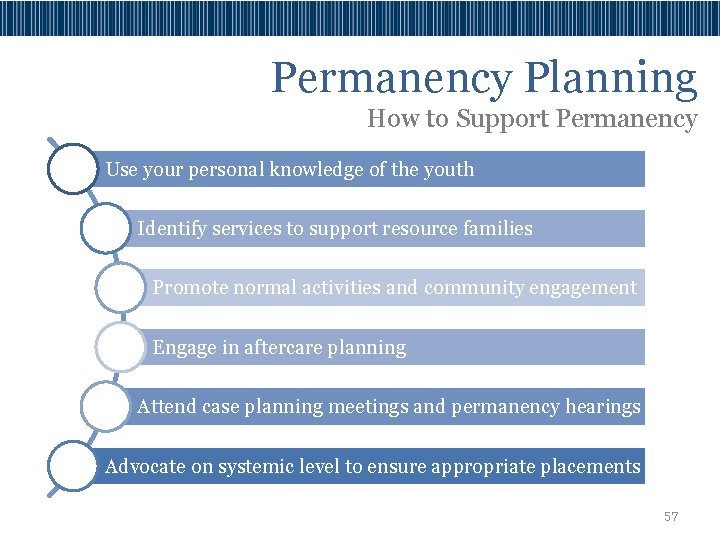
Permanency Planning How to Support Permanency Use your personal knowledge of the youth Identify services to support resource families Promote normal activities and community engagement Engage in aftercare planning Attend case planning meetings and permanency hearings Advocate on systemic level to ensure appropriate placements 57
Upcoming Webinars • Tuesday, May 18: Planning for a Quality Education in the Child Welfare System: What Disability Rights Advocates Need to Know • Tuesday, June 13: Achieving the Least Restrictive Setting in the Child Welfare System: What Disability Rights Advocates Need to Know • Thursday, July 6: Navigating Adult-Serving Systems after the Child Welfare System: What Disability Rights Advocates Need to Know 58
Questions? 59
Natane Eaddy Staff Attorney neaddy@jlc. org Lisa B. Swaminathan Staff Attorney lswaminathan@jlc. org
- Slides: 60