
Modeling human action understanding as inverse planning Chris
- Slides: 22
Modeling human action understanding as inverse planning Chris Baker, Josh Tenenbaum, Rebecca Saxe MIT
Heider and Simmel demo
Intuitive psychology • How do we infer hidden mental states of other agents that cause their observed behavior? – Beliefs, desires, plans, intentions, emotions. • How do we use mental-state inferences to learn about the world? – Pulling out into traffic, jumping off a summit… • What is the structure of intuitive theories of psychology that support these inferences, and how are those theories acquired?
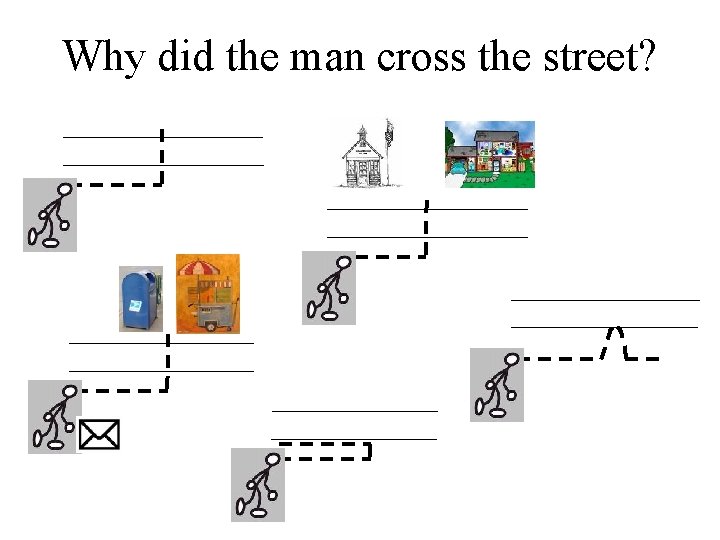
Why did the man cross the street?
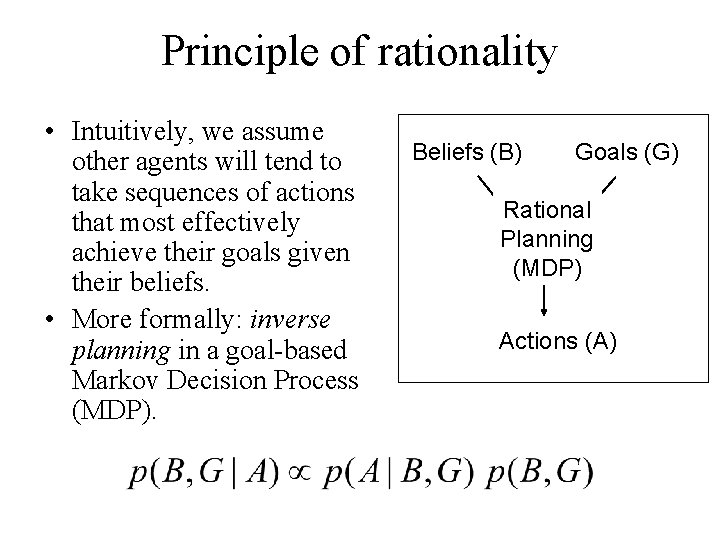
Principle of rationality • Intuitively, we assume other agents will tend to take sequences of actions that most effectively achieve their goals given their beliefs. • More formally: inverse planning in a goal-based Markov Decision Process (MDP). Beliefs (B) Goals (G) Rational Planning (MDP) Actions (A)
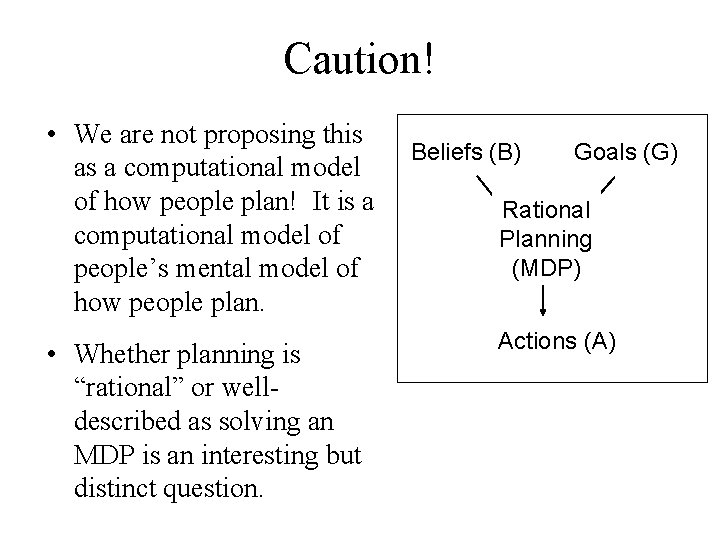
Caution! • We are not proposing this as a computational model of how people plan! It is a computational model of people’s mental model of how people plan. • Whether planning is “rational” or welldescribed as solving an MDP is an interesting but distinct question. Beliefs (B) Goals (G) Rational Planning (MDP) Actions (A)
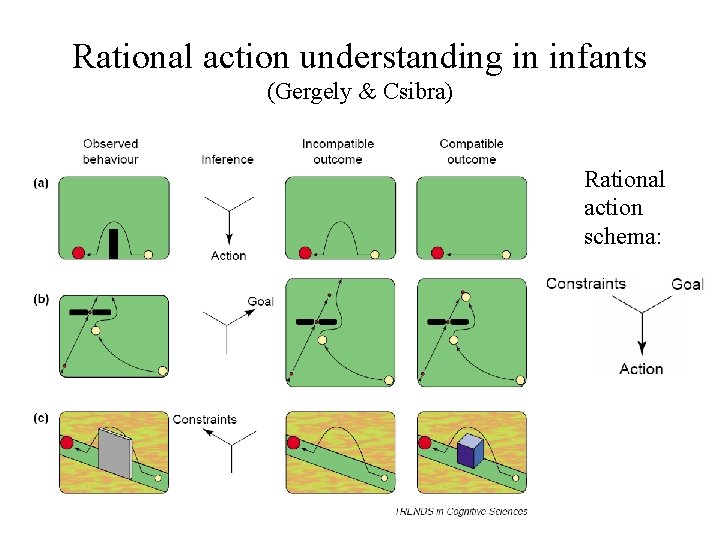
Rational action understanding in infants (Gergely & Csibra) Rational action schema:
The present research • Aims – To test how accurately and precisely the inverse planning framework can explain people’s intuitive psychological judgments. – To use the inverse planning framework as a tool to test alternative accounts of people’s intuitive theories of psychology. • Experiments 1 & 2: goal inference • Experiments 3 & 4: action prediction
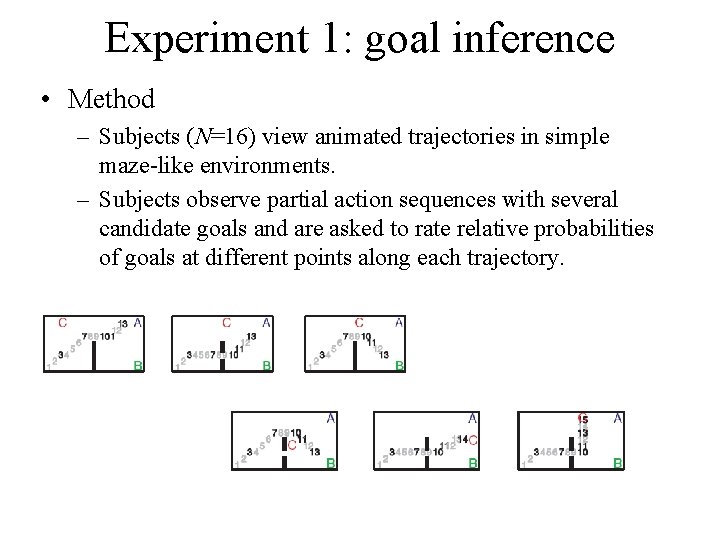
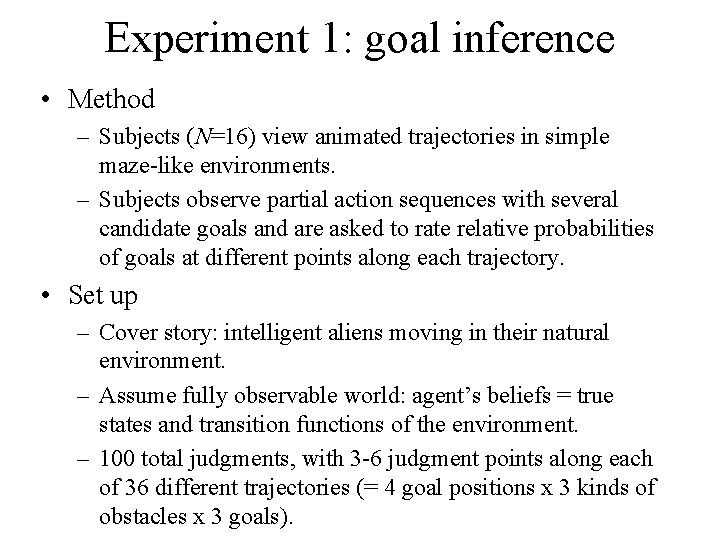
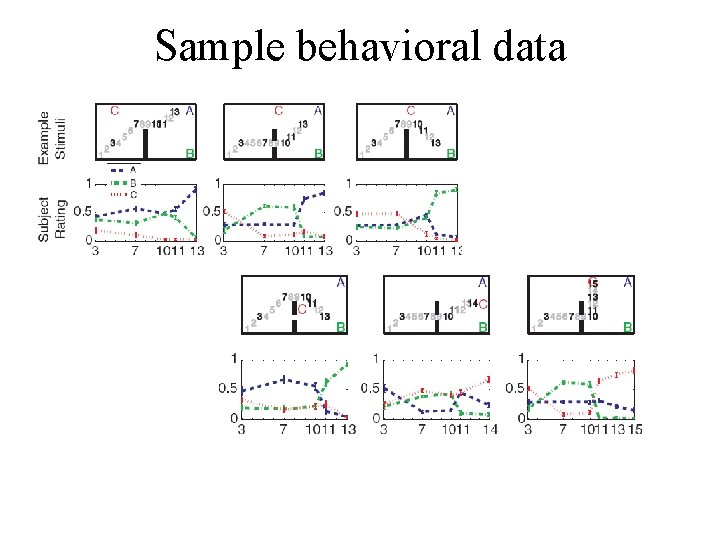
Experiment 1: goal inference • Method – Subjects (N=16) view animated trajectories in simple maze-like environments. – Subjects observe partial action sequences with several candidate goals and are asked to rate relative probabilities of goals at different points along each trajectory.
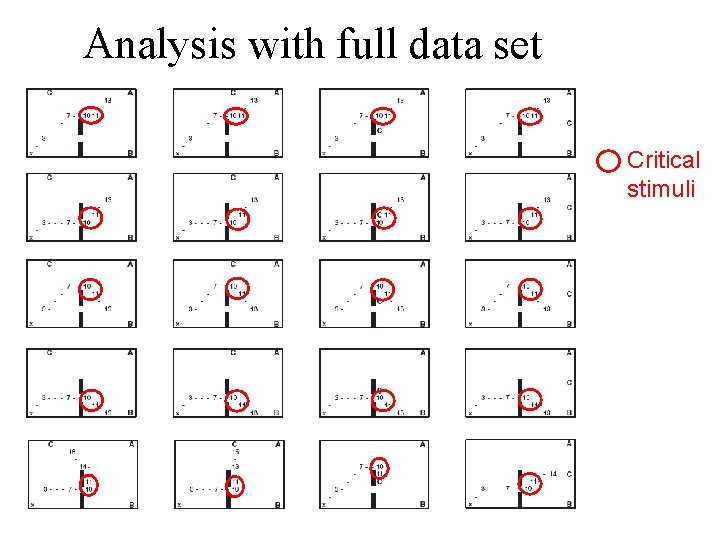
Experiment 1: goal inference • Method – Subjects (N=16) view animated trajectories in simple maze-like environments. – Subjects observe partial action sequences with several candidate goals and are asked to rate relative probabilities of goals at different points along each trajectory. • Set up – Cover story: intelligent aliens moving in their natural environment. – Assume fully observable world: agent’s beliefs = true states and transition functions of the environment. – 100 total judgments, with 3 -6 judgment points along each of 36 different trajectories (= 4 goal positions x 3 kinds of obstacles x 3 goals).
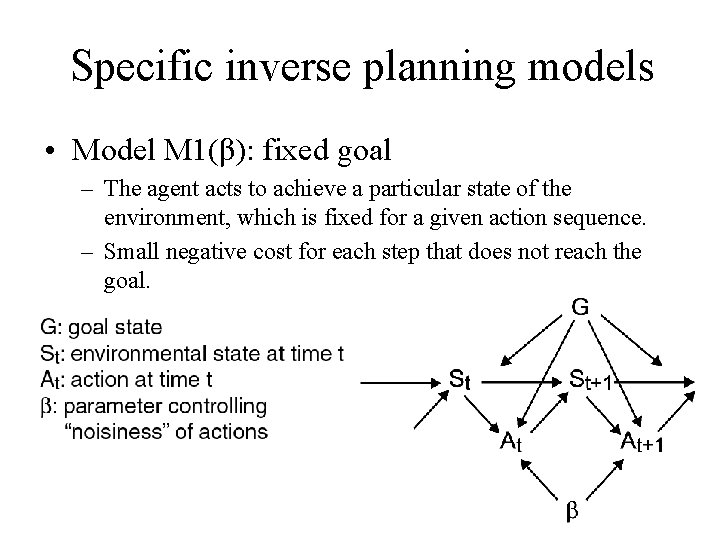
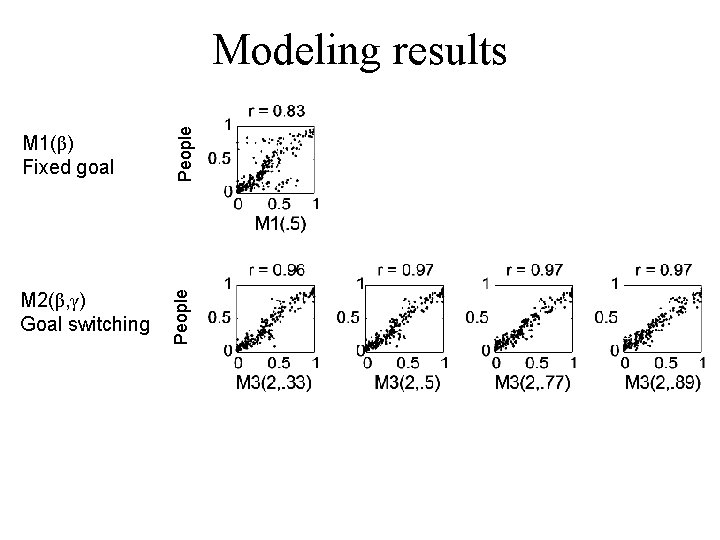
Specific inverse planning models • Model M 1(β): fixed goal – The agent acts to achieve a particular state of the environment, which is fixed for a given action sequence. – Small negative cost for each step that does not reach the goal.
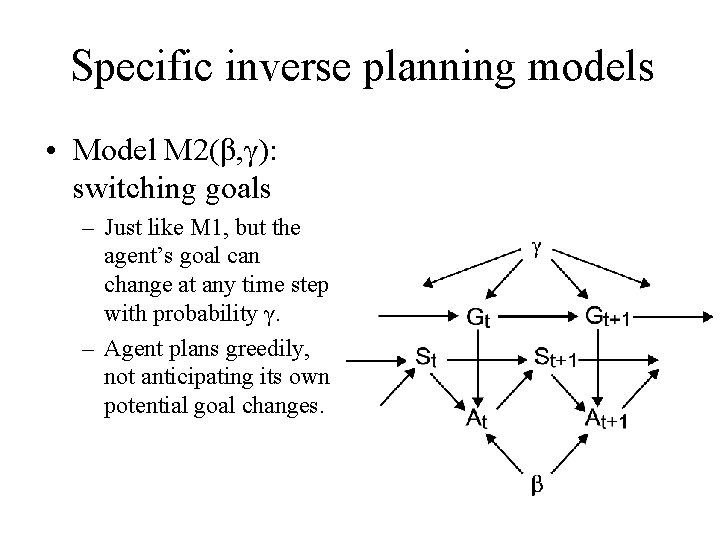
Specific inverse planning models • Model M 2(β, γ): switching goals – Just like M 1, but the agent’s goal can change at any time step with probability γ. – Agent plans greedily, not anticipating its own potential goal changes.
Sample behavioral data
M 1(β) Fixed goal People M 2(β, γ) Goal switching People Modeling results
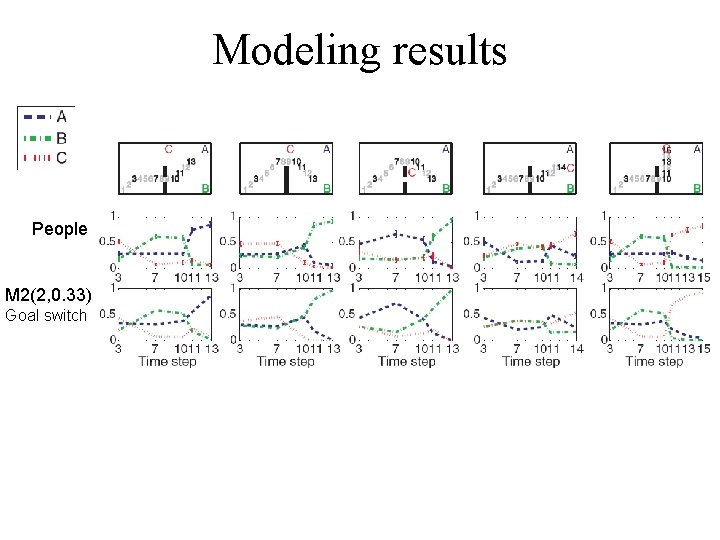
Modeling results People M 2(2, 0. 33) Goal switch
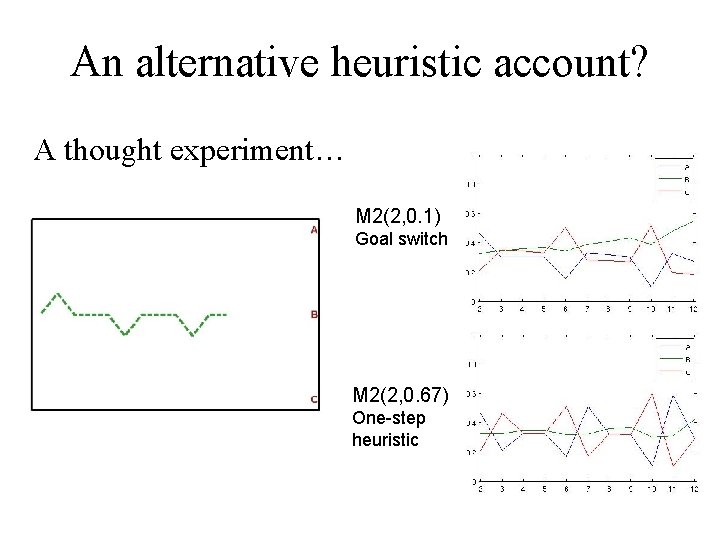
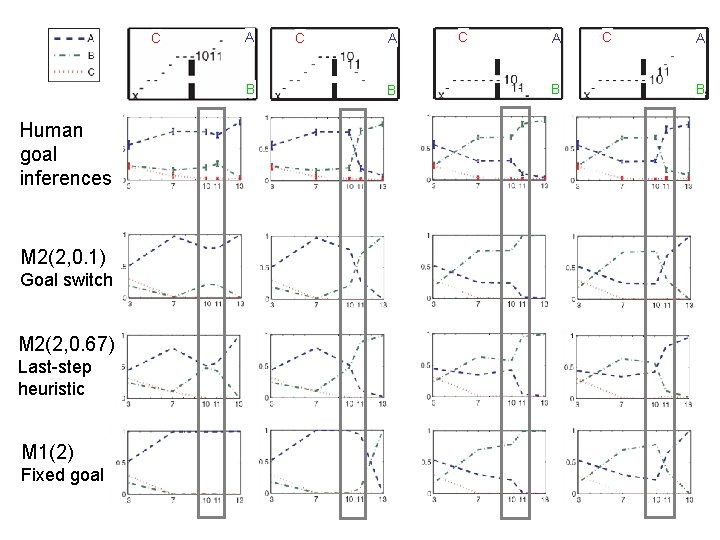
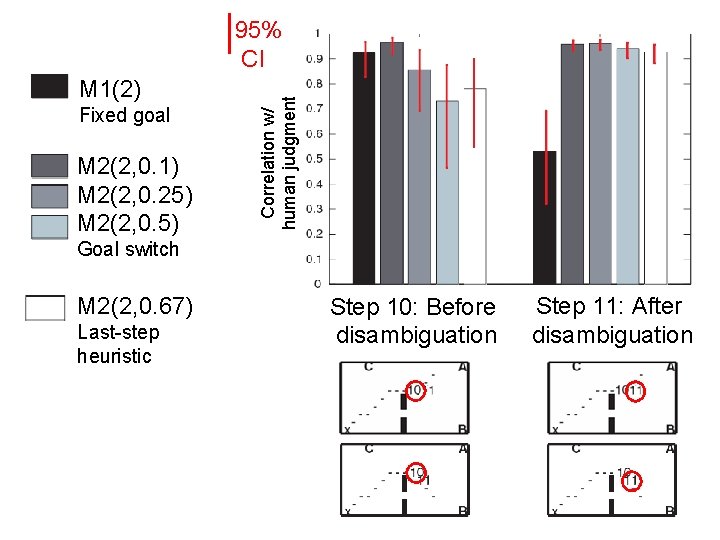
An alternative heuristic account? • Last-step heuristic: infer goal based on only the last movement (instead of the entire path) – a special case of M 2, equivalent to M 2(β, . 67). • This model correlates highly with people’s judgments in Experiment 1. • However, there are qualitative differences between this model’s predictions and people’s judgments that suggest that people are using a more sophisticated form of temporal integration.
An alternative heuristic account? A thought experiment… M 2(2, 0. 1) Goal switch M 2(2, 0. 67) One-step heuristic
C A B Human goal inferences M 2(2, 0. 1) Goal switch M 2(2, 0. 67) Last-step heuristic M 1(2) Fixed goal C A B
Analysis with full data set Critical stimuli
M 1(2) Fixed goal M 2(2, 0. 1) M 2(2, 0. 25) M 2(2, 0. 5) Correlation w/ human judgment 95% CI Goal switch M 2(2, 0. 67) Last-step heuristic Step 10: Before disambiguation Step 11: After disambiguation
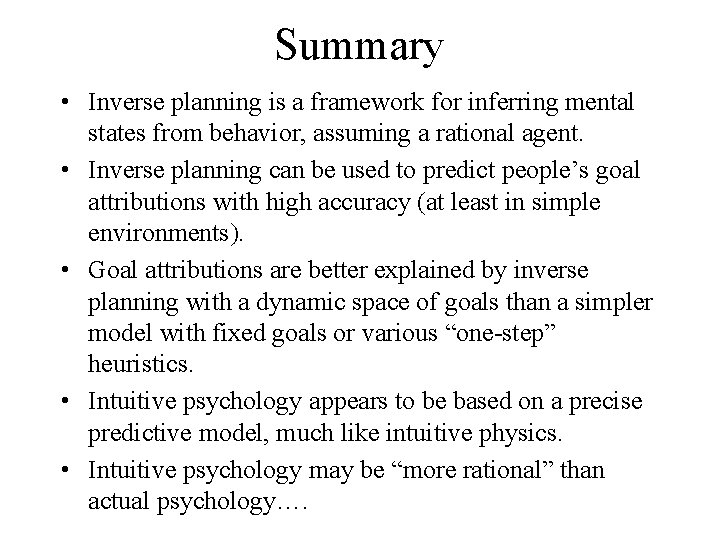
Summary • Inverse planning is a framework for inferring mental states from behavior, assuming a rational agent. • Inverse planning can be used to predict people’s goal attributions with high accuracy (at least in simple environments). • Goal attributions are better explained by inverse planning with a dynamic space of goals than a simpler model with fixed goals or various “one-step” heuristics. • Intuitive psychology appears to be based on a precise predictive model, much like intuitive physics. • Intuitive psychology may be “more rational” than actual psychology….
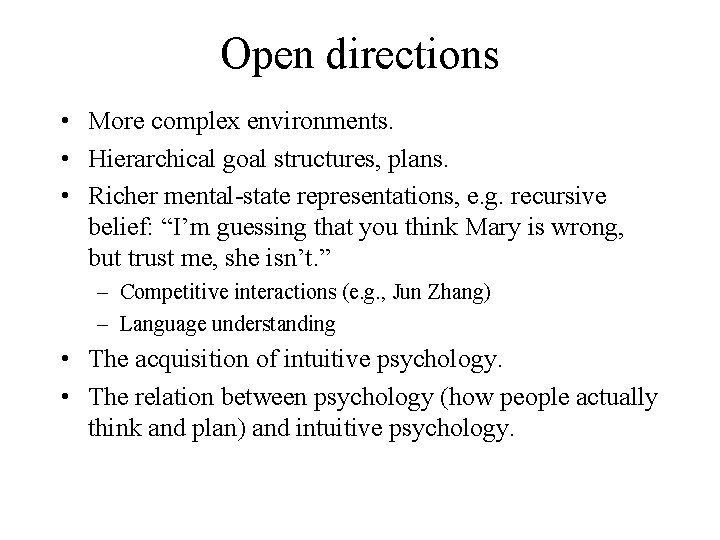
Open directions • More complex environments. • Hierarchical goal structures, plans. • Richer mental-state representations, e. g. recursive belief: “I’m guessing that you think Mary is wrong, but trust me, she isn’t. ” – Competitive interactions (e. g. , Jun Zhang) – Language understanding • The acquisition of intuitive psychology. • The relation between psychology (how people actually think and plan) and intuitive psychology.