UltraFast Silicon Detector Nicolo Cartiglia INFN Torino UFSD
- Slides: 20
Ultra-Fast Silicon Detector Nicolo Cartiglia, INFN, Torino - UFSD - RD 50 CERN 2014 This report is a summary of what was shown at IEEE. Nicolo Cartiglia With LGAD group of RD 50 1
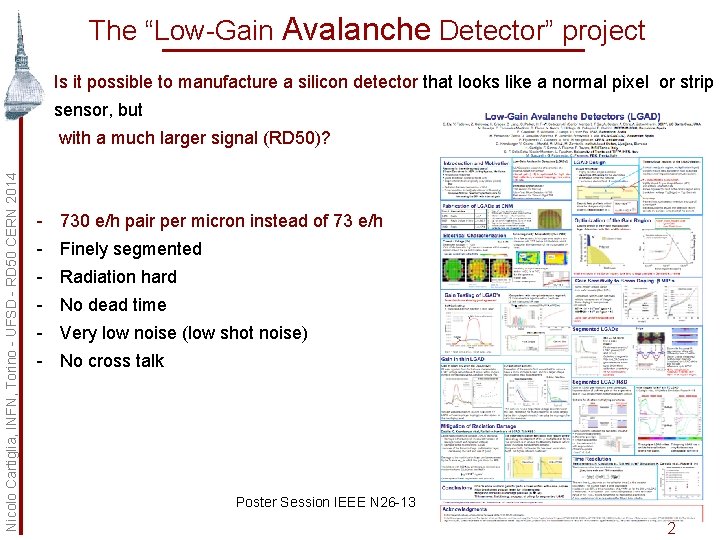
The “Low-Gain Avalanche Detector” project Is it possible to manufacture a silicon detector that looks like a normal pixel or strip sensor, but Nicolo Cartiglia, INFN, Torino - UFSD - RD 50 CERN 2014 with a much larger signal (RD 50)? - 730 e/h pair per micron instead of 73 e/h - Finely segmented - Radiation hard - No dead time - Very low noise (low shot noise) - No cross talk Poster Session IEEE N 26 -13 2
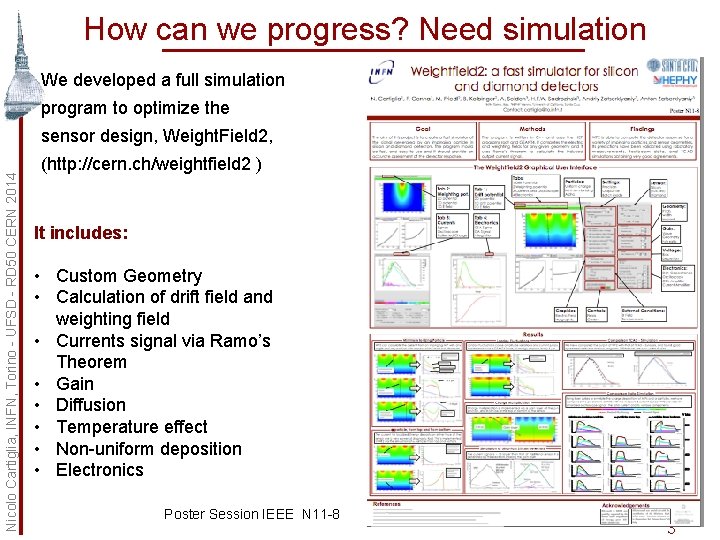
How can we progress? Need simulation We developed a full simulation program to optimize the Nicolo Cartiglia, INFN, Torino - UFSD - RD 50 CERN 2014 sensor design, Weight. Field 2, (http: //cern. ch/weightfield 2 ) It includes: • Custom Geometry • Calculation of drift field and weighting field • Currents signal via Ramo’s Theorem • Gain • Diffusion • Temperature effect • Non-uniform deposition • Electronics Poster Session IEEE N 11 -8 3
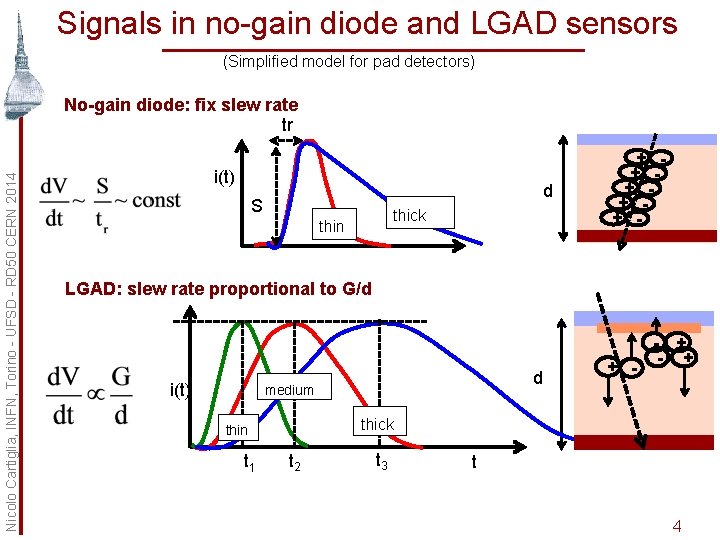
Signals in no-gain diode and LGAD sensors (Simplified model for pad detectors) Nicolo Cartiglia, INFN, Torino - UFSD - RD 50 CERN 2014 No-gain diode: fix slew rate tr i(t) d S thick thin + + + - LGAD: slew rate proportional to G/d i(t) d medium thick thin t 1 + - - + t 2 t 3 t 4
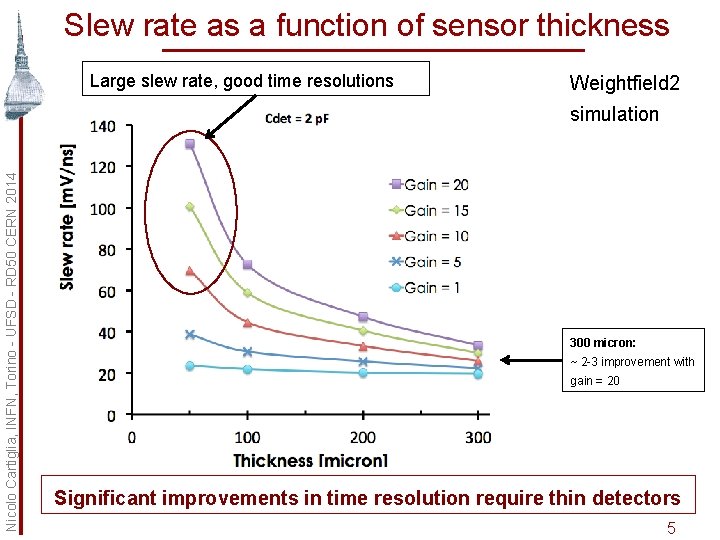
Slew rate as a function of sensor thickness Large slew rate, good time resolutions Weightfield 2 Nicolo Cartiglia, INFN, Torino - UFSD - RD 50 CERN 2014 simulation 300 micron: ~ 2 -3 improvement with gain = 20 Significant improvements in time resolution require thin detectors 5
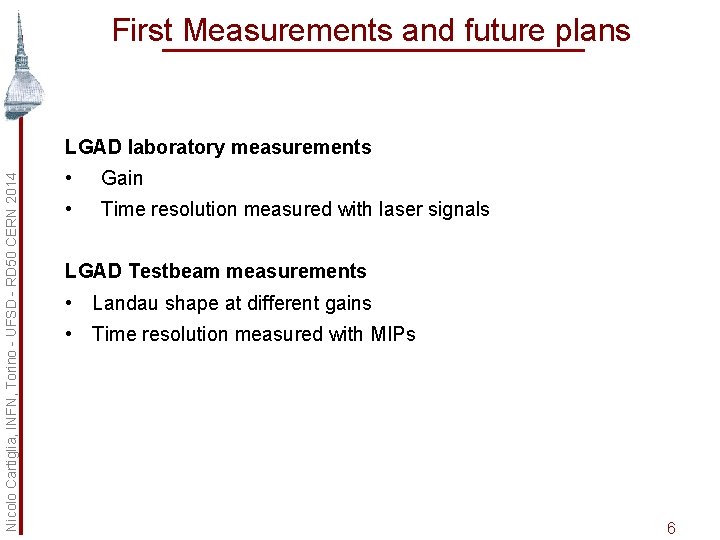
First Measurements and future plans Nicolo Cartiglia, INFN, Torino - UFSD - RD 50 CERN 2014 LGAD laboratory measurements • Gain • Time resolution measured with laser signals LGAD Testbeam measurements • Landau shape at different gains • Time resolution measured with MIPs 6
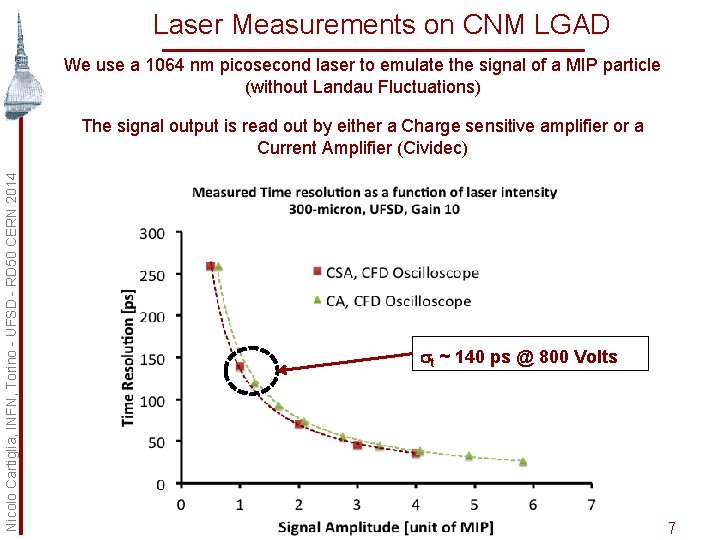
Laser Measurements on CNM LGAD We use a 1064 nm picosecond laser to emulate the signal of a MIP particle (without Landau Fluctuations) Nicolo Cartiglia, INFN, Torino - UFSD - RD 50 CERN 2014 The signal output is read out by either a Charge sensitive amplifier or a Current Amplifier (Cividec) st ~ 140 ps @ 800 Volts 7
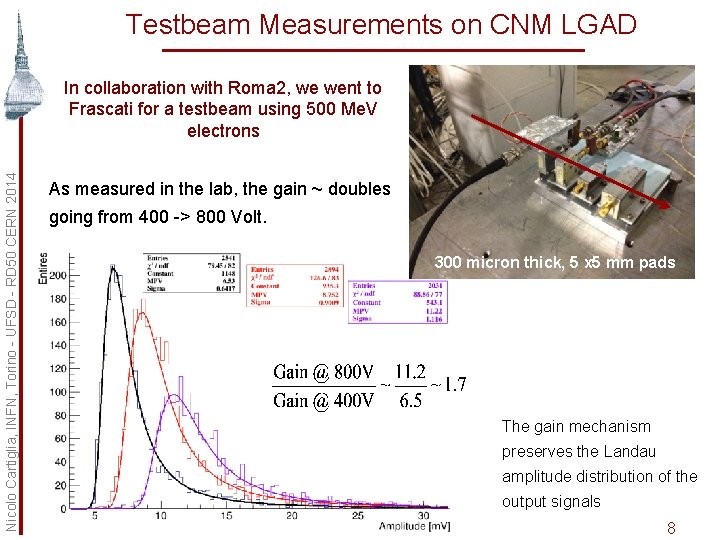
Testbeam Measurements on CNM LGAD Nicolo Cartiglia, INFN, Torino - UFSD - RD 50 CERN 2014 In collaboration with Roma 2, we went to Frascati for a testbeam using 500 Me. V electrons As measured in the lab, the gain ~ doubles going from 400 -> 800 Volt. 300 micron thick, 5 x 5 mm pads The gain mechanism preserves the Landau amplitude distribution of the output signals 8
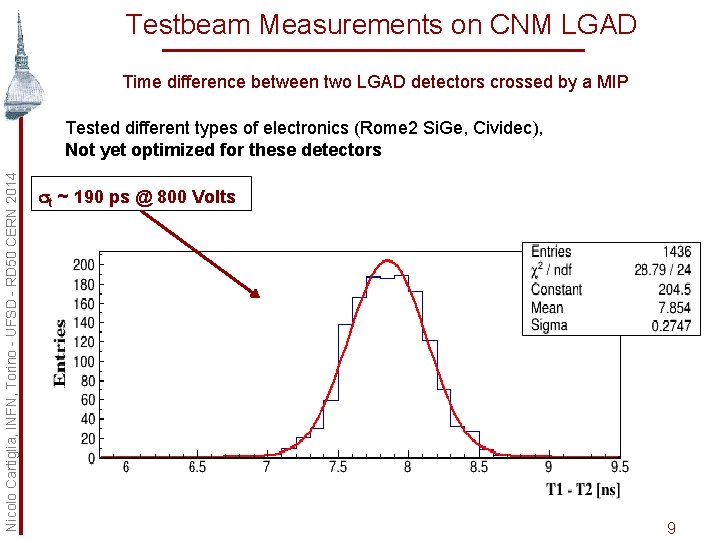
Testbeam Measurements on CNM LGAD Time difference between two LGAD detectors crossed by a MIP Nicolo Cartiglia, INFN, Torino - UFSD - RD 50 CERN 2014 Tested different types of electronics (Rome 2 Si. Ge, Cividec), Not yet optimized for these detectors st ~ 190 ps @ 800 Volts 9
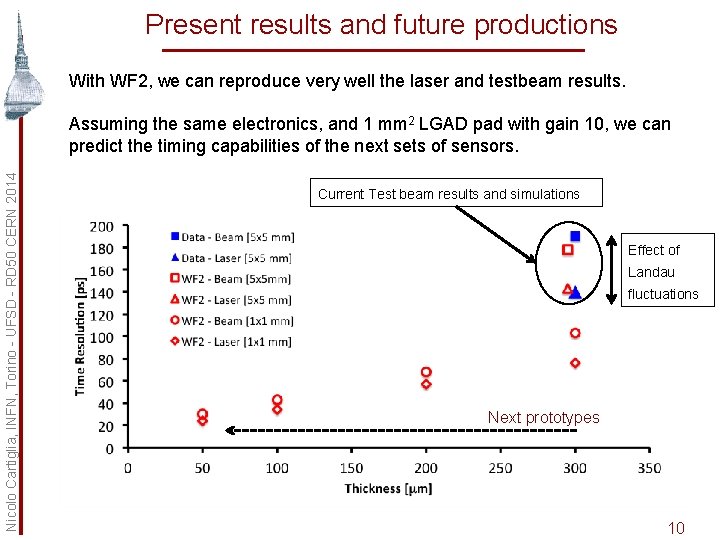
Present results and future productions With WF 2, we can reproduce very well the laser and testbeam results. Nicolo Cartiglia, INFN, Torino - UFSD - RD 50 CERN 2014 Assuming the same electronics, and 1 mm 2 LGAD pad with gain 10, we can predict the timing capabilities of the next sets of sensors. Current Test beam results and simulations Effect of Landau fluctuations Next prototypes 10
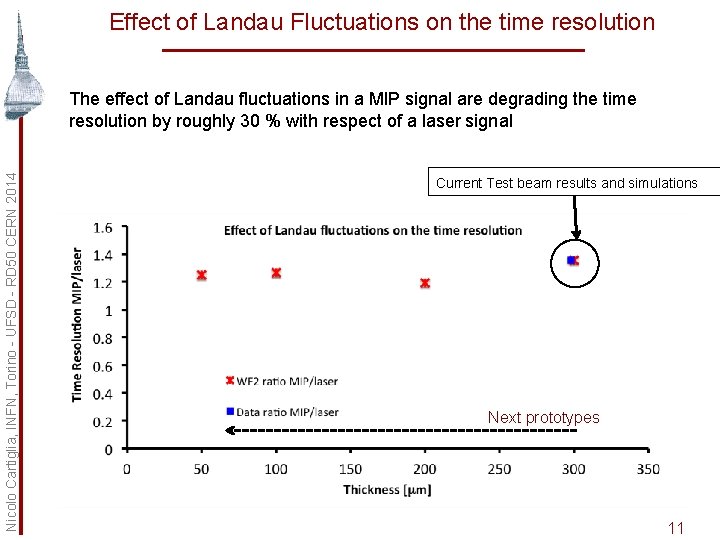
Effect of Landau Fluctuations on the time resolution Nicolo Cartiglia, INFN, Torino - UFSD - RD 50 CERN 2014 The effect of Landau fluctuations in a MIP signal are degrading the time resolution by roughly 30 % with respect of a laser signal Current Test beam results and simulations Next prototypes 11
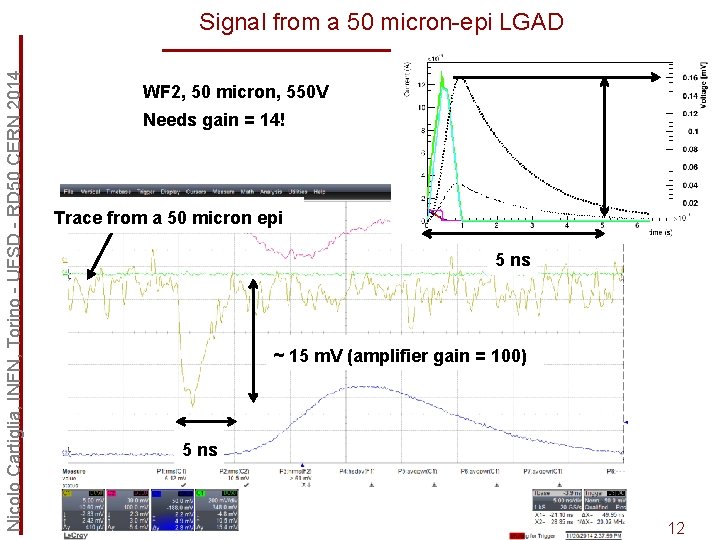
Nicolo Cartiglia, INFN, Torino - UFSD - RD 50 CERN 2014 Signal from a 50 micron-epi LGAD WF 2, 50 micron, 550 V Needs gain = 14! Trace from a 50 micron epi 5 ns ~ 15 m. V (amplifier gain = 100) 5 ns 12
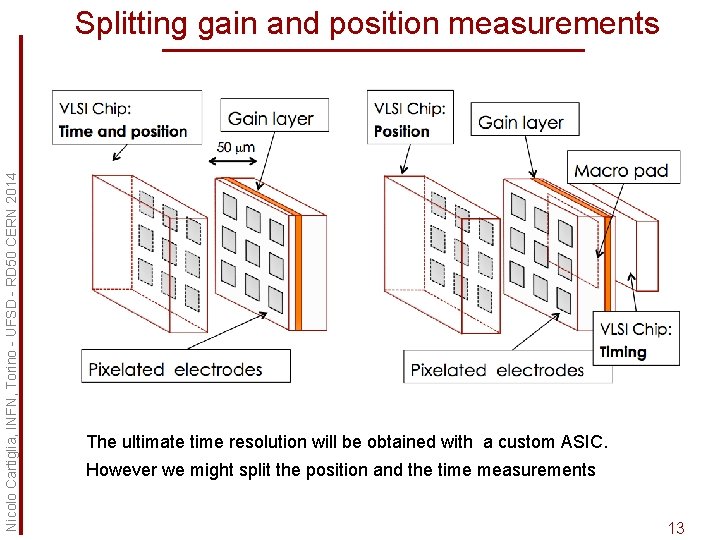
Nicolo Cartiglia, INFN, Torino - UFSD - RD 50 CERN 2014 Splitting gain and position measurements The ultimate time resolution will be obtained with a custom ASIC. However we might split the position and the time measurements 13
UFSD – Summary • The internal gain makes them ideal for accurate timing studies Nicolo Cartiglia, INFN, Torino - UFSD - RD 50 CERN 2014 • We measured 140 ps resolution with laser and 190 ps with MIPS (300 mm sensors) • We are manufacturing thin LGAD optimized for time resolution. With nonoptimized electronics we predict <50 ps resolution for a 50 mm thick, 1 mm 2 pad. • Ultimate time resolution (~10 -20 ps) requires custom ASIC design. Timescale: 300 - and 200 - micron sensors: Winter 2014 100 - and 50 - micron sensors: Summer 2015 14
Nicolo Cartiglia, INFN, Torino - UFSD - RD 50 CERN 2014 Acknowledgement This research was carried out with the contribution of the Ministero degli Affari Esteri, “Direzione Generale per la Promozione del Sistema Paese” of Italy. This work was developed in the framework of the CERN RD 50 collaboration and partially financed by the Spanish Ministry of Education and Science through the Particle Physics National Program (F P A 2010− 22060−C 02− 02 and FPA 2010 − 22163 − C 02 − 02). The work at SCIPP was partially supported by the United States Department of Energy, grant DE-FG 02 -04 ER 41286. 15
Nicolo Cartiglia, INFN, Torino - UFSD - RD 50 CERN 2014 Backup 16
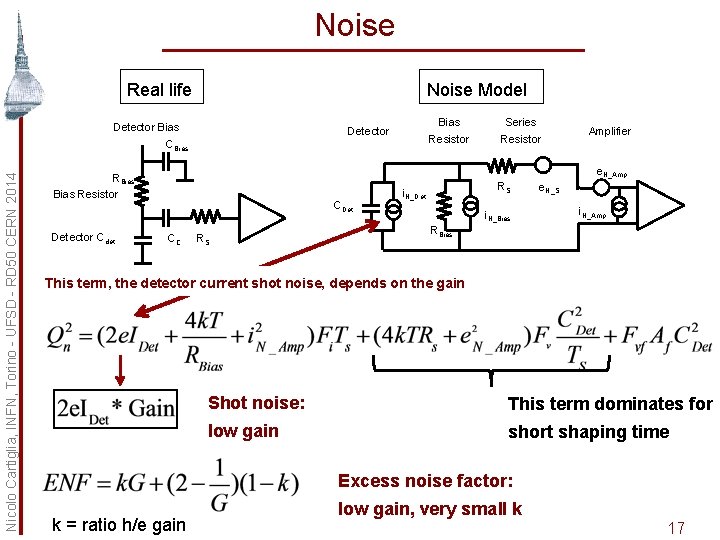
Noise Real life Noise Model Detector Bias Detector Nicolo Cartiglia, INFN, Torino - UFSD - RD 50 CERN 2014 CBias Series Resistor Amplifier e. N_Amp RBias Resistor Detector Cdet Bias CDet CC RS RS i. N_Det RBias This term, the detector current shot noise, depends on the gain e. N_S i. N_Bias Digitizer i. N_Amp 2 sensors Laser split into 2 Shot noise: This term dominates for low gain short shaping time Excess noise factor: k = ratio h/e gain low gain, very small k 17
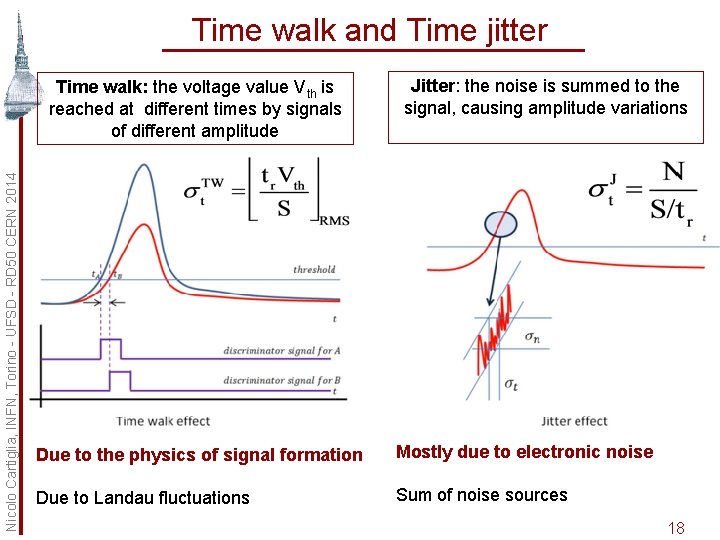
Time walk and Time jitter Nicolo Cartiglia, INFN, Torino - UFSD - RD 50 CERN 2014 Time walk: the voltage value Vth is reached at different times by signals of different amplitude Jitter: the noise is summed to the signal, causing amplitude variations Due to the physics of signal formation Mostly due to electronic noise Due to Landau fluctuations Sum of noise sources 18
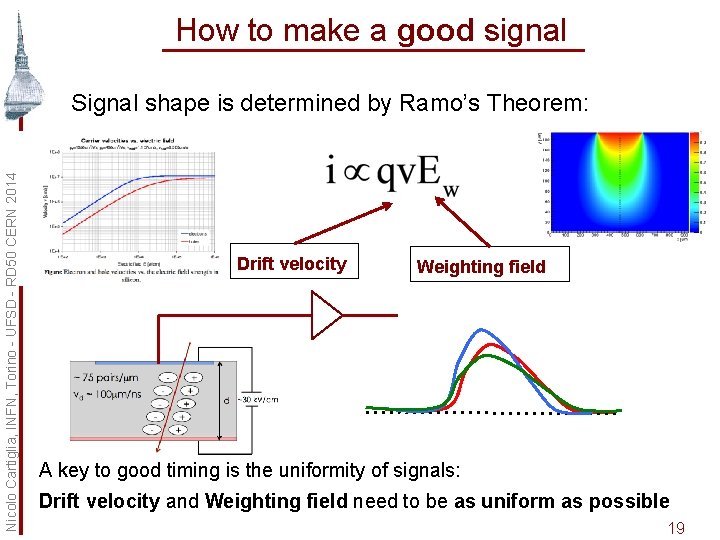
How to make a good signal Nicolo Cartiglia, INFN, Torino - UFSD - RD 50 CERN 2014 Signal shape is determined by Ramo’s Theorem: Drift velocity Weighting field A key to good timing is the uniformity of signals: Drift velocity and Weighting field need to be as uniform as possible 19
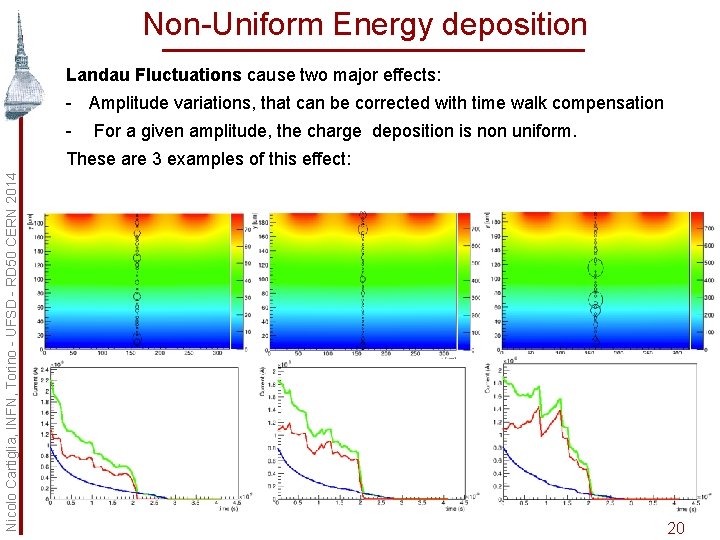
Non-Uniform Energy deposition Landau Fluctuations cause two major effects: - Amplitude variations, that can be corrected with time walk compensation - For a given amplitude, the charge deposition is non uniform. Nicolo Cartiglia, INFN, Torino - UFSD - RD 50 CERN 2014 These are 3 examples of this effect: 20