
Timing performance of LGADUFSD Nicolo Cartiglia INFN Torino

- Slides: 18
Timing performance of LGAD-UFSD Nicolo Cartiglia, INFN, Torino - RD 50 - Santander, 2015 1. New results from the last CNM LGAD runs 2. A proposal for LGAD segmentation Nicolo Cartiglia with INFN Gruppo V, Santa Cruz, CNM Barcelona 1
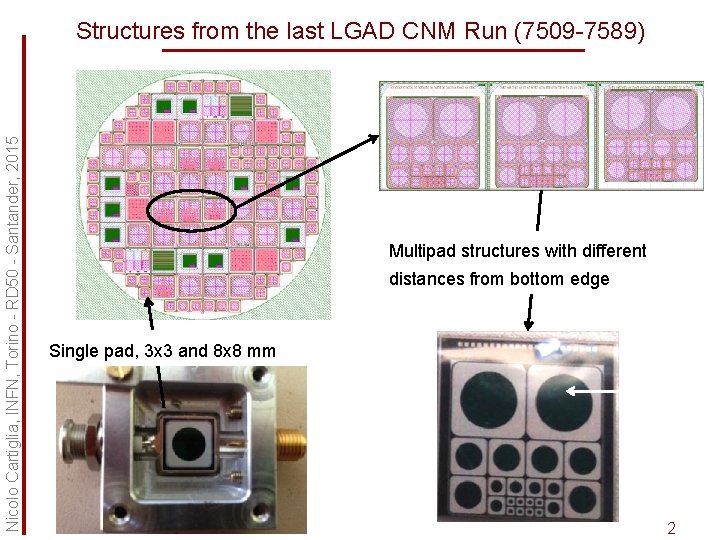
Nicolo Cartiglia, INFN, Torino - RD 50 - Santander, 2015 Structures from the last LGAD CNM Run (7509 -7589) Multipad structures with different distances from bottom edge Single pad, 3 x 3 and 8 x 8 mm 2
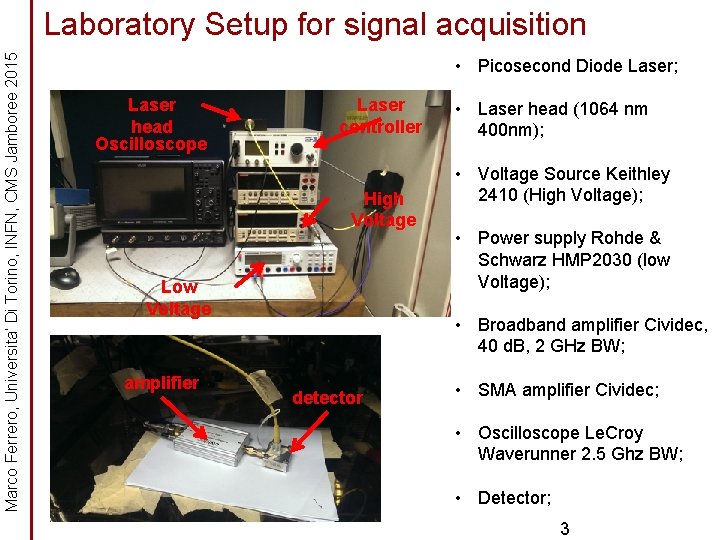
Marco Ferrero, Universita’ Di Torino, INFN, CMS Jamboree 2015 Laboratory Setup for signal acquisition • Picosecond Diode Laser; Laser head Oscilloscope Laser controller High Voltage Low Voltage amplifier • Laser head (1064 nm 400 nm); • Voltage Source Keithley 2410 (High Voltage); • Power supply Rohde & Schwarz HMP 2030 (low Voltage); • Broadband amplifier Cividec, 40 d. B, 2 GHz BW; detector • SMA amplifier Cividec; • Oscilloscope Le. Croy Waverunner 2. 5 Ghz BW; • Detector; 3
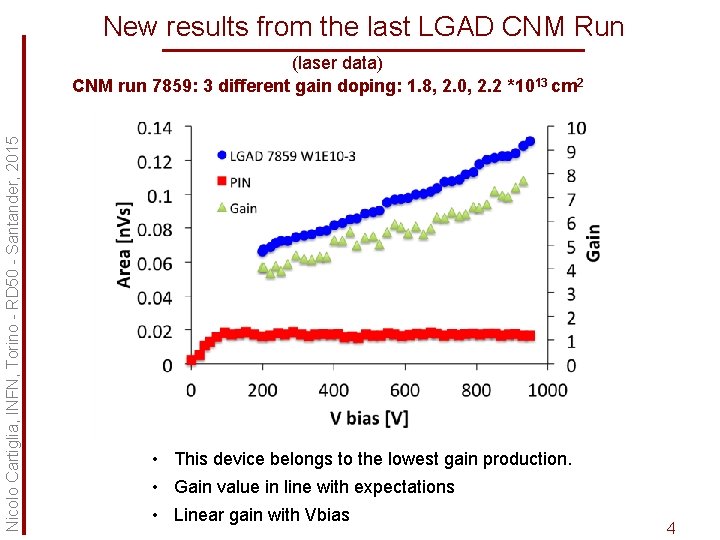
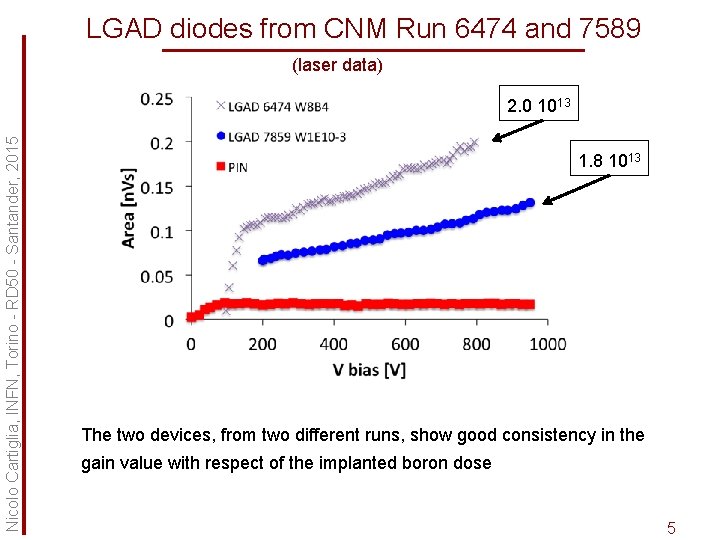
New results from the last LGAD CNM Run Nicolo Cartiglia, INFN, Torino - RD 50 - Santander, 2015 (laser data) CNM run 7859: 3 different gain doping: 1. 8, 2. 0, 2. 2 *1013 cm 2 • This device belongs to the lowest gain production. • Gain value in line with expectations • Linear gain with Vbias 4
LGAD diodes from CNM Run 6474 and 7589 (laser data) Nicolo Cartiglia, INFN, Torino - RD 50 - Santander, 2015 2. 0 1013 1. 8 1013 The two devices, from two different runs, show good consistency in the gain value with respect of the implanted boron dose 5
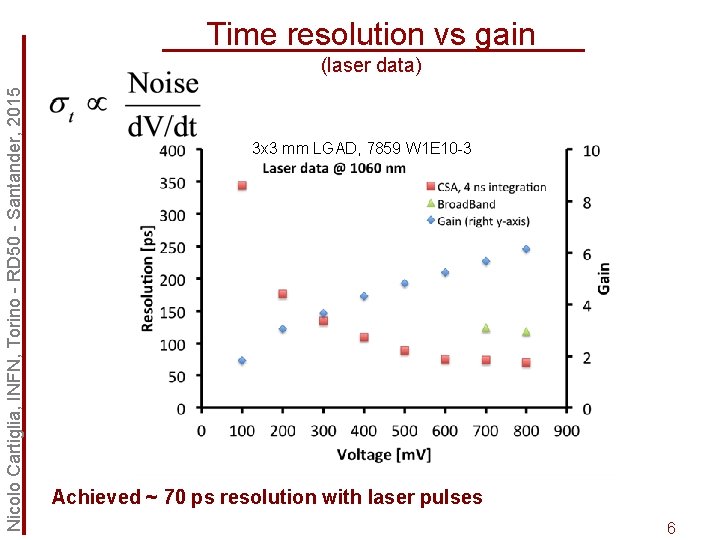
Time resolution vs gain Nicolo Cartiglia, INFN, Torino - RD 50 - Santander, 2015 (laser data) 3 x 3 mm LGAD, 7859 W 1 E 10 -3 Achieved ~ 70 ps resolution with laser pulses 6
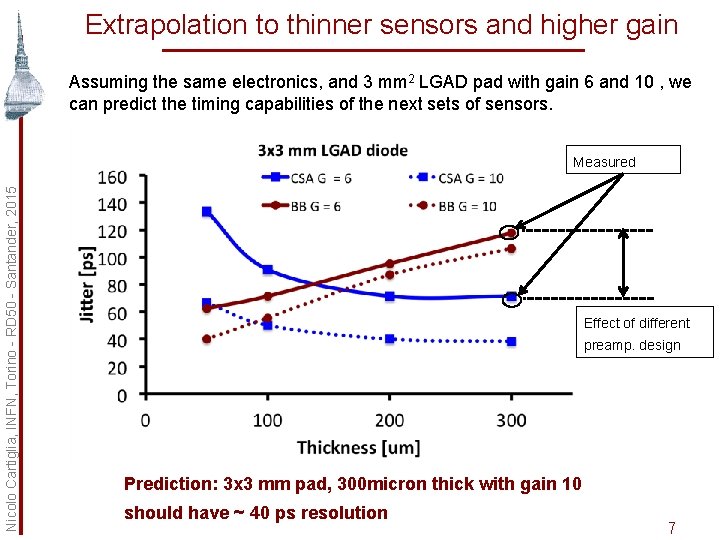
Extrapolation to thinner sensors and higher gain Assuming the same electronics, and 3 mm 2 LGAD pad with gain 6 and 10 , we can predict the timing capabilities of the next sets of sensors. Nicolo Cartiglia, INFN, Torino - RD 50 - Santander, 2015 Measured Effect of different preamp. design Prediction: 3 x 3 mm pad, 300 micron thick with gain 10 should have ~ 40 ps resolution 7
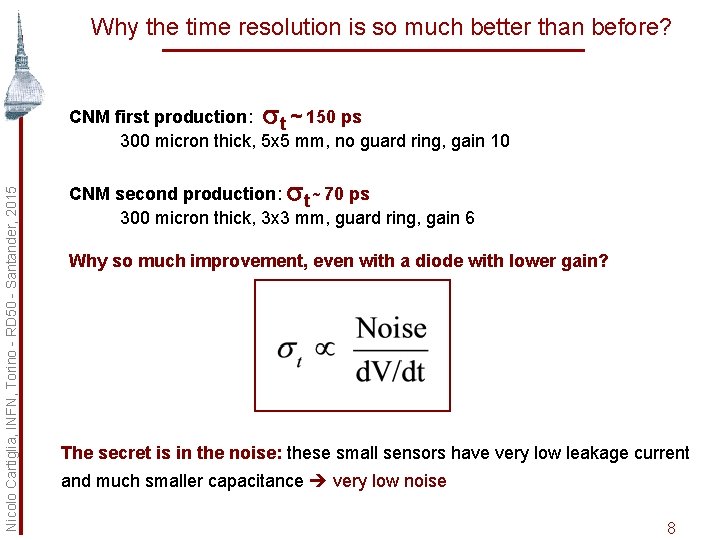
Why the time resolution is so much better than before? Nicolo Cartiglia, INFN, Torino - RD 50 - Santander, 2015 CNM first production: st ~ 150 ps 300 micron thick, 5 x 5 mm, no guard ring, gain 10 CNM second production: st ~ 70 ps 300 micron thick, 3 x 3 mm, guard ring, gain 6 Why so much improvement, even with a diode with lower gain? The secret is in the noise: these small sensors have very low leakage current and much smaller capacitance very low noise 8
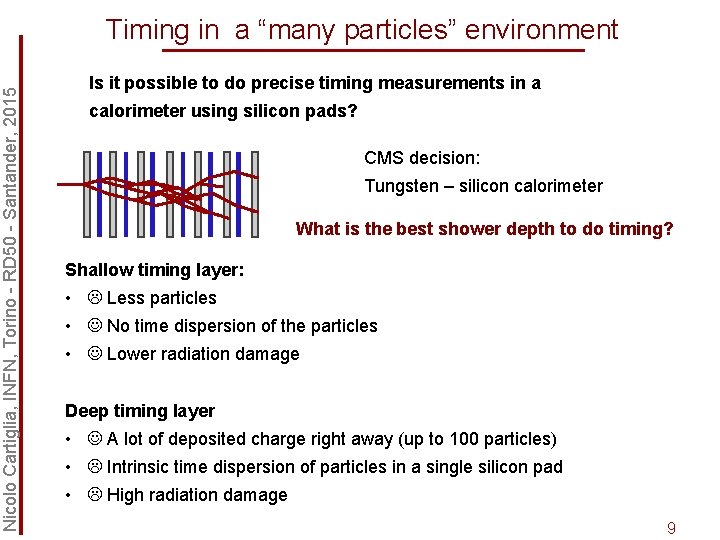
Nicolo Cartiglia, INFN, Torino - RD 50 - Santander, 2015 Timing in a “many particles” environment Is it possible to do precise timing measurements in a calorimeter using silicon pads? CMS decision: Tungsten – silicon calorimeter What is the best shower depth to do timing? Shallow timing layer: • Less particles • No time dispersion of the particles • Lower radiation damage Deep timing layer • A lot of deposited charge right away (up to 100 particles) • Intrinsic time dispersion of particles in a single silicon pad • High radiation damage 9
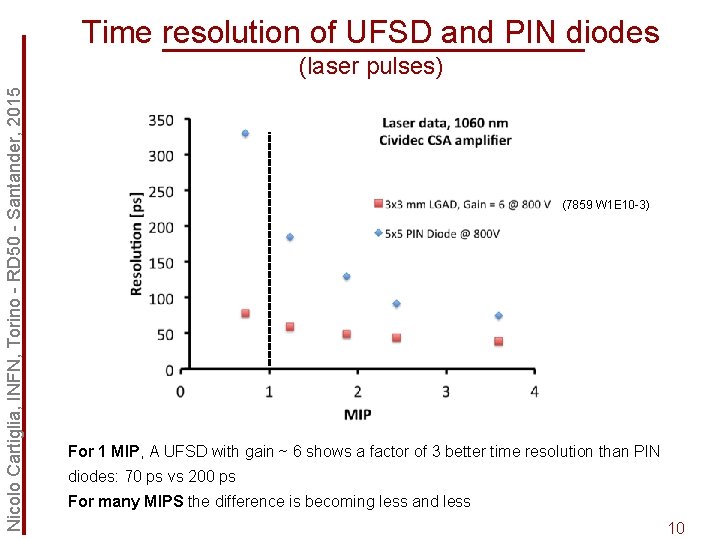
Time resolution of UFSD and PIN diodes Nicolo Cartiglia, INFN, Torino - RD 50 - Santander, 2015 (laser pulses) (7859 W 1 E 10 -3) For 1 MIP, A UFSD with gain ~ 6 shows a factor of 3 better time resolution than PIN diodes: 70 ps vs 200 ps For many MIPS the difference is becoming less and less 10
Nicolo Cartiglia, INFN, Torino - RD 50 - Santander, 2015 A proposal for LGAD segmentation 11
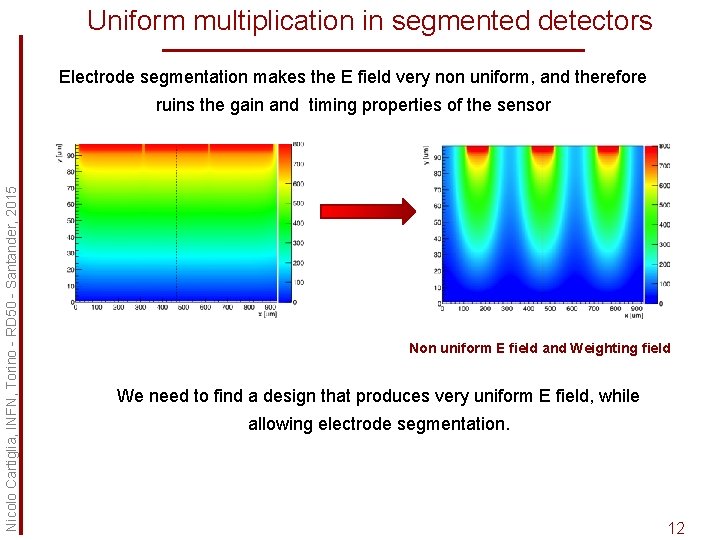
Uniform multiplication in segmented detectors Electrode segmentation makes the E field very non uniform, and therefore Nicolo Cartiglia, INFN, Torino - RD 50 - Santander, 2015 ruins the gain and timing properties of the sensor Non uniform E field and Weighting field We need to find a design that produces very uniform E field, while allowing electrode segmentation. 12
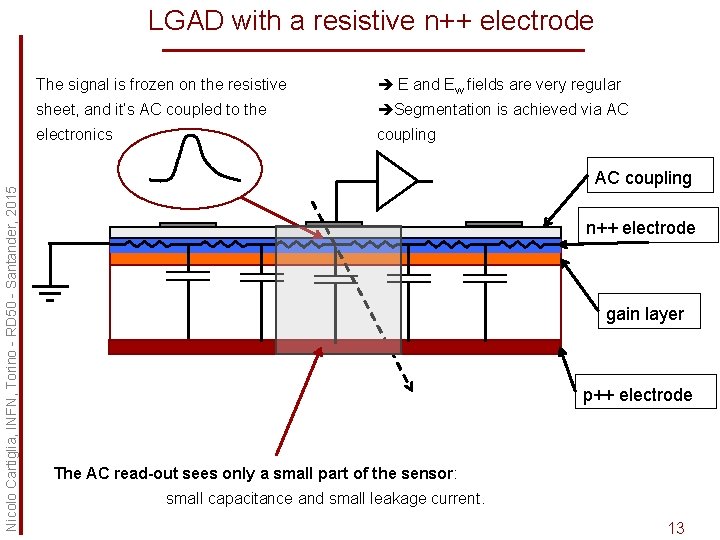
Nicolo Cartiglia, INFN, Torino - RD 50 - Santander, 2015 LGAD with a resistive n++ electrode The signal is frozen on the resistive E and Ew fields are very regular sheet, and it’s AC coupled to the Segmentation is achieved via AC electronics coupling AC coupling n++ electrode gain layer p++ electrode The AC read-out sees only a small part of the sensor: small capacitance and small leakage current. 13
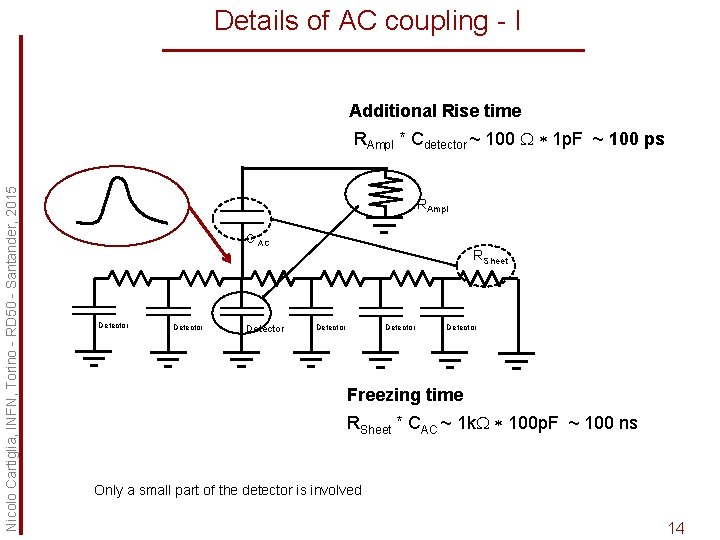
Details of AC coupling - I Additional Rise time Nicolo Cartiglia, INFN, Torino - RD 50 - Santander, 2015 RAmpl * Cdetector ~ 100 W * 1 p. F ~ 100 ps RAmpl C AC RSheet Detector Detector Freezing time RSheet * CAC ~ 1 k. W * 100 p. F ~ 100 ns Only a small part of the detector is involved 14
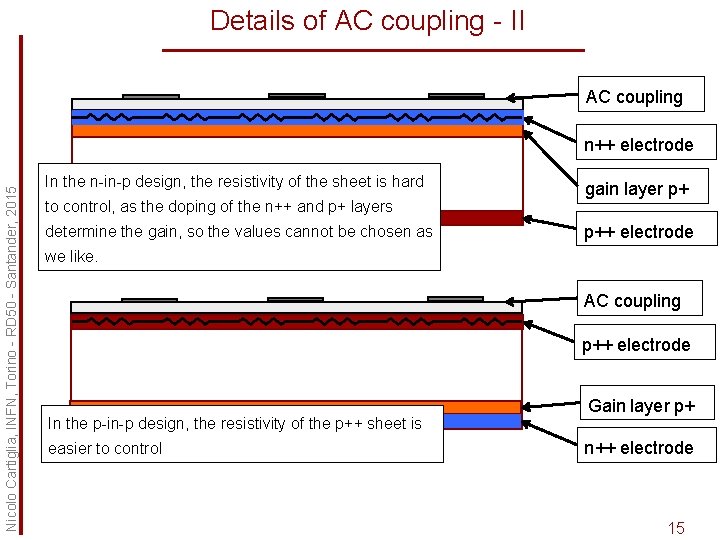
Details of AC coupling - II AC coupling Nicolo Cartiglia, INFN, Torino - RD 50 - Santander, 2015 n++ electrode In the n-in-p design, the resistivity of the sheet is hard to control, as the doping of the n++ and p+ layers determine the gain, so the values cannot be chosen as gain layer p+ p++ electrode we like. AC coupling p++ electrode In the p-in-p design, the resistivity of the p++ sheet is easier to control Gain layer p+ n++ electrode 15
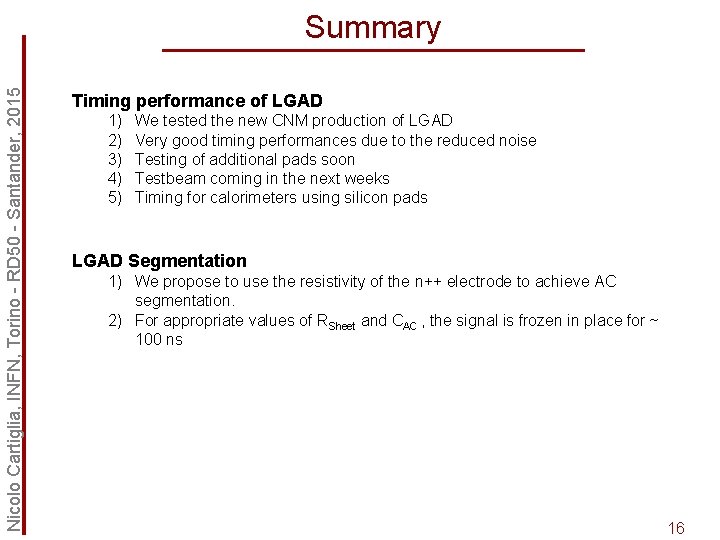
Nicolo Cartiglia, INFN, Torino - RD 50 - Santander, 2015 Summary Timing performance of LGAD 1) 2) 3) 4) 5) We tested the new CNM production of LGAD Very good timing performances due to the reduced noise Testing of additional pads soon Testbeam coming in the next weeks Timing for calorimeters using silicon pads LGAD Segmentation 1) We propose to use the resistivity of the n++ electrode to achieve AC segmentation. 2) For appropriate values of RSheet and CAC , the signal is frozen in place for ~ 100 ns 16
Nicolo Cartiglia, INFN, Torino - RD 50 - Santander, 2015 Extra 17
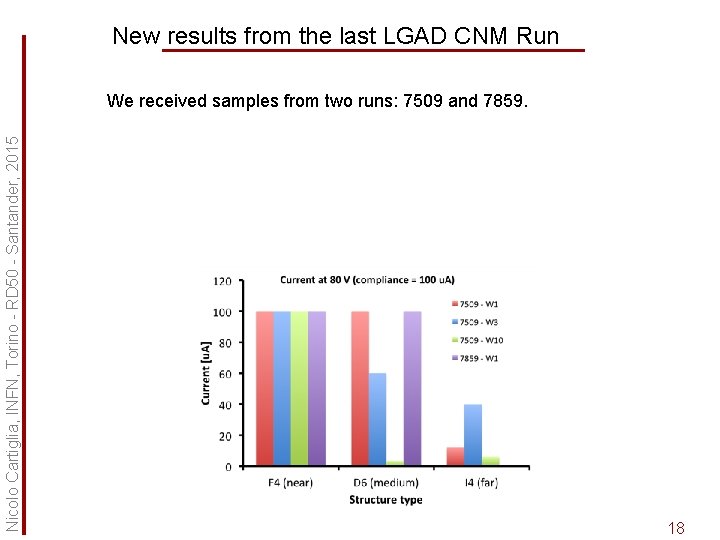
New results from the last LGAD CNM Run Nicolo Cartiglia, INFN, Torino - RD 50 - Santander, 2015 We received samples from two runs: 7509 and 7859. 18