TWOPORT NETWORKS TWOPORT NETWORK Definition A port an


- Slides: 33
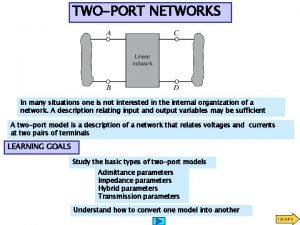
TWO-PORT NETWORKS
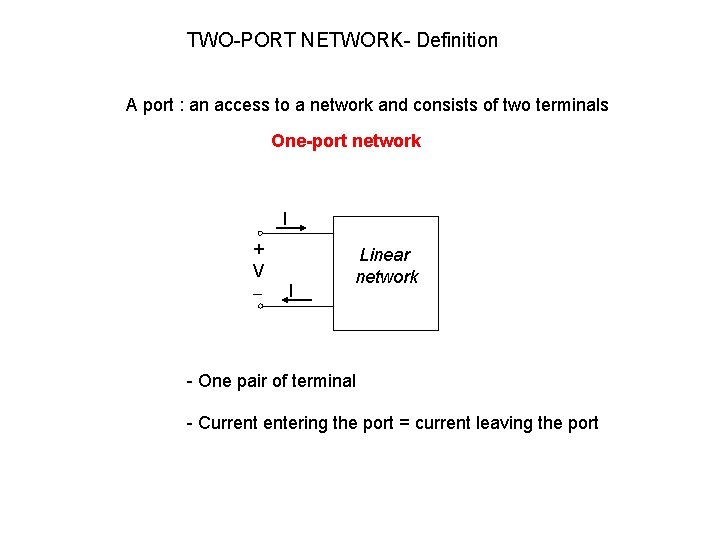
TWO-PORT NETWORK- Definition A port : an access to a network and consists of two terminals One-port network I + V I Linear network - One pair of terminal - Current entering the port = current leaving the port
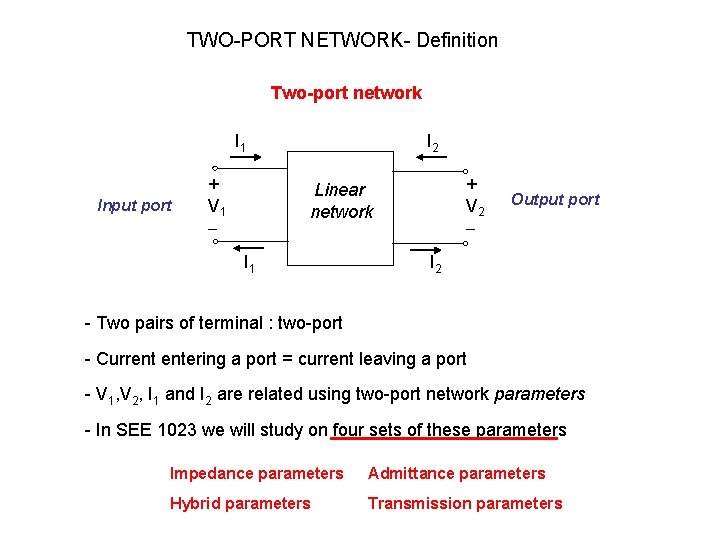
TWO-PORT NETWORK- Definition Two-port network I 1 Input port + V 1 I 2 + V 2 Linear network I 1 Output port I 2 - Two pairs of terminal : two-port - Current entering a port = current leaving a port - V 1, V 2, I 1 and I 2 are related using two-port network parameters - In SEE 1023 we will study on four sets of these parameters Impedance parameters Admittance parameters Hybrid parameters Transmission parameters
TWO-PORT NETWORK Why ? - Typically found in communications, control systems, electronics - used in modeling, designing and analysis - Know how to model two-port network will help in the analysis of larger network - two-port network treated as ‘black box’
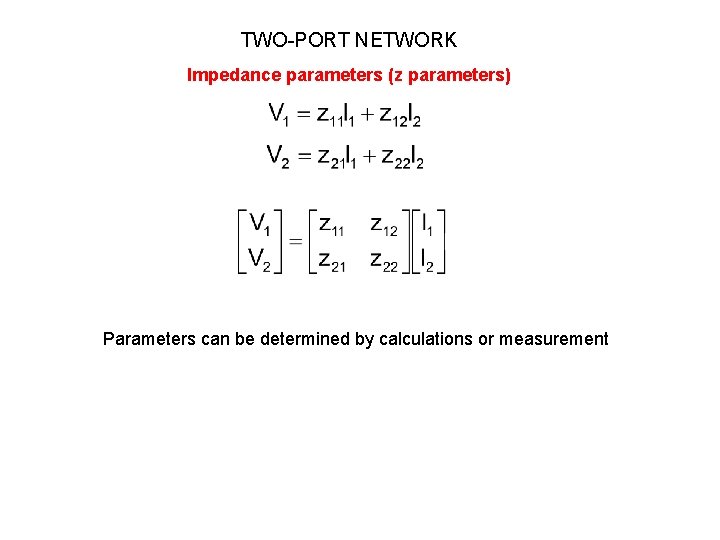
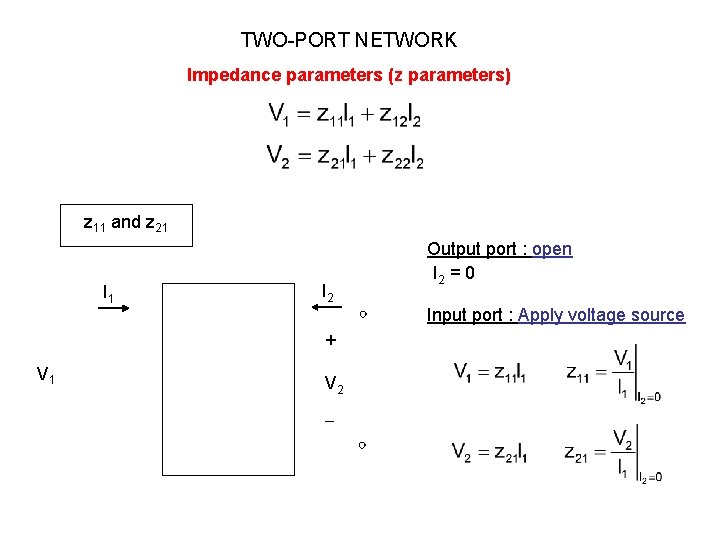
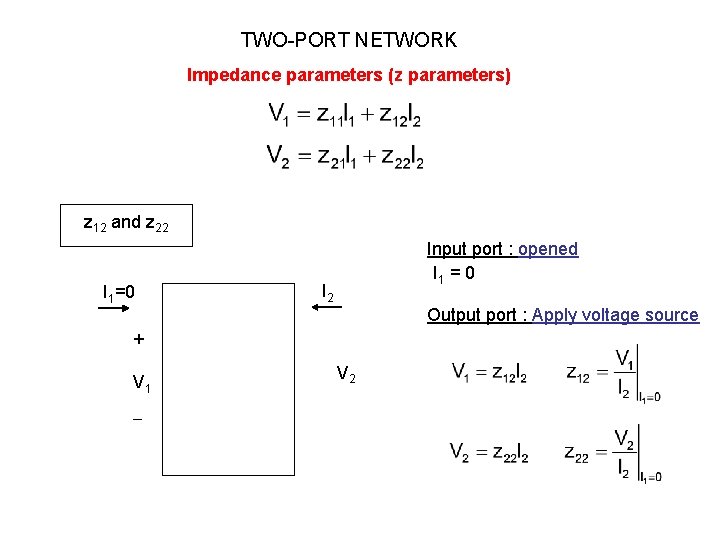
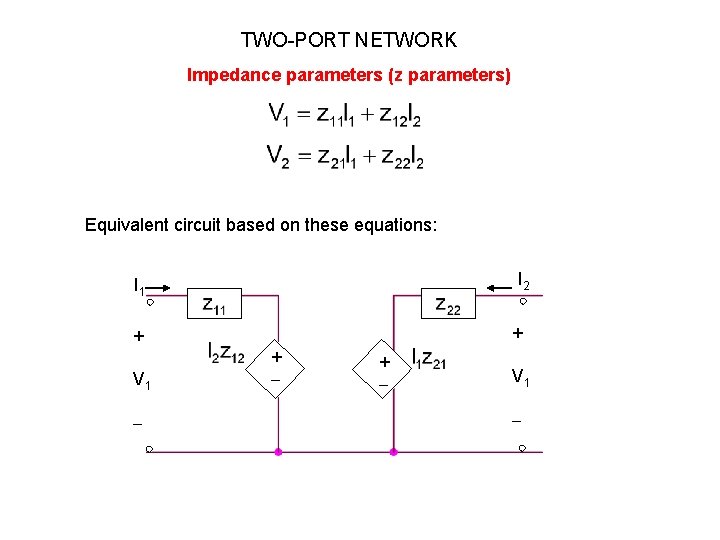
TWO-PORT NETWORK Impedance parameters (z parameters) Parameters can be determined by calculations or measurement
TWO-PORT NETWORK Impedance parameters (z parameters) z 11 and z 21 I 2 Input port : Apply voltage source + V 1 Output port : open I 2 = 0 V 2
TWO-PORT NETWORK Impedance parameters (z parameters) z 12 and z 22 I 1=0 Input port : opened I 1 = 0 I 2 Output port : Apply voltage source + V 1 V 2
TWO-PORT NETWORK Impedance parameters (z parameters) Equivalent circuit based on these equations: I 2 I 1 + + V 1 + + V 1
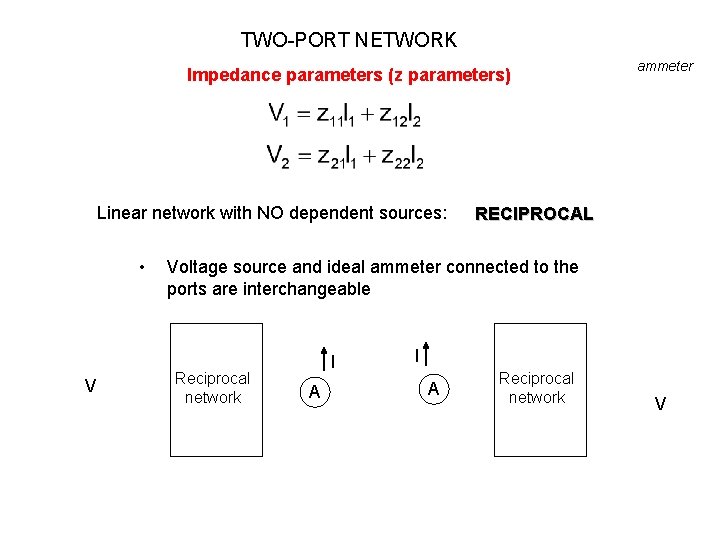
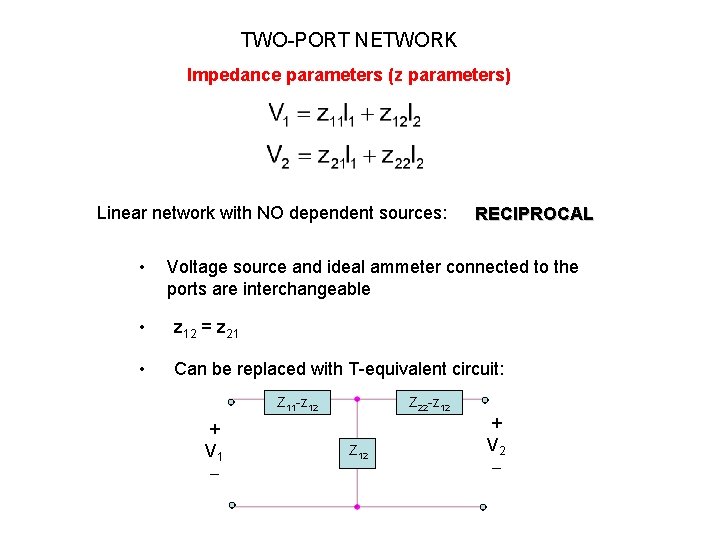
TWO-PORT NETWORK Impedance parameters (z parameters) Linear network with NO dependent sources: • V ammeter RECIPROCAL Voltage source and ideal ammeter connected to the ports are interchangeable Reciprocal network I A Reciprocal network V
TWO-PORT NETWORK Impedance parameters (z parameters) Linear network with NO dependent sources: • RECIPROCAL Voltage source and ideal ammeter connected to the ports are interchangeable • z 12 = z 21 • Can be replaced with T-equivalent circuit: Z 11 -z 12 + V 1 Z 22 -z 12 Z 12 + V 2
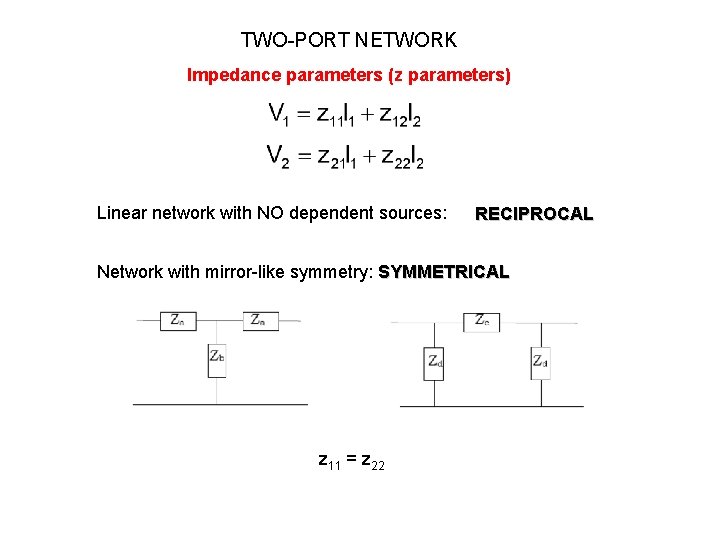
TWO-PORT NETWORK Impedance parameters (z parameters) Linear network with NO dependent sources: RECIPROCAL Network with mirror-like symmetry: SYMMETRICAL z 11 = z 22
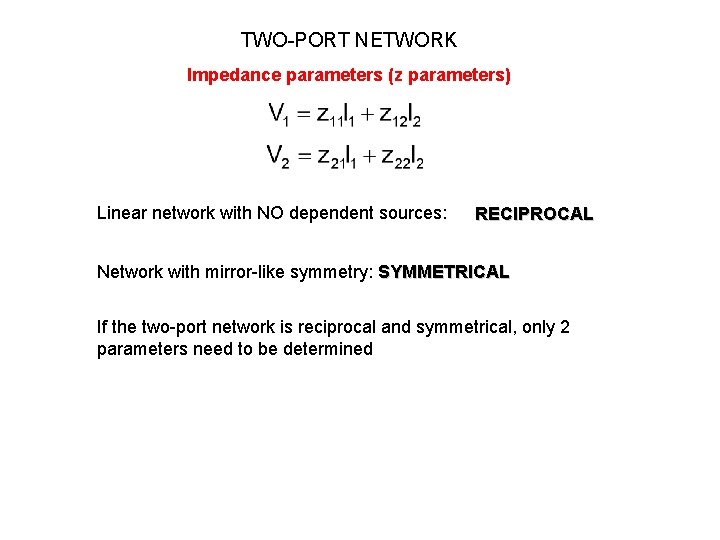
TWO-PORT NETWORK Impedance parameters (z parameters) Linear network with NO dependent sources: RECIPROCAL Network with mirror-like symmetry: SYMMETRICAL If the two-port network is reciprocal and symmetrical, only 2 parameters need to be determined
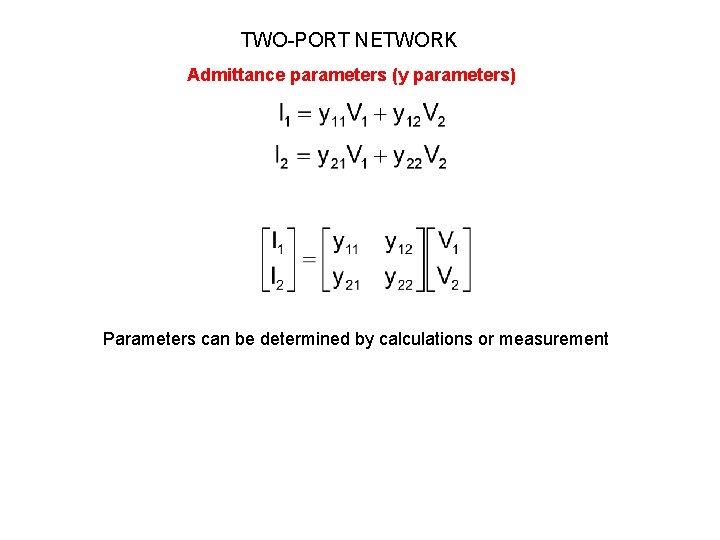
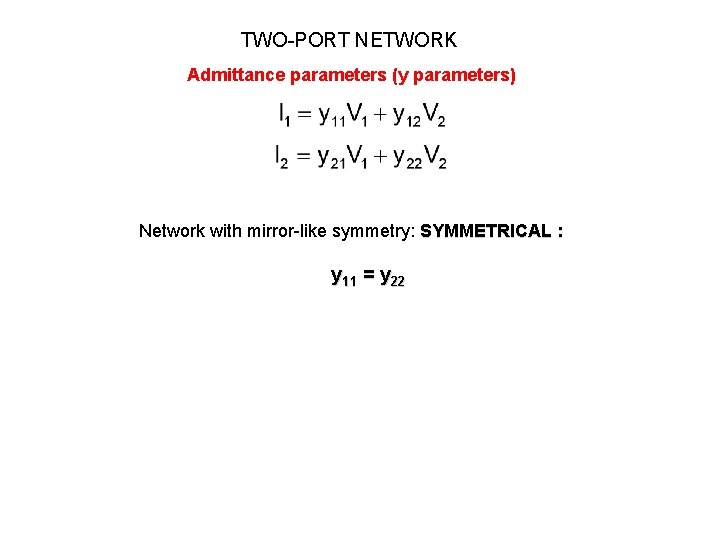
TWO-PORT NETWORK Admittance parameters (y parameters) Parameters can be determined by calculations or measurement
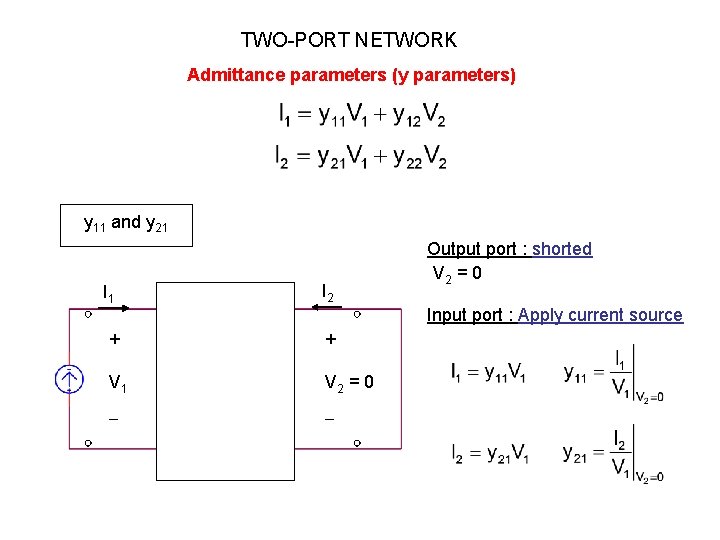
TWO-PORT NETWORK Admittance parameters (y parameters) y 11 and y 21 I 2 + + V 1 V 2 = 0 Output port : shorted V 2 = 0 Input port : Apply current source
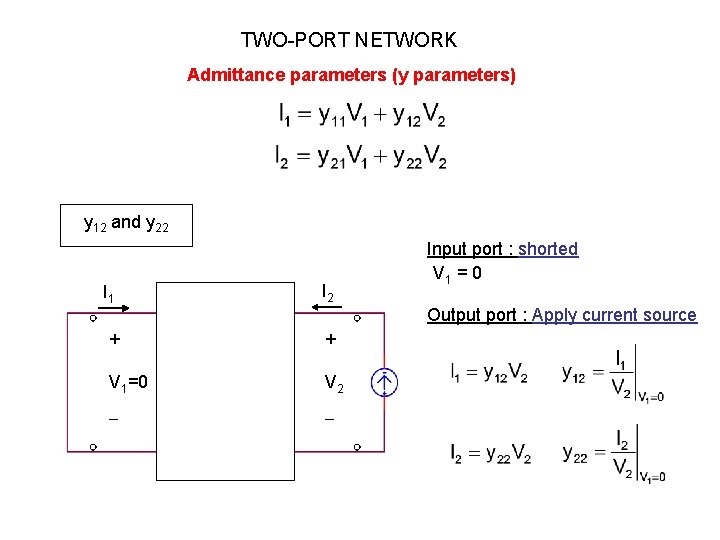
TWO-PORT NETWORK Admittance parameters (y parameters) y 12 and y 22 I 1 I 2 + + V 1=0 V 2 Input port : shorted V 1 = 0 Output port : Apply current source
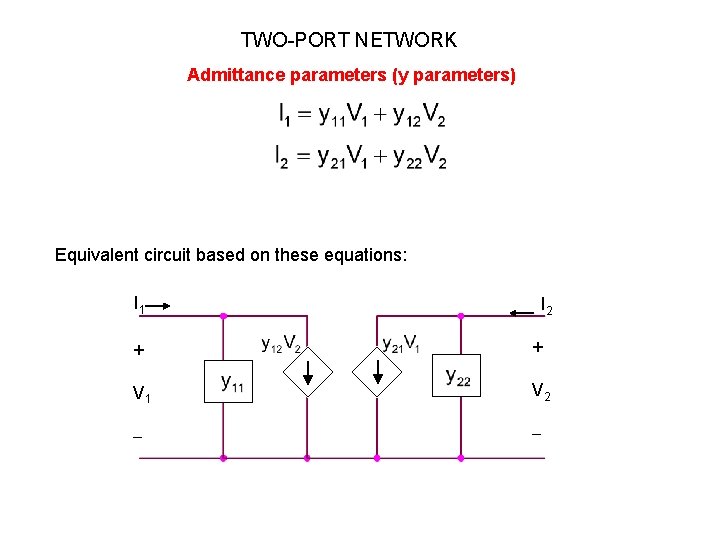
TWO-PORT NETWORK Admittance parameters (y parameters) Equivalent circuit based on these equations: I 1 I 2 + + V 1 V 2
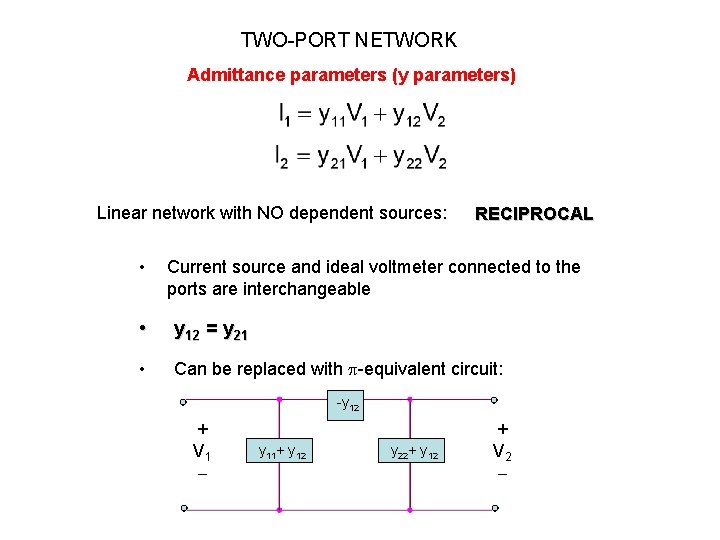
TWO-PORT NETWORK Admittance parameters (y parameters) Linear network with NO dependent sources: • RECIPROCAL Current source and ideal voltmeter connected to the ports are interchangeable • y 12 = y 21 • Can be replaced with -equivalent circuit: -y 12 + V 1 y 11+ y 12 y 22+ y 12 + V 2
TWO-PORT NETWORK Admittance parameters (y parameters) Network with mirror-like symmetry: SYMMETRICAL : y 11 = y 22
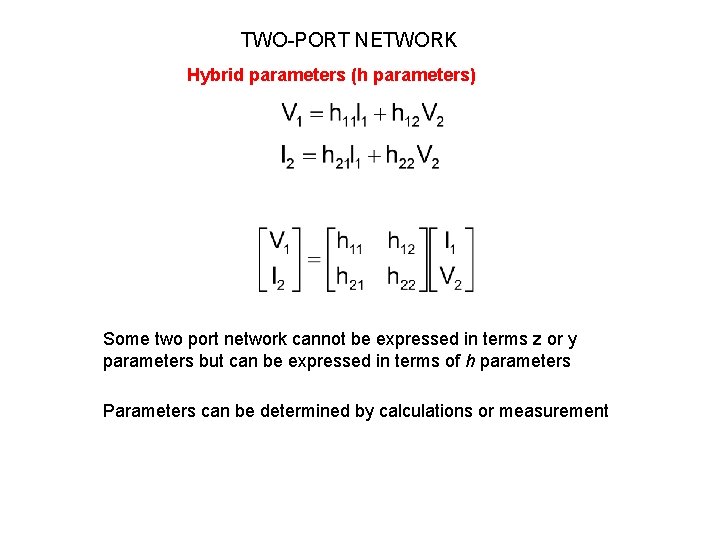
TWO-PORT NETWORK Hybrid parameters (h parameters) Some two port network cannot be expressed in terms z or y parameters but can be expressed in terms of h parameters Parameters can be determined by calculations or measurement
TWO-PORT NETWORK Hybrid parameters (h parameters) h 11 and h 21 I 2 + + Output port : shorted V 2 = 0 Input port : Apply current source V 1 V 2 = 0 ( )
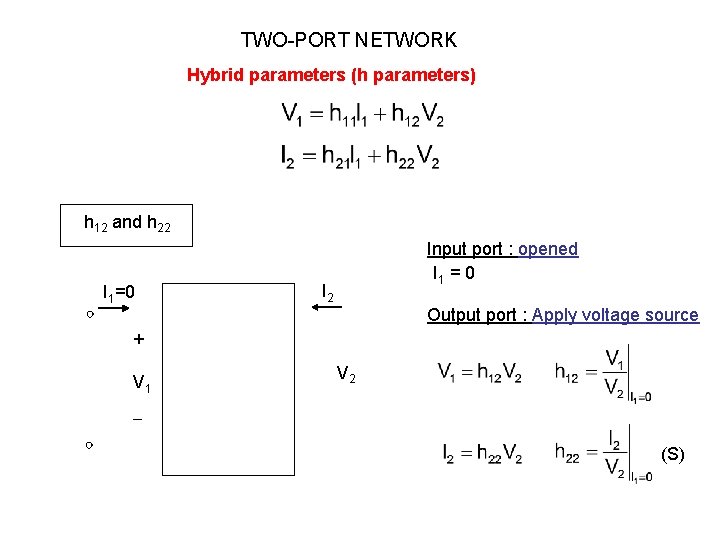
TWO-PORT NETWORK Hybrid parameters (h parameters) h 12 and h 22 I 1=0 Input port : opened I 1 = 0 I 2 Output port : Apply voltage source + V 1 V 2 (S)
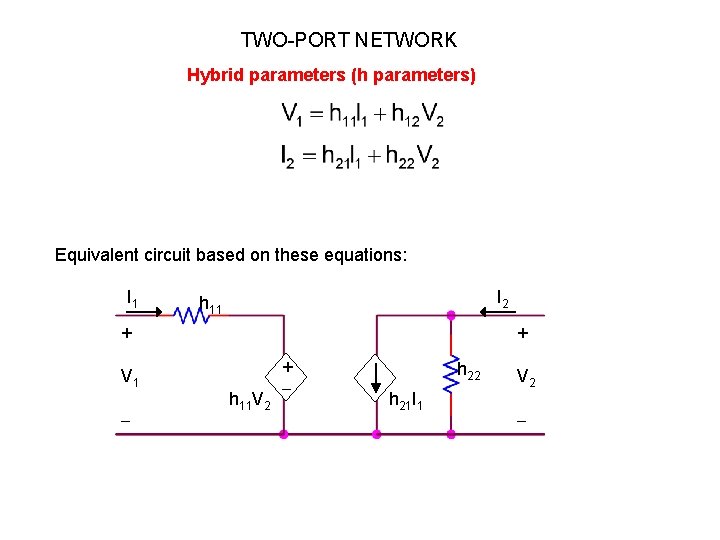
TWO-PORT NETWORK Hybrid parameters (h parameters) Equivalent circuit based on these equations: I 1 I 2 h 11 + V 1 + h 11 V 2 + h 22 h 21 I 1 V 2
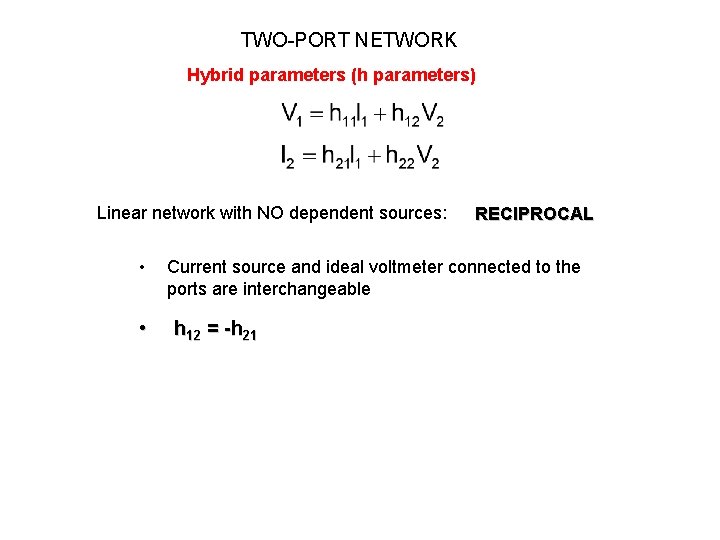
TWO-PORT NETWORK Hybrid parameters (h parameters) Linear network with NO dependent sources: • • RECIPROCAL Current source and ideal voltmeter connected to the ports are interchangeable h 12 = -h 21
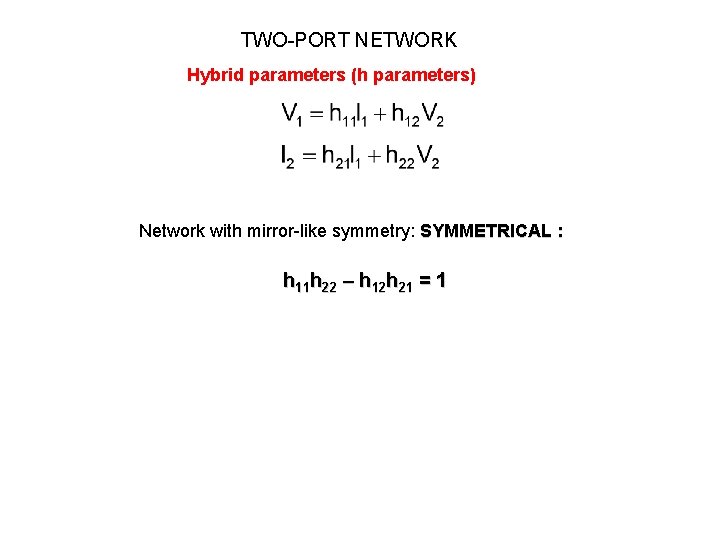
TWO-PORT NETWORK Hybrid parameters (h parameters) Network with mirror-like symmetry: SYMMETRICAL : h 11 h 22 – h 12 h 21 = 1
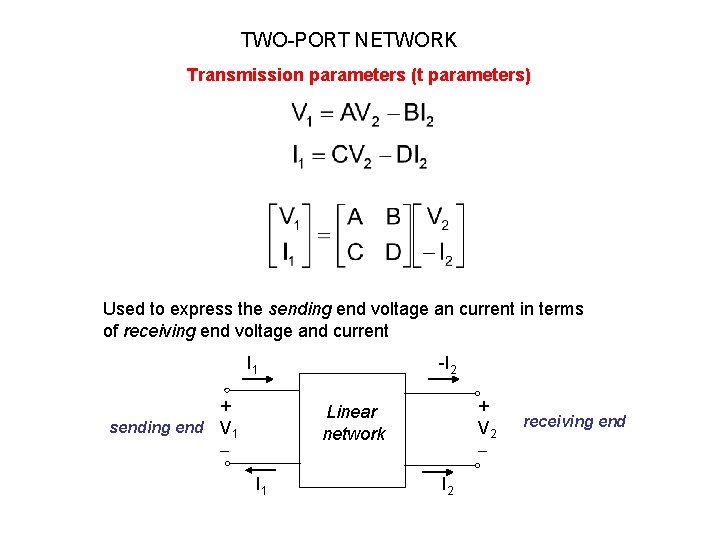
TWO-PORT NETWORK Transmission parameters (t parameters) Used to express the sending end voltage an current in terms of receiving end voltage and current I 1 + sending end V 1 -I 2 + V 2 Linear network I 1 I 2 receiving end
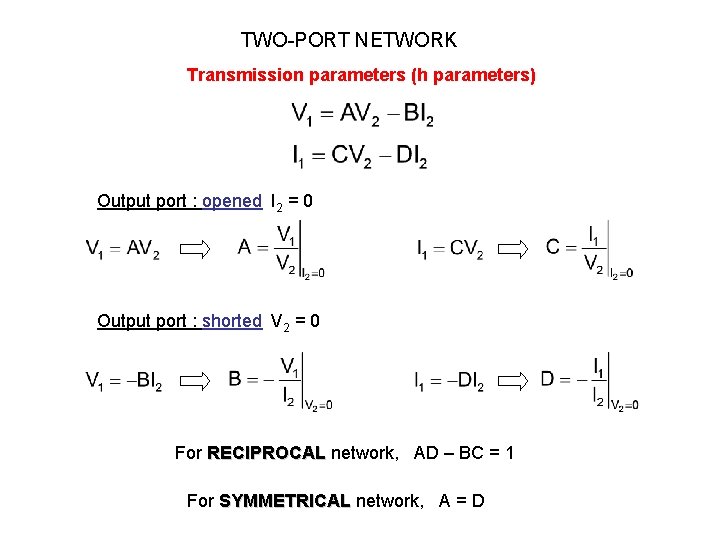
TWO-PORT NETWORK Transmission parameters (h parameters) Output port : opened I 2 = 0 Output port : shorted V 2 = 0 For RECIPROCAL network, AD – BC = 1 For SYMMETRICAL network, A = D
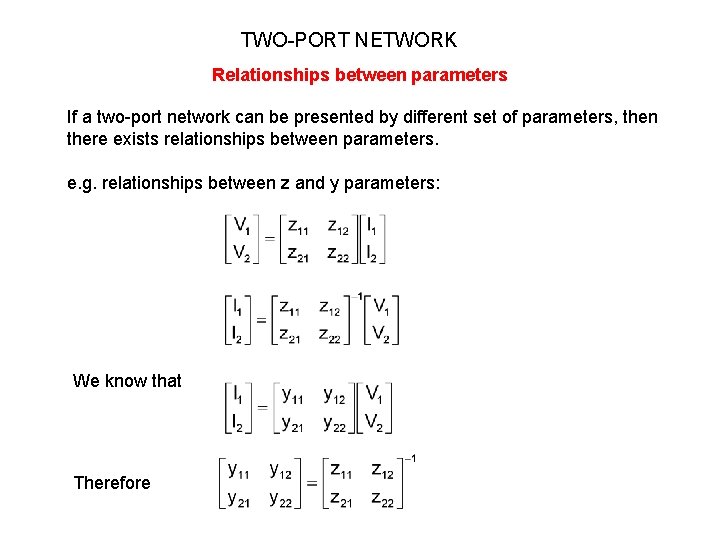
TWO-PORT NETWORK Relationships between parameters If a two-port network can be presented by different set of parameters, then there exists relationships between parameters. e. g. relationships between z and y parameters: We know that Therefore
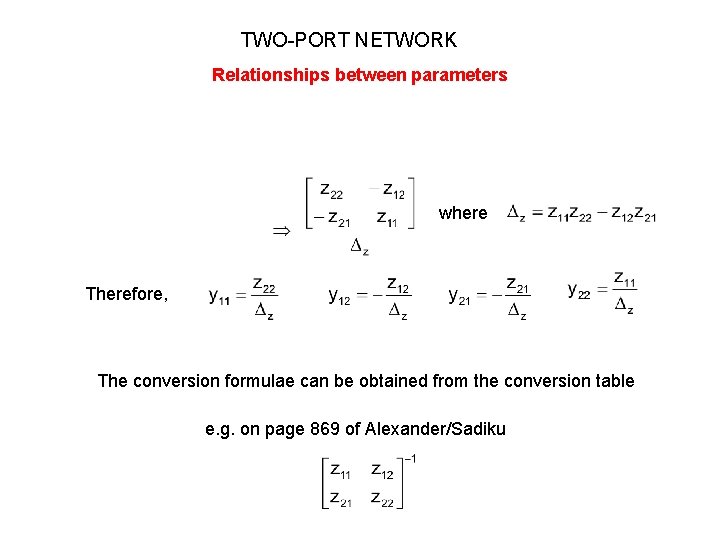
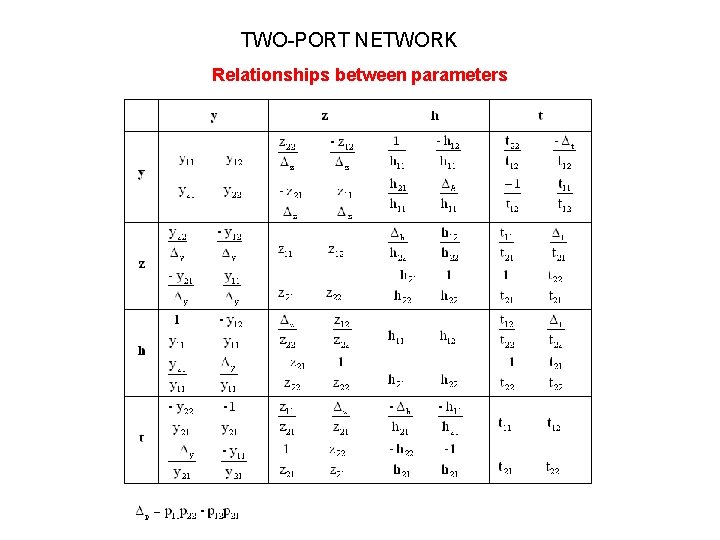
TWO-PORT NETWORK Relationships between parameters where Therefore, The conversion formulae can be obtained from the conversion table e. g. on page 869 of Alexander/Sadiku
TWO-PORT NETWORK Relationships between parameters
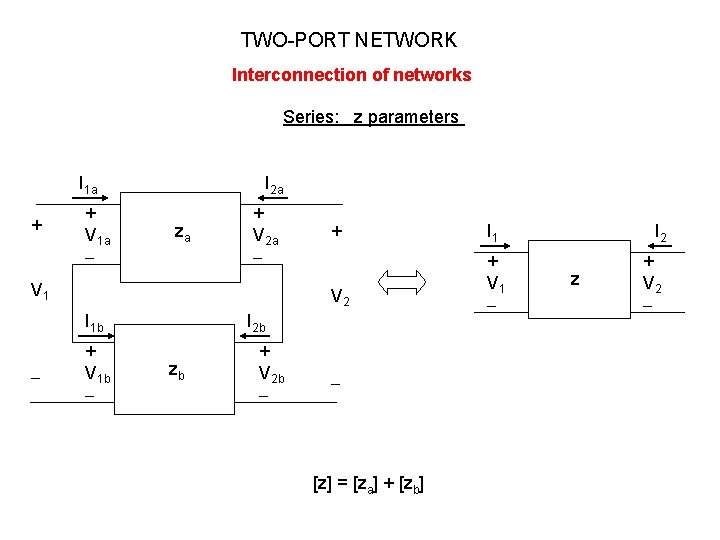
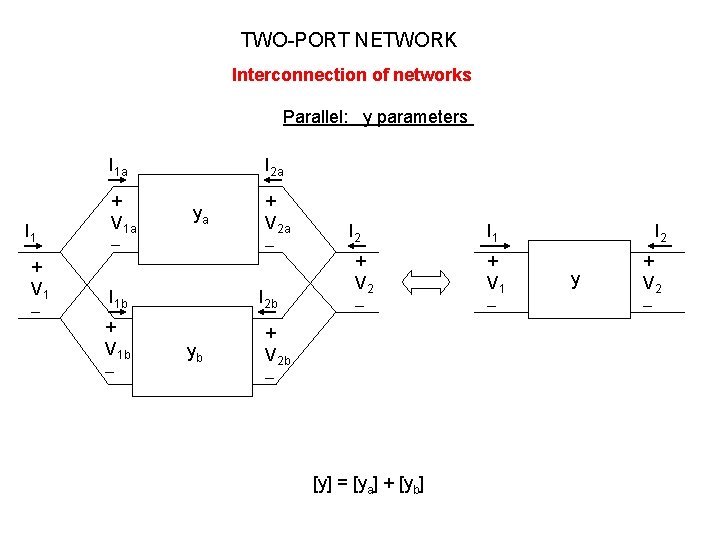
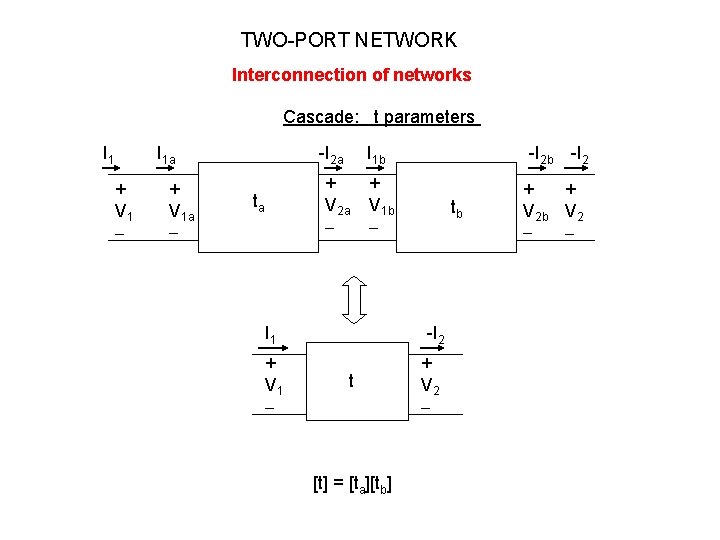
TWO-PORT NETWORK Interconnection of networks Complex large network can be modeled with interconnected two-port networks • Simplify the analysis /synthesis • Simplify the design Parameters of interconnected two-port networks can be obtained easily: depending on the type of parameters and type of connections: • Series: z parameters • Parallel: y parameters • Cascade: transmission parameters
TWO-PORT NETWORK Interconnection of networks Series: z parameters I 2 a I 1 a + + V 1 a za + V 2 a V 1 I 1 V 2 + V 1 I 2 b I 1 b + V 1 b + zb + V 2 b [z] = [za] + [zb] I 2 z + V 2
TWO-PORT NETWORK Interconnection of networks Parallel: y parameters I 1 a I 1 + V 1 a I 2 a ya I 1 b + V 1 b + V 2 a I 2 b yb I 2 + V 2 b [y] = [ya] + [yb] I 1 + V 1 I 2 y + V 2
TWO-PORT NETWORK Interconnection of networks Cascade: t parameters I 1 a + V 1 a -I 2 a I 1 b + V 2 a ta + V 1 b I 1 + V 1 -I 2 b -I 2 t [t] = [ta][tb] + V 2 + + V 2 b V 2