TOWARDS 5 G AKE THE SECURITY AND PRIVACY

- Slides: 24
TOWARDS 5 G AKE: THE SECURITY AND PRIVACY OF 3 G/4 G AKA WITH P. -A. FOUQUE (UR 1), B. RICHARD, G. MACARIO-RAT (ORANGE) S. ALT (DGA)
AUTHENTICATED KEY EXCHANGE
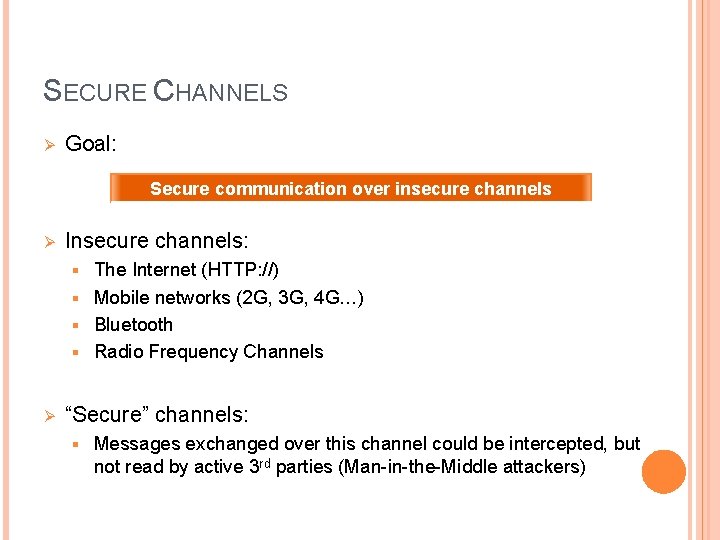
SECURE CHANNELS Ø Goal: Secure communication over insecure channels Ø Insecure channels: The Internet (HTTP: //) § Mobile networks (2 G, 3 G, 4 G…) § Bluetooth § Radio Frequency Channels § Ø “Secure” channels: § Messages exchanged over this channel could be intercepted, but not read by active 3 rd parties (Man-in-the-Middle attackers)
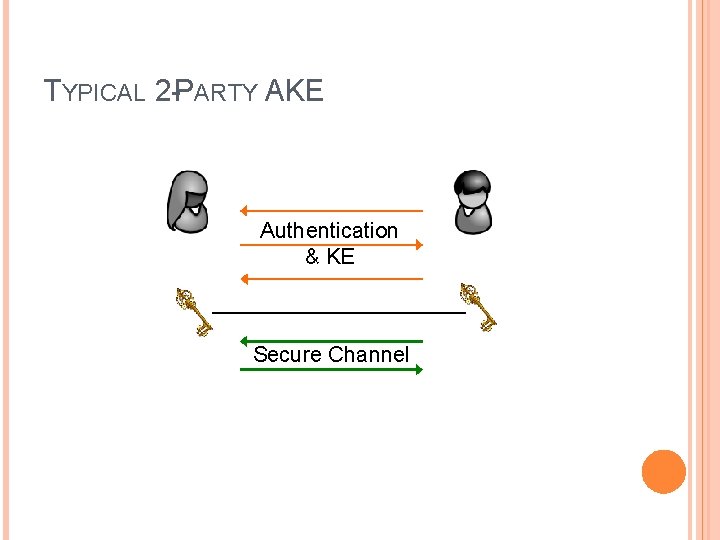
TYPICAL 2 -PARTY AKE Authentication & KE Secure Channel
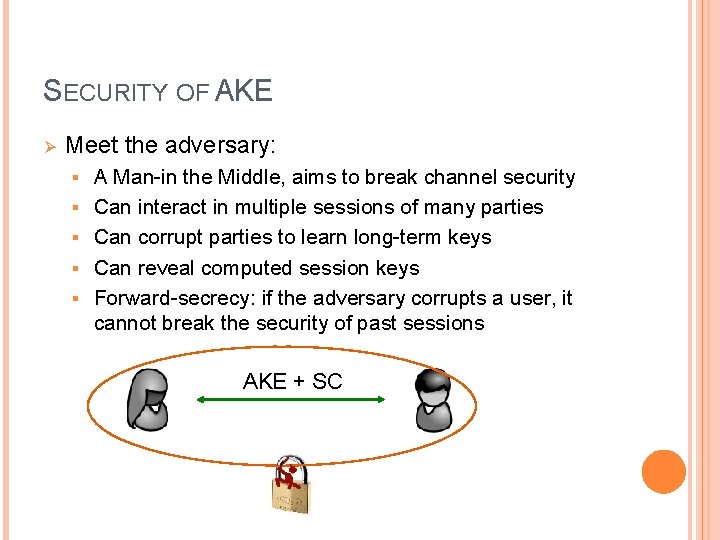
SECURITY OF AKE Ø Meet the adversary: § § § A Man-in the Middle, aims to break channel security Can interact in multiple sessions of many parties Can corrupt parties to learn long-term keys Can reveal computed session keys Forward-secrecy: if the adversary corrupts a user, it cannot break the security of past sessions AKE + SC
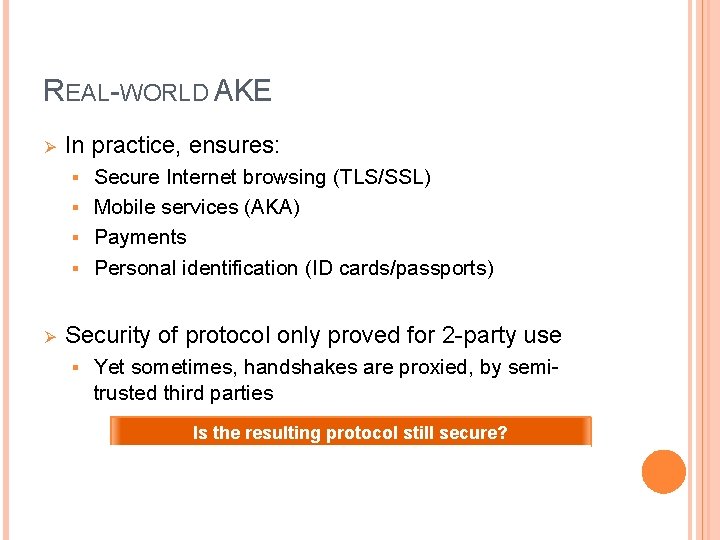
REAL-WORLD AKE Ø In practice, ensures: Secure Internet browsing (TLS/SSL) § Mobile services (AKA) § Payments § Personal identification (ID cards/passports) § Ø Security of protocol only proved for 2 -party use § Yet sometimes, handshakes are proxied, by semitrusted third parties Is the resulting protocol still secure?
THE CASE OF AKA
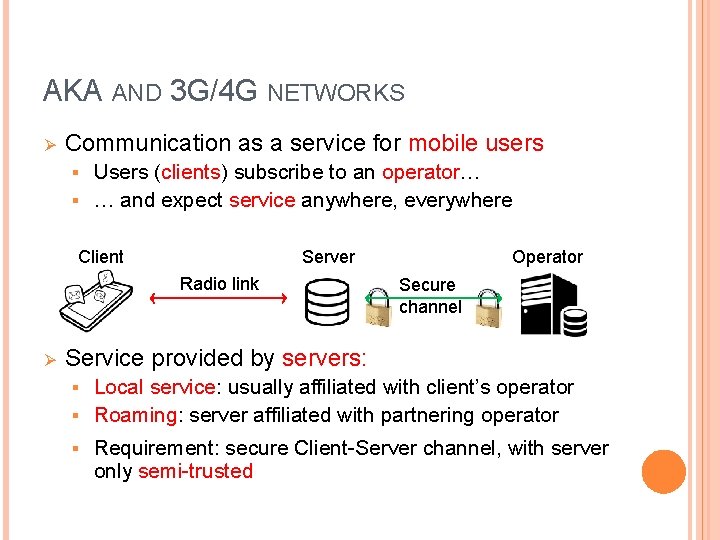
AKA AND 3 G/4 G NETWORKS Ø Communication as a service for mobile users Users (clients) subscribe to an operator… § … and expect service anywhere, everywhere § Client Server Radio link Ø Operator Secure channel Service provided by servers: Local service: usually affiliated with client’s operator § Roaming: server affiliated with partnering operator § § Requirement: secure Client-Server channel, with server only semi-trusted
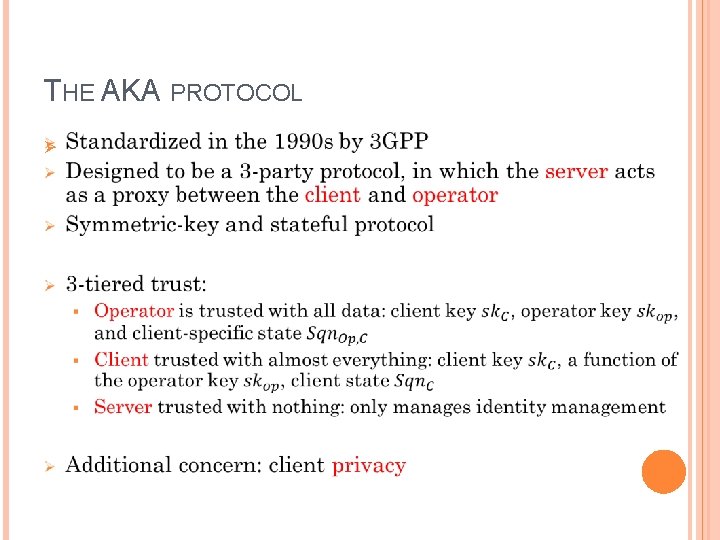
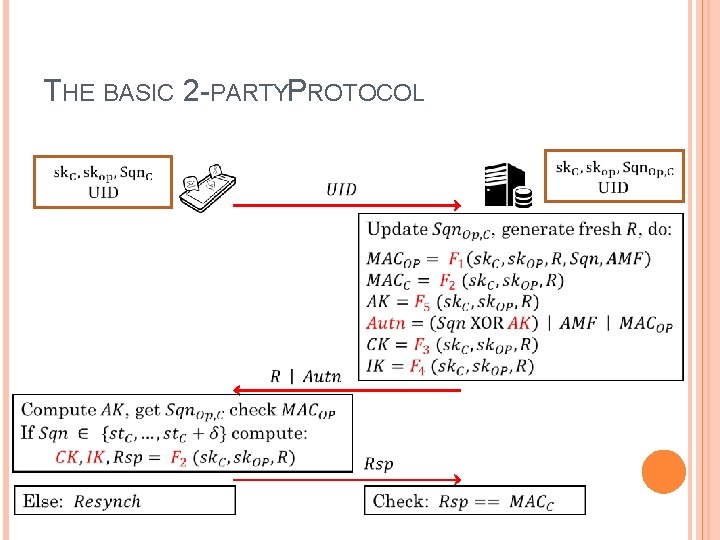
THE AKA PROTOCOL Ø
THE BASIC 2 -PARTYP ROTOCOL
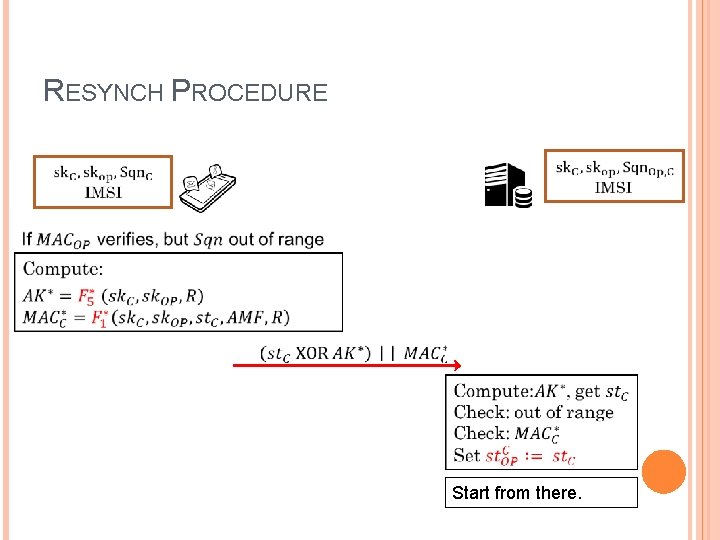
RESYNCH PROCEDURE Start from there.
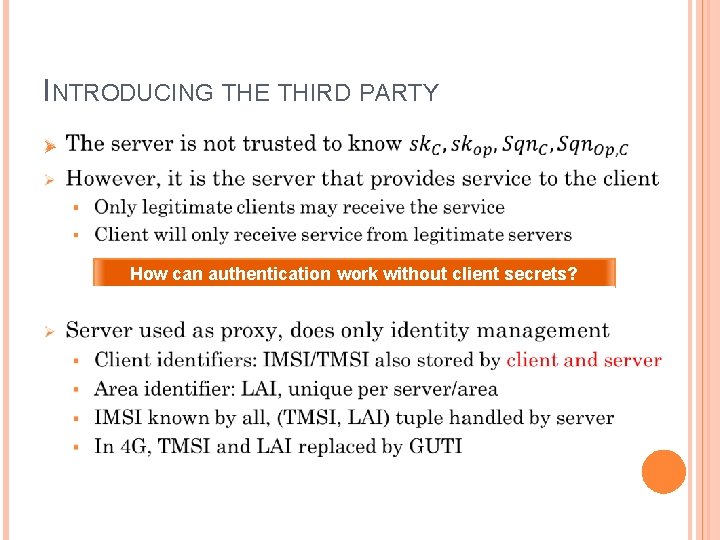
INTRODUCING THE THIRD PARTY Ø How can authentication work without client secrets?
AKA PROTOCOL STRUCTURE Client Operator Server (TMSI, LAI) or IMSI Get IMSI Batch Auth. vectors Challenge-Response TMSI reallocation
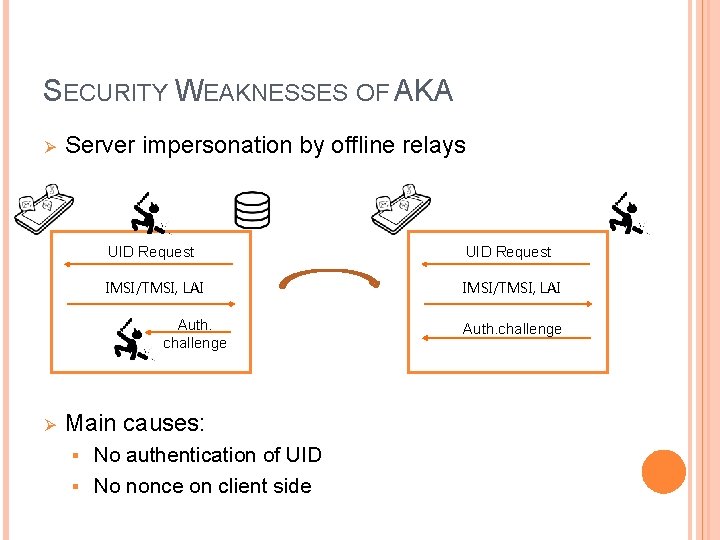
SECURITY WEAKNESSES OF AKA Ø Server impersonation by offline relays UID Request IMSI/TMSI, LAI Auth. challenge Ø Main causes: No authentication of UID § No nonce on client side § Auth. challenge
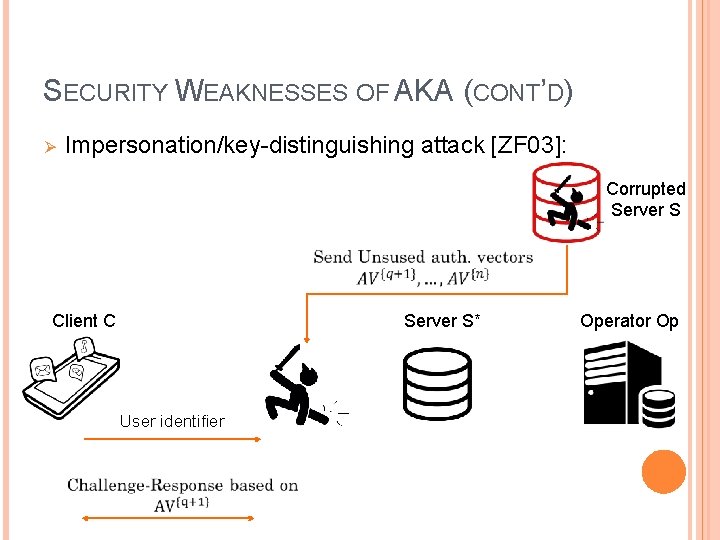
SECURITY WEAKNESSES OF AKA (CONT’D) Ø Impersonation/key-distinguishing attack [ZF 03]: Corrupted Server S Client C Server S* User identifier Operator Op
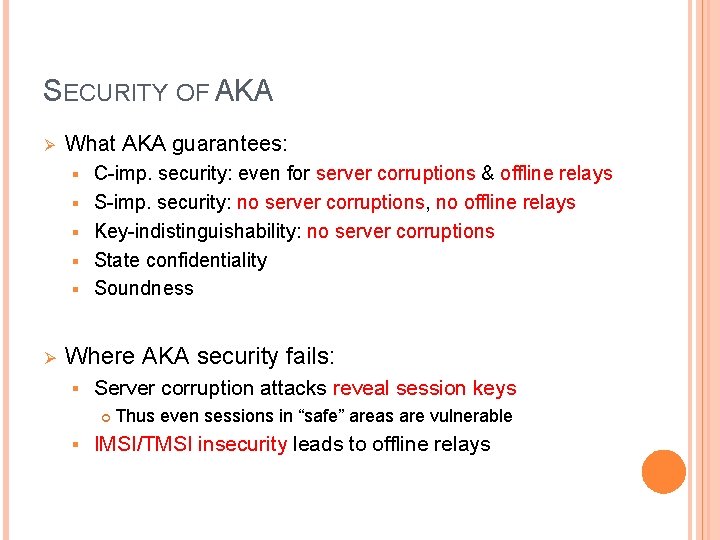
SECURITY OF AKA Ø What AKA guarantees: § § § Ø C-imp. security: even for server corruptions & offline relays S-imp. security: no server corruptions, no offline relays Key-indistinguishability: no server corruptions State confidentiality Soundness Where AKA security fails: § Server corruption attacks reveal session keys § Thus even sessions in “safe” areas are vulnerable IMSI/TMSI insecurity leads to offline relays
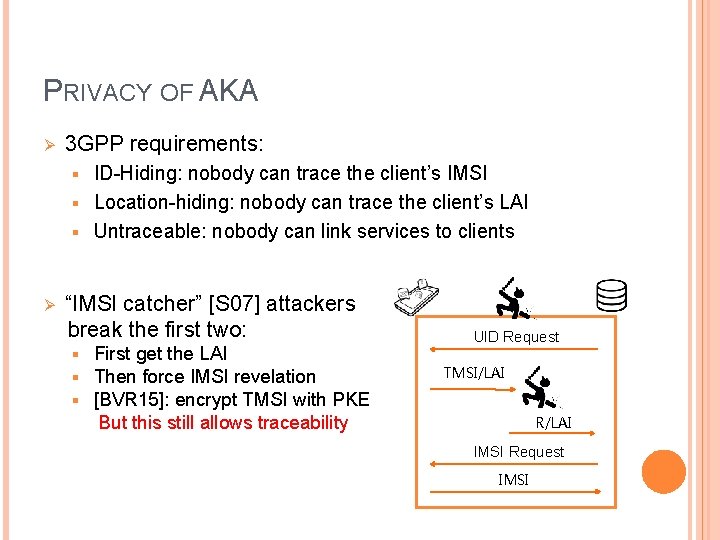
PRIVACY OF AKA Ø 3 GPP requirements: ID-Hiding: nobody can trace the client’s IMSI § Location-hiding: nobody can trace the client’s LAI § Untraceable: nobody can link services to clients § “IMSI catcher” [S 07] attackers break the first two: Ø First get the LAI Then force IMSI revelation [BVR 15]: encrypt TMSI with PKE But this still allows traceability § § § UID Request TMSI/LAI R/LAI IMSI Request IMSI
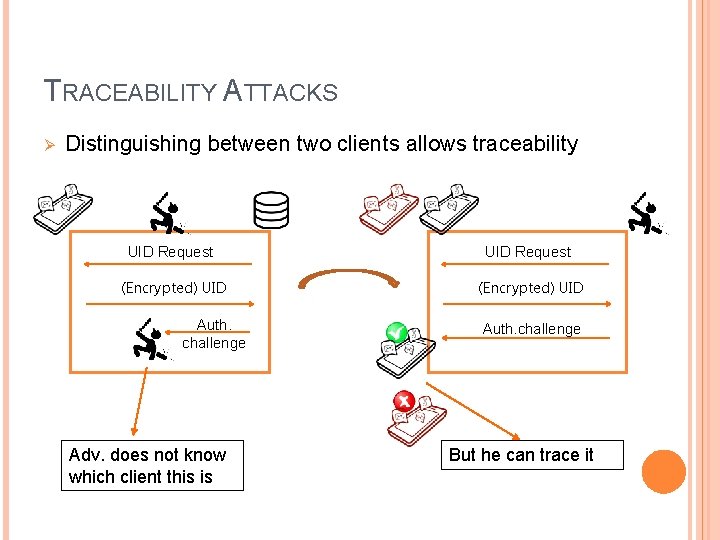
TRACEABILITY ATTACKS Ø Distinguishing between two clients allows traceability UID Request (Encrypted) UID Auth. challenge Adv. does not know which client this is Auth. challenge But he can trace it
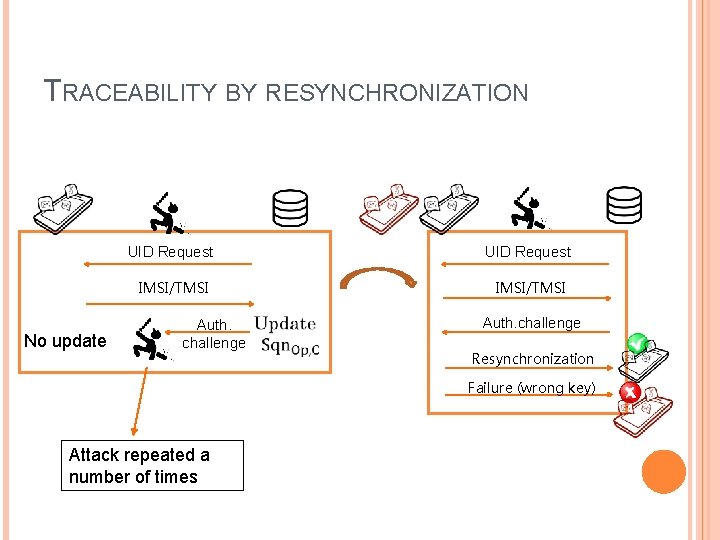
TRACEABILITY BY RESYNCHRONIZATION No update UID Request IMSI/TMSI Auth. challenge Resynchronization Failure (wrong key) Attack repeated a number of times
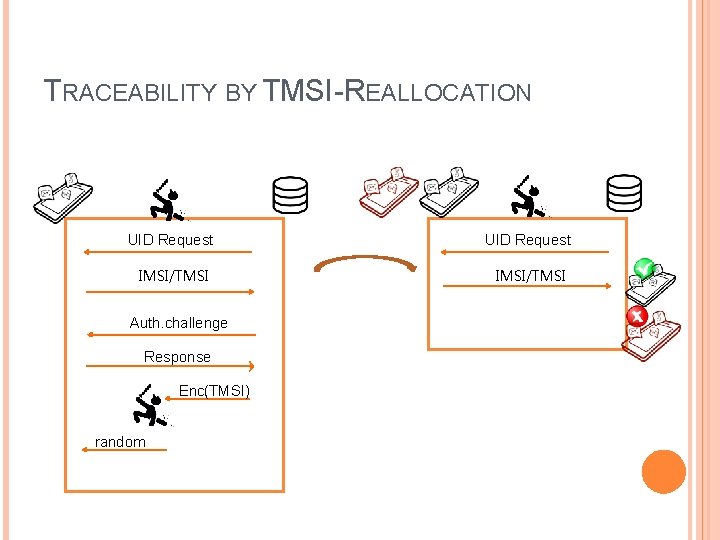
TRACEABILITY BY TMSI-REALLOCATION UID Request IMSI/TMSI Auth. challenge Response Enc(TMSI) random
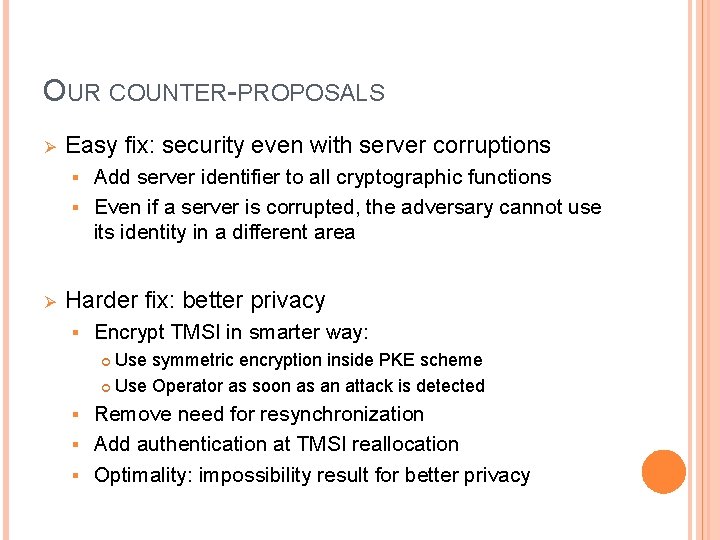
OUR COUNTER-PROPOSALS Ø Easy fix: security even with server corruptions Add server identifier to all cryptographic functions § Even if a server is corrupted, the adversary cannot use its identity in a different area § Ø Harder fix: better privacy § Encrypt TMSI in smarter way: Use symmetric encryption inside PKE scheme Use Operator as soon as an attack is detected Remove need for resynchronization § Add authentication at TMSI reallocation § Optimality: impossibility result for better privacy §
TOWARDS 5 G
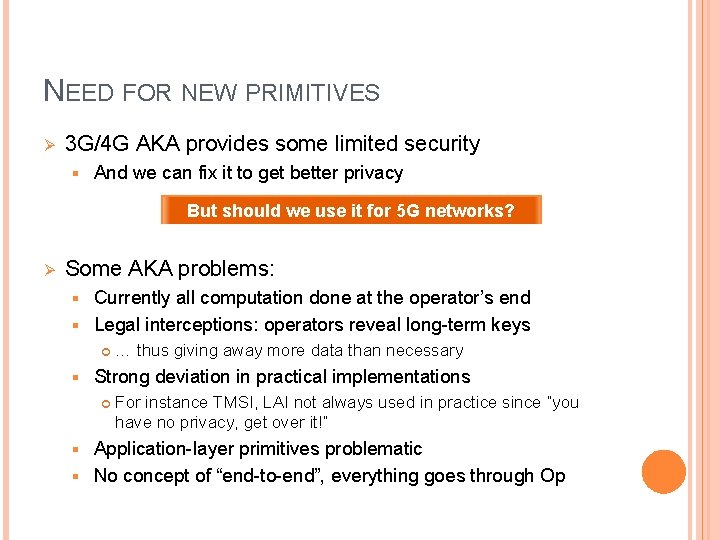
NEED FOR NEW PRIMITIVES Ø 3 G/4 G AKA provides some limited security § And we can fix it to get better privacy But should we use it for 5 G networks? Ø Some AKA problems: Currently all computation done at the operator’s end § Legal interceptions: operators reveal long-term keys § § … thus giving away more data than necessary Strong deviation in practical implementations For instance TMSI, LAI not always used in practice since “you have no privacy, get over it!” Application-layer primitives problematic § No concept of “end-to-end”, everything goes through Op §
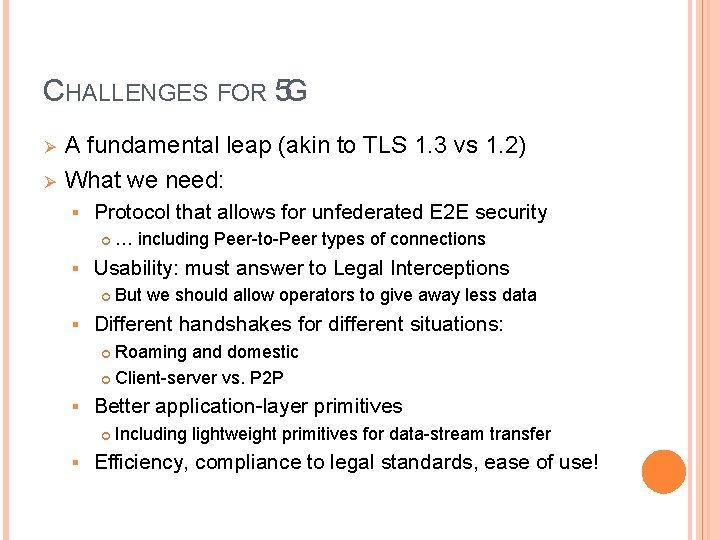
CHALLENGES FOR 5 G Ø Ø A fundamental leap (akin to TLS 1. 3 vs 1. 2) What we need: § Protocol that allows for unfederated E 2 E security § Usability: must answer to Legal Interceptions § … including Peer-to-Peer types of connections But we should allow operators to give away less data Different handshakes for different situations: Roaming and domestic Client-server vs. P 2 P § Better application-layer primitives § Including lightweight primitives for data-stream transfer Efficiency, compliance to legal standards, ease of use!