TopographyGuided Photorefractive Keratectomy TGPRK for Keratoconus KC With
- Slides: 10
Topography-Guided Photorefractive Keratectomy (TG-PRK) for Keratoconus (KC) With Simultaneous Collagen Cross-Linking (CXL): Excimer Laser Simon Holland David TC Lin ASCRS, Chicago, Illinois 2012 *No financial interests Purpose § To evaluate efficacy and safety of simultaneous TG-PRK for KC with simultaneous CXL
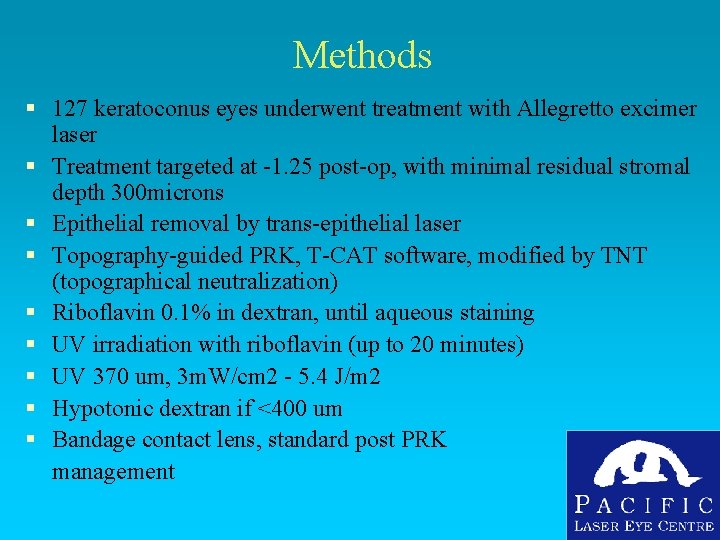
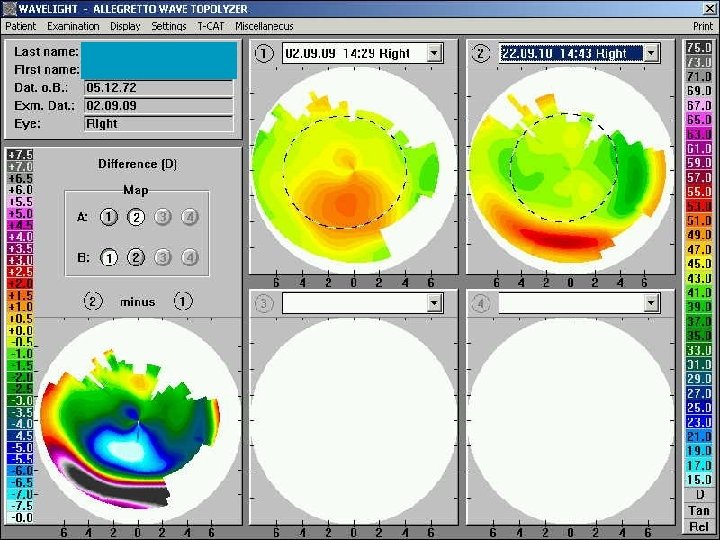
Methods § 127 keratoconus eyes underwent treatment with Allegretto excimer laser § Treatment targeted at -1. 25 post-op, with minimal residual stromal depth 300 microns § Epithelial removal by trans-epithelial laser § Topography-guided PRK, T-CAT software, modified by TNT (topographical neutralization) § Riboflavin 0. 1% in dextran, until aqueous staining § UV irradiation with riboflavin (up to 20 minutes) § UV 370 um, 3 m. W/cm 2 - 5. 4 J/m 2 § Hypotonic dextran if <400 um § Bandage contact lens, standard post PRK management
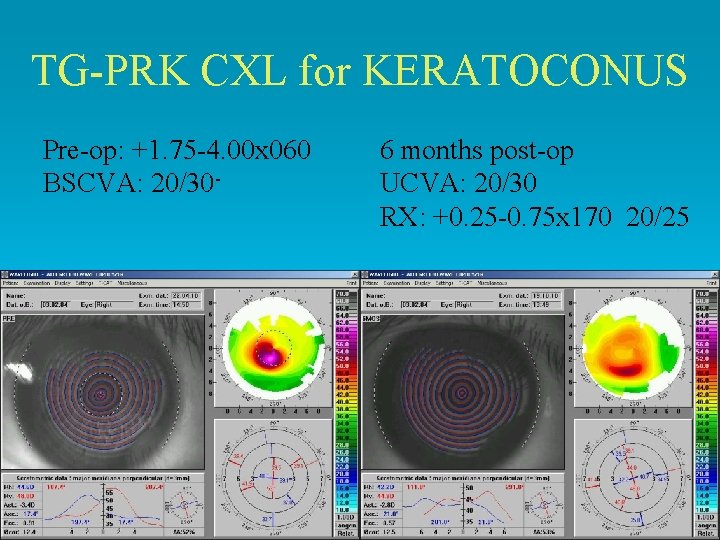
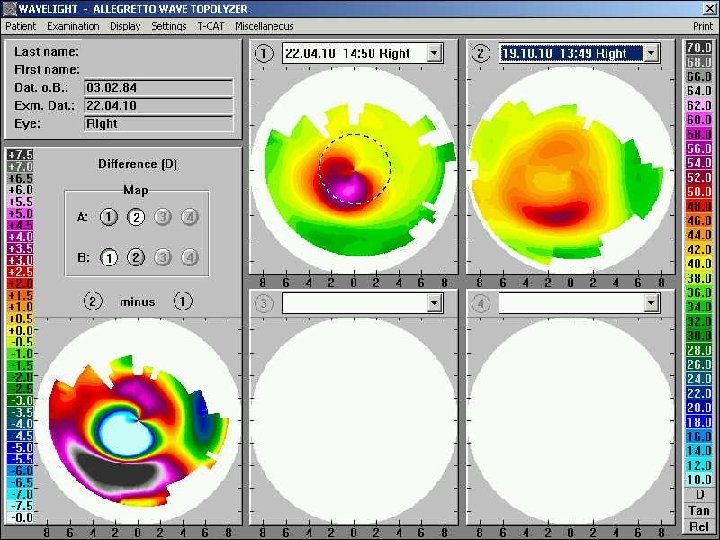
TG-PRK CXL for KERATOCONUS Pre-op: +1. 75 -4. 00 x 060 BSCVA: 20/30 - 6 months post-op UCVA: 20/30 RX: +0. 25 -0. 75 x 170 20/25
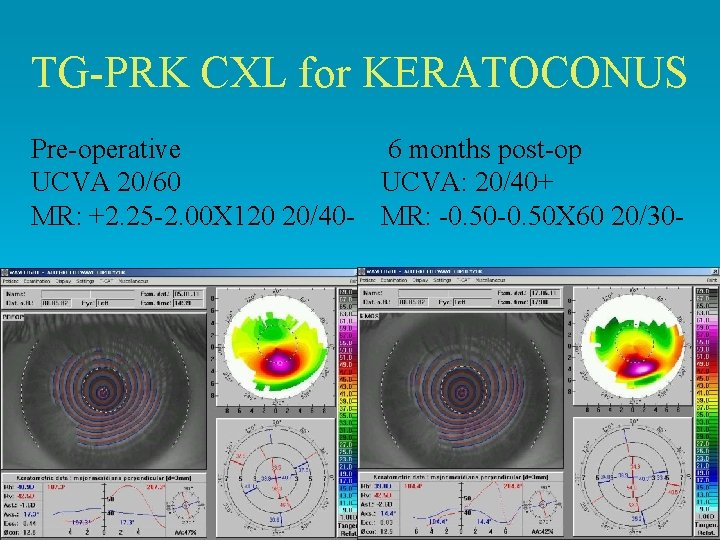
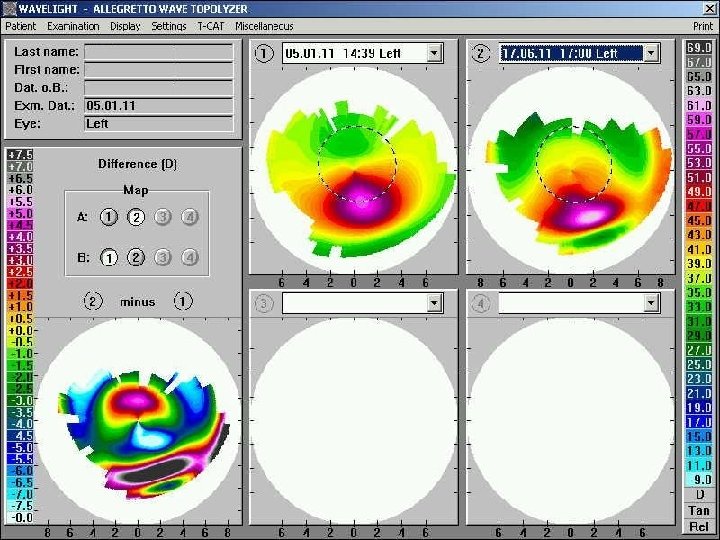
TG-PRK CXL for KERATOCONUS Pre-operative 6 months post-op UCVA 20/60 UCVA: 20/40+ MR: +2. 25 -2. 00 X 120 20/40 - MR: -0. 50 X 60 20/30 -
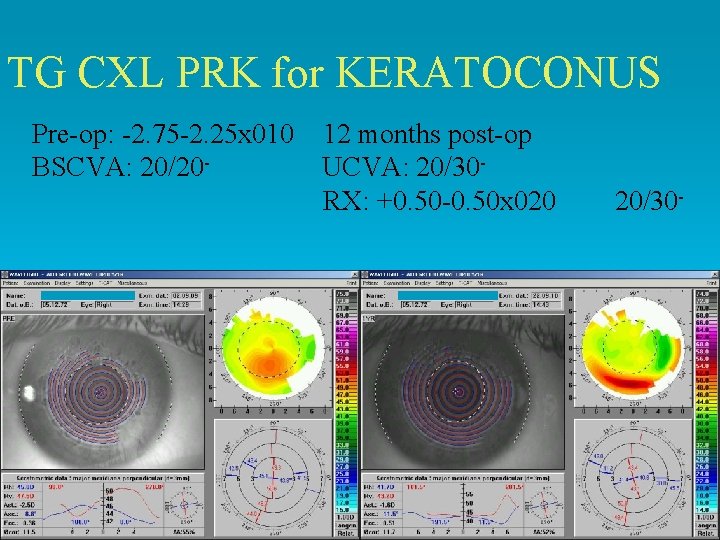
TG CXL PRK for KERATOCONUS Pre-op: -2. 75 -2. 25 x 010 BSCVA: 20/20 - 12 months post-op UCVA: 20/30 RX: +0. 50 -0. 50 x 020 20/30 -
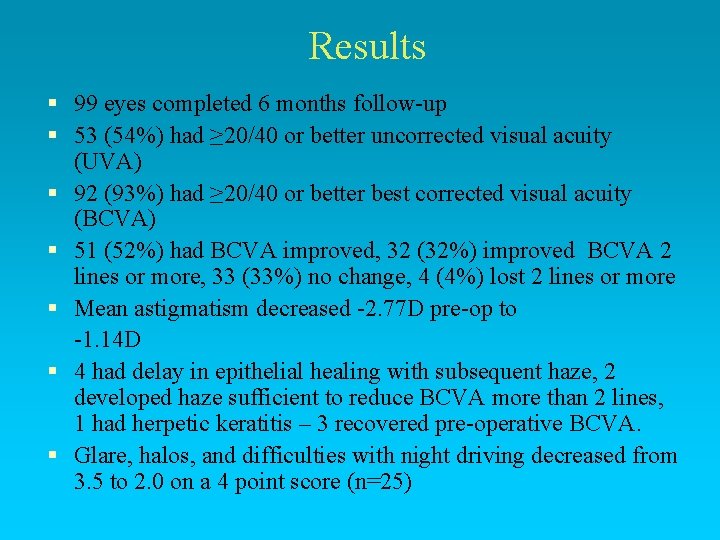
Results § 99 eyes completed 6 months follow-up § 53 (54%) had ≥ 20/40 or better uncorrected visual acuity (UVA) § 92 (93%) had ≥ 20/40 or better best corrected visual acuity (BCVA) § 51 (52%) had BCVA improved, 32 (32%) improved BCVA 2 lines or more, 33 (33%) no change, 4 (4%) lost 2 lines or more § Mean astigmatism decreased -2. 77 D pre-op to -1. 14 D § 4 had delay in epithelial healing with subsequent haze, 2 developed haze sufficient to reduce BCVA more than 2 lines, 1 had herpetic keratitis – 3 recovered pre-operative BCVA. § Glare, halos, and difficulties with night driving decreased from 3. 5 to 2. 0 on a 4 point score (n=25)
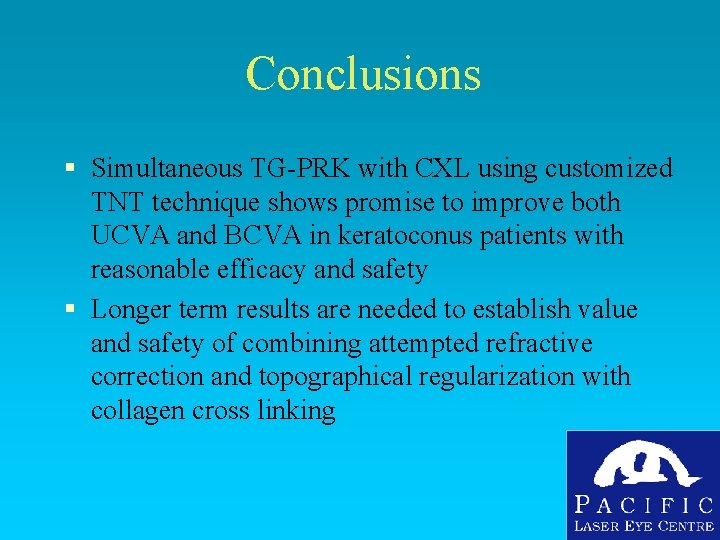
Conclusions § Simultaneous TG-PRK with CXL using customized TNT technique shows promise to improve both UCVA and BCVA in keratoconus patients with reasonable efficacy and safety § Longer term results are needed to establish value and safety of combining attempted refractive correction and topographical regularization with collagen cross linking