Topic 15 Implementing and Using Stacks stack n

- Slides: 30
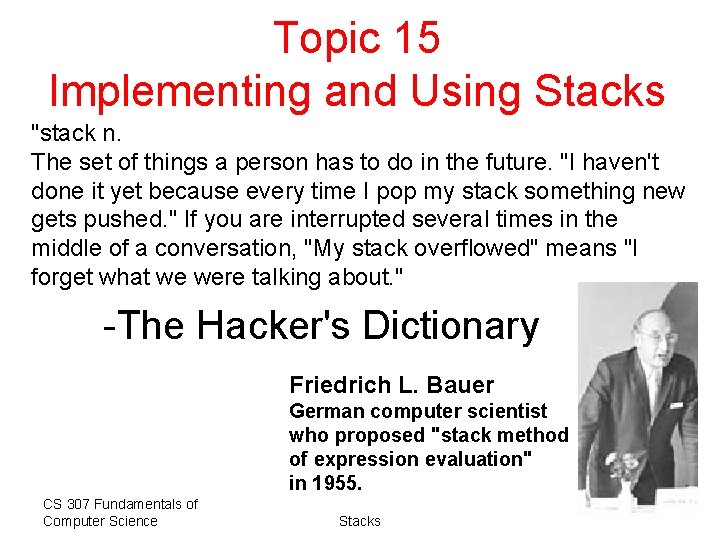
Topic 15 Implementing and Using Stacks "stack n. The set of things a person has to do in the future. "I haven't done it yet because every time I pop my stack something new gets pushed. " If you are interrupted several times in the middle of a conversation, "My stack overflowed" means "I forget what we were talking about. " -The Hacker's Dictionary Friedrich L. Bauer German computer scientist who proposed "stack method of expression evaluation" in 1955. CS 307 Fundamentals of Computer Science Stacks 1
Stack Overflow CS 307 Fundamentals of Computer Science Stacks 2
Sharper Tools Stacks Lists CS 307 Fundamentals of Computer Science Stacks 3
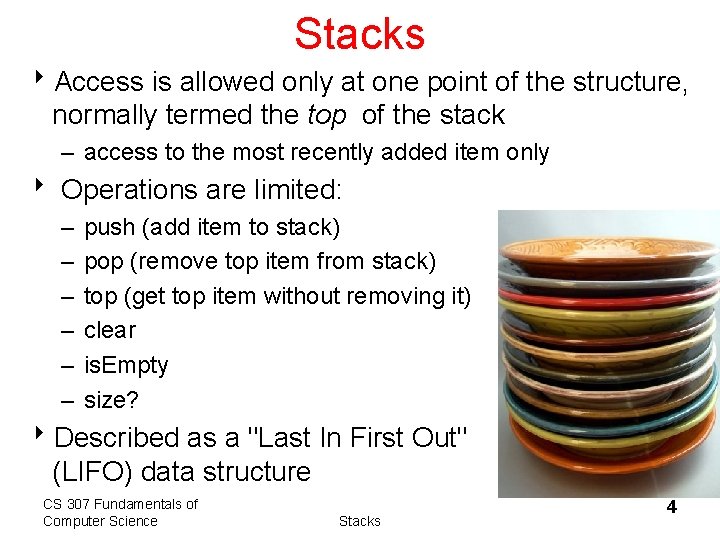
Stacks 8 Access is allowed only at one point of the structure, normally termed the top of the stack – access to the most recently added item only 8 Operations are limited: – – – push (add item to stack) pop (remove top item from stack) top (get top item without removing it) clear is. Empty size? 8 Described as a "Last In First Out" (LIFO) data structure CS 307 Fundamentals of Computer Science Stacks 4
Stack Operations Assume a simple stack for integers. Stack s = new Stack(); s. push(12); s. push(4); s. push( s. top() + 2 ); s. pop() s. push( s. top() ); //what are contents of stack? CS 307 Fundamentals of Computer Science Stacks 5
Stack Operations Write a method to print out contents of stack in reverse order. CS 307 Fundamentals of Computer Science Stacks 6
Common Stack Error Stack s = new Stack(); // put stuff in stack for(int i = 0; i < 5; i++) s. push( i ); // print out contents of stack // while emptying it. (? ? ) for(int i = 0; i < s. size(); i++) System. out. print( s. pop() + “ “); // What is output? CS 307 Fundamentals of Computer Science Stacks 7
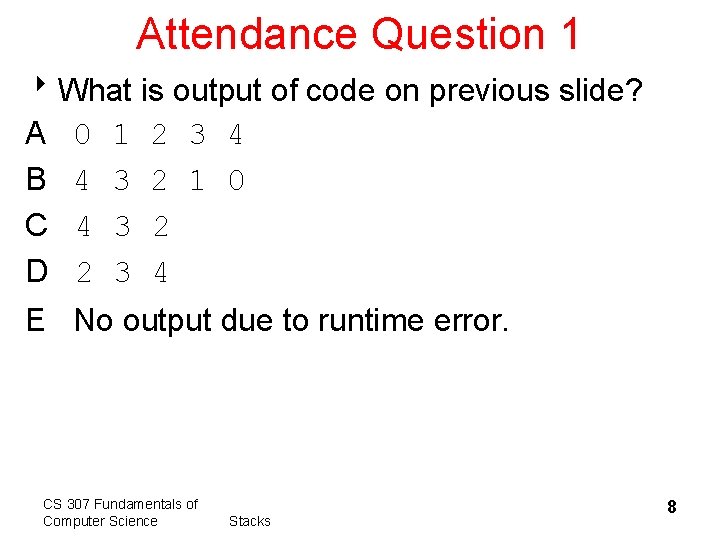
Attendance Question 1 8 What is output of code on previous slide? A 0 1 2 3 4 B 4 3 2 1 0 C 4 3 2 D 2 3 4 E No output due to runtime error. CS 307 Fundamentals of Computer Science Stacks 8
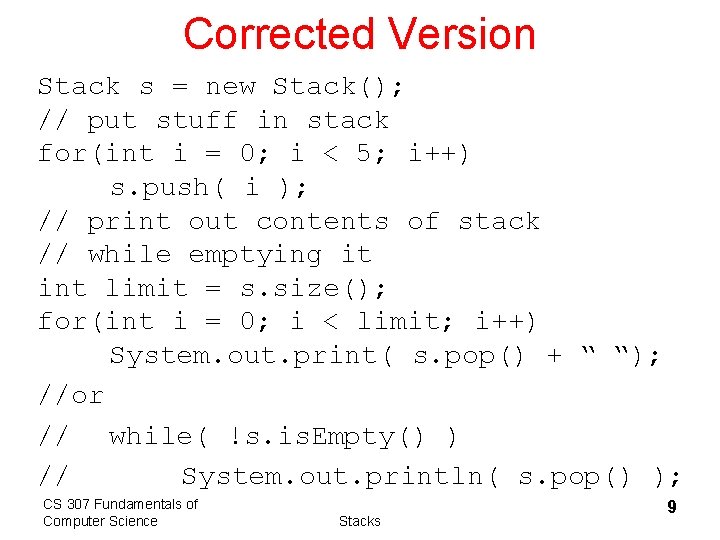
Corrected Version Stack s = new Stack(); // put stuff in stack for(int i = 0; i < 5; i++) s. push( i ); // print out contents of stack // while emptying it int limit = s. size(); for(int i = 0; i < limit; i++) System. out. print( s. pop() + “ “); //or // while( !s. is. Empty() ) // System. out. println( s. pop() ); CS 307 Fundamentals of Computer Science Stacks 9
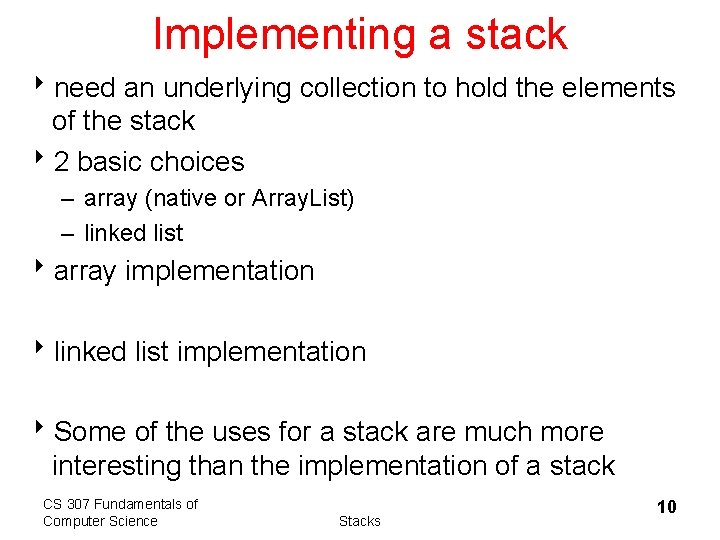
Implementing a stack 8 need an underlying collection to hold the elements of the stack 82 basic choices – array (native or Array. List) – linked list 8 array implementation 8 linked list implementation 8 Some of the uses for a stack are much more interesting than the implementation of a stack CS 307 Fundamentals of Computer Science Stacks 10
Applications of Stacks CS 307 Fundamentals of Computer Science Stacks 11
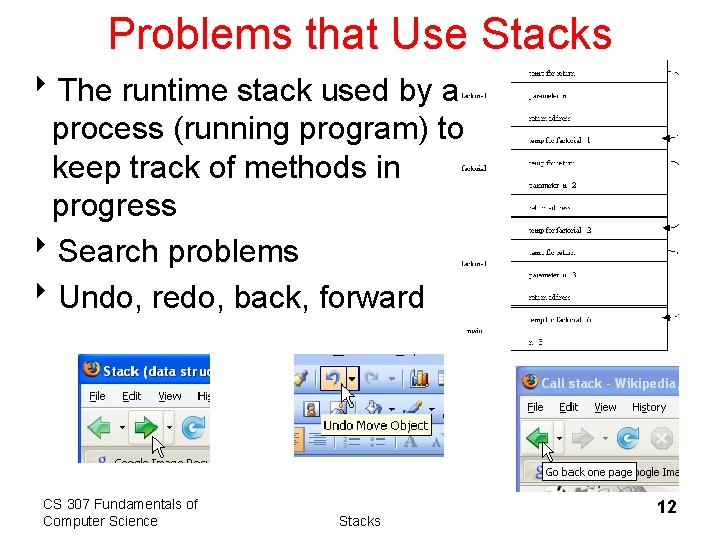
Problems that Use Stacks 8 The runtime stack used by a process (running program) to keep track of methods in progress 8 Search problems 8 Undo, redo, back, forward CS 307 Fundamentals of Computer Science Stacks 12
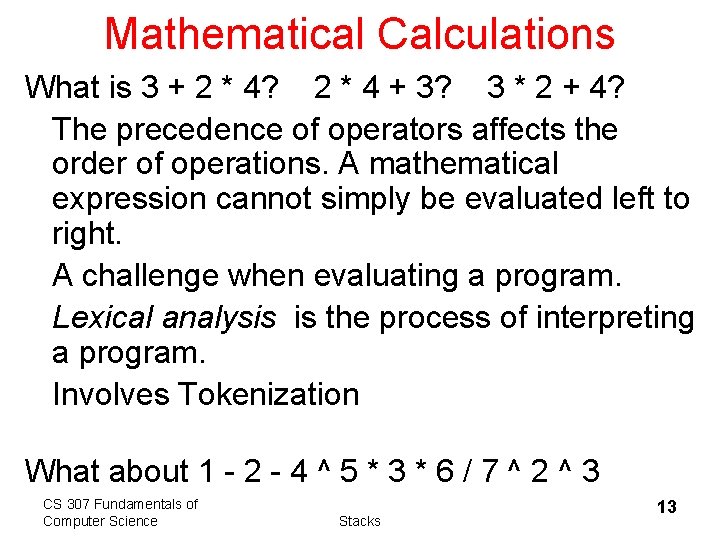
Mathematical Calculations What is 3 + 2 * 4? 2 * 4 + 3? 3 * 2 + 4? The precedence of operators affects the order of operations. A mathematical expression cannot simply be evaluated left to right. A challenge when evaluating a program. Lexical analysis is the process of interpreting a program. Involves Tokenization What about 1 - 2 - 4 ^ 5 * 3 * 6 / 7 ^ 2 ^ 3 CS 307 Fundamentals of Computer Science Stacks 13
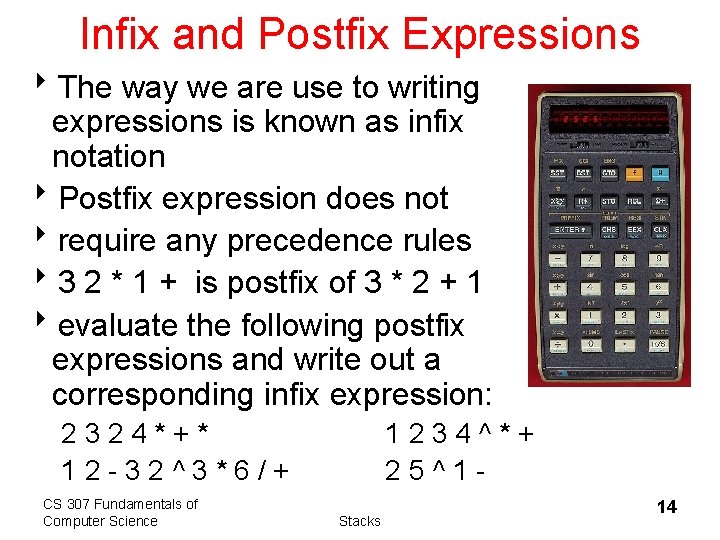
Infix and Postfix Expressions 8 The way we are use to writing expressions is known as infix notation 8 Postfix expression does not 8 require any precedence rules 83 2 * 1 + is postfix of 3 * 2 + 1 8 evaluate the following postfix expressions and write out a corresponding infix expression: 2324*+* 12 -32^3*6/+ CS 307 Fundamentals of Computer Science 1234^*+ 25^1 Stacks 14
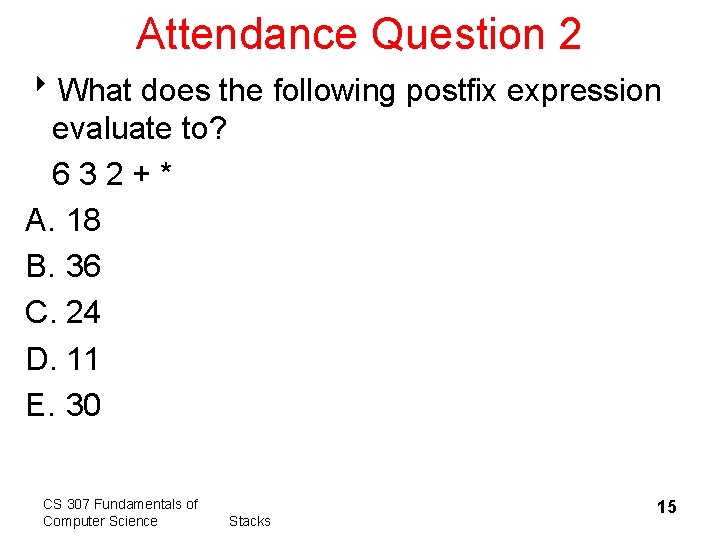
Attendance Question 2 8 What does the following postfix expression evaluate to? 632+* A. 18 B. 36 C. 24 D. 11 E. 30 CS 307 Fundamentals of Computer Science Stacks 15
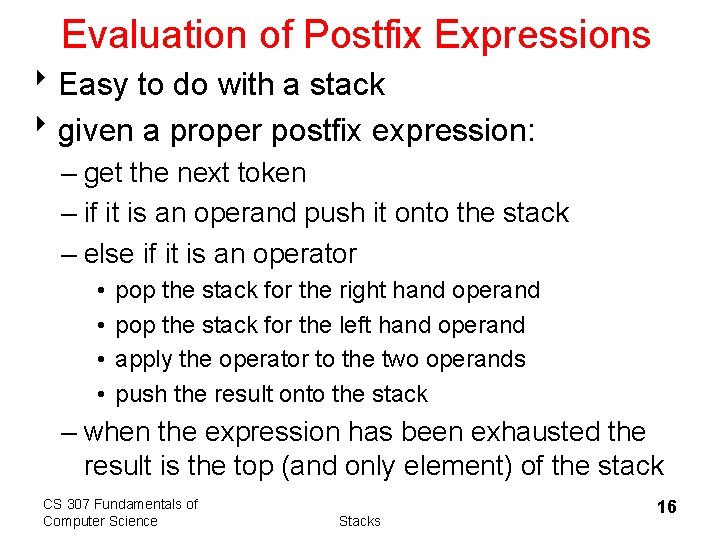
Evaluation of Postfix Expressions 8 Easy to do with a stack 8 given a proper postfix expression: – get the next token – if it is an operand push it onto the stack – else if it is an operator • • pop the stack for the right hand operand pop the stack for the left hand operand apply the operator to the two operands push the result onto the stack – when the expression has been exhausted the result is the top (and only element) of the stack CS 307 Fundamentals of Computer Science Stacks 16
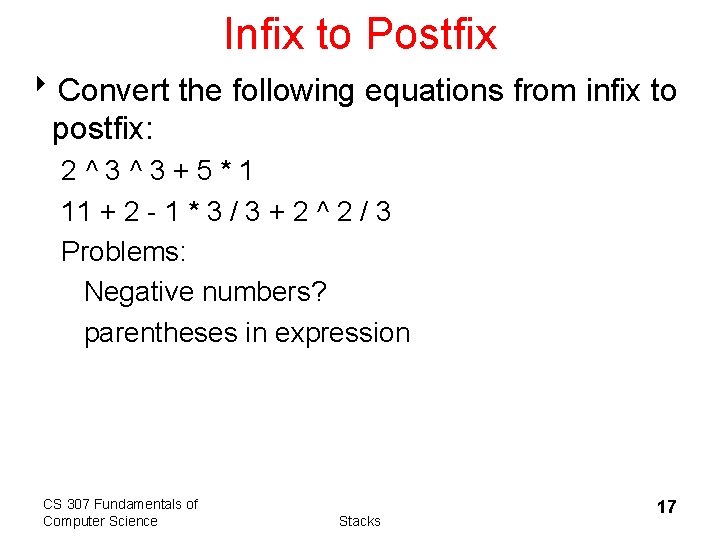
Infix to Postfix 8 Convert the following equations from infix to postfix: 2^3^3+5*1 11 + 2 - 1 * 3 / 3 + 2 ^ 2 / 3 Problems: Negative numbers? parentheses in expression CS 307 Fundamentals of Computer Science Stacks 17
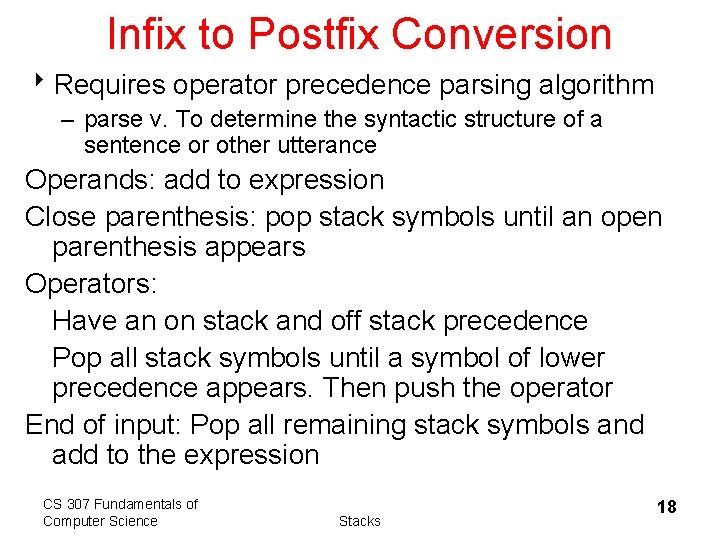
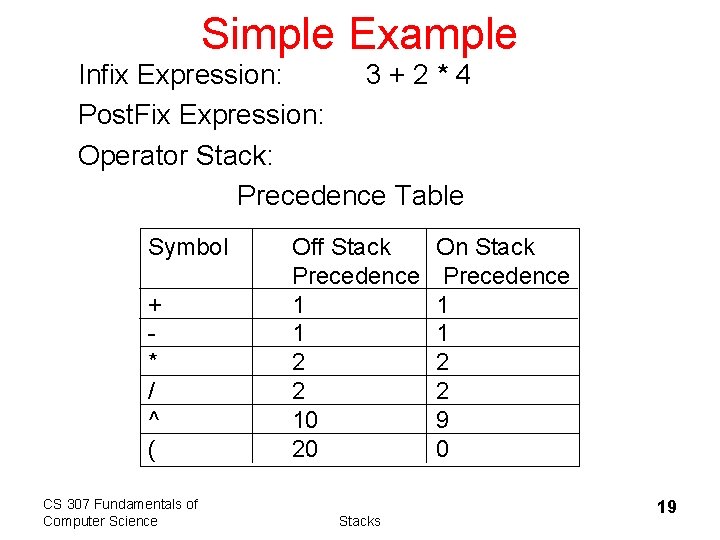
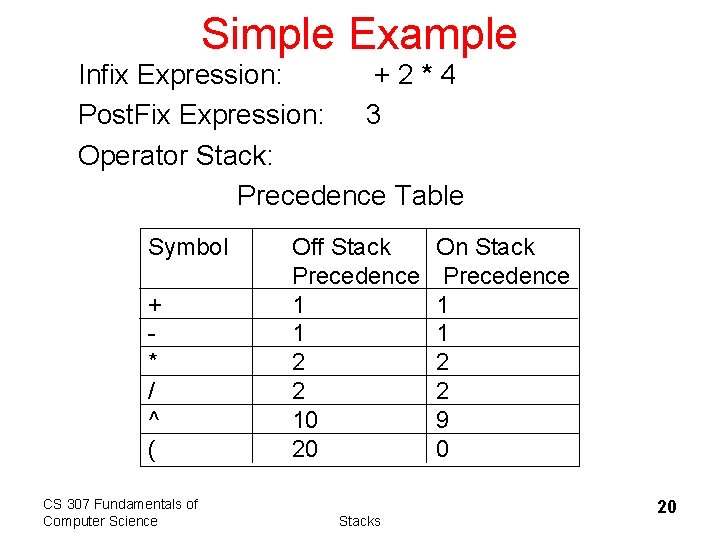
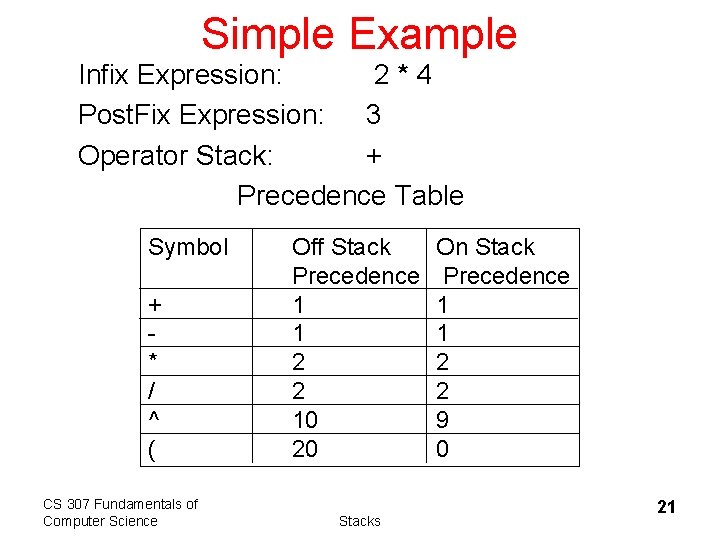
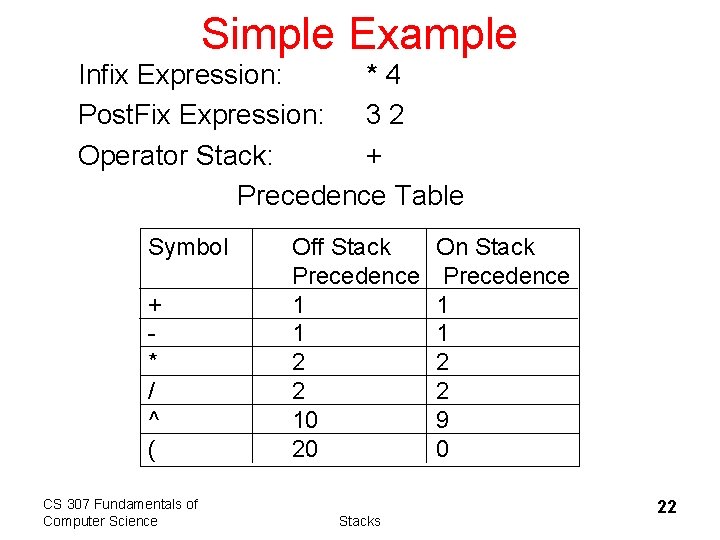
Infix to Postfix Conversion 8 Requires operator precedence parsing algorithm – parse v. To determine the syntactic structure of a sentence or other utterance Operands: add to expression Close parenthesis: pop stack symbols until an open parenthesis appears Operators: Have an on stack and off stack precedence Pop all stack symbols until a symbol of lower precedence appears. Then push the operator End of input: Pop all remaining stack symbols and add to the expression CS 307 Fundamentals of Computer Science Stacks 18
Simple Example Infix Expression: 3+2*4 Post. Fix Expression: Operator Stack: Precedence Table Symbol + * / ^ ( CS 307 Fundamentals of Computer Science Off Stack Precedence 1 1 2 2 10 20 Stacks On Stack Precedence 1 1 2 2 9 0 19
Simple Example Infix Expression: +2*4 Post. Fix Expression: 3 Operator Stack: Precedence Table Symbol + * / ^ ( CS 307 Fundamentals of Computer Science Off Stack Precedence 1 1 2 2 10 20 Stacks On Stack Precedence 1 1 2 2 9 0 20
Simple Example Infix Expression: 2*4 Post. Fix Expression: 3 Operator Stack: + Precedence Table Symbol + * / ^ ( CS 307 Fundamentals of Computer Science Off Stack Precedence 1 1 2 2 10 20 Stacks On Stack Precedence 1 1 2 2 9 0 21
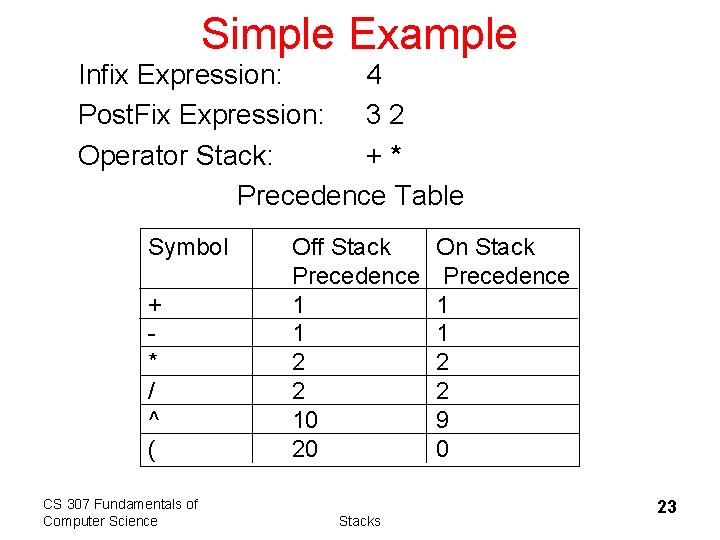
Simple Example Infix Expression: *4 Post. Fix Expression: 3 2 Operator Stack: + Precedence Table Symbol + * / ^ ( CS 307 Fundamentals of Computer Science Off Stack Precedence 1 1 2 2 10 20 Stacks On Stack Precedence 1 1 2 2 9 0 22
Simple Example Infix Expression: 4 Post. Fix Expression: 3 2 Operator Stack: +* Precedence Table Symbol + * / ^ ( CS 307 Fundamentals of Computer Science Off Stack Precedence 1 1 2 2 10 20 Stacks On Stack Precedence 1 1 2 2 9 0 23
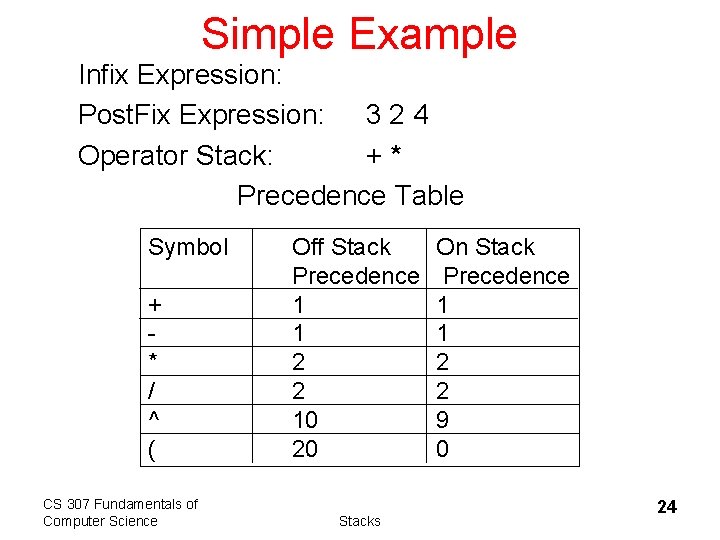
Simple Example Infix Expression: Post. Fix Expression: 3 2 4 Operator Stack: +* Precedence Table Symbol + * / ^ ( CS 307 Fundamentals of Computer Science Off Stack Precedence 1 1 2 2 10 20 Stacks On Stack Precedence 1 1 2 2 9 0 24
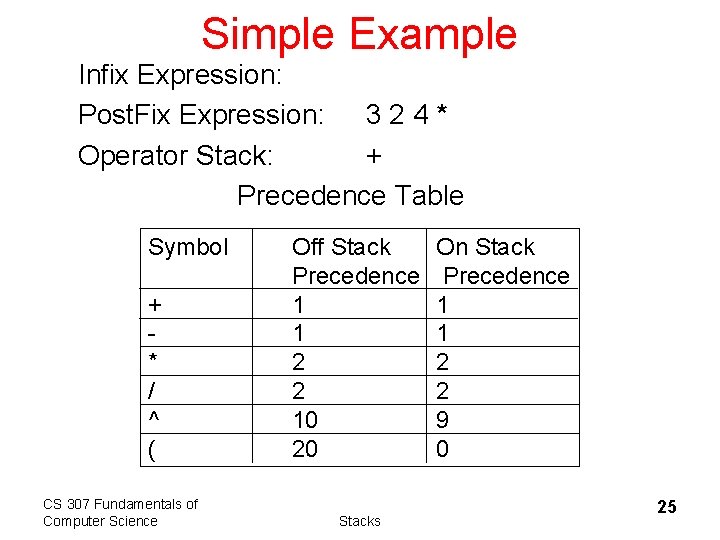
Simple Example Infix Expression: Post. Fix Expression: 3 2 4 * Operator Stack: + Precedence Table Symbol + * / ^ ( CS 307 Fundamentals of Computer Science Off Stack Precedence 1 1 2 2 10 20 Stacks On Stack Precedence 1 1 2 2 9 0 25
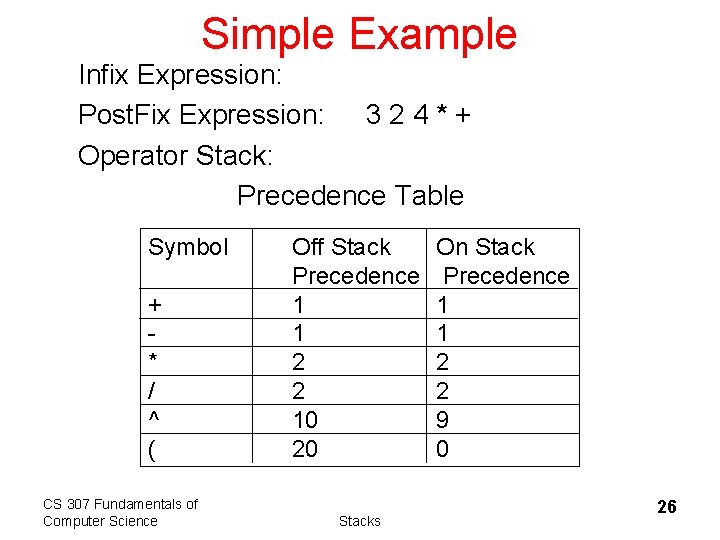
Simple Example Infix Expression: Post. Fix Expression: 3 2 4 * + Operator Stack: Precedence Table Symbol + * / ^ ( CS 307 Fundamentals of Computer Science Off Stack Precedence 1 1 2 2 10 20 Stacks On Stack Precedence 1 1 2 2 9 0 26
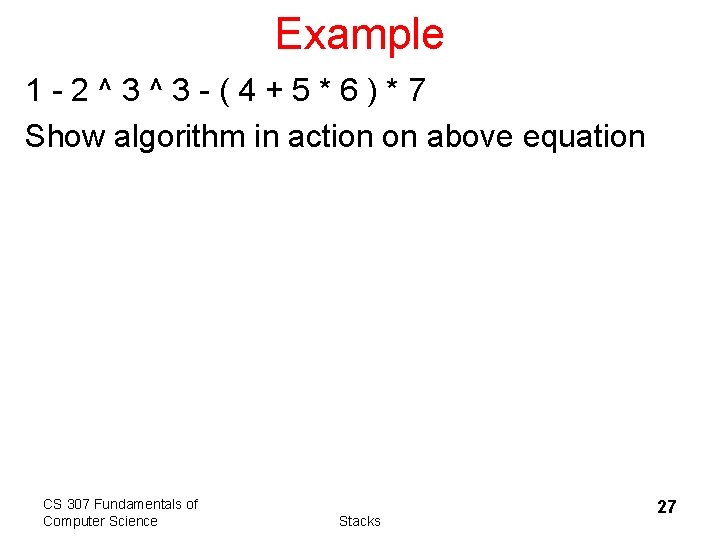
Example 1 -2^3^3 -(4+5*6)*7 Show algorithm in action on above equation CS 307 Fundamentals of Computer Science Stacks 27
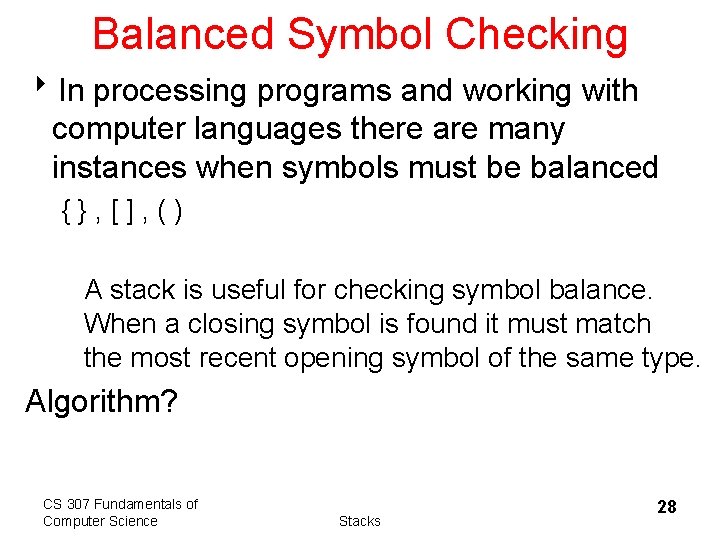
Balanced Symbol Checking 8 In processing programs and working with computer languages there are many instances when symbols must be balanced {}, [], () A stack is useful for checking symbol balance. When a closing symbol is found it must match the most recent opening symbol of the same type. Algorithm? CS 307 Fundamentals of Computer Science Stacks 28
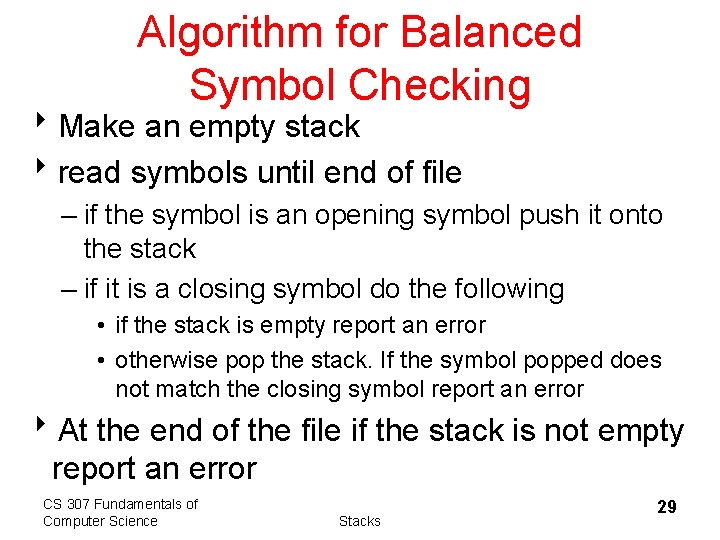
Algorithm for Balanced Symbol Checking 8 Make an empty stack 8 read symbols until end of file – if the symbol is an opening symbol push it onto the stack – if it is a closing symbol do the following • if the stack is empty report an error • otherwise pop the stack. If the symbol popped does not match the closing symbol report an error 8 At the end of the file if the stack is not empty report an error CS 307 Fundamentals of Computer Science Stacks 29
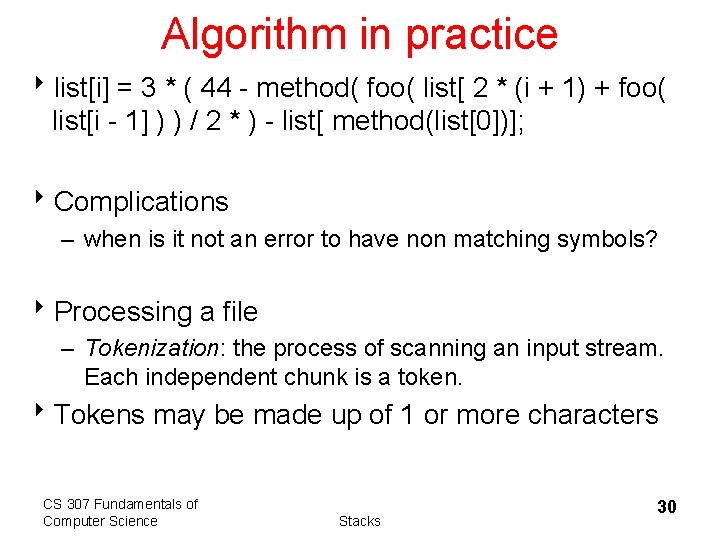
Algorithm in practice 8 list[i] = 3 * ( 44 - method( foo( list[ 2 * (i + 1) + foo( list[i - 1] ) ) / 2 * ) - list[ method(list[0])]; 8 Complications – when is it not an error to have non matching symbols? 8 Processing a file – Tokenization: the process of scanning an input stream. Each independent chunk is a token. 8 Tokens may be made up of 1 or more characters CS 307 Fundamentals of Computer Science Stacks 30