TimeAware Test Suite Prioritization Kristen R Walcott Mary

- Slides: 26
Time-Aware Test Suite Prioritization Kristen R. Walcott, Mary Lou Soffa University of Virginia Gregory M. Kapfhammer, Robert S. Roos Allegheny College International Symposium on Software Testing and Analysis Portland, Maine July 17 -20, 2006
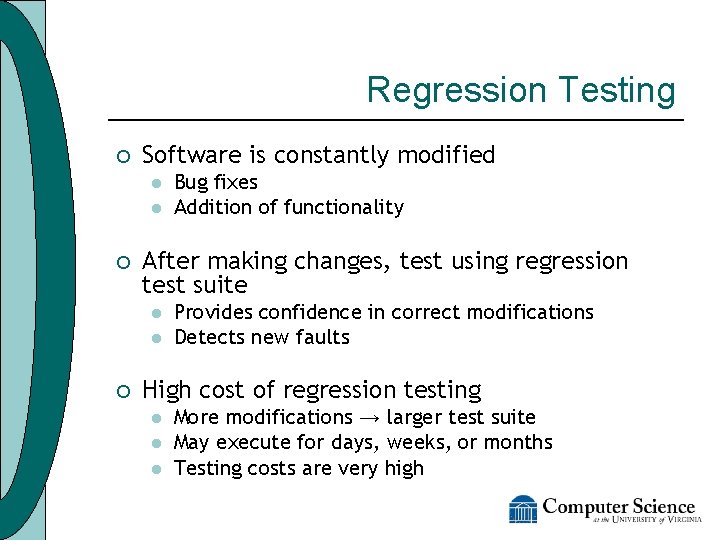
Regression Testing ¡ Software is constantly modified l l ¡ After making changes, test using regression test suite l l ¡ Bug fixes Addition of functionality Provides confidence in correct modifications Detects new faults High cost of regression testing l l l More modifications → larger test suite May execute for days, weeks, or months Testing costs are very high
Reducing the Cost ¡ Cost-saving techniques l l ¡ Selection: Use a subset of the test cases Prioritization: Reorder the test cases Prioritization methods l l Initial ordering Reverse ordering Random ordering Based on fault detection ability
Ordering Tests with Fault Detection ¡ Idea: First run the test cases that will find faults first ¡ Complications: l l ¡ Different tests may find the same fault Do not know which tests will find faults Use coverage to estimate fault finding ability
Prioritization Example Prioritized Test Suite (with some fault information) T 2 1 fault 1 min. T 1 7 faults 9 min. T 4 3 faults 4 min. T 5 3 faults 4 min. T 6 3 faults 4 min. T 3 2 faults 3 min. 0. 75 0. 667 Faults found / minute 1. 0 0. 778 0. 75 • Retesting generally has a time budget • Is this prioritization best when the time budget is considered? Contribution: A test prioritization technique that intelligently incorporates a time budget
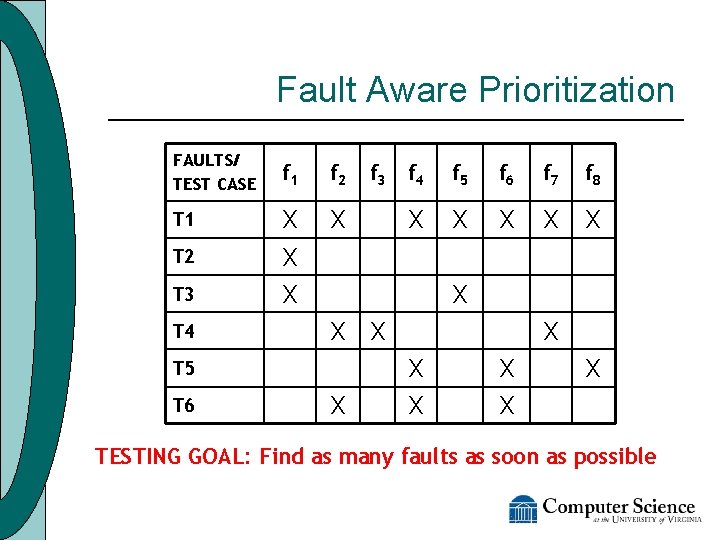
Fault Aware Prioritization FAULTS/ TEST CASE T 1 T 2 T 3 T 4 f 1 f 2 X X f 4 f 5 f 6 f 7 f 8 X X X X T 5 T 6 f 3 X X X X TESTING GOAL: Find as many faults as soon as possible
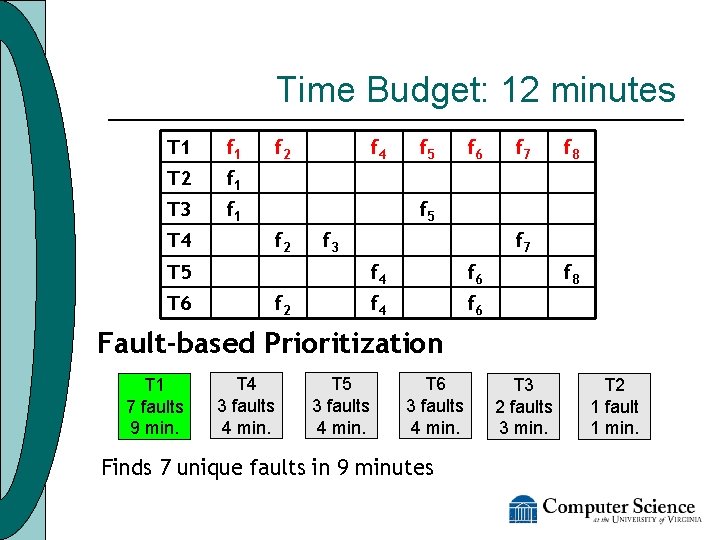
Time Budget: 12 minutes T 1 f 1 T 2 f 1 T 3 f 1 T 4 f 2 f 4 f 6 f 7 f 8 f 5 f 2 f 3 T 5 T 6 f 5 f 2 f 7 f 4 f 6 f 8 Fault-based Prioritization T 1 7 faults 9 min. T 4 3 faults 4 min. T 5 3 faults 4 min. T 6 3 faults 4 min. Finds 7 unique faults in 9 minutes T 3 2 faults 3 min. T 2 1 fault 1 min.
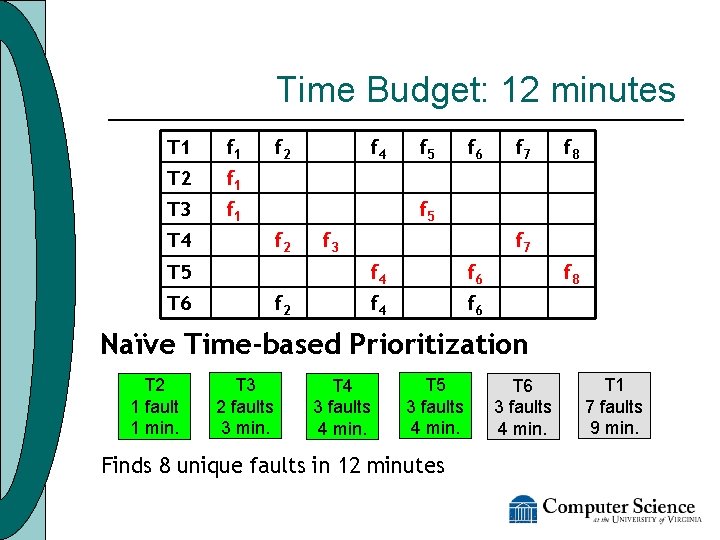
Time Budget: 12 minutes T 1 f 1 T 2 f 1 T 3 f 1 T 4 f 2 f 4 f 6 f 7 f 8 f 5 f 2 f 3 T 5 T 6 f 5 f 2 f 7 f 4 f 6 f 8 Naïve Time-based Prioritization T 2 1 fault 1 min. T 3 2 faults 3 min. T 4 3 faults 4 min. T 5 3 faults 4 min. Finds 8 unique faults in 12 minutes T 6 3 faults 4 min. T 1 7 faults 9 min.
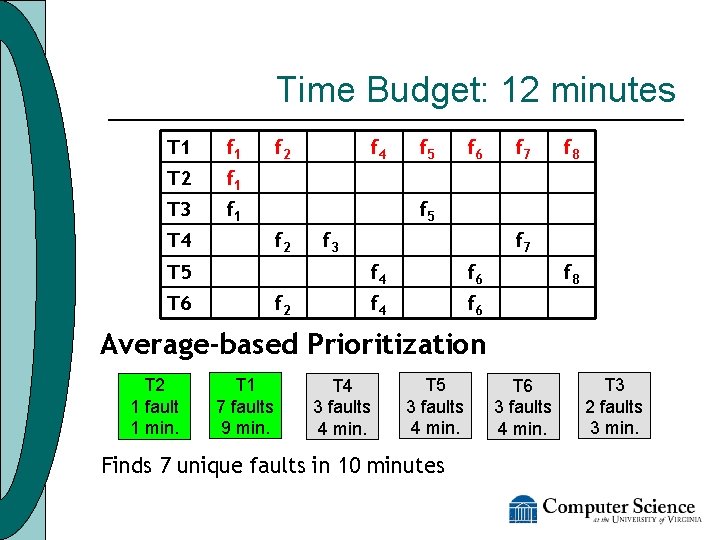
Time Budget: 12 minutes T 1 f 1 T 2 f 1 T 3 f 1 T 4 f 2 f 4 f 6 f 7 f 8 f 5 f 2 f 3 T 5 T 6 f 5 f 2 f 7 f 4 f 6 f 8 Average-based Prioritization T 2 1 fault 1 min. T 1 7 faults 9 min. T 4 3 faults 4 min. T 5 3 faults 4 min. Finds 7 unique faults in 10 minutes T 6 3 faults 4 min. T 3 2 faults 3 min.
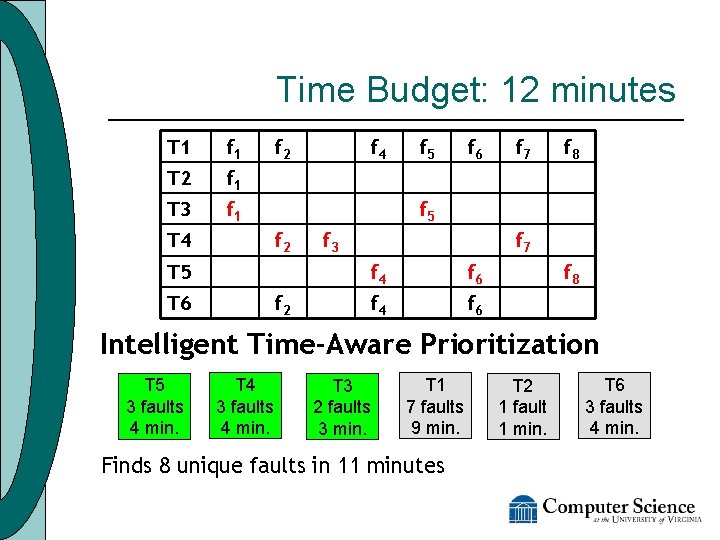
Time Budget: 12 minutes T 1 f 1 T 2 f 1 T 3 f 1 T 4 f 2 f 4 f 6 f 7 f 8 f 5 f 2 f 3 T 5 T 6 f 5 f 2 f 7 f 4 f 6 f 8 Intelligent Time-Aware Prioritization T 5 3 faults 4 min. T 4 3 faults 4 min. T 3 2 faults 3 min. T 1 7 faults 9 min. Finds 8 unique faults in 11 minutes T 2 1 fault 1 min. T 6 3 faults 4 min.
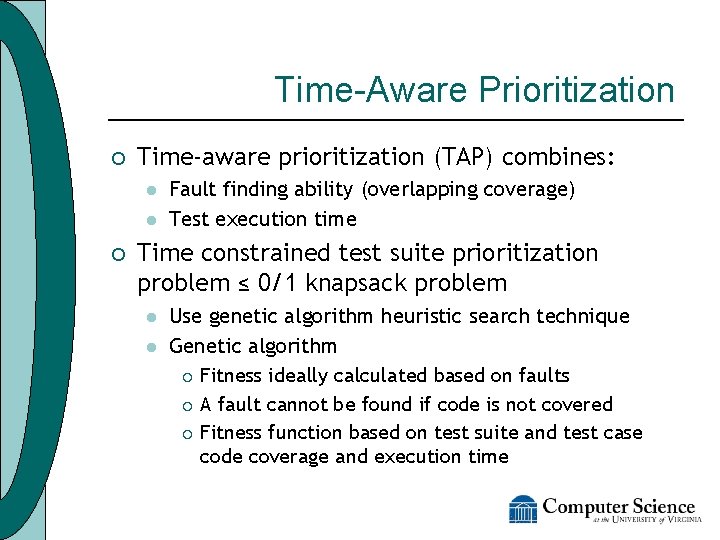
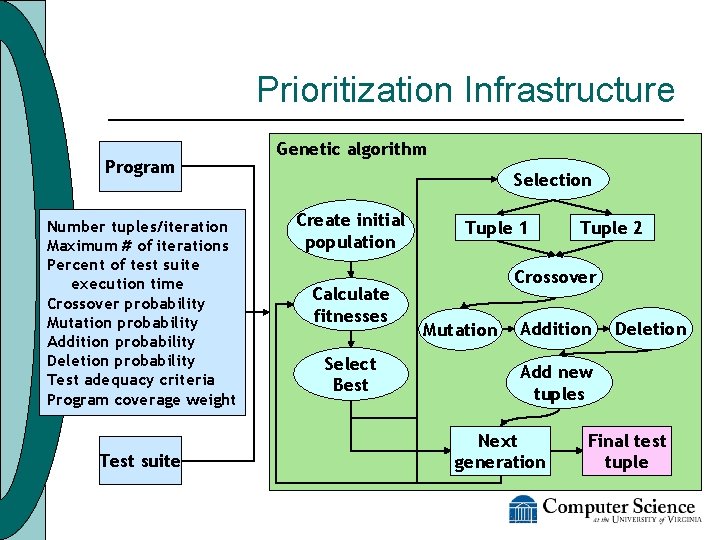
Time-Aware Prioritization ¡ Time-aware prioritization (TAP) combines: l l ¡ Fault finding ability (overlapping coverage) Test execution time Time constrained test suite prioritization problem ≤ 0/1 knapsack problem l l Use genetic algorithm heuristic search technique Genetic algorithm ¡ Fitness ideally calculated based on faults ¡ A fault cannot be found if code is not covered ¡ Fitness function based on test suite and test case code coverage and execution time
Prioritization Infrastructure Program Number tuples/iteration Maximum # of iterations Percent of test suite execution time Crossover probability Mutation probability Addition probability Deletion probability Test adequacy criteria Program coverage weight Test suite Genetic algorithm Selection Create initial population Calculate fitnesses Select Best Tuple 1 Tuple 2 Crossover Mutation Addition Deletion Add new tuples Next generation Final test tuple
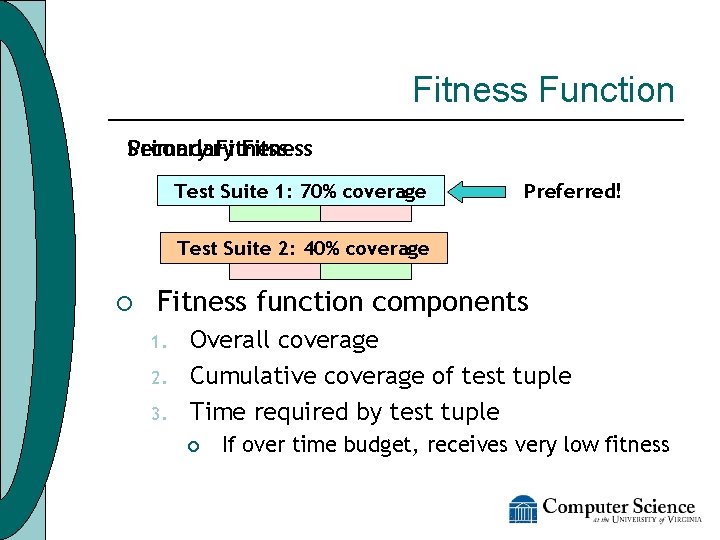
Fitness Function Primary Fitness ¡Secondary Use coverage information to estimate “goodness” of. T 1: coverage test Test Suite 1: 70% Preferred! T 2: 80% 40% case l l ¡ Block coverage Test Suite 2: 40% coverage T 1: 40% T 2: 80% Method coverage Fitness function components 1. 2. 3. Overall coverage Cumulative coverage of test tuple Time required by test tuple ¡ If over time budget, receives very low fitness
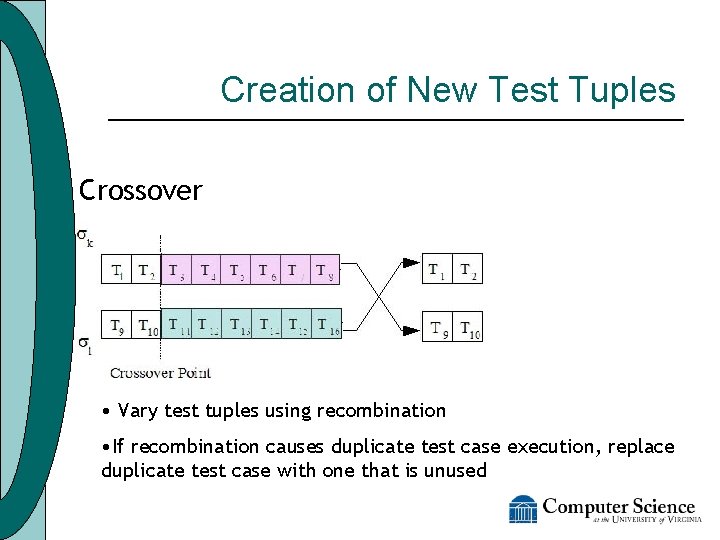
Creation of New Test Tuples Crossover • Vary test tuples using recombination • If recombination causes duplicate test case execution, replace duplicate test case with one that is unused
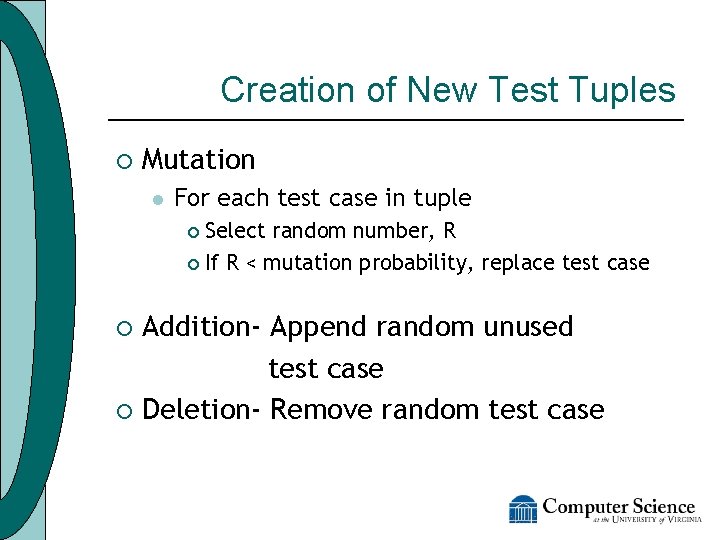
Creation of New Test Tuples ¡ Mutation l For each test case in tuple Select random number, R ¡ If R < mutation probability, replace test case ¡ Addition- Append random unused test case ¡ Deletion- Remove random test case ¡
Experimentation Goals ¡ Analyze trends in average percent of faults detected (APFD) ¡ Determine if time-aware prioritizations outperform selected set of other prioritizations ¡ Identify time and space overheads
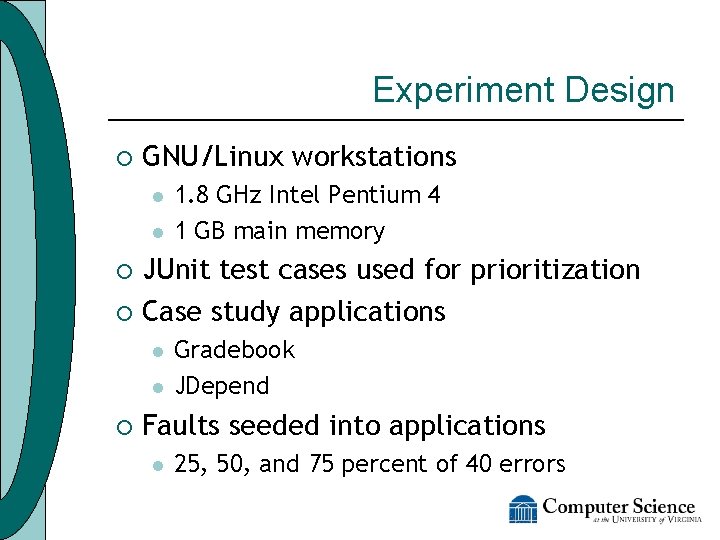
Experiment Design ¡ GNU/Linux workstations l l 1. 8 GHz Intel Pentium 4 1 GB main memory JUnit test cases used for prioritization ¡ Case study applications ¡ l l ¡ Gradebook JDepend Faults seeded into applications l 25, 50, and 75 percent of 40 errors
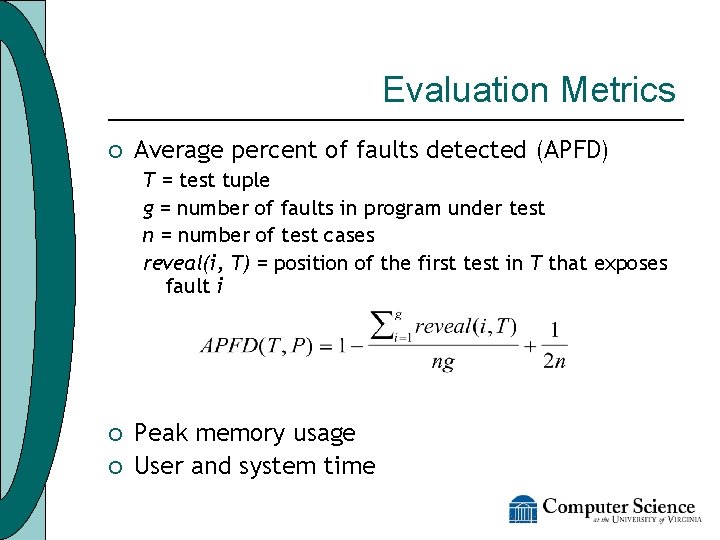
Evaluation Metrics ¡ Average percent of faults detected (APFD) T = test tuple g = number of faults in program under test n = number of test cases reveal(i, T) = position of the first test in T that exposes fault i ¡ ¡ Peak memory usage User and system time
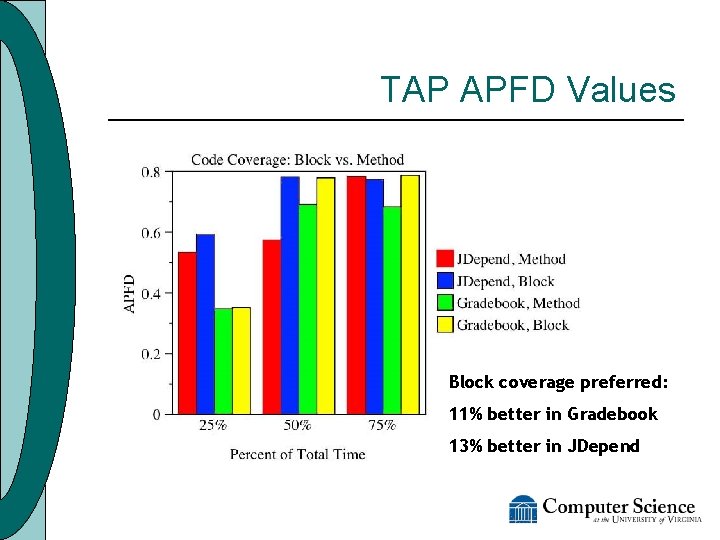
TAP APFD Values Block coverage preferred: 11% better in Gradebook 13% better in JDepend
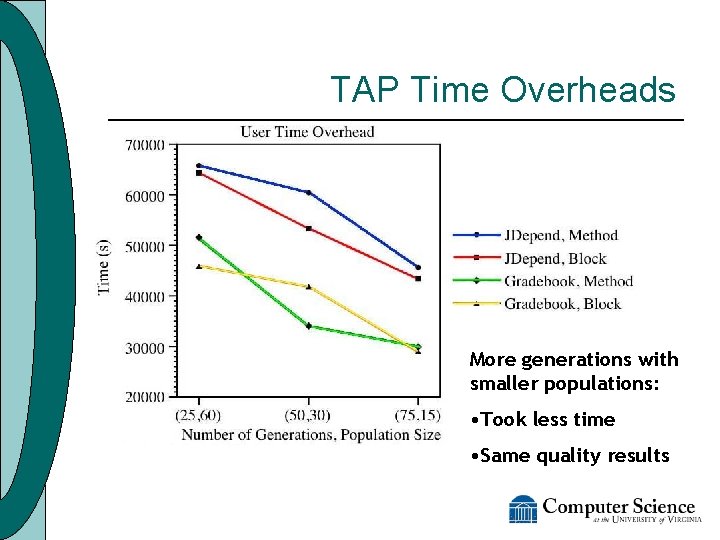
TAP Time Overheads More generations with smaller populations: • Took less time • Same quality results
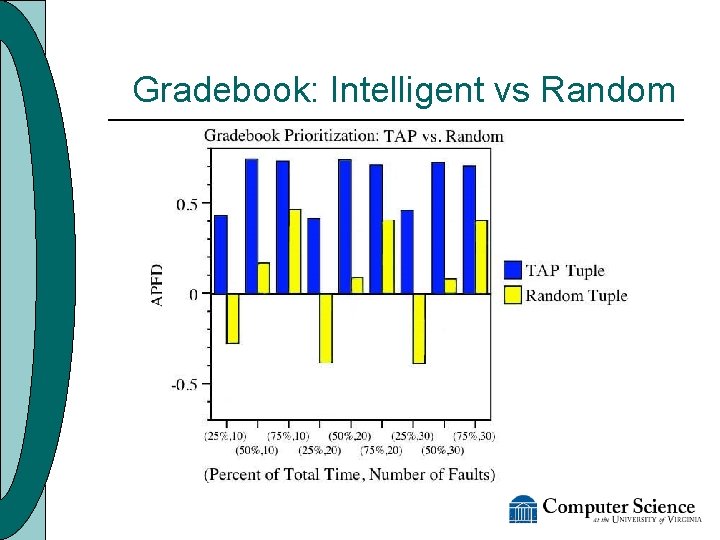
Gradebook: Intelligent vs Random
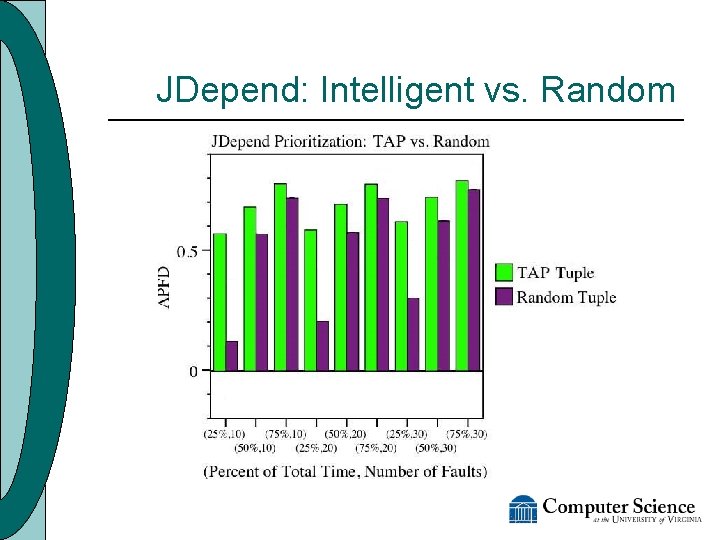
JDepend: Intelligent vs. Random
Other Prioritizations ¡ Random prioritizations redistribute fault -revealing test cases ¡ Other prioritizations l l l Initial ordering Reverse ordering Fault-aware Impossible to implement ¡ Good watermark for comparison ¡
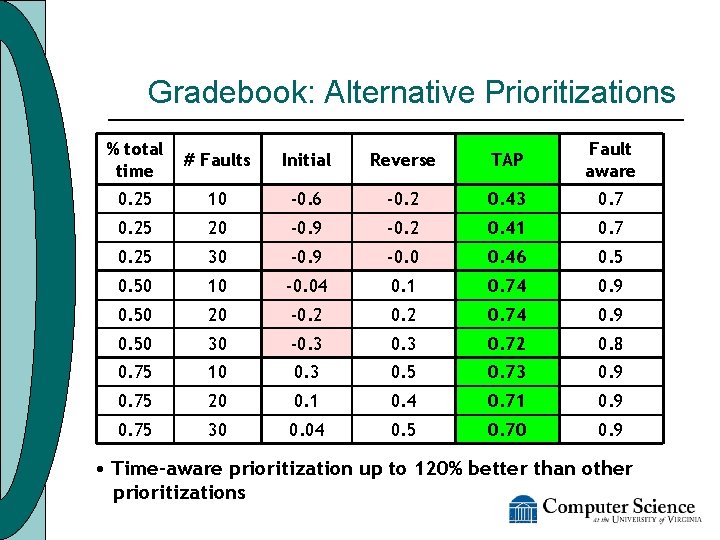
Gradebook: Alternative Prioritizations % total time # Faults Initial Reverse TAP Fault aware 0. 25 10 -0. 6 -0. 2 0. 43 0. 7 0. 25 20 -0. 9 -0. 2 0. 41 0. 7 0. 25 30 -0. 9 -0. 0 0. 46 0. 50 10 -0. 04 0. 1 0. 74 0. 9 0. 50 20 -0. 2 0. 74 0. 9 0. 50 30 -0. 3 0. 72 0. 8 0. 75 10 0. 3 0. 5 0. 73 0. 9 0. 75 20 0. 1 0. 4 0. 71 0. 9 0. 75 30 0. 04 0. 5 0. 70 0. 9 • Time-aware prioritization up to 120% better than other prioritizations
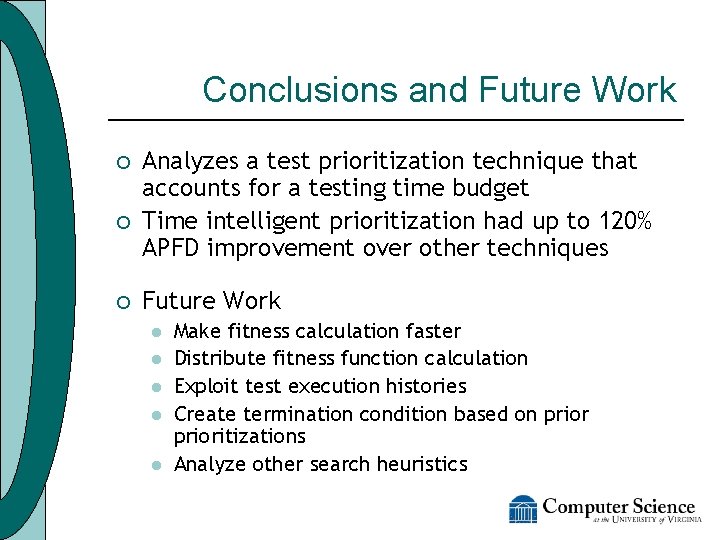
Conclusions and Future Work ¡ ¡ ¡ Analyzes a test prioritization technique that accounts for a testing time budget Time intelligent prioritization had up to 120% APFD improvement over other techniques Future Work l l l Make fitness calculation faster Distribute fitness function calculation Exploit test execution histories Create termination condition based on prioritizations Analyze other search heuristics
Thank you! Time-Aware Prioritization (TAP) Research: ¡ http: //www. cs. virginia. edu/~krw 7 c/Time. Aware. Prioritization. htm