
Negotiation Prioritization Based on slides from Steve Easterbrook
Negotiation & Prioritization Based on slides from Steve Easterbrook and Nan Niu, Artem Katasonov, Gregor v. Bochmann, Gunter Mussbacher, with material from: K. E. Wiegers, D. Leffingwell & D. Widrig, M. Jackson, I. K. Bray, B. Selic, Volere, Telelogic, D. Damian, S. Somé 2008, and D. Amyot 2008 -2009
Agreeing on a Specification Two key problems for getting agreement: 1) the problem of validation If we build to this spec, will the customer’s expectations be met? 2) the problem of negotiation How do you reconcile conflicting goals in a complex socio-cognitive setting? Validating Requirements Inspections and Reviews Prototyping Negotiating Requirements Prioritization Conflict and Conflict Resolution Requirements Negotiation Techniques 3
Requirements Negotiation (1) • Possible conflicts to be resolved among stakeholders – – – Between supplier and customers about costs, benefits, risks Power struggle within customer organization Conflicts with other projects about resources Conflicting goals, features, requirements. . . • Conflict resolution involves negotiation – Negotiating a coherent set of requirements is not easy – But it is one task of the requirements analyst – Difficult to satisfy everyone, to achieve all goals, make good decisions! – Involves a lot of (group) discussions 3
Requirements Negotiation (2) • First, detect when requirements are inconsistent • Then, convince all stakeholders to understand the essential point of view of each other – Have each party explain what they believe the other party wants and why • Finally, reach an agreement on a coherent set of requirements that meets the needs of as many stakeholders as possible – Analyze each party’s goals, find solutions that do not conflict but ideally support everybody’s goals 4
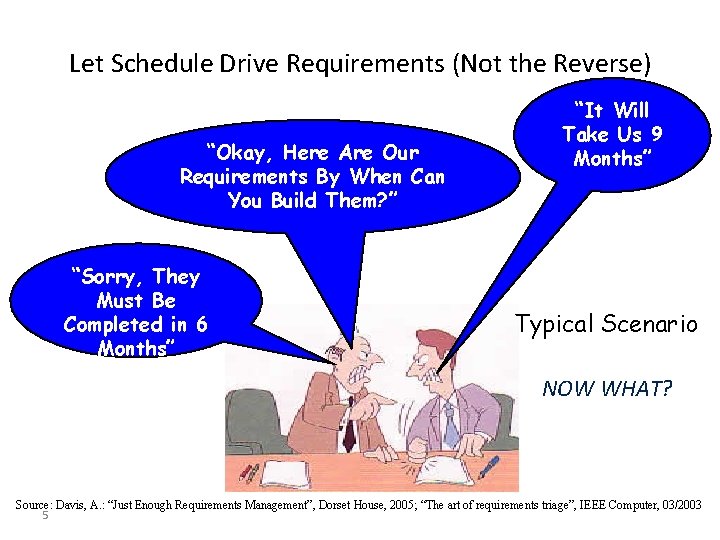
Let Schedule Drive Requirements (Not the Reverse) “Okay, Here Are Our Requirements By When Can You Build Them? ” “Sorry, They Must Be Completed in 6 Months” “It Will Take Us 9 Months” Typical Scenario NOW WHAT? Source: Davis, A. : “Just Enough Requirements Management”, Dorset House, 2005; “The art of requirements triage”, IEEE Computer, 03/2003 5
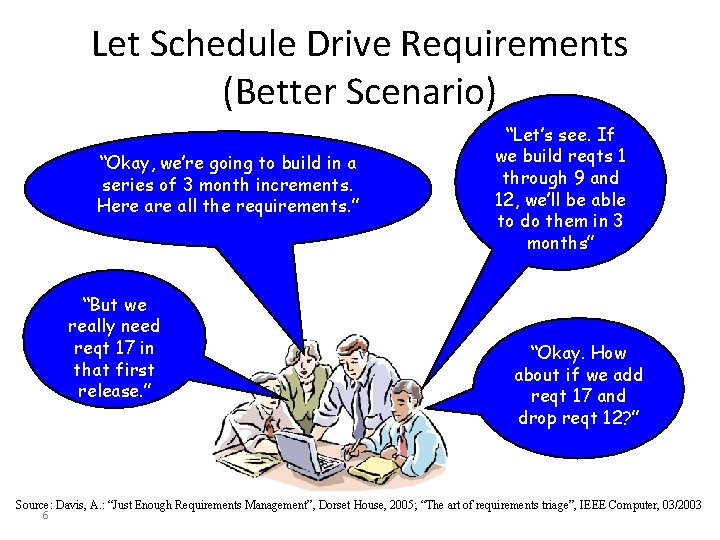
Let Schedule Drive Requirements (Better Scenario) “Okay, we’re going to build in a series of 3 month increments. Here all the requirements. ” “But we really need reqt 17 in that first release. ” “Let’s see. If we build reqts 1 through 9 and 12, we’ll be able to do them in 3 months” “Okay. How about if we add reqt 17 and drop reqt 12? ” Source: Davis, A. : “Just Enough Requirements Management”, Dorset House, 2005; “The art of requirements triage”, IEEE Computer, 03/2003 6
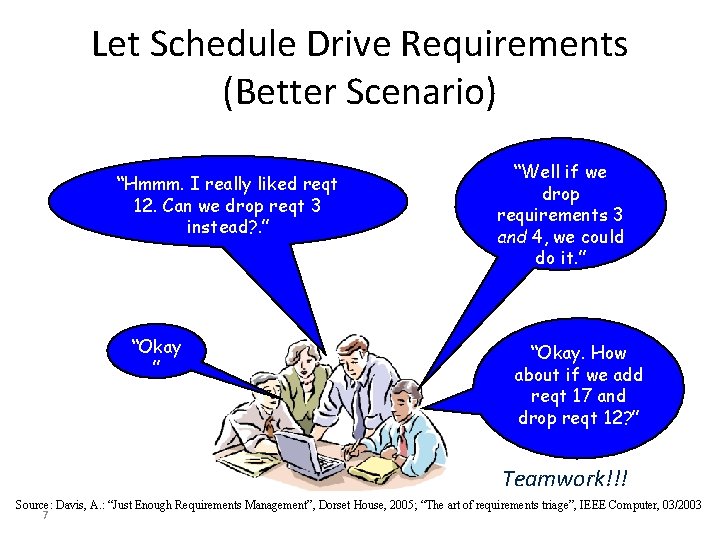
Let Schedule Drive Requirements (Better Scenario) “Hmmm. I really liked reqt 12. Can we drop reqt 3 instead? . ” “Okay ” “Well if we drop requirements 3 and 4, we could do it. ” “Okay. How about if we add reqt 17 and drop reqt 12? ” Teamwork!!! Source: Davis, A. : “Just Enough Requirements Management”, Dorset House, 2005; “The art of requirements triage”, IEEE Computer, 03/2003 7
Requirements Negotiation – Key Aspects (1) (by analogy with land negotiations) – Territory: desired requirements • The real requirements are those in the head of each stakeholder – Map: requirements document • An abstract model of intentions/requirements, imperfect and incomplete – Interpretation of the map: included requirements • May vary from one session to the next need to be clear, precise, and unambiguous – Looking at the map through the magnifying glass: importance • Each stakeholder has such a view about its requirements in the project • For each stakeholder, see if a documented requirement is important, conflicting, or optional 8
Requirements Negotiation – Key Aspects (2) – Negotiating boundaries: counterproposals of stakeholders • Reaction of a stakeholder (open, opposed, cooperative. . . ) to a documented requirement may indicate how far it is open for compromise • Helps optimize the requirements of all stakeholders • Can we be consistent? See techniques later on! 9
Difficulties (1) • There are too many requirements! • From many different sources • Resources are limited (budget, time…) • Establishing priorities is important, but – Which requirements are important, and to whom? – How to prioritize them? On what basis? What to minimize/maximize? – In which iteration should the requirement be considered? • Developers may not know the business value of some requirements, and clients may not know the implementation complexity of some requirements 10
Difficulties (2) • Different stakeholders have different goals and different priorities • Some stakeholders’ decisions carry more weight than others • Companies often lack systematic data, metrics, and technologies to support the prioritization process – Often done manually, informally, on an ad-hoc basis – Difficult to establish and communicate • Attitude! – "No need for priorities, we can do everything in the specification!“ • Yes, but when and at what cost? – Suddenly, when the deadline is fast approaching, some requirements are put aside in order to deliver something on time. . . 11
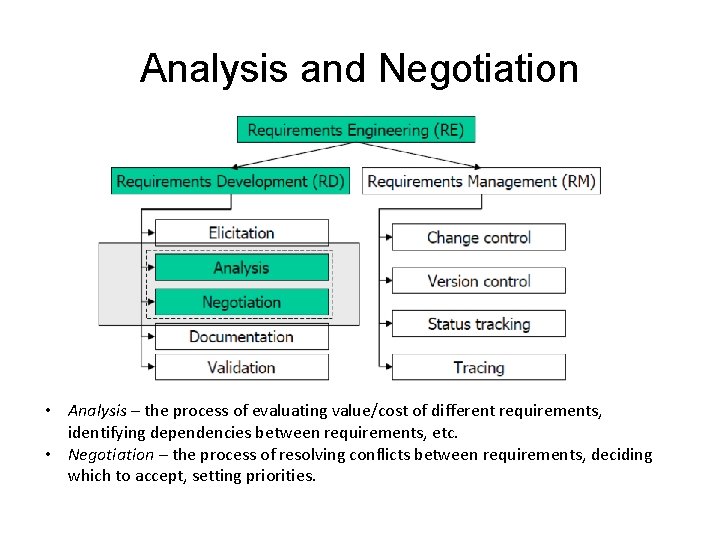
Analysis and Negotiation • Analysis – the process of evaluating value/cost of different requirements, identifying dependencies between requirements, etc. • Negotiation – the process of resolving conflicts between requirements, deciding which to accept, setting priorities.
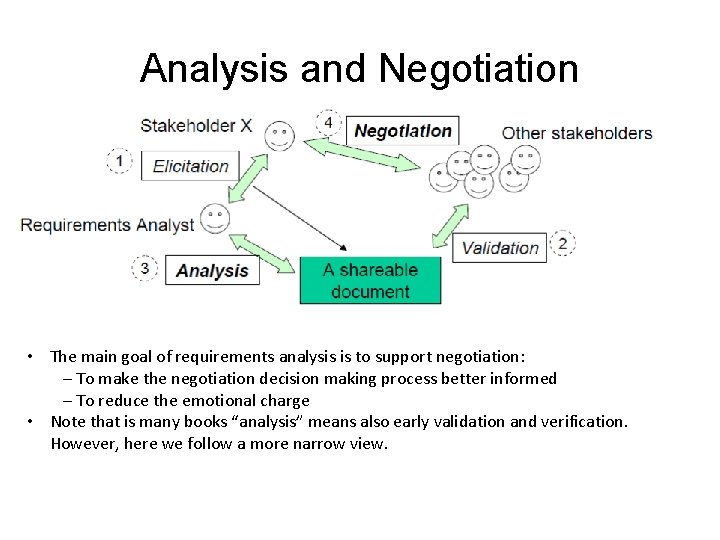
Analysis and Negotiation • The main goal of requirements analysis is to support negotiation: – To make the negotiation decision making process better informed – To reduce the emotional charge • Note that is many books “analysis” means also early validation and verification. However, here we follow a more narrow view.
Negotiation goals • Three basic goals of requirements negotiation (Pohl, 1996): – To make the conflicts explicit. – To make explicit, for each conflict, the relevant alternatives, the argumentations, and the underlying rationales. – To facilitate in that “right” decisions are made. • “Right” decision here denotes a decision made rationally, decision made based by evaluating the alternatives and selecting the best one. • In practice, this means that either: – One of the conflicting parties is educated to the level when it changes its mind, – Or a compromise is found.
Garbage can model • Especially in complex projects, requirements decisions are seldom discrete events in which pros and cons are systematically weighted in an effort to achieve optimal decisions. • Rather, decision-making occurs through what have been called the “garbage can model”, a protracted process, in which – problems are searching for solutions, – solutions are searching for problems, – and decision-makers are searching for decisions to be made (Bergman et al. , 2002). • In addition to goal incongruence, when stakeholders disagree on functional goals or at least the means of achieving goals, some of proposed requirements are not based on any functional goals, but on political ones.
Political ecology of requirements • Especially in complex projects, requirements engineering is a largely political process. • In addition to functional ecology, requirements have political ecology. – What goals different stakeholders pursue. – Who of them has power to make (or influence) what kind of decisions. • The functional ecology is ultimately dependent upon the political ecology, and the latter must be fixed and stable before the former can be. • On the other hand, functional decisions may change the balance in the political ecology. • It is common for problems of political ecology to appear on the surface as functional problems, triggering continuous changes in requirements, notsolving the actual – political – problem.
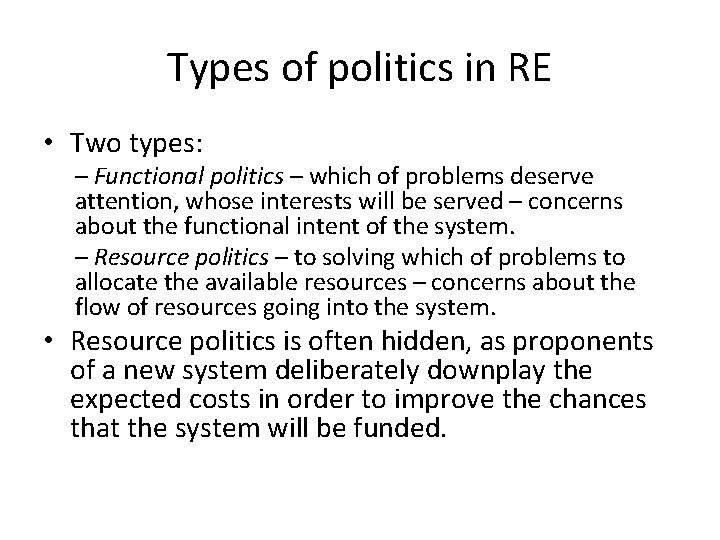
Types of politics in RE • Two types: – Functional politics – which of problems deserve attention, whose interests will be served – concerns about the functional intent of the system. – Resource politics – to solving which of problems to allocate the available resources – concerns about the flow of resources going into the system. • Resource politics is often hidden, as proponents of a new system deliberately downplay the expected costs in order to improve the chances that the system will be funded.
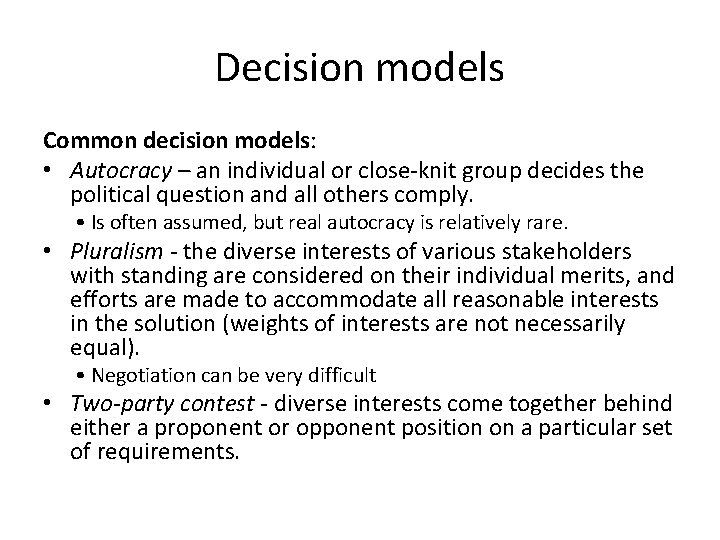
Decision models Common decision models: • Autocracy – an individual or close-knit group decides the political question and all others comply. • Is often assumed, but real autocracy is relatively rare. • Pluralism - the diverse interests of various stakeholders with standing are considered on their individual merits, and efforts are made to accommodate all reasonable interests in the solution (weights of interests are not necessarily equal). • Negotiation can be very difficult • Two-party contest - diverse interests come together behind either a proponent or opponent position on a particular set of requirements.
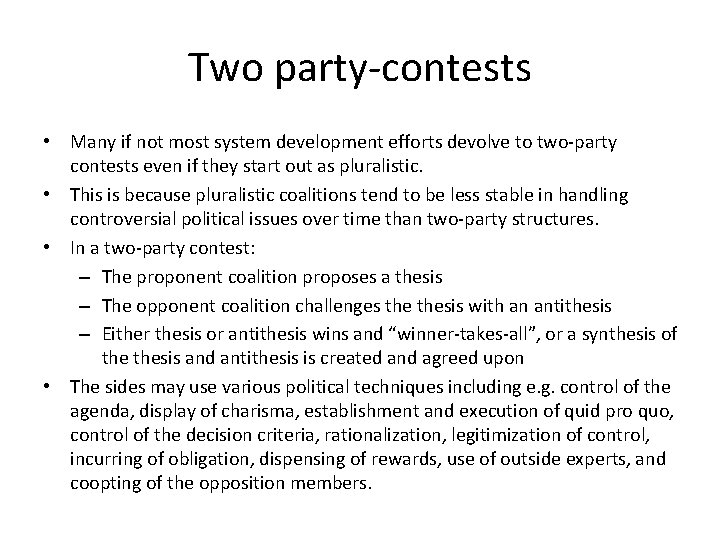
Two party-contests • Many if not most system development efforts devolve to two-party contests even if they start out as pluralistic. • This is because pluralistic coalitions tend to be less stable in handling controversial political issues over time than two-party structures. • In a two-party contest: – The proponent coalition proposes a thesis – The opponent coalition challenges thesis with an antithesis – Either thesis or antithesis wins and “winner-takes-all”, or a synthesis of thesis and antithesis is created and agreed upon • The sides may use various political techniques including e. g. control of the agenda, display of charisma, establishment and execution of quid pro quo, control of the decision criteria, rationalization, legitimization of control, incurring of obligation, dispensing of rewards, use of outside experts, and coopting of the opposition members.
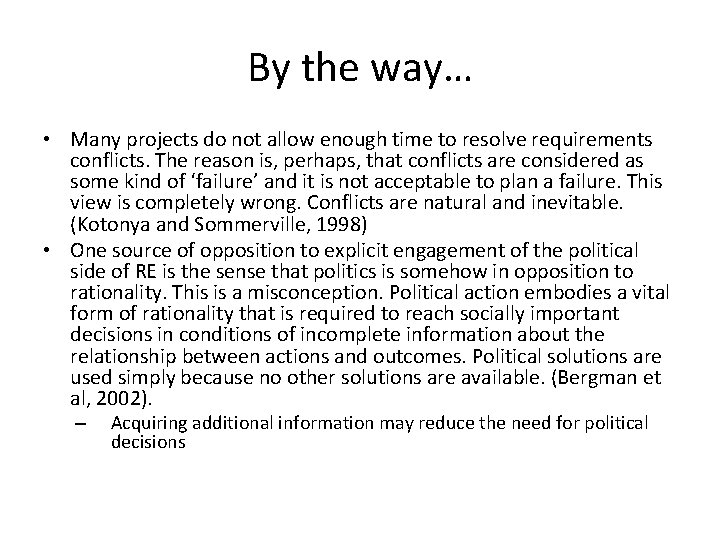
By the way… • Many projects do not allow enough time to resolve requirements conflicts. The reason is, perhaps, that conflicts are considered as some kind of ‘failure’ and it is not acceptable to plan a failure. This view is completely wrong. Conflicts are natural and inevitable. (Kotonya and Sommerville, 1998) • One source of opposition to explicit engagement of the political side of RE is the sense that politics is somehow in opposition to rationality. This is a misconception. Political action embodies a vital form of rationality that is required to reach socially important decisions in conditions of incomplete information about the relationship between actions and outcomes. Political solutions are used simply because no other solutions are available. (Bergman et al, 2002). – Acquiring additional information may reduce the need for political decisions
Negotiation meetings • RE tradition assumes that the requirements analyst is the person who is responsible to be the mediator who controls the negotiation process. • Especially in complex projects, it is unclear however whether the requirements analysts has sufficient political power even for that – e. g. for calling a negotiation meeting. • Anyway, he cannot stay out of the political process. • Use first some analysis techniques to make explicit the pros and cons of the alternatives, then • (Attempt to) Organize a meeting, conducted in three stages (Kotonya and Sommerville, 1998): – Information from the analyst about the nature of the problem – Discussion between the sides – Resolution
Requirements Analysis • Benefit/penalty/cost/risk analysis. Rate for each alternative or requirement: – The relative benefit of the requirement, e. g. from 1 (useless) to 9 (extremely valuable). – The relative penalty that will be suffered if the requirement is not included, e. g. from 1 (no one is upset) to 9 (very serious consequences). – The relative cost of implementing the requirement, e. g. from 1 (quick and easy) to 9 (very time consuming and expensive). – The relative risk of not getting the requirement implemented right, e. g. form 1 (no risk) to 9 (significant risks exist related to available expertise, reliability of tools, technology or partners). • Interaction analysis. Analyze interaction between different requirements, what impact on other parts of the system will be when a particular alternative is selected, etc.
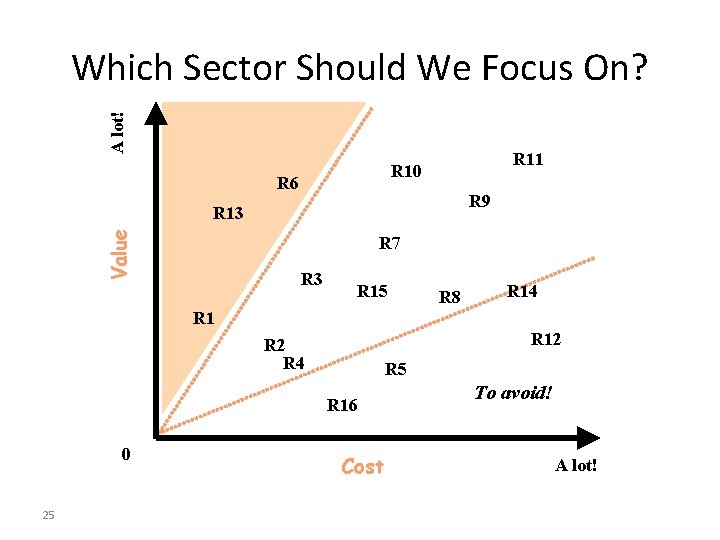
Requirements Prioritization and Triage • Requirements prioritization is also referred to as triage • Need to decide which requirements really matter or on those that need to be implemented in the current release • Need for compromise, negotiation, priorities • Prioritization is needed because there will almost always be the need for trade-offs (e. g. , required functionality vs. time and resources) • Must help: – Make acceptable tradeoffs among goals of value, cost, time-to-market – Allocate resources based on importance of requirements to the project as a whole (project planning) – Determine when a requirements should become part of the product – Offer the right product! 23
80 -20 Rule • 20% of functionalities provide 80% of revenues – Think of MS Word… • The remaining 80% of functionalities offer a lower return on investment while adding delays, development costs, maintenance costs. . . • How to find the most useful and beneficial 20% of functionalities? 24
A lot! Which Sector Should We Focus On? R 11 R 10 R 6 R 9 Value R 13 R 7 R 3 R 15 R 8 R 14 R 12 R 4 R 5 R 16 0 25 Cost To avoid! A lot!
Requirements Triage Process • Must be simple and fast, for industry adoption • Must yield accurate and trustworthy results • Must consider issues such as – The value of requirements to stakeholder (maximize) The cost of implementation (minimize) Time to market (to minimize) • Important to agree on requirements granularity – E. g. , use cases, features, detailed functional requirements 26
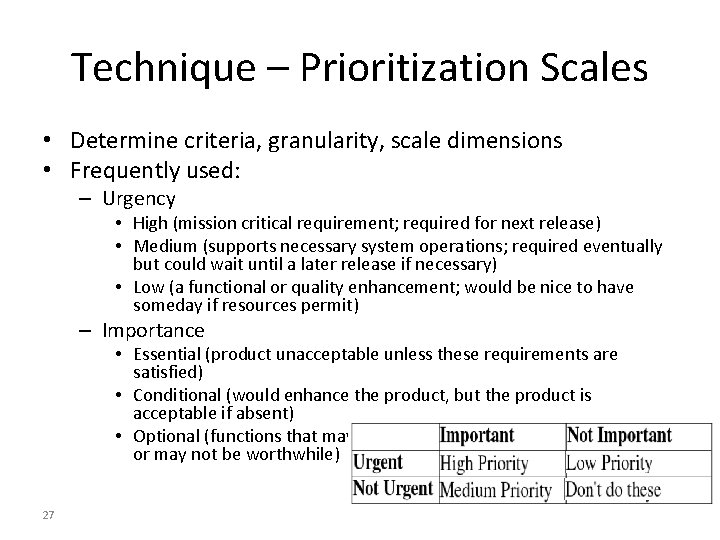
Technique – Prioritization Scales • Determine criteria, granularity, scale dimensions • Frequently used: – Urgency • High (mission critical requirement; required for next release) • Medium (supports necessary system operations; required eventually but could wait until a later release if necessary) • Low (a functional or quality enhancement; would be nice to have someday if resources permit) – Importance • Essential (product unacceptable unless these requirements are satisfied) • Conditional (would enhance the product, but the product is acceptable if absent) • Optional (functions that may or may not be worthwhile) 27
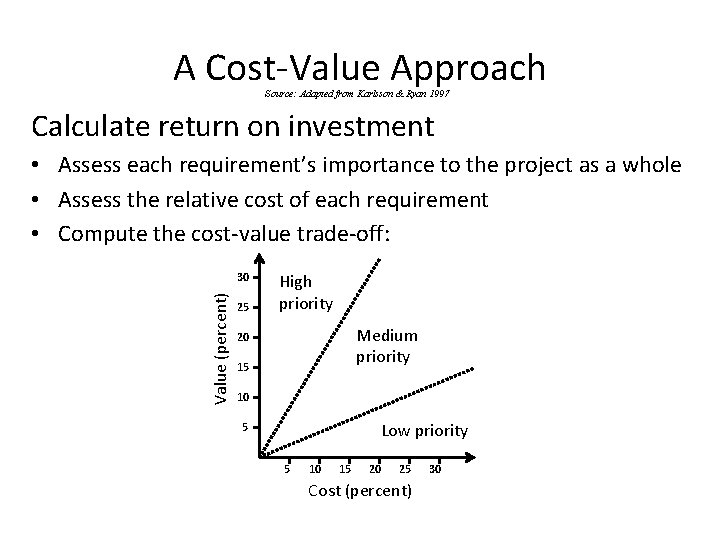
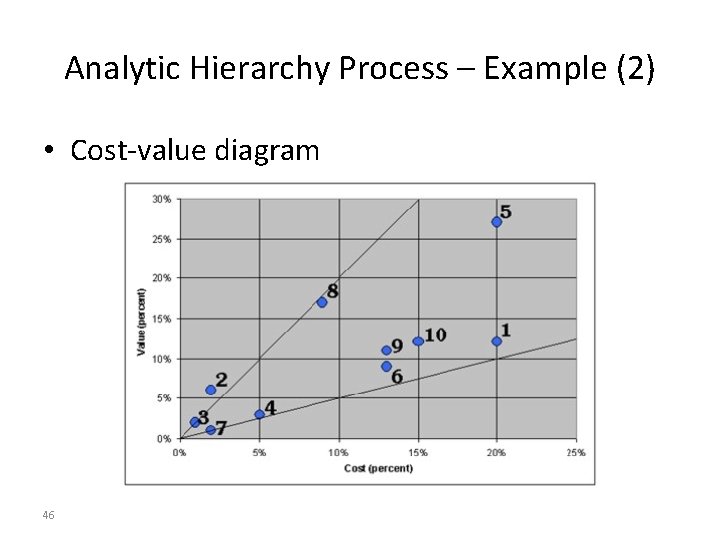
A Cost-Value Approach Source: Adapted from Karlsson & Ryan 1997 Calculate return on investment • Assess each requirement’s importance to the project as a whole • Assess the relative cost of each requirement • Compute the cost-value trade-off: Value (percent) 30 25 High priority Medium priority 20 15 10 Low priority 5 5 10 15 20 25 Cost (percent) 30
Estimating Cost & Value • Two approaches: – Absolute scale (e. g. dollar values) • Requires much domain experience – Relative values (e. g. less/more; a little, somewhat, very) • Much easier to elicit • Prioritization becomes a sorting problem • Comparison Process - options – Basic sorting - for every pair of requirements (i, j), ask if i>j? • E. g. bubblesort - start in random order, and swap each pair if out of order • requires n*(n-1)/2 comparisons – Construct a Binary Sort Tree • Requires O(n log n) comparisons – Contruct a Minimal Spanning Tree • for each pair (Ri, Ri+1) get the distance between them • Requires n-1 comparisons
Some complications • Hard to quantify differences – easier to say “x is more important than y”… – …than to estimate by how much. • Not all requirements comparable – E. g. different level of abstraction – E. g. core functionality vs. customer enhancements • Requirements may not be independent – No point selecting between X and Y if they are mutually dependent • Stakeholders may not be consistent – E. g. If X > Y, and Y > Z, then presumably X > Z? • Stakeholders might not agree – Different cost/value assessments for different types of stakeholder
Technique – Wiegers’ Prioritization • Semi-quantitative analytical approach to requirements prioritization based on value, cost, and risk • Relies on estimation of relative priorities of requirements – Dimensions • • Relative benefit (for having requirement) Relative penalty to stakeholder (if requirement is not included) Relative cost (to implement requirement) Relative risk (technical and other risks) – Each dimension is given a value on a given scale (e. g. , 0. . 9) – Dimensions have relative weights • Formula used to derive overall priority – priority = (value%) / ((cost% * cost weight) + (risk% * risk weight)) • Still limited by ability to properly estimate – Requires adaptation and calibration 31
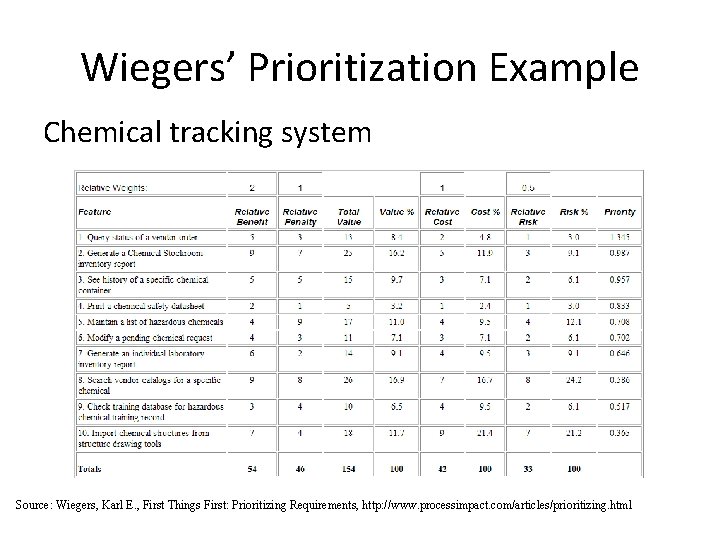
Wiegers’ Prioritization Example Chemical tracking system Source: Wiegers, Karl E. , First Things First: Prioritizing Requirements, http: //www. processimpact. com/articles/prioritizing. html
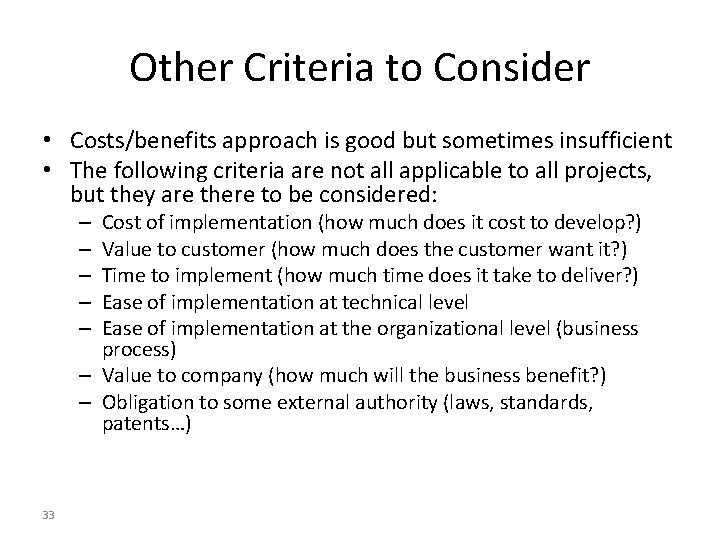
Other Criteria to Consider • Costs/benefits approach is good but sometimes insufficient • The following criteria are not all applicable to all projects, but they are there to be considered: Cost of implementation (how much does it cost to develop? ) Value to customer (how much does the customer want it? ) Time to implement (how much time does it take to deliver? ) Ease of implementation at technical level Ease of implementation at the organizational level (business process) – Value to company (how much will the business benefit? ) – Obligation to some external authority (laws, standards, patents…) – – – 33
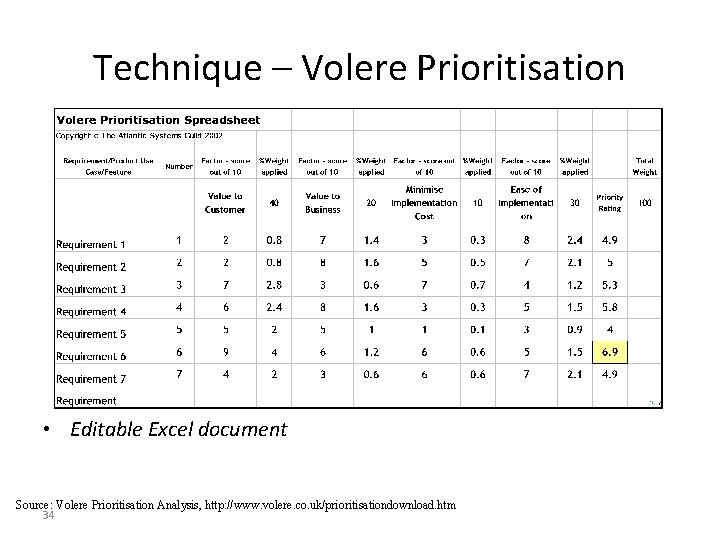
Technique – Volere Prioritisation • Editable Excel document Source: Volere Prioritisation Analysis, http: //www. volere. co. uk/prioritisationdownload. htm 34
Pairwise Comparisons (1) • Finding scores and weights is difficult and subjective • Potential solution: pairwise comparison – Which requirements (A or B) is more important: A << < = > >> B • Benefits – Indicates what is important to the client – Identifies requirements of high value and low cost (priority!) – Identifies requirements of low value and high cost (likely to be removed) – Has already been used to assist numerous corporate and government decision makers • Choosing a telecommunication system, formulating a drug policy, choosing a product marketing strategy 35
Pairwise Comparisons (2) • New problems – Large number of pairs – pairwise comparison can be tedious • Solved using transitivity and other tricks! • Mathematical optimization of the number of pairs to be considered (no need to cover all) – Many dependencies between requirements • Can actually be used to further reduce the # of pairs • E. g. , group many requirements as features, use cases, services… • Example approach – Analytic Hierarchy Process 1 [1] Karlsson, J. and Ryan, K. A cost-value approach for prioritizing requirements, IEEE Software, Sept/Oct 1997 36
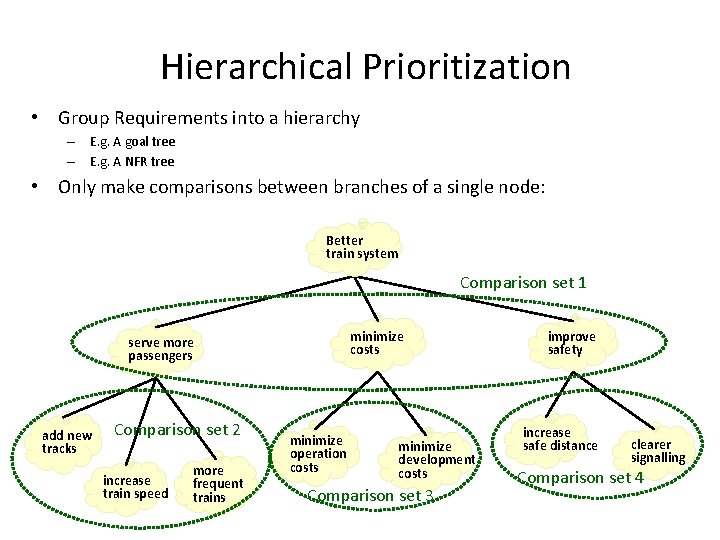
Hierarchical Prioritization • Group Requirements into a hierarchy – E. g. A goal tree – E. g. A NFR tree • Only make comparisons between branches of a single node: Better train system Comparison set 1 minimize costs serve more passengers add new tracks Comparison set 2 increase train speed more frequent trains minimize operation costs minimize development costs Comparison set 3 improve safety increase safe distance clearer signalling Comparison set 4
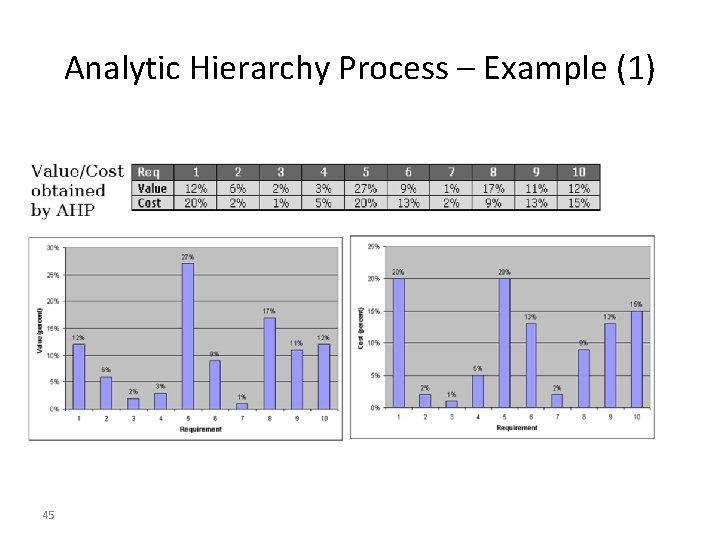
Technique – Analytic Hierarchy Process (AHP) • Developed by Karlsson and Ryan (1997) based on work by Saaty (early 1970) – see also http: //en. wikipedia. org/wiki/Analytic_Hierarchy_Process • Use cost-value diagrams to analyze and discuss candidate requirements • Useful for requirements triage and release planning (but also applicable in many other situations where complex decisions are to be made) • Basic procedure for rating a set of criteria – Develop pairwise comparison matrix of each criterion – Normalize the matrix – Average the value of each row to get corresponding rating • Criterion ratings are then used to evaluate different potential decisions 38
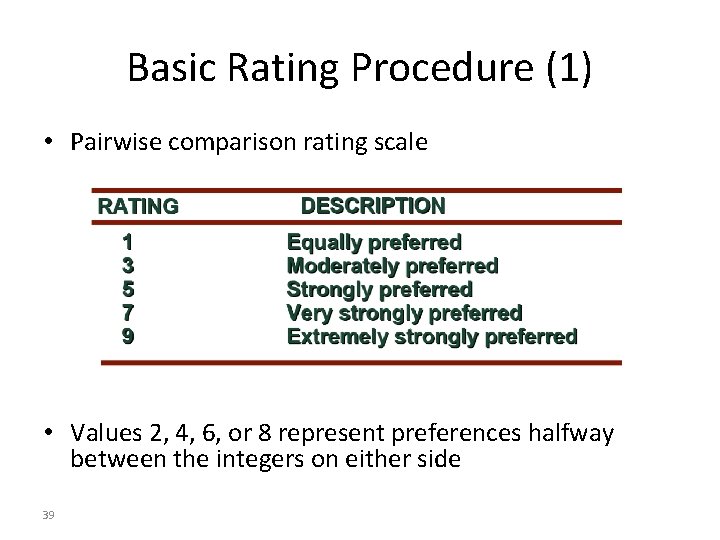
Basic Rating Procedure (1) • Pairwise comparison rating scale • Values 2, 4, 6, or 8 represent preferences halfway between the integers on either side 39
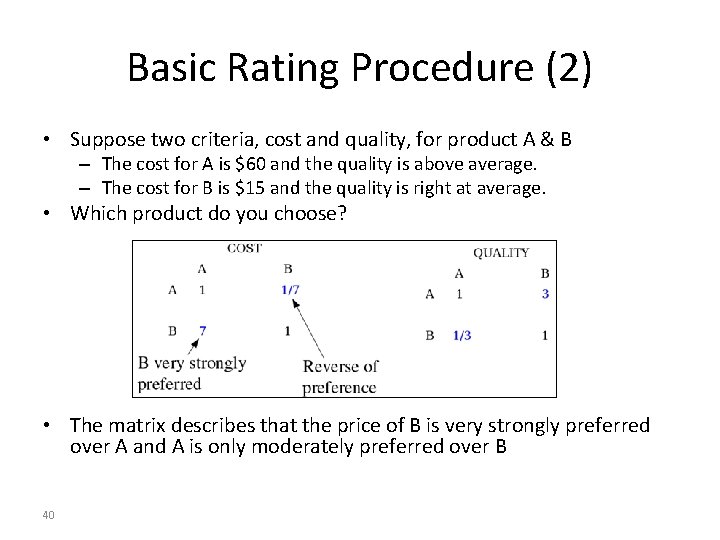
Basic Rating Procedure (2) • Suppose two criteria, cost and quality, for product A & B – The cost for A is $60 and the quality is above average. – The cost for B is $15 and the quality is right at average. • Which product do you choose? • The matrix describes that the price of B is very strongly preferred over A and A is only moderately preferred over B 40
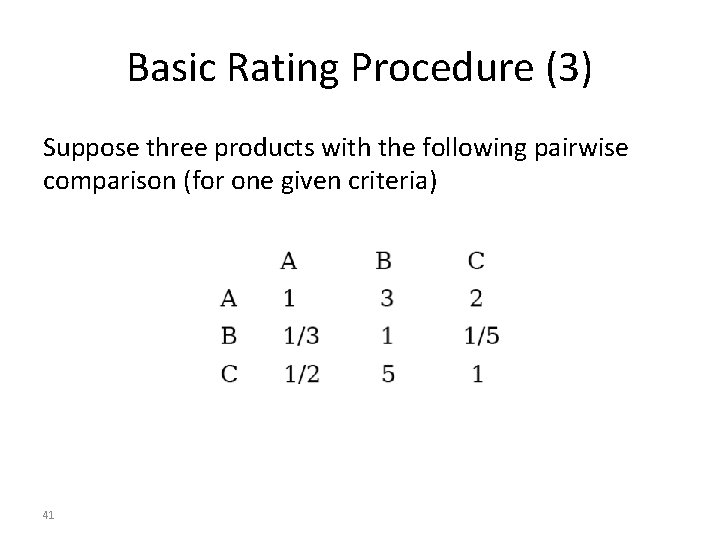
Basic Rating Procedure (3) Suppose three products with the following pairwise comparison (for one given criteria) 41
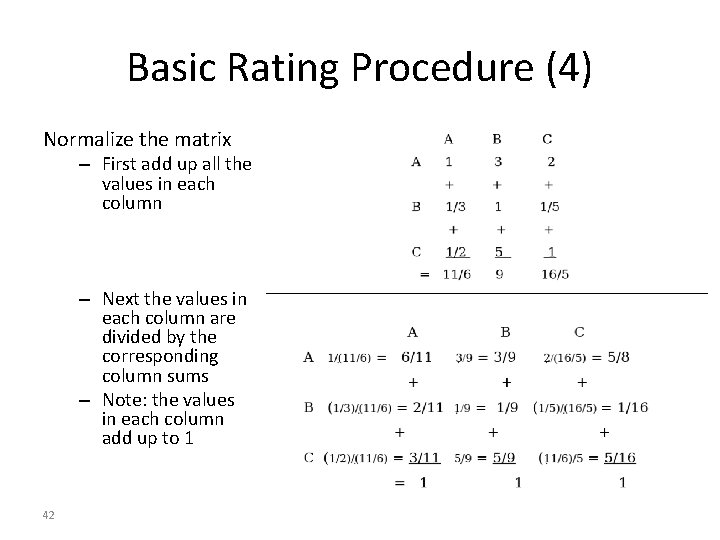
Basic Rating Procedure (4) Normalize the matrix – First add up all the values in each column – Next the values in each column are divided by the corresponding column sums – Note: the values in each column add up to 1 42
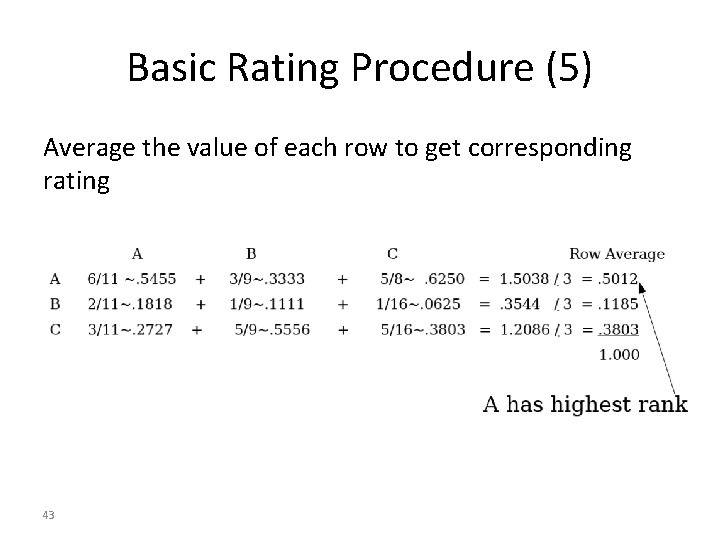
Basic Rating Procedure (5) Average the value of each row to get corresponding rating 43
Analytic Hierarchy Process – Steps • Requirements engineers check individual requirements for ambiguities, completeness… • Apply AHP’s pairwise comparison to estimate the relative value of candidate requirements • Experienced software engineers use AHP’s pairwise comparison to estimate the cost of candidate requirements • Plot these values on a cost-value diagram • Stakeholders use this diagram for analysis and to make trade-offs 44
Analytic Hierarchy Process – Example (1) 45
Analytic Hierarchy Process – Example (2) • Cost-value diagram 46
Analytic Hierarchy Process – Stakeholders (1) • Each client is unique! • Each stakeholder group may have a different weight – Process uses a weighting criteria to consider each individual stakeholder group • Example (stakeholders M 1 to M 10 are different markets) – – – – 47 Revenue last release Profit last release Number of sold licenses last release Predictions of the above criteria for the coming release Number of contracts lost to competitors Number of potential customer with nil licenses to date Size of total market segment Growth potential
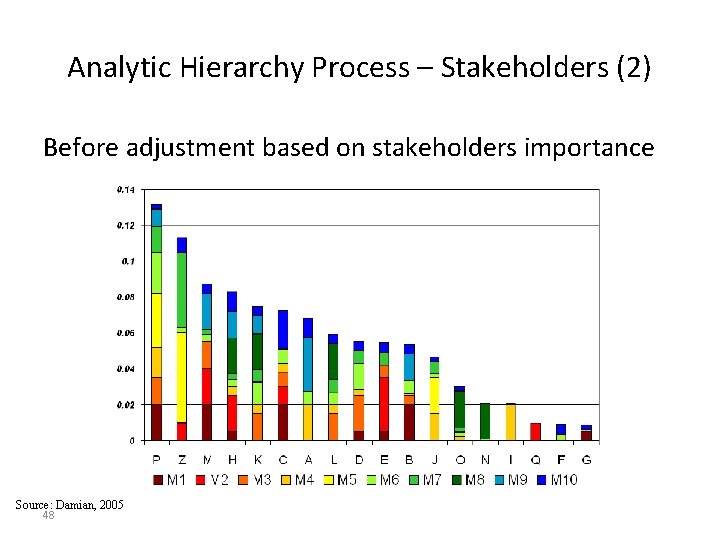
Analytic Hierarchy Process – Stakeholders (2) Before adjustment based on stakeholders importance Source: Damian, 2005 48
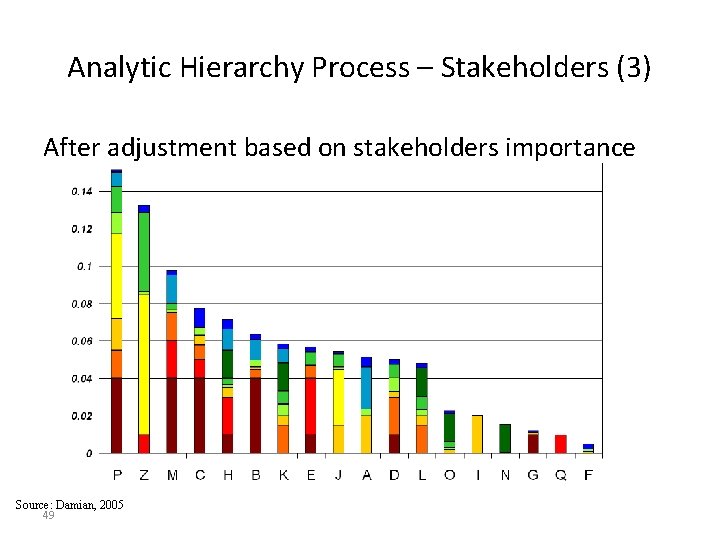
Analytic Hierarchy Process – Stakeholders (3) After adjustment based on stakeholders importance Source: Damian, 2005 49
Example of Commercial Tool IBM Rational (formerly Telelogic) Focal Point – Decision support, portfolio management – Pairwise comparisons of features • Creation and validation of web questionnaires – Dynamic algorithm for reducing the number of pairs, according to the responses – Detection of inconsistency between the answers – Priorities • For different markets – Represented in various different ways – Integration with DOORS – http: //www-01. ibm. com/software/awdtools/focalpoint/ 50
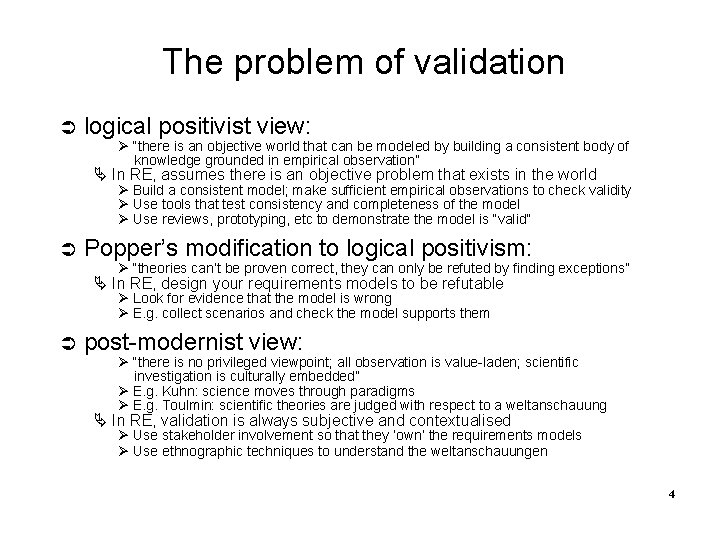
The problem of validation logical positivist view: “there is an objective world that can be modeled by building a consistent body of knowledge grounded in empirical observation” In RE, assumes there is an objective problem that exists in the world Build a consistent model; make sufficient empirical observations to check validity Use tools that test consistency and completeness of the model Use reviews, prototyping, etc to demonstrate the model is “valid” Popper’s modification to logical positivism: “theories can’t be proven correct, they can only be refuted by finding exceptions” In RE, design your requirements models to be refutable Look for evidence that the model is wrong E. g. collect scenarios and check the model supports them post-modernist view: “there is no privileged viewpoint; all observation is value-laden; scientific investigation is culturally embedded” E. g. Kuhn: science moves through paradigms E. g. Toulmin: scientific theories are judged with respect to a weltanschauung In RE, validation is always subjective and contextualised Use stakeholder involvement so that they ‘own’ the requirements models Use ethnographic techniques to understand the weltanschauungen 4
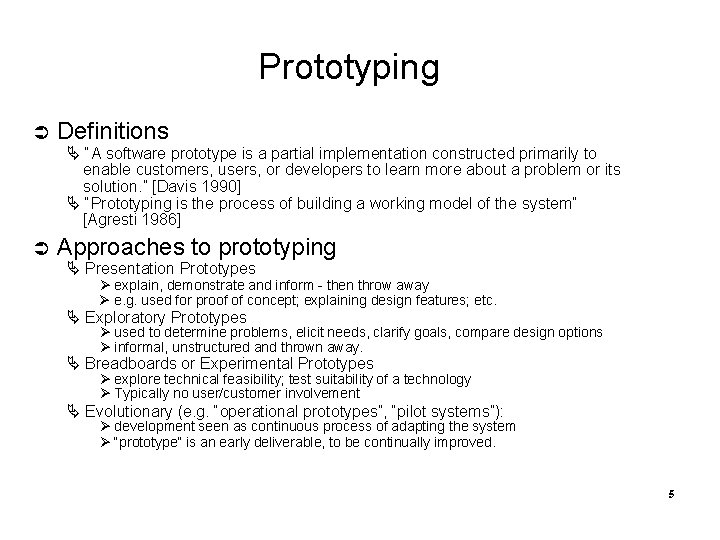
Prototyping Definitions “A software prototype is a partial implementation constructed primarily to enable customers, users, or developers to learn more about a problem or its solution. ” [Davis 1990] “Prototyping is the process of building a working model of the system” [Agresti 1986] Approaches to prototyping Presentation Prototypes explain, demonstrate and inform - then throw away e. g. used for proof of concept; explaining design features; etc. Exploratory Prototypes used to determine problems, elicit needs, clarify goals, compare design options informal, unstructured and thrown away. Breadboards or Experimental Prototypes explore technical feasibility; test suitability of a technology Typically no user/customer involvement Evolutionary (e. g. “operational prototypes”, “pilot systems”): development seen as continuous process of adapting the system “prototype” is an early deliverable, to be continually improved. 5
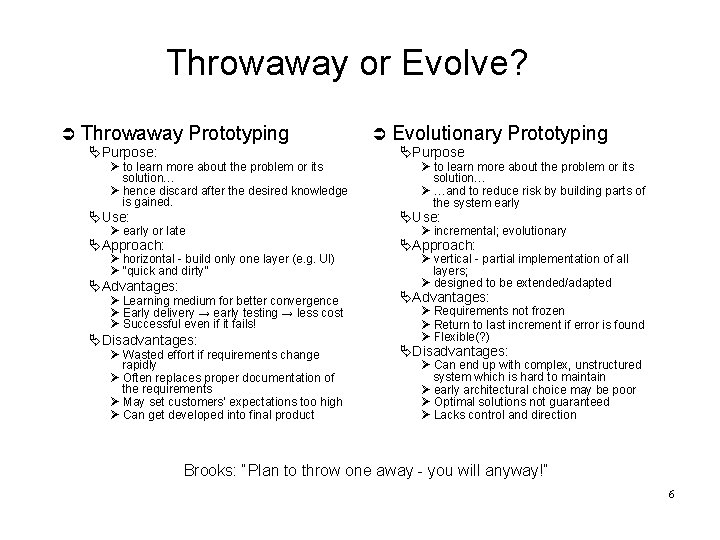
Throwaway or Evolve? Throwaway Prototyping Evolutionary Prototyping Purpose: Purpose Use: Approach: to learn more about the problem or its solution… hence discard after the desired knowledge is gained. early or late horizontal - build only one layer (e. g. UI) “quick and dirty” Advantages: Learning medium for better convergence Early delivery → early testing → less cost Successful even if it fails! Disadvantages: Wasted effort if requirements change rapidly Often replaces proper documentation of the requirements May set customers’ expectations too high Can get developed into final product to learn more about the problem or its solution… …and to reduce risk by building parts of the system early incremental; evolutionary vertical - partial implementation of all layers; designed to be extended/adapted Advantages: Requirements not frozen Return to last increment if error is found Flexible(? ) Disadvantages: Can end up with complex, unstructured system which is hard to maintain early architectural choice may be poor Optimal solutions not guaranteed Lacks control and direction Brooks: “Plan to throw one away - you will anyway!” 6
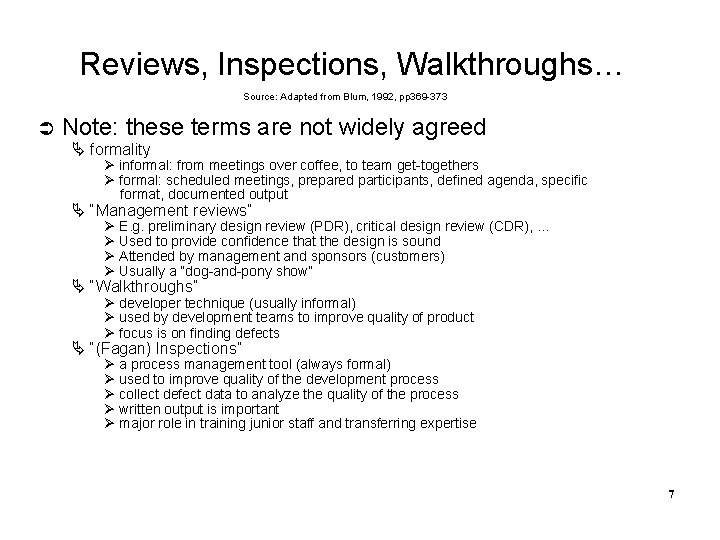
Reviews, Inspections, Walkthroughs… Source: Adapted from Blum, 1992, pp 369 -373 Note: these terms are not widely agreed formality informal: from meetings over coffee, to team get-togethers formal: scheduled meetings, prepared participants, defined agenda, specific format, documented output “Management reviews” E. g. preliminary design review (PDR), critical design review (CDR), … Used to provide confidence that the design is sound Attended by management and sponsors (customers) Usually a “dog-and-pony show” “Walkthroughs” developer technique (usually informal) used by development teams to improve quality of product focus is on finding defects “(Fagan) Inspections” a process management tool (always formal) used to improve quality of the development process collect defect data to analyze the quality of the process written output is important major role in training junior staff and transferring expertise 7
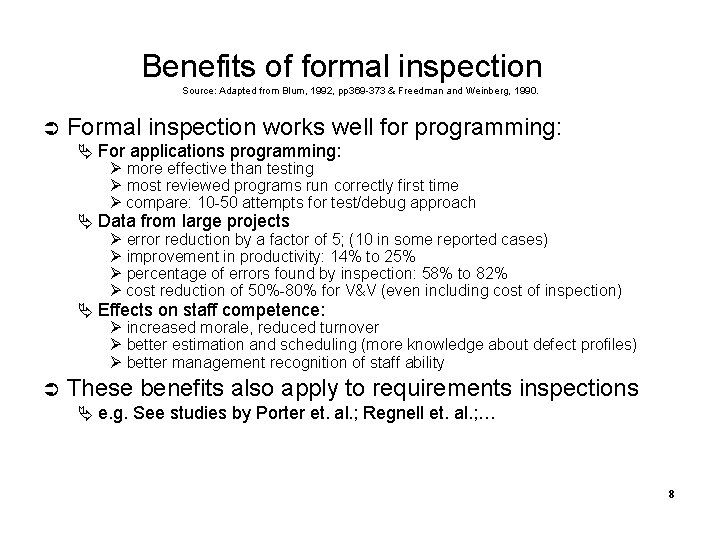
Benefits of formal inspection Source: Adapted from Blum, 1992, pp 369 -373 & Freedman and Weinberg, 1990. Formal inspection works well for programming: For applications programming: more effective than testing most reviewed programs run correctly first time compare: 10 -50 attempts for test/debug approach Data from large projects error reduction by a factor of 5; (10 in some reported cases) improvement in productivity: 14% to 25% percentage of errors found by inspection: 58% to 82% cost reduction of 50%-80% for V&V (even including cost of inspection) Effects on staff competence: increased morale, reduced turnover better estimation and scheduling (more knowledge about defect profiles) better management recognition of staff ability These benefits also apply to requirements inspections e. g. See studies by Porter et. al. ; Regnell et. al. ; … 8
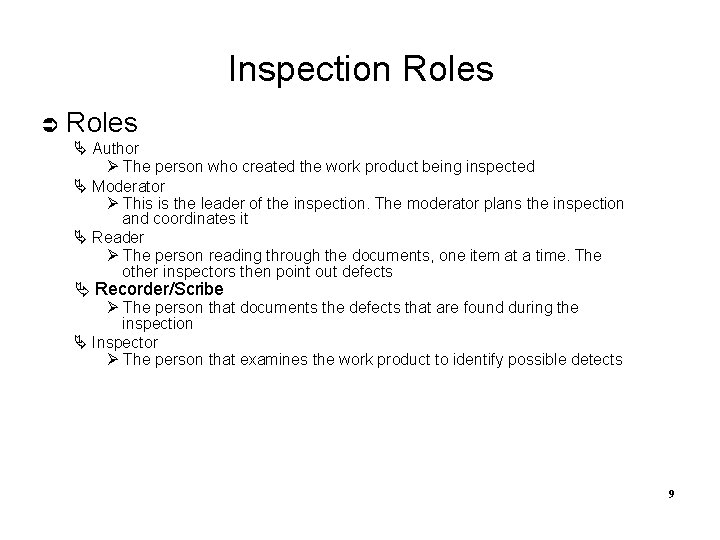
Inspection Roles Author The person who created the work product being inspected Moderator This is the leader of the inspection. The moderator plans the inspection and coordinates it Reader The person reading through the documents, one item at a time. The other inspectors then point out defects Recorder/Scribe The person that documents the defects that are found during the inspection Inspector The person that examines the work product to identify possible detects 9
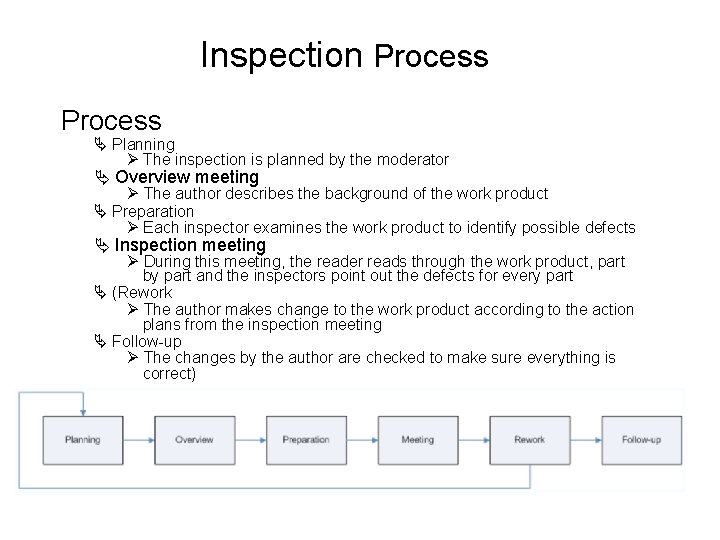
Inspection Process Planning The inspection is planned by the moderator Overview meeting The author describes the background of the work product Preparation Each inspector examines the work product to identify possible defects Inspection meeting During this meeting, the reader reads through the work product, part by part and the inspectors point out the defects for every part (Rework The author makes change to the work product according to the action plans from the inspection meeting Follow-up The changes by the author are checked to make sure everything is correct) 10
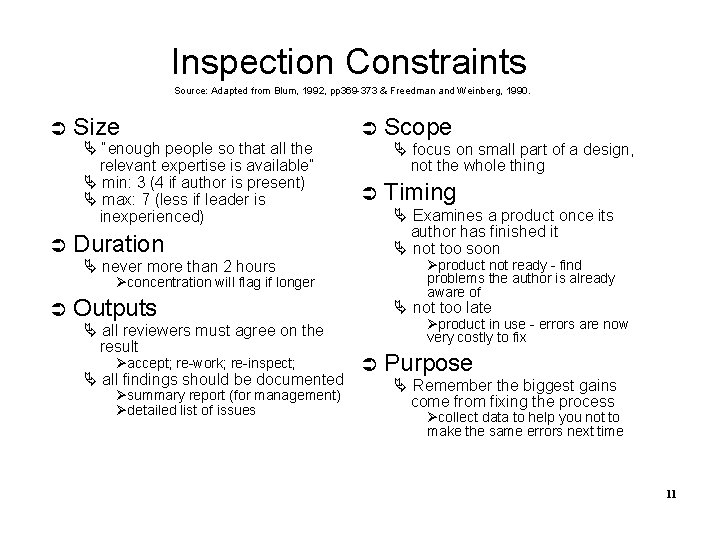
Inspection Constraints Source: Adapted from Blum, 1992, pp 369 -373 & Freedman and Weinberg, 1990. Size “enough people so that all the relevant expertise is available” min: 3 (4 if author is present) max: 7 (less if leader is inexperienced) focus on small part of a design, not the whole thing Duration product not ready - find problems the author is already aware of concentration will flag if longer Outputs all reviewers must agree on the result accept; re-work; re-inspect; all findings should be documented summary report (for management) detailed list of issues Timing Examines a product once its author has finished it not too soon never more than 2 hours Scope not too late product in use - errors are now very costly to fix Purpose Remember the biggest gains come from fixing the process collect data to help you not to make the same errors next time 11
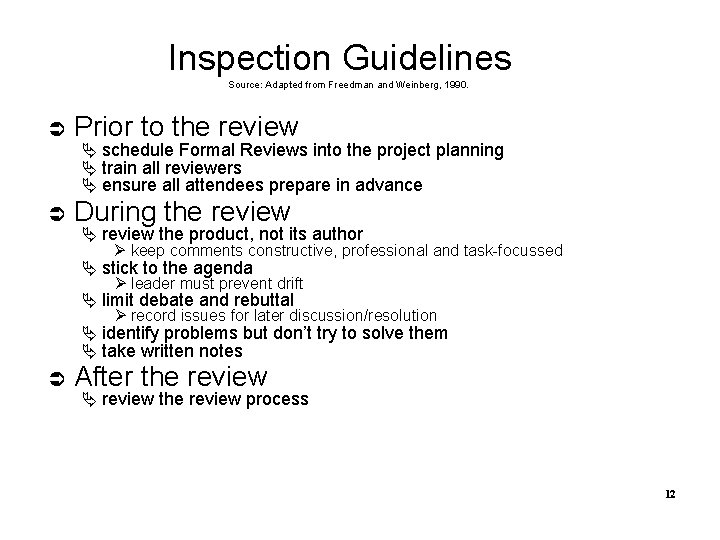
Inspection Guidelines Source: Adapted from Freedman and Weinberg, 1990. Prior to the review During the review schedule Formal Reviews into the project planning train all reviewers ensure all attendees prepare in advance review the product, not its author keep comments constructive, professional and task-focussed stick to the agenda leader must prevent drift limit debate and rebuttal record issues for later discussion/resolution identify problems but don’t try to solve them take written notes After the review process 12
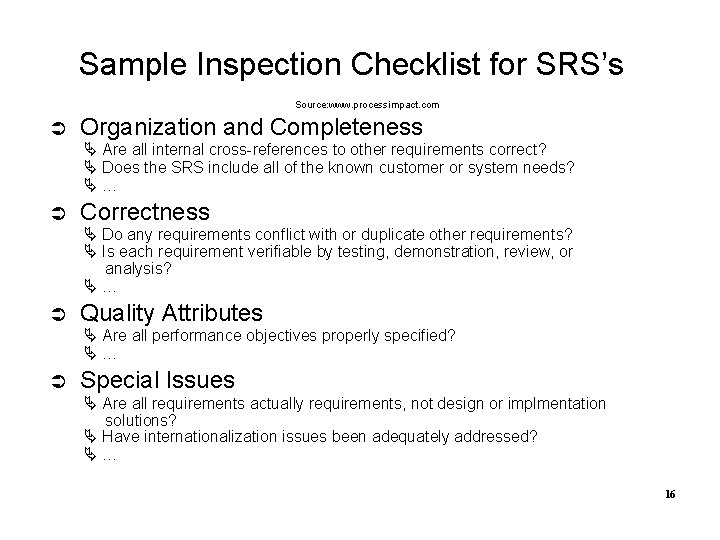
Sample Inspection Checklist for SRS’s Source: www. processimpact. com Organization and Completeness Are all internal cross-references to other requirements correct? Does the SRS include all of the known customer or system needs? … Correctness Do any requirements conflict with or duplicate other requirements? Is each requirement verifiable by testing, demonstration, review, or analysis? … Quality Attributes Are all performance objectives properly specified? … Special Issues Are all requirements actually requirements, not design or implmentation solutions? Have internationalization issues been adequately addressed? … 16
- Slides: 60