
The Vigorous Afterlife of Massive Stars Kristen Menou


- Slides: 24
The Vigorous Afterlife of Massive Stars Kristen Menou Institut d’Astrophysique de Paris (IAP)
New Manifestations à DISCUSSED: -- (Long) Gamma-Ray Burst: Afterglows and Central Engines -- Accretion onto Black Holes -- Strongly-Magnetized Neutron Stars: Magnetars à Omitted: -- Accretion-Powered and nuclear-Powered ms X-ray Pulsars -- White Dwarf Populations and X-ray Sources in Globular Clusters -- X-ray Quasi-Periodic Oscillations (QPOs) in Accreting Sources -- Ultra-luminous X-ray Sources and Intermediate-Mass Black Holes -- Supernova Remnants
GAMMA-RAY BURTS
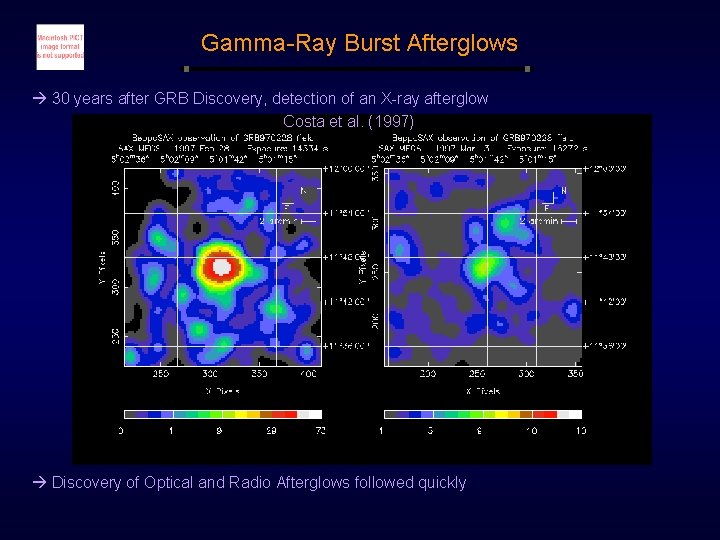
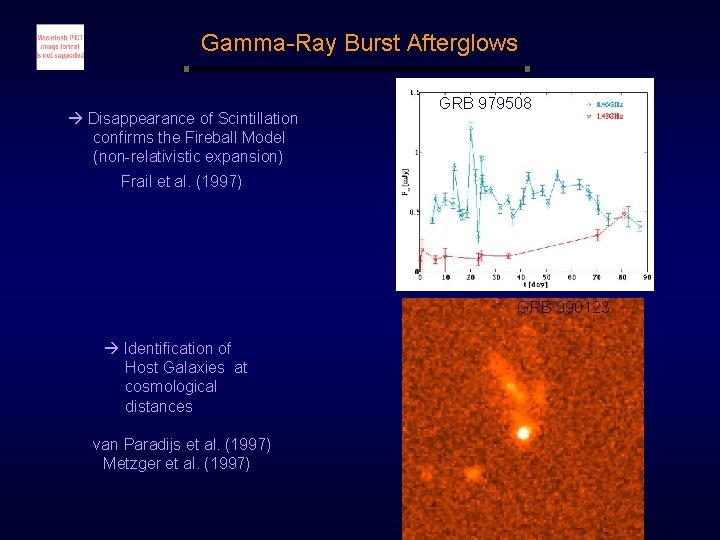
Gamma-Ray Burst Afterglows à 30 years after GRB Discovery, detection of an X-ray afterglow Costa et al. (1997) à Discovery of Optical and Radio Afterglows followed quickly
Gamma-Ray Burst Afterglows à Disappearance of Scintillation confirms the Fireball Model (non-relativistic expansion) GRB 979508 Frail et al. (1997) GRB 990123 à Identification of Host Galaxies at cosmological distances van Paradijs et al. (1997) Metzger et al. (1997)
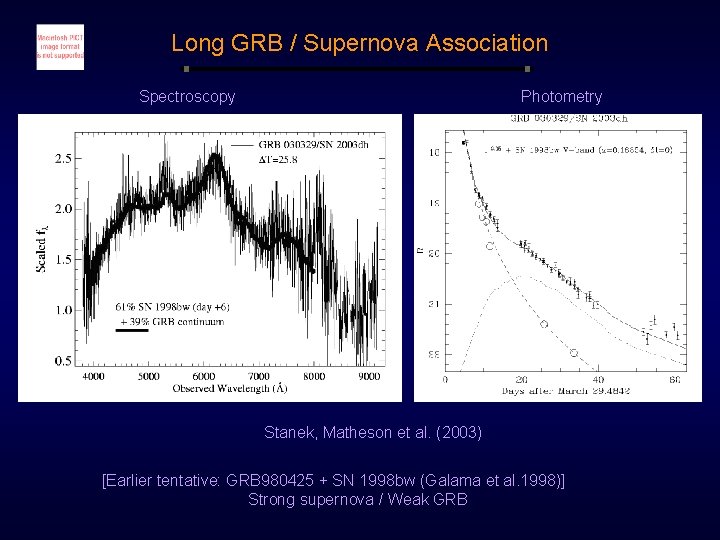
Long GRB / Supernova Association Spectroscopy Photometry Stanek, Matheson et al. (2003) [Earlier tentative: GRB 980425 + SN 1998 bw (Galama et al. 1998)] Strong supernova / Weak GRB
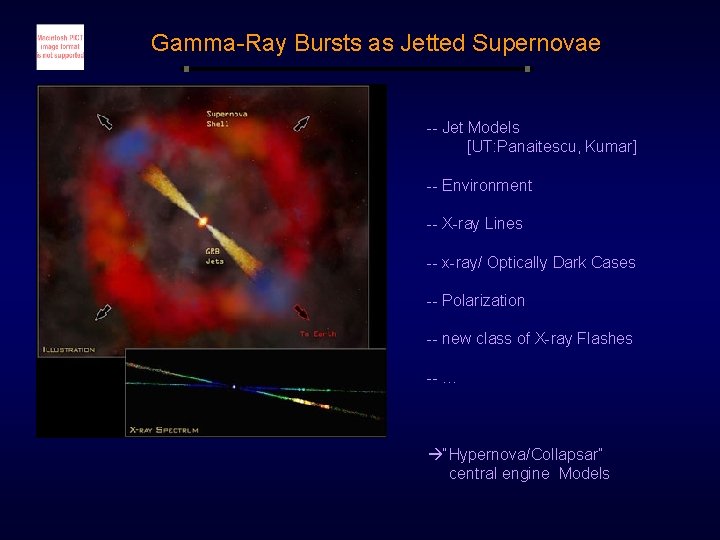
Gamma-Ray Bursts as Jetted Supernovae -- Jet Models [UT: Panaitescu, Kumar] -- Environment -- X-ray Lines -- x-ray/ Optically Dark Cases -- Polarization -- new class of X-ray Flashes -- … à“Hypernova/Collapsar” central engine Models
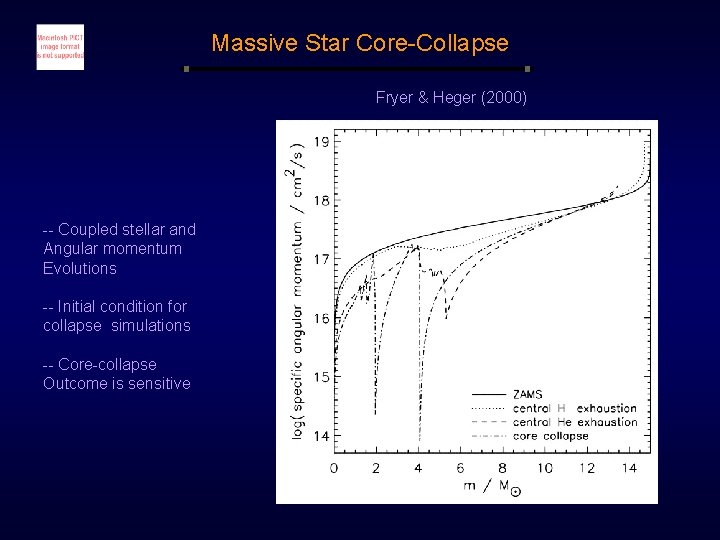
Massive Star Core-Collapse Fryer & Heger (2000) -- Coupled stellar and Angular momentum Evolutions -- Initial condition for collapse simulations -- Core-collapse Outcome is sensitive
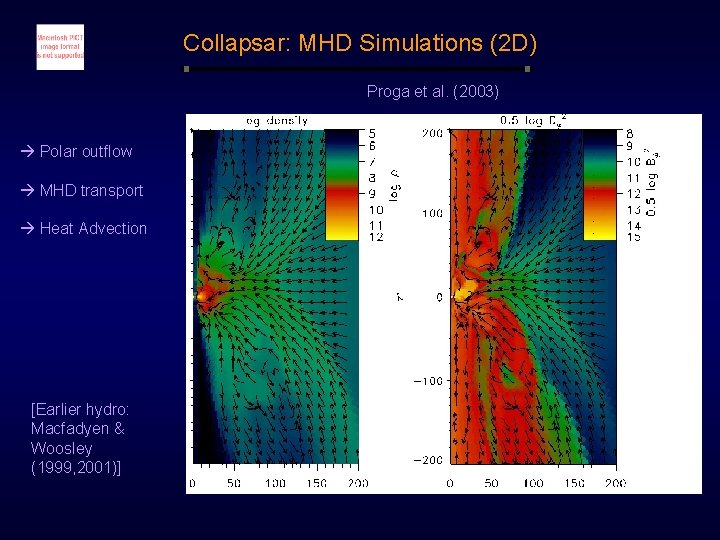
Collapsar: MHD Simulations (2 D) Proga et al. (2003) à Polar outflow à MHD transport à Heat Advection [Earlier hydro: Macfadyen & Woosley (1999, 2001)]
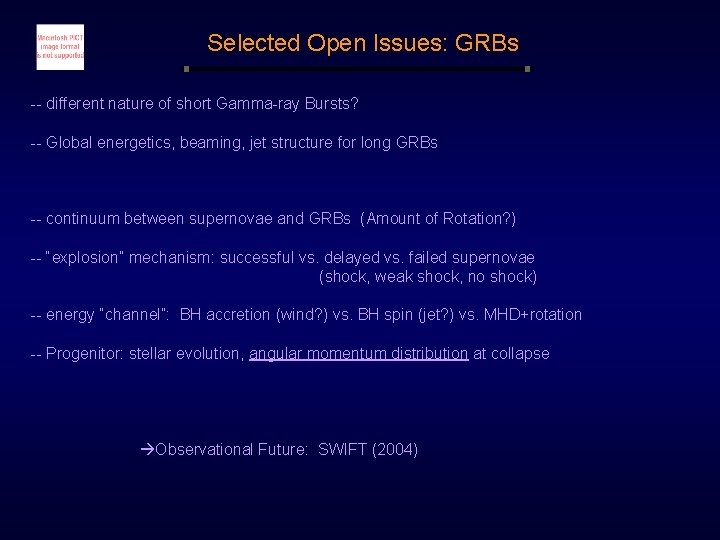
Selected Open Issues: GRBs -- different nature of short Gamma-ray Bursts? -- Global energetics, beaming, jet structure for long GRBs -- continuum between supernovae and GRBs (Amount of Rotation? ) -- “explosion” mechanism: successful vs. delayed vs. failed supernovae (shock, weak shock, no shock) -- energy “channel”: BH accretion (wind? ) vs. BH spin (jet? ) vs. MHD+rotation -- Progenitor: stellar evolution, angular momentum distribution at collapse àObservational Future: SWIFT (2004)
BLACK HOLE ACCRETION
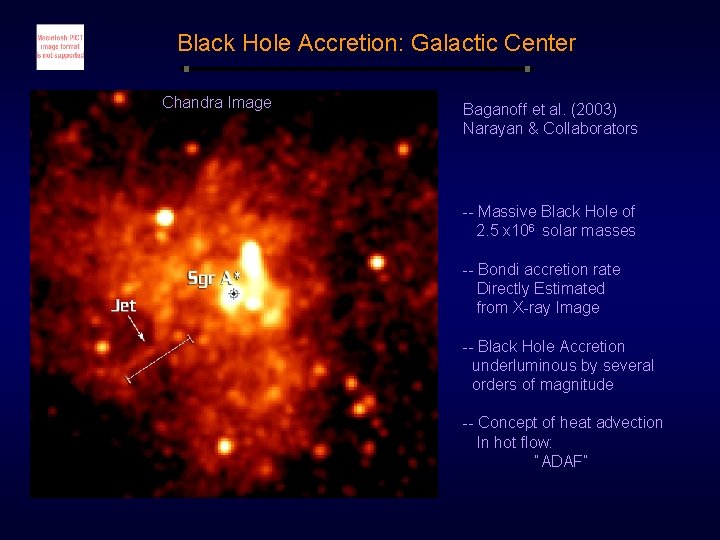
Black Hole Accretion: Galactic Center Chandra Image Baganoff et al. (2003) Narayan & Collaborators -- Massive Black Hole of 2. 5 x 10⁶ solar masses -- Bondi accretion rate Directly Estimated from X-ray Image -- Black Hole Accretion underluminous by several orders of magnitude -- Concept of heat advection In hot flow: “ADAF”
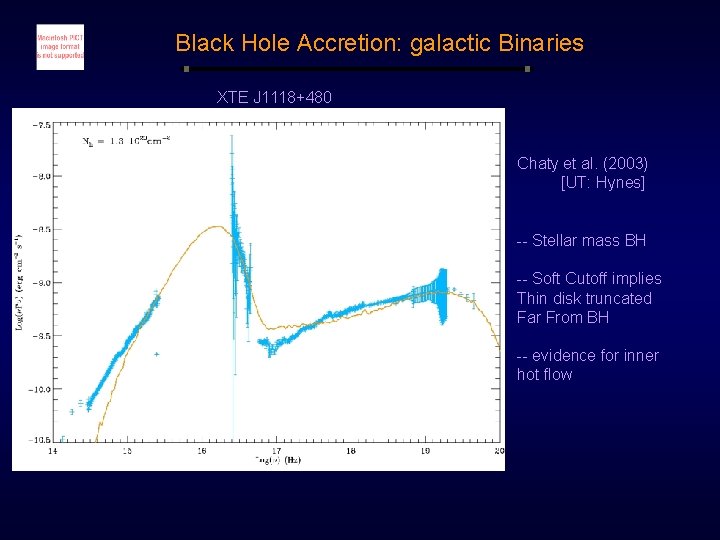
Black Hole Accretion: galactic Binaries XTE J 1118+480 Chaty et al. (2003) [UT: Hynes] -- Stellar mass BH -- Soft Cutoff implies Thin disk truncated Far From BH -- evidence for inner hot flow
Black Hole Accretion: MHD Simulations Density evolution Magneto-rotational Instability Full (Static) GR MHD, Kerr BH, Prograde Adiabatic torus De Villiers & Hawley (2003) Hawley & balbus (2002)
Selected Open Issues: BH Accretion -- Global structure of flows with advection (wind? ) -- nature of flow near the black hole (marginally stable orbit, etc…) -- feasibility of BH spin extraction, origin of Jets -- Collision-less nature of flow (turbulence, particle heating) -- Measure of BH spin via broadened iron line? à Observational Future: Constellation-X (2011) Black Hole Imager (? )
NEUTRON STARS
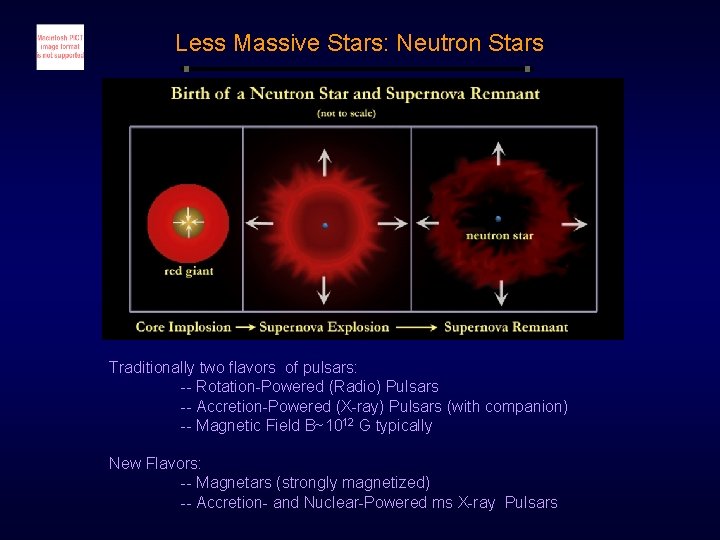
Less Massive Stars: Neutron Stars Traditionally two flavors of pulsars: -- Rotation-Powered (Radio) Pulsars -- Accretion-Powered (X-ray) Pulsars (with companion) -- Magnetic Field B~1012 G typically New Flavors: -- Magnetars (strongly magnetized) -- Accretion- and Nuclear-Powered ms X-ray Pulsars
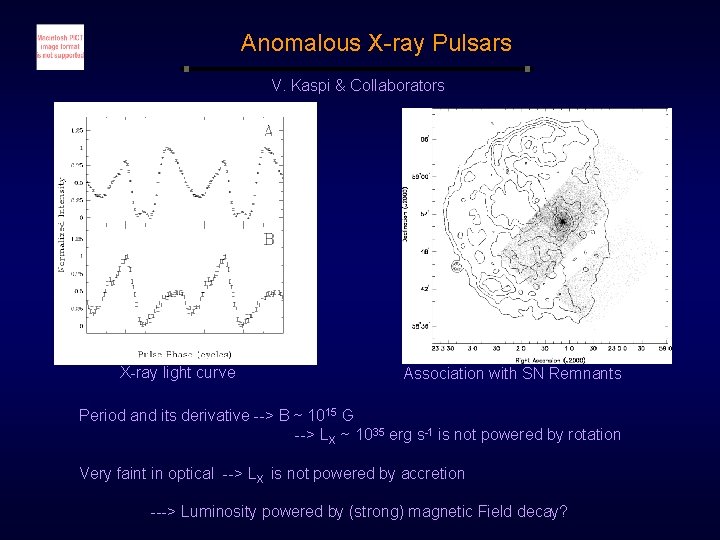
Anomalous X-ray Pulsars V. Kaspi & Collaborators X-ray light curve Association with SN Remnants Period and its derivative --> B ~ 1015 G --> LX ~ 1035 erg s-1 is not powered by rotation Very faint in optical --> LX is not powered by accretion ---> Luminosity powered by (strong) magnetic Field decay?
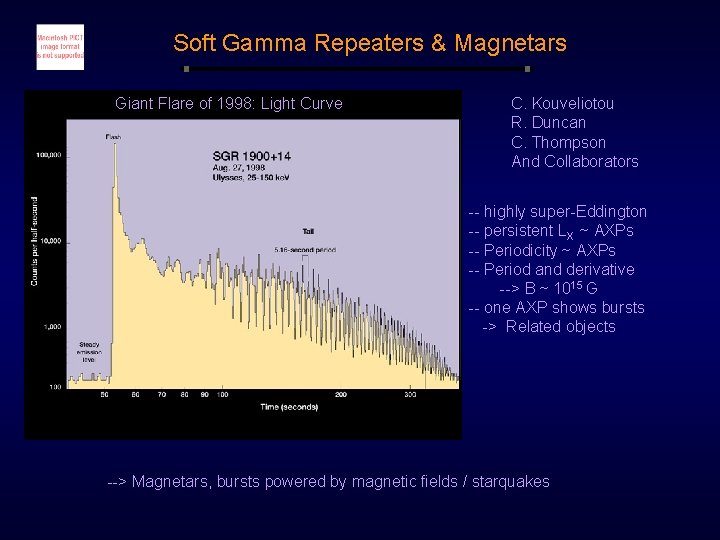
Soft Gamma Repeaters & Magnetars Giant Flare of 1998: Light Curve C. Kouveliotou R. Duncan C. Thompson And Collaborators -- highly super-Eddington -- persistent LX ~ AXPs -- Periodicity ~ AXPs -- Period and derivative --> B ~ 1015 G -- one AXP shows bursts -> Related objects --> Magnetars, bursts powered by magnetic fields / starquakes
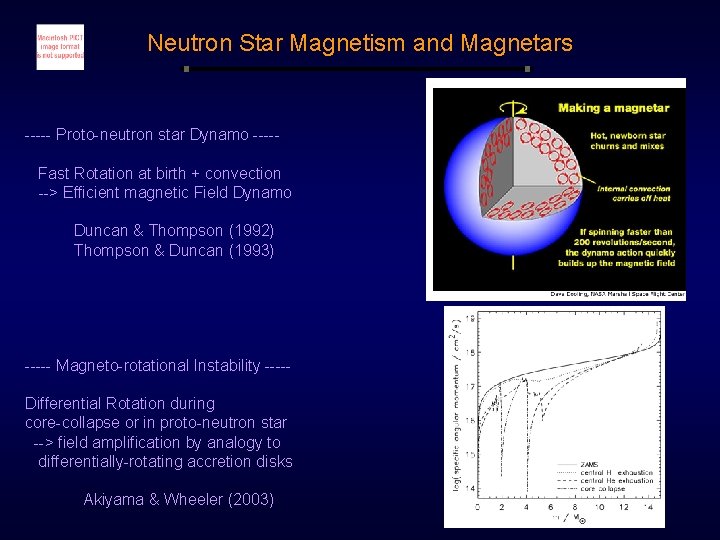
Neutron Star Magnetism and Magnetars ----- Proto-neutron star Dynamo ----Fast Rotation at birth + convection --> Efficient magnetic Field Dynamo Duncan & Thompson (1992) Thompson & Duncan (1993) ----- Magneto-rotational Instability ----Differential Rotation during core-collapse or in proto-neutron star --> field amplification by analogy to differentially-rotating accretion disks Akiyama & Wheeler (2003)
EPILOGUE
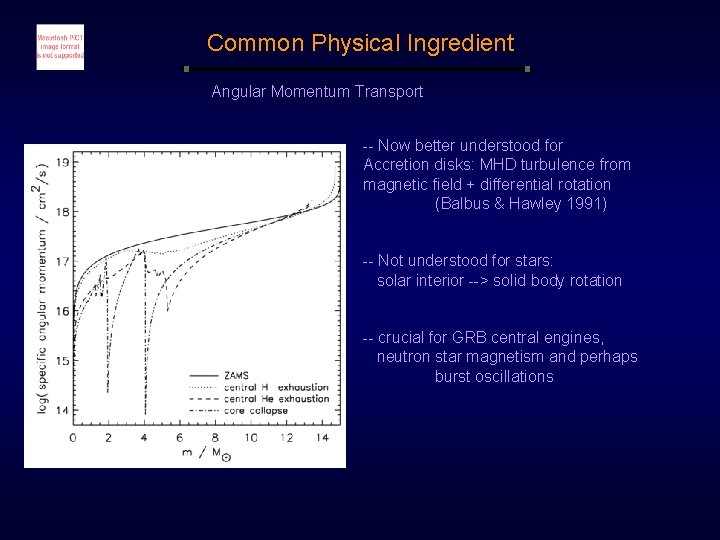
Common Physical Ingredient Angular Momentum Transport -- Now better understood for Accretion disks: MHD turbulence from magnetic field + differential rotation (Balbus & Hawley 1991) -- Not understood for stars: solar interior --> solid body rotation -- crucial for GRB central engines, neutron star magnetism and perhaps burst oscillations
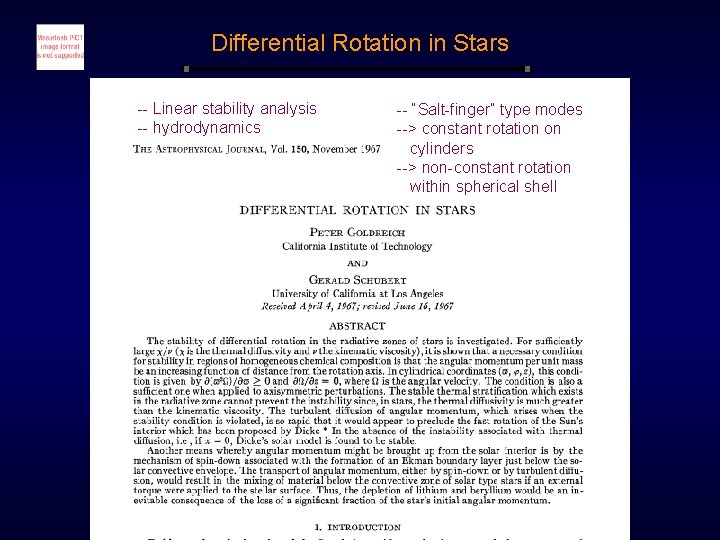
Differential Rotation in Stars -- Linear stability analysis -- hydrodynamics -- “Salt-finger” type modes --> constant rotation on cylinders --> non-constant rotation within spherical shell
Differential Rotation + magnetic Field Menou, Balbus & Spruit (2003) -- New ingredients: weak magnetic field Resistivity (+viscosity+heat conduction) -- New result: in inviscid or perfect-conductor limits --> constant rotation on cylinders --> constant rotation within shell => solid body rotation! -- Amenable to numerical simulations (transport and mixing in stars)? à could help explain the diversity of afterlife manifestations Menou (2003)