
THE BIG AGENDA PRIORITIZING TICKETS THAT HOLD REAL

THE BIG AGENDA PRIORITIZING TICKETS THAT HOLD REAL VALUE Not all tickets are equal. Here, we explore new and innovative methods of prioritizing tickets so that the highest value is returned in the shortest time, achieving improved effectiveness with no additional effort.
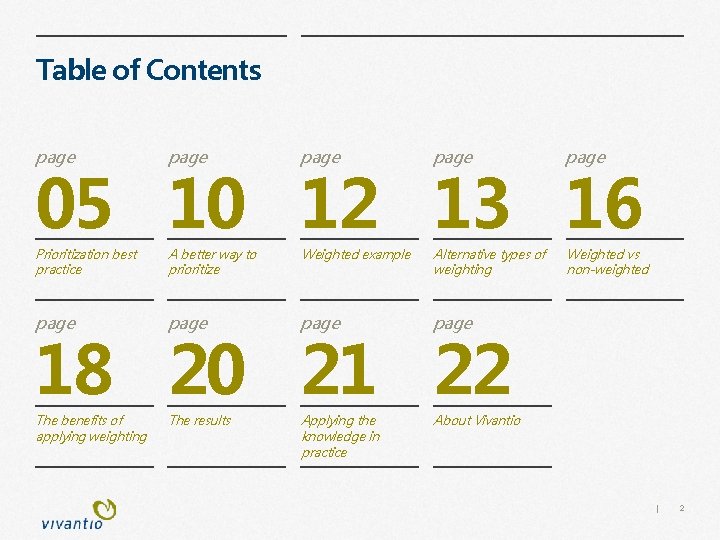
Table of Contents page page Prioritization best practice A better way to prioritize Weighted example Alternative types of weighting Weighted vs non-weighted page The benefits of applying weighting The results Applying the knowledge in practice About Vivantio 05 10 12 13 16 18 20 21 22 | 2
Introduction All tickets are not equal. Whilst best practice advises that a ticket’s priority is the product of its impact and urgency, there are other methodologies for prioritization that can be used. Methods that deliver real value to the business. This document explores new ways to prioritize tickets and seeks to demonstrate that it’s possible to achieve a prioritization model that will improve SLA delivery rates and dramatically improve business value. Prioritizing those tickets that hold the real value. | 3
About the authors Greg Rich Quentin Mc. Phee Director and Co-Founder, Vivantio IT Service Management Consultant, Vivantio Greg co-founded Vivantio in 2003 and was instrumental in creating one of the leading ITSM platforms for the upper midmarket today. Greg’s desire and commitment to shake up the ITSM industry through innovation and a focus on the customer has led to industry recognition and numerous awards in service management and customer service. With many years of implementing ITSM best practice, from small business right through to global enterprise clients, Quentin has a wealth of experience in ITSM implementation and operation. He leads the implementations of Viva. Desk at Vivantio and provides hands-on consultation on ITIL change management and service level management. | 4
Prioritization best practice Attributes of a ticket ITIL guidance The reality Target time resolution
The attributes of a ticket Tickets are discrete packages of work. When the ticket is submitted the owners of the ticket aim to resolve the work and close the ticket. When a ticket is submitted, they are defined by the following attributes: Priority: The measure of how much pain the business experiences without the ticket being completed. It is the comparison of ticket priorities that will decide which ticket is tackled next. Category: The purpose or type of work. Understanding the type of work that is done will likely drive strategic changes in response. Status: The position of the ticket within its life cycle. Typically In Progress, On Hold or Closed. | 6
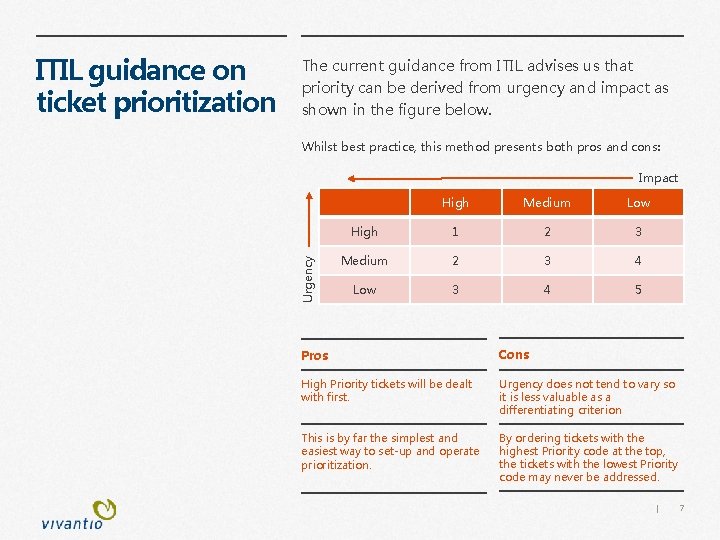
The current guidance from ITIL advises us that priority can be derived from urgency and impact as shown in the figure below. Whilst best practice, this method presents both pros and cons: Impact Urgency ITIL guidance on ticket prioritization High Medium Low High 1 2 3 Medium 2 3 4 Low 3 4 5 Pros Cons High Priority tickets will be dealt with first. Urgency does not tend to vary so it is less valuable as a differentiating criterion This is by far the simplest and easiest way to set-up and operate prioritization. By ordering tickets with the highest Priority code at the top, the tickets with the lowest Priority code may never be addressed. | 7
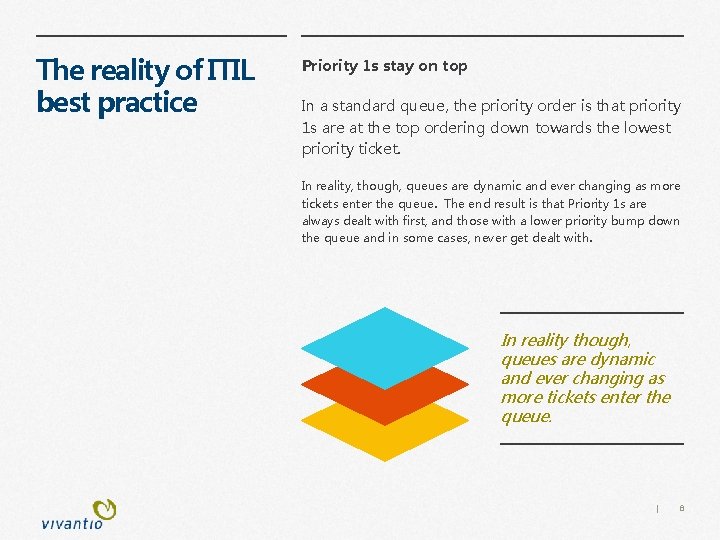
The reality of ITIL best practice Priority 1 s stay on top In a standard queue, the priority order is that priority 1 s are at the top ordering down towards the lowest priority ticket. In reality, though, queues are dynamic and ever changing as more tickets enter the queue. The end result is that Priority 1 s are always dealt with first, and those with a lower priority bump down the queue and in some cases, never get dealt with. In reality though, queues are dynamic and ever changing as more tickets enter the queue. | 8
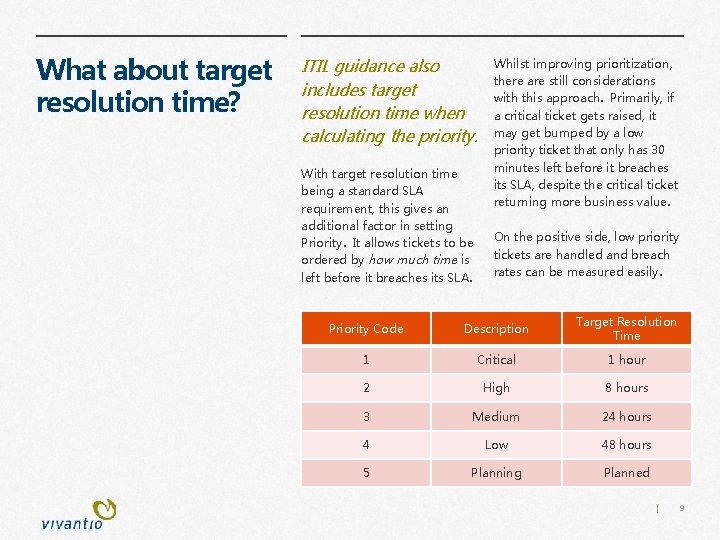
What about target resolution time? ITIL guidance also includes target resolution time when calculating the priority. With target resolution time being a standard SLA requirement, this gives an additional factor in setting Priority. It allows tickets to be ordered by how much time is left before it breaches its SLA. Whilst improving prioritization, there are still considerations with this approach. Primarily, if a critical ticket gets raised, it may get bumped by a low priority ticket that only has 30 minutes left before it breaches its SLA, despite the critical ticket returning more business value. On the positive side, low priority tickets are handled and breach rates can be measured easily. Priority Code Description Target Resolution Time 1 Critical 1 hour 2 High 8 hours 3 Medium 24 hours 4 Low 48 hours 5 Planning Planned | 9
A better way Business value attributes Weighting in practice Weighting innovation Weighting results uncovered Alternative forms of weighting Fixed SLA reduction SLA improvements Applying the knowledge
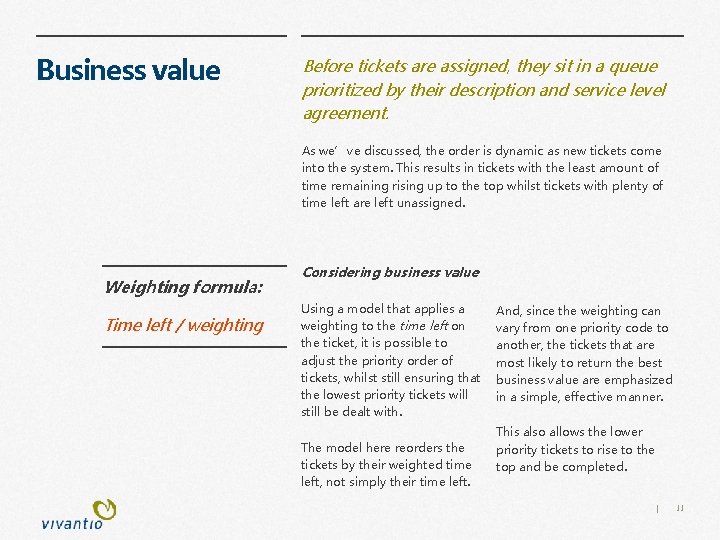
Business value Before tickets are assigned, they sit in a queue prioritized by their description and service level agreement. As we’ve discussed, the order is dynamic as new tickets come into the system. This results in tickets with the least amount of time remaining rising up to the top whilst tickets with plenty of time left are left unassigned. Weighting formula: Time left / weighting Considering business value Using a model that applies a weighting to the time left on the ticket, it is possible to adjust the priority order of tickets, whilst still ensuring that the lowest priority tickets will still be dealt with. The model here reorders the tickets by their weighted time left, not simply their time left. And, since the weighting can vary from one priority code to another, the tickets that are most likely to return the best business value are emphasized in a simple, effective manner. This also allows the lower priority tickets to rise to the top and be completed. | 11
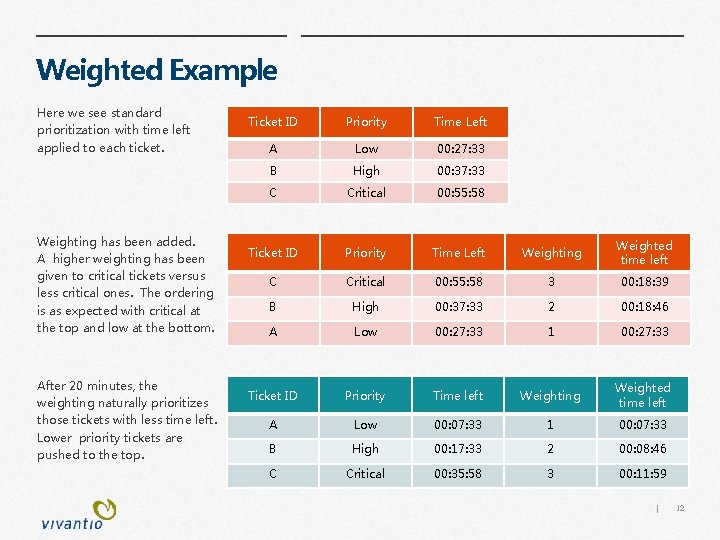
Weighted Example Here we see standard prioritization with time left applied to each ticket. Weighting has been added. A higher weighting has been given to critical tickets versus less critical ones. The ordering is as expected with critical at the top and low at the bottom. After 20 minutes, the weighting naturally prioritizes those tickets with less time left. Lower priority tickets are pushed to the top. Ticket ID Priority Time Left A Low 00: 27: 33 B High 00: 37: 33 C Critical 00: 55: 58 Ticket ID Priority Time Left Weighting Weighted time left C Critical 00: 55: 58 3 00: 18: 39 B High 00: 37: 33 2 00: 18: 46 A Low 00: 27: 33 1 00: 27: 33 Ticket ID Priority Time left Weighting Weighted time left A Low 00: 07: 33 1 00: 07: 33 B High 00: 17: 33 2 00: 08: 46 C Critical 00: 35: 58 3 00: 11: 59 | 12
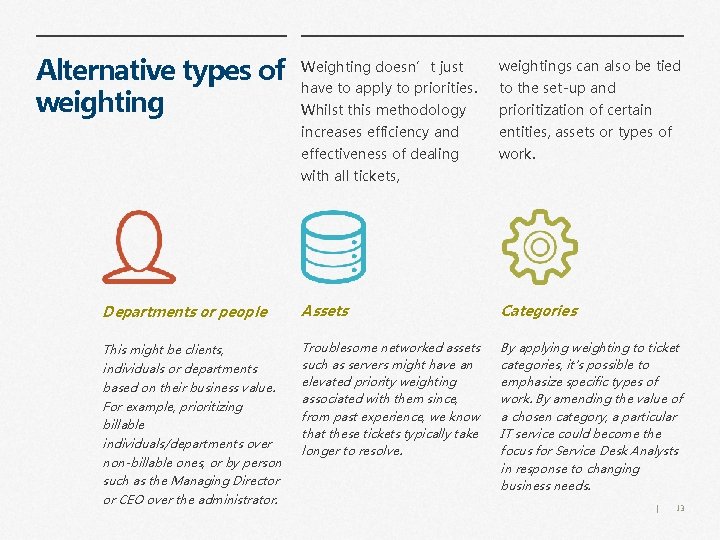
Alternative types of weighting Weighting doesn’t just weightings can also be tied have to apply to priorities. to the set-up and Whilst this methodology prioritization of certain increases efficiency and entities, assets or types of effectiveness of dealing work. with all tickets, Departments or people Assets Categories This might be clients, individuals or departments based on their business value. For example, prioritizing billable individuals/departments over non-billable ones, or by person such as the Managing Director or CEO over the administrator. Troublesome networked assets such as servers might have an elevated priority weighting associated with them since, from past experience, we know that these tickets typically take longer to resolve. By applying weighting to ticket categories, it's possible to emphasize specific types of work. By amending the value of a chosen category, a particular IT service could become the focus for Service Desk Analysts in response to changing business needs. | 13
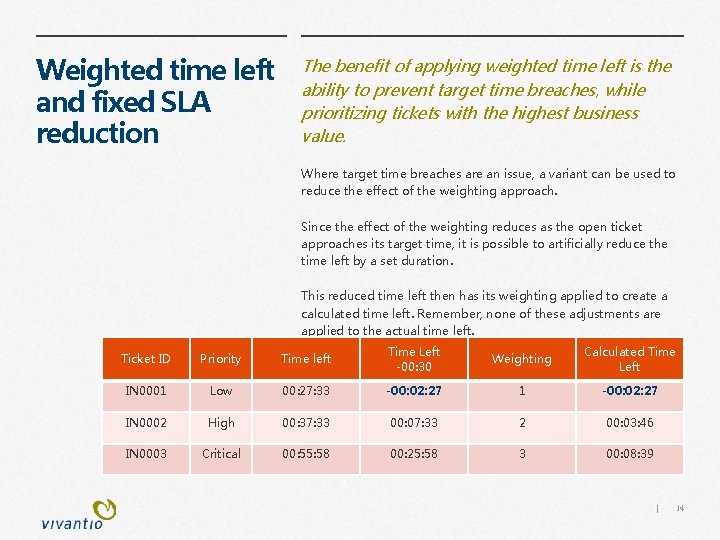
Weighted time left and fixed SLA reduction The benefit of applying weighted time left is the ability to prevent target time breaches, while prioritizing tickets with the highest business value. Where target time breaches are an issue, a variant can be used to reduce the effect of the weighting approach. Since the effect of the weighting reduces as the open ticket approaches its target time, it is possible to artificially reduce the time left by a set duration. This reduced time left then has its weighting applied to create a calculated time left. Remember, none of these adjustments are applied to the actual time left. Ticket ID Priority Time left Time Left -00: 30 Weighting Calculated Time Left IN 0001 Low 00: 27: 33 -00: 02: 27 1 -00: 02: 27 IN 0002 High 00: 37: 33 00: 07: 33 2 00: 03: 46 IN 0003 Critical 00: 55: 58 00: 25: 58 3 00: 08: 39 | 14
Availability cap The application of weighted time can also include agreed levels of IT service availability. Whilst some thought is required as to how IT services are recorded within the service desk, where it is possible, the service desk would become more responsive to availability targets. This can be achieved for those tickets that represent IT service down time by having their actual time left adjusted down to a calculated time left that is capped by the remaining availability target. This would introduce a more meaningful way service level management can be considered within the organization. It’s important that Service Level Management is considered before the availability metric can be applied. | 15
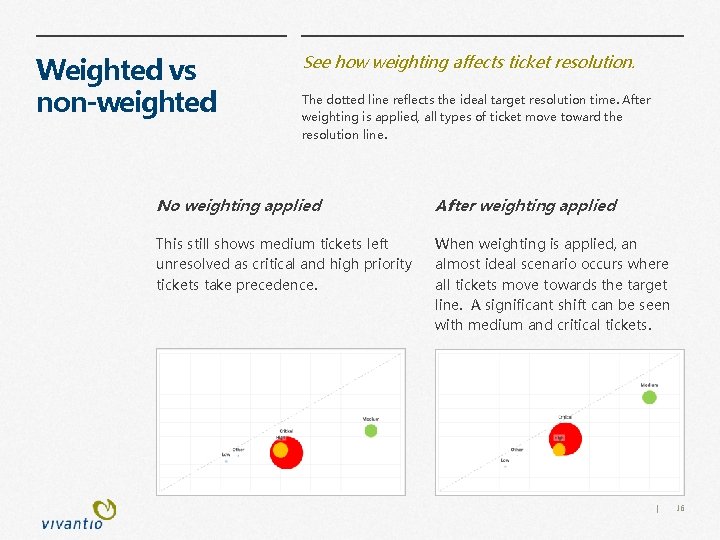
Weighted vs non-weighted See how weighting affects ticket resolution. The dotted line reflects the ideal target resolution time. After weighting is applied, all types of ticket move toward the resolution line. No weighting applied After weighting applied This still shows medium tickets left unresolved as critical and high priority tickets take precedence. When weighting is applied, an almost ideal scenario occurs where all tickets move towards the target line. A significant shift can be seen with medium and critical tickets. | 16
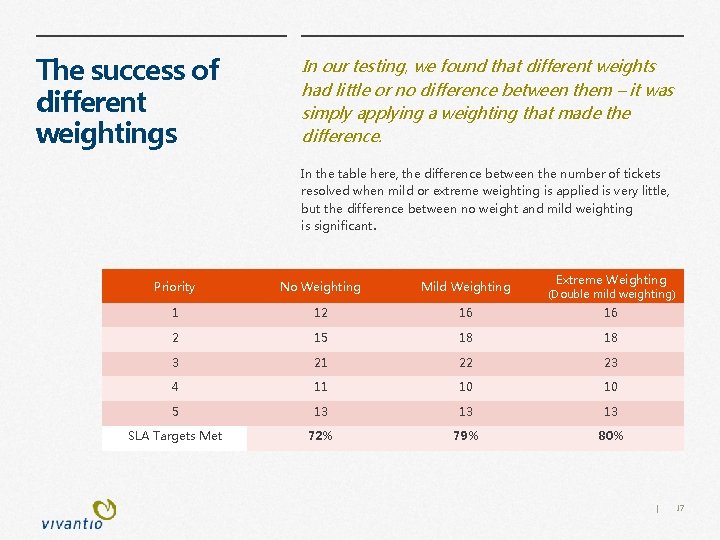
The success of different weightings In our testing, we found that different weights had little or no difference between them – it was simply applying a weighting that made the difference. In the table here, the difference between the number of tickets resolved when mild or extreme weighting is applied is very little, but the difference between no weight and mild weighting is significant. Extreme Weighting Priority No Weighting Mild Weighting 1 12 16 16 2 15 18 18 3 21 22 23 4 11 10 10 5 13 13 13 SLA Targets Met 72% 79% 80% (Double mild weighting) | 17
Benefits of applying weighting Tickets with higher business value prioritized first Effective control over your service desk SLA targets improved | 18
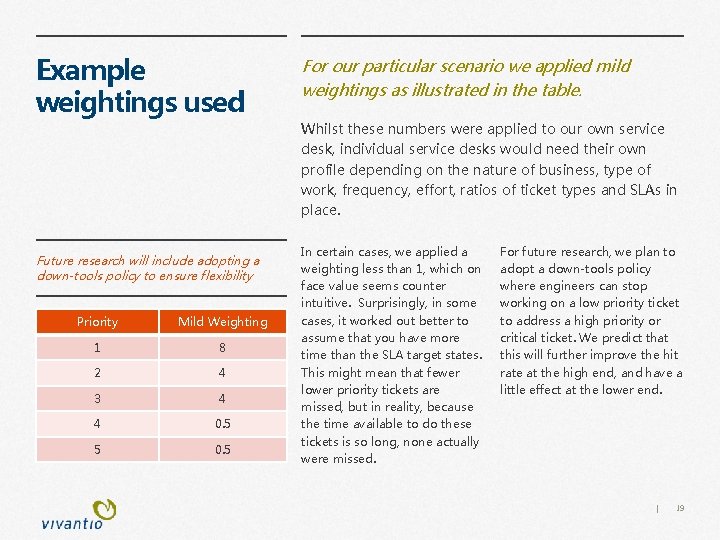
Example weightings used For our particular scenario we applied mild weightings as illustrated in the table. Whilst these numbers were applied to our own service desk, individual service desks would need their own profile depending on the nature of business, type of work, frequency, effort, ratios of ticket types and SLAs in place. Future research will include adopting a down-tools policy to ensure flexibility Priority Mild Weighting 1 8 2 4 3 4 4 0. 5 5 0. 5 In certain cases, we applied a weighting less than 1, which on face value seems counter intuitive. Surprisingly, in some cases, it worked out better to assume that you have more time than the SLA target states. This might mean that fewer lower priority tickets are missed, but in reality, because the time available to do these tickets is so long, none actually were missed. For future research, we plan to adopt a down-tools policy where engineers can stop working on a low priority ticket to address a high priority or critical ticket. We predict that this will further improve the hit rate at the high end, and have a little effect at the lower end. | 19
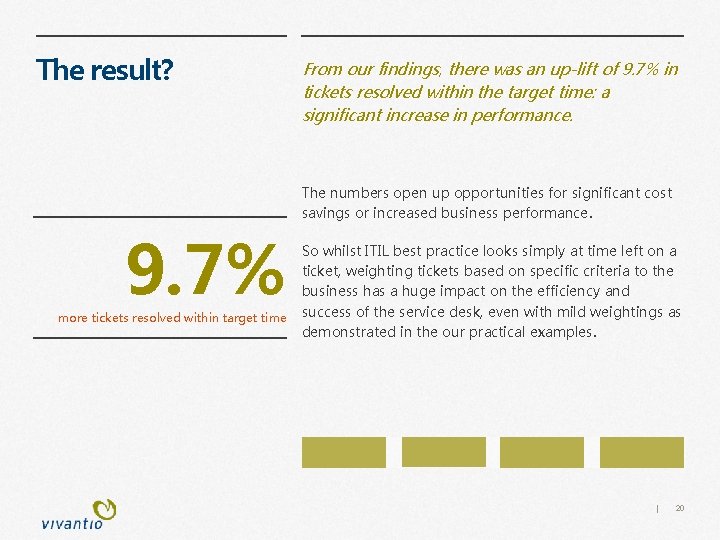
The result? From our findings, there was an up-lift of 9. 7% in tickets resolved within the target time: a significant increase in performance. The numbers open up opportunities for significant cost savings or increased business performance. 9. 7% more tickets resolved within target time So whilst ITIL best practice looks simply at time left on a ticket, weighting tickets based on specific criteria to the business has a huge impact on the efficiency and success of the service desk, even with mild weightings as demonstrated in the our practical examples. | 20
Applying the knowledge in practice Currently, the weighted approach to ticket prioritization is in its infancy. Service desk profiles widely vary, and therefore a generic model to weighted prioritization isn’t appropriate. A more complex model that takes into consideration a multitude of factors is required – a complex algorithm that can be customized to the individual service desk. At Vivantio, we recognize the value that weighted prioritization can offer and we’re working on building this vision into the Viva. Desk platform. www. vivadesk. com | 21
About Vivantio was formed in 2003 with the goal of developing new and innovative products for the service management industry. Their multi-award winning service desk product Viva. Desk helps organizations to improve, automate and measure their customer service, help desk and ITSM operations. Vivantio has offices in the UK and US, and strategic partners in Europe and Australia. The company has been recognized as a pioneer in the field by industry analysts and continues to build on this reputation with a team of service management experts and project managers committed to providing a flexible and reliable service. North America United Kingdom +1 800 676 3185 +44 (0) 1934 424 840 One Gateway Center, Suite 607 Newton MA 02458 25 -31 Boulevard Weston-super-Mare BS 23 1 NX | 22
Thank you
- Slides: 23