Thyroid Gland Diseases in Children Riga Olena Kh



- Slides: 49
Thyroid Gland Diseases in Children Riga Olena Kh. NMU
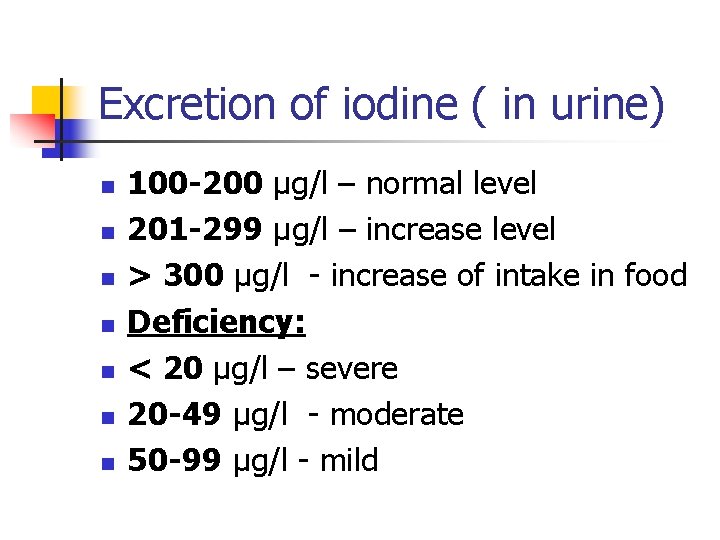
Excretion of iodine ( in urine) n n n n 100 -200 μg/l – normal level 201 -299 μg/l – increase level > 300 μg/l - increase of intake in food Deficiency: < 20 μg/l – severe 20 -49 μg/l - moderate 50 -99 μg/l - mild
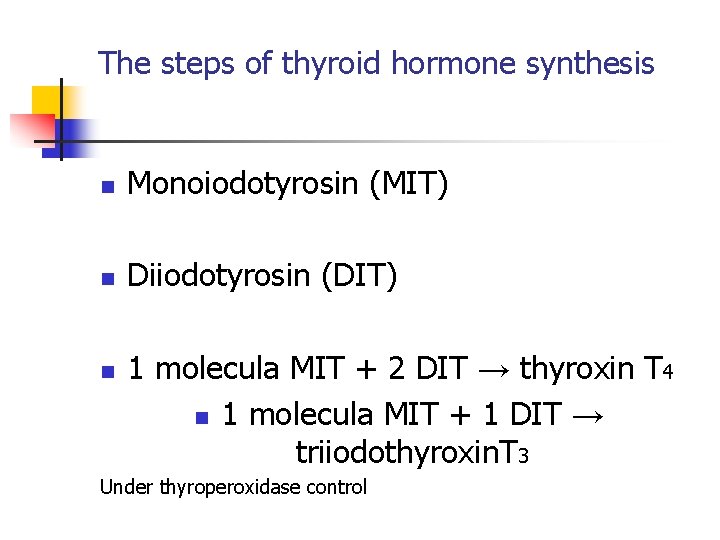
The steps of thyroid hormone synthesis n Monoiodotyrosin (MIT) n Diiodotyrosin (DIT) n 1 molecula MIT + 2 DIT → thyroxin T 4 n 1 molecula MIT + 1 DIT → triiodothyroxin. T 3 Under thyroperoxidase control
Peripheral conversation T 3 from T 4 n n n Both T 4 and T 3 circulate in plasma bound to the plasma thyroid hormonebinding protein (TBP) Thyroxine-binding globulin. Thyroid produces only 8 μg of T 4 and 4 μg T 3 daily. Serum T 3 concentration is usually low because of reduced conversation from T 4.
The factors that destroyed of conversation T 4→T 3 n n n n n systemic disease starvation, anorexia surgical intervention newborn period gerontological period glucocorticosteroids β-adrenoblocks amiodarone (cordaron) propylthyouracil
Action of thyroid hormones n Genomic effects: the interaction of TH and its receptors is believed to precede other cellular events of messenger RNA and specific protein synthesis
Action of thyroid hormones n Maturation of the CNS: lack of TH in the first year or two results in decreased brain cell size and number. Myelinization of axons is retarded leading to abnormalities and dendritic arborization
Action of thyroid hormones n n Maturation of the skeletal and dental system Maintenance of oxidative metabolism and heart production Control of temperature production TH differentiates all tissues and organs
Diagnostic of Thyroid gland disease n n n Visual & palpating method Investigation of thyroid function (basal level of free. T 3 , free. T 4) Functional tests (TSH) USG, radiography, scanning, etc. Biopsia
Diagnostic of Thyroid gland disease Serological tests: *Markers of autoimmune disease (antibodies to thyroglobulin, thyroperoxidase, to TSH-receptors) *Markers of cancer (thyroglobulin, calcitonin) n
Goiter WHO (1994) n n n 0 – goiter is absent I – goiter isn’t visualized, but it’s size less than distal phalanx of thumb II – goiter is palpated & visualized
Functional condition of Thyroid influence may be as n n n Euthyroidism Hypothyroidism hyperthyroidism
Нypothyroidism n Hypothyroidism - syndrome with particular or total deficiency T 3 and T 4 or theirs acts to target cells
Classification of hypothyroidism n n Disturbances PRIMARY - defects of biosynthesis of T 3, T 4 due to pathology of thyroid gland SECONDARY - decreasing T 3, T 4 due to deficiency of TSH (pituitary) or TRH (hypothalamus) or Resistance of receptors for T 3, T 4
Classification of hypothyroidism Onset Congenital Acquired (rare)
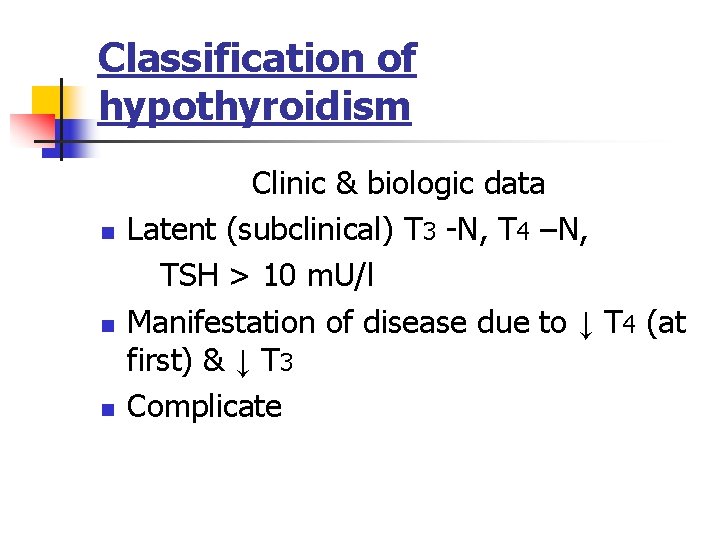
Classification of hypothyroidism n n n Clinic & biologic data Latent (subclinical) T 3 -N, T 4 –N, TSH > 10 m. U/l Manifestation of disease due to ↓ T 4 (at first) & ↓ T 3 Complicate
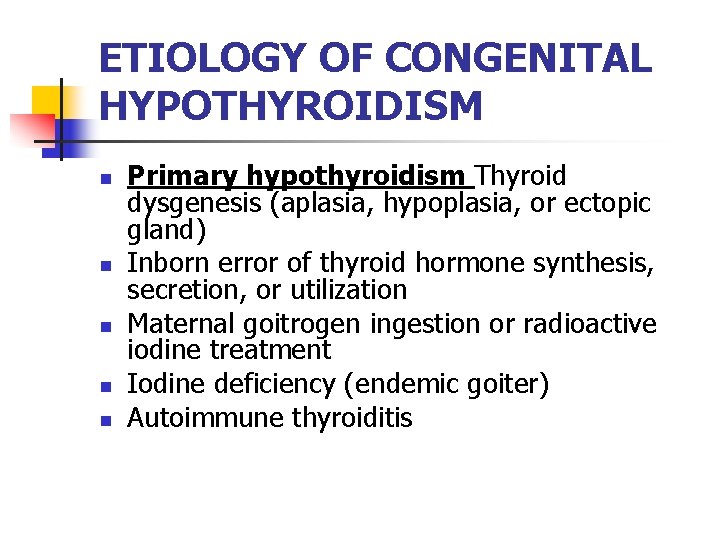
ETIOLOGY OF CONGENITAL HYPOTHYROIDISM n n n Primary hypothyroidism Thyroid dysgenesis (aplasia, hypoplasia, or ectopic gland) Inborn error of thyroid hormone synthesis, secretion, or utilization Maternal goitrogen ingestion or radioactive iodine treatment Iodine deficiency (endemic goiter) Autoimmune thyroiditis
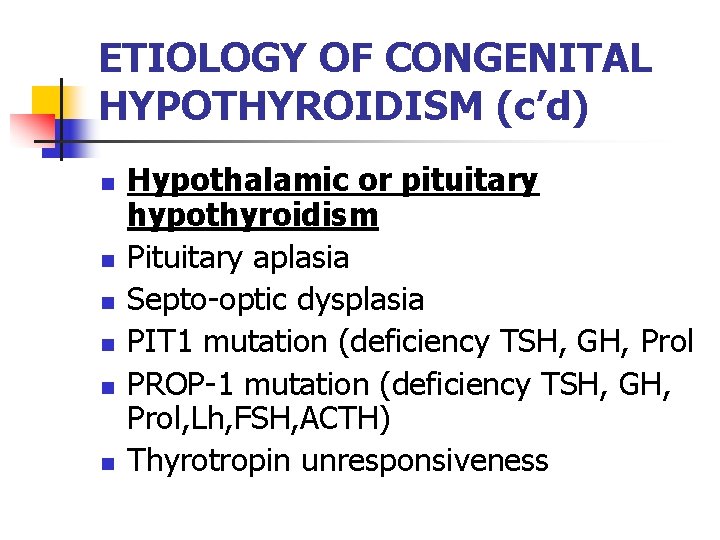
ETIOLOGY OF CONGENITAL HYPOTHYROIDISM (c’d) n n n Hypothalamic or pituitary hypothyroidism Pituitary aplasia Septo-optic dysplasia PIT 1 mutation (deficiency TSH, GH, Prol PROP-1 mutation (deficiency TSH, GH, Prol, Lh, FSH, ACTH) Thyrotropin unresponsiveness
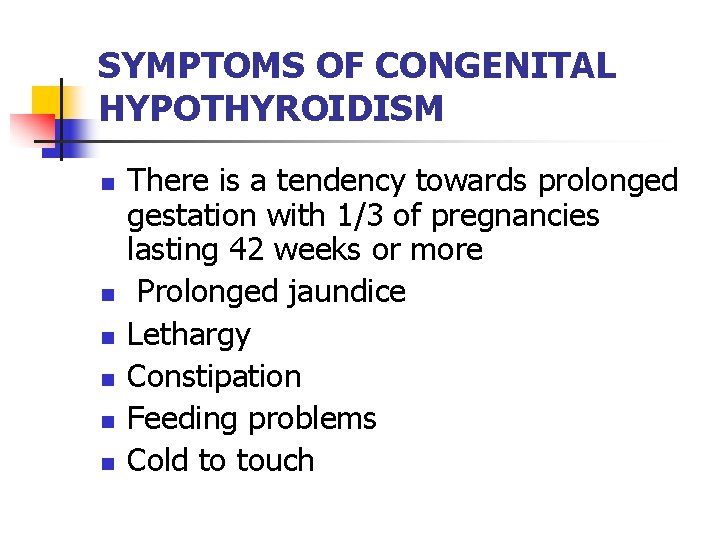
SYMPTOMS OF CONGENITAL HYPOTHYROIDISM n n n There is a tendency towards prolonged gestation with 1/3 of pregnancies lasting 42 weeks or more Prolonged jaundice Lethargy Constipation Feeding problems Cold to touch
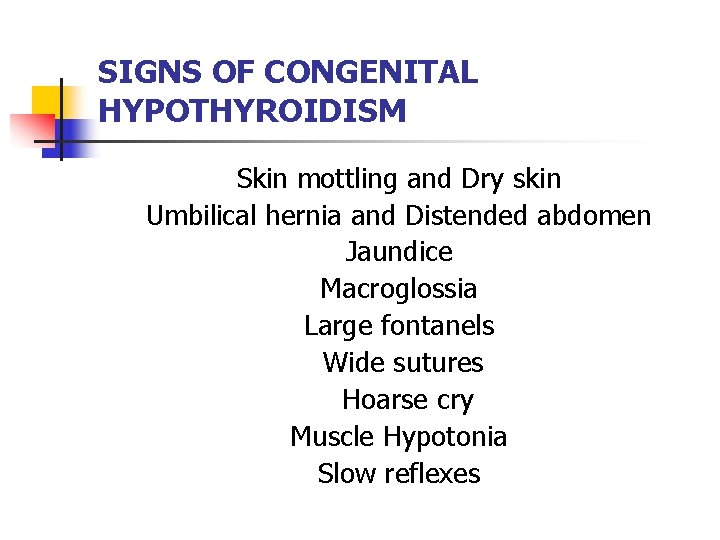
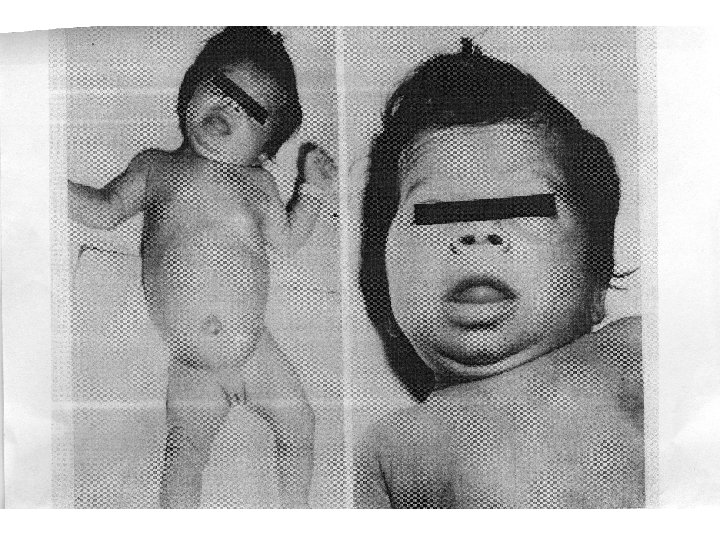
SIGNS OF CONGENITAL HYPOTHYROIDISM Skin mottling and Dry skin Umbilical hernia and Distended abdomen Jaundice Macroglossia Large fontanels Wide sutures Hoarse cry Muscle Hypotonia Slow reflexes
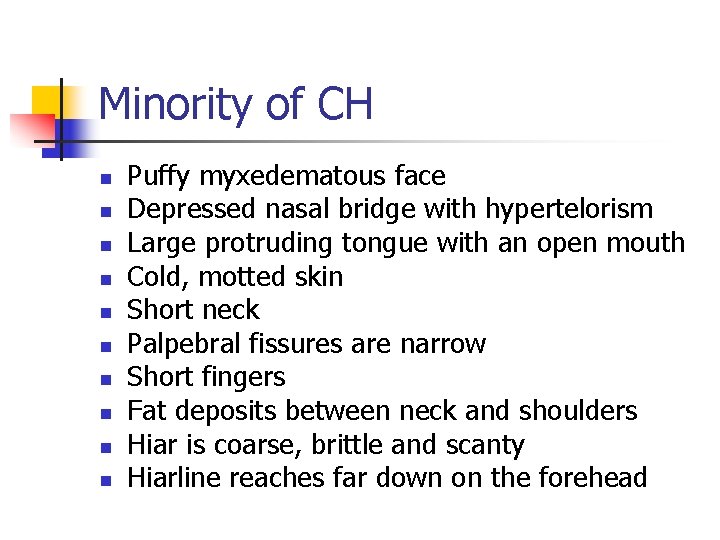
Minority of CH n n n n n Puffy myxedematous face Depressed nasal bridge with hypertelorism Large protruding tongue with an open mouth Cold, motted skin Short neck Palpebral fissures are narrow Short fingers Fat deposits between neck and shoulders Hiar is coarse, brittle and scanty Hiarline reaches far down on the forehead
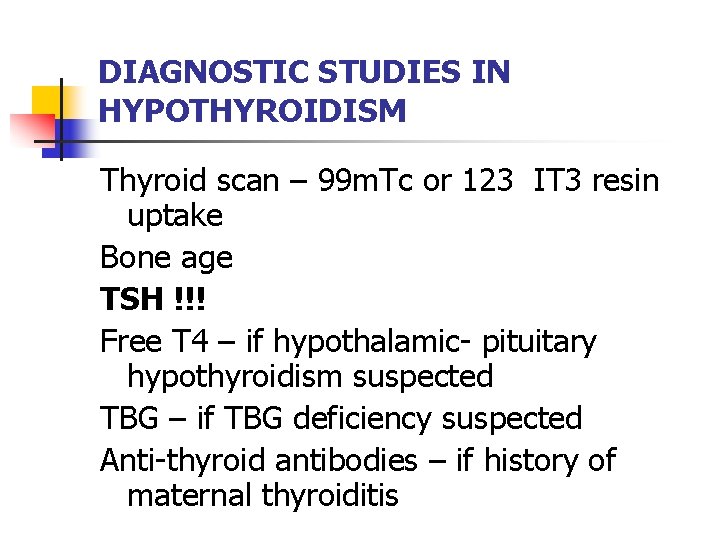
DIAGNOSTIC STUDIES IN HYPOTHYROIDISM Thyroid scan – 99 m. Tc or 123 IT 3 resin uptake Bone age TSH !!! Free T 4 – if hypothalamic- pituitary hypothyroidism suspected TBG – if TBG deficiency suspected Anti-thyroid antibodies – if history of maternal thyroiditis
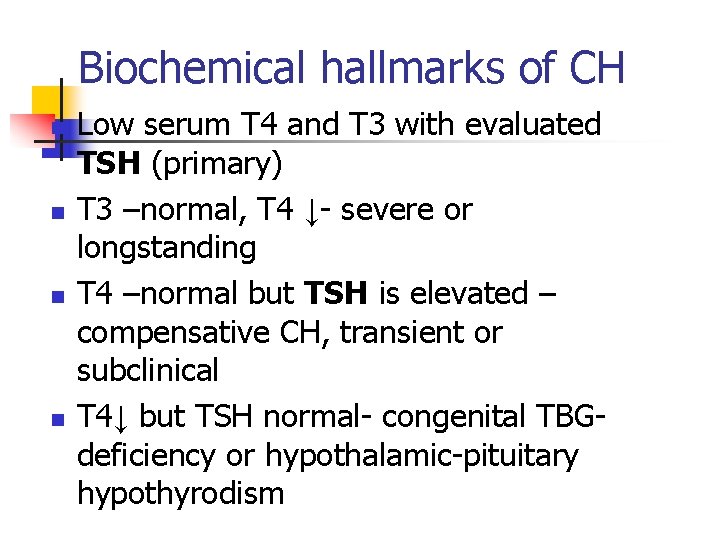
Biochemical hallmarks of CH n n Low serum T 4 and T 3 with evaluated TSH (primary) T 3 –normal, T 4 ↓- severe or longstanding T 4 –normal but TSH is elevated – compensative CH, transient or subclinical T 4↓ but TSH normal- congenital TBGdeficiency or hypothalamic-pituitary hypothyrodism
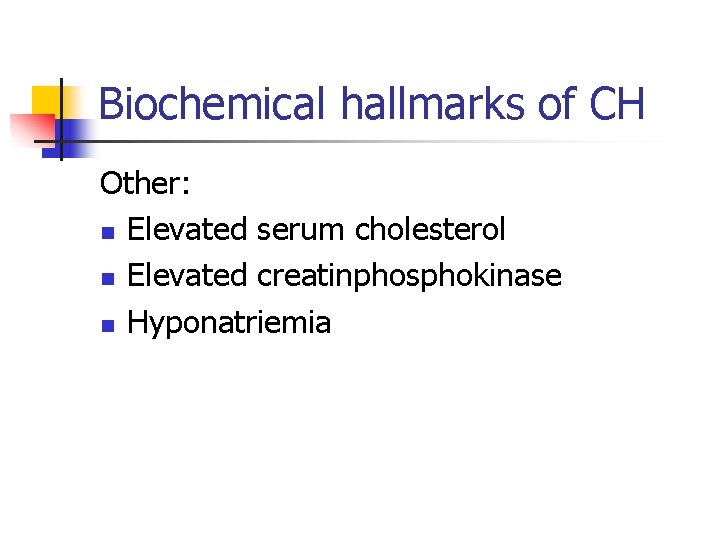
Biochemical hallmarks of CH Other: n Elevated serum cholesterol n Elevated creatinphosphokinase n Hyponatriemia
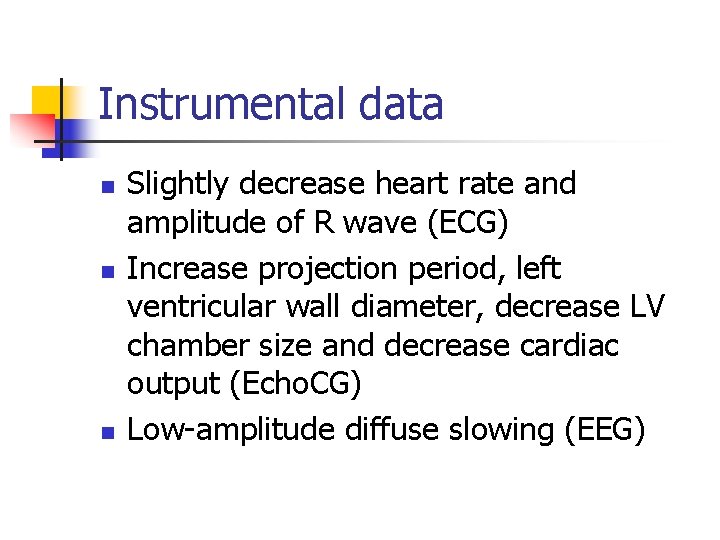
Instrumental data n n n Slightly decrease heart rate and amplitude of R wave (ECG) Increase projection period, left ventricular wall diameter, decrease LV chamber size and decrease cardiac output (Echo. CG) Low-amplitude diffuse slowing (EEG)
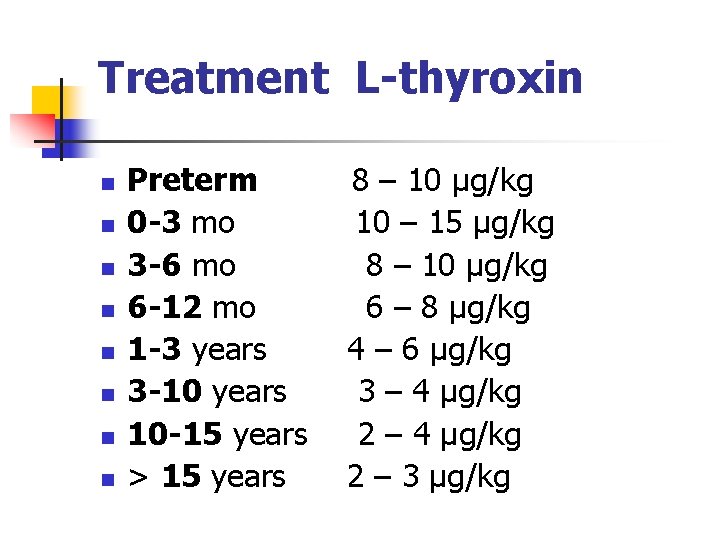
Treatment L-thyroxin n n n n Preterm 0 -3 mo 3 -6 mo 6 -12 mo 1 -3 years 3 -10 years 10 -15 years > 15 years 8 – 10 μg/kg 10 – 15 μg/kg 8 – 10 μg/kg 6 – 8 μg/kg 4 – 6 μg/kg 3 – 4 μg/kg 2 – 3 μg/kg
ETIOLOGY OF ACQUIRED HYPOTHYROIDISM n n n Chronic lymphocytic (Hashimoto`s) thyroiditis (CLT) Subacute thyroiditis (De Quervain`s) Goitrogens (iodide, thiouracil, etc. ) Thyroidectomy or ablation following radioactive iodine Infiltrative disease (e. g. , cystinosis, histiocytosis X)-systemic disease
ETIOLOGY OF ACQUIRED HYPOTHYROIDISM (c’d) n n n Hypothalamic or pituitary disease Congenital thyroid disorders, e. g. , ectopia, may not decompensate until later childhood and thus may appear acquired Peripheral resistance to thyroid hormones, including receptor defects Jatrogenic (propylthiouracil, methimazole, iodides, lithium, amiodarone) Hemangiomas of the liver
SYMPTOMS OF ACQUIRED HYPOTHYROIDISM n n n n n Slow growth Puffiness Decreased appetite Constipation Swollen thyroid gland Lethargy Drop in school performance Cold intolerance Galactorrhea Menometrorrhagia
SIGNS OF ACQUIRED HYPOTHYROIDISM n n n Short stature Decreased growth velocity Increased upper to lower segment ratio Delayed dentition Myxedema or mildly overweight Goiter
SIGNS OF ACQUIRED HYPOTHYROIDISM (c’d) n n n Delayed reflex return Dull, placid expression Pale, thick, carotenemic, or cool skin Muscle pseudohypertrophy Delayed puberty or precocious puberty Treatment –same CH
Chronic thyroiditis Hashimoto disease Clinical presentation: n goiter with euthyroidism n Thoxic thyroiditis n Hypothyroidism with or without thyromegaly n Dysphagia, pain or pressure sensation in the neck, cough and headache have been reported
Diagnosis Hashimoto disease n n n T 4 total and free, serum TSH Biopsy Antibodies test: antithyroglobulin antibodies to thyroperoxidase antimicrosomal test
Causes of thyrotoxicosis n n n Congenital: transient, neonatal Graves’ disease Acquired: Graves’ disease Functional adenoma Thyroid cancer TSH-secreting pituitary tumor Jatrogenic
(Graves disease) n Diffuse toxity goiter - autoimmune pathology with prolonged elevation T 3 & T 4 and enlagment of Thyroid gland, and in 70% cases with ophthalmopathy
Graves disease (symptoms) n n n Hyperactivity, irritability, altered mood Fatigue, weakness Goiter Tachycardia and ↑ pul’s pressure Nervousness
Graves disease (symptoms) n n n Palpitations Weight loss with ↑ appetite Heat intolerants, increase sweating Increased stool frequency Thirst and polyuria Oligomenorrea, loss of libido
Graves disease (sings) n n n n Sinus tachycardia, atrial fibrillation Tremor, hyperkinesis Warm, moist skin Palmar erythema, onycholysis Hair loss Muscle weakness & wasting Heart failure, psychosis (rare)
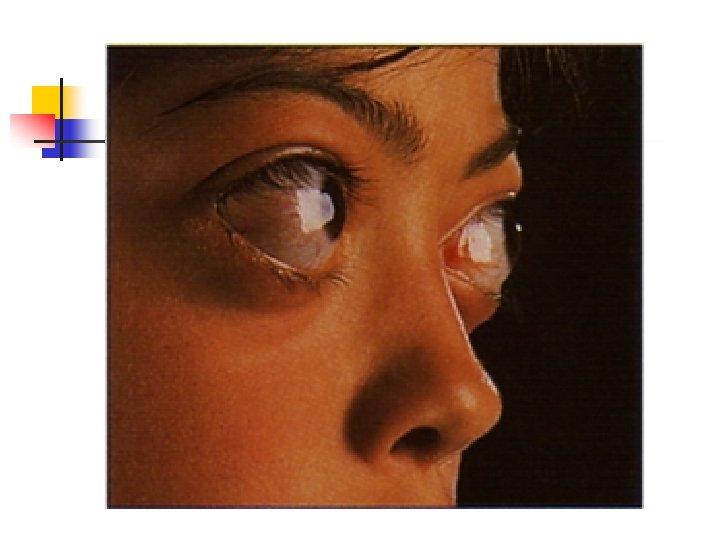
Graves disease Ophthalmopathy n n A feeling of grittiness & discomfort in the eye Retrobulbar pressure or pain Eyelid lag or retraction Periorbital edema, chemosis, scleral injection
Graves disease Ophthalmopathy (c’d) n n Proptosis Extraocular muscle dysfunction Exposure keratitis Optic neuropathy
Treatment of thyrotoxicosis n n Thionamids: mercasolyl 0. 3 -0. 5 mg/kg divided 2 -3 times – 14 -21 days , than supportive dose – 2. 5 -7. 5 mg/daily 1 time Β ab (anaprilin) 1 -2 mg/kg divided 3 times Euthyrosis – mercasolil 5 -10 mg/daily with L-thyroxin 25 -50 μg/daily Surgical treatment
Thyroid storm (crisis) n n n n n Sudden onset Fever Profuse diaphoresis Flushed warm skin Tachycardia Weakness, lethargy and confuson Coma Nausea, vomiting, diarrhea Enlarge liver, jaundice
Thyroid storm (crisis) n n n Na. J 1 -2 g daily IV immediately Propylthiouracil 200 -300 mg every 6 hours by nasogastric tube Β ab (propranolol) 0. 1 mg/kg IV or 4 mg/kg orally Dexamethasone 1 -2 mg every 6 hours Supportive: correction of dehydratation, antipyretics, digitalis to patients with cardiac failure
GOOD LUCK!