Three Wheeled Vehicles and Motor Tricycles in Canada

- Slides: 14
Three Wheeled Vehicles and Motor Tricycles in Canada 2011 Annual Region I Conference Baltimore, Maryland July 19, 2011 XXXXX 1
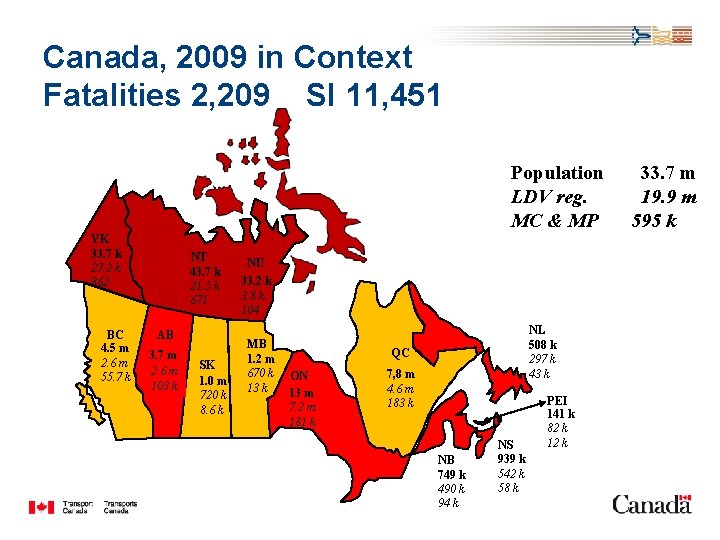
Canada, 2009 in Context Fatalities 2, 209 SI 11, 451 Population LDV reg. MC & MP YK 33. 7 k 27. 2 k 862 BC 4. 5 m 2. 6 m 55. 7 k NT 43. 7 k 21. 5 k 671 AB 3. 7 m 2. 6 m 103 k SK 1. 0 m 720 k 8. 6 k NU 33. 2 k 3. 8 k 104 MB 1. 2 m 670 k 13 k NL 508 k 297 k 43 k QC ON 13 m 7. 2 m 181 k 7, 8 m 4. 6 m 183 k NB 749 k 490 k 94 k NS 939 k 542 k 58 k PEI 141 k 82 k 12 k 33. 7 m 19. 9 m 595 k
Road Safety in Canada A Shared Responsibility: Federal Provincial/Territorial • New vehicle safety standards (CMVSS) • Criminal Code (impaired and dangerous drivers) • National leadership (e. g. data, research, program development, program evaluation, knowledge transfer) • • • Driver licensing Vehicle Registration Enforcement Road Infrastructure Data and Research Program development, implementation & evaluation
Canadian Council of Motor Transport Administrators (CCMTA) • Non-profit organization established by the provincial, territorial and federal governments • Promote awareness and share and exchange information • Pursue harmonization of road user, motor carrier and driver/vehicle licensing regulations and policies • Develop national models of motor vehicle transportation programs (safety and other)
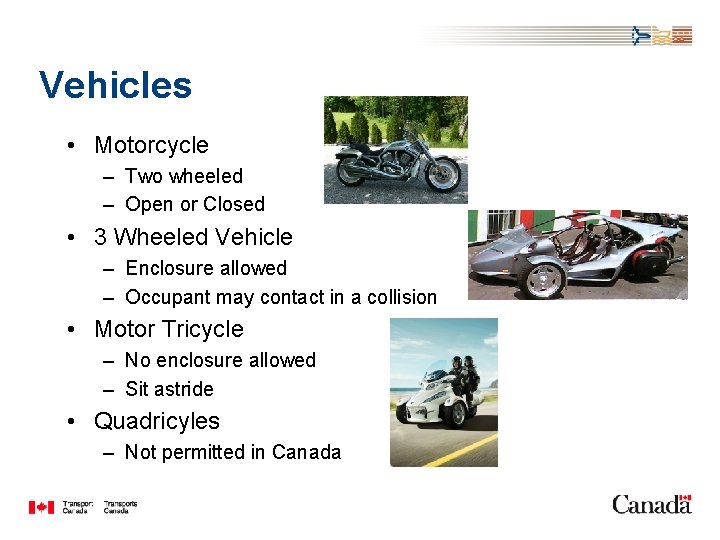
Vehicles • Motorcycle – Two wheeled – Open or Closed • 3 Wheeled Vehicle – Enclosure allowed – Occupant may contact in a collision • Motor Tricycle – No enclosure allowed – Sit astride • Quadricyles – Not permitted in Canada
Three Wheeled Vehicle Classification • US: Classified as motorcycles, “… designed to travel on not more than three wheels in contact with the ground” • Europe: May be classified as a L 2 or L 5. – L 2 for smaller vehicles with three wheels, engine 50 cc and less, maximum speed of 50 km/h – L 5 for vehicles with three wheels, engine over 50 cc, maximum speed over 50 km/h
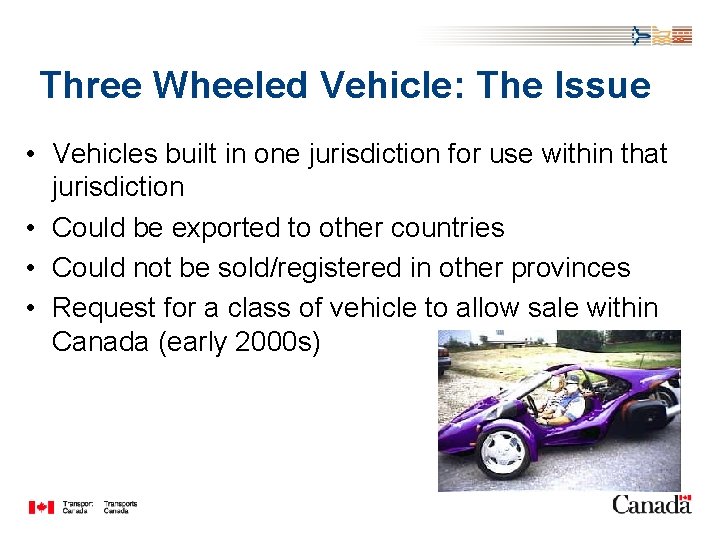
Three Wheeled Vehicle: The Issue • Vehicles built in one jurisdiction for use within that jurisdiction • Could be exported to other countries • Could not be sold/registered in other provinces • Request for a class of vehicle to allow sale within Canada (early 2000 s)
Three Wheeled Vehicle Regulations • New class to allow sale/registration in Canada – 1, 000 kilo or less – 4 seats or less • Has many characteristics similar to car – Must have seat belts – Brakes follow CMVSS 135 for passenger cars – Controls follow CMVSS 101 for passenger cars • Many CMVSS regulations apply – Vehicle Stability Requirement (CMVSS 505) – Fuel integrity (SAE J 288) (CMVSS 301. 3)
Three Wheeled Vehicle cont… – Other regulations less stringent than passenger vehicle • Single dynamic crash test limiting displacement of the steering column into the passenger compartment (CMVSS 204) • Warning label stating “This vehicle does not comply with the dynamic crash test in CMVSS 208” • Some regulations apply if equipment fitted – – CMVSS 103&4 – windshield defrosting and wipers CMVSS 113 - hood latch CMVSS 114 - locking system CMVSS 118 - power windows
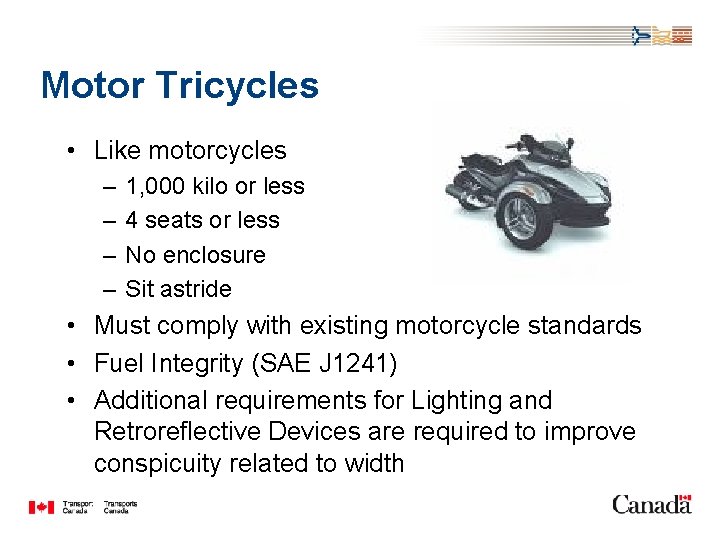
Motor Tricycles • Like motorcycles – – 1, 000 kilo or less 4 seats or less No enclosure Sit astride • Must comply with existing motorcycle standards • Fuel Integrity (SAE J 1241) • Additional requirements for Lighting and Retroreflective Devices are required to improve conspicuity related to width
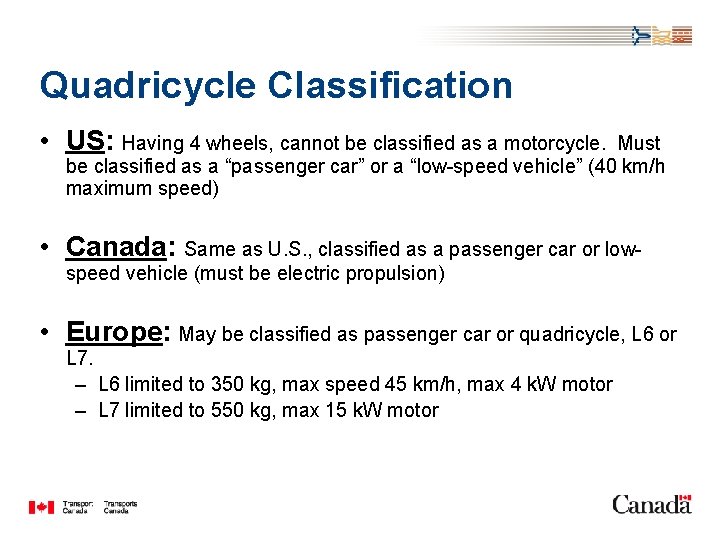
Quadricycle Classification • US: Having 4 wheels, cannot be classified as a motorcycle. Must be classified as a “passenger car” or a “low-speed vehicle” (40 km/h maximum speed) • Canada: Same as U. S. , classified as a passenger car or lowspeed vehicle (must be electric propulsion) • Europe: May be classified as passenger car or quadricycle, L 6 or L 7. – L 6 limited to 350 kg, max speed 45 km/h, max 4 k. W motor – L 7 limited to 550 kg, max 15 k. W motor
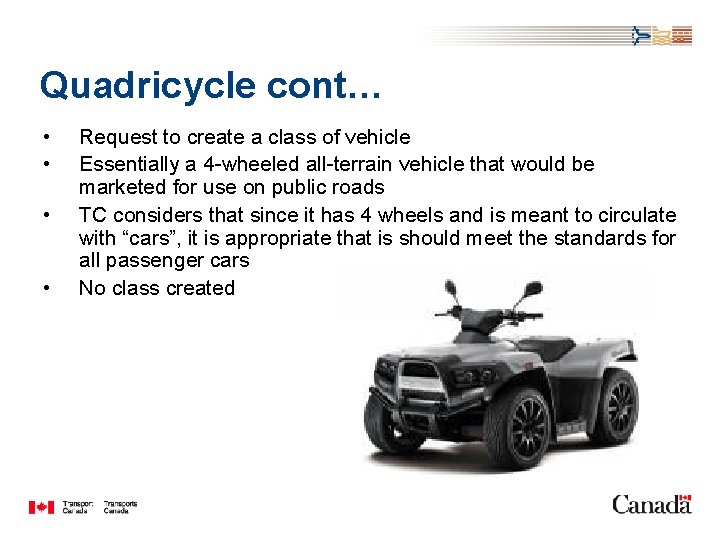
Quadricycle cont… • • Request to create a class of vehicle Essentially a 4 -wheeled all-terrain vehicle that would be marketed for use on public roads TC considers that since it has 4 wheels and is meant to circulate with “cars”, it is appropriate that is should meet the standards for all passenger cars No class created
Discussion • More pressure on safety vs. fuel efficiency • Vehicle classes and technology advances faster than ability to regulate and classify • Jurisdictional Issues – Provincial • Vehicles can be manufactured in one and not available in others • Can be driven in a jurisdiction but not registered – Three wheeled vehicles registered in QC not ON – International • Harmonization of standards • Freedom of movement
Questions? • www. tc. gc. ca/roadsafety • www. ccmta. ca • Paul. Boase@tc. gc. ca • Denis. Brault@tc. gc. ca