There are 8 million stories in the naked

- Slides: 26
“There are 8 million stories in the naked city. ” AP helps you tell them. WRITING IN AP STYLE
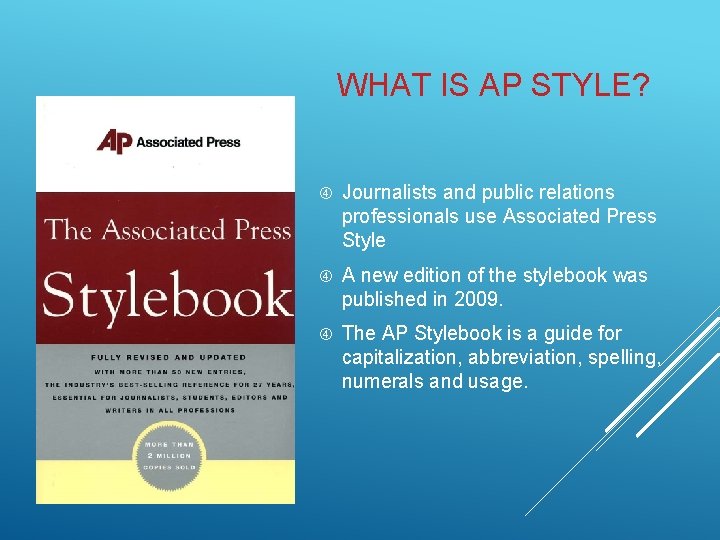
WHAT IS AP STYLE? Journalists and public relations professionals use Associated Press Style A new edition of the stylebook was published in 2009. The AP Stylebook is a guide for capitalization, abbreviation, spelling, numerals and usage.
No reference list or in-text citations. Small paragraphs: 1 -2 sentences per paragraph. Clear and concise writing. Avoid wordiness, long sentences, difficult vocabulary and jargon. AP Style allows contractions. MAJOR DIFFERENCES BETWEEN ACADEMIC WRITING AND AP STYLE
Information is listed alphabetically. Example: “Titles” is under T and “composition titles” is under C. Many entries will point the reader to other entries within the stylebook for more information. The actual stylebook makes up most of the AP Stylebook; however, there also a chapters on punctuation, media law, and sports and business writing. FINDING INFORMATION IN THE AP STYLEBOOK
When paraphrasing information, attribute it to a source at the beginning or end of a sentence. Example: Several factors could determine how quickly a fire engulfs a resident’s room, Frederick said. Important rule: It is always said. Don’t use pointed out, claimed or any other verb that could be perceived as biased. A person’s name or a pronoun always precedes said. PARAPHRASING
PARAPHRASING, CONT. Always attribute information that came from a source and is not general knowledge. As with academic writing, when in doubt, cite.
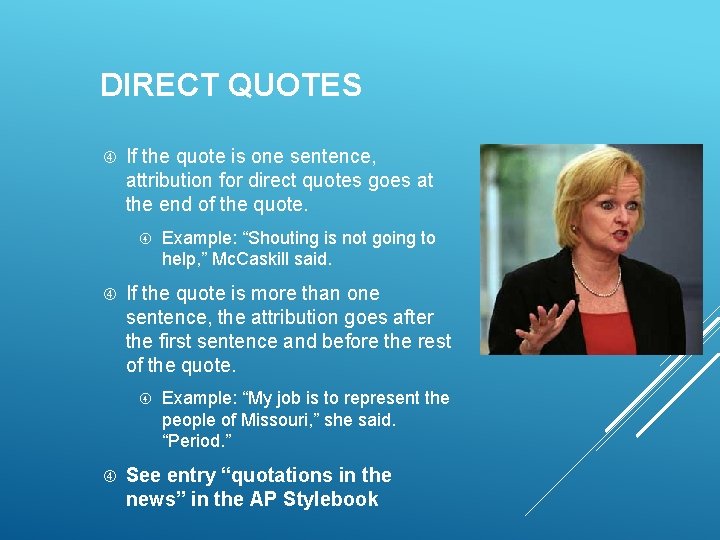
DIRECT QUOTES If the quote is one sentence, attribution for direct quotes goes at the end of the quote. If the quote is more than one sentence, the attribution goes after the first sentence and before the rest of the quote. Example: “Shouting is not going to help, ” Mc. Caskill said. Example: “My job is to represent the people of Missouri, ” she said. “Period. ” See entry “quotations in the news” in the AP Stylebook
AP Style deletes the comma in a series that comes before the conjunction. Example: It contained a bed, desk, posters and other items one would find in a typical dorm room. See the “comma” entry in the punctuation guideline chapter of the AP Stylebook. COMMAS IN A SERIES
Capitalize common nouns when they are part of a full name. Some words derive from a proper noun and depend on that word for their meaning. These should be capitalized. Examples: Christian, English, Marxism Other words no longer depend on proper nouns for their meaning and do not need to be capitalized. Example: The Democratic Party holds the majority in the Senate. Example: french fries See the “capitalization” entry in the AP Stylebook. CAPITALIZATION
TRADEMARKED WORDS Words that are trademarked are always capitalized. Examples: Ferris wheel, Frisbee, Kitty Litter, Dumpster, Taser Trademarked words should be avoided if possible. Instead, use generic terms like cat box filler or trash receptacle. See the “trademark” entry in the AP Stylebook.
Titles are capitalized only when used before a name. Examples: President Barack Obama addressed the nation last night. The president resigned from office. Put long titles after names for easier readability. A title with more than two words is generally considered long. Example: Steve Robinette, acting assistant provost of the extended campus, said it would be easier for Pang to work more with her father. TITLES
An exception: When attributing information to a source with a long title, it is acceptable to put said before the name to avoid confusing. Example: “I don’t think the numbers were drastically different, ” said Jane Robison, director of the International Center. TITLES, CONT.
Titles that are descriptive of occupations should not be capitalized. Example: assistant coach Mike Jones Do not use courtesy titles like “Mr. ” or “Mrs. ” Only include political party affiliations when relevant to story. Approaches to identifying party affiliation: Democratic Sen. Claire Mc. Caskill of Missouri said Sen. Claire Mc. Caskill, D-Mo. , said See the “titles” entry in the AP Stylebook. TITLES, CONT.
COMPOSITION TITLES Principle words in titles are capitalized, including prepositions or conjunctions of four or more letters. Examples: “Gone With the Wind” “Courage Under Fire” Articles are capitalized when they are the first or last word in a title. Example: “The Last Unicorn” AP Style requires quotation marks around titles, not italics or underlining. The Bible, reference books and software programs do not need quotations. See the “composition titles” entry in the AP Stylebook.
ABBREVIATIONS United States is abbreviated as U. S. Abbreviate these titles before a full name: Dr. , Gov. , Lt. Gov. , Rep. , the Rev. and Sen. Spell out all of these titles (except Dr. ) before a name in a quotation. No courtesy titles. Do not use Dr. as a title for a professor. Use doctorate degree and only establish academic credentials when it’s relevant to the story.
Most abbreviations are spelled out on first reference and abbreviated on second reference. Example: Agency for International Development (AID) Some abbreviations are acceptable in all references such as FBI, CIA and AFL-CIO After a name, abbreviate junior or senior as Jr. or Sr. After the name of a business, abbreviate company, corporation, incorporated and limited. See the “abbreviations and acronyms” entry in the AP Stylebook. ABBREVIATIONS, CONT.
When a month is used with a specific date, abbreviate: Jan. , Feb. , Aug. , Sept. , Oct. , Nov. and Dec. Spell out March, April, May, June and July. Spell out months when used alone or with a year only. DATES
Spell out all names of states when they stand alone. Eight states are never abbreviated: Alaska, Hawaii, Idaho, Iowa, Maine, Ohio, Texas and Utah. All other states are abbreviated when used with the name of a city, town, etc. , whether in datelines or in text. Some cities, such as New York City, St. Louis or Chicago, do not need a state after them. STATE ABBREVIATIONS
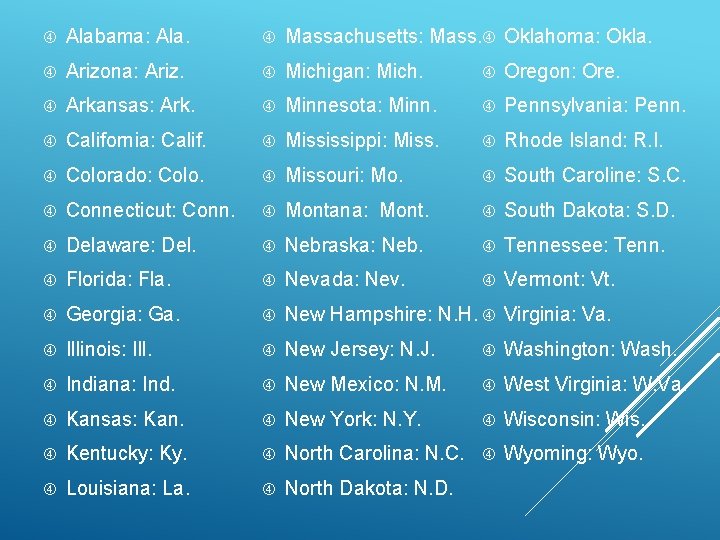
Alabama: Ala. Massachusetts: Mass. Oklahoma: Okla. Arizona: Ariz. Michigan: Mich. Oregon: Ore. Arkansas: Ark. Minnesota: Minn. Pennsylvania: Penn. California: Calif. Mississippi: Miss. Rhode Island: R. I. Colorado: Colo. Missouri: Mo. South Caroline: S. C. Connecticut: Conn. Montana: Mont. South Dakota: S. D. Delaware: Del. Nebraska: Neb. Tennessee: Tenn. Florida: Fla. Nevada: Nev. Vermont: Vt. Georgia: Ga. New Hampshire: N. H. Virginia: Va. Illinois: Ill. New Jersey: N. J. Washington: Wash. Indiana: Ind. New Mexico: N. M. West Virginia: W. Va. Kansas: Kan. New York: N. Y. Wisconsin: Wis. Kentucky: Ky. North Carolina: N. C. Wyoming: Wyo. Louisiana: La. North Dakota: N. D.
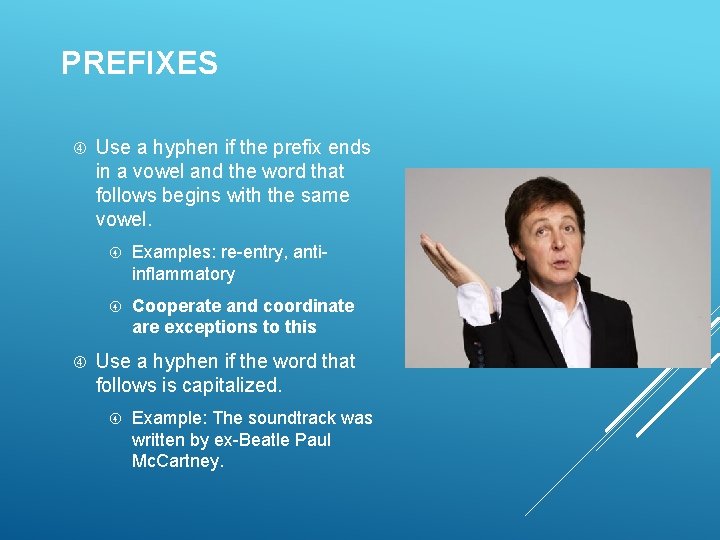
PREFIXES Use a hyphen if the prefix ends in a vowel and the word that follows begins with the same vowel. Examples: re-entry, antiinflammatory Cooperate and coordinate are exceptions to this Use a hyphen if the word that follows is capitalized. Example: The soundtrack was written by ex-Beatle Paul Mc. Cartney.
NUMBERS Spell out one through nine. Use figures for 10 and up. If a sentence begins with a numeral, either spell it out or rewrite the sentence. Figures for years are the exception. Always use numerals for ratios and ages.
NUMBERS, CONT. For dimensions, use figures and spell out inches, feet, etc. Example: She is 5 feet 4 inches tall. For percentages, write out percent. Do not use the % sign. Use numerals for decimal points. Example: Unemployment increased 1. 7 percent this year. See the “numerals” entry in the AP Stylebook.
Use a $ sign and numerals for an exact figure. For amounts less than a dollar, use numerals. Use a $ sign and numerals to two decimal points for amounts of $1 million and up. Example: It cost 99 cents. Example: The plan costs $74. 91 million. Spell out special cases. Example: She loaned me a dollar. MONEY
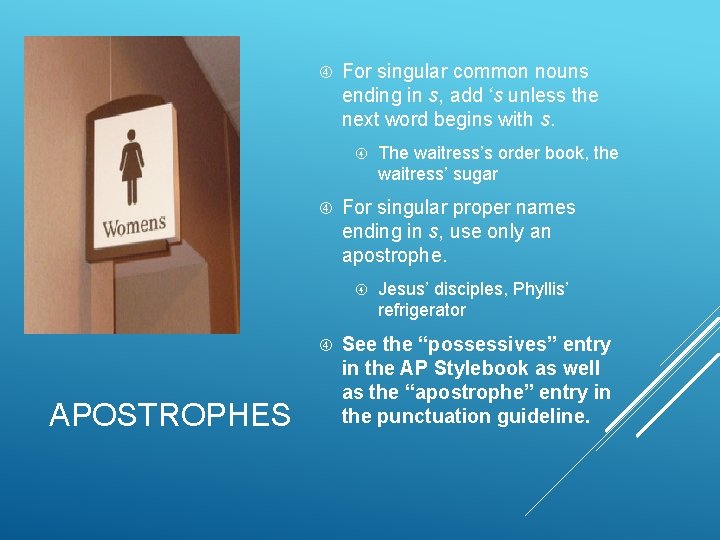
For singular common nouns ending in s, add ‘s unless the next word begins with s. For singular proper names ending in s, use only an apostrophe. APOSTROPHES The waitress’s order book, the waitress’ sugar Jesus’ disciples, Phyllis’ refrigerator See the “possessives” entry in the AP Stylebook as well as the “apostrophe” entry in the punctuation guideline.
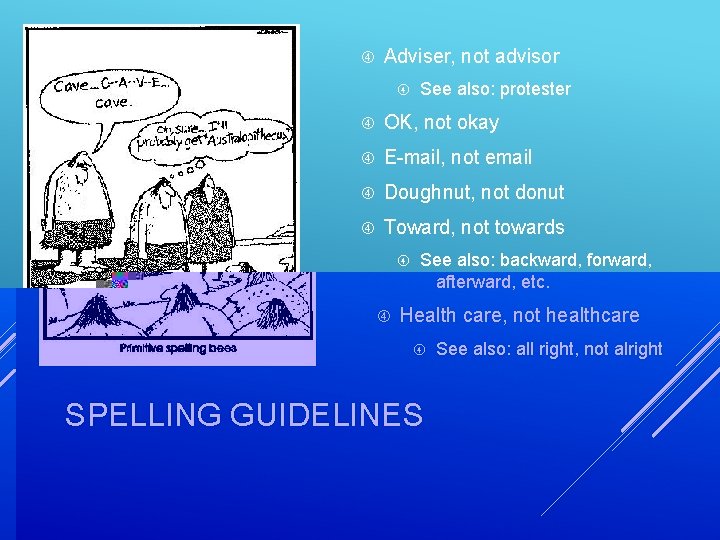
Adviser, not advisor See also: protester OK, not okay E-mail, not email Doughnut, not donut Toward, not towards See also: backward, forward, afterward, etc. Health care, not healthcare SPELLING GUIDELINES See also: all right, not alright
The stylebook is particular about words with similar but different meanings. Examples: adopt, approve, enact and pass Adopt or approve: amendments, ordinances, resolutions and rules are adopted or approved. Pass: bills are passed. Enact: laws are enacted. Allude and refer Allude: to allude to something is to speak of it without specifically mentioning it. Refer: to refer is to mention it directly. WORD CHOICE