
SATURN By Alex Clarke 7 4 Introduction For
SATURN By Alex Clarke 7. 4

Introduction • For my science project I have chosen to do Saturn, a large planet in our solar system. • This presentation will tell you everything you need to know about Saturn. Day -Length
Contents Choose what you would like to learn about and click on it, press the home button to return back to this slide. 1. The planet I would visit is. . . 2. An overview of Saturn 3. Composition of Saturn 4. Weather and Atmosphere 5. Comparison to Mars and Earth 6. Atmospheric comparison of the planets. 7. Saturn: Year-length, Temperature and Gravity 8. Year-length: comparison to other planets 9. Temperature: comparison to other planets. 10. Gravity: comparison to other planets. 11. Day length: comparison to other planets. 12. Other data 13. Saturn's Moons
I Would Visit. . . • I would visit Saturn. This planet is one of the most widely recognisable planets because of its rings. These are made of mainly ice and dust. If I was to visit this planet I would only have 10 ½ hours in a day because that is how fast it spins. • There have been 4 rockets that have gone to Saturn. These are Pioneer 11 (1979), Voyager 1 (1980), Voyager 2 DID YOU KNOW? ? ? (1981) and Cassini (2004). One of Saturn's moons, • It takes 30 years for Saturn to travel Enceladus. Is thought to around the sun. Scientists have water underneath noticed that Saturn has seasons and the surface. Where there's over time the rings rotate. Saturn water , there could be has 62 moons. Its biggest, Titan, is life. . . the second biggest moon in the solar system.
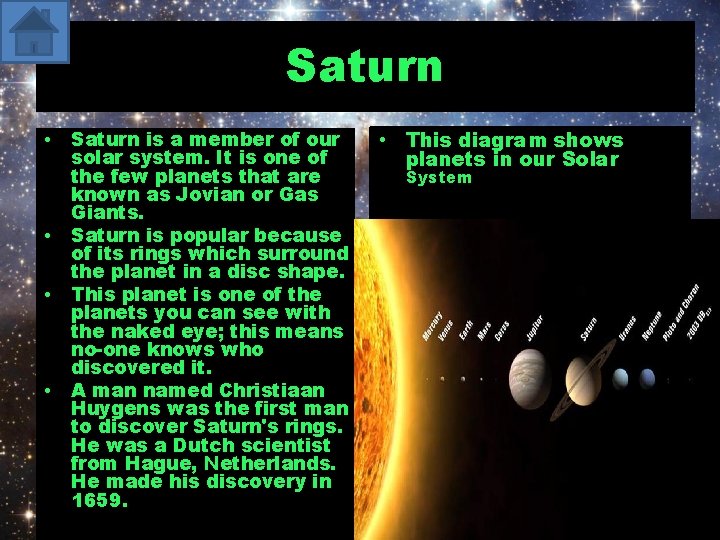
Saturn • • Saturn is a member of our solar system. It is one of the few planets that are known as Jovian or Gas Giants. Saturn is popular because of its rings which surround the planet in a disc shape. This planet is one of the planets you can see with the naked eye; this means no-one knows who discovered it. A man named Christiaan Huygens was the first man to discover Saturn's rings. He was a Dutch scientist from Hague, Netherlands. He made his discovery in 1659. • This diagram shows planets in our Solar System
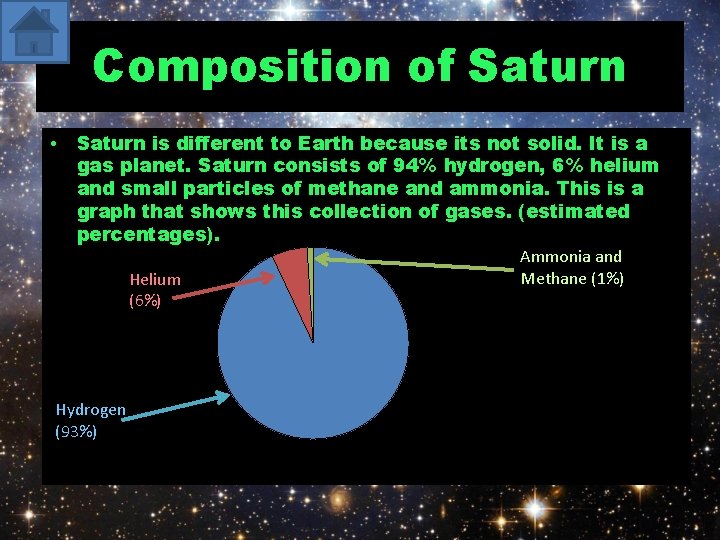
Composition of Saturn • Saturn is different to Earth because its not solid. It is a gas planet. Saturn consists of 94% hydrogen, 6% helium and small particles of methane and ammonia. This is a graph that shows this collection of gases. (estimated percentages). Helium (6%) Hydrogen (93%) Ammonia and Methane (1%)
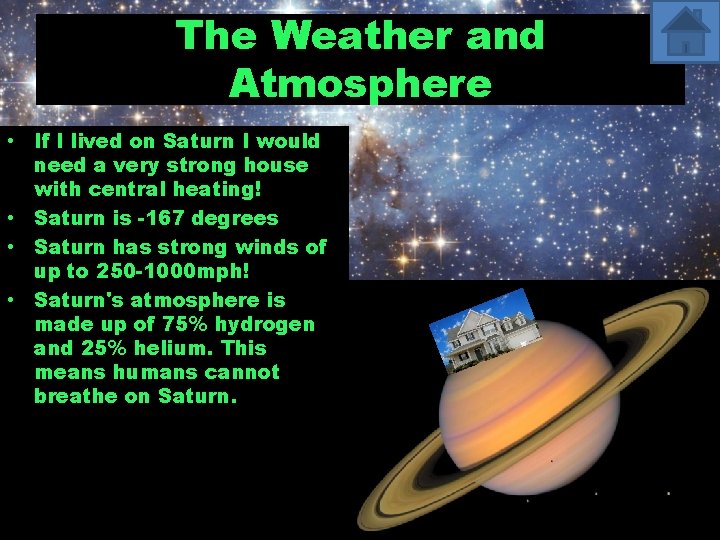
The Weather and Atmosphere • If I lived on Saturn I would need a very strong house with central heating! • Saturn is -167 degrees • Saturn has strong winds of up to 250 -1000 mph! • Saturn's atmosphere is made up of 75% hydrogen and 25% helium. This means humans cannot breathe on Saturn.
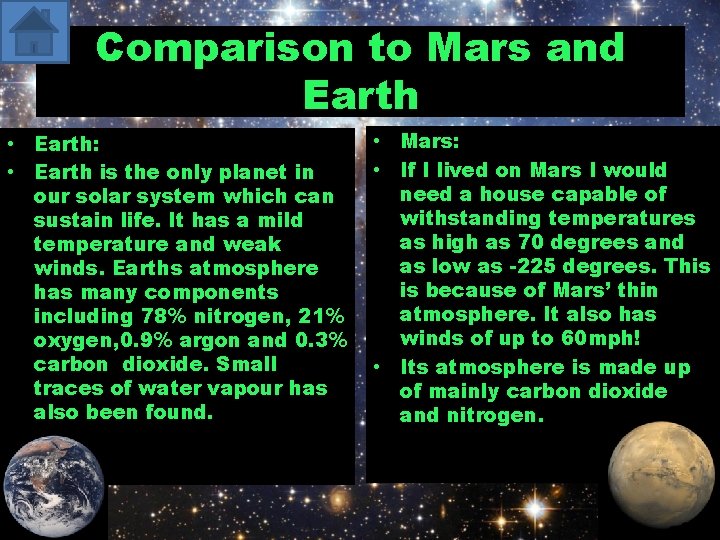
Comparison to Mars and Earth • Earth: • Earth is the only planet in our solar system which can sustain life. It has a mild temperature and weak winds. Earths atmosphere has many components including 78% nitrogen, 21% oxygen, 0. 9% argon and 0. 3% carbon dioxide. Small traces of water vapour has also been found. • Mars: • If I lived on Mars I would need a house capable of withstanding temperatures as high as 70 degrees and as low as -225 degrees. This is because of Mars’ thin atmosphere. It also has winds of up to 60 mph! • Its atmosphere is made up of mainly carbon dioxide and nitrogen.
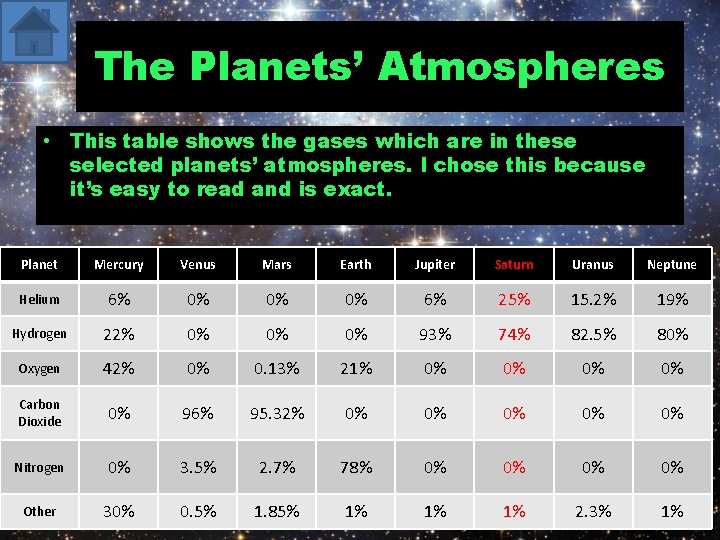
The Planets’ Atmospheres • This table shows the gases which are in these selected planets’ atmospheres. I chose this because it’s easy to read and is exact. Planet Mercury Venus Mars Earth Jupiter Saturn Uranus Neptune Helium 6% 0% 0% 0% 6% 25% 15. 2% 19% Hydrogen 22% 0% 0% 0% 93% 74% 82. 5% 80% Oxygen 42% 0% 0. 13% 21% 0% 0% Carbon Dioxide 0% 96% 95. 32% 0% 0% 0% Nitrogen 0% 3. 5% 2. 7% 78% 0% 0% Other 30% 0. 5% 1. 85% 1% 1% 1% 2. 3% 1%
Temperature, Gravity and Year Length • Saturn is very far from the sun so it takes 30 years to go around the sun. This very long compared to Earths year length which is only 365 ¼ days. • The gravity on Saturn is surprisingly low compared to Earth. Normally the larger the planet, the stronger the gravity. But, because Saturn is so light, it has much less weight than what it would be if it was solid. Saturn only has 92% the amount of gravity of Earth. • Because Saturn is so far away from the sun (1, 433, 000 km to be precise. ) it is much colder than the planets that are closer to the sun. Saturn is -167 degrees Celsius so it is a lot colder than Earths 20 degree temperature.
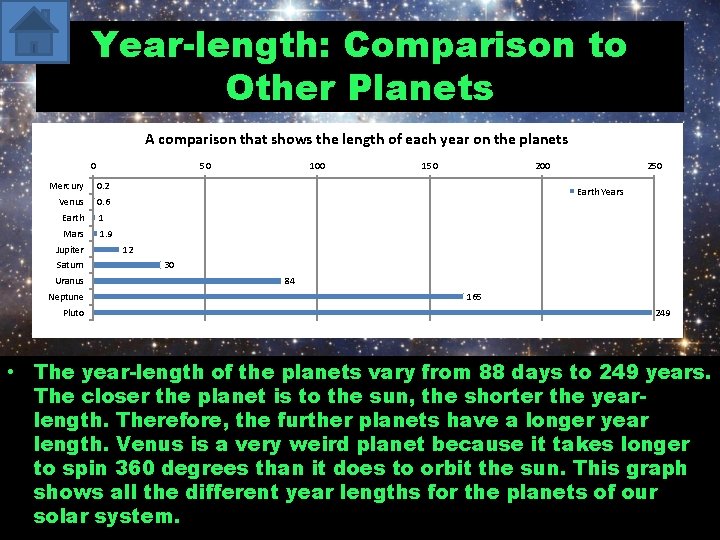
Year-length: Comparison to Other Planets A comparison that shows the length of each year on the planets 0 50 Mercury 0. 2 Venus 0. 6 Earth 1 Mars 1. 9 Jupiter Saturn Uranus Neptune Pluto 100 150 200 250 Earth Years 12 30 84 165 249 • The year-length of the planets vary from 88 days to 249 years. The closer the planet is to the sun, the shorter the yearlength. Therefore, the further planets have a longer year length. Venus is a very weird planet because it takes longer to spin 360 degrees than it does to orbit the sun. This graph shows all the different year lengths for the planets of our solar system.
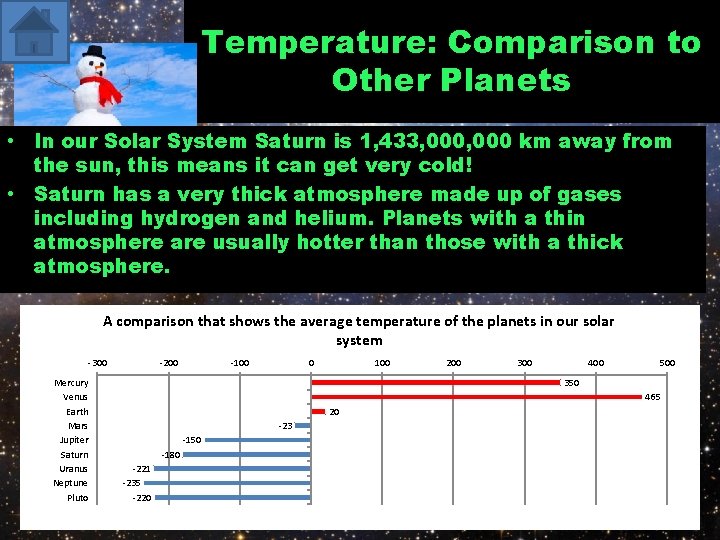
Temperature: Comparison to Other Planets • In our Solar System Saturn is 1, 433, 000 km away from the sun, this means it can get very cold! • Saturn has a very thick atmosphere made up of gases including hydrogen and helium. Planets with a thin atmosphere are usually hotter than those with a thick atmosphere. A comparison that shows the average temperature of the planets in our solar system -300 Mercury Venus Earth Mars Jupiter Saturn Uranus Neptune Pluto -200 -100 0 100 200 300 400 500 350 465 20 -23 -150 -180 -221 -235 -220
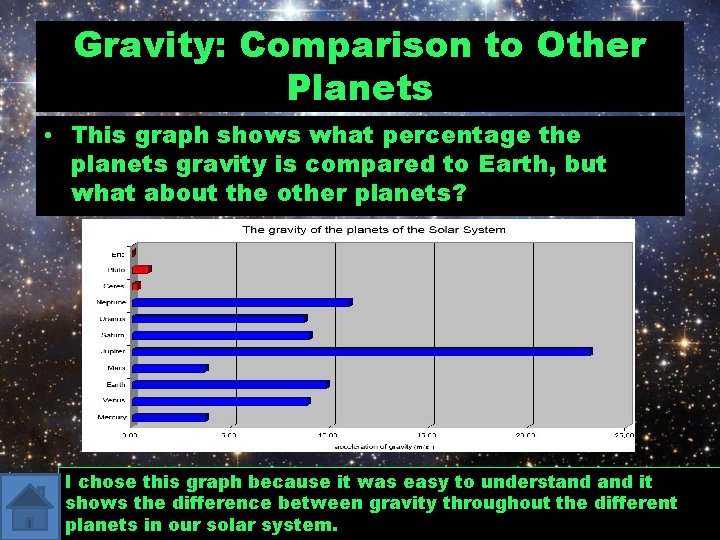
Gravity: Comparison to Other Planets • This graph shows what percentage the planets gravity is compared to Earth, but what about the other planets? I chose this graph because it was easy to understand it shows the difference between gravity throughout the different planets in our solar system.

Day-Length Comparison A comparison that shows the length of each day on the planets 0 Mercury Venus 2000 4000 0 6000 1416 Hours 5856 Earth: A day-length on Earth is 24 hours, this means it takes 1 day to do a full rotation. Earth spins quite fast so a day is shorter than those of planets such as Pluto because they turn slower. 20 40 Earth 24 Mars 25 Jupiter 10 Saturn 10 Uranus 17 Neptune 16 60 Pluto Saturn: This planet spins very fast making the planet look squished. A day on Saturn is only 10. 5 hours. 80 100 120 140 160 Ho. . . 153 Pluto: It takes approximately 6 days and 9 hours for it to spin completely. This is because of how slow it turns.
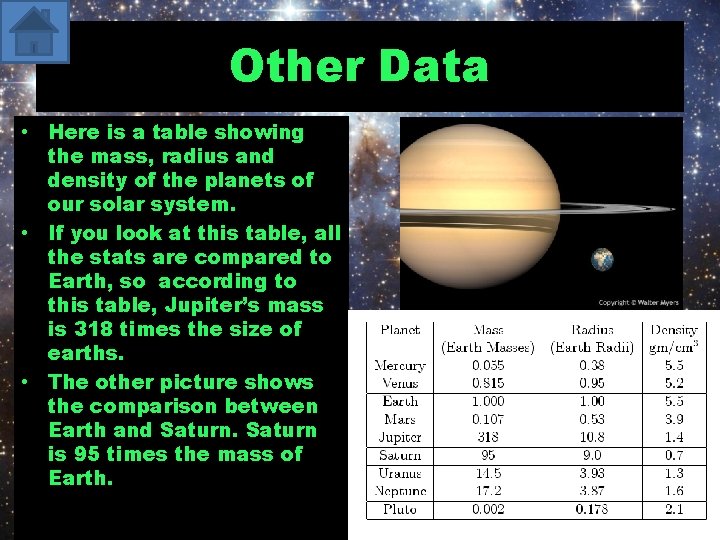
Other Data • Here is a table showing the mass, radius and density of the planets of our solar system. • If you look at this table, all the stats are compared to Earth, so according to this table, Jupiter’s mass is 318 times the size of earths. • The other picture shows the comparison between Earth and Saturn is 95 times the mass of Earth.
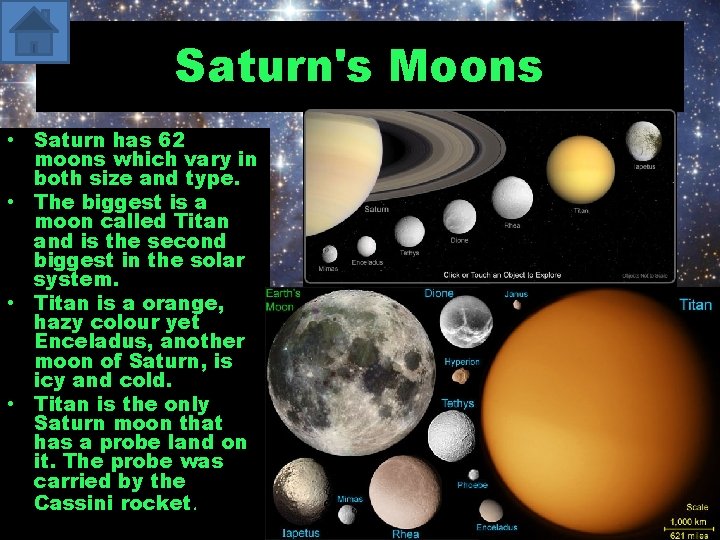
Saturn's Moons • Saturn has 62 moons which vary in both size and type. • The biggest is a moon called Titan and is the second biggest in the solar system. • Titan is a orange, hazy colour yet Enceladus, another moon of Saturn, is icy and cold. • Titan is the only Saturn moon that has a probe land on it. The probe was carried by the Cassini rocket.
Any Questions?
- Slides: 17