The Synergy of Language Culture and Identity Understanding

- Slides: 34
The Synergy of Language, Culture and Identity – Understanding and Developing Identity in French Immersion Students Sylvie Roy, professor and researcher Werklund School of Education, University of Calgary syroy@ucalgary. ca May 3, 2017 Mc. Master House
Our questions today How does one define the identity of a FI student? How do FI students define themselves? How does one “create” a school culture to support a FI student’s identity? Whether it be a dual track or a milieu school, what is the vision of a FI school? What is the role of the teacher? The school administrator? The student service team? How do you know you have successfully implemented a school culture that celebrates the identity of a FI student?
Citez comme ceci: Roy, S. (2017). The Synergy of Language, Culture and Identity – Understanding and Developing Identity in French Immersion Students. Invited speaker for a oneday workshop. Association manitobaine des directrices et directeurs des écoles d’immersion française. Winnipeg, May 3.
Presentation Our identities Discourses and ideologies French Immersion students (Who are they? ) School culture Discussions and Reflections
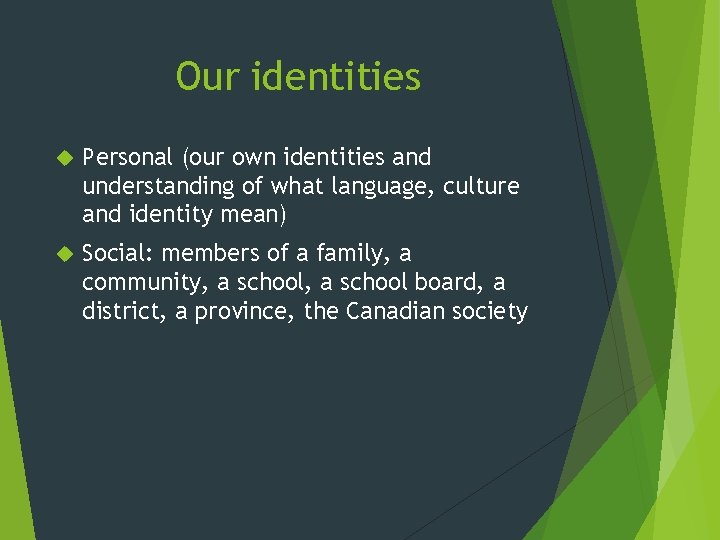
Our identities Personal (our own identities and understanding of what language, culture and identity mean) Social: members of a family, a community, a school board, a district, a province, the Canadian society
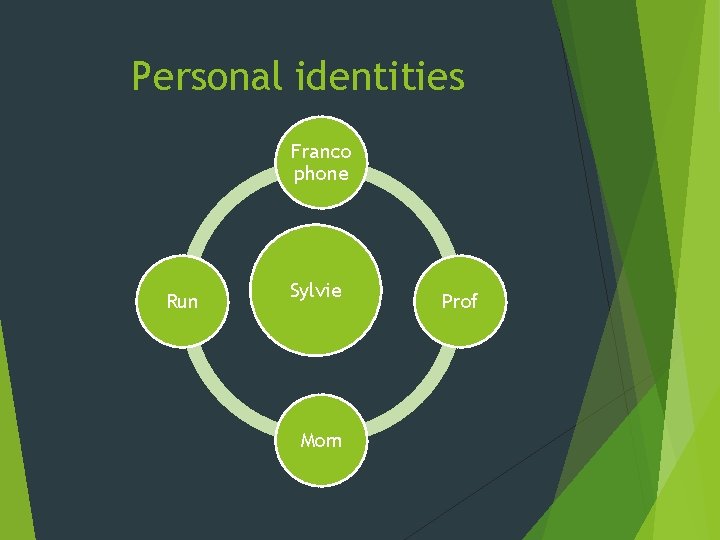
Personal identities Franco phone Run Sylvie Mom Prof
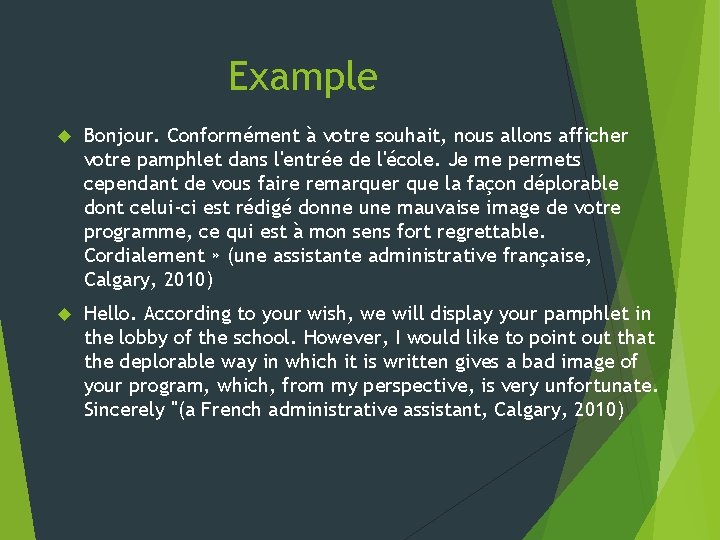
Example Bonjour. Conformément à votre souhait, nous allons afficher votre pamphlet dans l'entrée de l'école. Je me permets cependant de vous faire remarquer que la façon déplorable dont celui-ci est rédigé donne une mauvaise image de votre programme, ce qui est à mon sens fort regrettable. Cordialement » (une assistante administrative française, Calgary, 2010) Hello. According to your wish, we will display your pamphlet in the lobby of the school. However, I would like to point out that the deplorable way in which it is written gives a bad image of your program, which, from my perspective, is very unfortunate. Sincerely "(a French administrative assistant, Calgary, 2010)
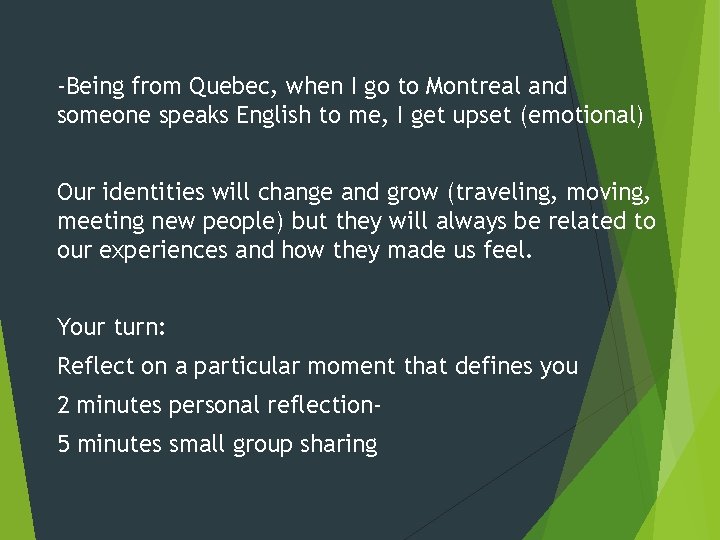
-Being from Quebec, when I go to Montreal and someone speaks English to me, I get upset (emotional) Our identities will change and grow (traveling, moving, meeting new people) but they will always be related to our experiences and how they made us feel. Your turn: Reflect on a particular moment that defines you 2 minutes personal reflection 5 minutes small group sharing
Social identities School, community, province, country French immersion students are part of the social and political spheres Discourses: French immersion and all its ideologies surrounding the learning and teaching of French in Canada Myths, stereotypes Power
French in Canada seems to belong to a specific group that can master the language. There are some historical and social reasons why French is special for some people, and less for others in Canada, in different provinces, in Manitoba. French is not only an international language, but its also part of the identity of francophones in Canada. So where are French immersion students in all that?
Notice here Keep an eye on the language use
M: Between Grade 7 and Grade 9, I think I can speak a bit more. . S: Fluently? M: Fluently, yes, sorry. I have a bigger vocabulary now. I also have a better comprehension of grammar and all that. I feel comfortable speaking with a Francophone now. . S: And you didn’t in Grade 7? M: No, not really. I could speak but I didn’t feel very comfortable about doing it. Now. . S: You started in kindergarten? M: Yes, yes. S: But why did that change? Is it because you’re older or is it because you have more vocabulary? M: I think it’s more about the vocabulary, because I can speak more, because I know all the vocabulary, and then my grammar which is pretty good, so I can use the different verb tenses and. . S: So in Grade 7, you couldn’t do that? M: Not as well, no. Now, it’s a lot more.
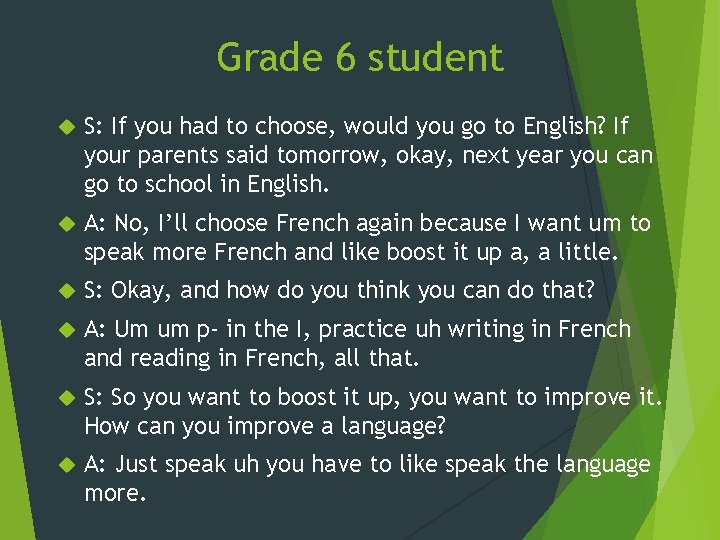
Grade 6 student S: If you had to choose, would you go to English? If your parents said tomorrow, okay, next year you can go to school in English. A: No, I’ll choose French again because I want um to speak more French and like boost it up a, a little. S: Okay, and how do you think you can do that? A: Um um p- in the I, practice uh writing in French and reading in French, all that. S: So you want to boost it up, you want to improve it. How can you improve a language? A: Just speak uh you have to like speak the language more.
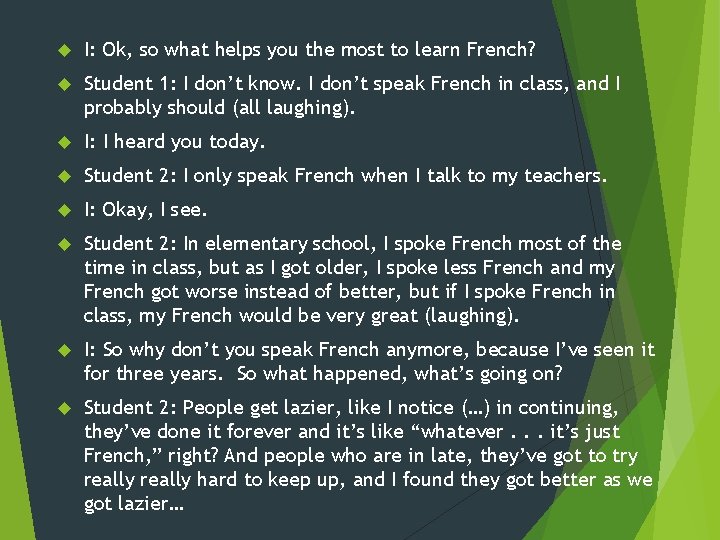
I: Ok, so what helps you the most to learn French? Student 1: I don’t know. I don’t speak French in class, and I probably should (all laughing). I: I heard you today. Student 2: I only speak French when I talk to my teachers. I: Okay, I see. Student 2: In elementary school, I spoke French most of the time in class, but as I got older, I spoke less French and my French got worse instead of better, but if I spoke French in class, my French would be very great (laughing). I: So why don’t you speak French anymore, because I’ve seen it for three years. So what happened, what’s going on? Student 2: People get lazier, like I notice (…) in continuing, they’ve done it forever and it’s like “whatever. . . it’s just French, ” right? And people who are in late, they’ve got to try really hard to keep up, and I found they got better as we got lazier…
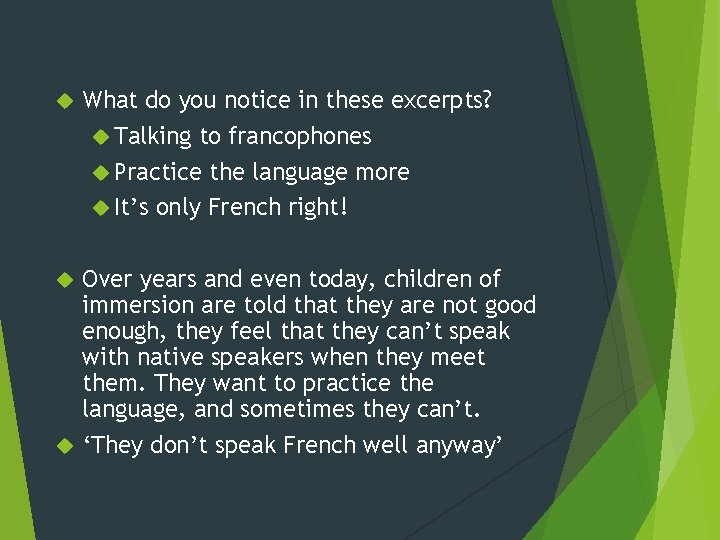
What do you notice in these excerpts? Talking to francophones Practice the language more It’s only French right! Over years and even today, children of immersion are told that they are not good enough, they feel that they can’t speak with native speakers when they meet them. They want to practice the language, and sometimes they can’t. ‘They don’t speak French well anyway’
Examining and changing discourses What is the language used in your school (bulletin board for example)? What do we say and hear about French immersion students (and teachers!!) What others say about them? What francophones say about them? What they say between each other? On sentence per table 10 minutes
How do you define the identity of a FI student? How do FI students define themselves? In group Tell us how do you see and define French immersion student ? Personal identities (who are they? ) Social identities (who are they in the world? ) 15 minutes discussions
How does one define the identity of a FI student? Anglophones or allophones learning French Bilinguals Life or multilinguals long learners Strugglers Illitterate
How do FI students define themselves? Most of them : bilinguals Bilingual in becoming… Interviewer: Do you think you’re bilingual? Emily: Like as fluent in French and English? Interviewer: Yes. Emily: Almost there. Getting there. I wouldn’t say completely. . Like not totally. I think pretty much. Like we could. . . fluent is a bit of a loose term too, so it’s kind of hard to say.
Bilinguals “Bilinguals know their languages to the level that they need them. Some bilinguals are dominant in one language, others do not know how to read and write one of their languages, others have only passive knowledge of a language and, finally, a very small minority, have equal and perfect fluency in their languages. What is important to keep in mind is that bilinguals are very diverse, as are monolinguals” (http: //www. francoisgrosjean. ch/myths_ en. html)
The program [French Immersion] nurtured me when I was young, gave me a place to learn, to develop skills and abilities that made me who I am today. The program gave me a place to be myself and to call home. I am not a French person, I am not a Quebecer, I am not a Franco-Albertan. I am a French Immersion person, my identity is not with a culture, it is a culture. (Mueller, 2008 p. 39)
I : Ah that’s great… what is…what is French for you? M: French for me? I: what does it represent? M: it is really an academic accomplishment… I can do like there are other people that are really good at school. They can do a lot of things and I do that too and in addition I do it in another language than my first language, and so, it is really an accomplishment. I am very proud.
Translanguaging space For me, translanguaging is both going between different linguistic structures and systems, including different modalities (speaking, writing, signing, listening, reading, remembering) and going beyond them. It includes the full range of linguistic performances of multilingual language users for purposes that transcend the combination of structures, the alternation between systems, the transmission of information and the representation of values, identities and relationships. The act of translanguaging then is transformative in nature; it creates a social space for the multilingual language user by bringing together different dimensions of their personal history, experience and environment, their attitude, belief and ideology, their cognitive and physical capacity into one coordinated and meaningful performance, and making it into a lived experience. I call this space ‘‘translanguaging space’’, a space for the act of translanguaging as well as a space created through translanguaging (Wei, 2010: 1222)
Multilingual competence I therefore propose a view of “truncated’ multilingualism: repertoires composed of specialized but partially and unevenly developed resources. We never know “all” of a language; we always know specific bits and pieces of it. This count for our “mother tongue” as well as for the languages we pick up in the course of a lifetime, and this is perfectly normal. I contend that such “truncated” repertoires are a better diagnostic of what real multilingual competence means in an age of globalization, as they explain the unfinished character of communication, as well as numerous problems that occur in processes of mobility. The truncated repertoires are grounded in people’s biographies and in the wider histories of the places where they were composed. (Blommaert, 2010, p. 23)
Conclusion What did we learn? Now that we know that FI students are bilingual or multilingual students that are learning French and English and sometimes other languages at home… Is is possible to help students to ‘develop’ a FI identity? What would be the best way to support them in the school in their everyday lives?
Changes in a school culture always start with its leaders !
How does one “create” a school culture to support a FI student’s identity? Whether it be a dual track or a milieu school, what is the vision of a FI school? What is the role of the teacher? The school administrator? The student service team? How do you know you have successfully implemented a school culture that celebrates the identity of a FI student?
What is a FI culture? It is not two separate languages and two separate cultures. It is not Maple syrup ! It is not to be able to speak French like native speakers
They are no challenges, only opportunities ! It might take some time.
In groups Look around first. What is your actual school culture? What are you going to keep that works ? What is the FI culture that you would like to have? What is your vision? 20 minutes
Action plan Name 3 actions that need to be done and recognize the importance of those actions Who is involved of changing the culture ? Identify who are the stakeholders How 20 will you know that it worked? minutes Between tables sharing
Higher competencies in French (build the language) : in the classroom… especially in High schools and Junior high … if the language is not high they won’t understand concepts AND they won’t be able to be confident and to speak to others Build a discourse of bilingualism and multilingualism and promote that
Does our Immersion program allow students, including students with special needs, to achieve a high level of linguistic competency in both French and English? Are students proud of their linguistic competencies and do they have confidence in their ability to speak French in various public settings: small and large group discussions/presentations inside and outside the classroom as well as outside of school? Are students aware of their own cultural identity and are they open to other languages and cultures? Do students have the confidence and the interest to participate in activities in the Francophone community, here and elsewhere? Do students value the learning of languages as a key to global citizenship? Do they see themselves as lifelong language learners? Manitoba Education and Training. Bureau de l’éducation française division. (2016). French language education review 2013‐ 2014: provincial report French immersion program. Winnipeg, Manitoba.
Questions Thank ? you Contactez-moi pour les références syroy@ucalgary. ca