The Notion of Tragedy in A Streetcar Named



- Slides: 40
The Notion of Tragedy in A Streetcar Named Desire and Othello Part 2
Key Questions • How similar or different are Blanche and Othello as tragic protagonists? • What are the methods employed by Shakespeare and Williams to create the sense of tragedy in both plays, and to evoke and sustain sympathy for Othello and Blanche? • What are the effects of the symbolism of music in both plays? • Does the symbolism of music augment the sense of tragedy in both plays?
Both playwrights use different dramatic techniques to evoke sympathy for their protagonists • In Othello, Shakespeare uses dramatic irony, soliloquies, changes in speech patterns and ocular imagery • In Streetcar, Williams uses flashbacks/memories of the past accompanied by the haunting polka music (a stark reminder of the heroine’s tragic circumstances); the imagery of light, darkness and death contribute to the pathos
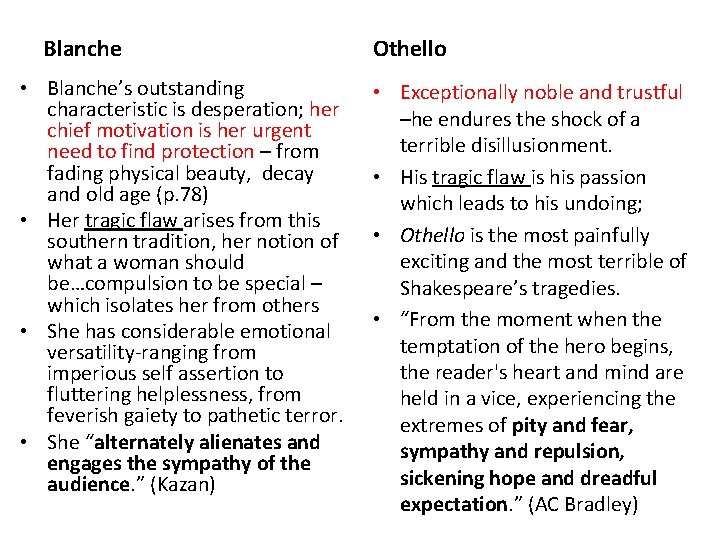
Blanche • Blanche’s outstanding characteristic is desperation; her chief motivation is her urgent need to find protection – from fading physical beauty, decay and old age (p. 78) • Her tragic flaw arises from this southern tradition, her notion of what a woman should be…compulsion to be special – which isolates her from others • She has considerable emotional versatility-ranging from imperious self assertion to fluttering helplessness, from feverish gaiety to pathetic terror. • She “alternately alienates and engages the sympathy of the audience. ” (Kazan) Othello • Exceptionally noble and trustful –he endures the shock of a terrible disillusionment. • His tragic flaw is his passion which leads to his undoing; • Othello is the most painfully exciting and the most terrible of Shakespeare’s tragedies. • “From the moment when the temptation of the hero begins, the reader's heart and mind are held in a vice, experiencing the extremes of pity and fear, sympathy and repulsion, sickening hope and dreadful expectation. ” (AC Bradley)
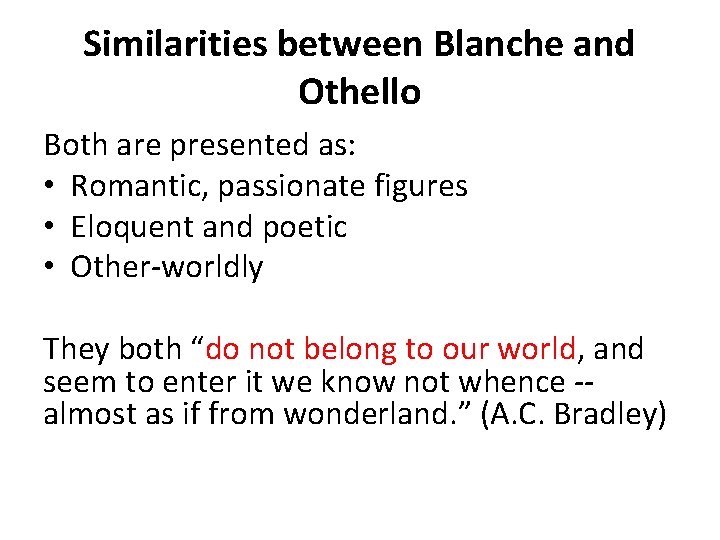
Similarities between Blanche and Othello Both are presented as: • Romantic, passionate figures • Eloquent and poetic • Other-worldly They both “do not belong to our world, and seem to enter it we know not whence -- almost as if from wonderland. ” (A. C. Bradley)
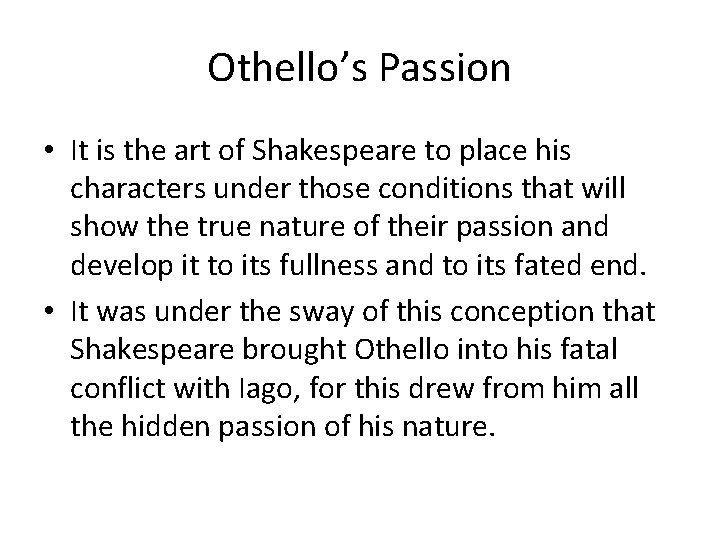
Othello’s Passion • It is the art of Shakespeare to place his characters under those conditions that will show the true nature of their passion and develop it to its fullness and to its fated end. • It was under the sway of this conception that Shakespeare brought Othello into his fatal conflict with Iago, for this drew from him all the hidden passion of his nature.
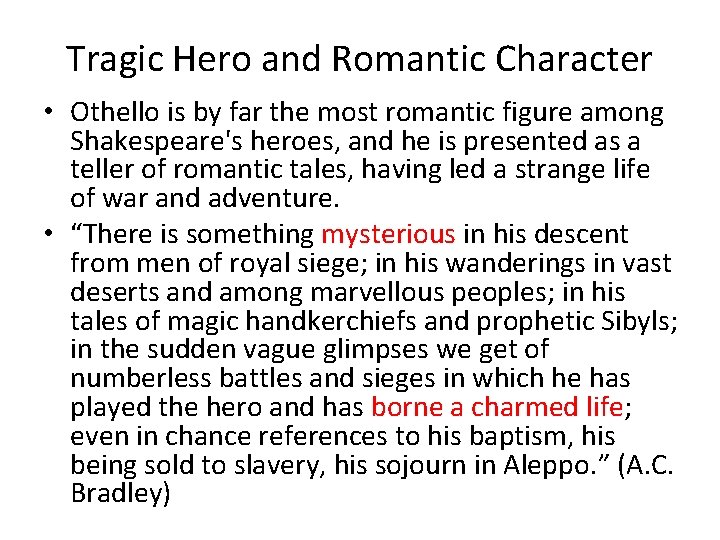
Tragic Hero and Romantic Character • Othello is by far the most romantic figure among Shakespeare's heroes, and he is presented as a teller of romantic tales, having led a strange life of war and adventure. • “There is something mysterious in his descent from men of royal siege; in his wanderings in vast deserts and among marvellous peoples; in his tales of magic handkerchiefs and prophetic Sibyls; in the sudden vague glimpses we get of numberless battles and sieges in which he has played the hero and has borne a charmed life; even in chance references to his baptism, his being sold to slavery, his sojourn in Aleppo. ” (A. C. Bradley)
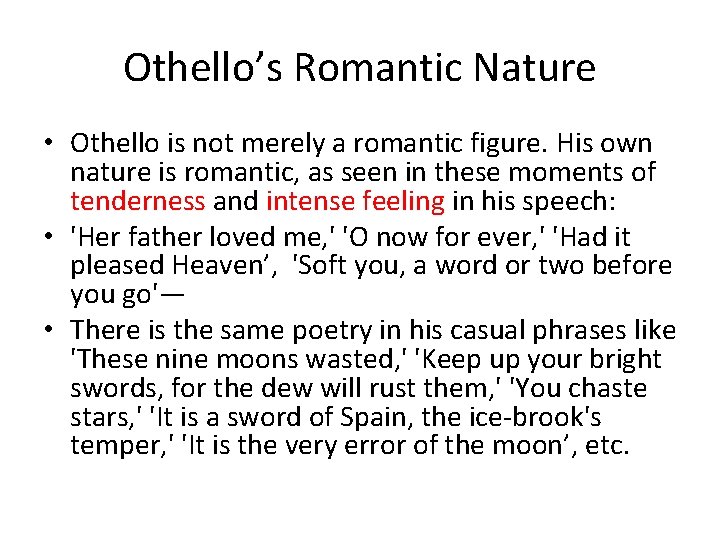
Othello’s Romantic Nature • Othello is not merely a romantic figure. His own nature is romantic, as seen in these moments of tenderness and intense feeling in his speech: • 'Her father loved me, ' 'O now for ever, ' 'Had it pleased Heaven’, 'Soft you, a word or two before you go'— • There is the same poetry in his casual phrases like 'These nine moons wasted, ' 'Keep up your bright swords, for the dew will rust them, ' 'You chaste stars, ' 'It is a sword of Spain, the ice-brook's temper, ' 'It is the very error of the moon’, etc.
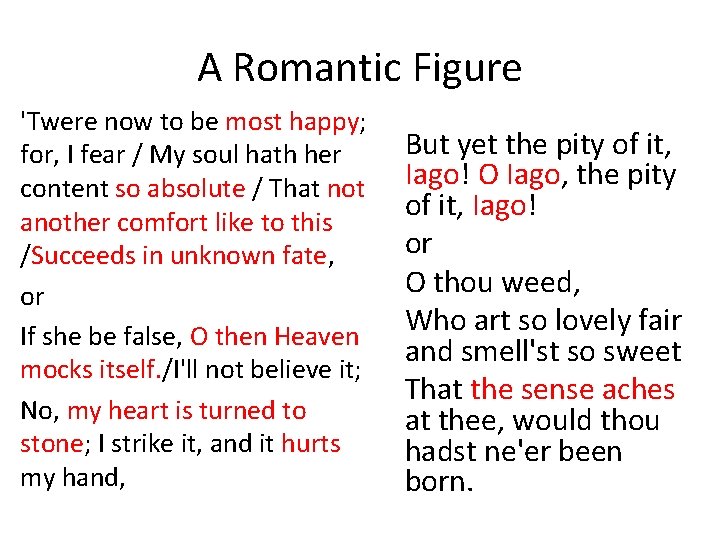
A Romantic Figure 'Twere now to be most happy; for, I fear / My soul hath her content so absolute / That not another comfort like to this /Succeeds in unknown fate, or If she be false, O then Heaven mocks itself. /I'll not believe it; No, my heart is turned to stone; I strike it, and it hurts my hand, But yet the pity of it, Iago! O Iago, the pity of it, Iago! or O thou weed, Who art so lovely fair and smell'st so sweet That the sense aches at thee, would thou hadst ne'er been born.
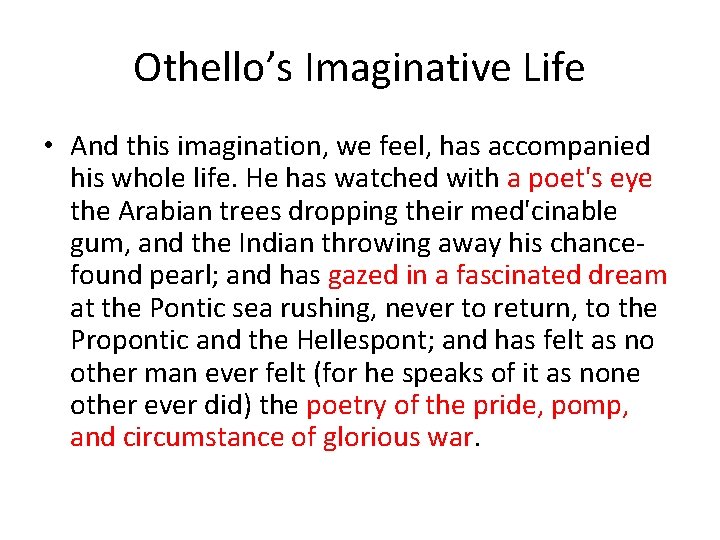
Othello’s Imaginative Life • And this imagination, we feel, has accompanied his whole life. He has watched with a poet's eye the Arabian trees dropping their med'cinable gum, and the Indian throwing away his chancefound pearl; and has gazed in a fascinated dream at the Pontic sea rushing, never to return, to the Propontic and the Hellespont; and has felt as no other man ever felt (for he speaks of it as none other ever did) the poetry of the pride, pomp, and circumstance of glorious war.
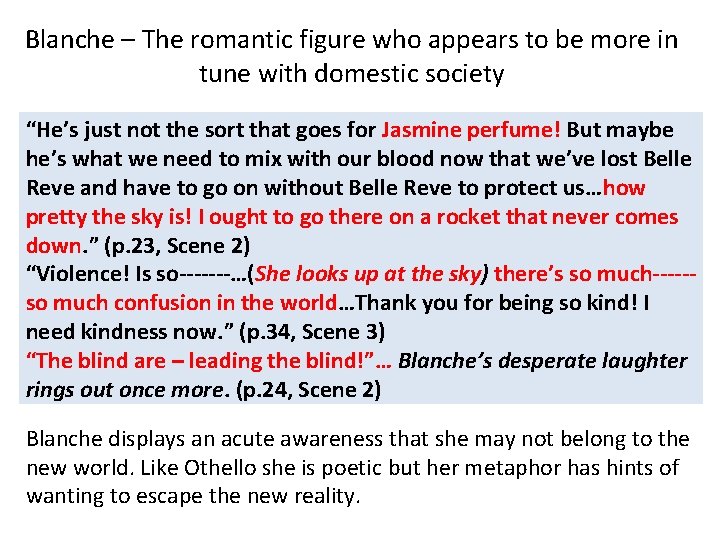
Blanche – The romantic figure who appears to be more in tune with domestic society “He’s just not the sort that goes for Jasmine perfume! But maybe he’s what we need to mix with our blood now that we’ve lost Belle Reve and have to go on without Belle Reve to protect us…how pretty the sky is! I ought to go there on a rocket that never comes down. ” (p. 23, Scene 2) “Violence! Is so-------…(She looks up at the sky) there’s so much-----so much confusion in the world…Thank you for being so kind! I need kindness now. ” (p. 34, Scene 3) “The blind are – leading the blind!”… Blanche’s desperate laughter rings out once more. (p. 24, Scene 2) Blanche displays an acute awareness that she may not belong to the new world. Like Othello she is poetic but her metaphor has hints of wanting to escape the new reality.
Blanche sees with a Poet’s Eye • Uses animal imagery to describe Stanley as one who would “kill, strike and grunt” and the poker party as “grunting, swilling, gnawing, hulking, growl(ing)” to warn us about being seduced by the new world (“dark march”)– that accepts violence and brutality as a compromise to live and be loved. • “Stanley Kowalski – survivor of the stone age! Bearing the raw meat home from the kill in the jungle! And you - you here - waiting for him! Maybe he’ll strike you or maybe grunt and kiss you! …night falls and the other apes gather!” (p. 41, Scene 4)
And extols the Beauty of Art • “Such things as art – as poetry and music – such kinds of new light have come into the world since then! In some kinds of people some tenderer feelings have had some little beginning! That we have got to make grow! And cling to, and hold as our flag! … Don’t, don’t hang with the brutes!” (p. 41, Scene 4) • Her language poetically pits the beauty, tenderness and enlightenment of (over-)refined feminism against the ugliness, brutality and backwardness of the male libido
Soft and Hard Imagery Effete Feminism vs Male Libido/Dominance • “I was never hard or self-sufficient enough. When people are soft…soft people have got to court the favour of hard ones. Have got to be seductive – put on soft colours, the colours of butterfly wings, and glow – make a little temporary magic just in order to pay for - one night’s shelter. That’s why I’ve been –not so awf’ly good lately. I’ve run for protection, Stella …protection. ” (p. 45, Scene 5) – The Individual and his dependence on Society – no man island
Imagery of Light and the loss of innocence Society has the power to shape the life of the individual • “Oh, I hope candles are going to glow in his life and I hope that his eyes are going to be like candles, like two blue candles lighted in a white cake!” • “His auntie knows …that candles (soft glow) burn out in little boys’ and girls’ eyes, or wind blows them out and after that happens , electric light bulbs (glare) go on and you see too plainly…” (p. 66, Scene 8) • Juxtaposition of the soft glow of the candles and the glare of the neon lights brings out the harshness of the new world.
Imagery of Music – haunting memories are omnipresent The past shapes the individual’s present and future life • “You’ve stopped that polka tune that I had caught in my head. Have you ever had anything caught in your head? Some words, a piece of music? That goes relentlessly on and on in your head? No, of course you haven’t, you dumb angel-puss, you’d never get anything awful caught in your head. ” (p. 70, Sc. 9) • The repetition of ‘caught in your head’ creates a dire sense of psychological entrapment.
Poetic Picture of Desperation Driven by Circumstances P. 73, Scene 9: • “Yes, a big spider! I stayed at a hotel called the Tarantula Arms! That’s where I brought my victims…” (sardonic tone) • “After the death of Allan-intimacies with strangers was all I seemed able to fill my empty heart with…I think it was panic, just panic, that drove me from one to another, hunting for some protection-here and there, in the most unlikely places-even, at last, in a seventeen-year-old boy…” (sympathy created for this tragic heroine, who is presented as being both predator and prey)
Blanche’s Language Rich in Poetry • “My youth was suddenly gone up the waterspout. ” – Her youth vanquished • “You seemed to be gentle - a cleft in the rock of the world that I could hide in! The poor man’s Paradise - is a little peace…” -- Mitch as the sanctuary, a little space, for her to grow and find a new life • “Kiefaber, Stanley and Shaw have tied an old tin can to the tail of the kite. ” (p. 73, Sc. 9) -- Imagery of entrapment preventing her from finding her peace and freedom
Blanche’s Passion and Spiritual Journey P. 85, Scene 11: • “Cathedral bells –they’re the only clean thing in the Quarter. Well, I’m going now. I’m ready to go. ” • “I can smell the sea air…And when I die, I’m going to die on the sea. And I’ll be buried at sea sewn up in a clean white sack and dropped overboardat noon-in the blaze of summer-and into an ocean as blue as (cathedral chimes are heard) my first lover’s eyes!” • ‘This vignette suggests the warmth and passion of first love, not the coldness of death. ’ (p. 120)
Religious Imagery – Connotations of Purity, Liberation and Transcendence • Though the sea has connotations of grandeur and vastness, it also evokes a sense of mystery. In this context, it may suggest Blanche’s final liberation as she transcends this world, psychologically triumphing the survivors of the new world. • The cluster of religious images in this final scene may be interpreted as final absolution as Blanche states and believes that the ‘cathedral chimes’ are the only pure thing in the Quarter helping her to transcend this world to attain the purity of Madonna. (Blanche has put on her “Della Robbia blue” jacket, “the blue robe in the old Madonna pictures. ” – p. 84) • Perception becomes reality.
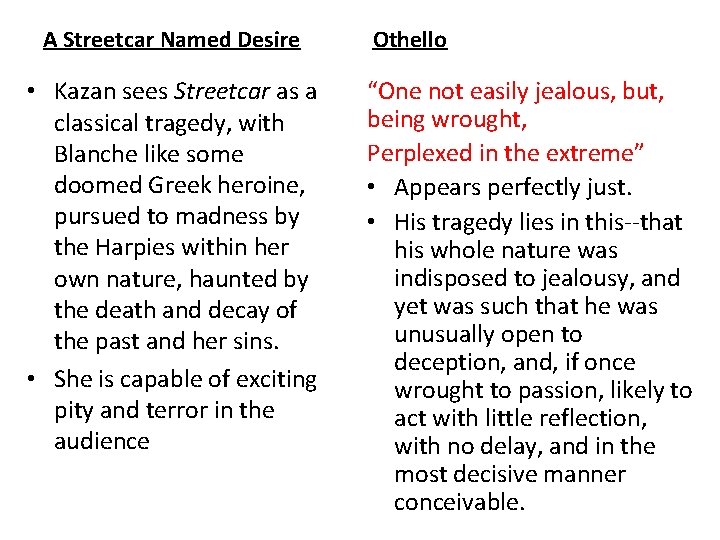
A Streetcar Named Desire • Kazan sees Streetcar as a classical tragedy, with Blanche like some doomed Greek heroine, pursued to madness by the Harpies within her own nature, haunted by the death and decay of the past and her sins. • She is capable of exciting pity and terror in the audience Othello “One not easily jealous, but, being wrought, Perplexed in the extreme” • Appears perfectly just. • His tragedy lies in this--that his whole nature was indisposed to jealousy, and yet was such that he was unusually open to deception, and, if once wrought to passion, likely to act with little reflection, with no delay, and in the most decisive manner conceivable.
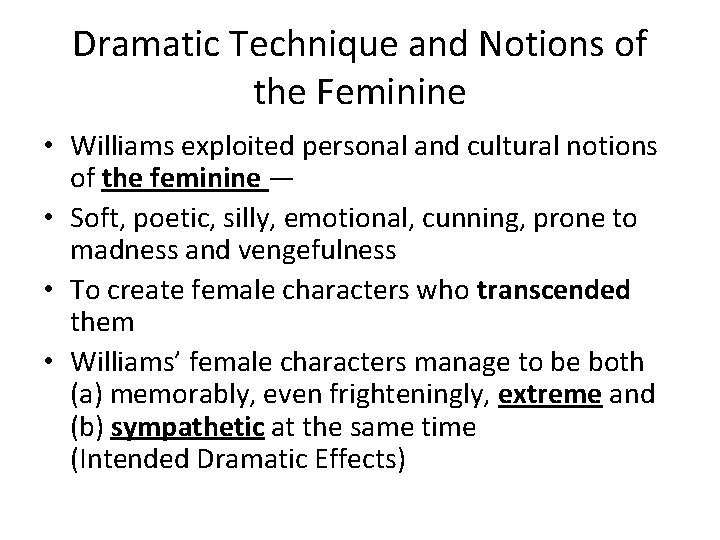
Dramatic Technique and Notions of the Feminine • Williams exploited personal and cultural notions of the feminine — • Soft, poetic, silly, emotional, cunning, prone to madness and vengefulness • To create female characters who transcended them • Williams’ female characters manage to be both (a) memorably, even frighteningly, extreme and (b) sympathetic at the same time (Intended Dramatic Effects)
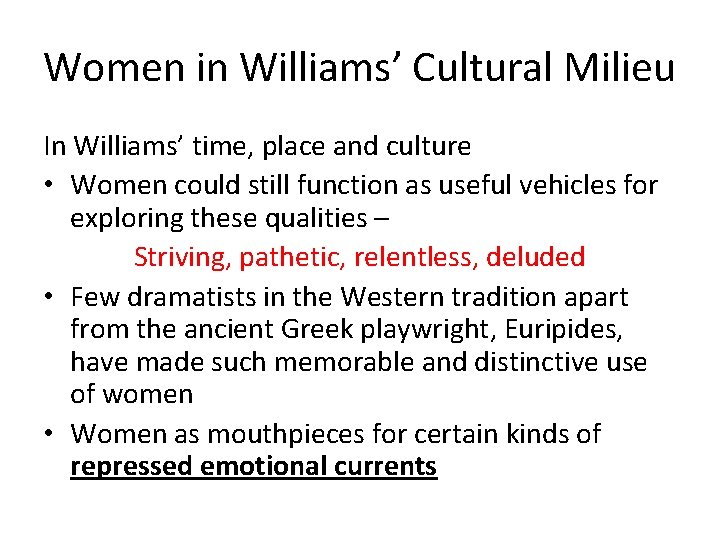
Women in Williams’ Cultural Milieu In Williams’ time, place and culture • Women could still function as useful vehicles for exploring these qualities – Striving, pathetic, relentless, deluded • Few dramatists in the Western tradition apart from the ancient Greek playwright, Euripides, have made such memorable and distinctive use of women • Women as mouthpieces for certain kinds of repressed emotional currents
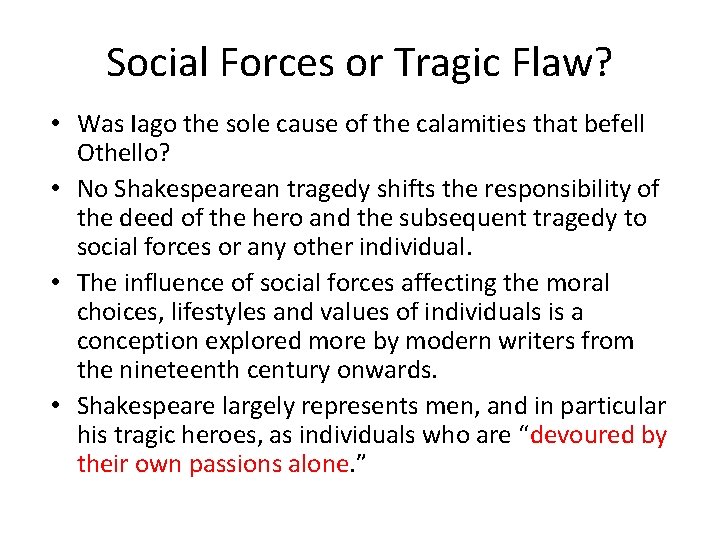
Social Forces or Tragic Flaw? • Was Iago the sole cause of the calamities that befell Othello? • No Shakespearean tragedy shifts the responsibility of the deed of the hero and the subsequent tragedy to social forces or any other individual. • The influence of social forces affecting the moral choices, lifestyles and values of individuals is a conception explored more by modern writers from the nineteenth century onwards. • Shakespeare largely represents men, and in particular his tragic heroes, as individuals who are “devoured by their own passions alone. ”
Social Forces or Tragic Flaw? • Does Williams also present Blanche as a victim of her own desire? • While part of Blanche’s tragedy is circumstantial, is she ultimately undone by her own desire? • She has a weakness for Stanley and his kind • Stanley only gives her a little push in the direction she has been headed in all along • After all, we hear Stanley declare towards the end of the play that “We’ve had this date with each other from the beginning!” (p. 81, Sc. 10)
Symbolism • Williams’ use of symbols as a dramatic technique, integrating ideas and thematic content. • He once explained that symbolism is a way to “say a thing more directly and simply and beautifully than it could be said in words … sometimes it would take page after tedious page of exposition to put across an idea that can be said with an object or a gesture on the lighted page” (Jackson). • Thus Williams uses symbols extensively to create mood and atmosphere on stage. Symbols are also used to evoke thematic concerns and give life to people and places.
Lyricism / Musicality • Lyricism springs mostly from vivid expressions that work on our reservoir of feelings and associations, from “connotation, imagery and metaphor. ” (Constance Hale) • Williams works his words so that they convey deep emotions and the passion of individuals • Williams makes your imagination leap and your heart sing. (Through his use of sounds and music, the arrangement of words, the repetition of words, and phrases)
Music, Mood and Emotion in this Tragedy of Pathos • Music contributes in a haunting way to the tone of the play • It corresponds with the different aspects of Blanche's mental anguish, and increasingly with her emotional deterioration. • The Varsouviana Polka plays in Blanche's head when she thinks of her deceased husband, Allen Grey and the destructive path that it led to • She relives this early trauma, and the guilt and responsibility for the death of both Allen Grey and Belle Reve. • The music is thus presented as a phantom from the traumatic past she is unable to shake off
Music gives gravity to emotions • Music plays an important role in A Streetcar Named Desire because it appears in almost every scene and stresses the atmosphere in a very distinct way. • There are two main types of music used in the stage directions: the blue piano and the Varsouviana Polka. • Each one appears in scenes which are occupied by a certain emotional state of the main character Blanche.
The Blue Piano • The blue piano is first mentioned in the introductory stage directions of the first scene: “This ‘blue piano’ expresses the spirit of the life which goes on there” (p. 3). • Throughout the play, the blue piano always appears when Blanche is talking about the loss of her family and Belle Reve (Scene 2), but it is also present when she meets and kisses the young newspaper man (Scene 5). • The blue piano thus stands for depression, loneliness and her longing for love, which the adjective ‘blue’ already suggests. • It describes Blanche’s emotions and represents her need for companionship and love, but also her hope, as the scene with the paper-boy shows.
The Blue Piano • Mitch tells her in Scene Nine that he will not marry her due to her promiscuous past. “The distant piano is slow and blue” (p. 75), symbolising the dashing of Blanche’s hopes of a future with Mitch. • Later, in Scene 10, it grows louder when she is on the phone trying to get in touch with Shep Huntleigh. In this situation, her hopes are rising, and so does the piano. • In the last scene, Blanche is being taken away to a mental institution, and Stanley and his friends play poker again: “The luxurious sobbing, the sensual murmur fade away under the swelling music of the ‘blue piano’ and the muted trumpet” (p. 90). • The blue piano, accompanying the card game, symbolises the sad reality of Stanley’s victory over Blanche.
The Varsouviana Polka (Scenes 1 , 6, 8, 9, 11) • The Varsouviana Polka, on the other hand, appears when Blanche is being confronted with her past and the truth, or when she talks about Allan. The reason for this seems obvious, for exactly this polka had been played when her husband Allan committed suicide. The polka represents death and imminent disaster. • Blanche tells Mitch in Scene 6 about Allan, and how she caught him cheating on her: “Polka music sounds, in a minor key faint with distance” (p. 57). • When Stanley gives her a ticket back to Laurel for a birthday present (in Scene 8), the situation means disaster for Blanche. She realises that she is not wanted anymore, and that she has nowhere to go. Her displacement from both Laurel and Elysian Fields is pronounced. “The Varsouviana music steals in softly and continues playing. ” (p. 68)
The Varsouviana Polka • In Scene 11, the connection between the polka and Blanche’s state of mind and emotion becomes even more obvious. • She gets totally lost in her illusions about Shep Huntleigh and runs into her room when the doctor arrives: “The Varsouviana is filtered into weird distortion, accompanied by the cries and noises of the jungle”. (p. 87) • Therefore the polka’s weird distortion matches the confusion in her mind
Cathedral Chimes (Scene 11) • Blanche turns weakly, hesitantly about. She lets them push her into a chair. • “I can smell the sea air. The rest of my time I am going to spend on the sea. And when I die I’m going to die on the sea. You know what I shall die of? (she plucks a grape) I shall dies of eating an unwashed grape one day out on the ocean. I will die-with my hand …That unwashed grape has transported her soul to heaven. (The cathedral chimes are heard) And I’ll be buried at sea sewn up in a clean white sack and dropped overboard-at noon-in the blaze of summerand into the ocean as blue as (Chimes again) my first lover’s eyes!”
Cathedral Chimes • This is the poignant moment in Streetcar, just before the doctor and matron arrive to take Blanche to the state mental institution. • “Blanche’s death-fantasy is at the center of the lyrical dramatist’s vision of American eros and its tragic trajectory. ”(Harold Bloom) • Blanche believes that cathedral chimes are the only pure things in this world – the bells chime for Blanche, signaling her escape from the real world and her entrance into a kinder reality (the Paradise that has eluded her all her life)
“It’s Only a Paper Moon” (Scene 7) • The lyrics of this “saccharine popular ballad” (p. 59) describe the way love turns the world into a “phony” fantasy, summing up Blanche’s mental state which moves in and out of different realities as she is unable to handle the ugly truth about her life – the more she tries to hide it, wash it away , the more she’s haunted by it… • The speaker of the song proclaims that without his/her lover, nothing seems real, that out of the lover's arms, the world is a "temporary parking place. " • The last words of the song sum up Blanche's feelings: It's a Barnum and Bailey world Just as phony as it can be But it wouldn't be make-believe If you believed in me.
“It’s Only a Paper Moon” • In fact, Blanche is living a lie but looking for someone to believe it, and to believe in her, be it in actual reality, or in the one that she has created. • She prefers the latter, as she herself does not want to believe the truth of the past and what it has taken from her, or turned her into.
“It’s Only a Paper Moon” and Contrapuntal Movement • As Blanche sits in the tub singing this song, Stanley tells Stella the details of Blanche’s sexually corrupt past. • Williams ironically juxtaposes Blanche’s fantastical understanding of herself with Stanley’s revelation of Blanche’s real nature, through the “contrapuntal” (p. 59) movement of Blanche’s singing and Stanley’s speech. • Blanche’s retreat into fantasy and Stanley’s stripping away of Blanche’s illusion take place concurrently, marking the discordant relationship between illusion and reality (rather than the musical harmony implied in contrapuntal movement).
Music, Mood and Emotion in this Tragedy of Pathos • Williams could not have been more accurate in choosing appropriate tunes • Though a polka is jolly music, mostly, the busy and quick notes can evoke an anxious feeling, which is apt overshadowing both for Allen's suicide and for Blanche's mental state when she hears it in her head.
Music, Mood and Emotion in Othello • What are the effects of the song of willow (weeping) sung by Desdemona in Act 4 Sc 3 and Emilia in Act 5 Sc 2? Desdemona: Emilia: The poor soul sat sighing by a sycamore tree, / Sing all a green willow; . . . Sing willow, willow; Her salt tears fell from her and softened the stones -- … [Sings] Sing willow, willow; … Let nobody blame him; his scorn I approve – I will play the swan, /And die in music. [Sings] Willow, willow – Moor, she was chaste. She loved thee, cruel Moor.