
Todays topics The notion of a relation properties
- Slides: 18
Today’s topics: • The notion of a relation • properties of relations on a set Relations • A “relation” is a fundamental mathematical notion expressing a relationship between sets • It’s an abstract notion useful for modeling many different relationships 1
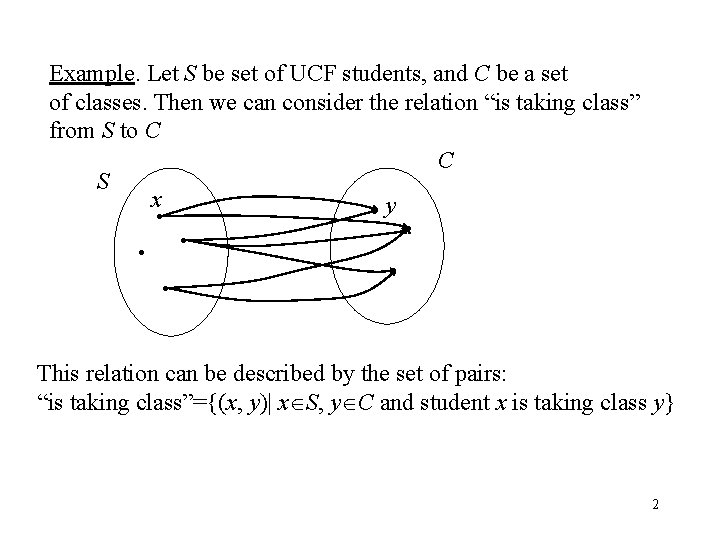
Example. Let S be set of UCF students, and C be a set of classes. Then we can consider the relation “is taking class” from S to C C S x y This relation can be described by the set of pairs: “is taking class”={(x, y)| x S, y C and student x is taking class y} 2
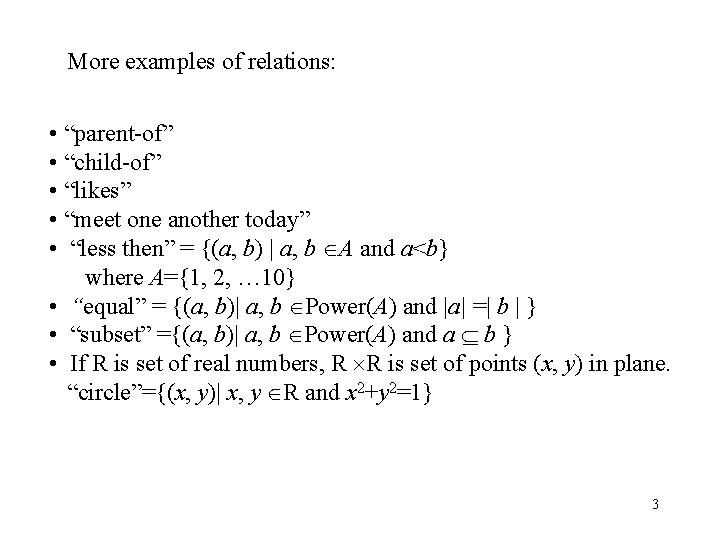
More examples of relations: • “parent-of” • “child-of” • “likes” • “meet one another today” • “less then” = {(a, b) | a, b A and a<b} where A={1, 2, … 10} • “equal” = {(a, b)| a, b Power(A) and |a| =| b | } • “subset” ={(a, b)| a, b Power(A) and a b } • If R is set of real numbers, R R is set of points (x, y) in plane. “circle”={(x, y)| x, y R and x 2+y 2=1} 3
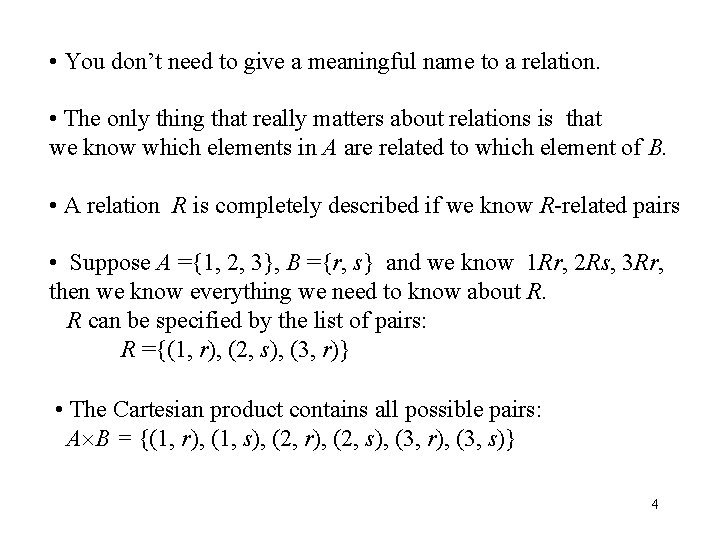
• You don’t need to give a meaningful name to a relation. • The only thing that really matters about relations is that we know which elements in A are related to which element of B. • A relation R is completely described if we know R-related pairs • Suppose A ={1, 2, 3}, B ={r, s} and we know 1 Rr, 2 Rs, 3 Rr, then we know everything we need to know about R. R can be specified by the list of pairs: R ={(1, r), (2, s), (3, r)} • The Cartesian product contains all possible pairs: A B = {(1, r), (1, s), (2, r), (2, s), (3, r), (3, s)} 4
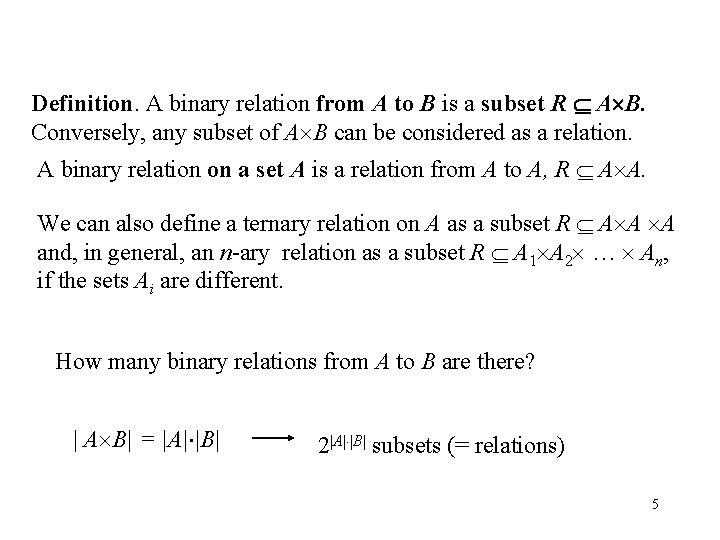
Definition. A binary relation from A to B is a subset R A B. Conversely, any subset of A B can be considered as a relation. A binary relation on a set A is a relation from A to A, R A A. We can also define a ternary relation on A as a subset R A A A and, in general, an n-ary relation as a subset R A 1 A 2 … An, if the sets Ai are different. How many binary relations from A to B are there? | A B| = |A| |B| 2|A| |B| subsets (= relations) 5
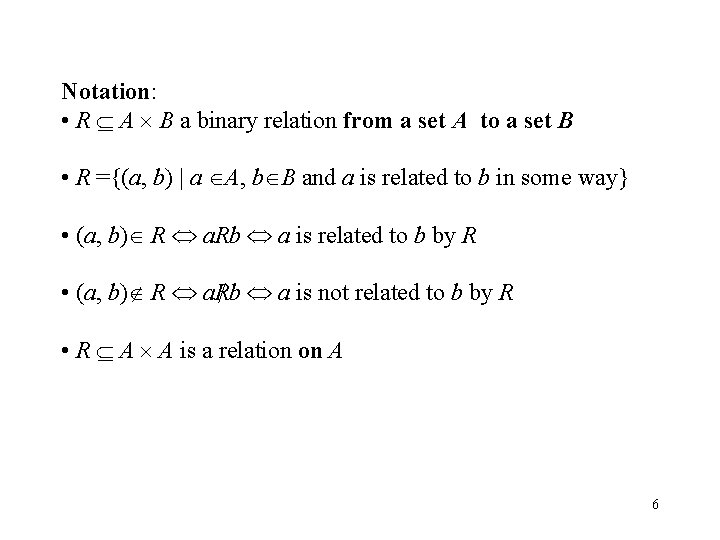
Notation: • R A B a binary relation from a set A to a set B • R ={(a, b) | a A, b B and a is related to b in some way} • (a, b) R a. Rb a is related to b by R • (a, b) R a. Rb / a is not related to b by R • R A A is a relation on A 6
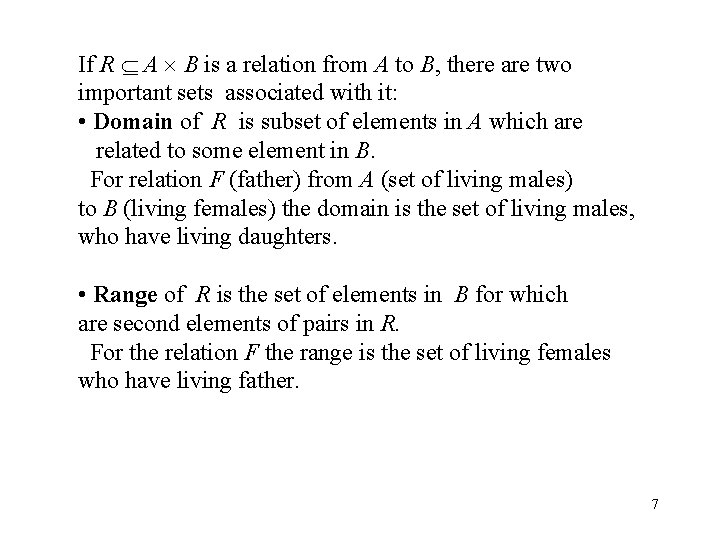
If R A B is a relation from A to B, there are two important sets associated with it: • Domain of R is subset of elements in A which are related to some element in B. For relation F (father) from A (set of living males) to B (living females) the domain is the set of living males, who have living daughters. • Range of R is the set of elements in B for which are second elements of pairs in R. For the relation F the range is the set of living females who have living father. 7
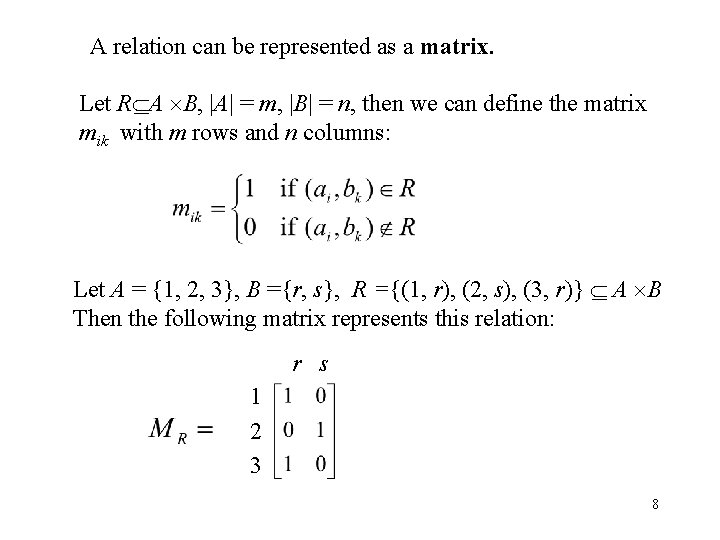
A relation can be represented as a matrix. Let R A B, |A| = m, |B| = n, then we can define the matrix mik with m rows and n columns: Let A = {1, 2, 3}, B ={r, s}, R ={(1, r), (2, s), (3, r)} A B Then the following matrix represents this relation: r s 1 2 3 8
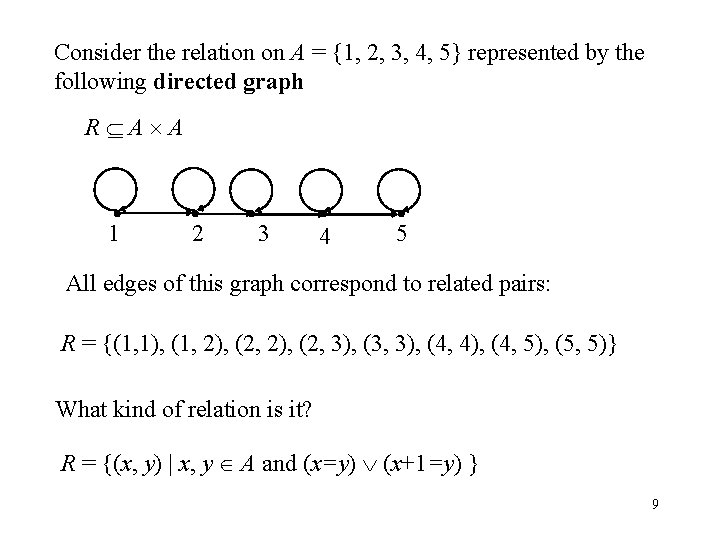
Consider the relation on A = {1, 2, 3, 4, 5} represented by the following directed graph R A A 1 2 3 4 5 All edges of this graph correspond to related pairs: R = {(1, 1), (1, 2), (2, 3), (3, 3), (4, 4), (4, 5), (5, 5)} What kind of relation is it? R = {(x, y) | x, y A and (x=y) (x+1=y) } 9
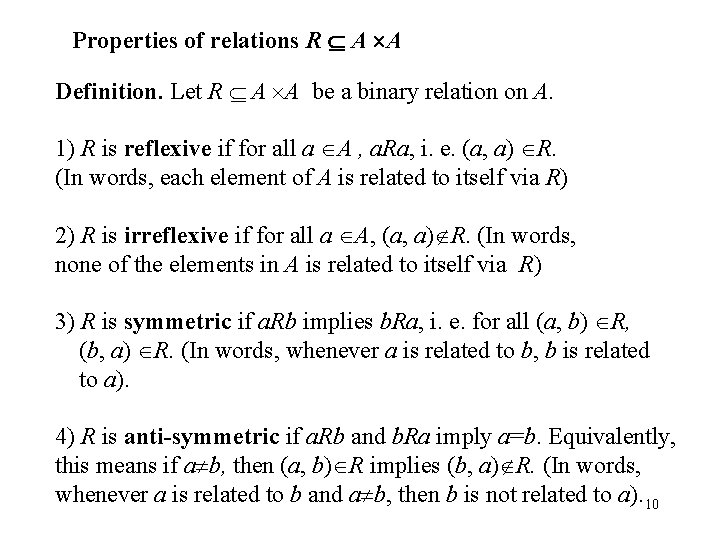
Properties of relations R A A Definition. Let R A A be a binary relation on A. 1) R is reflexive if for all a A , a. Ra, i. e. (a, a) R. (In words, each element of A is related to itself via R) 2) R is irreflexive if for all a A, (a, a) R. (In words, none of the elements in A is related to itself via R) 3) R is symmetric if a. Rb implies b. Ra, i. e. for all (a, b) R, (b, a) R. (In words, whenever a is related to b, b is related to a). 4) R is anti-symmetric if a. Rb and b. Ra imply a=b. Equivalently, this means if a b, then (a, b) R implies (b, a) R. (In words, whenever a is related to b and a b, then b is not related to a). 10
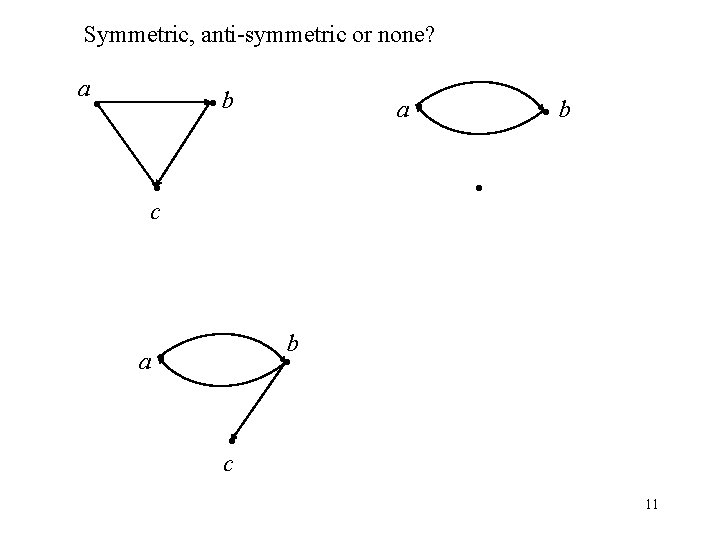
Symmetric, anti-symmetric or none? a b a b c a b c 11
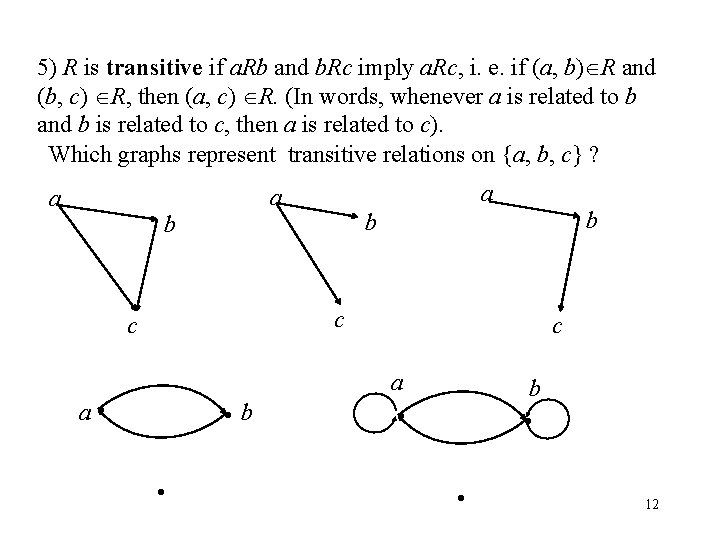
5) R is transitive if a. Rb and b. Rc imply a. Rc, i. e. if (a, b) R and (b, c) R, then (a, c) R. (In words, whenever a is related to b and b is related to c, then a is related to c). Which graphs represent transitive relations on {a, b, c} ? a a a b b b c c c a a b b 12
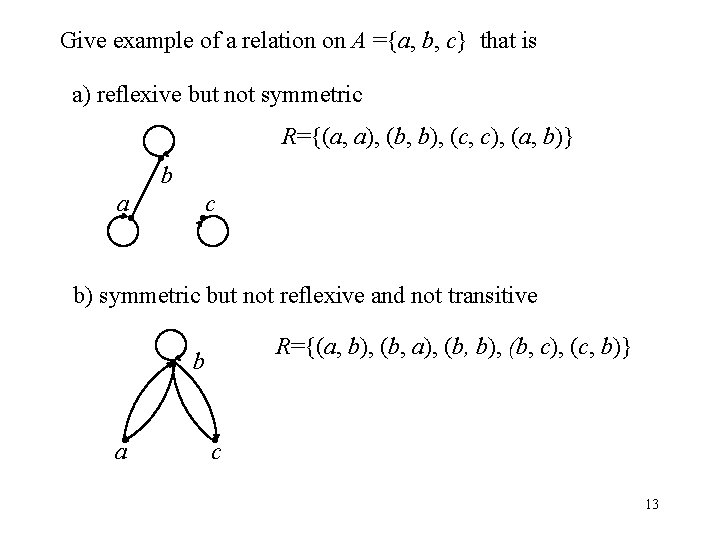
Give example of a relation on A ={a, b, c} that is a) reflexive but not symmetric R={(a, a), (b, b), (c, c), (a, b)} b a c b) symmetric but not reflexive and not transitive a R={(a, b), (b, a), (b, b), (b, c), (c, b)} b c 13
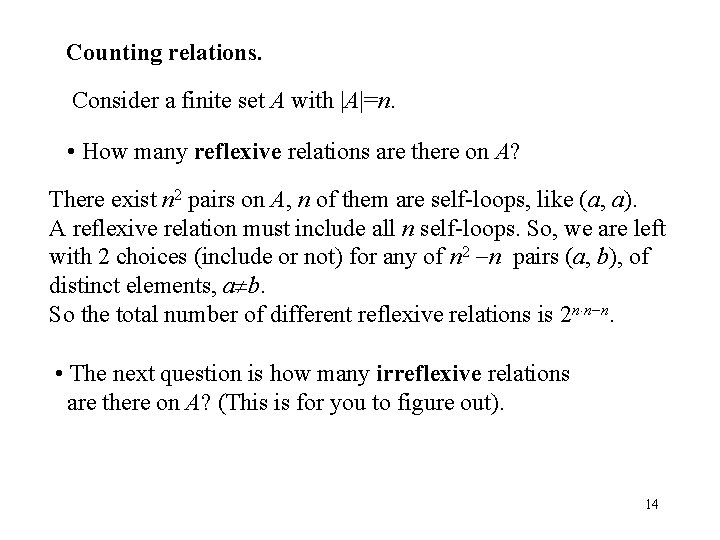
Counting relations. Consider a finite set A with |A|=n. • How many reflexive relations are there on A? There exist n 2 pairs on A, n of them are self-loops, like (a, a). A reflexive relation must include all n self-loops. So, we are left with 2 choices (include or not) for any of n 2 n pairs (a, b), of distinct elements, a b. So the total number of different reflexive relations is 2 n n n. • The next question is how many irreflexive relations are there on A? (This is for you to figure out). 14
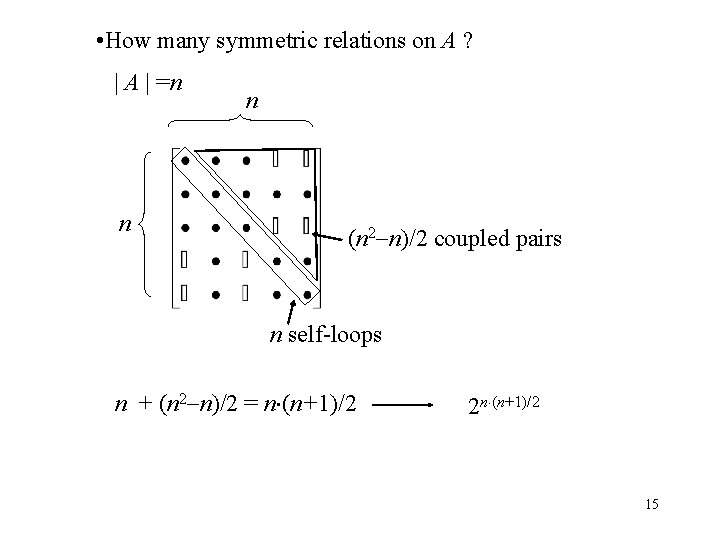
• How many symmetric relations on A ? | A | =n n n (n 2 n)/2 coupled pairs n self-loops n + (n 2 n)/2 = n (n+1)/2 2 n (n+1)/2 15
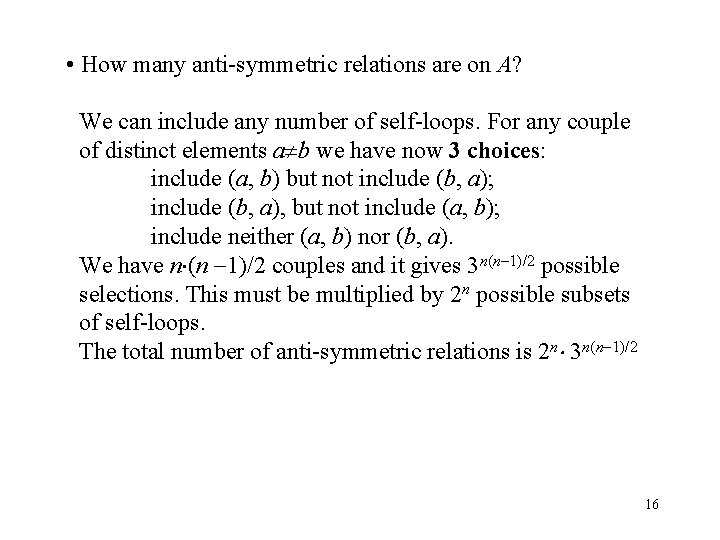
• How many anti-symmetric relations are on A? We can include any number of self-loops. For any couple of distinct elements a b we have now 3 choices: include (a, b) but not include (b, a); include (b, a), but not include (a, b); include neither (a, b) nor (b, a). We have n (n 1)/2 couples and it gives 3 n(n 1)/2 possible selections. This must be multiplied by 2 n possible subsets of self-loops. The total number of anti-symmetric relations is 2 n 3 n(n 1)/2 16
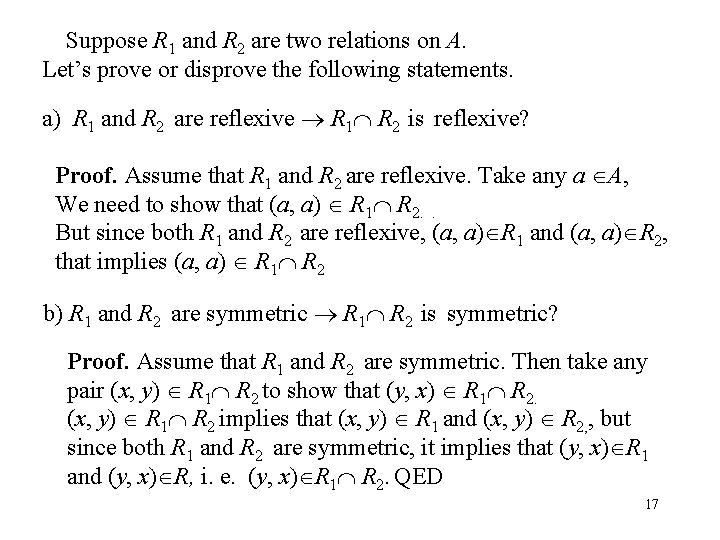
Suppose R 1 and R 2 are two relations on A. Let’s prove or disprove the following statements. a) R 1 and R 2 are reflexive R 1 R 2 is reflexive? Proof. Assume that R 1 and R 2 are reflexive. Take any a A, We need to show that (a, a) R 1 R 2. . But since both R 1 and R 2 are reflexive, (a, a) R 1 and (a, a) R 2, that implies (a, a) R 1 R 2 b) R 1 and R 2 are symmetric R 1 R 2 is symmetric? Proof. Assume that R 1 and R 2 are symmetric. Then take any pair (x, y) R 1 R 2 to show that (y, x) R 1 R 2. (x, y) R 1 R 2 implies that (x, y) R 1 and (x, y) R 2, , but since both R 1 and R 2 are symmetric, it implies that (y, x) R 1 and (y, x) R, i. e. (y, x) R 1 R 2. QED 17
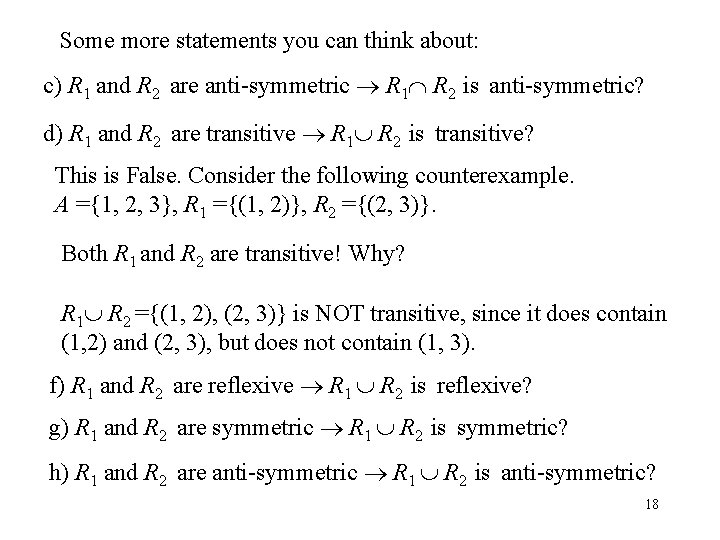
Some more statements you can think about: c) R 1 and R 2 are anti-symmetric R 1 R 2 is anti-symmetric? d) R 1 and R 2 are transitive R 1 R 2 is transitive? This is False. Consider the following counterexample. A ={1, 2, 3}, R 1 ={(1, 2)}, R 2 ={(2, 3)}. Both R 1 and R 2 are transitive! Why? R 1 R 2 ={(1, 2), (2, 3)} is NOT transitive, since it does contain (1, 2) and (2, 3), but does not contain (1, 3). f) R 1 and R 2 are reflexive R 1 R 2 is reflexive? g) R 1 and R 2 are symmetric R 1 R 2 is symmetric? h) R 1 and R 2 are anti-symmetric R 1 R 2 is anti-symmetric? 18