
A STREETCAR NAMED DESIRE Lecture 2 Thematic concerns
- Slides: 31
A STREETCAR NAMED DESIRE Lecture 2
Thematic concerns • Desire and Death • Blanche: “Take a streetcar named Desire and transfer to one called Cemeteries …and get off at - Elysian Fields!” p. 5 • How do the street cars embody the play’s interlinked themes of desire and death? • Streetcar – [mode of transport] - symbol of commerce and modern society. • Desire – refers to sexual desire but also to a need or longing ; a dream.
Death and Desire • Blanche’s opening line about disembarking from several conveyances – convey the idea of a journey. • And one of her last lines in the play pg 86, “I am only passing through” => suggests that the play builds its action around the image of an alienated, isolated wanderer seeking some kind of human connection. • It also suggests that Desire and Death are interlinked => that Desire will ‘inevitable’ lead to Death before one can reach the Elysian Fields. • How does the play convey the relationship between Death and Desire? And does Blanche ultimately reach the ‘Elysian Fields’ at the end of the play?
Death and Desire • Some ideas about Desire: • Blanche tells Mitch that ‘the opposite [of Death] is Desire’ pg 74 - that she used Desire to stave off Death and to fill the emptiness of her broken heart. • Desire made her feel ‘alive’ when she was surrounded by death and guilt in Laurel. • Desire was not enough – only a transitory pleasure – temporary respite – to assuage her pain and forget her past. • Desire [Sex] – is also the play’s great leveler. Both Stanley and Blanche ride the streetcar but for different reasons. For Stanley, sex is natural – a necessary function of life that gives him power and the ‘admiration’ of women – he holds Stella in a sexual thrall. Blanche is looking for physical ‘closeness’ as a substitute for emotional intimacy.
Death and Desire • Desire is the common ground on which Both meet and are judged. Blanche as a ‘whore’ by Stanley and Stanley as an ‘apish’ man by Blanche. • Both are right and wrong – Right in the light of ‘truth’ but wrong in the light of ‘understanding’. Blanche and Stanley’s behaviour stem from psychological needs / fears that both avoid facing. • How does Desire affect the other characters? • Stella as ‘star’ has plummeted down to the earthly. She has accepted the physical as a necessary component of the spiritual and Desire as normal has liberated her – BUT perhaps only to enslave her in a different way.
Death and Desire • She is content to be the ‘little woman’ and is a captive ‘worshipper’ at the altar of her husband – ‘there are things that happen between a man and a woman in the dark …. seem unimportant” pg 39 -40 • How long is Stella content with this kind of relationship in the play? What does the ending suggest of Stella and Desire? • Mitch – is like Stanley in his desire. Outwardly the gentleman, he has pent up desires that draw him to Blanche. His attempted ‘rape’ of Blanche foreshadows Stanley – just as his tearing away of the paper lantern is a violation of Blanche. • He represents a different kind of male but ‘crippled’ by societal norms and values.
The Desire and Dream for a Better Life • What do the characters in both plays desire or dream for? • What does Blanche/Stella/Stanley/Mitch desire? • Blanche dreams of a better life not unlike the immigrants who have come to Elysian fields. • She desires more than sexual companionship…she desires a respectable life - human dignity and reputation are also key concerns in Othello – Iago strips Othello of his dignity and his reputation…he hides behind the curtain of shame after he murders Desdemona. • Like Othello in his guilt, Blanche avoids a strong light like a moth p. 5
The Desire and Dream for a Better Life • Blanche longs for salvation and redemption. She longs for intimacy and a life of art and the imagination. • At the very fundamental level – a job – Blanche has to struggle to survive – she is penniless. • Her past though is a liability to herself. She struggles to free herself from the past and ‘still’ the sounds of the polka and gunshot in her mind. To what extent is Othello’s past presented as a liability to himself? • Stella? – she has settled for a stable, physically vibrant life – she seems able to put the past behind her.
The American Dream? • James Truslow Adams coined the phrase the American dream in his book ‘The Epic of America’, • which is “that dream of a land in which life should be better and richer and fuller for everyone, with opportunity for each according to ability or achievement… • It is a dream of social order in which each man and each woman shall be able to attain to the fullest stature of which they are innately capable, and be recognized by others for what they are, regardless of the fortuitous circumstances of birth or position”
The American Dream? • Stanley’s materialism/greed and determination to make sure he get what’s rightfully his - corresponds to the American dream – so does his demand that he is respected in his own home regardless of his uncultured behaviour and background. • Stanley also desires to protect his home / lifestyle from the interloper Blanche. • But there is also a sense of dissipation and decay among the men who indulge themselves in alcohol and women – to assuage their own sense of failure and limited lives. => failure of the American dream?
The Great American Dream • May strip man of his humanity and dignity in spite of the promise of the great American Dream. • Suggests perhaps that the desire, the dream comes at a cost.
Clash of Cultures • Conflict between the old and the new: • Urbanisation and industrialisation has led to commodification and alienation. • Urbanisation =>>gradual removal of the individual from rural community into urban isolation • Industrialisation =>focus of production has deflected from the human being, making him a minor part of the process causing => displacement, alienation, despondency and finally despair in workers. • Blanche and Stanley represent different cultures in conflict with each other. The genteel South versus the new modern society.
Stanley Kowalski Embodies the Paradox of the new urban life • Stanley Kowalski is a symbol of the new urban life: he is also portrayed as having a raffish charm; his crude ways are engaging and even attractive • But his actions are brutal and devoid of humanity as he violates Blanche sexually – “emblem of a gaudy seed bearer” p. 14 • His detachment and his lack of sympathy is evident as he strips the paper lantern to expose Blanche: stripping her of all her dignity in a final blow as she gets booted out of the Kowalski household. p. 87 • Blanche : “…. we need to mix our blood now that we’ve lost Belle Reve” p. 23 => an acknowledgement of the vigour and drive that the South may have ‘lost’.
Yet, Stanley has a force of character which has been interpreted as excitingly life-giving on the one-hand, and brutally destructive on the other The child of immigrants, he is the new, untamed pioneer, who brings to the South, Williams seems to be saying, a power more exuberant than destructive, a sort of Power that the South may have lost. (J. H. Adler, in Tennessee Williams, A tribute, p. 41)
Stage directions: Old vs New • The street is bounded by the famed river of old that once transported people and goods westward and the newer mechanized means of transportation associated with the captains of industrial age. “runs between L&N tracks and the river” pg 3 • The two storey building partakes of the same mix of old and new, of tradition and grace wearing down eg Now ‘weathered grey’ => it retains enough architectural touches from the past “ the quaintly ornamented gables” to evoke the decaying condition of Belle Reve – the old Dubois ancestral home that symbolizes the cavalier South in decline.
Alienation: • Is the alienation real or perceived, psychological or due to societal forces? • How are characters alienated? • To what extent do individuals have control over their lives?
alienation from own communities? alienation from closer connections, including family and loved ones? alienation by religious institutions? alienation from God himself? most extreme form of alienation lies in those who feel alienated from everything: family, society, and the whole of modern life?
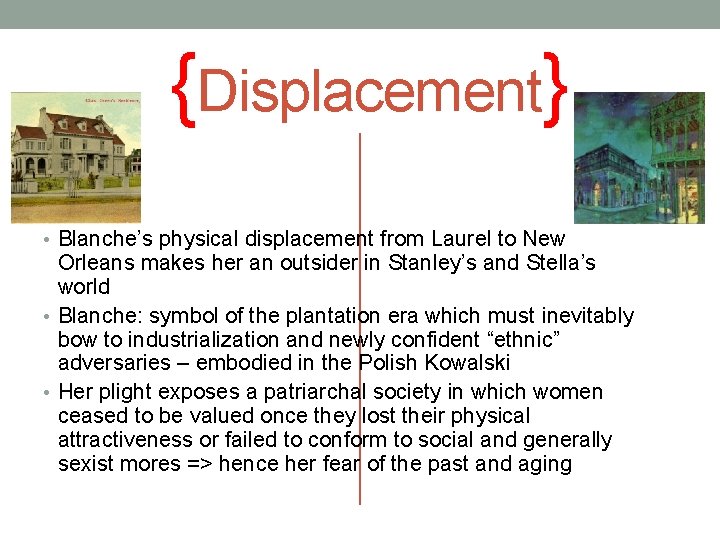
{Displacement} • Blanche’s physical displacement from Laurel to New Orleans makes her an outsider in Stanley’s and Stella’s world • Blanche: symbol of the plantation era which must inevitably bow to industrialization and newly confident “ethnic” adversaries – embodied in the Polish Kowalski • Her plight exposes a patriarchal society in which women ceased to be valued once they lost their physical attractiveness or failed to conform to social and generally sexist mores => hence her fear of the past and aging
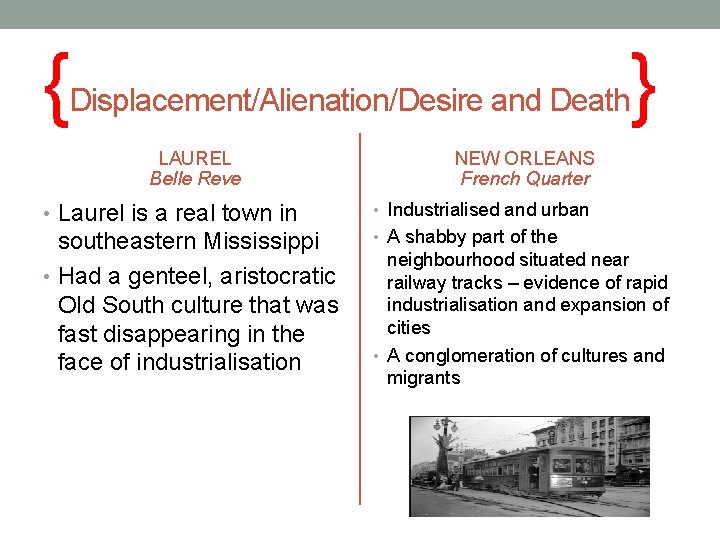
{ } Displacement/Alienation/Desire and Death LAUREL Belle Reve NEW ORLEANS French Quarter • Laurel is a real town in • Industrialised and urban southeastern Mississippi • Had a genteel, aristocratic Old South culture that was fast disappearing in the face of industrialisation • A shabby part of the neighbourhood situated near railway tracks – evidence of rapid industrialisation and expansion of cities • A conglomeration of cultures and migrants
Entrances - Contrast • Stanley enters only to leave almost immediately. • This technique serves to create a vibrant 1 st impression that is • • contrasted agst Blanche. Stanley belongs to the Quarter – its open and unpretentious style and its gutsy and sizzling life becomes him. Dressed in denim and bowling jacket, he struts in as the macho owner and controller of the scene – bellowing for his wife. He throws her blood stained meat package an action that vulgarly announces his manhood and his pride in it. The onstage audience – feigns approval; actually ‘thrilled’ by such displays – the 3 women laugh joyously – a signal to the audience. We too are swept up by S’s selfassuredness and easy good humour.
Entrances - Contrast • Stanley enters in power and glory but Blanche enters wan and defenseless. • Her unmannerly curtness and refusal to enter into the continual party that is typical of life in the French Quarter costs her the approval of her neighbor. • She is out of place and ill at ease not only becos of her demeanor and refinement but because of her high strung emotional and psychological state as well. • Next to Stanley’s swaggering masculinity, she is the frightened, nearly hysterical moth seeking protection and safety.
Blanche’s alienation • Scene 1: • Aware of social distinctions [note interaction with Eunice and • • neighbour’s acts] Pretentious: Vanity, need of flattery Pathos: fear of ageing, vulnerability Awareness of social distinctions: Monosyllybalic responses to Eunice and the Negro woman Blanche [wanting to get rid of her] Awareness of Stella’s apparent social regression: Eunice [defensively, noticing Blanche’s look]: It’s sort of messed up right now but when it’s clean it’s real sweet. Blanche: Is it?
Blanche’s alienation • Blanche: represents the dying aristocratic culture, an upper class that threatens Stanley’s role as patriarchal head. • Stanley: embodies a crude, lower class which threatens her class superiority • Essentially, in conflict with each other on almost every level • Yet, there is a certain baser, animal attraction between each other “there is such a thing as the hostility of – perhaps in some perverse kind of way he …. ” pg 55 • Predator/Prey model would work, but is also complex
Language • It is through her dialogue that B underlines her manor- born superiority. • She introduces cultural references – eg edgar allan poe ‘s story – Ulalume “ghoul haunted woodland of Weir” pg 8 • Recognizes that the lines from Mitch’s cigarette belongs to Mrs Browning. She also mentions Hawthorne and Whitman and calls the newspaper boy “a young prince out of Arabian nights” pg 49 • She also uses correct grammar and varied syntax. Her vocabulary contains Latinisms such as ‘heterogeneous’, ‘judicial’, transitory’, etc
Language • Also uses metaphors poetically => but they are stale or incongruous eg ‘a cleft in the rock of the world that I could hide in’ pg 73 – compares her past to ‘an old tin can on the tail of a kite’ pg 73; of her soldier friends – ‘paddy wagon would gather them up like daisies. ’ • Even her husband’s death is disclosed with ‘pretentious’ imagery => ‘and then the searchlight which had been turned on the world was turned off again and never for one moment has there been any light that’s stronger than this kitchen candle’ pg 57 • her hope for stella’s baby is => it will have eyes like ‘ two blue candles in a white cake’. Pg 66 Related but not functionally linked.
Language • When she tries to be uplifting, her images are stale. In scene 4, Seeking to inspire stella, she becomes trite and abstract – “ there has been some progress since then! Such things as art – as poetry and music- such kinds of new light have come into the world since then” pg 41 • To Stanley she can only summon the cliché phrases of popular magazines – “but the beauty of the mind and richness of the spirit and tenderness of the heart – and I have all those things – aren’t taken away, but grow. ’ pg 78=> Blanche is trapped in the poverty of her imagery which in turn reflects the poverty of her dreams.
Language vs action • Visually and verbally, Stanley is opposed to Blanche. ‘hey there! Stella, Baby! Catch! Meat!” • Monosyllabic, primitive cave man? => Stanley has trained stella to catch his meat in every sense of the word. • Stanley’s physicality contrasts with B’s ready verbalizations. His actions are cruel and rough – tossing meat, slapping stella, rifling through her clothes. Whereas blanche is marked by nervous talk.
Fantasy vs Reality • Blanche: Her leaving Belle Reve for New Orleans is symbolic of escape. A Flight from harsh reality to fantasy in the landscape of the mind. • When Stanley defies her to make her face the facts in scene 7, she replies in words that help define her => “ I don’t want realism. I want magic!. . I try to give that to people. I misrepresent things to them. I don’t tell the truth, I tell what ought to be truth. And if that is sinful, then let me be damned for it. ! “ P 145 • Blanche is also like an actress in a play that she first authors and then produces and directs. • She treats the apartment like her theatre, altering the décor to make it almost ‘dainty’ p 104.
Blanche creating reality out of fantasy • When Mitch joins her in scene 6, she becomes set decorator, lighting a candle in a wine bottle to foster the make-believe that they are sitting in a romantic Bohemian café on the Parisian Left Bank. – that they are Camille and Armand in Alexander Dumas’ famous play. • Blanche carries her own costumes and props in her trunk including the make up powder and gossamer scarf that causes her to shimmer and glow. Eg “rhinestone tiara” that she wore to a costume ball.
Fantasy vs reality • Blanche adopts a succession of shifting social roles and masks. • As Stanley says ‘she puts on her act’ => • we see Blanche play the demure lady, offended by any display of sensuality in scene 1, • the carefree flirt of scene 2 • the more determined seductress in scene 3.
A life restored, through a new reality? • At the end, Williams indicates/suggests that the psychic and physical violence done to B atones her guilt and reasserts her gallantry. • She emerges radiant, clothed in a Della Robbia blue jacket – the blue of the robe in the old Madonna paintings. • With the ringing of the cathedral bells and the grapes – Eucharistic wine – “cleansing blood”. B leaves a violated Madonna but blessed by whatever saving grace insanity or illusion can provide.