A STREETCAR NAMED DESIRE INTRODUCTORY LECTURE THE PLAY


- Slides: 28
A STREETCAR NAMED DESIRE INTRODUCTORY LECTURE
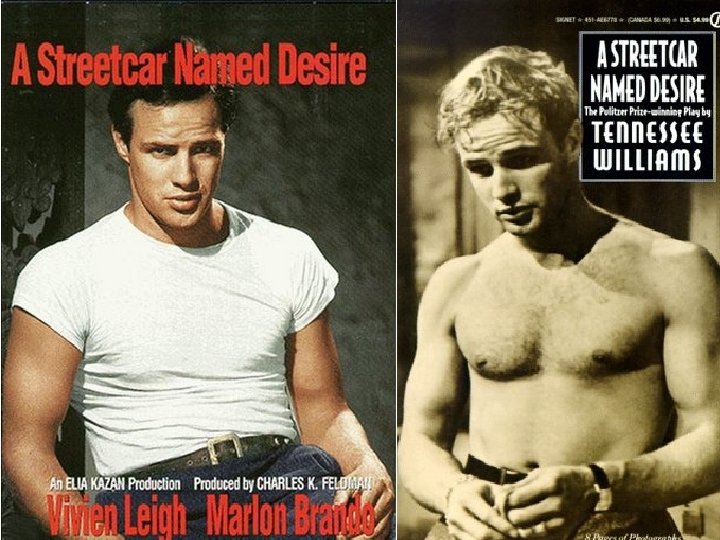
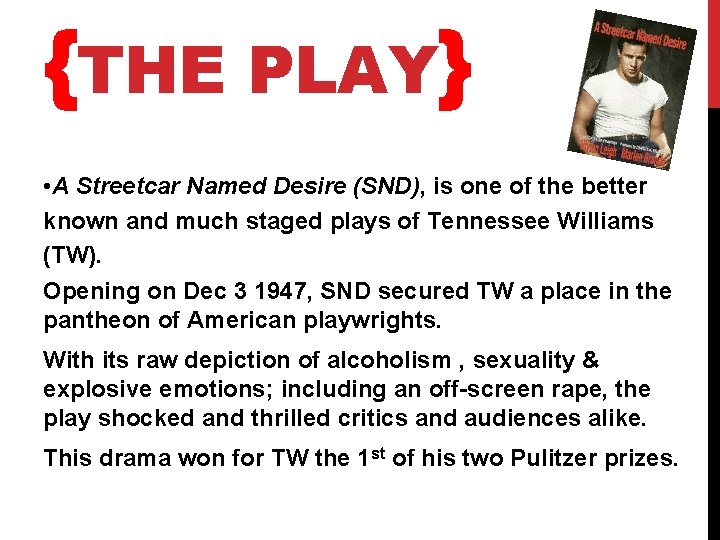
{THE PLAY} • A Streetcar Named Desire (SND), is one of the better known and much staged plays of Tennessee Williams (TW). Opening on Dec 3 1947, SND secured TW a place in the pantheon of American playwrights. With its raw depiction of alcoholism , sexuality & explosive emotions; including an off-screen rape, the play shocked and thrilled critics and audiences alike. This drama won for TW the 1 st of his two Pulitzer prizes.
{ } THE PLAY • Set in New Orleans, Louisiana, shortly after World War II, the play explores the plight of impoverished Southern gentry and the rapid changes of Southern society in the industrial age. Williams also turned to his personal life for the subject matter of his plays, …and yet there is a certain universality about his plays, for they aptly depict the shattering of the American Dream and its effect on the American people.
{SOCIAL CULTURAL CONTEXT} Published in 1946, A Streetcar Named Desire reflects the cultural tensions that pervaded the nation after the horrors of World War II. The 1940 s – “the mood of the decade was one of fear, terror, uncertainty, violence mingled with the sad satisfactions and a relief at victory” ‘Fiction of the 40 s’ Prof Chester Eisinger. Idealistic and ambitious America had just vanquished the Nazi threat but now faced the fear of the bomb and of the government. Fear of a nuclear holocaust fuelled by Cold War paranoia and xenophobia in the face of the communist threat.
{SOCIAL CULTURAL CONTEXT} The nation had suffered through a terrible war, and it was ready to embrace the "old-fashioned" values of family and home. National spotlight focused on the middle and lower classes as the true bearers of the heroic American spirit. Young men who had served in the war returned to their families and were ready to settle down - with wives, with children, and with steady jobs. Eg Stanley and his soldier buddies – returning to the Elysian Fields after a ‘victorious battle’ to make a home for themselves.
{SOCIAL CULTURAL CONTEXT} The shifts in social class as a result of the Great Depression in the 1930 s and increased industrialization in the wartime economy of the 40 s, made people feel a sense of dislocation. Their resulting search for belonging and connection led them to look to the past to discover some stability. Urbanization and Industrialization also brought increasing dehumanization => found reflection in the lit and art of the time with their themes of ‘the quest for identity’ and ‘the alienation of man from the self and from society. ’
{SOCIAL CULTURAL CONTEXT} • TW also reflects concern with identity, alienation and isolation in Streetcar. • Play also looks fleetingly at the returning soldier who must be re-integrated into the work force. • Veterans face jobs that were often unrewarding and a society that was not doing a great deal for those who served. • Their lives appear closer to drudgery than reaping the benefits of the American dream.
{SOCIAL CULTURAL CONTEXT} Play also champions a certain nostalgia for the old Southern charm that had been replaced during the 1940's by an air of industry and efficiency that had taken over the values of aristocracy and chivalry. The decline of the once influential families began when the South’s agricultural base could not compete with the new industrialization. The old tradition of an agrarian family aristocracy ruled by men came to an end. The ongoing power struggle between Blanche and Stanley thus reflects the battle between old Southern values and new industrial efficiency.
GIST OF THE STORY • Set in New Orleans, SND tells the story of the colossal and ultimately disastrous culture clash between Blanche Dubois , a fragile, aging Southern Belle prone to drink and mendacity and Stanley Kowalski, her brutally masculine blue collar worker brother-in-law. • Stella Kowalski forms the 3 rd point of this human Bermuda Triangle. • NB: As with many of Williams’ plays, SND contains overt and subtle autobiographical elements. Williams, who was openly homosexual and struggled with alcoholism and depression, was much like his protagonist Blanche.
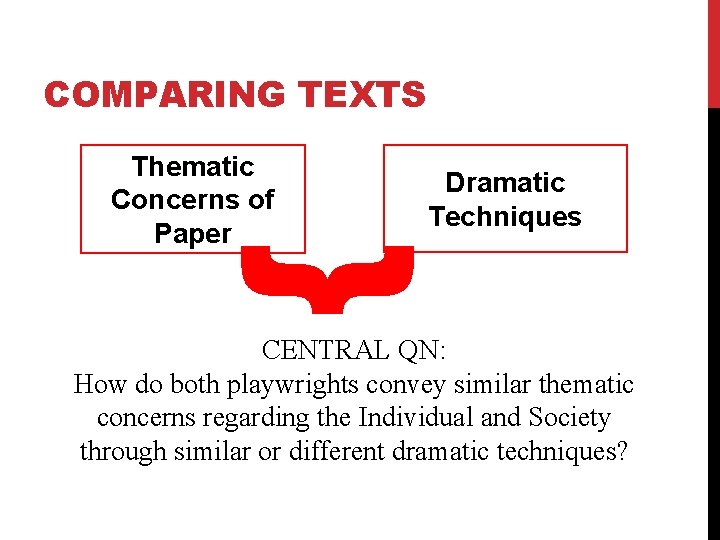
COMPARING TEXTS Dramatic Techniques { Thematic Concerns of Paper CENTRAL QN: How do both playwrights convey similar thematic concerns regarding the Individual and Society through similar or different dramatic techniques?
{KEEP IN MIND} When comparing and contrasting texts: • Ideas, issues, themes • Representation of the Individual and the Society • Dramatic techniques: similarities & differences [eg. Similar or different use of stage directions, metaphors, imagery, allusions, music etc] - Effects of these techniques: how similar, how different…?
STRUCTURE • SND is a one-act play with 11 scenes. • It is a tragedy, a serious domestic drama in which the problems or flaws of the central characters lead to an unhappy or catastrophic ending. • Each scene can be studied as a contained unit and most end on a note of tension or suspense. • Structural Flow: “ the first 4 scenes are comedy, then come two scenes of elegy, mood, romance; then 5 scenes of tragedy” – actress Roxana Stuart who played Blanche. • Director Elia Kazan => “what Blanche wants, makes happen and has happen to her. ” • Others suggest the scenes are split by sympathies for Stanley and then for Blanche.
STRUCTURE Classic dramatic tragedy – outlined by Aristotle is unified by place, time and plot. This means the story is set in a single location, within a discrete time period and built around a series of actions that pertain to a single, central plot. SND fits the standard parameters of a dramatic tragedy: => the Kowalski apartment where all the onstage action takes place, provides the unity of place. =>The story develops chronologically over the course of a few months – creating unity of time.
PLOT • There is only one plot – i. e. the conflict between Stanley and Blanche. • Stella and Mitch serve to complicate the plot but they do not have separate storylines of their own. • Minor characters Eunice and Steve Hubbell, serve only to echo the relationship of Stanley and Stella.
REALISM VS THEATRICALITY William’s “theatre of gauze’ – which plays unabashedly with the conventions of the stage – to make the audience more self-conscious of the play - going experience and thus give ‘truth in the pleasant disguise of illusion’. In SND, he combines elements of theatrical staging with verisimilitudinous plots and characters. In order to gain sympathy for a character on the brink of a breakdown, he depicts the character from within and without, providing both an objective and subjective view of the character.
STAGING • the symbolic devices in the staging not only help the audience to understand the emotional penumbra surrounding events and characters but also to view the world from the limited and distorted perspective of Blanche. • The setting, lighting, props, costumes, sound effects and music along with the play’s dominant symbols, the bath and the light bulb, provide direct access to the private lives of the characters.
STAGING • To show the relation between the decadent New Orleans street life and the events inside the Kowalski apartment, TW asked that the back wall of the apartment be made of gauze to permit, under proper lighting, a view of the city alley. • This wall becomes transparent in the rape scene => illustrating the destruction wrought by the intrusion of an external reality and suggesting that Blanche is brought fully into Stanley’s world – by sex.
STAGING • TW also uses costuming , props and lighting to convey the emotional strength of the characters. • Overwrought and emotionally drained, Blanche wears pastel colours in half lights. • Stanley as the ‘richly feathered male bird’ wears vivid primary colours under strong garish lights. e. g. His red silk pyjamas and his bright green bowling shirt
MUSIC & ATMOSPHERE • Music and other sounds also communicate a sense of the electable primitive forces that operate in the French Quarters. • From the ‘ 4 deuces’, come the sounds that express the life of New Orleans – blues, jazz, honky tonk. • The Varsouviana polka – is the only music that Blanche and we the audience can hear – subjectively leads us into the interior world of Blanche. • The music associated with her husband’s death also becomes the music of impending disaster.
MUSIC, ATMOSPHERE & CHARACTERISATION ‘the blue piano’ => the blues is an expression of the loneliness and rejection the exclusion and the isolation of the Negro and their longing for love and connection. Blanche too is looking for a home; abandoned and friendless. Thus the blue piano catches the soul of Blanche => the miserable human side of the girl which is beneath her frenetic duplicity, trickery lies, etc… Blues piano plays whenever Blanche recounts the deaths at Belle Reve and when she is led away to the asylum. In contrast, the uncomplicated, obtrusive rhythms of the Honky tonk express Stanley’s personality.
KEY SYMBOLS Williams structures SND using a vast network of imagery / SYMBOLS arranged in patterns of opposition. 1. PAPER LANTERN VS THE LIGHT BULB: Blanche, hypersensitive to her declining physical beauty, can’t stand being seen in bright light. She covers the glare of harsh reality with a patina of illusion that shows her off under a favourable glow. Blanche’s condition is as fragile as the easily destructible paper lantern The paper lantern is not only a symbol of her vulnerability and subjugation to time’s decay but also a symbol of the imaginative or creative act that temporarily protects her from the grimness and cruelty of reality. When Mitch and Stanley tear off the lantern, they are attacking Blanche herself and destroying her world of illusion/art.
KEY SYMBOLS For Blanche, there exists an order higher than what is merely factually true BUT for Stanley, the merciless light of unvarnished reality, exposing everything for what it is is the ONLY truth he will or can recognize.
KEY SYMBOLS Dressing – Blanche is like an apparition in white – she wears soft material in pastel shades throughout most of the play. The white suggests purity – her astrological sign is Virgo – the Virgin – which she desires to restore. Water is used to purify her spirit and to calm her frazzled nerves. She also looks forward to the cleansing bright blue sea to receive her in death. What surrounds her must be soft and soothing. She replaces the music of the polka with the ‘pure’ cathedral bells.
KEY SYMBOLS B’s hogging of the bath – is an aspect of the visiting in-law joke => so is Stanley’s bursting bladder – adds humour. Her obsessive bathing is a nominal gesture of guilt and wished-for redemption. Her bathing is an escape mechanism. Ritual cleansing restores her to a state of former innocence. Once again she is young and pure in a beautiful world. In the scene where Stanley reveals Blanche’s sordid past, B’s song in the bath asserts the capacity of the imagination to transform mere facts. Two B’s are counterpoised- Stanley’s revelation and B’s presentation of herself (Pg 60 – an ‘innocent child’. c/r scene 7. )
BLANCHE She is also ‘tigress’ and seductress, as her red satin robe suggests. Her inability to accept the coexistence of these opposite inclinations is at the root of her psychic difficulties. Blanche wants to be a creature of culture, refinement and gentility. She uses her poetic and imaginative faculties to re-create a charmed world. BUT Belle Reve and the idealized South that it stands for is a thing of the past if it even existed at all. => her efforts to re-establish the past are doomed.
STANLEY His universe thrives on bright bold colours the green and scarlet bowling shirts, the red silk pyjamas, the ‘coloured’ lights of sexuality – that help parade and show off his pure physicality – his sign is Capricorn – the goat. The pulsating rhythms of jazz, drums and trumpet are his.
STANLEY • Crude jokes, beer and poker parties replace poetry in his world of facts, a practical universe in which fantasies are lies that have the potential for revealing truths of the heart and spirit. • He is a creature of the North – a traveler peddling products from a factory assembly line – he represents an urban mechanized culture that measures the value of a thing only by its material usefulness.