
Lecture 4 Plot Analysis of Othello and The




- Slides: 57
Lecture 4 Plot Analysis of Othello and The Streetcar Named Desire
Plot Analysis How does the movement of the plot provide insightful explorations into: • the interactions between individuals and their societies • the significance of the relationships • the nature of the conflicts How are individual roles defined and developed in the play through the movements in the plot? • How do complications in the play help with the development of themes and characters? • In the final analysis, does the individual transcend society? Does the individual conform to society? Does the individual rebel against society?
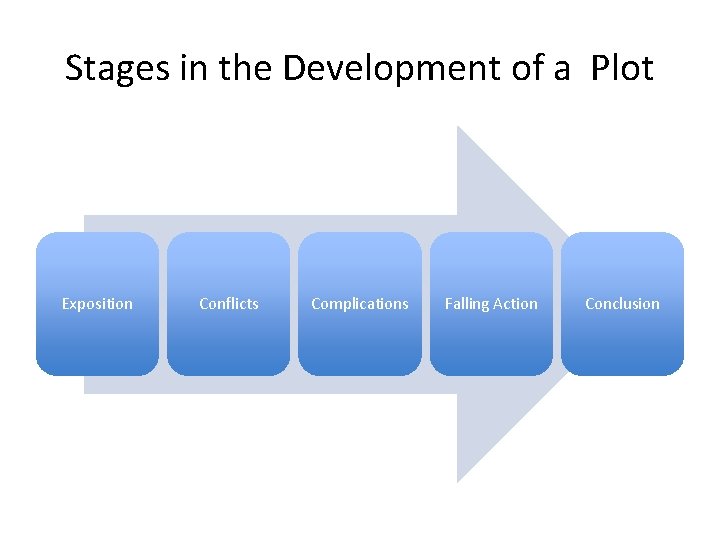
Stages in the Development of a Plot Exposition Conflicts Complications Falling Action Conclusion
Exposition • Initial Situation – Hope in the form of a dream for a better life • Stage directions create atmosphere of hope for a better future • Early interactions between individuals suggest harmonious co-existence: easy intermingling of the races etc • Early interactions between Stella and Kowalski similarly suggest a harmonious co-existence. He throws she catches the meat etc • Introduces gender politics in which men call the shots and women delight in obedience
Conflict – Sense of Displacement and Fear of Alienation • Blanche arrives • The playwright presents immediate physical incongruities between Blanche and her surroundings • Blanche comes around the corner, carrying a valise. P. 4 Her expression is one of shocked disbelief • Her first conversation with Stella hints at secrets she’s trying to hide. • And her first encounter with Stanley is wrought with tension, sexual and otherwise. • Inner conflict – awareness of public image and private issues – shame and guilt
Conflict with Ways of the New World (p. 4) • “Her appearance is incongruous to the setting – prepares audience for the clash of cultures. She is daintily dressed white suit, fluffy bodice, necklace and earrings of pearl white, white gloves, - looking as if she were arriving at a summer tea or cocktail party in the garden district. ” • “Her delicate beauty must avoid a strong light. Uncertain manner…white clothes that suggests a moth.
Inner Demons and Conflicts p. 6 • Blanche sits in a chair very stiffly…legs pressed close together…hands tightly clutching her purse…as if she were quite cold • Blind look …slowly looks around • Cat screeches – signifies the hostility and fierceness of the new world • Startled gesture – deepening sense of alienation • Removes a whisky bottle – pours a half tumbler of whisky and tosses it down – p. 7 you must have liquor on the place shaking all over …panting for breathe…where is ___? • She carefully replaces the bottle and washes out the tumbler • Blanche’s compulsive drinking, washing and bathing…signify her desire to escape the demons of her past and wash off her sins and start a anew
Conflict – tensions are subtle • First encounter with Stanley is wrought with tensions that arise out of social differences and Stanley’s sexuality. “Drawing involuntarily back from the Stanley’s stare” p. 14 (Stanley’s stare is similar to the glare of the light) “Where you from, Blanche? ” “Why I - live in Laurel. ” “In Laurel, huh? Oh, yeah. Yeah, in Laurel, that’s right. Not in my territory. Liquor goes fast in hot weather… Have a shot? (he engages her in superficial civilities) “No, I --rarely touch it. ” (Blanche seeks social approval) “Some people rarely touch it but it touches them often” (humour at Blanche’s expense – funny? ) “Ha! Ha!” (nervous laughter) “You are a teacher aren’t you? ” (condescending tone? ) “English” “I never was a very good English student…” • Stanley appears not to bother about what she thinks. Signifies perhaps that English Literature has lost its place and importance in this Brave New World • Power dynamics obvious in the initial interactions.
Veneer of civility • Stanley observes a veneer of civility in spite of his crude language S: You going to shack up here? B: I thought I would if it’s not inconvenient for you all. S: Good. (non committal reply) B: Travelling wears me out S: Well, take it easy.
Prepares us for Conflict • “I’m afraid I’ll strike you as being the unrefined type…You were married once, weren’t you? ” (class differences leading to conflict) The music of the polka rises up, faint in the distance • Yes. When I was quite young. • What happened? • The boy- the boy died. (She sinks back down) I’m afraid I’m going to be sick! Her head falls on her arms (End of Scene 1)
Effeminate Culture vs Masculine Libido • The Old World is presented in the play as one that embodies an effeminate culture while the new world is characterised as Masculine Libido. • The Old World as represented by Blanche is presented as one that is affected, over-refined and ineffectual just like “Her appearance is incongruous to the setting – prepares audience for the clash of cultures. She is daintily dressed white suit, fluffy bodice, necklace and earrings of pearl white, white gloves, - looking as if she were arriving at a summer tea or cocktail party in the garden district. Her delicate beauty must avoid a strong light. Uncertain manner…white clothes that suggests a moth.
The New World and Masculine Libido • The Old World is characterised by Stanley, the virile new man – relevant, hardworking and a brutal force for the brave new world. “Stanley is strongly and compactly built – there’s nothing extraneous or superfluous about Stanley, he is made for the ways of new industrial world. The adjectives in animal joy, rough humour, gaudy seed bearer and crude images present him as an iconic/cameo character. He is a picture of a crude but potent force – a main driver in this brave new world.
Effeminate Culture vs Masculine Libido • The conflict between Blanche and Stanley allegorizes the struggle between effeminate culture and masculine libido (Brustein, Robert, America’s New Cultural Hero, 1958) the virile new man – relevant, hardworking and brutal force for the brave new world and the effete aristocracy – affected, over-refined and ineffectual • Stanley has been described as a 20 th century Pan-Dionysus – a modern embodiment of the ancient spirits of anarchic sexuality and the pursuit of pleasure, capable of impulsive cruelty to those who try to censor or confine them…How far do you subscribe to this view since he belongs to the working class. Is he a man of excesses? • Dionysus was the god of fertility and wine, later considered a patron of the arts. He invented wine and spread the art of tending grapes. He has a dual nature. On the one hand bringing joy and divine ecstasy and on the other brutal, unthinking, rage
Conflict of Values • Conflict between traditional values: an old world graciousness and beauty running decoratively to seed versus the thrusting , rough edged , physical aggressive materialism of the new world. • The conflict between the two ways of life is concentrated within the battle between Blanche and Stanley • Tennessee dramatises such a clash in sexual terms – the old world associated with febrile femininity, the new with a crude yet potent masculinity or life force.
Conflict in the Ways of the 2 Worlds • Dramatisation of Invasion of the Kowalski household or territory is used to convey the growing tensions and conflict between the old and new lifestyles and values: The Kowalskis and the Dubois have different notions. p. 18 • Stella: I’m taking Blanche to Galatoire’s for supper and then to a show, because it’s your poker night • How about my supper, huh? I’m not going to no Galatoire’s for supper! …p. 15 Scene 2 • Stella: You’d better give me some money.
Multiple , Small Complications… • “These multiple, small complications are what modern writer and essayist John Barth calls “incremental perturbations” – water gets muddier bit by bit as the play progresses, and every new complication adds a layer of intensity and emotional weight to the story. • Complications in both plays thus have the effect of drawing out the true nature of characters as they dramatise how characters cope with new situations (through power play in dialogue, soliloquies, dramatic irony etc). In Othello, once the complication is introduced we see how our tragic hero deals with the new situation – he gets undone by his own passion, generosity of spirit and trust as his growing sexual jealousy results in an epileptic fit and eventual murder…
Complications • Blanche’s relationship with Stanley grows more and more antagonistic with the knowledge that Belle Reve has been lost. • The New World Man is presented as a territorial creature who will guard what he considers is his with a jealous rage. The presentation of the growing conflict and complications in the beginning of Act 2 raise these concerns in startling ways. (the conflict largely centres around the right to one’s territory and Stanley’s language becomes legalistic and he assumes a judicious air as he calls the bluff…)
"incremental perturbations" – the water gets muddier bit by bit In A Streetcar…the dramatic tension intensifies bit by bit as the audience grows more aware of the degree of pretense involved in the characters’ images. Stanley drops his civilities to reveal his basic animal drive to protect his territory and defend his wife in Act 2. P. 17 • Stella: Stan we’ve lost Belle Reve! • Stanley: How? • She didn’t show you no papers, no deed of sale or nothing like that, huh? • It seems like it wasn’t sold. • Well what in the hell was it then, give away? To charity? • Let’s see the papers • Not sold – lost, lost! So what happened to Belle Reve?
"incremental perturbations" – the water gets muddier bit by bit • Stanley’s response reveals an acute fear of losing what he thinks is rightfully his. Jealously guards his possessions. • He speaks with a judicious air referring to the Napoleonic Code and legal papers, his lawyer acquaintance who will study all the legal papers to intimidate Blanche into telling the truth. Using the metaphor of a game; Stanley calls the bluff but Blanche does not capitulate. • Blanche remains unperturbed and infantilizes Stanley. “My , but you have an impressive judicial air!” and she sprays herself and him playfully. He seizes atomiser from her and slams it down on the dresser. She throws back her head and laughs. “What’s in the back of that little boy’s mind of yours? ” p. 21 Contrasts are set up here between the legal papers Stanley is riled up about and only papers Blanche values, the love letters “yellow with antiquity, all from one boy”.
“Incremental Perturbations” • The discovery of , the love letters “yellow with antiquity, all from one boy” adds another layer of intensity and emotional weight to the story. • P. 21 -22 • The stage directions suggest sudden changes in Blanche’s mood from “coming out of the bathroom in a red satin robe… airily, throwing off her robe and slipping into a flowered print dress, smiles at him radiantly, smiling, lightly … to fiercely…Give those back to me! The touch of your hands insults them! Now that you’ve touched them I’ll burn them…She gets down on the floor gathering them. ”
The Complications bring out: • Blanche’s weakness and her past p. 22 • What in the hell are they? • Poems a dead boy wrote. I hurt him the way you would like to hurt me, but you can’t! I’m not young and vulnerable anytmore. But my my young husband was and I – nevermind about that! Just give them back to me! She now seems faint with exhaustion…
Incremental Perturbations… • Next, in Act 3…Poker Night • Stanley’s Poker game is disrupted with Mitch showing romantic interest in Blanche… • Blanche plays the radio – the Rhumba music comes on air and turns Stanley into a rage “Turn it off!” p. 28 Stanley yelling “Sit down!” …with a shouted oath he tosses the instrument out of the window…Stanley charges after Stella…Complications bring out the characters’ true nature…
Multiple, small complications… • “These multiple, small complications add a layer of intensity and emotional weight to the story. • They bring out the characters’ true colours… • Such unexpected events create dramatic interest as the private self breaks through the veneer of public image and appearances… • In Othello, we see complications in the plot wreaking havoc in the mind of Othello to reveal the destructive nature of his passion…
• As your read the play look out for complications in the plot (Acts 4 to 9) • How does the playwright introduce complications with such deftness to create changes in mood and atmosphere, and to bring out the true nature of Man…the private self…
Climax • Scene Ten – the rape • "We’ve had this date with each other from the beginning!” • The dramatisation of the rape scene presents the final blow to Blanche and all that she stands for; “effete aristocracy, febrile femininity, delicacy, and the graciousness of the old world are pronounced ineffectual and dead by the end of the play!
Denouement (falling action) • Scene Eleven • The play’s "falling action” leads us to Blanche’s descent into madness and its final blow complete • We’re now looking at the aftermath to the destruction in the climax when Blanche gets raped.
Conclusion • Stanley and Stella on the porch together • Stanley and Stella’s reaction to Blanche’s condition • This is summed up nicely in the image of her sitting on the porch with her baby in her arms, accepting comfort from her husband after her sister’s just been carted off to an institution. • Card game - “recreation” sole purview of the male world – male dominance reinstated • Last word in the play “STUD” – “This game is seven-card stud. ” it ends with card game though as Mitch says, “Poker should not be played in a house with women. ” p. 32 • Death of Effeminate culture and the establishment of masculine libido (Brustein, Robert, America’s New Cultural Hero, 1958) the virile new man triumphs over effete aristocracy
Plot Analysis A Streetcar Named Desire Othello • Moves from hope or dream of a better future to conflicts that frustrate to despondency, destruction (death of the old aristocratic world and its ways) and final despair. • Is Blanche eventually defeated by the new world or does she transcend it? • Moves from mid-action problems and tensions. All is not well in the state of Venice as perceived by Iago • Complications – that pose as Othello’s trials to his character. It is a test of his character. • Order is restored eventually by the state.
Whose Story? The Streetcar Named Desire Othello • The entire drama is Othello's story, though from the outset Iago takes the initiative, and seems to be the protagonist. • The initial situation, however, has been created by Othello and from this springs all the action or rather the reaction of Iago. • The entire play is Blanche’s story though the play begins by introducing random people on the street and then Stanley and Stella in a seemingly harmonious relationship even though Stanley seems to have the upper hand! • Similarly Blanche’s presence in New Orleans creates complications.
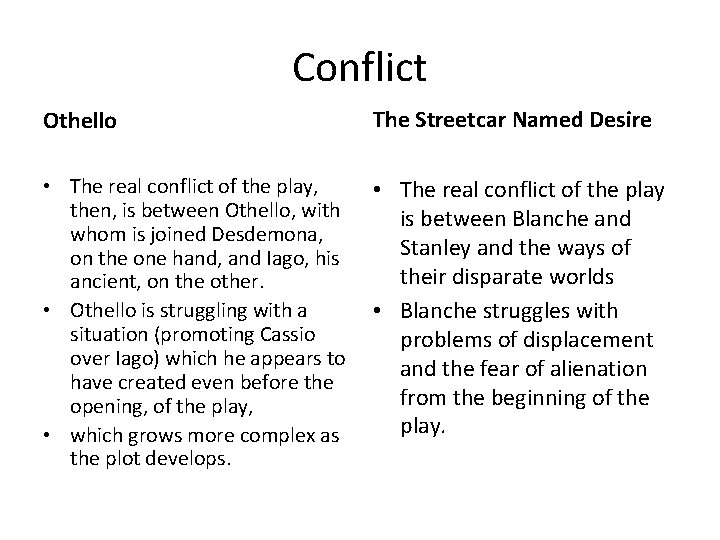
Conflict Othello The Streetcar Named Desire • The real conflict of the play, then, is between Othello, with whom is joined Desdemona, on the one hand, and Iago, his ancient, on the other. • Othello is struggling with a situation (promoting Cassio over Iago) which he appears to have created even before the opening, of the play, • which grows more complex as the plot develops. • The real conflict of the play is between Blanche and Stanley and the ways of their disparate worlds • Blanche struggles with problems of displacement and the fear of alienation from the beginning of the play.
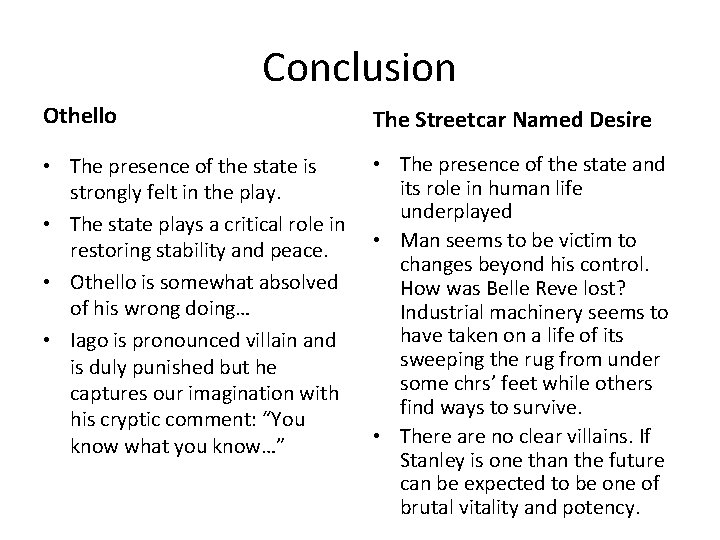
Conclusion Othello The Streetcar Named Desire • The presence of the state is strongly felt in the play. • The state plays a critical role in restoring stability and peace. • Othello is somewhat absolved of his wrong doing… • Iago is pronounced villain and is duly punished but he captures our imagination with his cryptic comment: “You know what you know…” • The presence of the state and its role in human life underplayed • Man seems to be victim to changes beyond his control. How was Belle Reve lost? Industrial machinery seems to have taken on a life of its sweeping the rug from under some chrs’ feet while others find ways to survive. • There are no clear villains. If Stanley is one than the future can be expected to be one of brutal vitality and potency.
{The Conclusion} A Streetcar Named Desire Othello • Ends in despair – living dead find no reprieve • Ends in a worse fate than death for Blanche and the old world • There is no acceptable resolution • The future seems uncertain • Tragedy is cathartic with hope of renewal as the villainy comes to light, the dead buried and new hands take the reign • Ends with hope not despair
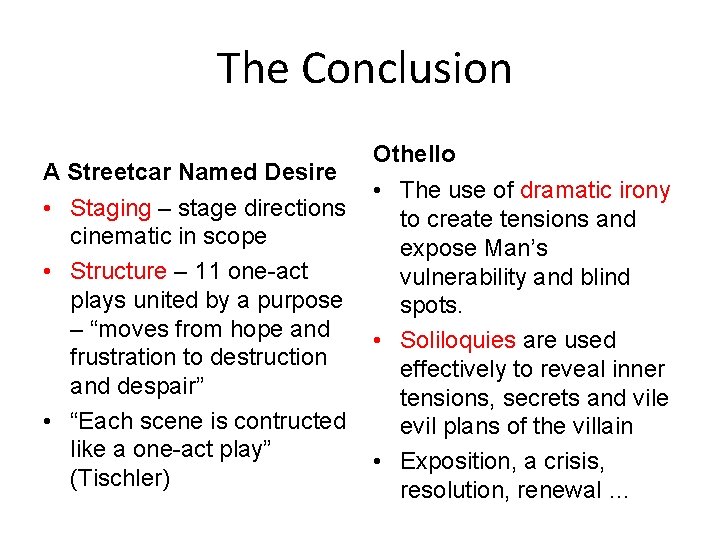
The Conclusion A Streetcar Named Desire • Staging – stage directions cinematic in scope • Structure – 11 one-act plays united by a purpose – “moves from hope and frustration to destruction and despair” • “Each scene is contructed like a one-act play” (Tischler) Othello • The use of dramatic irony to create tensions and expose Man’s vulnerability and blind spots. • Soliloquies are used effectively to reveal inner tensions, secrets and vile evil plans of the villain • Exposition, a crisis, resolution, renewal …
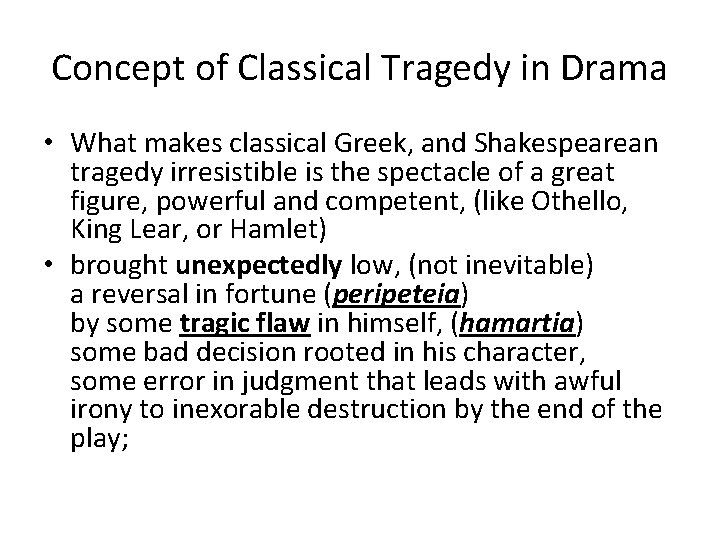
Concept of Classical Tragedy in Drama • What makes classical Greek, and Shakespearean tragedy irresistible is the spectacle of a great figure, powerful and competent, (like Othello, King Lear, or Hamlet) • brought unexpectedly low, (not inevitable) a reversal in fortune (peripeteia) by some tragic flaw in himself, (hamartia) some bad decision rooted in his character, some error in judgment that leads with awful irony to inexorable destruction by the end of the play;
HAMARTIA • A term from Greek tragedy that literally means "missing the mark. " Originally applied to an archer who misses the target, a hamartia came to signify a tragic flaw, especially a misperception, a lack of some important insight, or some blindness that ironically results from one's own strengths and abilities. • In Greek tragedy, the protagonist frequently possesses some sort of hamartia that causes catastrophic results after he fails to recognize some fact or truth that could have saved him if he recognized it earlier. • The idea of hamartia is often ironic; it frequently implies the very trait that makes the individual noteworthy is what ultimately causes the protagonist's decline into disaster.
Hamartia • The "fatalism of overmastering passion, " as it has been called by Professor Corson, 2 is the distinguishing feature of Shakespeare's conception of man's relation to the world, and marks the culmination of the Elizabethan drama • In the case of Othello, as , of all the other tragedies, it is the passion of the hero that is the mainspring of all the action of the play that finally and certainly destroys the hero. • The consuming and destructive power of passion gives rise to the action of the play and leads the hero to his fate.
Williams’ plays not Tragedies in the Classical Sense • Williams – the great dramatist of beautiful failure; • The poet of noble defeat; • The sense of inevitability that haunts his most powerful plays is the reason (it may be argued) they are not tragedies in the classical sense of the concept; • But rather dramas of pathos
Othello • Hamartia came to signify a tragic flaw, especially a misperception, a lack of some important insight, or some blindness that ironically results from one's own strengths and abilities. • Othello’s Hamartia (blindness) is made evident through dramatic irony and ocular imagery Blanche • Blanche unlike Othello is insightful. She sees Stanley and Estella ( for what they are) • She understands the ways of the world. • She is a victim of circumstances. The tragic events are beyond her control. • Her destruction it seems is inevitable!
Williams use of female characters; part of his dramatic technique • A crucial feature of Williams’ plays is of Beauty crushed, and heroic failure • a feature suggesting a certain resemblance between his drama and Greek tragic drama • Is Williams’ use of female characters intended to represent both the aspiration toward beauty and the inevitability of defeat, of brokenness?
Blanche is insightful unlike Othello “You’re simple, straightforward and honest, a little bit on the primitive side I should think. To interest you a woman would have to----” p. 20 “Well life is too full of evasions and ambiguities, I think. ” “The poor thing was out there listening to us, and I have an idea she doesn’t understand you as well as I do…”p. 20
Awareness of History of Debauchery but… “There are thousands of papers, stretching back over hundreds of years, affecting Belle Reve as, piece by piece, our improvident grandfathers and father and uncles and brothers exchanged the land for their epic fornications - to put it plainly. ” P. 22 S: “I have a lawyer acquaintance who will study these out” B: “Present them to him with a box of aspirin tablets”
Blanche is in some ways a Romantic like Othello but unlike him she appears more in tune with the ways of the world “He’s just not the sort that goes for Jasmine perfume! But maybe he’s what we need to mix with our blood now that we’ve lost Belle Reve and have to go on without Belle Reve to protect us…how pretty the sky is! I ought to go there on a rocket that never comes down. ” Violence! Is so-------…she looks up to the sky there’s so much------so much confusion in the world…Thank you for being so kind! I need kindness now. P. 34 The blind are – leading the blind! Blanche displays an acute awareness that she may not belong to the new world. Like Othello she is poetic but her metaphor has hints of a death wish right from the beginning!
Idealistic yet realistic! Stella: Stanley’s the only one of his crowd that’s likely to get anywhere. Blanche: What makes you think Stanley will? Stella: Look at him Blanche: I’ve looked at him…I’m sorry but I haven’t seen the stamp of genius even on Stanley’s forehead. Stanley: you hens cut out that conversation in there! Stella: this is my house and I’ll talk as much as I want to! Blanche: Stella don’t start a row.
Aristotelian Tragedy • Was Iago the sole cause of the calamities that befell Othello? • No Shakespearean tragedy shifts the responsibility of the deed of the hero and the subsequent tragedy to social forces or any other individual. • The influence of social forces affecting the moral choices, lifestyles and values of individuals is a conception explored more by modern writers from the nineteenth century onwards. • Shakespeare largely represents men and in particular his tragic heroes as individuals who are “devoured by their own passions alone. ”
Othello as Tragic Hero • Beginning, then, with this passion, it is the art of Shakespeare to place his characters under those conditions that will show the true nature of their passion and develop it to its fullness and to its fated end. • Every man's condemnation comes from the development of his own passions. • It was under the sway of this conception that Shakespeare brought Othello into his fatal conflict with Iago, for this drew from him all the hidden passion of his nature.
Tragic Hero and Romantic Character • Othello is by far the most romantic figure among Shakespeare's heroes; and he is so partly from the strange life of war and adventure which he has lived from childhood. • He does not belong to our world, and he seems to enter it we know not whence--almost as if from wonderland. • There is something mysterious in his descent from men of royal siege; in his wanderings in vast deserts and among marvellous peoples; in his tales of magic handkerchiefs and prophetic Sibyls; in the sudden vague glimpses we get of numberless battles and sieges in which he has played the hero and has borne a charmed life; even in chance references to his baptism, his being sold to slavery, his sojourn in Aleppo.
Othello’s Romantic Nature • And he is not merely a romantic figure; his own nature is romantic. -and in those brief expressions of intense feeling which ever since have been taken as the absolute expression • Recall his speeches: 'Her father loved me, ' 'O now for ever, ' 'Never, Iago, ' 'Had it pleased Heaven, ' 'It is the cause, ' 'Behold, I have a weapon, ' 'Soft you, a word or two before you go'— • There is the same poetry in his casual phrases like 'These nine moons wasted, ' 'Keep up your bright swords, for the dew will rust them, ' 'You chaste stars, ' 'It is a sword of Spain, the ice-brook's temper, ' 'It is the very error of the moon’ etc
A Romantic Figure 'Twere now to be most happy; for, I fear, My soul hath her content so absolute That not another comfort like to this Succeeds in unknown fate, or If she be false, O then Heaven mocks itself. I'll not believe it; No, my heart is turned to stone; I strike it, and it hurts my hand, But yet the pity of it, Iago! O Iago, the pity of it, Iago! or O thou weed, Who art so lovely fair and smell'st so sweet That the sense aches at thee, would thou hadst ne'er been born.
Othello’s Imaginative Life • And this imagination, we feel, has accompanied his whole life. He has watched with a poet's eye the Arabian trees dropping their med'cinable gum, and the Indian throwing away his chancefound pearl; and has gazed in a fascinated dream at the Pontic sea rushing, never to return, to the Propontic and the Hellespont; and has felt as no other man ever felt (for he speaks of it as none other ever did) the poetry of the pride, pomp, and circumstance of glorious war.
Blanche • Blanche’s outstanding characteristic according to Kazan is desperation; her chief motivation is her urgent need to find protection. – protection from fading physical beauty and old age p. 78 • Her tragic flaw arises from this southern tradition, her notion of what a woman should be…compulsion to be special – which isolates her from others • She has considerable emotional versatility-ranging from imperious self assertion to fluttering helplessness, from feverish gaiety to pathetic terror. • She alternately alienates and engages the sympathy of the audience Othello • Exceptionally noble and trustful –he endures the shock of a terrible disillusionment. • His tragic flaw is his passion which leads to his undoing; • Othello is the most painfully exciting and the most terrible. • From the moment when the temptation of the hero begins, the reader's heart and mind are held in a vice, experiencing the extremes of pity and fear, sympathy and repulsion, sickening hope and dreadful expectation. AC Bradley
A Streetcar Named Desire • • • Kazan sees streetcar as a classical tragedy, with Blanche like some doomed Greek heroine, pursued to madness by the Harpies within her own nature, haunted by the death and decay of the past and her sins. She is capable of exciting pity and terror in the audience “I was never hard or self-sufficient enough. When people are soft. . soft people have got to court the favour of hard ones. Have got to be seductive – put on soft colours, the colours of butterfly wings, and glow – make a little temporary magic just in order to pay for - one night’s shelter. That’s why I’ve been –not so awf’ly good lately. I’ve run for protection, stella …protection” P. 45 Othello “one not easily jealous, but, being wrought, Perplexed in the extreme, ” • Appears perfectly just. His tragedy lies in this--that his whole nature was indisposed to jealousy, and yet was such that he was unusually open to deception, and, if once wrought to passion, likely to act with little reflection, with no delay, and in the most decisive manner conceivable.
• Pity implies a compassionate concern; the audience must be able to believe in and care about the character. • She must have a dramatic reality. • She is given a past that makes sense of her present and that makes her future fate both consistent and “right”
• How does Tennessee evoke and sustain our sympathy for this selfish and pampered woman who thinks she is special? • Stella refers to Blanche’s upbringing and her sensitivity, in defense of her behaviour p. 58 • Blanche’s traumatic marriage and widowing ‘an experience that killed her illusions’ p. 61 • Blanche herself explains and justifies her desperate search for protection from poverty and physical decline when she describes te squalid horror of all those deaths p. 12
Women in Williams’ Cultural Milieu • In the time and place and culture that produced Williams, • Women could still function, without irony, as useful vehicles for exploring those qualities; • Few dramatists in the Western tradition apart from the ancient Greek playwright, Euripides, have made such memorable and distinctive use of women — Striving, pathetic, relentless, deluded • Women as mouthpieces for certain kinds of repressed emotional currents
Women in Williams’ Cultural Milieu • In the time and place and culture that produced Williams, • Women could still function, without irony, as useful vehicles for exploring those qualities; • Few dramatists in the Western tradition apart from the ancient Greek playwright, Euripides, have made such memorable and distinctive use of women — Striving, pathetic, relentless, deluded • Women as mouthpieces for certain kinds of repressed emotional currents
Like Euripides • Williams exploited personal and cultural notions of the feminine — • Soft, poetic, silly, emotional, prone to madness and vengefulness, and cunning • To create female characters who transcended them; • Williams’ female characters manage to be both (a) memorably, even frighteningly extreme and (b) sympathetic at the same time (Intended Dramatic Effects)
Blanche’s tragedy • Part of Blanche’s tragedy is circumstantial; • In the end she runs against the brick wall of her desire; she had a weakness for Stanley, and his kind; • Stanley only gives her a little push in the direction she has been headed in all along; • At the end of the play we hear Stanley declare ‘We’ve had this date with each other from the beginning. ’ • Blanche is undone by her own desire.