
A Streetcar Named Desire Welcome back to YR

A Streetcar Named Desire Welcome back to YR 13
Aims today • Analyse Scenes 5 and 6, with reference to: • Symbolism /Interpretation AO 5 • Structural features AO 2 – differences between sisters highlighted in Sc 4 affect the rest of the play, sense of tragedy looming over Sc 5 and Sc 6 • Context AO 3
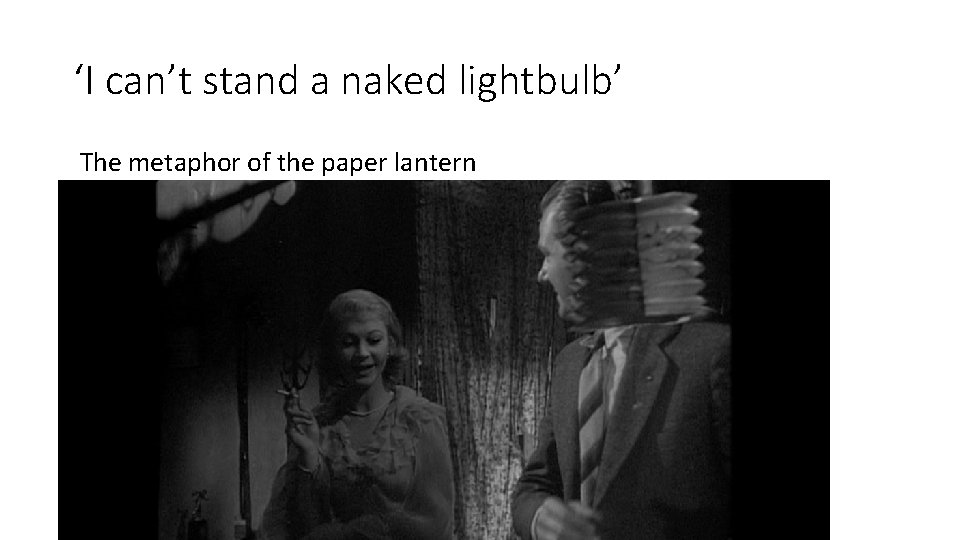
‘I can’t stand a naked lightbulb’ The metaphor of the paper lantern
‘My Rosenkavalier’ • Meaning: ‘the knight of the rose’ from Strauss’ comic opera of 1911. • A cultured lady?
Aspects of Blanche’s character in SC 5 • How is Blanche’s recklessness conveyed in this scene? • How is a sense of foreboding/tragedy established? • What dramatic device(s) do you feel are significant? • Task: in groups of 2 or 3, discuss these questions ( 10 minutes) • Feedback to class. •
Critical Theory: Feminist Perspectives Feminist critics argue that Tennessee Williams: Deconstructs categories of masculine and feminine identity Subverts the patriarchal discourse Normalizes transgressive behaviour Critiques the oppression, powerlessness, economic dependency and sexual objectification of women. • Jacqueline O’Connor in 1997 examines female dementia from two angles: a societal construct of a brutalizing society that confirms its own sanity by designating the Other and also as a patriarchal response to rein in the perceived disruption of the social order by committing the madwomen to the asylum. • • •
Blanche’s self-destructive nature • How do you interpret the brief episode with the young man? • Write between 200 and 300 words illustrating how Williams shows the contradictions in Blanche’s character. • Personal interpretation and textual evidence.
Scene 6 Blanche and Mitch • Blanche and Mitch return from an unsuccessful ‘date’ • Awkward conversation over drinks – Blanche over-compensates, Mitch is dull. • Blanche confides in Mitch about Stanley’s offensive attitude to her. • A more serious discussion develops where Mitch talks about his ailing mother, Blanche talks about the circumstances leading to her husband’s suicide. • Mitch is moved and embraces a weeping Blanche.
AO 3 Key Context • Reference to the novel ‘La Dame aux Camelias’ by Alexander Dumas the Younger. • ‘Voulez-vous coucher avec moi ce soir? ’
Blanche’s contradictions: • She seems uncertain about her own wishes and desires. • Would she really be happy with Mitch? • She offers to sleep with him – but is so caught up in her imaginary flight of fancy that she does not consider that he won’t understand her in French – or does she? • Complex/ contradictory/ infuriating/oddly sympathetic • ‘Sometimes- there’s God- so quickly!’
Blanche and Stanley • ‘There is such a thing as the hostility of sexual attraction’ • Sexual tension – she has enough experience of men to have clearly understood this before. • Indirect foreshadowing of the rape. • Stanley: ’We’ve had this date with each other since the beginning!’
Stage directions relating to music AO 2
Themes in ‘Streetcar’ – brainstorm in 3 minutes • Fate • Death • Madness • Social class • Desire
Desire and Fate • Desire and Cemeteries • The symbolical meaning of the streetcar • Promiscuity vs security • The train as a symbol of fate
Using the sub-headings, make notes about themes in pairs or threes.
Hart Crane – The Bridge • And so it was I entered the broken world • To trace the visionary company of love, its voice • An instant in the wind (I know not whither hurled) • But not for long to hold each desperate choice. • --Hart Crane's poem, "The Broken Tower"
Scenes 7 and 8 • L. O. summarize both scenes • Dramatic devices • Critical theory • Context • Alternative interpretations

Counterpoint – an explanation • https: //www. youtube. com/watch? v=4 O 6 lc_ym 12 U
Homework please!
Scene 7 – sequence the summary • Stella is appalled that Stanley has revealed Blanche’s past to Mitch – spoiling her chances • September – Blanche’s birthday – she is bathing while Stella puts finishing touches on her cake • Blanche emerges from bathroom, realises there has been a change in the atmosphere – she is unnerved • Stella refuses to believe Stanley • Stanley enters, triumphant at having discovered details about Blanche’s past
Context – why does Stella use the word ‘degenerate’ to describe Blanche’s husband? • In pairs, discuss • Feedback
Dramatic impact • Contrasts • Look for two ideas in this scene • ‘Contrapuntally’ • Cheerful mood of anticipation • Blanche’s sentimental song vs Stanley’s shocking disclosures
What is the main purpose of this scene? • Discuss please
Critical theory • References: • Post-modern critical theory - Nicholas Pagan • The process of ‘signification’ that is, the reader creates and imagines different perspectives eg the names Blanche and Stanley, Stella • reference to homosexuality: Du. Bois/De Boyes – fluid identity of Blanche – ‘queen’ • Major signifiers in ‘Streetcar’ are made of paper – see Philip Kolin in 1997 – mortgages, directions, letters, poems, telegrams, newspapers, songs, moons, lampshades. Contrast Blanche’s slip of paper directiong her to Stella’s home with Stanley’s bloodstained meat package. • Kleenex/ Shep Huntley/Chinese lantern
Scene 8 – More tension • ‘ I am the king around here, so don’t you forget it’ • Imagine you are interviewing Stanley about his relationship with Blanche. Prepare 5 or 6 questions you might ask to pin him down on what he thinks of her and how his attitude has developed.
Explore the role of deception in the action of A Streetcar Named Desire, and how it is presented. • Relate your response to Language and Structure.
- Slides: 26