The NewcastleOttawa Scale NOS for Assessing the Quality



- Slides: 39
The Newcastle-Ottawa Scale (NOS) for Assessing the Quality of Nonrandomized Studies in Meta. Analysis G. Wells, B. Shea, D. O’Connell, J. Robertson, J. Peterson, V. Welch, M. Losos, P. Tugwell
Development Applications Current Developments
Development: Item Selection • • Newcastle quality assessment form Ottawa comprehensive list Panel review Critical review by experts
Development: Grouping Items • Cohort studies • Selection of cohorts • Comparability of cohorts • Assessment of outcome • Case-Control studies • Selection of case and controls • Comparability of cases and controls • Ascertainment of exposure
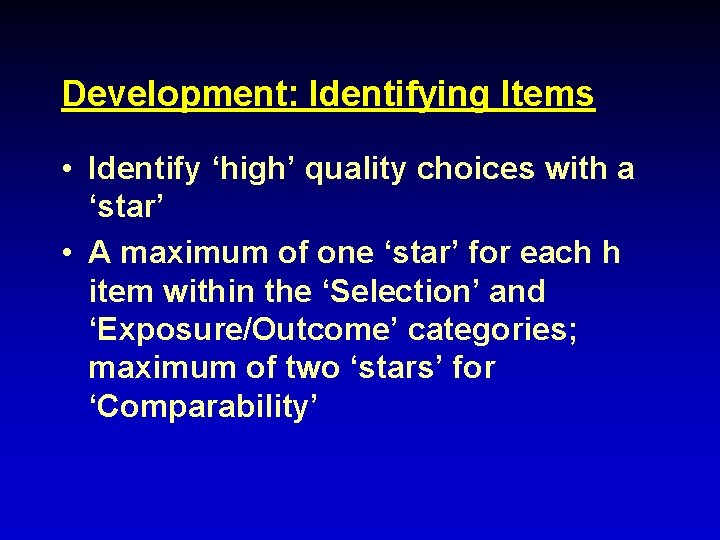
Development: Identifying Items • Identify ‘high’ quality choices with a ‘star’ • A maximum of one ‘star’ for each h item within the ‘Selection’ and ‘Exposure/Outcome’ categories; maximum of two ‘stars’ for ‘Comparability’
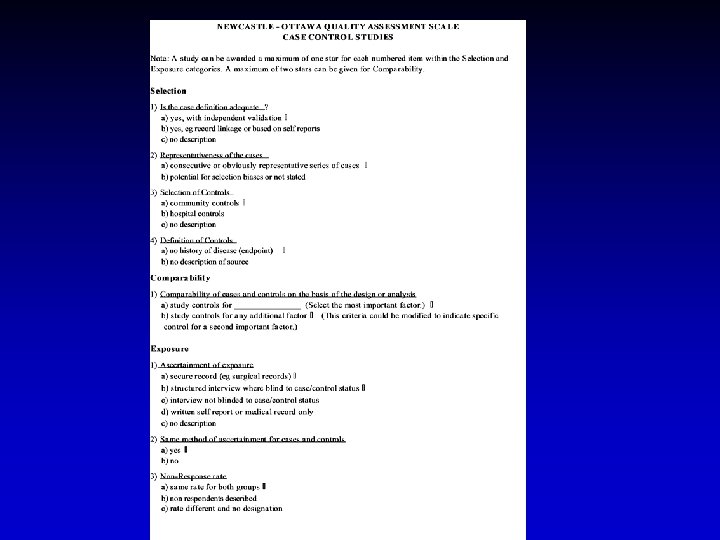
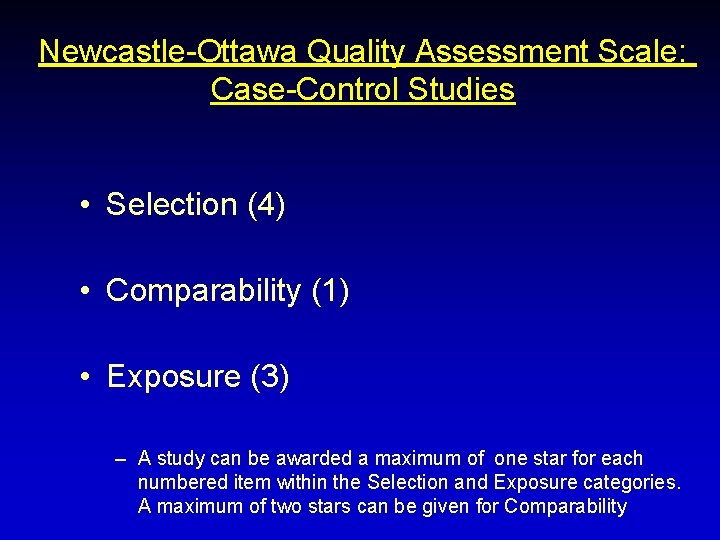
Newcastle-Ottawa Quality Assessment Scale: Case-Control Studies • Selection (4) • Comparability (1) • Exposure (3) – A study can be awarded a maximum of one star for each numbered item within the Selection and Exposure categories. A maximum of two stars can be given for Comparability
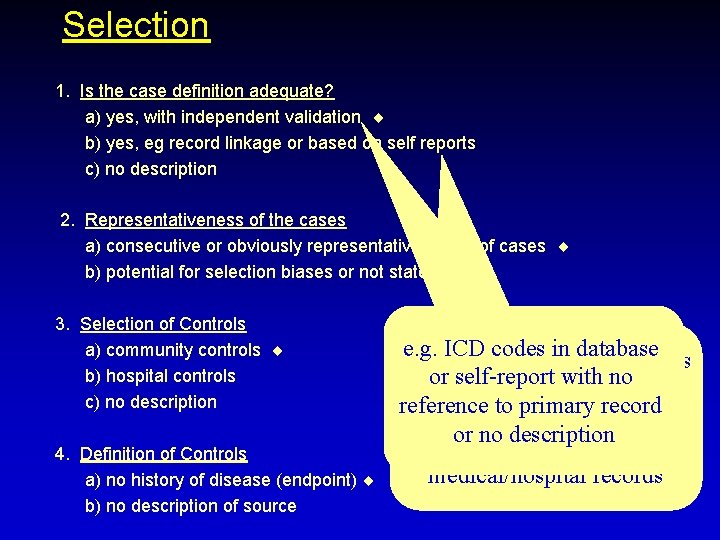
Selection 1. Is the case definition adequate? a) yes, with independent validation b) yes, eg record linkage or based on self reports c) no description 2. Representativeness of the cases a) consecutive or obviously representative series of cases b) potential for selection biases or not stated 3. Selection of Controls a) community controls b) hospital controls c) no description 4. Definition of Controls a) no history of disease (endpoint) b) no description of source e. g. ICD codes in database >1 person/record/time/process or self-report with no to extract information, or reference to primary record or no description source such as x-rays or medical/hospital records
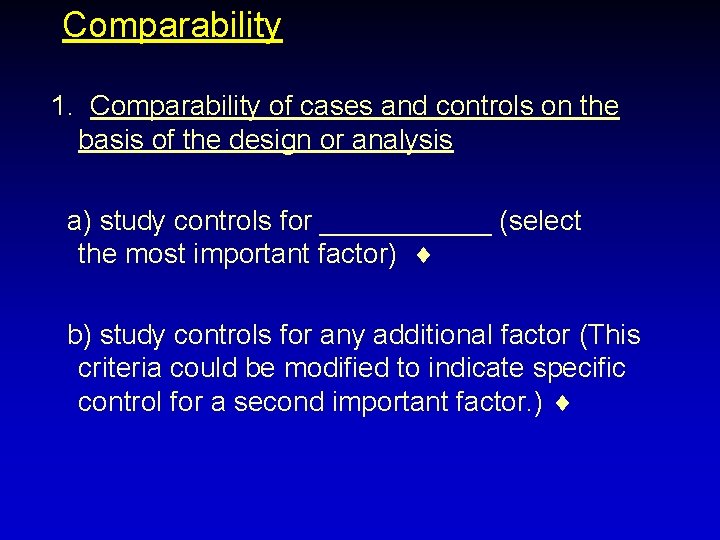
Comparability 1. Comparability of cases and controls on the basis of the design or analysis a) study controls for ______ (select the most important factor) b) study controls for any additional factor (This criteria could be modified to indicate specific control for a second important factor. )
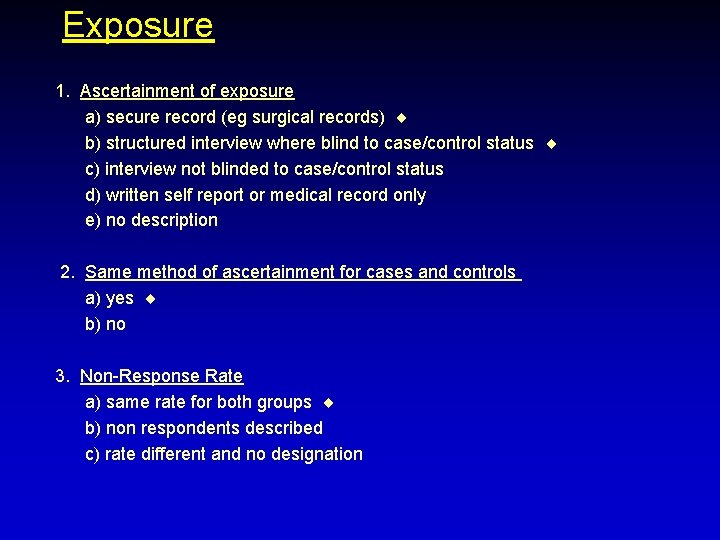
Exposure 1. Ascertainment of exposure a) secure record (eg surgical records) b) structured interview where blind to case/control status c) interview not blinded to case/control status d) written self report or medical record only e) no description 2. Same method of ascertainment for cases and controls a) yes b) no 3. Non-Response Rate a) same rate for both groups b) non respondents described c) rate different and no designation
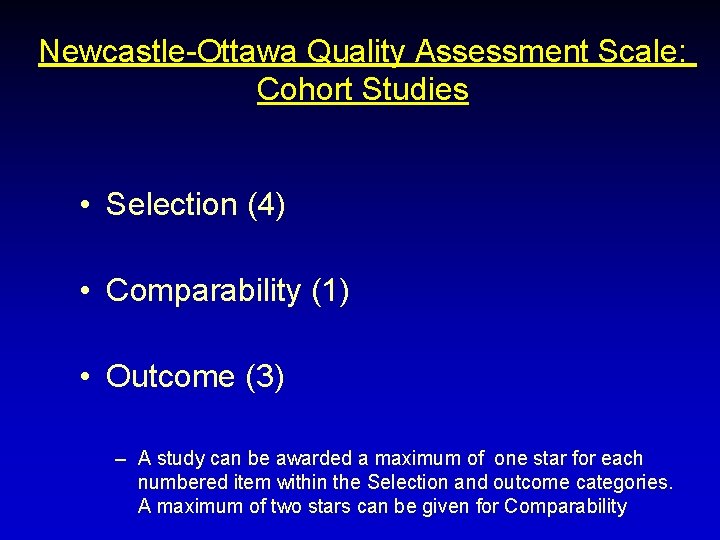
Newcastle-Ottawa Quality Assessment Scale: Cohort Studies • Selection (4) • Comparability (1) • Outcome (3) – A study can be awarded a maximum of one star for each numbered item within the Selection and outcome categories. A maximum of two stars can be given for Comparability
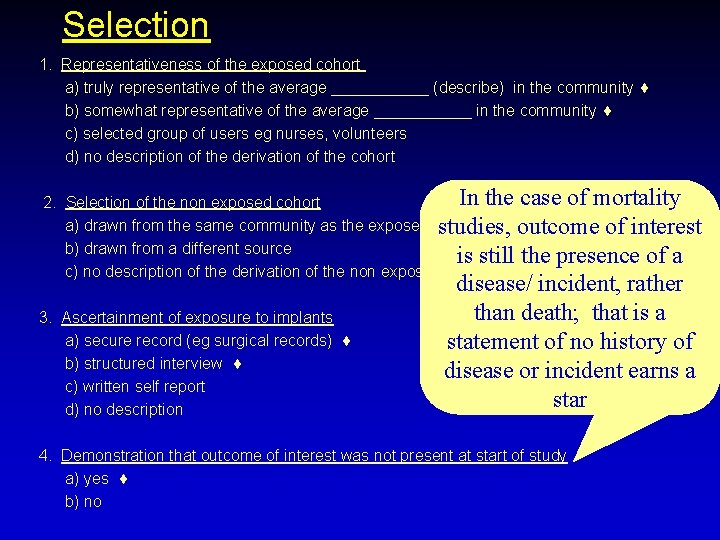
Selection 1. Representativeness of the exposed cohort a) truly representative of the average ______ (describe) in the community b) somewhat representative of the average ______ in the community c) selected group of users eg nurses, volunteers d) no description of the derivation of the cohort In the case of mortality 2. Selection of the non exposed cohort a) drawn from the same community as the exposed cohort outcome of interest studies, b) drawn from a different source is still the presence of a c) no description of the derivation of the non exposed cohort 3. Ascertainment of exposure to implants a) secure record (eg surgical records) b) structured interview c) written self report d) no description disease/ incident, rather than death; that is a statement of no history of disease or incident earns a star 4. Demonstration that outcome of interest was not present at start of study a) yes b) no
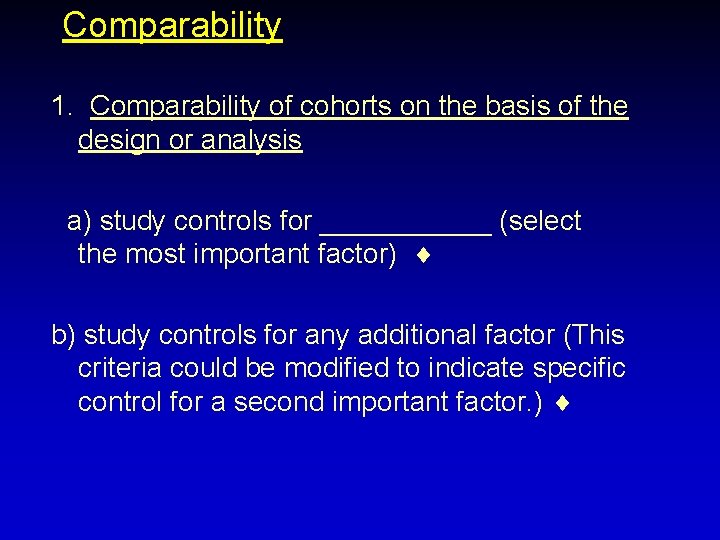
Comparability 1. Comparability of cohorts on the basis of the design or analysis a) study controls for ______ (select the most important factor) b) study controls for any additional factor (This criteria could be modified to indicate specific control for a second important factor. )
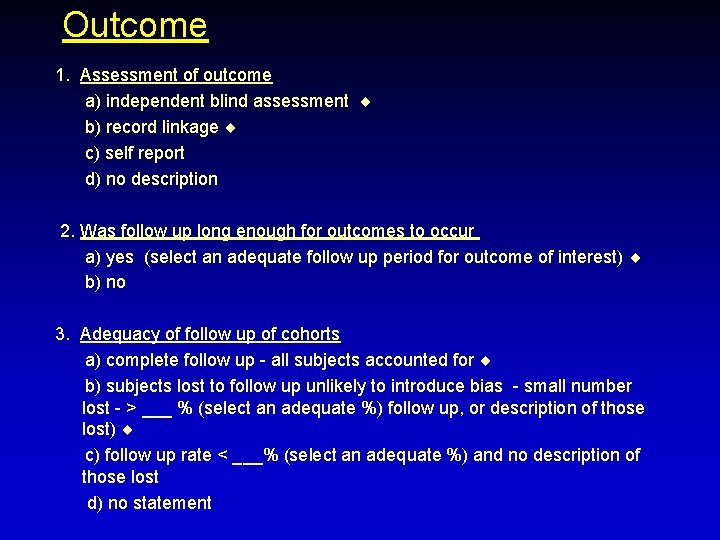
Outcome 1. Assessment of outcome a) independent blind assessment b) record linkage c) self report d) no description 2. Was follow up long enough for outcomes to occur a) yes (select an adequate follow up period for outcome of interest) b) no 3. Adequacy of follow up of cohorts a) complete follow up - all subjects accounted for b) subjects lost to follow up unlikely to introduce bias - small number lost - > ___ % (select an adequate %) follow up, or description of those lost) c) follow up rate < ___% (select an adequate %) and no description of those lost d) no statement
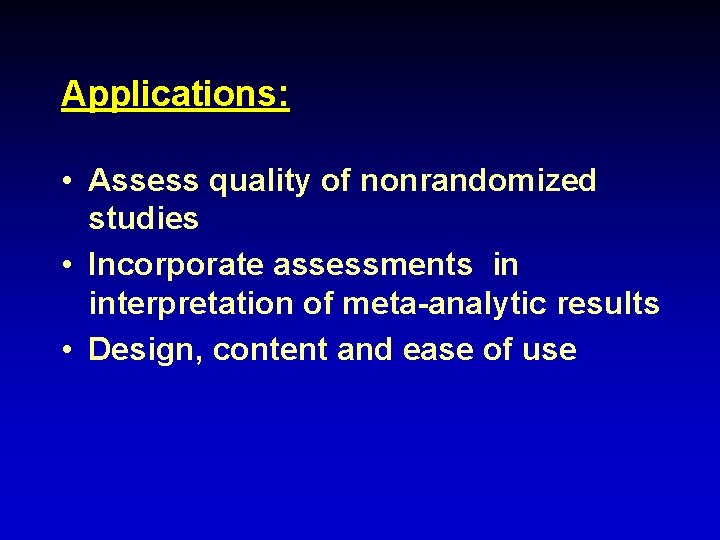
Applications: • Assess quality of nonrandomized studies • Incorporate assessments in interpretation of meta-analytic results • Design, content and ease of use
Long Term Hormone Replacement Therapy and Coronary Heart Disease Events
Steps of a Cochrane Systematic Review • Clearly formulated question • Comprehensive data search • Unbiased selection and abstraction process • Critical appraisal of data • Synthesis of data • Perform sensitivity and subgroup analyses if appropriate and possible • Prepare a structured report
Objective • Is there a relationship between hormone replacement therapy and the incidence of coronary heart disease in postmenopausal women
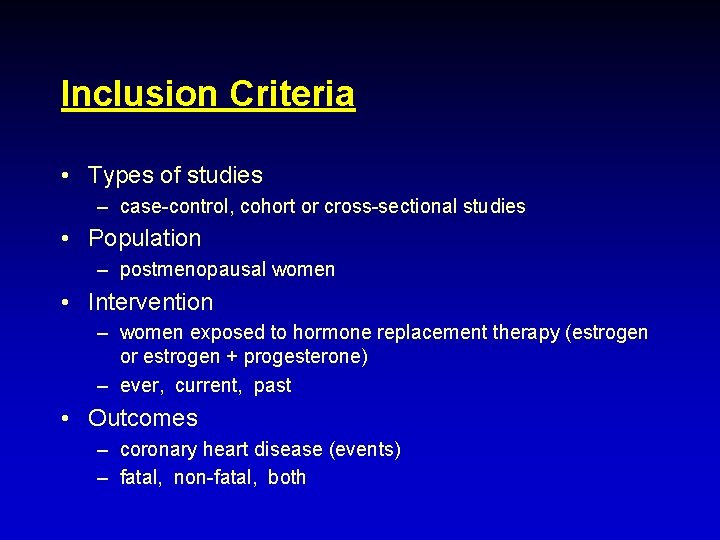
Inclusion Criteria • Types of studies – case-control, cohort or cross-sectional studies • Population – postmenopausal women • Intervention – women exposed to hormone replacement therapy (estrogen or estrogen + progesterone) – ever, current, past • Outcomes – coronary heart disease (events) – fatal, non-fatal, both
Steps of a Cochrane Systematic Review • Clearly formulated question • Comprehensive data search • Unbiased selection and abstraction process • Critical appraisal of data • Synthesis of data • Perform sensitivity and subgroup analyses if appropriate and possible • Prepare a structured report
Search Strategy • Electronic Search of: – MEDLINE (1966 to May 2000) – Current Contents (to May 2000) • Other Data Sources: – review of references cited in retrieved articles
Steps of a Cochrane Systematic Review • Clearly formulated question • Comprehensive data search • Unbiased selection and abstraction process • Critical appraisal of data • Synthesis of data • Perform sensitivity and subgroup analyses if appropriate and possible • Prepare a structured report
Data Extraction • 2 independent reviewers selected trials • 2 independent reviewers extracted data using pre-determined forms – – – study design population characteristics exposure to implants outcomes measures results • differences resolved by consensus
Results • 16 case-control or cross-sectional • 14 cohort
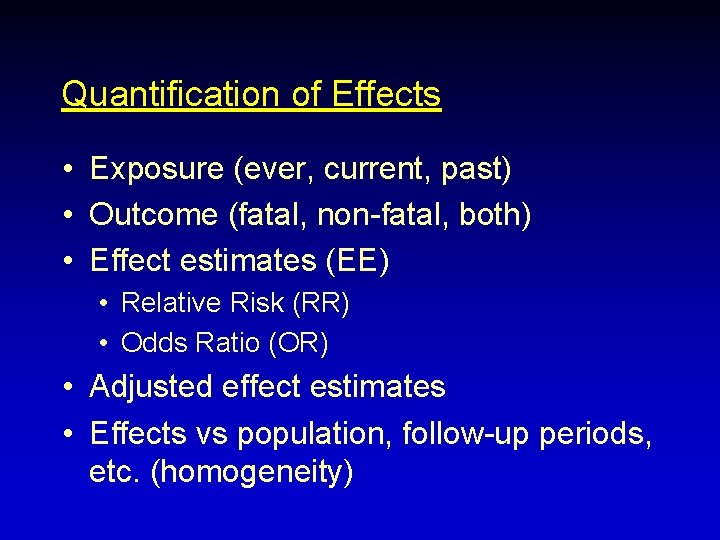
Quantification of Effects • Exposure (ever, current, past) • Outcome (fatal, non-fatal, both) • Effect estimates (EE) • Relative Risk (RR) • Odds Ratio (OR) • Adjusted effect estimates • Effects vs population, follow-up periods, etc. (homogeneity)
Steps of a Cochrane Systematic Review • Clearly formulated question • Comprehensive data search • Unbiased selection and abstraction process • Critical appraisal of data • Synthesis of data • Perform sensitivity and subgroup analyses if appropriate and possible • Prepare a structured report
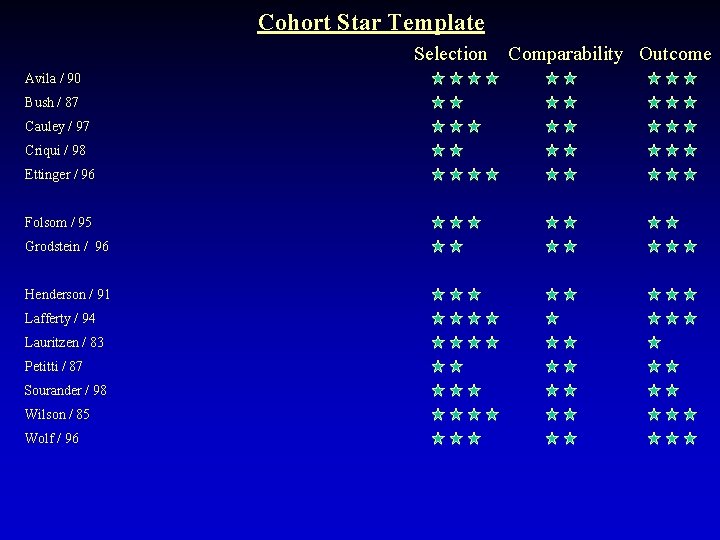
Cohort Star Template Selection Avila / 90 Bush / 87 Cauley / 97 Criqui / 98 Ettinger / 96 Folsom / 95 Grodstein / 96 Henderson / 91 Lafferty / 94 Lauritzen / 83 Petitti / 87 Sourander / 98 Wilson / 85 Wolf / 96 Comparability Outcome
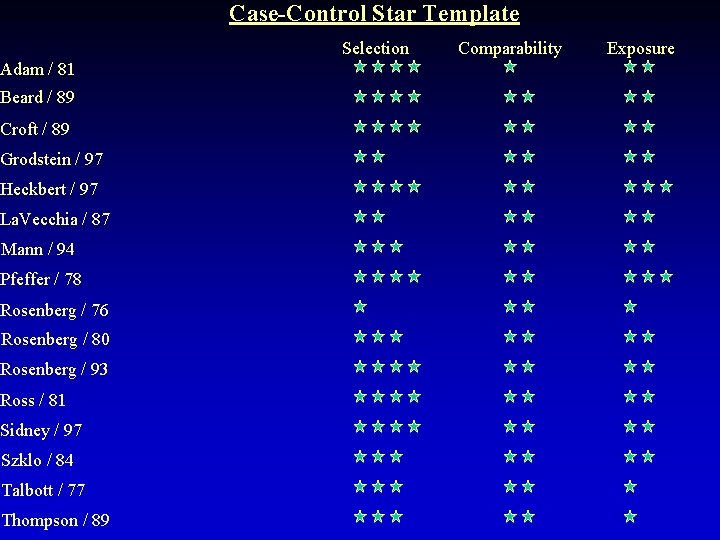
Case-Control Star Template Selection Adam / 81 Beard / 89 Croft / 89 Grodstein / 97 Heckbert / 97 La. Vecchia / 87 Mann / 94 Pfeffer / 78 Rosenberg / 76 Rosenberg / 80 Rosenberg / 93 Ross / 81 Sidney / 97 Szklo / 84 Talbott / 77 Thompson / 89 Comparability Exposure
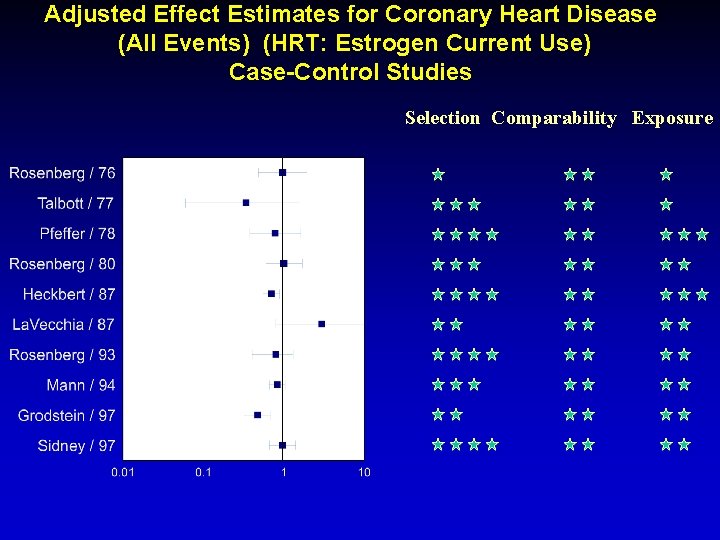
Adjusted Effect Estimates for Coronary Heart Disease (All Events) (HRT: Estrogen Current Use) Case-Control Studies Selection Comparability Exposure
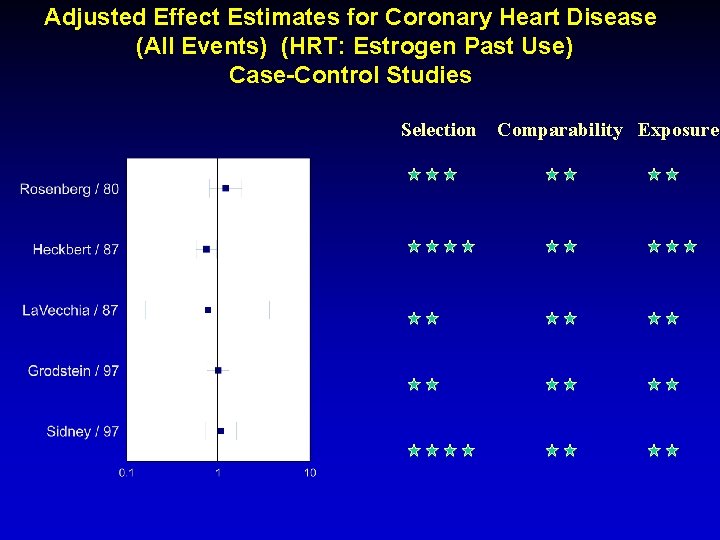
Adjusted Effect Estimates for Coronary Heart Disease (All Events) (HRT: Estrogen Past Use) Case-Control Studies Selection Comparability Exposure
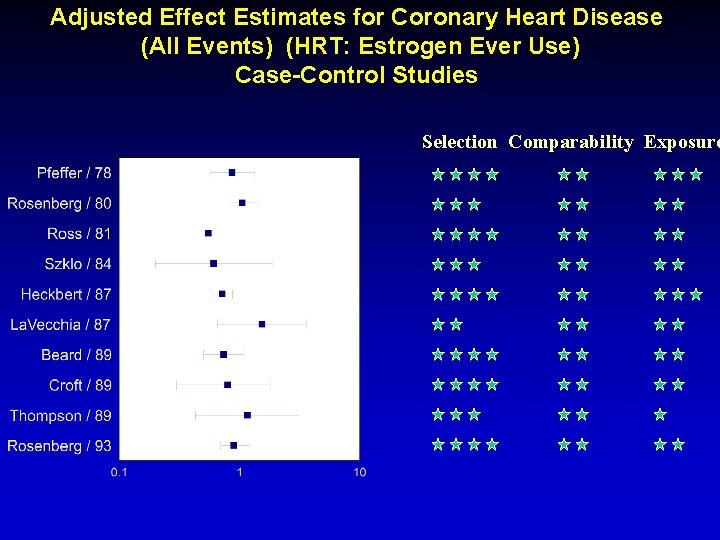
Adjusted Effect Estimates for Coronary Heart Disease (All Events) (HRT: Estrogen Ever Use) Case-Control Studies Selection Comparability Exposure
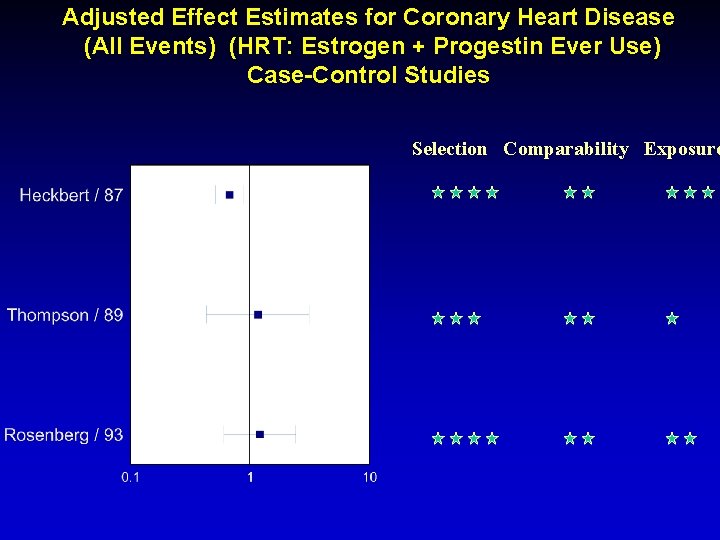
Adjusted Effect Estimates for Coronary Heart Disease (All Events) (HRT: Estrogen + Progestin Ever Use) Case-Control Studies Selection Comparability Exposure
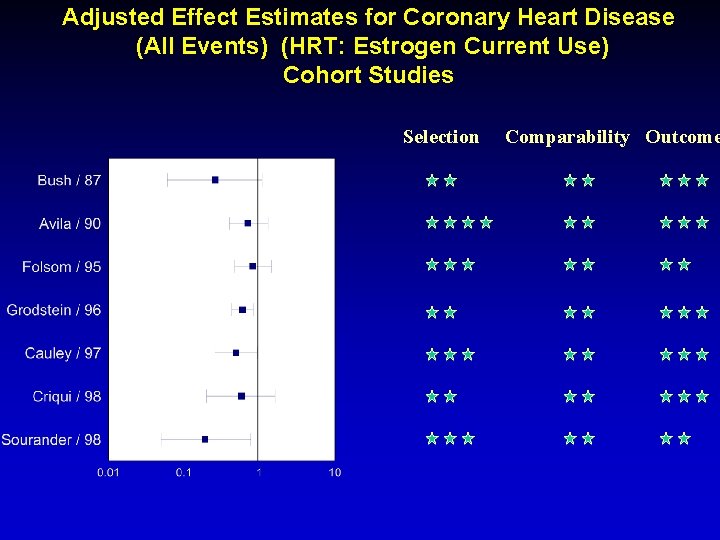
Adjusted Effect Estimates for Coronary Heart Disease (All Events) (HRT: Estrogen Current Use) Cohort Studies Selection Comparability Outcome
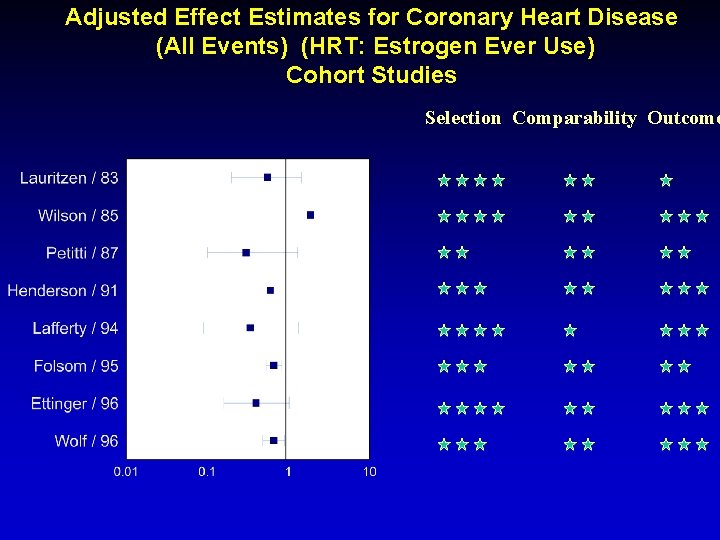
Adjusted Effect Estimates for Coronary Heart Disease (All Events) (HRT: Estrogen Ever Use) Cohort Studies Selection Comparability Outcome
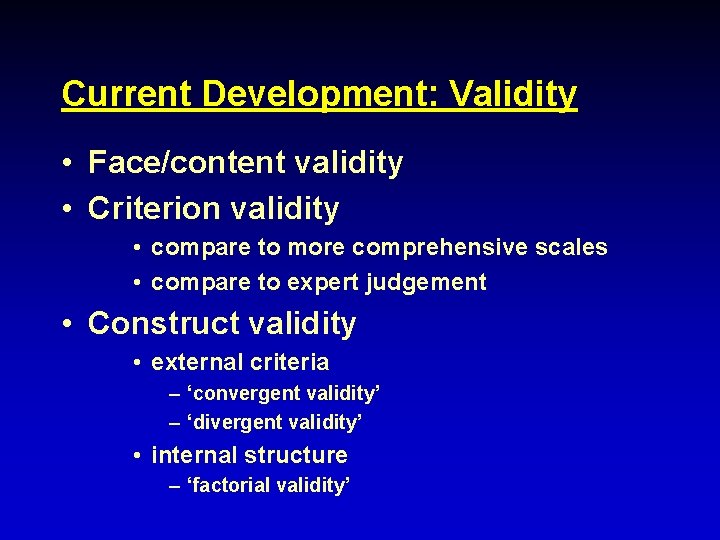
Current Development: Validity • Face/content validity • Criterion validity • compare to more comprehensive scales • compare to expert judgement • Construct validity • external criteria – ‘convergent validity’ – ‘divergent validity’ • internal structure – ‘factorial validity’
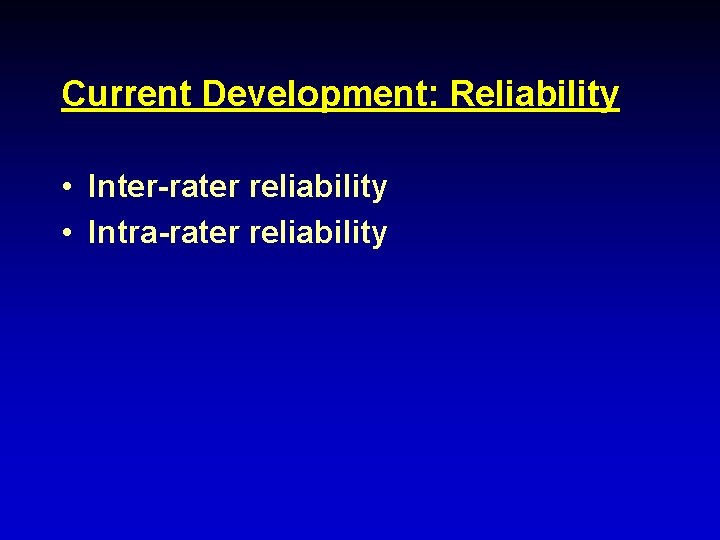
Current Development: Reliability • Inter-rater reliability • Intra-rater reliability
Future Development: Scoring • Identify threshold score distinguishing between ‘good’ and ‘poor’ quality studies
The Newcastle-Ottawa Scale (NOS) for Assessing the Quality of Nonrandomized Studies in Meta. Analysis www. lri. ca NOS Quality Assessment Scales: Case-control studies Cohort studies Manual for NOS Scales