
Assessing the Internal Environment of the Firm chapter
- Slides: 14
Assessing the Internal Environment of the Firm chapter 3 . Copyright © 2014 Mc. Graw-Hill Education. All rights reserved. No reproduction or distribution without the prior written consent of Mc. Graw-Hill Education
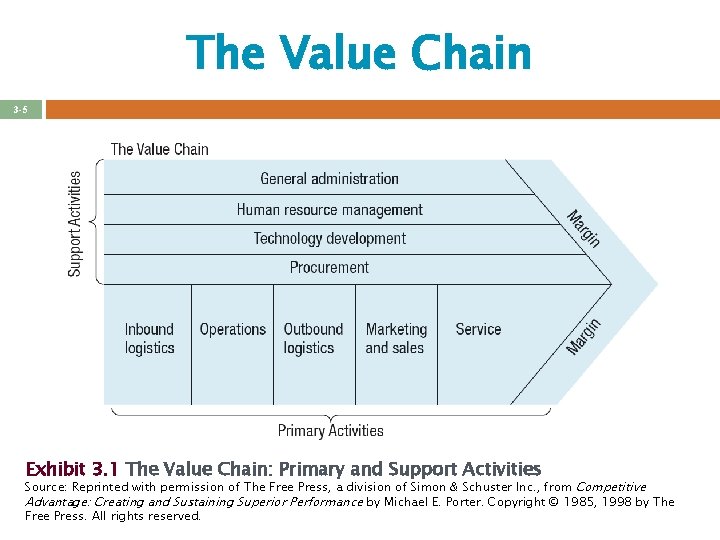
Value-Chain Analysis 3 -2 ¤ Value-chain analysis looks at the sequential process of value-creating activities © Value is the amount buyers are willing to pay for what a firm provides © How is value created within the organization? © How is value created for other organizations in the overall supply chain or distribution channel? © The value received must exceed the costs of production
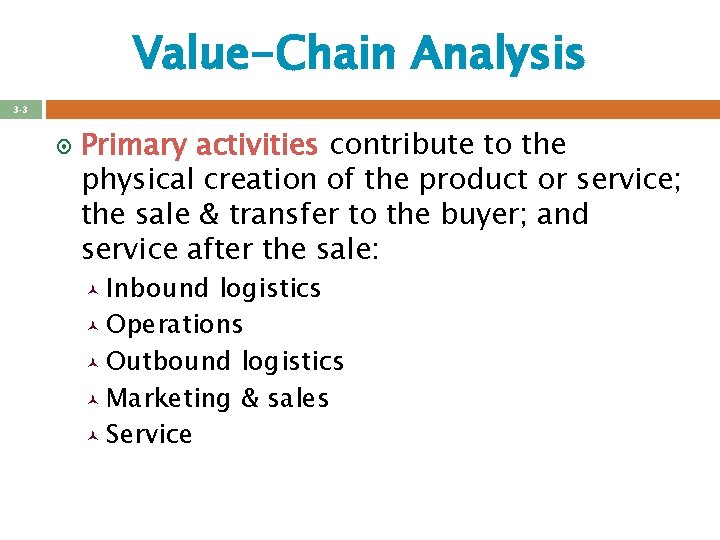
Value-Chain Analysis 3 -3 ¤ Primary activities contribute to the physical creation of the product or service; the sale & transfer to the buyer; and service after the sale: © Inbound logistics © Operations © Outbound logistics © Marketing & sales © Service
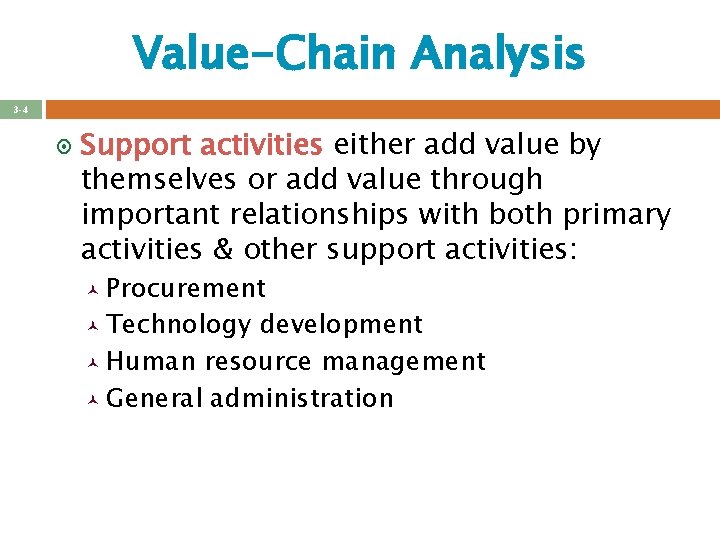
Value-Chain Analysis 3 -4 ¤ Support activities either add value by themselves or add value through important relationships with both primary activities & other support activities: © Procurement © Technology development © Human resource management © General administration
The Value Chain 3 -5 Exhibit 3. 1 The Value Chain: Primary and Support Activities Source: Reprinted with permission of The Free Press, a division of Simon & Schuster Inc. , from Competitive Advantage: Creating and Sustaining Superior Performance by Michael E. Porter. Copyright © 1985, 1998 by The Free Press. All rights reserved.
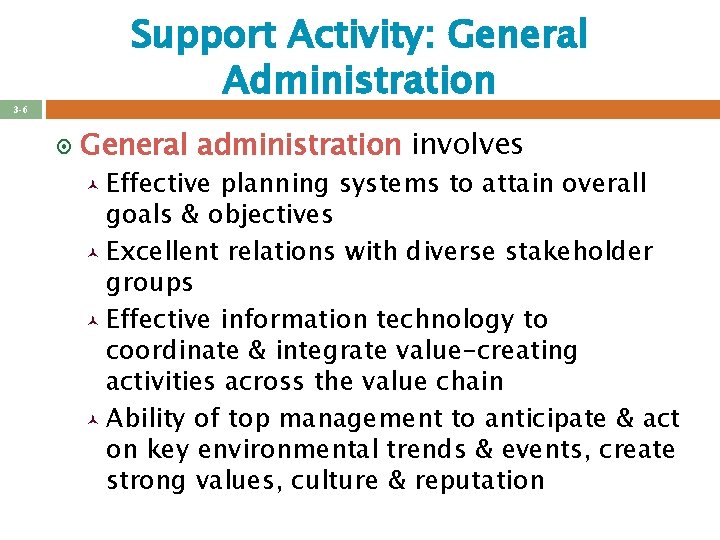
Support Activity: General Administration 3 -6 ¤ General administration involves © Effective planning systems to attain overall goals & objectives © Excellent relations with diverse stakeholder groups © Effective information technology to coordinate & integrate value-creating activities across the value chain © Ability of top management to anticipate & act on key environmental trends & events, create strong values, culture & reputation
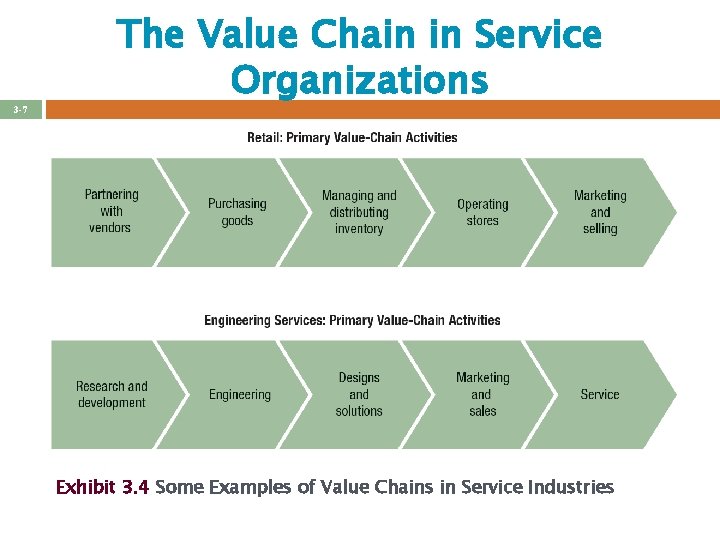
3 -7 The Value Chain in Service Organizations Exhibit 3. 4 Some Examples of Value Chains in Service Industries
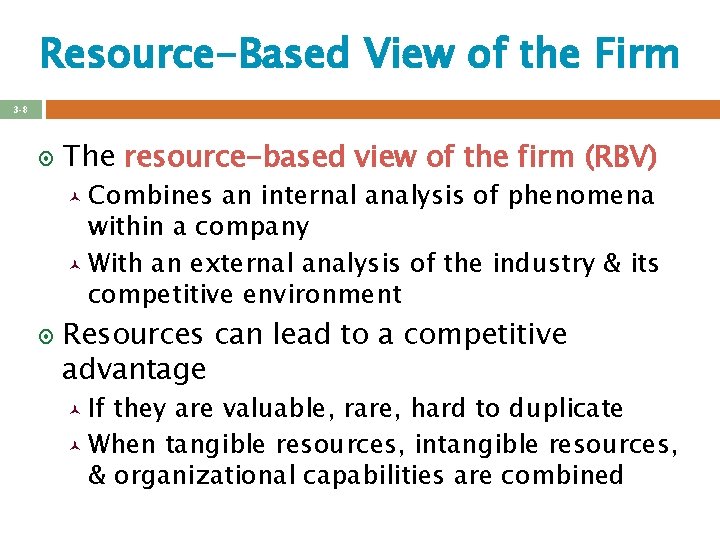
Resource-Based View of the Firm 3 -8 ¤ The resource-based view of the firm (RBV) © Combines an internal analysis of phenomena within a company © With an external analysis of the industry & its competitive environment ¤ Resources can lead to a competitive advantage © If they are valuable, rare, hard to duplicate © When tangible resources, intangible resources, & organizational capabilities are combined
Types of Firm Resources 3 -9 ¤ Tangible resources are assets that are relatively easy to identify: © Physical assets: plant & facilities, location, machinery & equipment © Financial assets: cash & cash equivalents, borrowing capacity, capacity to raise equity © Technological resources: trade secrets, patents, copyrights, trademarks, innovative production processes © Organizational resources: effective planning processes & control systems
Types of Firm Resources 3 -10 ¤ Intangible resources are difficult for competitors to account for or imitate – are embedded in unique routines & practices: © Human resources: trust, experience & capabilities of employees; managerial skills & effectiveness of work teams © Innovation resources: technical & scientific expertise & ideas; innovation capabilities © Reputation resources: brand names, reputation for fairness with suppliers; reliability & product quality with customers
Types of Firm Resources 3 -11 ¤ Organizational capabilities are competencies or skills that a firm employs to transform inputs into outputs; the capacity to combine tangible & intangible resources to attain desired ends © Outstanding customer service © Excellent product development capabilities © Superb innovation processes & flexibility in manufacturing processes © Ability to hire, motivate, & retain human capital
Firm Resources and Sustainable Competitive Advantages 3 -12 Strategic resources have four attributes: ¤ Valuable in formulating & implementing strategies to improve efficiency or effectiveness ¤ Rare or uncommon; difficult to exploit ¤ Difficult to imitate or copy due to physical uniqueness, path dependency, causal ambiguity, or social complexity ¤ Difficult to substitute with strategically equivalent resources or capabilities ¤
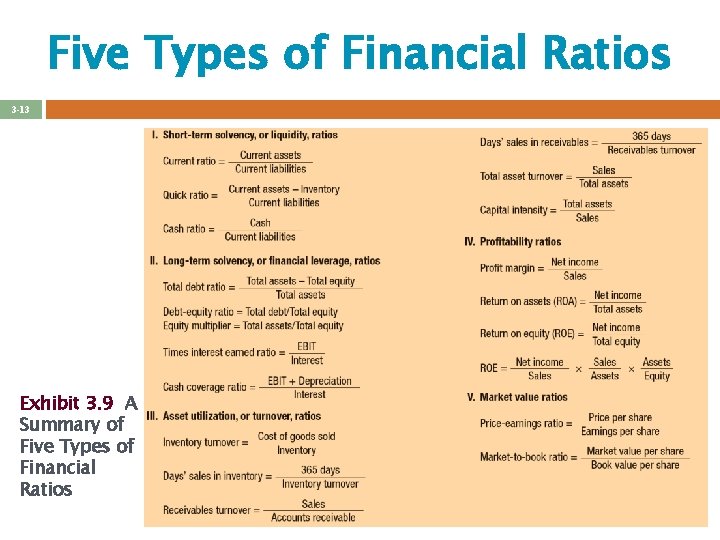
Five Types of Financial Ratios 3 -13 Exhibit 3. 9 A Summary of Five Types of Financial Ratios
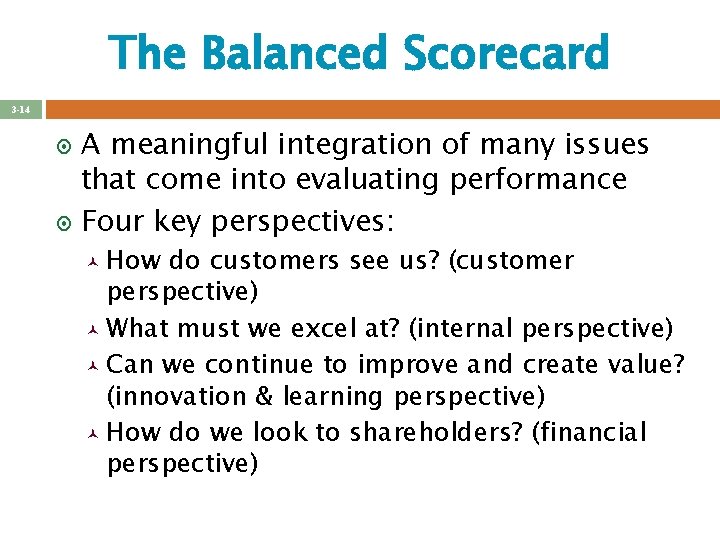
The Balanced Scorecard 3 -14 A meaningful integration of many issues that come into evaluating performance ¤ Four key perspectives: ¤ © How do customers see us? (customer perspective) © What must we excel at? (internal perspective) © Can we continue to improve and create value? (innovation & learning perspective) © How do we look to shareholders? (financial perspective)