The Marketing Plan PART 3 Developing the New
- Slides: 29
The Marketing Plan PART 3 Developing the New Venture Business Plan Power. Point Presentation by Charlie Cook, The University of West Alabama © 2010 Cengage Learning. All Rights Reserved. May not be scanned, copied or duplicated, or posted to a publicly accessible Web site, in whole or in part.
Looking Ahead After studying this chapter, you should be able to: 1. Describe small business marketing. 2. Identify the components of a formal marketing plan. 3. Discuss the nature of the marketing research process. 4. Define market segmentation and its related strategies. 5. Explain the different methods of forecasting sales. 2 © 2010 Cengage Learning. All Rights Reserved. May not be scanned, copied or duplicated, or posted to a publicly accessible Web site, in whole or in part.
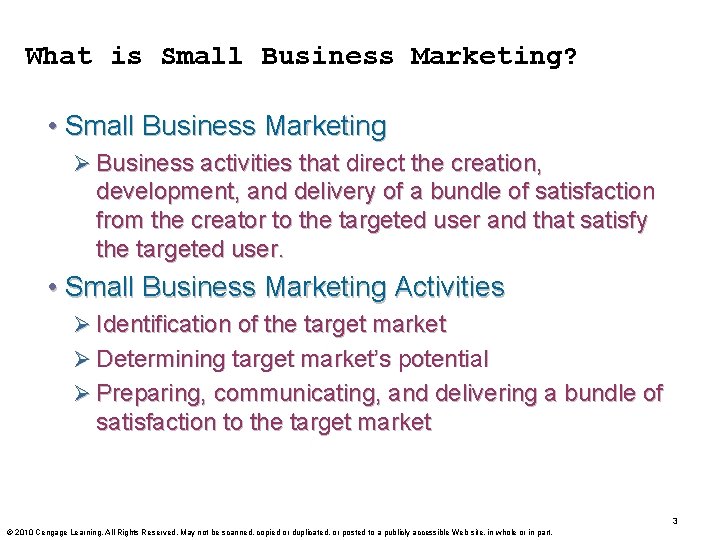
What is Small Business Marketing? • Small Business Marketing Ø Business activities that direct the creation, development, and delivery of a bundle of satisfaction from the creator to the targeted user and that satisfy the targeted user. • Small Business Marketing Activities Ø Identification of the target market Ø Determining target market’s potential Ø Preparing, communicating, and delivering a bundle of satisfaction to the target market 3 © 2010 Cengage Learning. All Rights Reserved. May not be scanned, copied or duplicated, or posted to a publicly accessible Web site, in whole or in part.
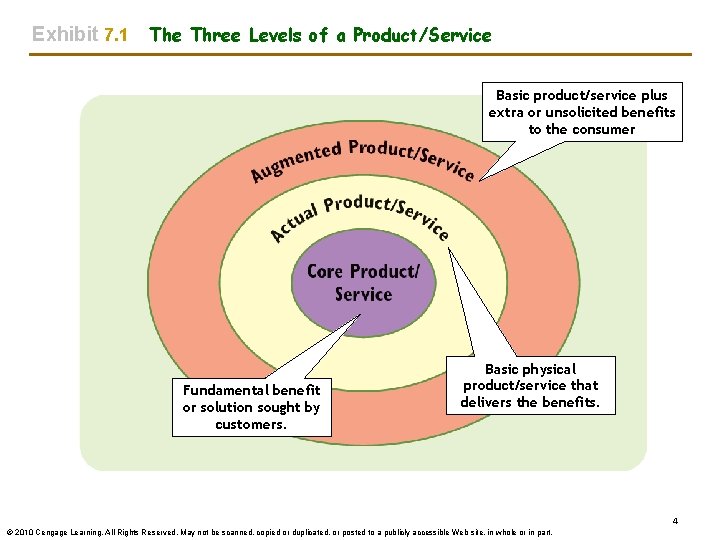
Exhibit 7. 1 The Three Levels of a Product/Service Basic product/service plus extra or unsolicited benefits to the consumer Fundamental benefit or solution sought by customers. Basic physical product/service that delivers the benefits. 4 © 2010 Cengage Learning. All Rights Reserved. May not be scanned, copied or duplicated, or posted to a publicly accessible Web site, in whole or in part.
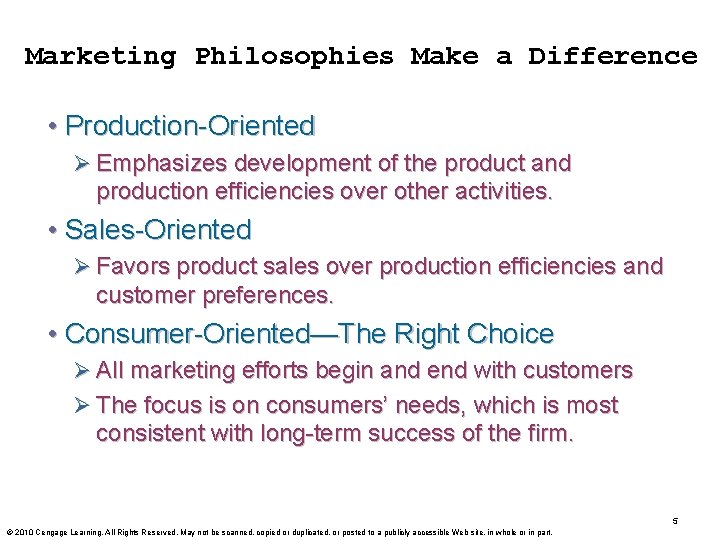
Marketing Philosophies Make a Difference • Production-Oriented Ø Emphasizes development of the product and production efficiencies over other activities. • Sales-Oriented Ø Favors product sales over production efficiencies and customer preferences. • Consumer-Oriented—The Right Choice Ø All marketing efforts begin and end with customers Ø The focus is on consumers’ needs, which is most consistent with long-term success of the firm. 5 © 2010 Cengage Learning. All Rights Reserved. May not be scanned, copied or duplicated, or posted to a publicly accessible Web site, in whole or in part.
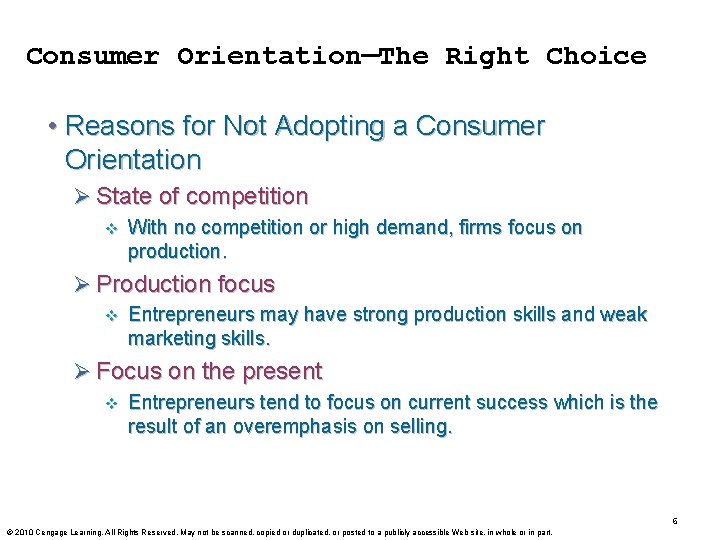
Consumer Orientation—The Right Choice • Reasons for Not Adopting a Consumer Orientation Ø State of competition v With no competition or high demand, firms focus on production. Ø Production focus v Entrepreneurs may have strong production skills and weak marketing skills. Ø Focus on the present v Entrepreneurs tend to focus on current success which is the result of an overemphasis on selling. 6 © 2010 Cengage Learning. All Rights Reserved. May not be scanned, copied or duplicated, or posted to a publicly accessible Web site, in whole or in part.
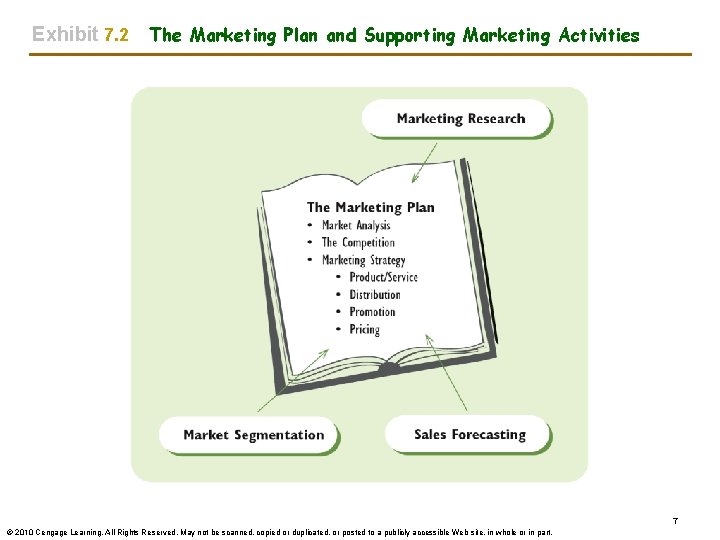
Exhibit 7. 2 The Marketing Plan and Supporting Marketing Activities 7 © 2010 Cengage Learning. All Rights Reserved. May not be scanned, copied or duplicated, or posted to a publicly accessible Web site, in whole or in part.
Marketing Research Activities • Market Analysis Ø An evaluation process that encompasses market segmentation, marketing research, and sales forecasting • Developing the Marketing Mix Ø The combination of product, pricing, promotion, and distribution activities. 8 © 2010 Cengage Learning. All Rights Reserved. May not be scanned, copied or duplicated, or posted to a publicly accessible Web site, in whole or in part.
The Formal Marketing Plan • Market Analysis Ø Customer profile v A description of potential customers in a target market Ø Sales forecasts v “Most likely, ” “pessimistic, ” and “optimistic • The Competition Ø Profile of key management personnel Ø Overall strengths and weaknesses (SWOT) Ø Related products being marketed or tested Ø Likelihood of competitors’ entry into target market 9 © 2010 Cengage Learning. All Rights Reserved. May not be scanned, copied or duplicated, or posted to a publicly accessible Web site, in whole or in part.
The Formal Marketing Plan (cont’d) • Marketing Strategy Ø Product and/or service section v Decisions affecting the total product Ø Distribution section v Decisions regarding product delivery to customers Ø Pricing section v Setting an acceptable value on the product Ø Promotional section v Communicating information to the target market 10 © 2010 Cengage Learning. All Rights Reserved. May not be scanned, copied or duplicated, or posted to a publicly accessible Web site, in whole or in part.
The Nature of Marketing Research • Marketing Research Ø The gathering, processing, reporting, and interpreting of market information • Outside Sources Ø Hiring professional marketing researchers Ø Using the Internet for web-based surveys and online focus groups 11 © 2010 Cengage Learning. All Rights Reserved. May not be scanned, copied or duplicated, or posted to a publicly accessible Web site, in whole or in part.
The Nature of Marketing Research • Steps In the Marketing Research Process Ø Identifying the informational need v Why do we need to know this? Ø Searching for secondary data v Who has researched this topic already? Ø Collecting primary data v Who do we ask and what do we ask them? Ø Interpreting the data v Got the information, now what does it mean? 12 © 2010 Cengage Learning. All Rights Reserved. May not be scanned, copied or duplicated, or posted to a publicly accessible Web site, in whole or in part.
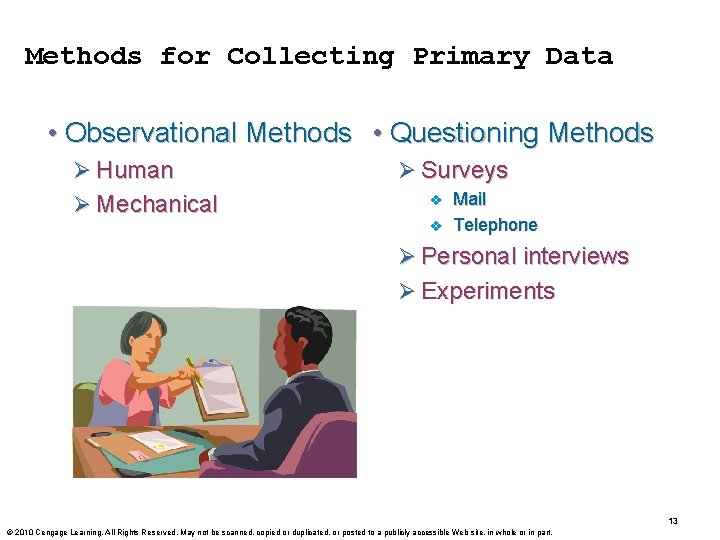
Methods for Collecting Primary Data • Observational Methods • Questioning Methods Ø Human Ø Mechanical Ø Surveys v v Mail Telephone Ø Personal interviews Ø Experiments 13 © 2010 Cengage Learning. All Rights Reserved. May not be scanned, copied or duplicated, or posted to a publicly accessible Web site, in whole or in part.
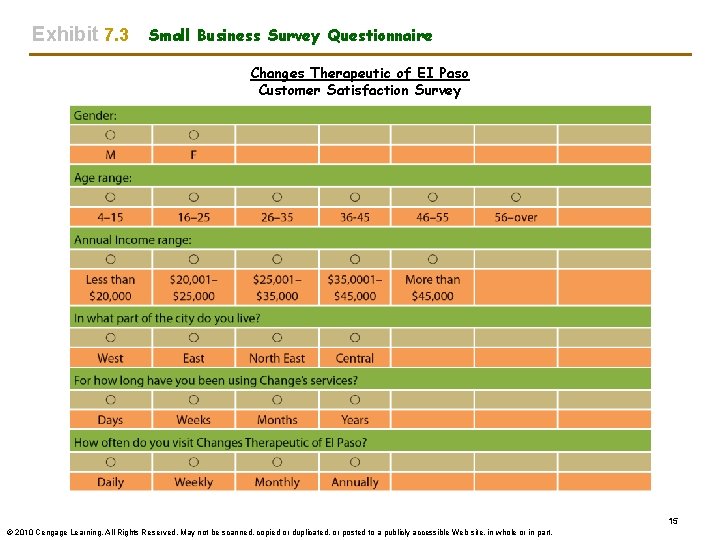
Designing and Testing a Questionnaire • • • Ask questions that relate to the issue. Use open-ended and multiple-choice questions. Carefully consider the order of the questions to avoid producing biased answers to later questions. • Ask sensitive questions near the end of the questionnaire. • Word questions as simply, clearly, and objectively as possible. • Pre-test the questionnaire on a small representative sample of respondents. 14 © 2010 Cengage Learning. All Rights Reserved. May not be scanned, copied or duplicated, or posted to a publicly accessible Web site, in whole or in part.
Exhibit 7. 3 Small Business Survey Questionnaire Changes Therapeutic of EI Paso Customer Satisfaction Survey 15 © 2010 Cengage Learning. All Rights Reserved. May not be scanned, copied or duplicated, or posted to a publicly accessible Web site, in whole or in part.
Interpreting the Data Gathered • Transforming Data into Information Ø Tables and charts Ø Descriptive statistics • When Research is Too Expensive Ø Newspaper, magazine, and industry trade journal articles and trade research Ø Internet searches Ø Check out the competition Ø Use students to stretch research budget Ø Trust your hands-on feel for the market 16 © 2010 Cengage Learning. All Rights Reserved. May not be scanned, copied or duplicated, or posted to a publicly accessible Web site, in whole or in part.
When Not To Conduct Formal Research • Your firm doesn’t have the resources to conduct research properly or to implement findings generated from the proposed research. • The opportunity for a new business or product introduction has passed. If you’ve been beaten to the punch, it may be wise to wait and see how the early entrant to the market fares. • A decision to move forward has already been made. There’s no need to spend money on a decision that has already been made. • You can’t decide what information is needed. If you don’t know where you are going, any road will take you there. • The needed information already exists (that is, secondary information is available). • The cost of conducting research outweighs the potential benefits. 17 © 2010 Cengage Learning. All Rights Reserved. May not be scanned, copied or duplicated, or posted to a publicly accessible Web site, in whole or in part.
Understanding Potential Target Markets • Market Ingredients Ø A group of (1) customers or potential customers who have (2) purchasing power and (3) unsatisfied needs • Market Segmentation Ø The division of a market into several smaller customer groups with similar needs • Focus Strategy Ø A type of competitive strategy in which cost and differentiation-based advantages are achieved within narrow market segments. 18 © 2010 Cengage Learning. All Rights Reserved. May not be scanned, copied or duplicated, or posted to a publicly accessible Web site, in whole or in part.
Market Segmentation and Its Variables • Segmentation Variables Ø The parameters used to distinguish one form of market behavior from another for the purpose of market segmentation • Benefit Variables Ø Specific characteristics that distinguish market segments according to the benefit sought • Demographic Variables Ø Specific characteristics that describe customers and their purchasing power 19 © 2010 Cengage Learning. All Rights Reserved. May not be scanned, copied or duplicated, or posted to a publicly accessible Web site, in whole or in part.
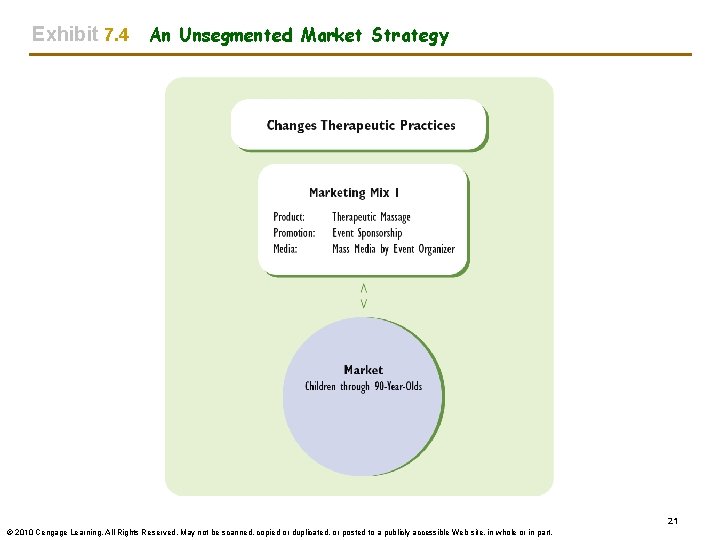
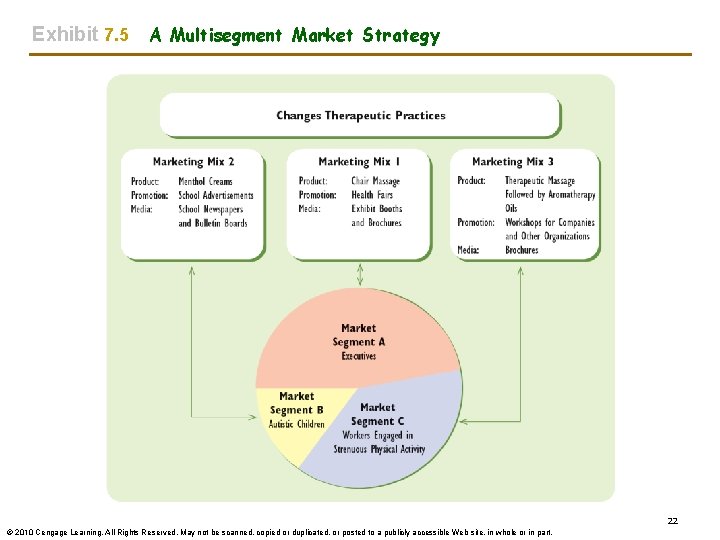
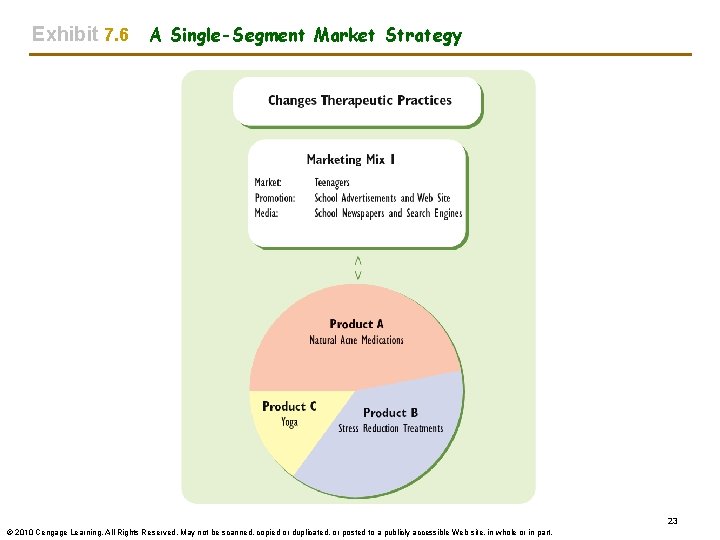
Types of Market Segmentation Strategies • Unsegmented Strategy (Mass Marketing) Ø A strategy that defines the total market as the target market. • Multisegment Strategy Ø A strategy that recognizes different preferences of individual market segments and develops a unique marketing mix for each. • Single-Segment Strategy Ø A strategy that recognizes the existence of several distinct segments but focuses on only the most profitable segment. 20 © 2010 Cengage Learning. All Rights Reserved. May not be scanned, copied or duplicated, or posted to a publicly accessible Web site, in whole or in part.
Exhibit 7. 4 An Unsegmented Market Strategy 21 © 2010 Cengage Learning. All Rights Reserved. May not be scanned, copied or duplicated, or posted to a publicly accessible Web site, in whole or in part.
Exhibit 7. 5 A Multisegment Market Strategy 22 © 2010 Cengage Learning. All Rights Reserved. May not be scanned, copied or duplicated, or posted to a publicly accessible Web site, in whole or in part.
Exhibit 7. 6 A Single-Segment Market Strategy 23 © 2010 Cengage Learning. All Rights Reserved. May not be scanned, copied or duplicated, or posted to a publicly accessible Web site, in whole or in part.
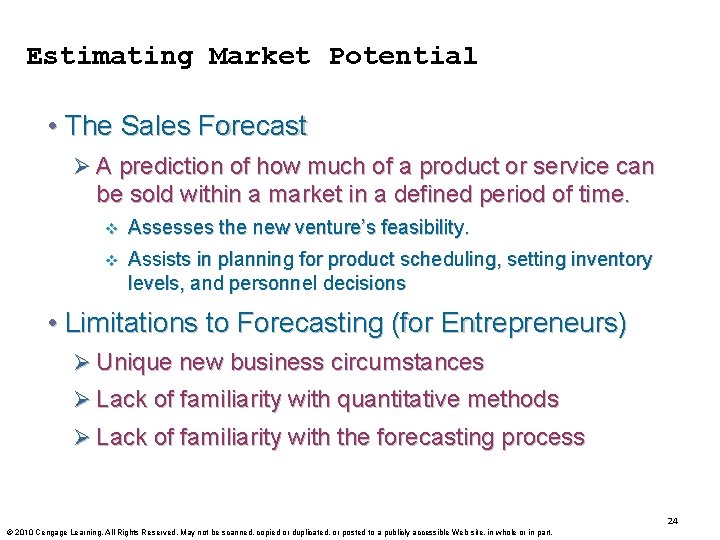
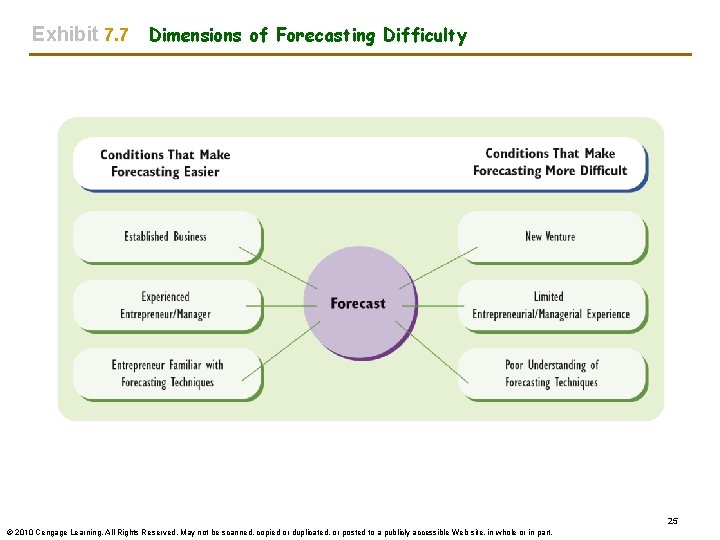
Estimating Market Potential • The Sales Forecast Ø A prediction of how much of a product or service can be sold within a market in a defined period of time. v Assesses the new venture’s feasibility. v Assists in planning for product scheduling, setting inventory levels, and personnel decisions • Limitations to Forecasting (for Entrepreneurs) Ø Unique new business circumstances Ø Lack of familiarity with quantitative methods Ø Lack of familiarity with the forecasting process 24 © 2010 Cengage Learning. All Rights Reserved. May not be scanned, copied or duplicated, or posted to a publicly accessible Web site, in whole or in part.
Exhibit 7. 7 Dimensions of Forecasting Difficulty 25 © 2010 Cengage Learning. All Rights Reserved. May not be scanned, copied or duplicated, or posted to a publicly accessible Web site, in whole or in part.
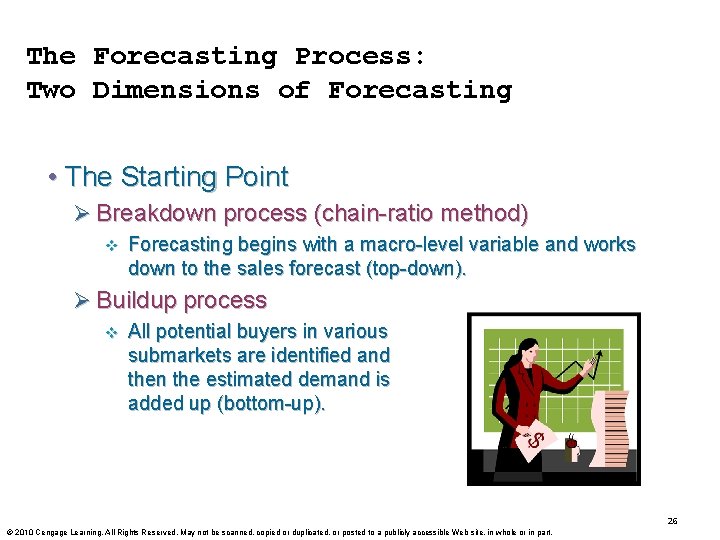
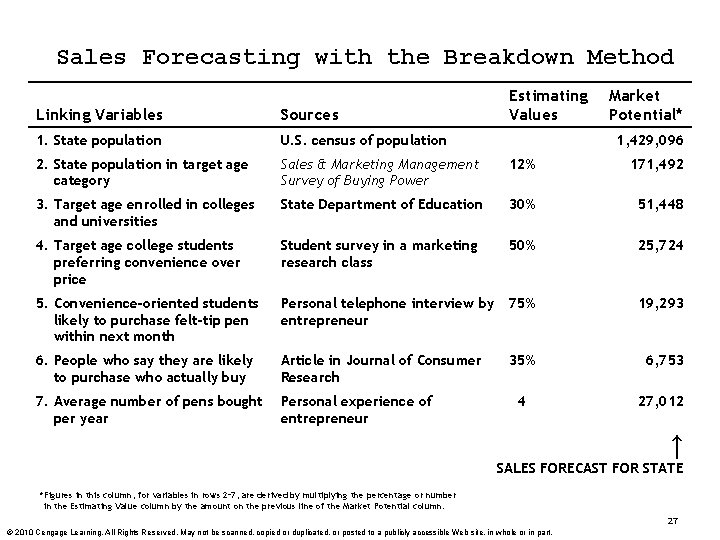
The Forecasting Process: Two Dimensions of Forecasting • The Starting Point Ø Breakdown process (chain-ratio method) v Forecasting begins with a macro-level variable and works down to the sales forecast (top-down). Ø Buildup process v All potential buyers in various submarkets are identified and then the estimated demand is added up (bottom-up). 26 © 2010 Cengage Learning. All Rights Reserved. May not be scanned, copied or duplicated, or posted to a publicly accessible Web site, in whole or in part.
Sales Forecasting with the Breakdown Method Estimating Values Market Potential* Linking Variables Sources 1. State population U. S. census of population 2. State population in target age category Sales & Marketing Management Survey of Buying Power 12% 171, 492 3. Target age enrolled in colleges and universities State Department of Education 30% 51, 448 4. Target age college students preferring convenience over price Student survey in a marketing research class 50% 25, 724 5. Convenience-oriented students likely to purchase felt-tip pen within next month Personal telephone interview by entrepreneur 75% 19, 293 6. People who say they are likely to purchase who actually buy Article in Journal of Consumer Research 35% 6, 753 7. Average number of pens bought per year Personal experience of entrepreneur 4 27, 012 1, 429, 096 ↑ SALES FORECAST FOR STATE * Figures in this column, for variables in rows 2– 7, are derived by multiplying the percentage or number in the Estimating Value column by the amount on the previous line of the Market Potential column. 27 © 2010 Cengage Learning. All Rights Reserved. May not be scanned, copied or duplicated, or posted to a publicly accessible Web site, in whole or in part.
Forecasting and Predicting Variables • Direct Forecasting Ø Use of sales as the predicting variable • Indirect Forecasting Ø Use of related variables related to sales as proxies to project future sales 28 © 2010 Cengage Learning. All Rights Reserved. May not be scanned, copied or duplicated, or posted to a publicly accessible Web site, in whole or in part.
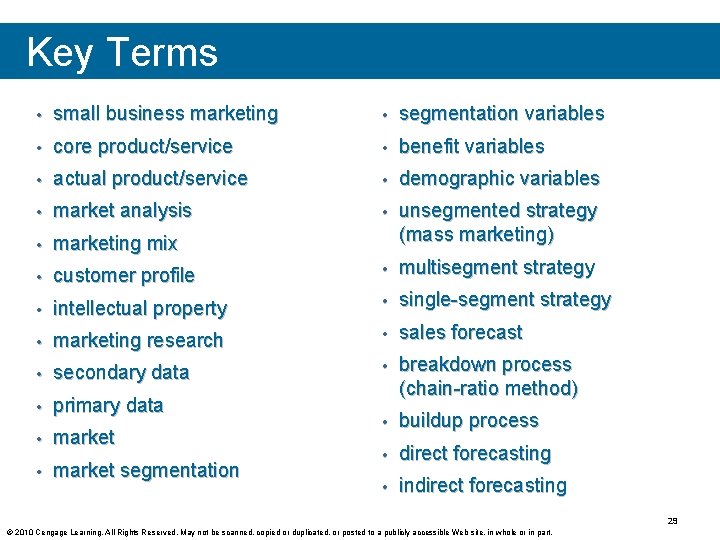
Key Terms • small business marketing • segmentation variables • core product/service • benefit variables • actual product/service • demographic variables • market analysis • • marketing mix unsegmented strategy (mass marketing) • customer profile • multisegment strategy • intellectual property • single-segment strategy • marketing research • sales forecast • secondary data • • primary data breakdown process (chain-ratio method) • market • buildup process • market segmentation • direct forecasting • indirect forecasting 29 © 2010 Cengage Learning. All Rights Reserved. May not be scanned, copied or duplicated, or posted to a publicly accessible Web site, in whole or in part.